Cached at:
04/22/26, 02:15 PM
# The Edge of Safe Rust
Source: [https://kyju.org/blog/tokioconf-2026/](https://kyju.org/blog/tokioconf-2026/)
*Horribly misusing Rust features to provide provable memory safety and tracing garbage collection for pointer soup\.*
**2026\-04\-22**
- [Introduction](https://kyju.org/blog/tokioconf-2026/#introduction)
- [Background](https://kyju.org/blog/tokioconf-2026/#background)
- [Pointers in Rust without clear ownership is Very Hard](https://kyju.org/blog/tokioconf-2026/#pointers-in-rust-without-clear-ownership-is-very-hard)
- [Rust is actually just really good at Vec](https://kyju.org/blog/tokioconf-2026/#rust-is-actually-just-really-good-at-vec)
- [But Rust is pretty bad at safe circular references](https://kyju.org/blog/tokioconf-2026/#but-rust-is-pretty-bad-at-safe-circular-references)
- [Generativity, or for<'a\> is the coolest feature in Rust](https://kyju.org/blog/tokioconf-2026/#generativity-or-for-a-is-the-coolest-feature-in-rust)
- [Dealing with "reachability" via tracing](https://kyju.org/blog/tokioconf-2026/#dealing-with-reachability-via-tracing)
- [A sketch of a real, raw\-pointer based GC](https://kyju.org/blog/tokioconf-2026/#a-sketch-of-a-real-raw-pointer-based-gc)
- [Wrapping up \-\- The Bigger Picture](https://kyju.org/blog/tokioconf-2026/#wrapping-up-the-bigger-picture)
---
[Talk slides are here\!](https://kyju.org/tokioconf-2026-slides/index.html)
## Introduction
This is the text version of a talk that I am giving for the first ever[TokioConf](https://www.tokioconf.com/)on April 22\. I'm writing this talk first a mostly normal blog post because I find that writing these things as prose first helps me prepare\.
I'm including a link to the slides here if you're watching my talk and would like to follow along, and whenever a video version is ready I will also link that\.
When picking what to do for a talk, I'm always torn between two conflicting goals:
1. Write about something that I know well and will be interesting to a large audience\.
2. Write about something that I have a unique perspective on, where I might be able to say things that few others can\.
Neither of these is a bad strategy, but this talk / post will be almost entirely an example of the*second*goal\. I have been recently living in a very strange corner of the Rust language, and I decided to base my talk around that experience\.
This talk is going to be about something that might seem unusual for*Tokio*Conf, it's going to be about, at least on the surface, garbage collection and VMs in safe Rust\. Since I've decided on the*second*approach to my talk, I have to confront the reality that I haven't actually written a lot of real networking code lately ¯\\\(ツ\)/¯ \(and any networking code I write is always video game centric, which is not really the same what Tokio is used for\)\. More than that though, for the last few months I've been working with Kong \(one of the sponsors of TokioConf\!\) on*exactly this topic*, they've contracted me to help them design small, isolated,*safe*Rust VMs for their networking rules engine\. Therefore, I would argue, it*must*be at least a little on topic\! But really, this is what I've been working on, this is what I have at least a*chance*of saying something interesting on, so this is what my talk is\.
I hope you find it interesting\!
> I'm also assuming here no familiarity with any of my other work or talks or previous blog posts, so I will definitley cover some things I've talked about before\.
## Background
A long while ago I had an obsession with trying to integrate tracing garbage collection into safe Rust\.
I was[far from the only one](https://manishearth.github.io/blog/2021/04/05/a-tour-of-safe-tracing-gc-designs-in-rust/)who tried, but I may have been the only one who had two specific, very aggressive, core goals:
1. Totally zero\-cost pointers\[1\]This is subtle, but what I mean is that`Gc`pointers*themselves*would be transparent wrappers around`\*const T`and`Copy`, and thus have exactly the same cost as a raw pointer, even if there is obviously \(unavoidable\) overhead in the allocation and collection parts\.
2. Usable from completely safe Rust
I consider myself to largely have*failed*and determined that doing this in the general case more or less*required*language support that didn't exist yet\. However I must not have failed that badly, becuase my best attempt at solving this,[gc\-arena](https://github.com/kyren/gc-arena)\[2\]Since being used by`Ruffle`,`gc\-arena`has had*lots*of really core contributions from Ruffle devs, I am not trying to take sole credit for it\!is now used by two projects that are used by millions of people\.[Ruffle](https://github.com/ruffle-rs/ruffle), the browser based flash emulator, uses`gc\-arena`for its ActionScript VM, and[Fields of Mistria](https://www.fieldsofmistria.com/)is using \(in its next release\) my own project[fabricator](https://github.com/kyren/fabricator), a[GameMaker](https://gamemaker.io/)replacement runtime which in turn also uses`gc\-arena`\.\[3\]What actually happened is that the problem I*did*manage solve \(garbage collecting only when no Rust code is "active" within the GC "context"\) is perfect for games, because games \(and Ruffle is basically a game engine\) never really need to bother garbage collecting*within*a frame, and programs \(other than special things like coroutines\) never run for*more than a single frame*\. This should be viewed as a wonderful example of "do you maybe have a different problem that I*can*solve instead?"
This is obviously a brag, but more than that, I've realized that I, along with just a few other people, exist in an[exceedingly strange](https://kyju.org/blog/rust-safe-garbage-collection/)ecosystem that barely anyone using Rust is even aware of\. This is not unique to my effort \(obviously I'm the most familiar with this one\), but solving safe garbage collection in Rust almost universally requires type or lifetime tricks or coding patterns that look*insane*from the outside\. You don't need to understand these examples, but look at this code written for a real, professional project\[4\]*Fields of Mistria*which I unabashedly***adore***and is a[*steal*](https://store.steampowered.com/app/2142790/Fields_of_Mistria/)and you should definitely try you like cozy farming games\.that is sold to real people for money\.\.\.
```
// What the hell is `ctx`?
let methods = Gc::new(&ctx, DsGridMethods);
// What the hell is `unsize!`? Why does it have custom syntax?
let methods_ptr = gc_arena::unsize!(methods => dyn vm::UserDataMethods<'gc>);
```
and this\.\.\.
```
// What the hell is the `Rootable![_]` macro, it evaluates to a **type**?
// What the hell does '_ in a macro mean?
let methods = ctx.singleton::<Rootable![DsGridMethodsSingleton<'_>]>().0;
let ud = vm::UserData::new::<Rootable![DsGrid<'_>]>(&ctx, self);
ud.set_methods(&ctx, Some(methods));
```
and this\.\.\.
```
// Okay downcasting I understand, `downcast_write` must be like...
// `downcast_mut`, returning a `&mut T`? No? It's something else entirely that
// is impenetrable GC jargon? `&'gc barrier::Write<T>`?
let ds_list = DsList::downcast_write(&ctx, ud).unwrap();
// Again, what the hell is a barrier? Why does this have to be a macro? What
// syntax is this? WHY??
let inner = barrier::field!(ds_list, DsList, inner);
// Okay this part I basically understand, but what the hell is *unlocking*?
let mut vec = inner.unlock().borrow_mut();
```
This is the kind of over\-engineered "I'm too smart for my own good" code that might get you*fired*\[5\]or, somehow, invited to TokioConfif you didn't have an EXTREMELY good reason to write it this way\.
And yet\.\.\. even though code like this is nearly inscrutable, it still exists right now in two moderately popular, real world projects? I'm taking this is a sign that there is a poorly understood corner of the problem space for potential Rust programs, and that it is a good time to introduce more people to this space\. There are a lot of interesting classes of programs that I feel***ought***to be simpler in safe Rust but are not at all right now, and even with the cognitive load of programming in what can feel like a strange pidgin language that just sort of mostly looks like Rust, it can even be the*best viable option*\.
> *If I introduce more people to my personal hell, then maybe it won't be so bad?*
## Pointers in Rust without clear ownership is Very Hard
But don't worry, this post is not actually about the specific design of`gc\-arena`or most of this stuff I just showed you\.\[6\]Start[here](https://kyju.org/blog/rust-safe-garbage-collection/)if you're actually interested\.The real point was to show you that handling garbage collection in Rust, at least if you don't want`unsafe \{\}`and`\*const T`everywhere in your user code, is*incredibly hard*\. This post is not even about garbage collection primarily, what it's about is mostly dealing with a simple, frustrating truth that everyone using Rust for long enough has run into countless times:
***Rust is really bad at dealing with cyclic pointers\.***\[7\]Controversial, I know\.
This is the central idea in this talk, an exploration of some of the ways to deal with this reality in current Rust\.
Now, this post is going to contain a lot of what is effectively just whining about the state of Rust as a langauge, but it's important to put this in the proper context\. When I complain, I'm complaining about what is achievable with a completely*safe*Rust interface, and really for the set of problems I'm going to describe, Rust is*basically the only game in town*if you want provable memory safety\.
Programming languages, extremely broadly, fall into one of three camps in how they deal with pointers\[8\]What I mean by "pointer" is technically*either*a pointer*or*a reference in Rust parlance, whatever way that the language provides to "point" to a value from somewhere else\.and pointer safety:
1. The Ownership and`Drop`camp: Safe Rust, Swift, C\+\+ in theory
2. The "Reachability" camp, AKA the "garbage collected" languages: Javascript, Go, Python, Ruby, Lua, OCaml, Java, Scheme, on and on\.\.\. These langauges always allow cyclic pointers, usually because they only have a single reference type and there is no such thing as "owning" or such a thing as "pointers" to break cycles\.
3. The "Just Trust Me Bro" camp, AKA most of the "systems programming" languages: Unsafe Rust, C, C\+\+ in practice, anything where you may hear the words "use after free"\.
Almost everyone who reads \#2 in that list will immediately think "the garbage collected languages", and they're not wrong, but before we go on I want to make one \(possibly\) controversial statement that will be very relevant in how we think about this solution space:
***Ownership and`Drop`are also a form of garbage collection\.***
This is obviously a simple matter of definition, but I think this is the definition that makes the most sense\. Any language that doesn't*force*the user to free memory manually must somehow free that memory automatically, and the name "garbage collection" is usually used to describe any system that frees memory automatically? I feel like this should not be thought of as strange at all\.\[9\]Calling`Drop`and`Rc`just another kind of garbage collection seems to be a hobby horse of much of the GC literature, but I do agree with it\.
So with this lens, we can immediately see why Rust is bad at dealing with circular pointers\.\.\. Since \(safe\) Rust is memory safe and must prove that pointers \(references\) are not dangling, and its only garbage collection system is based on ownership,*and cyclic pointers by definition do not have any clear ownership relation*, it must not be able to garbage collect them\! So,*either*all possibly cyclic pointers must live for exactly the same amount of time \(`&'static T`\), or garbage collection is not automatic and thus cannot be proved safe by the compiler \(pointers must be raw pointers and freed manually\)\.
Everyone who uses Rust finds out about this almost immediately\.\[10\]and usually this discovery is derogatorily called "fighting the borrow checker"The only possibly new thing I'm introducing is how to think about this problem in relation to other languages: Rust has ownership and automatic drop, most other safe languages instead have a notion of*reachability*, and when an object is*unreachable*it is freed\. Rust picked a garbage collection system that has "deterministic" drop*at the expense of being able to deal with cycles through reachability*, because this is what is most broadly useful in systems programming: it has deterministic performance, minimal runtime requirements, and it allows non\-trivial or load\-bearing behavior at the statically known point of drop\.
---
Now, thinking about the projects that I've been working on recently, it should be obvious why I've been forced to deal with this unfortunate reality of Rust: Those projects have been using Rust to*safely implement a languages in the "reachability" camp*\.
It's a bit of a meme at this point that it's[hard to build linked lists in Rust](https://rust-unofficial.github.io/too-many-lists/fourth-breaking.html)\. Here's a cyclical linked list in Lua:
```
-- An example of a cyclical linked list in Lua
local a = {}
local b = {}
local c = {}
-- You can just like... set the `next` pointer? And that's it?
a.next = b
b.next = c
c.next = a
-- Now our nodes look like this. Easy!
--
-- [a] -> [b] -> [c]
-- ^ |
-- | |
-- +-------------+
```
This is done trivially, and cycles like this are pervasive in real Lua code \(and Python, and Ruby, and Javascript, and even*Java*, and\.\.\.\), even if it's almost never literally a linked list\. So, how can Rust possibly handle this? Somewhere, in a Rust interpreter for such a "reachability" language, you*must*be able to represent this data structure as some inner Rust data structure\.
Given what I've said, this should be impossible to do safely\. And, at least if you want to ever*delete*any unreachable pointer, then doing this using normal`&'a T`is \(in the general case\), impossible to do soundly\. We will cover ways in which we can do this using*other*kinds of special pointers and evil tricks later\.
For now, we certainly know from just looking at crates\.io that there exists Rust code that can handle cyclic graphs structures, and*certainly*the vast majority of it does not use advanced lifetime tricks or[bacon\-rajan](https://github.com/fitzgen/bacon-rajan-cc)cyclic`Rc`to accomplish this\. Let's first discuss the \(by far\) most common way to handle this problem in Rust\.\.\.
## Rust is actually just really good at Vec
Normally, at some point when you first learn Rust, you will run into a problem that seems to require a cyclic reference and you will inevitably get a borrow check error\. Almost nobody runs into this with academic examples like linked lists \(unless they're learning by implementing those specifically\), usually it's actually something that*can*be solved in a different \(sometimes better, sometimes just different, sometimes a little more irritating\) way and then you move on until you internalize Rust's ownership system a bit better\.
Eventually however, you will run into a problem that just plain*requires*some kind of cyclic reference\. Sometimes there just isn't a way to always know what a "back reference" is from context, or objects are in a truly unstructured cyclic graph and have no obvious ownership relation, and there are no other options\.
Eventually you will figure out \(or someone will tell you\) that the proper way to solve this problem is by encoding your graph using a Vec with indexes\. This is honestly a great solution, especially when the problem is otherwise simple\!*If*all of your "nodes" can be a single Rust type,*and*you just need to sort of build a graph structure and not really do a lot of small, dynamic inserts and deletes, then you can build your graph by pushing nodes onto a Vec, and use their indexes into the Vec as your "pointer", and that's it\! The only real change is having to pipe through a "pointer context" of sorts \(access to the underling storage vector\) and the syntactic change from`node\.field`to`nodes\[node\_idx\]\.field`\.
Let's look at a very small worked example of this, with just a bit of a helper API\.\.\.
> For simplicity in this section, this is only going to cover the allocation of a*single type*\. This can be pretty straightforwardly extended to an allocation of multiple types by using something like`HashMap<TypeId, Box<dyn Any\>\>`and downcasting\.
```
// An allocator for slots in a vec.
struct SlotAlloc<T> {
slots: Vec<T>,
}
impl<T> SlotAlloc<T> {
// Allocate a new slot, push it onto our `slots` vec, return its index!
// Picture of simplicity.
fn alloc(&mut self, value: T) -> usize { ... }
// Get a value by an allocated index.
fn get(&self, index: usize) -> &T { ... }
fn get_mut(&mut self, index: usize) -> &mut T { ... }
}
```
When we use Vec this way, I would posit that we use it much more like an*allocator*than an array\. We don't really care*what*the actual value is returned by`SlotAlloc::alloc`is the same way we don't usually care about the exact address returned by an allocator\.\[11\]Yeah yeah processors love memory locality and there's caching and prefetching and all that, we all know, that's not what I'm talking about <3If we scrambled the locations of all of the slots and updated the index "pointers", any algorithm we run would not meaningfully change\.
This is either going to sound pointless or*painfully*obvious\[12\]If it is, I at least hope I'm going somewhere you don't already expect\(or both\), but I would like you to think of this technique like this:*pointers*\(`usize`indexes\) with some kind of*context*\(the owning`SlotAlloc`\)\. Thinking about things in this way helps us evaluate it in comparison to other kinds of pointers like safe builtin references, raw pointers, etc\.
First, the good parts\.\.\. For one, nothing beats`usize`for simplicity\! It's`Copy`, you can*serialize*it, since we're using "segmented memory", you can choose native pointer sizes \(`usize`\) or shrink the address space \(`u32`/`u16`\)\. Also crucially, unlike a real reference,`usize`will never be`\!Send`even if the referent isn't`Sync`, which makes the entire container able to be`Send`when any use of real references might not allow this\!\[13\]This one is important and will come up again later\! If you want, start thinking about*why*this is true very carefully\.This one can be*almost*unsolvable in a safe way and even*force*you into an index\-based strategy for soundness\.
Okay now for the bad parts\. First, there are some annoyances in comparison to normal pointers\.
All of the bad qualities of our "pointers" are extremely similar to problems that arise using real machine pointers\. First, like all allocation strategies, basically ANYTHING will work if you simply never actually free\!\. Extending our`SlotAlloc`to be able to free entries is simple enough, we just need to replace our slot type by`Option<T\>`and keep a list of free slots\.\.\.
```
// An allocator for slots in a vec.
struct SlotAlloc<T> {
slots: Vec<Option<T>>,
free_list: Vec<usize>,
}
impl<T> SlotAlloc<T> {
// Allocate a new value. If we have any known free indexes in `free_list`,
// use them. Otherwise, push a new value, either way, return the index of
// the assigned slot.
fn alloc(&mut self, value: T) -> usize { ... }
// Set this slot to `None` and push the slot onto `free_list`.
fn free(&mut self, index: usize) { ... }
// Get a value by an allocated index. If we are given an `index` that has
// been freed, these will panic!
fn get(&self, index: usize) -> &T { ... }
fn get_mut(&mut self, index: usize) -> &mut T { ... }
}
```
But, besides not actually automatically freeing anything \(obviously\), "freeing" our "pointers" can lead to classic use after free bugs\! If you are careless and accidentally free an index then try to access the freed index, this will lead to invalid use of freed memory \(unwrapping a`None`\)\. Now, in this case you get a deterministic*panic*, which is a billion times better than UB, but still, it is much less useful than automatically managing memory\.
There is a second problem, known as the ABA problem\. In our pointer analogy this is another case of "use after free", but it is much worse than a panic\. If you accidentally free an index that still has a live reference somewhere, then allocate another value and it happens to get the same index, accessing the "dead" index will both succeed and give you an effectively*random, valid value*of whatever your`T`type is\. Though unlikely, this could even turn out to be as bad as something like[Heartbleed](https://en.wikipedia.org/wiki/Heartbleed), where instead of getting the data you expect, you get some other random data with no errors whatsoever and then potentially expose that data to the wrong party\.
There's also a third problem, which is that if we have more than one of our`SlotAlloc`allocators, we've split our memory up into "segments"\. Now, this is not a problem on its face, in fact it's kind of an useful feature to be able to split our "address space" like this, but it does allow the user to*confuse segments*for their pointers\. If you have one`SlotAlloc`instance and are importing data into another separate`SlotAlloc`instance and you mix up which index goes with which instance, you will get either panics if you're lucky, and our "UB but not*really*" if you're not\.
Let's solve as many of these problems as we can\.
---
First, let's tackle the ABA problem\.
There's this pretty well known idea\[14\]which I actually also talked about in my[2018 RustConf talk](https://kyju.org/blog/rustconf-2018-keynote/)called "generational indexes"\. The idea is pretty simple, we need to keep a separate counter called a "generation" with every slot in the`SlotAlloc`structure\. Then, every time an entry is*deleted*, increment the`generation`counter for that slot\. The "index" returned on alloc becomes a new type which is a pair of both the normal slot index, and whatever this "generation" was at the time of allocation\. The whole idea looks something like this\.\.\.
```
// An allocator for slots in a vec.
struct SlotAlloc<T> {
slots: Vec<Slot<T>>,
free_list: Vec<usize>,
}
// A slot within a `SlotAlloc`.
struct Slot<T> {
// The `generation` is incremented every time a slot is freed.
generation: u32,
value: Option<T>,
}
// An abstract "index" into a `SlotAlloc`.
#[derive(Copy, Clone)]
struct Index {
// The index into the `slots` vec.
slot: u32,
// The generation at the time of allocation.
generation: u32,
}
impl<T> SlotAlloc<T> {
// Allocate a new value. If we have any known free slots in `free_list`,
// assign our value to that slot, *increment the generation*.
//
// Otherwise, create a new slot at the end of the `slots` vec with a
// `generation` of 0 and set the value.
//
// The returned `Index` will have the assigned `slot`, along with the
// `generation` of that slot.
fn alloc(&mut self, value: T) -> Index { ... }
// Set the slot for this index to `None` and push the slot onto `free_list`.
//
// Panics if `index.generation` is not identical to the current slot
// generation, because this would be a double free!
fn free(&mut self, index: Index) { ... }
// Get a value by an allocated index.
//
// If the value in `index.slot` is freed or if `index.generation` does not
// match the current slot generation, then these methods will panic.
//
// This protects against both direct UAF and also the ABA problem.
fn get(&self, index: Index) -> &T { ... }
fn get_mut(&mut self, index: Index) -> &mut T { ... }
}
```
Unfortunately, there is no simple solution to statically preventing errors \(panics, whatever\) when accessing deleted indexes\. But, with the generational solution to the ABA problem, nothing here "feels like" UB by another name anymore\. We either will have a valid`Index`into our`SlotAlloc`and get back the right value, or`Index`is invalid and we will get a panic instead\.
The problem of using an index to access the wrong`SlotAlloc`\[15\]"segment", because I am determined to make you*sick*of this analogy by the time I am done <3is just as easily solved\. It is simple enough to assign a unique ID to each`SlotAlloc`and return that as part of the`Index`, and check this ID on access\. Now our`Index`type could look like this\.\.\.
```
struct SlotAlloc {
// Randomly generated ID value.
alloc_id: u32,
...
}
struct Slot<T> { ... }
struct Index {
// The ID of the parent `SlotAlloc`
alloc_id: u32,
...
}
impl<T> SlotAlloc<T> {
// Return a new `SlotAlloc` with a randomized `alloc_id`.
fn new() -> SlotAlloc<T> { ... }
fn alloc(&mut self, value: T) -> Index { ... }
// `free`, `get`, and `get_mut` now all also panic if the `index.alloc_id`
// value does not match, which means they were generated by a different
// `SlotAlloc`.
fn free(&mut self, index: Index) { ... }
fn get(&self, index: Index) -> &T { ... }
fn get_mut(&mut self, index: Index) -> &mut T { ... }
}
```
And, with this, we have pretty much solved the problems listed with our original`SlotAlloc`design, at least to the point that every possible error will be checked at*runtime*and deterministically panic\. We no longer have any of the "sort of UB" behavior that we were trying to avoid\!
We also have seem to made what feels even more like a normal allocator for a single Rust type? The`SlotAlloc`really behaves just like an allocator, except instead of handing back`\*mut T`it hands back`Index`\. We haven't ensured that errors can't happen, but we did at least ensure that no error can possibly happen silently\. This is kind of cool that you can take "indexes into a Vec" this far\!
So, to summarize, we have a kind of "special pointer" \(`Index`\) into a "segment" \(`SlotAlloc`\), which contains some identifier for our segment \(`alloc\_id`\), the real pointer into this segment \(`slot`\), and a kind of*provenance*value that tells which call to`alloc`generated our "pointer" \(`generation`\)\.
We can just decide on any number of bits of the three pieces, lets decide on a nice, evocative number of*bits*for each piece of our`TypedIdx`and lay them out in memory like this\.\.\.
```
[------arena ID (32 bits)------][-----generation (32 bits)-----]
[------------------------slot (64 bits)------------------------]
```
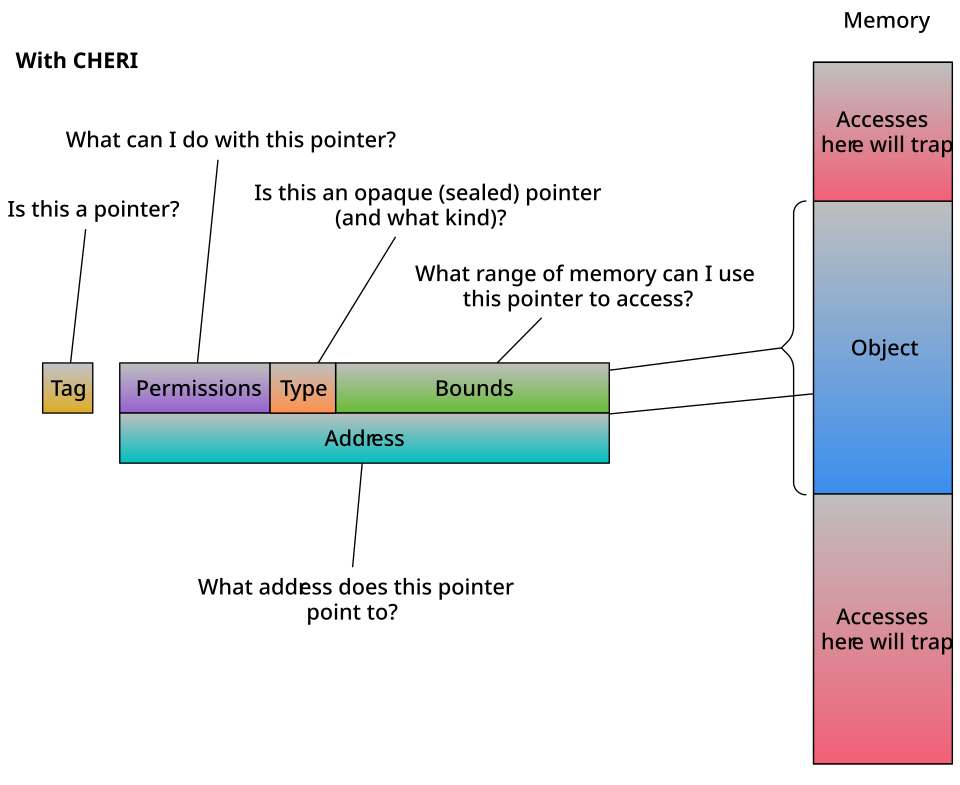
Please direct your attention to this graphic, from the[wikipedia article](https://en.wikipedia.org/wiki/Capability_Hardware_Enhanced_RISC_Instructions)on CHERI \(Capability Hardware Enhanced RISC Instructions\):
### *Pointer problems require Pointer solutions*
CHERI is an extremely cool hardware capability system\[16\]to say I'm not doing it justice in my description here is a ridiculous understatementthat prevents UB by marking pointers with*metadata*that ensures that they are used correctly, and if they are used incorrectly, are guaranteed to "trap" \(invoke an error handler\)\.
Now\.\.\. I understand that saying CHERI is the same as generational indexing extremely silly\.\.\.\[17\]it's*hardware acclerated*generational indexing\!but the similarities are*kind of suggestive*\.\[18\]Please understand I don't actually*literally*think this\. I know CHERI has hardware enforced validity, bounds checking, can protect against data races, and has been in research for 15 years\. This is a shitpost\.The point here is that we've built a system that is*a lot*like a normal hardware pointer but safe, both in the real UB sense of safe and also our "inner UB\-like behavior" sense, so it makes sense that to do this we'd be looking over the same landscape of solutions\.
The point of this section is to show you that, if you look at it the right way, the "use Vecs and indexes" solution to \(safe\) Rust lacking more capable pointers*is remarkably similar*to just wholesale reinventing the pointer without the Rust enforced limitations\. I'm not saying this is even a bad thing\! Having a spectrum of compiler enforced correctness vs runtime correctness is a*good*thing\[19\]If CHERI was widely deployed, I could see Rust having a`CheriPtr<T\>`type that, depending on the platform specifics, could be freely, cheaply shared and manually freed, guaranteeing to*trap*instead of cause UB\.but we need to be clear eyed about it\. Any level of this situation is*definitely*better than raw pointers and UB\[20\]From personal experience, just having generational indexing from something like`slotmap`can be a godsend and is a genuinely great place to*stop*\. About 90% of the time, it works every time\.but it is not a good place for work us to all stop looking for solutions\.
## But Rust is pretty bad at safe circular references
Okay, so we've seen that a complete pointer\-*like*index solution is viable, but \(in many of the same ways as raw pointers\) is not ideal\. Is there a way to do better?
Well, obviously true Rust references \(`&'a T`\) are better than any kind of Vec index or raw pointer, and are usually even better than any kind of "smart" pointer, so let's see if it's possible at all to generate a data structure with actual circular references in Rust\.
Surprisingly, it turns out, that it is not oly possible but relatively easy\! We'll take inspiration from our example that we used for`Lua`before and create a linked list in Rust\.
This is what our`Node`type could look like\.\.\.
```
// A simple example of a node in a linked list.
struct Node<'a> {
value: String,
next: Cell<Option<&'a Node<'a>>>,
}
impl<'a> Node<'a> {
fn new(value: String) -> Node<'a> {
Node {
next: Cell::new(None),
value,
}
}
fn next(&self) -> Option<&'a Node<'a>> {
self.next.get()
}
fn set_next(&self, node: Option<&'a Node<'a>>) {
self.next.set(node)
}
}
```
And we can use it like this\.\.\.
```
// A bump allocator from the `bumpalo` crate.
let bump = bumpalo::Bump::new();
// Each returned node here is a reference, and that reference has the lifetime
// of the `bump` allocator itself.
let a = bump.alloc(Node::new("1".to_owned()));
let b = bump.alloc(Node::new("2".to_owned()));
let c = bump.alloc(Node::new("3".to_owned()));
// We can thus set the ``next` node pointers to make make the 'a lifetime
// in each of the nodes equal to the lifetime of the references returned by
// `Bump::alloc`.
//
// Since all of the lifetimes of references returned by `Bump::alloc` are the
// same, all of the 'a lifetimes in each `Node` instance become the same, and
// *that* is why this can even work. The fact that this is circular is encoded
// in the fact that Rust has determined all of these lifetimes to be the same.
//
// This *has* to be true, because every node references (either directly or
// indirectly) every other one, so they *must* live for exactly the same time.
a.set_next(Some(b));
b.set_next(Some(c));
c.set_next(Some(a));
```
So, if this is so easy, what exactly is this blog post even about?
Well, this solution has a few problems\. The first, obvious one is that since we use lifetimes in our node types that end up borrowing`bump`, you can't easily*move*the entire set of`bump`,`a`,`b`, and`c`anywhere, but this is not unsolvable\. You can use things like[self\_cell](https://docs.rs/self_cell/latest/self_cell/)to move the allocator along with the things it has allocated\.
There is a much bigger problem though, and that is, in order to maintain soundness,*none of these Nodes can ever be dropped*\. If you've ever used`bumpalo`for any amount of time you will have run into this before, and this fact is at the very top of the[documentation for`Bump`](https://docs.rs/bumpalo/latest/bumpalo/struct.Bump.html)\. Why is this required for soundness? Well, suppose we had a`Drop`impl like so\.\.\.
```
impl<'a> Drop for Node<'a> {
fn drop(&mut self) {
println!("dropping node with value {:?}", self.value);
if let Some(next) = self.next() {
println!("next value {:?}", next.value);
}
}
}
```
Since all of our nodes`a`,`b`, and`c`have`next`pointers set, all of their`Drop`impls would print their own value and their next value\. However, what order should`a`,`b`, and`c`be dropped in? No matter what order we pick, there is not a valid order that wouldn't have UB\! If you drop`a`first, then the owned`String`value in`a`will be dropped, and then the drop impl for`b`and`c`will be able to access it for UAF, and the same thing for any other node that you pick first\.
This is obvious once you think about it, and this is THE reason why`bumpalo`cannot offer such an API\. In fact, here's an equivalent way to build the same linked list without`bumpalo`at all\.
```
let a = Box::leak(Node::new("1".to_owned()));
let b = Box::leak(Node::new("2".to_owned()));
let c = Box::leak(Node::new("3".to_owned()));
```
Obviously this also works because all of the returned allocations have the same lifetime, it's just that this lifetime is now`'static`\!
Why doesn't this drop problem show up with Vec\-based solutions? Well, the answer is pretty obvious, we didn't store*real*pointers, we stored "pointers" that were only useful when we had access to their "context" type`SlotAlloc`\. Since we*don't*have access to`SlotAlloc`by the construction of the`Drop`trait, this problem just never came up\!
Maybe we can manually delete nodes like we can with`SlotAlloc`? Well as it stands, I believe without[`MaybeDangling`](https://doc.rust-lang.org/stable/std/mem/struct.MaybeDangling.html)it is*actually*impossible to ever manually drop any`Node`without UB \(because there is no viable order to do so\)\. If you wrap references in some kind of wrapper, either with`MaybeDangling`or just internal raw pointers, there might be a solution to allow removing nodes, but it is not clear at all how to enable this with a safe interface or to ensure that only unreachable nodes are dropped\.
It gets even worse though\!`Cell<T\>`is`Send`assuming that`T`is Send\. There's nothing at all unsafe about sending a`Cell<T\>`to another thread, what would be unsafe is sending a`&Cell<T\>`to another thread, since`Cell`itself has no thread safety for updates, which is why`Cell<\_\>`is always`\!Sync`\. Well, unfortunately, that makes our`Node`type above also`\!Send`, since it has references to other`Node`s in it, which makes the entire thing also`\!Send`\.
```
struct RefNode<'a> {
value: String,
// RefNode can't be `Sync` because of `Cell<T>`, but that makes `&'a
// RefNode<'a>` `!Send`, so `RefNode` can't be `Send` either.
next: Cell<Option<&'a Node<'a>>>,
}
struct IdxNode {
value: String,
// If instead of using raw references we use an index, this problem
// completely goes away. `IdxNode` is `Send`, and any network of them is
// also `Send`.
next: Cell<Option<NodeIdx>>,
}
```
Now even though this attempt has a lot of limitations, it has taught us an important hint for any eventual better solution\.\.\.
***In any set of circular references, all of those references must have the same lifetime\.***
It's actually a promising sign that this is even directly*possible*in Rust and that Rust seems like it can at least handle this case where a graph of objects are all non\-`'static`but need to have the same lifetime\. Is there anything we can do about the limitations? Our indexing solution didn't have these problems, let's back up and think about the indexing solution again to see if we can't get any inspiration there\.
## Generativity, or`for<'a\>`is the coolest feature in Rust
So our indexing solution actually had QUITE a lot of advantages\! The main disadvantage, besides potential performance issues, is that indexes are only checked at*runtime*rather than compile time\. This is not unusual, normally when writing any kind of Rust code that indexes into a slice, indexes are checked at runtime to ensure safety, so this may not seem like an issue, but we are using indexes as a kind of pointer\.\.\. it is*certainly*not the case that`&'a T`or`Rc<T\>`or`Arc<T\>`have to be checked to be dangling at runtime\!
So, I said that it is normal for indexes into a Vec to have runtime checking, and this is true, but it doesn't*have*to be true\. There is actually a technique in Rust to allow for, among other things, safe indexing without bounds checking\! It uses a kind of type property called "generativity", and it was first described by Gankra in her[master's thesis](https://raw.githubusercontent.com/Gankro/thesis/master/thesis.pdf)that Rust actually has such types, sort of by accident\!
"Generativity" of a type is a property that makes it a sort of limited kind of dependent type: means that every time a bit of code is executed at runtime, it is*as though*a brand new type is generated at that location in code*at runtime*, and the generated type will be distinct from any*other*generated type created by execution of the same code\.
Now this is literally not what is occurring, there is no notion of types at runtime in a Rust program, but it is still possible to have this property in Rust using lifetimes and the borrow checker\! By specifying a HRTB \(Higher Ranked Trait Bound\) on a function parameter, we can declare that this function must work for*any possible lifetime*like this:
```
fn generate_a_lifetime(f: for<'a> impl Fn(&'a ())) {
f(&());
}
```
Now this is actually fairly normal in Rust code, but it is already close to what we want\. The Rust borrow checker, by policy, does not cross function boundaries\. So, within the body of the provided callback, the borrow checker has minimal knowledge of what`'a`actually is, since we have declared that our callback function must work for*any*possible`'a`\. It is*as though*when`f`is called, it is given a brand new, totally unique lifetime`a`for that call, which is exactly the property we want\! In fact this would actually be a complete example of generativity if it were not for the fact that Rust lifetimes have*subtyping*\. For example\.\.\.
```
generate_a_lifetime(|a| {
generate_a_lifetime(|mut b| {
// `a` has a type like `&'a ()` and `b` has a type like `&'b ()`, and
// we want the 'a and 'b to be two totally distinct types, yet this will
// type check! The problem is that the type `&'a ()` is *covariant* over
// the lifetime 'a, so it can be *shortened*.
b = a;
});
})
```
So, if we can get rid of Rust's lifetime*subtyping*, then we can give types using those lifetimes perfect generativity\. It turns out we absolutely*can*do that by making a type that is*invariant*over the lifetime`'a`\.
```
// Any mutable type is always invariant over the data it holds, so `Cell<T>` is
// invariant over `T`. If we use a lifetime 'a in `T`, the resulting type will
// always be invariant over a', and so will not have any subtyping relationship
// with any different lifetime.
type Id<'id> = PhantomData<Cell<&'id ()>>;
fn generate_an_id(f: for<'a> impl Fn(Id<'a>)) {
// This is to point out that it doesn't actually *matter* what the
// "real" lifetime is here for the `Id` we pass in. Safety comes from the
// *guaranteed lack of knowledge* that the callback has, due to the borrow
// checker never using information from across function boundaries.
let id: Id<'static> = PhantomData;
f(id);
}
generate_an_id(|mut a| {
generate_an_id(|mut b| {
// Neither of these statements will work, the lifetime 'a in `Id<'a>`
// cannot be lengthened or shortened to unify with any other. This is
// *exactly* the property we want! As a nice side effect, it is also now
// impossible to place `Id<'a>` in something like thread local storage,
// so we additionally know that our `Id<'a>` type cannot *escape* the
// callback.
//
// a = b;
// b = a;
});
});
```
And success, we now have a type`Id<'a\>`that has this generativity property\!
So, what does this buy us? Well, you can read more in the paper, but the essential ability that this gives Rust is that it allows for creating a copyable`Id`, then at a later time, verifying that a given`Id`is a copy of the original`Id`**at compile time**\. This can be used to provide totally safe indexing*without bounds checks*\. Let's look at an example\[21\]copied almost verbatim from the linked paper\.\.\.
```
// Invariant branding ID.
type Id<'id> = PhantomData<Cell<&'id ()>>;
// A wrapper around a slice, combined with a unique type `Id`.
struct Array<'arr, 'id, T> {
array: &'arr [T],
_id: Id<'id>,
}
// A *trusted* in-bounds index to an `Array` with the same `Id`.
struct Index<'id> {
idx: usize,
_id: Id<'id>,
}
impl<'arr, 'id> Array<'arr, 'id> {
fn len(&self) -> usize { ... }
// Return an `Index<'id>` if `idx` is < `self.len()`.
fn verify(&self, idx: usize) -> Option<Index<'id>> { ... }
// This method does not need bounds checking internally! As long as we know
// that an `Index` with the correct `Id` can only be generated by calling
// `Self::verify` on *this* instance, we know that it must be within the
// bounds of our inner slice.
fn get(&self, idx: Index<'id>) -> &T { ... }
}
// Create an `Array` out of a slice and visit it in a checked indexing "context".
fn make_array<'arr, 'id, T>(
array: &'arr [T],
f: for<'id> impl FnOnce(Array<'arr, 'id, T>)
) { ... }
```
And this is how we use it\.\.\.
```
make_array(&[1, 2, 3, 4, 5] |array| {
// Verifying a raw index requires a bounds check.
let idx = array.verify(4).unwrap();
// But using that index does not! Because of our `Id` type, we know that the
// `idx` value *must* have come from the `array` that created it.
dbg!(array.get(idx));
make_array(&[1, 2, 3], |array2| {
// This will not type check, because the `Id` in `array` is not the same
// as the `Id` in `array2`.
//
// let _ = array2.get(idx);
})
});
```
Obviously in this simple example this is a little silly, but you could imagine using this technique in interesting ways that would actually be useful, in fact there's even a[crate](https://docs.rs/indexing/latest/indexing/)for it\. But what if we used this technique to add compile time safety to our indexing system from before?
---
So to recap, our original indexing system had two main sources of correctness problems at runtime: 1\) use after free / the ABA problem, and 2\) confusion of indexes between different arenas\. It's pretty obvious how generativity can be used to prevent arena confusion, at least on the surface: an`Id`type can "brand"`Index`, and then only`Index`es returned from the correct`SlotAlloc`can be used to index into that`SlotAlloc`\. This is almost the same as the example above \(if you completely skip over the complexity of storing`NodeIdx`*outside*of the callback, which we'll get to\)\.
So that's one potential correctness issue checked at compile time, what about the other one? Well, our problem statement was to find a solution to*circular references*, but really the way that languages that allow this as part of their runtime handle this is through*determining reachability*\. If we allow for manual deletion, then it's not really possible to avoid manual checks, at least not in any way that will help\[22\]We could scan the entire graph for validity or something but then why do manual checks?\. If we were somehow able to*automatically determine reachability*and delete nodes that are no longer*reachable*, then \(at least, outside of the code that does this\) we could even make it impossible to observe deleted`Index`es\! We could even get rid of generational indexing entirely\!
We have hardly*proved*that this is possible, but it is a very promising lead\! In the next secion, we are going to flesh this idea out completely and build a working system to handle circular references, complete with automatic deletion of unreachable references\.
## Dealing with "reachability" via tracing
Let's digress from our exploration of the larger solution space and dig into a precise solution for everything we've been talking about so far, complete with, yes, actual tracing garbage collection\. We'll start sketching out a garbage collection system which internally uses indexes and starts from a similar place to our`SlotAlloc`example from before\.
> Just like in the section on`SlotAlloc`, we'll be sticking to a single type for simplicity\. In this case, it is not obvious*at all*how to extend this design to multiple types, so you'll just have to trust me that it is possible\!
We have a lot of decisions to make, but based on what we've decided so far, we should be able to at least figure out what our equivalent to`Index`should look like\. We'll call them what we hope will be a more appropriate name once everything is done,`Gc`\. We'll also use our`Id`type from above\.\.\.
```
// Invariant branding ID.
type Id<'gc> = PhantomData<Cell<&'gc ()>>;
// A "pointer" into an `Arena` based on sound, unchecked indexing.
#[derive(Copy, Clone)]
struct Gc<'gc> {
// Let's call our shot, we should need neither an arena ID nor a generation!
index: usize,
_id: Id<'gc>,
}
```
We'll also pick the same storage solution as our first`SlotAlloc`attempt, the absolute simplest, bare minimum\.
```
struct Arena {
slots: Vec<Option<T>>,
free_list: Vec<usize>,
}
```
Okay so far so good, but we still have to figure out what the interface should look like\. Let's add an accessor that passes in a type with the branding`Id`and a few methods on it\.\.\.
```
type Id<'gc> = ...;
struct Gc<'gc> { ... }
struct Arena<T> {
// Our `ArenaCtx` is what actually will hold all of the data.
ctx: ArenaCtx<'static, T>,
}
impl<T> Arena<T> {
// This is kind of like our `make_array` function from the checked indexing
// example. Inside, we have a "context", represented by `ArenaCtx`, which
// will be unique for every call to this method.
fn enter<F, R>(&mut self, f: F) -> R
where F: for<'gc> FnOnce(&mut ArenaCtx<'gc, T>) -> R
{
// Just like in the checked indexing example, the specific lifetime 'gc
// doesn't actually matter, only the lack of knowledge.
f(&mut self.ctx)
}
}
// A handle passed in via `Arena::enter` that allows accessing the arena.
struct ArenaCtx<'gc, T> {
slots: Vec<Option<T>>,
free_list: Vec<usize>,
_id: Id<'gc>,
}
impl<'gc, T> ArenaCtx<'gc, T> {
// Allocate a new value and return the `Gc` index.
fn alloc(&mut self, value: T) -> Gc<'gc> { ... }
// Access a value by its index. We are *sure* that any `Gc` passed in here
// MUST have been retured from `ArenaCtx::alloc` from *the same* instance
// due to our branding `Id` type! It should be impossible to use these in a
// way that causes a panic, checked at compile time!
fn get(&self, gc: Gc<'gc>) -> &T { ... }
fn get_mut(&mut self, gc: Gc<'gc>) -> &mut T { ... }
}
```
So this actually works, however in practice this feels pretty incomplete\. The most major problem is that the entire design makes sure that`Gc<'gc\>`indexes can't escape from a call to`Arena::enter`, because just like the checked indexing example,`Arena::enter`is what is used to define the branding`Id`type which we are using to ensure correctness\. If we can't get anything into or out of`Arena::enter`, then really each call is totally independent and this really isn't as useful as we'd like\.
Another problem is our`T`type\. We pick our concrete`T`type from the outside, let's say we wanted to use this for our linked list example\.\.\.
```
// A linked list node containing a `Gc` index.
struct Node<'gc> {
next: Cell<Option<Gc<'gc>>>,
value: String,
}
// We can't really create an `Arena` type like this because `Arena` can't
// actually allocate anything that contains `Gc` pointers. All of those `Gc`
// pointers will be "branded", and this branding comes from `Arena::enter`, but
// we're not inside it yet. We can only use this to allocate values that don't
// contain `Gc` indexes at all, but that's not very useful!
type NodeArena = Arena<Node<'_>>;
```
It really doesn't work as is, because whatever`T`we pick can't possibly hold any`Gc`values\. Is there any solution to these?
---
Let's tackle the second solution first\. If we can somehow come up with a`'static`version of`Node`called something like\.\.\.`ArenaNode`, and this type can*produce*a`Node<'gc\>`for the branding`'gc`lifetime, then we can at least define whatever the`T`in`Arena<T\>`is\. We'll make a trait for this just so we're not writing code for only a concrete type, since that's not helpful, and it turns out we can use GATs \(Generic Associated Types\) to "produce" our non\-'static type\.
```
// We will need an implementation of this type for whatever we want our `Arena`
// to store.
trait ArenaType {
// We can use GATs! If we ever need to reference a type with the right
// brand, we can just reference this associated type and give it the brand
// lifetime we want.
type Value<'gc>;
}
```
So lets try to change our`Arena`type from above to use our new trait\.
```
type Id<'gc> = ...;
struct Gc<'gc> { ... }
// Okay, so rather than taking a `T` type parameter, we know we will need to
// take a `A: ArenaType` instead.
struct Arena<A: ArenaType> {
ctx: ArenaCtx<'static, A>,
}
struct ArenaCtx<'gc, A: ArenaType> {
slots: Vec<Option<A::Value<'gc>>>,
free_list: Vec<usize>,
_id: Id<'gc>,
}
// And then we just... update all of our methods to take `A` instead. This
// seems like it actually does work!
impl<A: ArenaType> Arena<A> {
fn enter<F, R>(&mut self, f: F) -> R
where F: for<'gc> FnOnce(&mut ArenaCtx<'gc, A>) -> R
{
f(&mut self.ctx)
}
}
impl<'gc, A: ArenaType> ArenaCtx<'gc, A> {
fn alloc(&mut self, value: A::Value<'gc>) -> Gc<'gc> { ... }
fn get(&self, gc: Gc<'gc>) -> &A::Value<'gc> { ... }
fn get_mut(&mut self, gc: Gc<'gc>) -> &mut A::Value<'gc> { ... }
}
```
And then we have to do a bit of boilerplate, but it should be possible to use this for our`Node<'gc\>`type now\.
```
struct Node<'gc> { ... }
// We'll use an empty type to act as our proxy to implement `ArenaType`. We
// could actually also just implement `ArenaType` for Node<'static> to be cute,
// but this is a little clearer.
struct ArenaNode;
impl ArenaType for ArenaNode {
// The magic, we can now produce our real `Node<'gc>` type.
type Value<'gc> = Node<'gc>;
}
// And now we can finally define a type for our arena of nodes!
type ArenaOfNodes = Arena<ArenaNode>;
```
So this actually works\! We can now use our`Arena`to allocate nodes, at least within the body of`Arena::enter`, and we are perfectly able to allocate types which themselves contain branded`Id`s\.
It's extremely interesting that we can just*use a 'static*in the type of`slots`in`Arena`and everything still works out\. We're lucky that the checked indexing system can actually use*any*real lifetime for`Id`, as long as there is the right kind of callback boundary with a`for<'gc\>`\!
---
We still have to tackle storing some kind of pointer to values*outside*of`Arena::enter`, otherwise our arena still isn't very useful\. We have a promising lead though, which is that we are now able to*refer*to types "inside" the arena \(`Node<'gc\>`\) with a`'static`\(`ArenaNode`\)\.
Really, the meaningful part of`Gc<'gc\>`types is*just*the`index`, we could just\.\.\. provide a way of getting the raw index from a`Gc`and producing a`Gc`from a raw index?
```
impl<'gc, A: ArenaType> ArenaCtx<'gc, A> {
fn alloc(&mut self, value: A::ArenaType<'gc>) -> Gc<'gc> { ... }
fn get(&self, gc: Gc<'gc>) -> &A::ArenaType<'gc> { ... }
fn get_mut(&mut self, gc: Gc<'gc>) -> &mut A::ArenaType<'gc> { ... }
// Return the plain index out of a branded `Gc` index
fn gc_to_index(self, gc: Gc<'gc>) -> usize { ... }
// Turn a plain index back into a branded `Gc` index.
//
// If the `index` does not refer to a valid, allocated value, then return
// `None`.
fn index_to_gc(self, usize: index) -> Option<Gc<'gc>> { ... }
}
```
That actually does work\! Let's see how this might be finally used to create our linked list\.\.\.
```
struct Node<'gc> { ... }
impl ArenaType for ArenaNode { ... }
impl<'gc> Node<'gc> {
fn new(value: String) -> Self { ... }
fn next(&self) -> Option<Gc<'gc>> { ... }
fn set_next(&self, next: Option<Gc<'gc>>) { ... }
}
// We can use it like this...
let arena = Arena::<ArenaNode>::new();
// We pick a "root" value of the `a` node.
let a_root: usize = arena.enter(|ctx| {
let a = ctx.alloc(Node::new("1".to_owned()));
let b = ctx.alloc(Node::new("2".to_owned()));
let c = ctx.alloc(Node::new("3".to_owned()));
a.set_next(Some(b));
b.set_next(Some(c));
c.set_next(Some(a));
ctx.gc_to_index(a)
});
// Now, even after we exit the arena, we can re-enter it and get back our
// `root`!
arena.enter(|ctx| {
let a = ctx.index_to_gc(a_root).unwrap();
let b = a.next().unwrap();
let c = b.next().unwrap();
});
```
It's a little depressing that we're back to passing around plain`usize`indexes \(which we can get wrong\), but at least the structure*inside*doesn't have fallible indexes\! This is actually a big improvement, especially if the number of "roots" that we need outside of our arena is relatively small, like, for example, the single root node of a graph\.
We haven't finsihed yetb, but we're in the home stretch\. We need*one*more thing to make this complete: to actually have tracing garbage collection\!
---
What we'd like to do here is is something like this, from the outside of the`Arena`\.\.\.
```
impl<A: ArenaType> Arena<A> {
// Magically, somehow, remove every unreachable value.
//
// What makes a value reachable? Well, we have to pick what we mean by that
// by specifying our *root set*, and what we'd like is to remove everything
// not reachable from this root set. Let's just pass all the roots in!
fn collect(&mut self, roots: impl IntoIterator<Item = usize>) { ... }
}
```
Which is a pretty simple API\!\. It should be obvious that to do this we need to know*something*about our held values, how else could the`Arena`can't know that you can reach`b`from`a`and`c`from`b`? To do this, we'll add a single method to our`ArenaType`trait and add one new helper trait\.
```
// Helper trait for tracing held `Gc` pointers
trait Visitor<'gc> {
fn visit(&mut self, gc: Gc<'gc>);
}
trait ArenaType {
type Value<'gc>;
// The implementation of this method should visit every held `Gc<'gc>`
// pointer and call `visitor.visit(gc)` on it.
fn trace<'gc, V: Visitor<'gc>>(this: Self::Value<'gc>, visitor: &mut V);
}
```
Let's see a brief sketch of the rest of the missing pieces\.\.\.
```
impl ArenaType for ArenaNode {
type Value<'gc> = Node<'gc>;
fn trace<'gc, V: Visitor<'gc>>(this: Node<'gc>, trace: &mut V) {
// This is all our user code needs to do!
if let Some(next) = self.next.get() {
visitor.visit(next);
}
}
}
impl<A: ArenaType> Arena<A> {
...
fn collect(&mut self, roots: impl IntoIterator<Item = usize>) {
let queue: Vec<usize> = roots.into_iter().collect();
let visited: HashSet<usize> = HashSet::new();
// We won't to through it in detail here, since what we're doing is
// a very standard "mark-and-sweep", but what we do is start with
// our set of `roots` and call `A::trace` on each one. We'll need an
// implementation of the `Visitor` helper trait, and the helper trait
// should push every `Gc` visited by `A::trace` to our `queue`.
//
// Once a `Gc` is visited, we make sure that we insert its index into
// the `visited` set.
//
// Finally, take every node *not* in the `visited` set and "free" it,
// setting the value to `None` and putting the index into the free list.
// And we're done!
}
}
```
Whew, and that's really it this time\! We've made a primitive \(if complete\!\) tracing garbage collection which can be made in safe code\!
We have three possible sources of incorrectness left\.\.\.
1. External "roots" are`usize`indexes which can be mixed up, stored incorrectly etc\.
2. We have to pass in our root set explicitly\.
3. Internally, it should be impossible for any access of a`Gc<'gc\>`index to panic,***assuming that the`ArenaType::trace`method is implemented correctly***\.
But this is really REALLY close to something actually nice\! What we've done in this section is build all the core pieces of a*minimum viable`gc\-arena`style interface to garbage collection*\. This really is*every*piece that you need to understand the core idea of this style of garbage collector\.\.\. except for*one new wrinkle*\.
What if we made`Gc<'gc\>`instead store a pointer?
## A sketch of a real, raw\-pointer based GC
We just need to make a few more changes to our design to reach something that, at least from the*outisde*, is pretty much feature parity with a collector like`gc\-arena`\.
This is going to start going faster both because the details are messier but also because the internals are not so important\.
First, it's pretty terrible both that we have our roots as plain`usize`AND that we have to remember to pass the roots into`Arena::collect`\. this is actually pretty easy to solve using*handle types*\.
```
struct ArenaRoots<A: ArenaType> {
roots: Vec<Weak<InnerRoot<A>>>,
}
// Instead of `usize`, hand out something that wraps an `Arc`. We can then
// both iterate over the roots in `Arena::collect` without specifically having
// to list them, *and* we can pack some identifier data into the `InnerRoot`
// to make sure that we panic at runtime if a `Root` is used with the wrong
// `Arena`.
struct Root<A: ArenaType>(Arc<InnerRoot<'gc, A>>);
impl<A: ArenaType> Arena<A> {
...
// We no longer need to list all of our roots explicitly!
fn collect(&mut self, roots: impl IntoIterator<Item = usize>) { ... }
}
impl<'gc, A: ArenaType> ArenaCtx<'gc, A> {
...
fn gc_to_root(self, gc: Gc<'gc>) -> Root<A> { ... }
// Panics if the given `root` was not produced from `gc_to_root` of the
// same *Arena*. It is fine if it is produced by a different call to
// `Arena::enter`, though!
fn root_to_gc(self, root: &Root<A>) -> Option<Gc<'gc>> { ... }
}
```
So that's actuallly quite easy, and solves at least one of our listed sources of incorrectness\. Unfortunately, there's no real way to statically guarantee that the*right*root is used on the*right*arena, but this is still valuable\! In experience dealing with garbage collection systems like this, there are*many*more internal pointers than external ones, sometimes there is as little as a*single*root for a huge number of inner values\.
The biggest remaining problem usability wise is that we can only allocate a single type`T`\. This is actually totally solvable, even safely\!
> Please read the*extremely*excellent[blog post](https://fitzgen.com/2024/02/06/safe-gc.html)by fitzgen on how to do garbage collection safely in Rust\. His design is more or less a much better version of the design we've sketched out so far, plus multiple allocated types and minus using generativity tricks\. He is the one that actually sat and did proof\-by\-construction that totally safe tracing GC is possible\.
But we're not going to try to explain how to do this using raw indexes\. Instead, let's make the biggest change so far to our design, which will finally explain the real reason we've been doing things this way so far: we're going to change`Gc<'gc\>`from an*index*to a*pointer*\. Here's what our new`Gc`type will be\.\.\.
```
// A simple, transparent wrapper around a raw pointer.
#[derive(Copy, Clone)]
#[repr(transparent)]
struct Gc<'gc, T> {
ptr: NonNull<T>,
_id: Id<'gc>,
}
```
We'll also \(without going over the details of*how*\) let our`Arena`allocate multiple types\. Let's see a full sketch of what the whole API could look like with this change\. We'll need a few drive by changes as well to the`ArenaType`trait\.
```
// Our branding type.
type Id<'gc> = ...;
// A simple, transparent wrapper around a raw pointer.
#[derive(Copy, Clone)]
#[repr(transparent)]
struct Gc<'gc, T> {
ptr: NonNull<T>,
_id: Id<'gc>,
}
// Helper trait for tracing.
trait Visitor<'gc> {
fn visit<T: Trace>(&mut self, gc: Gc<'gc, T>);
}
// A new trait! This is exactly the same as the `trace` method from our
// `ArenaType` trait, but now since our `Arena` will store multiple types
// internally, this needs to be separate.
//
// It is also *unsafe*! We want to deal with raw pointers, so if this method
// *misses* any held pointer, we will delete it on collection and it will become
// dangling!
unsafe trait Trace<'gc> {
fn trace<'gc, V: Visitor<'gc>>(this: Self::Value<'gc>, visitor: &mut V);
}
// This trait goes back to just being a way to produce a `Value` for any given
// `'gc` lifetime.
trait ArenaType {
// The actual value our arena will store, whatever the 'gc lifetime.
type Value<'gc>: Trace<'gc>;
}
// A "root" handle into some `Arena`. Note that we must use the `ArenaType`
// projection type instead of a bare type with a 'gc lifetime attached.
struct Root<A: ArenaType> { ... }
// Our `Arena` type is now typeless! We can allocate any type within it. We are
// *skipping* what the internal storage looks like, but if you want to see one
// full example, you can look at the `gc-arena` internals.
struct Arena {
ctx: ArenaCtx<'static>,
}
struct ArenaCtx<'gc> {
...
_id: Id<'gc>,
}
impl Arena {
fn enter<F, R>(&mut self, f: F) -> R
where F: for<'gc> FnOnce(&mut ArenaCtx<'gc>) -> R
{ ... }
}
impl<'gc> ArenaCtx<'gc> {
// Typed variants of our functions from before...
// We changed `alloc` to take `&self` instead of `&mut self`, because since
// we're dealing with unsafety now, it's not a big deal to use internally
// mutable allocators (or even just the system allocator).
//
// We've also added a `Send` bound, the reason for this will be explained
// soon.
fn alloc<T: Trace + Send>(&self, value: T) -> Gc<'gc, T> { ... }
// Because of all the work we've done on compile time safety,
// `ArenaCtx::get` and `ArenaCtx::get_mut` should be able to be implemented
// as *raw pointer dererfs with no checks*.
//
// We have to trust that our branding system and our other soundness logic
// works, but if it does, that makes `Gc` *no more expensive than `&T`, and
// that's EXTREMELY cool!
fn get(&self, gc: Gc<'gc, T>) -> &T { ... }
fn get_mut(&mut self, gc: Gc<'gc, T>) -> &mut T { ... }
// These methods are now a bit more funky. Calling `gc_to_root` will always
// require manually naming some *projection* type `A` to make sure we can
// get a "lifetimeless" version of `T`.
fn gc_to_root<A: ArenaType>(self, gc: Gc<'gc, A::Value<'gc>>) -> Root<A> { ... }
fn root_to_gc<A: ArenaType>(self, root: &Root<A>) -> Option<Gc<'gc, A::Value<'gc>>> { ... }
}
```
Whew\! So this,***finally***is the core of the real design design of a branded pointer GC like`gc\-arena`\.
> In truth, actual`gc\-arena`'s design is both more complex than this and also not quite as good\. The design of`gc\-arena`makes slightly different tradeoffs for ergonomics and a lot of extra complexity \(like write barriers\) due to supporting incremental collection\.
Without`gc\-arena`'s goal of tyring to use raw pointers to the*maximum*extent possible, it would not have been necessary to take a detour into "generativity"\. It's really this idea, using "generativity" to make*almost all*of the pointer accesses provably safe, that allwos for this design using raw pointers to work\.
This design is even slightly better than the current`gc\-arena`design\. Let's do something that will look incredibly spooky, but I promise is sound\.
```
// A simple, transparent wrapper around a raw pointer.
#[derive(Copy, Clone)]
#[repr(transparent)]
struct Gc<'gc, T> {
ptr: NonNull<T>,
_id: Id<'gc>,
}
// Okay, there are no *bounds* on `T`, how can this be sound?
//
// Well, our API is inherited from a different design where `Gc` was a simple
// *index*. Note that we have added nothing like `ops::Deref` to `Gc` since we
// changed it to store a pointer!
//
// We're still *using* the `Gc` value in the same way we would use an index.
// Usize indexes can be Send and Sync because there's nothing you can *do* with
// them without the a Vec to index into, and despite how sketchy this looks,
// this is also true here!
//
// `Gc` is totally inert without calling `ArenaCtx::get` or similar, so as long
// as we properly control what we can do with `Arena` and `ArenaCtx` we can
// safely make `Gc` `Send` and `Sync`!
unsafe impl<T> Send for Gc<'gc, T> {}
unsafe impl<T> Sync for Gc<'gc, T> {}
```
So let's use this in our linked list example and show*why*this is a cool feature\.\[23\]One that`gc\-arena`is actually missing\. We'll also show over another feature that comes from`gc\-arena`without going into too much detail about it: since`Trace`is such a mechanical trait to implement, we can write a proc\-macro to implement it for us, no longer requiring the user to write ANY`unsafe`code\!
```
// We can make a proc-macro that derives `Trace` automatically! As long as we
// have a large set of standard types that also implement `Trace`, like `Option`
// and `Cell`, we can use the same strategy for automatic implementations that
// other similar traits like `Clone` or `Serialize` do, saving us from having to
// write any unsafe code!
#[derive(Trace)]
struct Node<'gc> {
next: Cell<Option<Gc<'gc, Node<'gc>>>>,
value: String,
}
struct ArenaNode;
impl ArenaType for ArenaNode {
type Value<'gc> = Node<'gc>;
}
impl<'gc> Node<'gc> {
fn new(value: String) -> Self { ... }
fn next(&self) -> Option<Gc<'gc, Node<'gc>>> { ... }
fn set_next(&self, next: Option<Gc<'gc, Node<'gc>>>) { ... }
}
let arena = Arena::new();
// We can place values into our arena, like before...
let a_root: usize = arena.enter(|ctx| {
let a = ctx.alloc(Node::new("1".to_owned()));
let b = ctx.alloc(Node::new("2".to_owned()));
let c = ctx.alloc(Node::new("3".to_owned()));
a.set_next(Some(b));
b.set_next(Some(c));
c.set_next(Some(a));
// We can create a root to `a`, but unfortunately we have to name a
// projection type manually.
ctx.gc_to_root::<ArenaNode>(a)
});
```
So now that we have this`arena`and our`a\_root`, both`'static`\. Whenever we want, we can "enter" our arena and get back the non\-`'static`real`Node<'gc\>`values we've stored, but once we've "exited", the only types we have our`'static`\! We can move around whole networks of cyclic pointers, neat\!
But you know what's even*better*about this design? Both`Arena`and`Root`can also implement`Send`\!
This is why we worked so hard to keep`Gc``Send`\.\.\.`Cell`is`Send`,`Option`is`Send`,`Gc`is`Send`, so our`Node`value is send\! This is also why we*have*to put that extra`Send`bound on`T: Trace \+ Send`in`ArenaCtx::alloc`\.\.\. we haven't talked about what the internal storage of`Arena`actually looks like, but internally it must hold something akin to`Box<dyn Trace \+ Send\>`if it itself is also`Send`, so that bound must be there\.
This is the real logic behind this entire design, and if you take away one piece of this, everything falls apart\. Making`Gc`implement`Deref`means it can't implement`Send`if`T`is not`Sync`, which for a`T`of`Node`it can't be because`Node`contains`Cell`\. This is why`Gc`acts like an "index", to make the "jail" that is the`Arena`able to hold things which are only`Send`, not`Sync`\.
Remember our try at using raw circular references from before? This is*fundamentally*a more powerful design than that, even if it has a huge number of moving pieces\. It is in fact almost like separate, stranger version of self\-borrowing: like other self\-borrowing solutions, everything is inside a box that is "`'static`at rest", but even better than that, it's a way to have a network of safe pointers \(like references\) that don't have infectious`\!Send`\.
This is extremely useful, and pretty unique within the Rust world in the powers it gives you\!
## Wrapping up \-\- The Bigger Picture
This design that I have explained is a very cool pattern, but it takes so many*really strange*steps to get here that I have struggled in the past to explain it in what I feel is the*right way*\.
This time, I've tried a different tack and I'm explaining a design*starting*from what Rust is naturally good at,`Vec`and indexes, and trying to move from that into a full network of self\-references instead based on fast pointers\.
Really,`gc\-arena`style GC designs are nothing more than
> "Vec \+ indexing" \+ "tracing GC" \+ "checked indexing"
Having statically verified indexes is*virtually the same as a safe pointer*, the only difference is that there's no pointer offset\!
---
There are also issues that pervade Rust that can have solutions that are at least the same*shape*as`gc\-arena`\. For example, suppose our linked list was not circular and could`Rc`instead of`Gc`\.\.\. We*know*that Rust cannot send networks of`Rc`but it's interesting that it apparently*can*send networks of`Gc`?
The idea of "jailing" a set of values, being able to "exit" the jail and do something that is sound*as long as you can guarantee only the whole jail can move at once*seems to be a somewhat difficult to achieve but compelling feature of Rust\.
---
When I started`gc\-arena`I had an extremely lofty, pretty arrogant goal: to be able to*solve*Rust integration with garbage collection\. I don't think I've done that, simply because of the major limitation of`gc\-arena`style designs: that no garbage collection can take place inside methods like`Arena::enter`\.
I used to think of this as a limitation that more or less made the approach only extremly niche, but I've actually no longer think this is quite as true\.\[24\]It's still not for every problem, it's[pretty hard](https://github.com/kyren/piccolo/blob/master/src/async_callback.rs)to implement a runtime that allows code to run indefinitely and still use this style of GC\.
Go find a random "systems programmer" and ask them how they feel about adding a GC to their program and they will almost certainly make a face at you like this:
> ୧\(๑•̀ᗝ•́\)૭
Now ask them if they want*a thousand*GCs in their program and I*bet*you most of them will react even worse\! One garbage collector is awful, a thousand has to be a thousand times worse\!
In my opinoion, this is fundamentally wrong\. Many \(but not all\! looking at you[safe\-gc](https://github.com/fitzgen/safe-gc)\) of Rust's garbage collector solutions try to come up with a collector that acts like the kind found in*garbage collected languages*, operating on the entire process at once or at least on an entire system`Thread`at once\.\[25\]*seamlessly integrated*
Fundamentally, tracing garbage collection*must*have a runtime "proportional to the size of the live set", as they say in GC literature\. If you have a completely incremental GC this can be okay, but any GC \(and this absolutely counts for most state\-of\-the\-art generational GCs\) that has to stop\-the\-world to scan a whole generation*WILL pay a cost proportional to the live set in that generation*\.
You know what language is known for its very low tail latency?*Erlang*\. One of THE primary reasons for this is that it doesn't just have*one*GC it has*many separate*GCs, one per Erlang process\!\[26\]They're like a lightweight, strictly isolated thread\.If one process uses a lot of heap, this will*not*interrupt other processes, keeping P99 pause time very low\.
People often times separate systems programming languages by "not having a GC", and I think this is totally, completely backwards\. GCs are*everywhere*, wherever you fall on the debate about whether`Rc`\+`Drop`is a GC or not, even*tracing*GCs are everywhere, like inside[the Linux kernel](https://github.com/torvalds/linux/blob/master/net/unix/garbage.c)\.
I'm going to make a very strange, maybe controversial statement:
***Systems programming languages are languages where you can have any number of garbage collectors at a time\.***
I think safe interfaces to garbage collection are potentially*unavoidably*intertwined with safe representations of cyclic pointers in general\. I think my dream systems programming language would be able to \(SAFELY\!\) integrate GCs*a la carte*, and I also think that GCs are sort of a*missing data structure*for systems programming\.
---
This is achievable in Rust today, as we've shown, but obviously there is still quite a bit of pain to be had to get the benefits\. Sometimes, though, provable safety*really is worth the pain*\.
Tracing GC errors are some of*the worst kinds of UB bugs you will ever encounter*\. They often involve wrongly unreachable objects or missed "barriers"\[27\]Part of the complexity of having a*concurrent*GC like`gc\-arena`, which is not covered here\.and the crashes can be completely spatially and temporally separate from wherever the true*logic*bug is, only triggered on the next entire GC cycle\.
I have \(and this is completely true\)*never*had to deal with a GC bug using`gc\-arena`outside of developing`gc\-arena`itself\. I also asked one of the core[Ruffle](https://github.com/ruffle-rs/ruffle)devs about this, and as far as they could tell, Ruffle's whole history seems to have had three instances of this\[28\]or, this as many as they could find, one was that`gc\-arena`did not allocate over\-aligned structures properly \(which has nothing to do with garbage collection\), and two cases of`unsafe impl Collect \{\}`\[29\]`gc\-arena`'s version of the`Trace`trait is called`Collect`that were stale and had missed fields\. Now, obviously those last two are potentially bad and hard to debug, but the point is having to manually implement`Collect`in`gc\-arena`*is really rare*, and that is the reason`Ruffle`has not had to spend as much engineering effort tracking as they would have otherwise\!
Being able to integrate safe garbage collection into a systems programming language, has other benefits too\. In[Fields of Mistria](https://www.fieldsofmistria.com/)for example, the`fabricator`VM is already plenty faster than the GMS2 one, but this isn't actually a live\-or\-die issue for NPC\-Studio to begin with\. The simple fact that Rust code can*directly*and*safely*access ALL of the internal data structures of`fabricator`values and can also directly construct values which are themselves safely garbage collected is*huge*\! It means that at no point are you*trapped*in script code, almost*any*script code can be replaced by Rust, safely, and almost even down to the smallest inner loop \(modulo the inherent Rust call overhead, which is pretty low\!\) rewriting a section of GML in Rust will always be*faster*\. This pretty rare among scripting langauge FFI boundaries\!
---
I'm not trying to get you to go out and use any of my crates, this post is not meant to be an advertisement\.\[30\]And frankly, I'm*pretty bad*at crate maintainership\.
What I've tried to do here is explain why I am in such a crazy corner of Rust, how I got here, why I needed to be here, and that I think this corner is actually under\-explored\. If my talk inspires somebody's interest in this and they can do a better job than me writing garbage collection libraries with this design and they go do that, I'll use their library and be utterly overjoyed\.
I think there's a place in Rust, and frankly all systems programming, for more easily integratable "GC as just a fancy data structure", so that you can pick the*right*algorithm for the right task and not have to deal with a*global systems decision*that somebody else has made\. This is kind of the essence of systems programming\!
Thank you for reading\!