@MLWhiz: I've spent the last two-plus months writing the GenAI Fundamentals series — my attempt at building the "how do LLMs act…
Summary
A comprehensive blog series by Rahul (MLWhiz) builds an understanding of LLMs from scratch, covering transformers, pretraining, and post-training in five parts.
View Cached Full Text
Cached at: 07/09/26, 09:40 AM
I’ve spent the last two-plus months writing the GenAI Fundamentals series — my attempt at building the “how do LLMs actually work” mental model from scratch, no hand-waving. Just added the fifth part.
Five parts, in order:
-
Understanding Transformers, the MLE Way — what a transformer actually is before you write a line of code. https://buff.ly/dFUh4AH
-
The Transformer, Demystified — Let’s Actually Build One — the from-scratch implementation: attention, positional encoding, the easy-to-get-subtly-wrong parts. https://buff.ly/G71JxyX
-
What is an LLM? Tokens, Embeddings, and the Big Picture — raw text to next-token prediction, tokenization quirks included. https://buff.ly/M2Tj2aN
-
Pretraining 101: Data, Scale, and the Loss Function — how random weights become a base model: cross-entropy, data pipelines, compute budgets. https://buff.ly/VQcz2fM
-
Post-Training 101: From Base Model to Assistant — how that base model becomes ChatGPT/Claude/DeepSeek-R1: SFT, RLHF vs DPO, KTO, and the RLVR/GRPO reasoning era. https://buff.ly/4DrUbv9
The arc: build the intuition, build the thing, understand what it predicts, understand how it’s trained, then understand how it becomes an assistant. Start at Part 1 if you’ve ever nodded along about “the transformer architecture” without being sure why attention works.
Understanding Transformers, the MLE Way
Source: https://www.mlwhiz.com/p/transformers?utm_content=bufferad5c1&utm_medium=social&utm_source=twitter.com&utm_campaign=buffer
 Hey, Rahul here! 👋 Each week, I publish long-form ML+AI posts covering ML, AI, and System design for MLwhiz. Paid subscribers also get how-to guides with full code walkthroughs. I publish occasional extra articles. If you’d like to become a paid subscriber, here’s a button for that:
Over the coming weeks, I’ll be writing more about GenAI, including topics like pre-training and post-training. This post is one of the foundational pieces meant to set up that series.

 Transformers have become the de facto standard for almost everything. Though the architecture was introduced for NLP, it now powers computer vision, recommender systems, and—most importantly—the entire wave of modern LLMs.
Yet for all their ubiquity, transformers remain as hard to understand as ever.
It has taken me multiple readings through the Google research**paper**that first introduced transformers, along with just so many blog posts, to really understand how a transformer works.
So, I thought of putting the whole idea down in as simple words as possible, and with some very basic Math and some puns, as I am a proponent of having some fun while learning. I will try to keep both the jargon and the technicality to a minimum, yet it is such a topic that I could only do so much. And my goal is to make the reader understand even the most gory details of Transformer by the end of this post.
Also, this is officially my longest post, both in terms of time taken to write it as well as the length of the post. Hence, I will advise you to Grab A Coffee.☕️
Before we dive in, here’s the path we’ll walk together: we’ll start with the big picture of what a transformer even does, then crack open theencoderstack (attention, feed-forward, positional encodings, and those mysterious “Add & Norm” boxes). From there, we’ll move to thedecoderstack and the masking trick that makes it tick, bolt on anoutput headto actually get our German words, and finish with how the whole thing istrainedand how it makespredictionsat test time. Long road, but I promise the view is worth it. Onwards.
Q: So, why should I even understand Transformer?
In the past, the LSTM and GRU architecture(as explained here in my past**poston NLP), along with the attention mechanism, used to be the State of the Art Approach for Language modeling problems (put very simply, predict the next word) and Translation systems. But the main problem with these architectures is that they are recurrent in nature, and the runtime increases as the sequence length increases. That is, these architectures take a sentence and process each word in asequential**way, and hence, with the increase in sentence length, the whole runtime increases.
Transformer, a model architecture first explained in the paper Attention is all you need, lets go of this recurrence and instead relies entirely on an attention mechanism to draw global dependencies between input and output. And that makes it FAST.
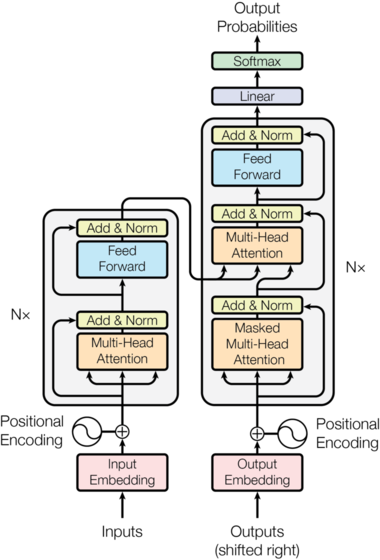 From the Paper
This is the picture of the full transformer as taken from the paper. And, it surely is intimidating. So, I will aim to demystify it in this post by going through each piece. So read ahead.
From the Paper
This is the picture of the full transformer as taken from the paper. And, it surely is intimidating. So, I will aim to demystify it in this post by going through each piece. So read ahead.
Q: That sounds interesting. So, what does a transformer do exactly?
Essentially, a transformer can perform almost any NLP task. It can be used for language modeling, Translation, or Classification as required, and it does it fast by removing the sequential nature of the problem. So, the transformer in a machine translation application would convert one language to another, or for a classification problem will provide the class probability using an appropriate output layer.
It all will depend on the final output layer for the network; the Transformer basic structure will remain quite the same for any task. For this particular post, I will be continuing with the machine translation example.
So, from a very high place, this is how the transformer looks for a translation task. It takes as input an English sentence and returns a German sentence.
 Transformer for Translation
Q: That was too basic. 😎 Can you expand on it?
Transformer for Translation
Q: That was too basic. 😎 Can you expand on it?
Okay, just remember in the end, you asked for it. Let’s go a little deeper and try to understand what a transformer is composed of.
So, a transformer is essentially composed of a stack of encoder and decoder layers. The role of an encoder layer is to encode the English sentence into a numerical form using the attention mechanism, while the decoder aims to use the encoded information from the encoder layers to give the German translation for the particular English sentence.
In the figure below, the transformer is given an English sentence as input, which gets encoded using 6 encoder layers. The output from the final encoder layer then goes to each decoder layer to translate English to German.
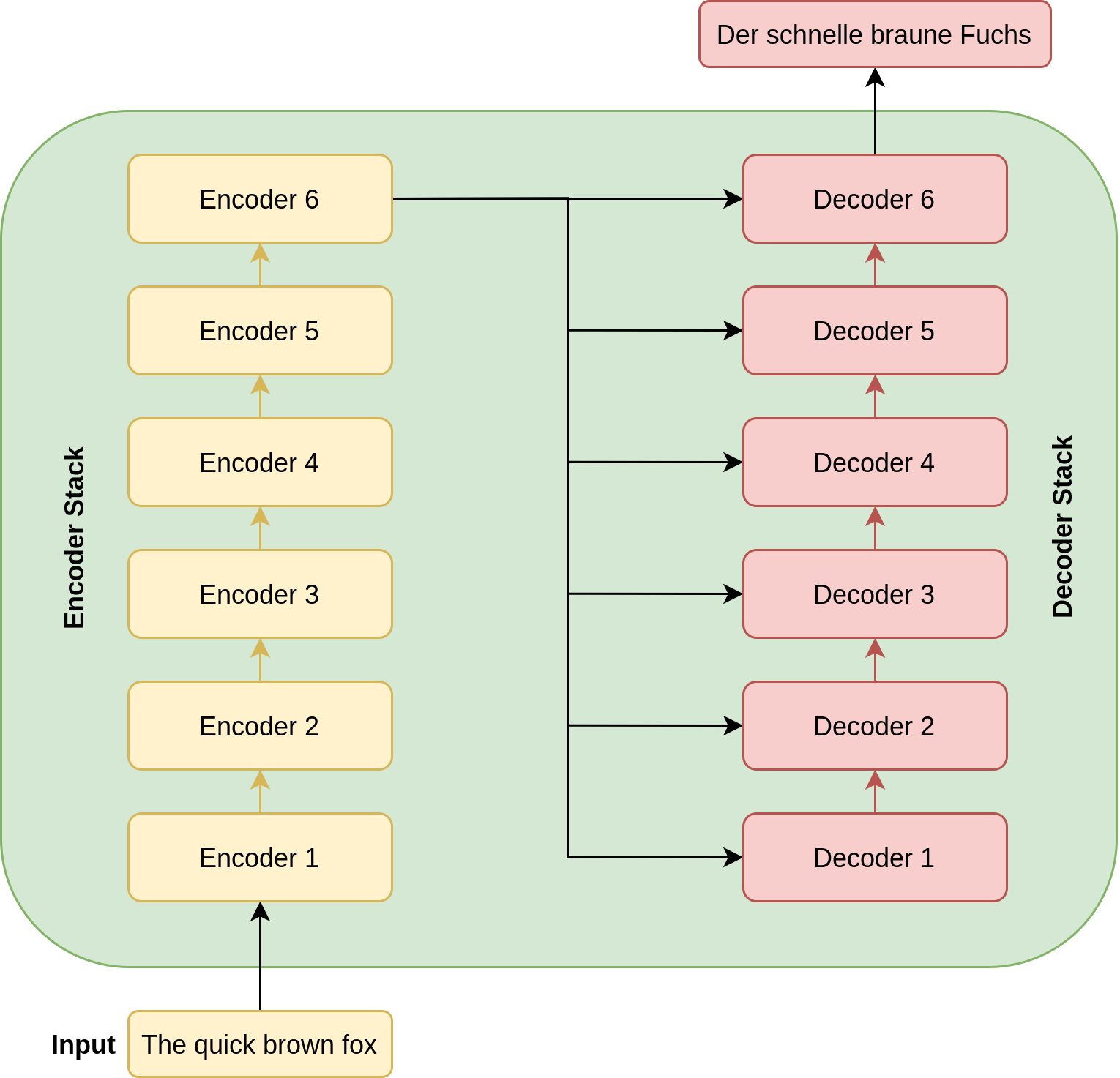 Data Flow in a Transformer
Q: That’s alright, but how does an encoder stack encode an English sentence exactly?
Data Flow in a Transformer
Q: That’s alright, but how does an encoder stack encode an English sentence exactly?
Patience, I am getting to it. So, as I said, the encoder stack contains six encoder layers on top of each other(As given in the paper, but the future versions of transformers use even more layers). And each encoder in the stack has essentially two main layers:
- a multi-head self-attention Layer, and
- a position-wise fully connected feed-forward network
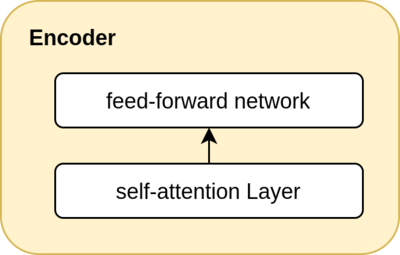 Very basic encoder Layer
They are a mouthful. Right? Don’t lose me yet as I will explain both of them in the coming sections. Right now, just remember that the encoder layer incorporates attention and a position-wise feed-forward network.
Very basic encoder Layer
They are a mouthful. Right? Don’t lose me yet as I will explain both of them in the coming sections. Right now, just remember that the encoder layer incorporates attention and a position-wise feed-forward network.
Q: But, how does this layer expect its inputs to be?
This layer expects its inputs to be of the shapeSxD(as shown in the figure below) whereSis the source sentence(English Sentence) length, andDis the dimension of the embedding whose weights can be trained with the network. In this post, we will be using D as 512 by default throughout. While S will be the maximum length of a sentence in a batch. So it normally changes with batches.
Similar Articles
@DanKornas: Learn LLMs and generative AI with a structured Stanford course. What you will learn: - Understand transformer and LLM c…
A structured Stanford course on LLMs and generative AI is being shared, covering transformer and LLM concepts without treating them as black boxes.
@Ai_Vaidehi: Steps to building AI systems with LLM's. I've given a simple detailed explanation below. 𝗦𝘁𝗲𝗽 1 – 𝗟𝗟𝗠𝘀 (𝗟𝗮𝗿𝗴𝗲 𝗟𝗮𝗻𝗴𝘂𝗮𝗴𝗲 𝗠𝗼𝗱𝗲𝗹𝘀)
A step-by-step guide to building AI systems using LLMs, covering steps from choosing models to evaluation using frameworks, vector databases, and data extraction tools.
@oliviscusAI: OpenAI's co-founder just released his personal guide to train LLMs from scratch. It's called llm.c. No heavy setup. Jus…
OpenAI co-founder Andrej Karpathy released llm.c, an open-source guide to training LLMs from scratch with simple code that runs on any hardware, including CPUs and MacBooks, and is 7% faster than standard approaches.
@TheAhmadOsman: INCREDIBLE RESOURCE The MOST COMPLETE GUIDE for understanding LLMs from first principles is now available online to rea…
A comprehensive free guide explaining LLMs from first principles, covering tokens, transformers, attention, fine-tuning, and local deployment.
@techNmak: Build LLMs from Scratch Found this gem from Vizuara, a 43-lecture series that actually delivers on its promise: buildin…
A 43-lecture series by Vizuara teaches how to build LLMs from scratch, covering transformer architecture, GPT internals, tokenization, and attention mechanisms with full Python implementations.