@0x0SojalSec: - http://cpu.land : the visual explainer I wish existed years ago. gorgeous diagrams showing multitasking, syscalls, an…
Summary
cpu.land is a visual explainer that clarifies how CPUs work, multitasking, syscalls, and Linux program loading, aimed at filling knowledge gaps for self-taught programmers.
View Cached Full Text
Cached at: 07/12/26, 09:00 PM
- https://t.co/vKs7XDGSwD : the visual explainer I wish existed years ago. gorgeous diagrams showing multitasking, syscalls, and how Linux loads your programs.
Feels like someone finally explained the ‘brain’ of your machine without the jargon overload. https://t.co/LE5DM8A7ey
Intro - Putting the “You” in CPU
Source: https://cpu.land/
From the beginning…Edit on GitHub
I’ve donea lot of things with computers, but I’ve always had a gap in my knowledge: what exactly happens when you run a program on your computer? I thought about this gap — I had most of the requisite low-level knowledge, but I was struggling to piece everything together. Are programs really executing directly on the CPU, or is something else going on? I’ve used syscalls, but how do theywork? What are they, really? How do multiple programs run at the same time?
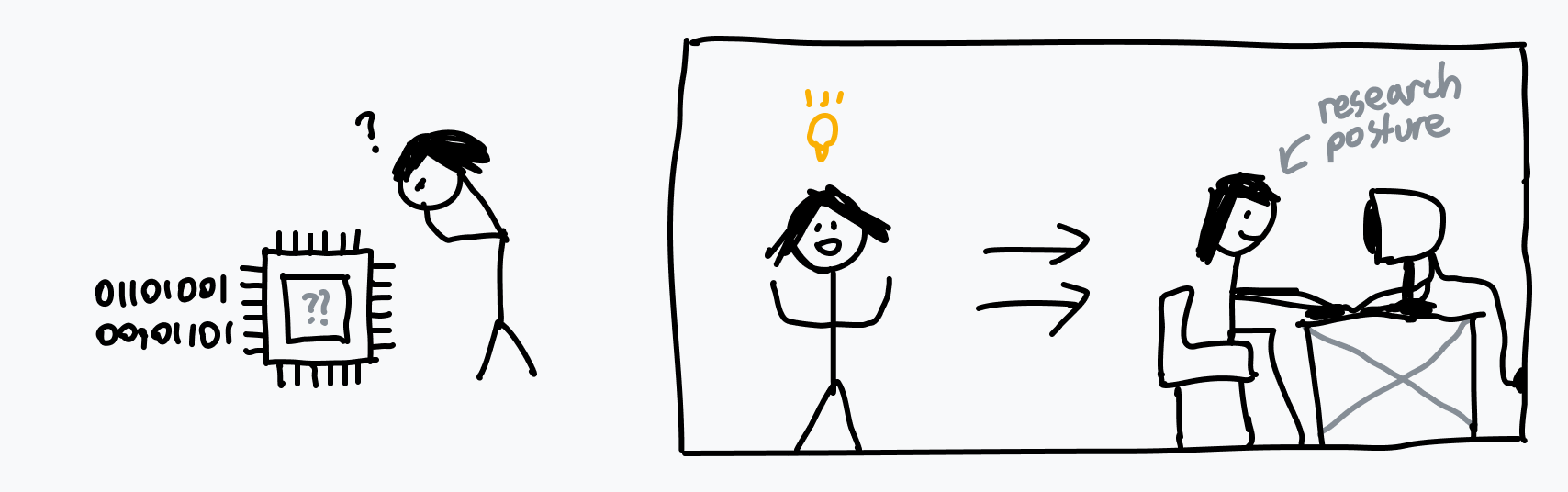
I cracked and started figuring as much out as possible. There aren’t many comprehensive systems resources if you aren’t going to college, so I had to sift through tons of different sources of varying quality and sometimes conflicting information. A couple weeks of research and almost 40 pages of notes later, I think I have a much better idea of how computers work from startup to program execution. I would’ve killed for one solid article explaining what I learned, so I’m writing the article that I wished I had.
And you know what they say… you only truly understand something if you can explain it to someone else.
In a hurry? Feel like you know this stuff already? Read chapter 3and I guarantee you will learn something new. Unless you’re like, Linus Torvalds himself.
Similar Articles
@0x0SojalSec: Learn algorithms visually! interactive visualizations that actually make concepts click, Prim's, Dijkstra, sorting it's…
Introduces a tool that provides live visualizations and code for learning algorithms like Prim's, Dijkstra, and sorting, making concepts easier to understand.
A Linux desktop in x86_64 Assembly
A developer rebuilt their entire Linux desktop stack—from shell to terminal, window manager, and utilities—in pure x86_64 Assembly using Claude Code, achieving microsecond startup times and hours of extra battery life.
@techNmak: THIS IS LITERALLY THE BEST LLM EXPLAINER I'VE EVER COME ACROSS. And it's free. Interactive. 3D. Step-by-step. Watch a r…
An interactive, 3D, step-by-step visualizer that shows a token moving through every transformer layer, from embedding to output, for free.
@bellicosiX: This one was such a delight to read. This was written with a lot of love. I am grateful. @abhi9u
A comprehensive, book-level blog post covering virtual memory concepts in Linux, including page tables, TLBs, demand paging, copy-on-write, memory-mapped I/O, and performance implications, presented through a dialogue between a process and the kernel.
@agupta: some ideas are much clearer when you can use coding agents to show a proof of concept. eg I hadn’t really understood ho…
A tweet highlights how coding agents can clarify complex ideas, using GPU vs NPU memory competition on devices as an example demonstrated through code.