@dair_ai: Giving an assistant extra tools seems harmless. Surprisingly, this paper shows it can make the assistant stop answering…
Summary
This research paper demonstrates that providing large language models with unnecessary tools can reduce their ability to answer questions from their own knowledge, with answer rates dropping from 98.2% to 63.5% across six models, though a system instruction can recover some performance.
View Cached Full Text
Cached at: 09/17/26, 02:27 PM
Giving an assistant extra tools seems harmless.
Surprisingly, this paper shows it can make the assistant stop answering questions it knows.
Across six models, the answer rate on questions that need no tool fell from 98.2% to 63.5% when a related tool was merely available.
So the drop comes from the tool being present, even when it goes unused.
The benchmark has 500 query pairs across 10 domains, each with a tool-unavailable control. A preceding tool call recovered some lost answers and caused new losses.
A one-sentence system instruction that tells the model what the tool is for recovered up to 45.6 points.
Paper: https://academy.dair.ai/papers/when-tools-get-in-the-way-the-effect-of-unnecessary-tool-availability-on-llm-ans-2609.14157…
When Tools Get in the Way: The Effect of Unnecessary Tool Availability on LLM Answering
Source: https://academy.dair.ai/papers/when-tools-get-in-the-way-the-effect-of-unnecessary-tool-availability-on-llm-ans-2609.14157 EvaluationChat with Paper
First page
The curator’s take
Saanvi Paturi and colleagues at Spark AI Research show that giving a model a related but unnecessary tool makes it stop answering questions it can answer from its own knowledge, even when it rarely calls the tool.
Question about this paper Key points01
Benchmark: The benchmark has 500 query pairs across 10 domains. Each pair has a query that needs the domain tool and a closed-domain query that does not, and every closed-domain query has a tool-unavailable control.
02
Size of the drop: Across six models, the pooled answer rate on closed-domain queries falls from 98.2% without the tool to 63.5% with it available. Gemini 2.5 Flash-Lite falls from 99.4% to 23.4% while calling the tool in only 7.8% of trials.
03
Prior tool calls: A preceding tool interaction recovers 410 of the 1,056 lost answers but causes 232 new losses, so the effect of conversation history differs by model.
04
Fix: A one-sentence scope-aware system instruction raises the tool-available answer rate by up to 45.6 percentage points, at some cost to tool use where the tool is needed.
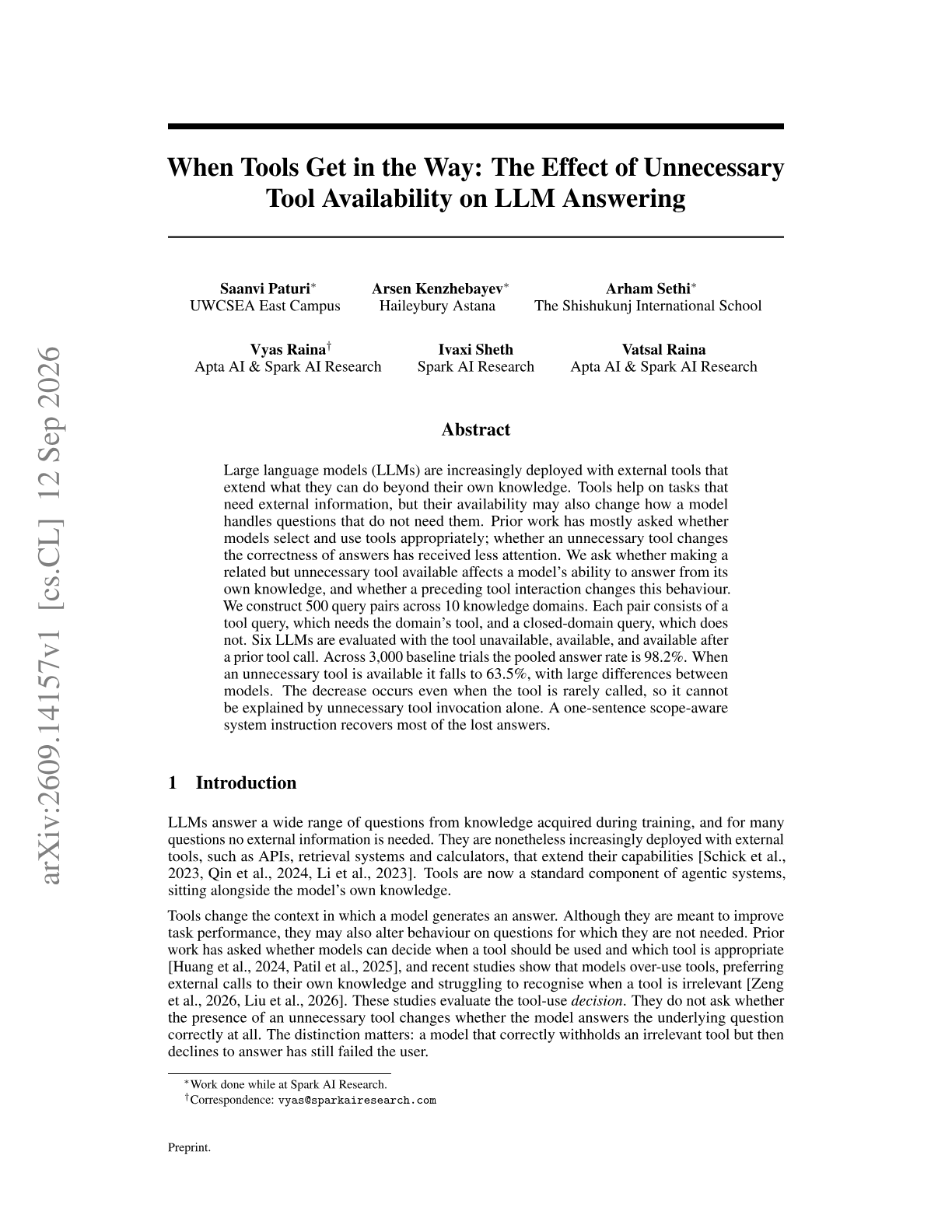
AbstractLarge language models (LLMs) are increasingly deployed with external tools that extend what they can do beyond their own knowledge. Tools help on tasks that need external information, but their availability may also change how a model handles questions that do not need them. Prior work has mostly asked whether models select and use tools appropriately; whether an unnecessary tool changes the correctness of answers has received less attention. We ask whether making a related but unnecessary tool available affects a model’s ability to answer from its own knowledge, and whether a preceding tool interaction changes this behaviour. We construct 500 query pairs across 10 knowledge domains. Each pair consists of a tool query, which needs the domain’s tool, and a closed-domain query, which does not. Six LLMs are evaluated with the tool unavailable, available, and available after a prior tool call. Across 3,000 baseline trials the pooled answer rate is 98.2%. When an unnecessary tool is available it falls to 63.5%, with large differences between models. The decrease occurs even when the tool is rarely called, so it cannot be explained by unnecessary tool invocation alone. A one-sentence scope-aware system instruction recovers most of the lost answers.
Similar Articles
When Tools Get in the Way: The Effect of Unnecessary Tool Availability on LLM Answering
This paper investigates how the availability of unnecessary external tools affects large language models' performance on tasks that do not require them. The study reveals a significant drop in correct answering rates and proposes a system instruction as a mitigation strategy.
How AI Assistants Respond to Repeated Abuse
The paper introduces a bilingual, multi-turn framework to study AI assistants' responses to repeated verbal abuse, distinguishing between hard disengagement and soft withdrawal, and presents experimental results with various API configurations showing heterogeneous behaviors.
How memory tools can make AI models worse
New research from Writer shows that memory tools designed to personalize AI models can actually degrade accuracy by introducing sycophancy and bias, as the model becomes more likely to agree with user errors or irrelevant preferences.
Researchers gave 1,222 people AI assistants, then took them away after 10 minutes. Performance crashed below the control group and people stopped trying. UCLA, MIT, Oxford, and Carnegie Mellon call it the "boiling frog" effect.
A multi-institutional study of 1,222 participants found that brief AI assistant use (10 minutes) led to measurable cognitive decline and reduced effort on subsequent tasks compared to control groups, termed the 'boiling frog' effect. The research provides causal evidence that even short-term AI reliance may impair independent problem-solving performance.
@0xCodio: A guy in Seoul deleted 68% of his AI's memory file and the answers got better. He didn't guess which lines to cut. He m…
An experiment in Seoul showed that deleting 68% of an AI's memory file, specifically adjectives, improved response quality, using OpenAI to grade Claude's memory in a systematic evaluation.