Cached at:
08/09/26, 08:28 PM
# How I use LLMs to learn complex topics · Laurentiu Raducu
Source: [https://laurentiugabriel.github.io/blog/articles/how-i-use-llms-to-learn/](https://laurentiugabriel.github.io/blog/articles/how-i-use-llms-to-learn/)
Many engineers I know use generative AI for many functions, like building PoCs, internal tools or dashboards, or even learning new stuff\. I personally find the style used by LLMs to explain things difficult to follow\. It's just too simplistic and depending on the number of emojis used, a bit annoying too\.
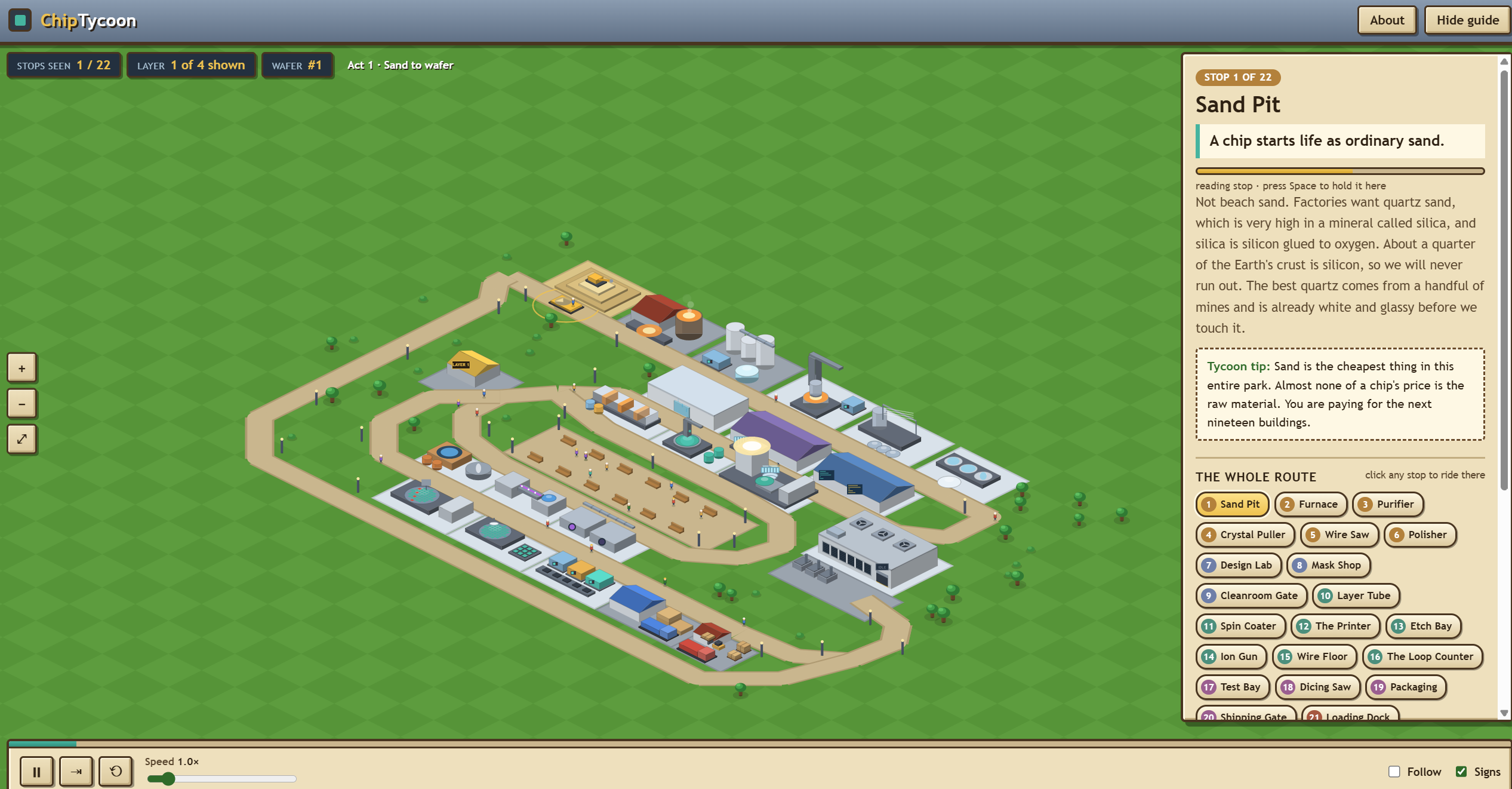
While I was analyzing new AI bottlenecks that might slow down data center buildup, I realized there are many aspects of chip production that I do not know\. Surfing the web, I asked myself what if there would be a game to get you through the process of building a chip at a fab? For sure learning this way will stick, since you can map concepts with objects within the game\. This is when I decided to try it, and it actually turned out really well\.
## The flow
Instead of just asking AI to explain a topic, I use the following flow:
- In plan mode \(using CC, or OpenCode\) I ask a model to build the foundational knowledge for X topic\.
- I ask it to review the accuracy of the knowledge base it built in the previous step\.
- I proceed asking it to build a simulation of that topic in a low\-poly, Rollercoaster Tycoon\-like animation\. I add some UX elements as well, like the page needs to be visible on both large and small screens, have controls to stop the flow whenever I want etc\.
- I then push it to a new repo and enable GitHub Pages for it\.
## The result
What you get is a beautiful animation that is 100% accurate and free of hallucinations\. For me, this method works a lot better than just reading endless materials that I find on Google, or trying to digest a bulleted list that is spat by a language model\.
I've done this specifically for learning chip building and launch it under this website:[ChipTycoon](https://laurentiugabriel.github.io/ChipTycoon/)\. You get to follow a cart from the moment when sand is collected, to the moment when a chip is finalized and delivered to a data center\.
Visually, you can follow the cart and see how it changes too\. Since it's low\-poly, the details might be missing, but it's still a good indicator for showing how the product changes once it goes through the many steps required in the manufacturing process\.
## How to improve it further
Let's say that the low\-poly design requires to much immagination to actually visualize what happened to the quartz sand pile after it left the furnace\. To transform this into a more realistic representation, you can use my[skill for transforming pictures into 3d objects](https://github.com/LaurentiuGabriel/unreal-game-assets-creation-skill), and map the resulting objects to your simulation\. This way you get more accurate design\.
Also, you can add challenges to your simulation too\. Trying to answer questions about a previous step in the chip manufacturing process will help you retain the knowledge tremendously\. Add intuitive puzzles too that will help you learn even better\.
Check out what other pages I created:
- [How rocket engines are made](https://laurentiugabriel.github.io/rocket-engine/)
- [How LLMs work](https://laurentiugabriel.github.io/token-town/)
- [How F1 engines are built](https://laurentiugabriel.github.io/engineworks/)
- [How an EUV machine is built](https://laurentiugabriel.github.io/euv-lithography/)