Cached at:
09/15/26, 11:20 AM
# Is The Era of Human Achievement Coming to an End?
Source: [https://orrubin.substack.com/p/is-the-era-of-human-achievement-coming?r=92rft3](https://orrubin.substack.com/p/is-the-era-of-human-achievement-coming?r=92rft3)
[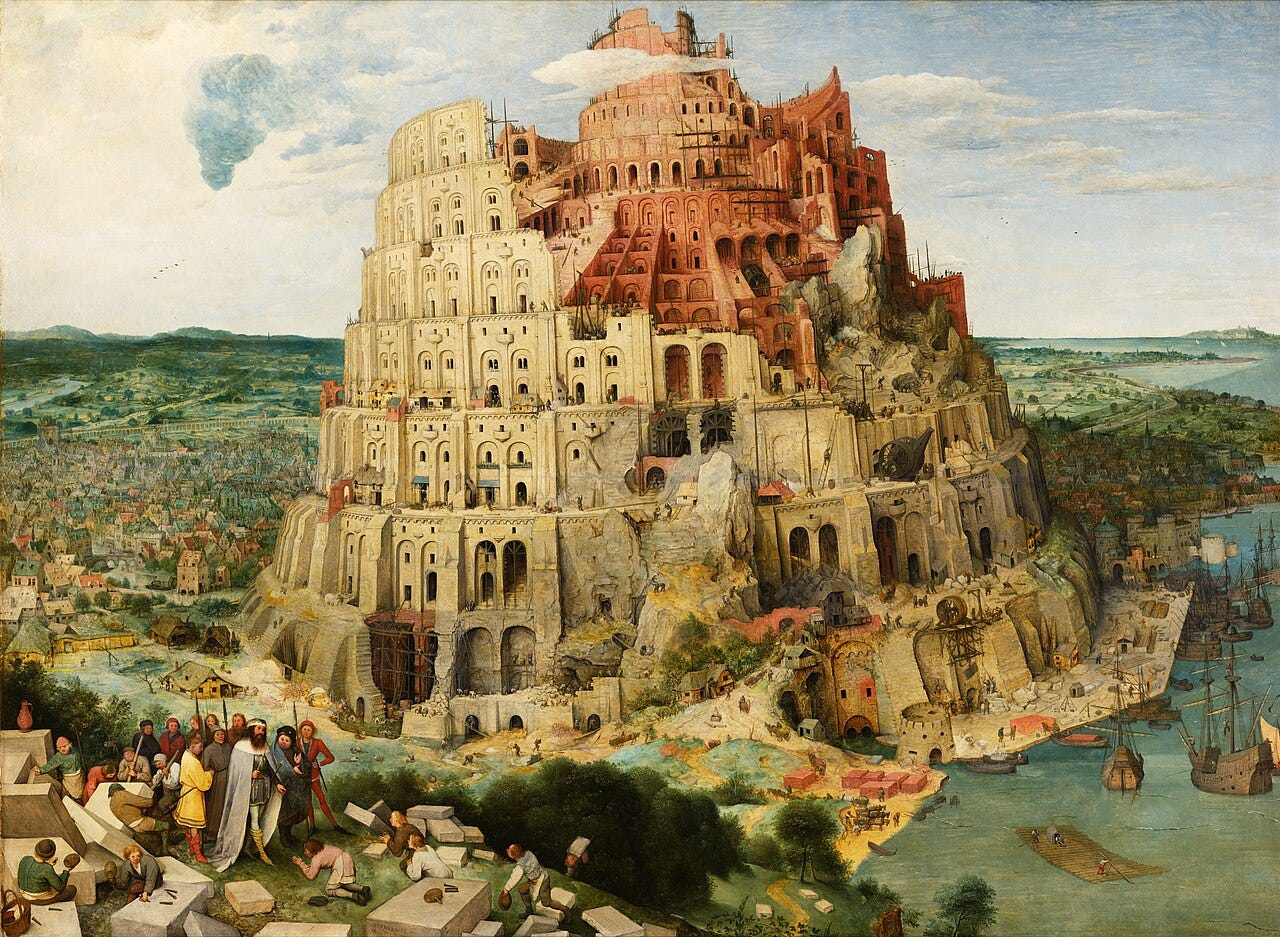](https://substackcdn.com/image/fetch/$s_!YDLI!,f_auto,q_auto:good,fl_progressive:steep/https%3A%2F%2Fsubstack-post-media.s3.amazonaws.com%2Fpublic%2Fimages%2F9615c39d-dbeb-47e0-994d-b2c00204077b_1280x937.jpeg)*The Tower of Babel*by Pieter Bruegel the Elder c\. 1563
For as long as humans have existed, they have achieved\. Whether this was an impressive hunt to provide the tribe with a much\-needed meal, the inexplicable magic of composing a beautiful musical piece, or a scientific achievement that changed the way we understood the natural world – the human desire to achieve, the desire to reach a goal through hard work and effort, has been a constant propelling force throughout history that has characterized our tenacious species\.
The importance of achievement for humanity is not without cause\. Throughout human history, people have often had to achieve great—and sometimes seemingly impossible—things simply to survive or to improve their odds of survival\. Humanity’s shared history is full of stories that pridefully tell tales of impossible achievement, whether fictitious or real\. But more than only necessity, the human will to achieve also comes out of a will to prove oneself to oneself or others, out of pride, out of a need for meaning, and many more reasons\. Whatever the causes for human achievement, it may well be considered a long\-lasting characteristic element of humanity throughout history\.
But the era of human achievement may be coming to an end\. Human achievement, achievement in which humans are the sole or primary agents, seems to be disrupted by the revolutionary technology of Artificial Intelligence\. The accelerating development of AI is demonstrating that increasingly significant intellectual achievements may be produced with increasingly little direct human participation\.
On September 8, 2026, OpenAI announced that its unreleased internal model has[proposed a solution to the Navier–Stokes existence and smoothness problem](https://openai.com/index/navier-stokes-solution/), one of the seven Millennium Prize Problems, which is considered one of the most difficult problems in mathematics and has eluded mathematicians for over a century\. To produce the solution, OpenAI used a “swarm” or a collection of AI agents, in this case 10,000 agents, to collectively and autonomously work on the Navier–Stokes problem\. After 88 hours, the agents produced a solution which is currently under review\.
What OpenAI’s Navier–Stokes case exemplifies is not only an increasingly intelligent AI capable of impressive intellectual feats that have thus far eluded humans, but also a paradigmatic shift in next\-generation AI models: a substantial increase in autonomy and agency\. Surely, while bright programmers, scientists, and mathematicians at OpenAI have guided the swarm to its solution, and while[there is controversy over whether OpenAI's effort drew on a mathematician's unpublished, private research,](https://mastodon.social/@tristanbuckmaster/117233413705701198)the swarm worked autonomously for 88 hours, likely independently testing and falsifying hypotheses, combining ideas, and communicating with fellow AI agents without any human in the loop during its reasoning process\.
[AI experts have predicted](https://ai-2027.com/)that what is demonstrated in the Navier–Stokes case gives a glimpse of what may lie in the future of AI: “Agentic AI” that is increasingly autonomous and able to execute impressive work without any humans in the loop\. Or, in other words, AI that is able to achieve great things, with increasingly little need for humans\. If AI reaches such levels of autonomy, combined with the expectation that AI will surpass humans in increasingly important forms of intellectual work, it is likely that the locus of groundbreaking achievements will be passed on from human to machine, and humans may, for the first time in history, have to deal with a world in which they are no longer the most capable agents of intellectual achievement\.
But not everyone agrees with the certainty of this change\. Some say that AI, agentic or not, will not replace human achievement but only change it—not unlike how other technologies have changed the form but not the essence of human achievement in the past\. For example, the rise of the calculator may have turned complex mental arithmetic unnecessary and obsolete, but it did open the door to faster and more complex math computation, as did the computer\. In other words, novel technologies were used as tools to enhance human achievement rather than making it obsolete\.
However, this argument may not apply for the new generation of agentic AI\. Firstly, past responses to technological innovations can only teach us so much about the future\. Nothing guarantees that patterns from previous technological transformations will continue to hold in the face of a fundamentally different technology, however robust they may seem\. Secondly, in past technological innovations, the notion of*human achievement*was never truly in danger, even if some believed it was\. Going back to our example, both the calculator and computer were limited in the kinds of cognitive work they could perform\. It would be reasonable to say that they could replace specific cognitive modules of human cognition, like mental arithmetic, documentation, bureaucratic memory, etc\., without themselves becoming general agents of intellectual achievement\.
This is not the case with agentic AI\. This type of AI cannot be characterized as a mere tool or intelligence enhancement; it is an increasingly autonomous system capable of performing forms of intellectual work previously dependent on human intelligence\. Tools, like a calculator, are subject to the very specific \(and limited\) task that we give them\. They are unable to go beyond the task that we use them for\. This keeps the locus of agency around the human that is using the tool, not the tool itself\. An AI system that independently determines how to approach a problem, what hypotheses to generate, evaluates the strength of possible solutions, and pursues lines of reasoning that its creators did not explicitly specify, showcases a shift in the locus of intellectual agency away from humans and towards machines\.
Does that mean that humans will not adapt to this new technology? No\. I believe that adaptation is likely\. Humans have an incredible ability to adapt to new ecological contexts, and it is likely that younger generations, who will have grown up in a world with AI, will find it increasingly natural to live alongside autonomous systems capable of accomplishing things that humans cannot\. But adaptation does not mean that the era of human achievement will not come to an end, nor that such a change will not have profound consequences\.
Until now, the will to achieve—to struggle for some higher goal, whether that may be scientific, artistic, spiritual, or whatever—was a propeller of human pride, identity, and meaning\. This begs the ultimate questions—what becomes of human endeavor when our achievements may be overshadowed by machines? What happens when humanity’s achievements are challenged, and potentially eclipsed, by another form of intelligence? What happens when a historical trend that seemed timeless and universal is for the first time in history broken up and disrupted?
Perhaps our obsession with great achievement was misguided and overrated and did nothing other than fuel our egos and will to power, while straying us from the truly important human activities like connecting with fellow humans, creating, learning, and playing out of intrinsic desire, and not judging and distinguishing people based on the antiquated notion of achievement\. Some signs that this is possible can already be seen in the chess world in which humans are eclipsed in chess achievements by AI\. Instead of striving to be the objectively best player in the world, humans are happy to settle for inter\-human competition, and it does not appear that this hampers human happiness in playing chess in a considerable way\.
Perhaps this type of play is enough for us\. Perhaps humans will be perfectly content to play with the world, to create for the sake of creating, and to pursue things not because they constitute the greatest possible achievement, but because we enjoy the process of pursuing them\. But perhaps this will not be enough\. Perhaps the desire to push the boundaries of what is possible, to achieve something genuinely difficult and unprecedented, is deeply tied to what gives human life meaning\. If so, the end of humanity’s monopoly on achievement may be far more consequential than the loss of any particular job\.
*This is the first of what I hope will be a regular series on AI, meaning, and how novel technologies are changing what it means to be human\. If the questions above stuck with you, subscribe—I’ll be back with the next one soon\.*
#### Discussion about this post
### Ready for more?