@jiqizhixin: Awesome blog! State of RL for reasoning LLMs https://aweers.de/blog/2026/rl-for-llms/…
Summary
A comprehensive blog post reviewing the state of reinforcement learning for reasoning LLMs, covering methods from REINFORCE and PPO to GRPO and beyond, with connections to key models like InstructGPT and DeepSeek-R1.
View Cached Full Text
Cached at: 05/08/26, 07:37 PM
Awesome blog!
State of RL for reasoning LLMs
https://t.co/K0qxuxMYzT https://t.co/mEw5lOhqsI
State of RL for reasoning LLMs
Source: https://aweers.de/blog/2026/rl-for-llms/ Reinforcement learning has been one of the most consequential additions to the LLM post-training stack. It was the key ingredient that transformed GPT-3 into InstructGPT[1], and it has since become central to the current wave of reasoning improvements[2][3].
The first generation of RL for LLMs was dominated by PPO[4], a method developed for more conventional RL settings such as Atari games and robotics, but adapted very successfully to RLHF.
The second generation, driven by the goal of improving reasoning capabilities, brought another round of algorithmic refinement. A large number of variants have appeared in a short period of time, with most differing from their predecessors in only small but consequential ways.
This post provides a compact overview of the major developments inRL for reasoning LLMs(2024-2026). It starts from the foundations (REINFORCE and PPO), then covers GRPO and subsequent methods that refined and improved upon it.
Brief RL Introduction
In the standard RL setting, anagentobserves astates\_t, chooses anactiona\_t according to apolicy\\pi\(a\_t \\mid s\_t\), transitions to a new state s\_\{t\+1\} according to the environment dynamics p\(s\_\{t\+1\} \\mid s\_t, a\_t\), and receives arewardr\_t.
A concrete example is a robot navigating a room: the state is its current position and sensor reading, the actions are movement commands, the transition dynamics are governed by physics (wheels might slip), and the reward reflects progress toward the goal.
This loop repeats over Ttime steps. The agent aims to maximize the expected discounted return
J = \\mathbb\{E\}\\left\[\\sum\_\{t=0\}^\{T\} \\gamma^t r\_t\\right\]
where thediscount factor0 \\leq \\gamma \\leq 1 controls how strongly future rewards are discounted.
The policy is usually parametrized by \\theta. A central object in many RL algorithms is thevalue function
V^\\pi\(s\) = \\mathbb\{E\}\_\\pi\\left\[\\sum\_\{l=0\}^\{T\-t\} \\gamma^l r\_\{t\+l\} \\mid s\_t = s\\right\],
which measures how good it is to be in state s under policy \\pi. From this, one can deriveadvantages, which estimate whether a particular action was better or worse than expected.
For LLMs, the setup is often simplified substantially. We have a parametrizedmodel\\pi\_\\theta samplingresponsesy \\sim \\pi\_\\theta\(\\cdot\|x\) given apromptx \\sim \\mathcal\{D\} from our dataset, which we grade with a scalarrewardr\(x, y\). The objective becomes:
J\(\\theta\) = \\mathbb\{E\}\_\{x \\sim \\mathcal\{D\},\\, y \\sim \\pi\_\\theta\(\\cdot\|x\)\}\\left\[r\(x, y\)\\right\]
One can still model this environment with states being*(prompt + previously generated tokens)*and actions being the next token. In practice, however, it is usually not possible to assign meaningful rewards to individual tokens, but only provide one reward for the complete response given the prompt. The reward would be zero for all tokens except the last, making the setup unnecessarily complicated.
REINFORCE
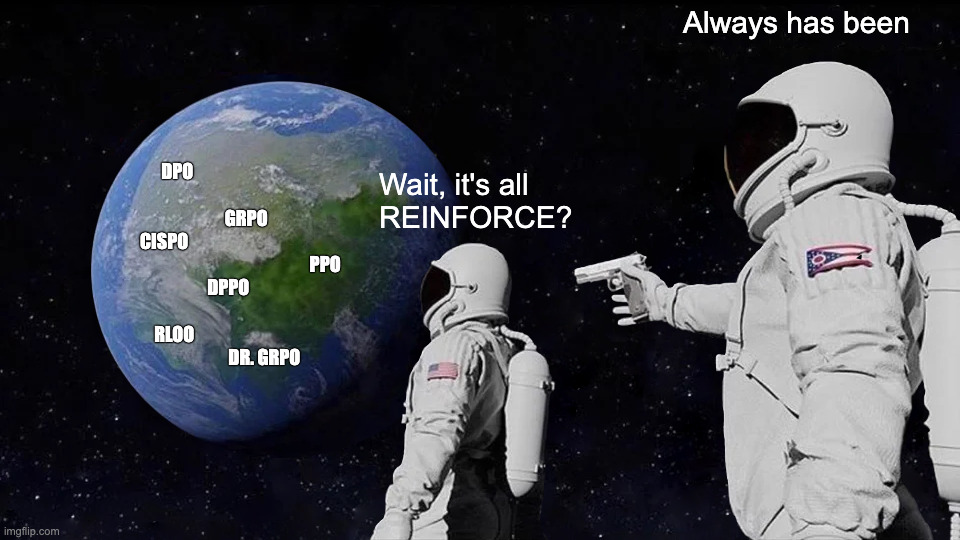
We start with REINFORCE[5], since it is both conceptually simple and the foundation of all policy gradient methods.
In its simplest form, the REINFORCE objective is:
J\(\\theta\) = \\mathbb\{E\}\_\{y \\sim \\pi\_\\theta\(\\cdot \\mid x\)\}\\left\[r\(x, y\)\\right\]
The gradient of this objective has a simple and interpretable form:
\\nabla\_\\theta J\(\\theta\) = \\mathbb\{E\}\_\{y \\sim \\pi\_\\theta\(\\cdot \\mid x\)\}\\left\[\\nabla\_\\theta \\log \\pi\_\\theta\(y \\mid x\) \\cdot r\(x, y\)\\right\]
For comparison, the gradient of supervised fine-tuning is
\\nabla\_\\theta L\_\{\\text\{SFT\}\}\(\\theta\) = \-\\nabla\_\\theta \\log \\pi\_\\theta\(y^\* \\mid x\)
(Note, that the SFT loss is minimized, while the RL objective is maximized).
This comparison reveals that REINFORCE is essentially aweightedform of SFT. Instead of reinforcing provided, off-policy answers y^\*, we reinforce or punish sampled, on-policy answers y weighted according to their rewards.
The main disadvantage of REINFORCE is variance. Even when the reward is relatively structured (e.g., a large test suite where each test contributes partial reward), gradient estimates can vary substantially across samples.
To reduce variance, REINFORCE subtracts abaselineb\(x\) that does not depend on the sampled action (response). This leaves the expected gradient unchanged since
\\mathbb\{E\}\_\{y \\sim \\pi\_\\theta\(\\cdot \\mid x\)\}\\left\[\\nabla\_\\theta \\log \\pi\_\\theta\(y \\mid x\)\\, b\(x\)\\right\] = 0,
while often reducing variance substantially. The gradient then becomes
\\nabla\_\\theta J\(\\theta\) = \\mathbb\{E\}\_\{y \\sim \\pi\_\\theta\(\\cdot \\mid x\)\}\\left\[\\nabla\_\\theta \\log \\pi\_\\theta\(y \\mid x\)\\, \\bigl\(r\(x,y\)\-b\(x\)\\bigr\)\\right\]\.
The quantity r\(x,y\)\-b\(x\) is the simplest form of an advantage estimate.
PPO
PPO (Proximal Policy Optimization)[4]became the dominant general-purpose policy gradient algorithm and, for several years, the default choice for RLHF.
The PPO objective is often presented in a form that appears complex:
J^\{\\text\{PPO\}\}\(\\theta\) = \\mathbb\{E\}\_t\\left\[\\min\\left\(\\rho\_t\(\\theta\)\\hat\{A\}\_t,\\; \\operatorname\{clip\}\(\\rho\_t\(\\theta\), 1\-\\epsilon, 1\+\\epsilon\)\\hat\{A\}\_t\\right\)\\right\],
where
\\rho\_t\(\\theta\) = \\frac\{\\pi\_\\theta\(a\_t \\mid s\_t\)\}\{\\pi\_\{\\theta\_\{\\text\{old\}\}\}\(a\_t \\mid s\_t\)\}
is theimportance sampling(IS) ratio between the current policy \\pi\_\\theta and the policy that generated the rollout \\pi\_\{\\theta\_\\text\{old\}\}.
One might ask: “Shouldn’t this always be 1 for on-policy RL?” The answer is yes, but only for thefirstoptimizer step after generating rollouts.
This ratio is needed because rollouts are expensive. In practice, one usually reuses a batch of generated data for multiple minibatch updates or multiple epochs. After the first optimizer step, the training policy is no longer exactly the same as the generation policy, so PPO becomes slightly off-policy. The ratio corrects for this mismatch, and the clipping limits how far optimization can move away from the generation policy. This is PPO’s approximation to a trust region[6].
Note that clipping affects not only the objective’s value but, more importantly, its dependence on \\theta. Since we optimize \\theta to maximize J, clipped cases produce zero gradients because the learned policy is no longer part of the equation. Updates for these cases are skipped since we have moved outside the trust region.
The clipping handles four scenarios:
Not clippedClippedPositive advantage(good answer, reinforce)\\rho\_t\(\\theta\)\\hat\{A\}\_t: the answer is good and has not been over-updated\(1\+\\epsilon\)\\hat\{A\}\_t: the answer is already sufficiently more likely, so the gradient is stoppedNegative advantage(bad answer, discourage)\\rho\_t\(\\theta\)\\hat\{A\}\_t: the answer is bad and has not been over-updated\(1\-\\epsilon\)\\hat\{A\}\_t: the answer is already sufficiently less likely, so the gradient is stoppedWe can also express this clipping as a mask:
M\(\\hat\{A\}\_t, \\rho\_t, \\epsilon\) = \\begin\{cases\} 0 & \\text\{if \} \(\\hat\{A\}\_t \> 0 \\land \\rho\_t \> 1 \+ \\epsilon\) \\lor \(\\hat\{A\}\_t < 0 \\land \\rho\_t < 1 \- \\epsilon\) \\\\ 1 & \\text\{otherwise\} \\end\{cases\}
With this formulation, the objective simplifies to:
J^\{\\text\{PPO\}\}\(\\theta\) = \\mathbb\{E\}\_t\\left\[M\(\\hat\{A\}\_t,\\rho\_t\(\\theta\),\\epsilon\)\\,\\rho\_t\(\\theta\)\\,\\hat\{A\}\_t\\right\]\.
So, PPO is essentially an importance-weighted policy gradient with a trust region mask.
For advantage estimation, PPO uses theGeneralized Advantage Estimator(GAE):
\\hat\{A\}\_t = \\sum\_\{l=0\}^\{\\infty\} \(\\gamma \\lambda\)^l \\delta\_\{t\+l\}
Computing \\delta requires a learned value function. In the LLM setting, this usually requires an additional value model, often of similar size to the policy model. That is costly in memory and increases the training complexity. We will not examine GAE in detail in this post, since removing this component is GRPO’s main practical contribution. See thisdetailed postfor an in-depth explanation of PPO and all its components.
Finally, the PPO objective is often combined with KL regularization:
J^\{\\text\{PPO\-KL\}\}\(\\theta\) = \\mathbb\{E\}\_t\\left\[M\(\\hat\{A\}\_t,\\rho\_t,\\epsilon\)\\rho\_t\(\\theta\)\\hat\{A\}\_t\\right\] \- \\beta\\, D\_\{\\text\{KL\}\}\(\\pi\_\\theta \\,\\\|\\, \\pi\_\{\\text\{ref\}\}\)\.
Here \\pi\_\{\\text\{ref\}\} is usually the model before RL training. In RLHF this term is especially important, since it preserves general capabilities and helps to control the distribution shift relative to the reward model (that was trained on the reference policy \\pi\_\{\\text\{ref\}\}). In reasoning RL, the KL penalty is often set much smaller or omitted entirely[3][7].
In its full form, PPO requires four large components in memory: the trainable policy, the rollout policy, the reference policy, and the value model.
GRPO
GRPO (Group Relative Policy Optimization), introduced in DeepSeekMath and later popularized by DeepSeek-R1[8][3], removes PPO’s value model and replaces it with a group-relative baseline.
The key insight is that we can get a good baseline for each response by comparing it to other responses for the same prompt. For each prompt x \\sim \\mathcal\{D\}, GRPO samples a group of G responses \\\{y\_1, \\ldots, y\_G\\\}, computes rewards r\_i = r\(x, y\_i\), andnormalizes rewards within the groupto obtain advantages:
\\hat\{A\}\_i = \\frac\{r\_i \- \\mu\_G\}\{\\sigma\_G\}, \\qquad \\mu\_G = \\frac\{1\}\{G\}\\sum\_\{j=1\}^\{G\} r\_j, \\qquad \\sigma\_G = \\sqrt\{\\frac\{1\}\{G\}\\sum\_\{j=1\}^\{G\}\(r\_j\-\\mu\_G\)^2\}\.
Intuitively, the baseline for a rollout is no longer a learned value function, but the performance of the other rollouts for the same prompt. This works particularly well when rewards are sparse but multiple samples per prompt are available.
The GRPO objective keeps PPO-style clipped importance sampling and in its original formulation includes a KL term:
J^\{\\text\{GRPO\}\}\(\\theta\) = \\mathbb\{E\}\_\{x \\sim \\mathcal\{D\}\}\\left\[\\frac\{1\}\{G\}\\sum\_\{i=1\}^\{G\} \\min\\left\(\\rho\_i\(\\theta\) \\hat\{A\}\_i,\\, \\text\{clip\}\(\\rho\_i\(\\theta\), 1\-\\epsilon, 1\+\\epsilon\) \\hat\{A\}\_i\\right\) \- \\beta \\cdot D\_\{\\text\{KL\}\}\(\\pi\_\\theta\(\\cdot\|x\) \\\| \\pi\_\{\\text\{ref\}\}\(\\cdot\|x\)\)\\right\]
where \\rho\_i\(\\theta\)=\\frac\{\\pi\_\\theta\(y\_i \\mid x\)\}\{\\pi\_\{\\theta\_\{\\text\{old\}\}\}\(y\_i \\mid x\)\}.
Group normalization has two useful effects. Subtracting the mean makes the learning signal prompt-relative: a reward of 0\.8 should be interpreted differently if all samples for that prompt lie in \[0\.8, 1\.0\] than if they lie in \[0\.2, 0\.8\]. Dividing by the standard deviation makes reward scale less sensitive, which is useful when combining tasks with different reward ranges.
The more important reason for GRPO’s success, however, is simpler: itremoved the critic. That cuts memory use significantly and made large-scale RL for reasoning models much easier to run.
RLOO
RLOO (REINFORCE Leave-One-Out)[9]arrived at a similar conclusion from a different direction: PPO might be more complex than required for the LLM fine-tuning setting[1][1]LLMs are already well-trained when RL is applied, unlike traditional RL agents that typically start from random initialization. Though the action space (vocabulary) is much larger, the probability mass is concentrated on a small number of plausible tokens.↩.
For each prompt, RLOO samples K responses \\\{y\_1, \\ldots, y\_K\\\}. The advantage for response y\_i is its reward minus the mean reward of the other K\-1 responses:
\\hat\{A\}\_i = r\_i \- \\frac\{1\}\{K\-1\}\\sum\_\{j \\neq i\} r\_j
This baseline is unbiased and requires no learned value model. Unlike GRPO, RLOO does not divide by the group’s standard deviation.
More importantly, RLOO drops PPO-style clipping and returns to a pure REINFORCE-style update.
The RLOO objective is:
J^\{\\text\{RLOO\}\}\(\\theta\) = \\mathbb\{E\}\_\{x \\sim \\mathcal\{D\}\}\\left\[\\frac\{1\}\{K\}\\sum\_\{i=1\}^\{K\} \\nabla\_\\theta \\log \\pi\_\\theta\(y\_i\|x\) \\cdot \\hat\{A\}\_i\\right\]
The authors argue that such clipping is active in less than 5% of cases in their experiments and may not be necessary in this setting. As we will see, subsequent work reaches different conclusions.
Dr. GRPO
DeepSeek reported in their DeepSeek-Math and R1 papers that response length increases substantially as RL training progresses. They attributed this to improving reasoning and reflection capabilities (the well-known “Aha” moment). While this may be one driver, the authors of Dr. GRPO (short for “GRPO Done Right”)[10]identify another, more significant cause: the standard sample-level loss normalization introduces a bias favoring short correct responses and long incorrect ones.
In the common GRPO implementation, token losses are first averaged within each sequence and then across sequences. That means a fixed sequence-level reward is spread over all tokens in the sequence. Long responses therefore receive weaker per-token reinforcement if they are correct, and weaker per-token penalty if they are incorrect. This can create an incentive to be overly verbose.
The fix is straightforward: instead of dividing first by sequence length and then by batch size, Dr. GRPOdivides by a fixed constant(maximum tokens). This effectively removes the incentive for incorrect answers to be unnecessarily long.
Dr. GRPO also removes another normalization that introduces an unwanted bias. When rewards per prompt are normalized by their standard deviation, prompts where all answers have similar rewards (e.g., all but one are correct, low variance in rewards), even small reward differences can turn into large normalized advantages. As a result, prompts on which the model is already mostly correct can receive disproportionately large updates.
The Dr. GRPO advantage simplifies to:
\\hat\{A\}\_i = r\_i \- \\mu\_G
without the division by standard deviationand the loss is aggregated at the token level with a fixed normalization, rather than first averaging by sequence length.
The practical message is not that GRPO was fundamentally broken, but that some of its seemingly innocuous normalizations were not neutral. In long-form reasoning, they change which prompts and which tokens receive gradient signal.
DAPO
DAPO (Decoupled Advantage Policy Optimization)[7]is another in-depth analysis of multiple components of GRPO and proposes four improvements:
First, DAPO replaces sample-level averaging with an aggregation ontoken-level(similar to Dr. GRPO, but DAPO divides by number of actual tokens, while Dr. GRPO uses a constant).
The second improvement targets the clipping mechanism: PPO’s symmetric ratio clipping is particularly (overly) restrictive for low probability tokens. E.g., if a token has probability 0\.01, then with \\epsilon = 0\.2 its probability can only rise to 0\.012 before being clipped, barely changing its likelihood of being sampled. This can suppress learning of rare but useful reasoning continuations. DAPO therefore decouples the clip bounds and uses a larger upper bound \\epsilon\_\{\\text\{high\}\} = 0\.28, keeping \\epsilon\_\{\\text\{low\}\} = 0\.2 (asymmetric clipping).
With token-level aggregation and asymmetric clipping, the DAPO objective becomes:
J^\{\\text\{DAPO\}\}\(\\theta\) = \\mathbb\{E\}\\left\[ \\frac\{1\}\{\\sum\_\{i=1\}^\{G\}\|y\_i\|\} \\sum\_\{i=1\}^\{G\}\\sum\_\{t=1\}^\{\|y\_i\|\} \\min\\left\( \\rho\_\{i,t\}\(\\theta\)\\hat\{A\}\_i,\\; \\operatorname\{clip\}\(\\rho\_\{i,t\}\(\\theta\),1\-\\epsilon\_\{\\text\{low\}\},1\+\\epsilon\_\{\\text\{high\}\}\)\\hat\{A\}\_i \\right\) \\right\]\.
The other two improvements do not modify the objective equation, but improve the step efficiency.
The third change isoverlong reward shaping. In many setups, truncated responses receive the same reward as completely wrong responses. That is noisy: a response may contain mostly correct reasoning and still be cut off by the length limit. DAPO adds a soft penalty zone before the hard cutoff:
R\_\\text\{length\}\(y\) = \\begin\{cases\} 0, & \|y\| \\le L\_\\text\{max\} \- L\_\\text\{cache\} \\\\ \\frac\{\(L\_\\text\{max\} \- L\_\\text\{cache\}\) \- \|y\|\}\{L\_\\text\{cache\}\}, & L\_\\text\{max\} \- L\_\\text\{cache\} < \|y\| \\le L\_\\text\{max\} \\\\ \-1, & L\_\\text\{max\} < \|y\|\. \\end\{cases\}
This creates a more straightforward learning signal, because slightly overlong responses are penalized only mildly, while excessive responses receive stronger negative feedback. The model can therefore learn that response length is the problem, instead of conflating truncation with complete task failure.
The fourth change isdynamic sampling. If all sampled responses for a prompt are correct, or all are incorrect, then group-relative advantages are all zero and the prompt contributes no gradient. In such cases, DAPO keeps sampling until each prompt has mixed outcomes, ensuring that every prompt in the optimization batch provides a learning signal. This improves step efficiency, although it can increase wall-clock time because hard batches may require more generation.
CISPO
CISPO (Clipped Importance Sampling Policy Optimization), introduced in the MiniMax-M1 report[11], targets a specific weakness of PPO-style clipping: when a token falls outside the clip range, PPO blocks its gradient entirely.
This behaviour is conservative, but can also be overcautious. Tokens that undergo large probability shifts are often precisely the ones that matter most for learning reasoning behavior (the reports mentions for example “However”, “Recheck”, “Wait”, and “Aha” to have low probability in the base model, but can serve as forks in reasoning traces). If those tokens are masked whenever the ratio becomes too large, the learning is slowed down by discarding some informative gradients.
CISPO therefore decouples clipping from gradient flow. Instead of clipping the objective in a way that induces a hard mask, it clips only the importance-samplingweightand applies a stop-gradient operation to that weight:
J^\{\\text\{CISPO\}\}\(\\theta\) = \\mathbb\{E\}\\left\[ \\operatorname\{sg\}\\\!\\left\(\\hat\{\\rho\}\_t\(\\theta\)\\right\)\\, \\hat\{A\}\_t\\, \\log \\pi\_\\theta\(a\_t \\mid s\_t\) \\right\], \\qquad \\hat\{\\rho\}\_t\(\\theta\)=\\operatorname\{clip\}\\bigl\(\\rho\_t\(\\theta\), 1\-\\epsilon\_\{l\}, 1\+\\epsilon\_\{h\}\\bigr\),
where \\operatorname\{sg\}\(\\cdot\) denotes stop-gradient.
Interestingly they report that only the upper clipping \\epsilon\_h is required and tuned, the lower one \\epsilon\_l is set to a high enough value to be effectively not active.
This formulation preserves the variance-reduction benefits of IS weight clipping while allowinggradients to flow for all tokens. The result is more stable training that does not suppress learning on high-information tokens, and in the MiniMax experiments a 2x speed-up in step-efficiency compared to DAPO.
CISPO can be viewed as a soft alternative to PPO-style masking: keep the trust region intuition, but clip the weight rather than deleting the complete update.
MaxRL
MaxRL (Maximum Likelihood Reinforcement Learning)[12]starts from a different perspective: standard RL objectives optimize for expected reward (pass@1), which is often observed (pass@1 improves at the cost of pass@k), yet not necessarily the most suitable objective. In contrast, maximum-likelihood training (as used during pre-training and SFT) would maximize \\log p\_\\theta\(x\) instead.
This matters, since they show that
\\log p\_\\theta\(x\) = \-\\sum\_\{k=1\}^\{\\infty\}\\frac\{\(1\-p\_\\theta\(x\)\)^k\}\{k\},
so the maximum-likelihood gradient is an infinite harmonic mixture of pass@k gradients, not just pass@1. And standard RL keeps just the first-order term of that expansion.
Therefore, MaxRL defines a compute-indexed family of truncated objectives:
J\_\{\\text\{MaxRL\}\}^\{\(T\)\}\(x\) = \-\\sum\_\{k=1\}^\{T\}\\frac\{\(1\-p\_\\theta\(x\)\)^k\}\{k\},
where T=1 recovers standard RL and T\\to \\infty recovers maximum likelihood.
The on-policy estimator whose expected gradients match this objective is remarkably simple: Given N rollouts for a prompt, let K be the number of successful rollouts. Then MaxRL averages the score functions of the successful trajectories only:
\\hat\{g\}\_N\(x\) = \\begin\{cases\} \\displaystyle \\frac\{1\}\{K\}\\sum\_\{i=1\}^\{N\} r\_i \\nabla\_\\theta \\log \\pi\_\\theta\(y\_i \\mid x\), & K \\ge 1, \\\\\[0\.8em\] 0, & K = 0\. \\end\{cases\}
This estimator is unbiased for a truncated MaxRL objective with T=N. The key difference from REINFORCE is that in this case an increase in rollouts reduces the estimator variance, and simultaneously also makes theoptimized objective itself a better approximationto maximum likelihood.
One can also rewrite the estimator in a REINFORCE-like form with a zero-mean control variate, which makes the weighting more explicit. If \\hat r = K/N is the success rate for that prompt, then the effective advantage becomes proportional to
\\hat\{A\}\_i^\{\\text\{MaxRL\}\} \\propto \\frac\{r\_i \- \\hat r\}\{\\hat r\}\.
This shows why MaxRL concentrates learning signal on hard prompts. When \\hat r is small but non-zero, successful rollouts on that prompt are weighted strongly. By contrast, easy prompts with \\hat r \\approx 1 receive relatively little extra emphasis.
Empirically, MaxRL improves pass@k, preserves output diversity better than GRPO, and yields substantial gains in test-time scaling efficiency.
Conceptually, it is also interesting because it reframes RL for verifiable tasks as approximate maximum-likelihood training under non-differentiable sampling.
DPPO
DPPO (Divergence PPO)[13]revisits the trust region question more directly than DAPO or CISPO.
The core critique is that PPO clips based on the probability ratio of the sampled token. This might be a poor proxy for actual policy divergence, especially for rare tokens. Their probability could change by an order of magnitude and still only have a very small effect on the full-distribution.
This problem is further amplified by training / inference framework mismatches: even with identical parameters, the probability ratio can be highly volatile for low-probability tokens between different frameworks, while divergence measures such as total variation are much more stable.
DPPO therefore replaces ratio-based masking with atrust region defined in terms of estimated policy divergence(TV or KL). The computation of exact full divergence over the vocabulary is expensive, but a binary approximation (comparing just the sampled token’s probability under both policies) or top-K approximation both work well empirically.
The DPPO update becomes
J^\{\\text\{DPPO\}\}\(\\theta\) = \\mathbb\{E\}\\left\[ M\_\{\\text\{div\}\}\\\!\\left\(\\widehat\{D\}\(\\pi\_\\theta,\\pi\_\{\\theta\_\{\\text\{old\}\}\}\), \\tau\\right\)\\, \\rho\(\\theta\)\\, \\hat\{A\} \\right\],
where M\_\{\\text\{div\}\} masks updates whose estimated divergence exceeds a threshold \\tau.
An interesting insight from their experiments: just a small fraction (less than 0.5%) of updates are the cause of instability, when negative samples push the policy too far. Blocking those is enough to stabilize training (in their experiments).
DPPO therefore raises (and proposes one answer for) the question on how we define trust regions in the LLM regime.
ScaleRL
ScaleRL[14]is less about inventing a new objective than about determining which design choices continue to matter once compute is scaled seriously. The paper reports more than 400,000 GPU-hours of ablations and, more importantly, evaluates methods by fitting sigmoidal performance vs compute curves rather than comparing a single training checkpoint.
That framing is useful because it separates two quantities that are often conflated: how quickly a method improves at a given compute budget, and where it eventually saturates. A method can look strong at low compute and still plateau early. Another can rise more slowly but reach a better asymptote.
Their main findings are:
**Asynchronous RL.**ScaleRL prefers a pipelined asynchronous setup over the common generate-then-update loop. In this setup rollouts are generated continuously and weight updates are pushed immediately. This mainly improves compute efficiency by reducing idle time, while keeping the final performance competitive or better.
**Loss type.**Among the off-policy loss functions they compare, CISPO and GSPO outperform DAPO in asymptotic performance, with CISPO selected as the default because it combines strong results with relative robustness.
**FP32 logits.**Small numerical mismatches between generation kernels and training kernels can materially distort importance-sampling ratios. As proposed in the MiniMax report[11], computing the LM head in FP32 sharply reduces this issue and substantially improves asymptotic performance in their ablations.
**Loss aggregation.**For loss aggregation they show the same bias as outlined by Dr. GRPO[10]and DAPO[7]that a sample averaging is suboptimal. Instead they see the best performance for prompt-level averaging.
**Zero variance filtering.**If all answers for a prompt are correct or all are incorrect, there is no learning signal. Instead of sampling more (as in DAPO[@dapo ], which may be optimal for number of steps), they exclude those prompts from optimization, accelerating training.
**No positive resampling.**If a prompt results in more than 90% correct answers, it is excluded from future epochs. This slightly slows training but reaches higher asymptotic performance.
ScaleRL is valuable both for its large-scale empirical validation and for clarifying the shape of improvement curves, including both early learning speed and asymptotic performance.
Summary
The table below summarizes the main differences between methods:
MethodBaseline/AdvantageClippingMaskingLoss aggregationImprovementsREINFORCEEMA or batch mean rewardNoneNoneSample averageestablishes policy gradientsPPOGAE with criticsymmetric ISM\_\\text\{sym\}\(\\hat\{A\}\_t, \\rho\_t, 0\.2\)Sample averagestable, more sample efficientGRPO\(r\-\\mu\_G\)/\\sigma\_Gsymmetric ISM\_\\text\{sym\}\(\\hat\{A\}\_t, \\rho\_t, 0\.2\)Length normalized^\\daggerless memory-intenseRLOOLeave-one-out meanNoneNoneSample averagevariance reduction without criticDr. GRPOr \- \\mu\_Gsymmetric ISM\_\\text\{sym\}\(\\hat\{A\}\_t, \\rho\_t, 0\.2\)Token average^\\ddaggerremove length-bias and std weightingDAPO\(r\-\\mu\_G\)/\\sigma\_Gasymmetric ISM\_\\text\{asym\}\(\\hat\{A\}\_t, \\rho\_t, 0\.2, 0\.28\)Token averagegive small probabilities more room to increaseCISPO\(r\-\\mu\_G\)/\\sigma\_G within groupupper-bound ISNoneToken averagedon’t mask gradients, just clipDPPO\(r\-\\mu\)/\\sigma within groupsymmetric DVM\_\\text\{div\}\(\\hat\{A\}\_t, \\upsilon\_t, 0\.15\)Sample averageuse DV trust regions to adapt to LLM domainMaxRL\(r\_i \- \\hat\{r\}\)/\(N\\cdot \\hat\{r\}\) with \\hat\{r\}=K/NNoneNoneSample averageinterpolates between RL and MLE, better pass@kScaleRL\(r\-\\mu\_B\)/\\sigma\_Bupper-bound ISNonePrompt averageLarge scale validation and scaling laws^\\dagger implementations might differ, e.g.,Huggingface TRL
^\\ddagger with constant denominator
where
\\begin\{align\*\} \\rho\_t\(\\theta\) &= \\frac\{\\pi\_\\theta\(a\|s\)\}\{\\pi\_\{\\theta\_\{\\text\{old\}\}\}\(a\|s\)\} \\\\ \\upsilon\_t\(\\theta\) &= \\pi\_\\theta\(a\|s\) \- \\pi\_\{\\theta\_\{\\text\{old\}\}\}\(a\|s\) \\\\ M\_\\text\{sym\}\(\\hat\{A\}\_t, \\rho\_t, \\epsilon\) &= \\begin\{cases\} 0 & \\text\{if \} \(\\hat\{A\}\_t \> 0 \\land \\rho\_t \> 1 \+ \\epsilon\) \\lor \(\\hat\{A\}\_t < 0 \\land \\rho\_t < 1 \- \\epsilon\) \\\\ 1 & \\text\{otherwise\} \\end\{cases\} \\\\ M\_\\text\{asym\}\(\\hat\{A\}\_t, \\rho\_t, \\epsilon\_l, \\epsilon\_h\) &= \\begin\{cases\} 0 & \\text\{if \} \(\\hat\{A\}\_t \> 0 \\land \\rho\_t \> 1 \+ \\epsilon\_h\) \\lor \(\\hat\{A\}\_t < 0 \\land \\rho\_t < 1 \- \\epsilon\_l\) \\\\ 1 & \\text\{otherwise\} \\end\{cases\} \\\\ M\_\\text\{div\}\(\\hat\{A\}\_t, \\upsilon\_t, \\delta\) &= \\begin\{cases\} 0 & \\text\{if \} \(\\hat\{A\}\_t \> 0 \\land \\upsilon\_t \> \\delta\) \\lor \(\\hat\{A\}\_t < 0 \\land \\upsilon\_t < \\delta\) \\\\ 1 & \\text\{otherwise\} \\end\{cases\} \\end\{align\*\}
Across these methods, a few patterns appear repeatedly:
**The critic appears unnecessary for LLM training.**Every method since PPO has found that simpler baselines (group means, leave-one-out, greedy rollouts) match or exceed learned value functions while saving approximately 50% memory. The LLM fine-tuning setting, where models start from strong pretrained checkpoints rather than random initialization, seems to make PPO’s variance-reduction machinery largely redundant. That does not mean we will never see value models again. They just don’t justify the memory cost at the moment as variance reduction.
**Standard deviation normalization tends to hurt.**Both Dr. GRPO and MaxRL show that dividing advantages by \\sigma adds too much weight on nearly solved problems. The ScaleRL ablation confirms that DAPO (with standard deviation normalization) reaches a significantly lower asymptotic performance compared to CISPO and GSPO[15](not covered in this article, possibly in an extension).
Loss aggregation is not a minor detailDr. GRPO and DAPO show that sequence-level rewards combined with sample-level averaging can distort per-token learning signals. The reduction of loss is a crucial part of the method, and a wrong choice might introduce a subtle bias.
Trust regions are a good point for optimization. PPO’s definition of trust regions (\\epsilon = 0\.2) seems to be remarkably well-chosen, as it works well across models and tasks. However, recently many methods target trust regions and show improved performance: DAPO relaxes it asymmetrically, CISPO clips weights instead of masking gradients, and DPPO argues that the sampled-token ratio is the wrong quantity to constrain in the first place. The field has not yet converged on a good definition for trust regions, and there might not be a single, task- and model-agnostic one, but some further research here might lead to continued improvements.
**A provisional recipe is emerging.**The strongest current large-scale evidence points toward critic-free training, token-aware or prompt-aware loss aggregation, softer or more principled trust region handling, and increasingly explicit attention to curriculum and compute allocation[11][13][14]. While that is progress, it can quickly change with the introduction of a new method or detail.
Open Problems
Despite rapid progress, several fundamental challenges remain. References in this section are incomplete, please reach out if you think I missed a one.
Credit assignment.[16][17][18]Current outcome-based methods assign essentially the same reward to all tokens in a response. That works surprisingly well, they are easy to implement, but it is clearly inefficient. The token that caused a reasoning failure receives the same signal as boilerplate tokens around it. Process reward models, step-level verifiers, search-based methods, and branch-sensitive training objectives all try to address this, but none has yet become the standard solution.
Sample efficiency.[19]Famously, the information gain in RL is just a single bit (correct/incorrect). Most current recipes rely on multiple rollouts per prompt, often 8 to 64, to construct useful relative baselines. That is expensive even with automatic verifiers, and much worse when verification is costly or partially manual. Better reuse of unsuccessful samples, better offline-to-online mixing, or better prompt selection policies could reduce this cost substantially.
Very hard problems.[20][21]If a model never produces a correct rollout for a prompt, then all of the methods here provide no gradient. Curriculum learning helps in practice, but it is only a workaround. Stronger methods for extracting signal from partially correct trajectories, or for combining search with RL, remain an important research direction (connected to credit assignment).
Extension beyond math and code.[22][23]Nearly all recent progress comes from domains with cheap and unambiguous verification (math and code). Extending these methods to settings with noisy rewards, delayed rewards, subjective evaluation, or multi-turn interaction is still difficult.
Empirical reliability.[24][25]Perhaps the most underappreciated open problem is that much of the evidence in this area is still empirical, relatively narrow, and expensive to reproduce. Many papers test one model family, one verifier setup, one dataset mix, and one compute budget. As ScaleRL makes clear, an intervention can change early learning speed, asymptotic performance, or both, and these are not interchangeable. We therefore still know less than it sometimes appears. Some methods may be robust algorithmic improvements, while others may work mainly for a particular model, reward design, or training regime. Both can be useful, but we need to know their limitations.
These open problems suggest a broader conclusion. RL for LLMs is no longer bottlenecked by the absence of workable algorithms. We now have several. The harder problems are about efficiency, robustness, generality, and understanding which empirical improvements actually survive scale and transfer.
Comments, corrections, and relevant references are very welcome. Just reach out onXor write me at[email protected]
Similar Articles
@pallavishekhar_: Large Reasoning Models (LRMs) Read here: https://outcomeschool.com/blog/large-reasoning-models…
This blog post explains Large Reasoning Models (LRMs), how they differ from standard LLMs, their training, and when to use them. It covers examples like DeepSeek R1 and GPT-5.5 Thinking.
Learning to reason with LLMs
OpenAI publishes an article exploring reasoning techniques with LLMs through cipher-decoding examples, demonstrating step-by-step problem-solving approaches and pattern recognition in language models.
@lateinteraction: ICYMI: read the blog on Pedagogical RL Instead of sampling blindly from your LLM, leverage the label used for RLVR! Lea…
Introduces Pedagogical RL, a method that leverages privileged information to guide the sampling of successful trajectories for LLM reasoning, achieving up to 40% relative gains over GRPO and on-policy distillation.
Rethinking RL for LLM Reasoning: It's Sparse Policy Selection, Not Capability Learning
This paper challenges the assumption that RL teaches new reasoning capabilities to LLMs, arguing instead that it performs sparse policy selection at high-entropy decision points. It introduces ReasonMaxxer, an RL-free method that matches full RL performance with significantly lower training costs.
Can RL Teach Long-Horizon Reasoning to LLMs? Expressiveness Is Key
This paper introduces ScaleLogic, a framework demonstrating that RL training compute scales as a power law with reasoning depth in LLMs. It highlights that logical expressiveness is key to improving downstream transfer and training efficiency.