@dair_ai: Banger paper from Salesforce AI Research on agent memory. The overall finding is that you want to store raw trajectorie…
Summary
Salesforce AI Research proposes Just-in-Time Memory for LLM agents, storing raw trajectories and curating task-adaptive payloads at read time, outperforming baselines by significant margins on benchmarks like ALFWorld and WebShop.
View Cached Full Text
Cached at: 09/26/26, 12:59 PM
Banger paper from Salesforce AI Research on agent memory.
The overall finding is that you want to store raw trajectories and decide what to extract from them when the next task arrives, instead of summarizing each run when it ends.
Just-in-Time Memory uses a curator that reads the retrieved traces together with the new task and writes a short memory payload for that task. Because the payload is used right away, the curator can be trained on whether that same task succeeds.
On ALFWorld, WebShop and tau2-bench it beats the strongest baseline by 16.2, 16.3 and 3.9 success-rate points. Even the untrained curator matches or beats memory that is written when a task ends.
Paper: https://academy.dair.ai/papers/just-in-time-memory-learning-to-curate-task-adaptive-memory-for-llm-agents-2609.27334…
Just-in-Time Memory: Learning to Curate Task-Adaptive Memory for LLM Agents
Source: https://academy.dair.ai/papers/just-in-time-memory-learning-to-curate-task-adaptive-memory-for-llm-agents-2609.27334 Memory · AgentsChat with Paper
First page
The curator’s take
Yefan Zhou, Yang Li, Zeyu Leo Liu, Semih Yavuz and Shafiq Joty (Salesforce AI Research) propose Just-in-Time Memory (JitMem), which stores raw trajectories and decides what to extract from them only when a new task arrives.
Ask this paper
Question about this paper Key points01
Write-time problem. Reflection, workflow and skill memories are distilled when a task ends, before the future query is known, which discards information and yields one summary for all later uses.
02
Read-time curation. Given retrieved traces and the new task, a curator writes a compact payload tailored to that task.
03
Direct training signal. Because the payload is used on the same task, the curator can be trained from immediate task success, avoiding delayed credit assignment across many later tasks.
04
Results. On ALFWorld, WebShop and tau2-bench, JitMem beats the strongest baseline by 16.2, 16.3 and 3.9 success-rate points.
05
Untrained curator. Even without training, read-time curation is competitive with or better than write-time baselines, and training adds further gains.
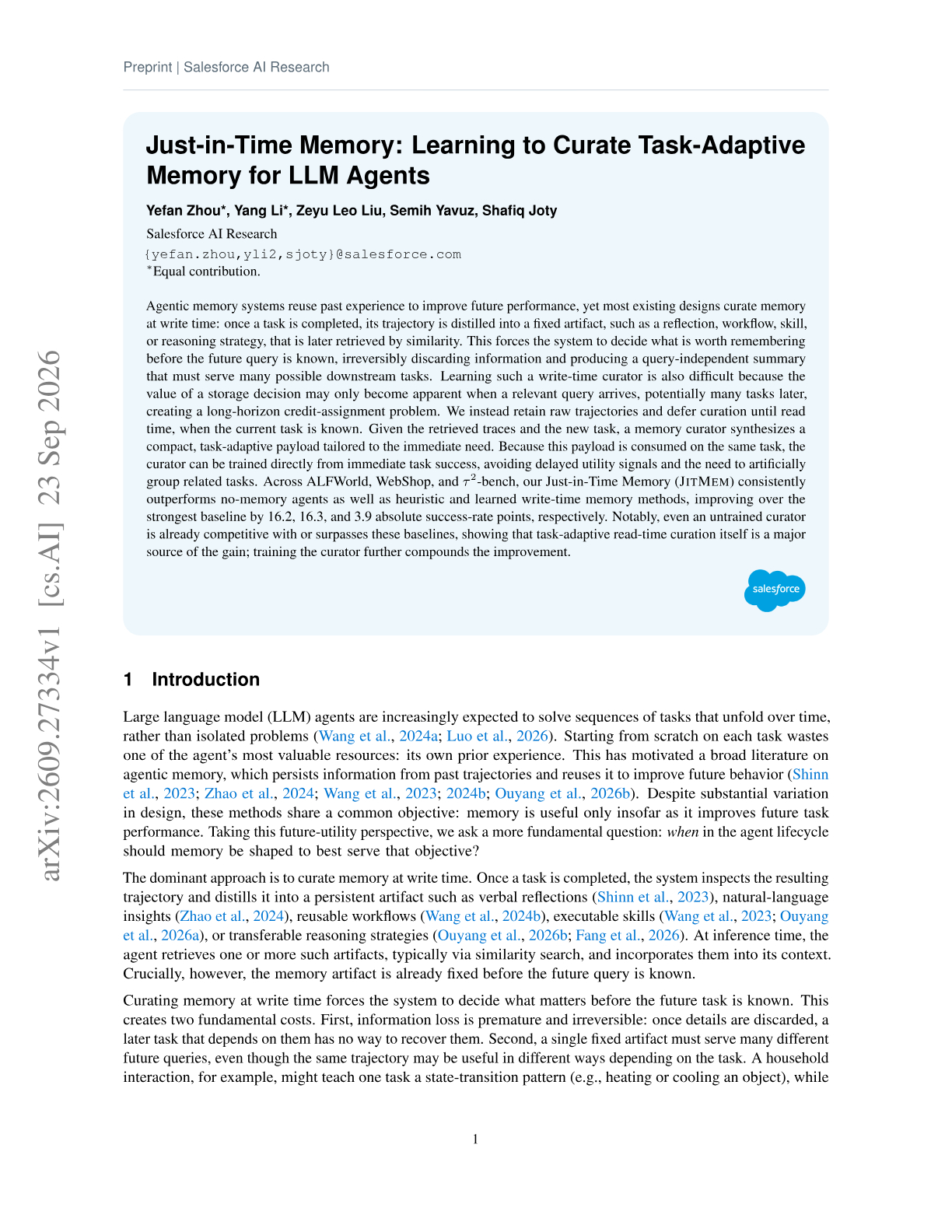
AbstractAgentic memory systems reuse past experience to improve future performance, yet most existing designs curate memory at write time: once a task is completed, its trajectory is distilled into a fixed artifact, such as a reflection, workflow, skill, or reasoning strategy, that is later retrieved by similarity. This forces the system to decide what is worth remembering before the future query is known, irreversibly discarding information and producing a query-independent summary that must serve many possible downstream tasks. Learning such a write-time curator is also difficult because the value of a storage decision may only become apparent when a relevant query arrives, potentially many tasks later, creating a long-horizon credit-assignment problem. We instead retain raw trajectories and defer curation until read time, when the current task is known. Given the retrieved traces and the new task, a memory curator synthesizes a compact, task-adaptive payload tailored to the immediate need. Because this payload is consumed on the same task, the curator can be trained directly from immediate task success, avoiding delayed utility signals and the need to artificially group related tasks. Across ALFWorld, WebShop, and τ^2-bench, our Just-in-Time Memory (JitMem) consistently outperforms no-memory agents as well as heuristic and learned write-time memory methods, improving over the strongest baseline by 16.2, 16.3, and 3.9 absolute success-rate points, respectively. Notably, even an untrained curator is already competitive with or surpasses these baselines, showing that task-adaptive read-time curation itself is a major source of the gain; training the curator further compounds the improvement.
Similar Articles
@KakaluoteW45042: Now the agent’s memory systems are all retreading the old path of data engineering: storing raw trajectories, periodica…
The author critiques current AI agent memory systems for following old data engineering patterns, highlighting the risk of gaps in memory and advocating for auditable raw trajectories before layered summaries.
What I learned trying to make agent memory survive more than one session
The article reflects on the complexities of AI agent memory beyond simple storage, highlighting challenges such as determining truthfulness, priority changes, distinguishing decisions from noise, and appropriate timing for surfacing context.
Just-in-Time Memory: Learning to Curate Task-Adaptive Memory for LLM Agents
This paper introduces Just-in-Time Memory (JitMem), a method for LLM agents that defers memory curation to read-time for task-adaptive payloads, demonstrating significant performance improvements over baseline methods in benchmarks like ALFWorld and WebShop.
@dair_ai: Great paper on long-term memory for LLM agents. (bookmark it) Coarse summaries drift and unconstrained updates corrupt,…
AtomMem introduces a long-term memory system for LLM agents that uses atomic facts as efficient memory units, organizing them into hierarchical event structures and temporal user profiles, achieving state-of-the-art on the LoCoMo benchmark.
@tom_doerr: Curated papers on short, long-term, and experiential agent memory https://github.com/TsinghuaC3I/Awesome-Memory-for-Age…
A curated repository of papers on agent memory, organized by short-term, long-term, and experiential memory, with a taxonomy and application scenarios for LLM agents.