@dair_ai: Super interesting work from Zoom and colleagues. If you maintain a hand-built coding harness, there are some great insi…
Summary
This article summarizes an empirical study on harness design for coding agents, showing that context management prevents overflow failures, rule-based elision before LLM summarization is cost-effective, and planning's role varies with model strength.
View Cached Full Text
Cached at: 09/19/26, 05:07 PM
Super interesting work from Zoom and colleagues.
If you maintain a hand-built coding harness, there are some great insights here.
(bookmark it)
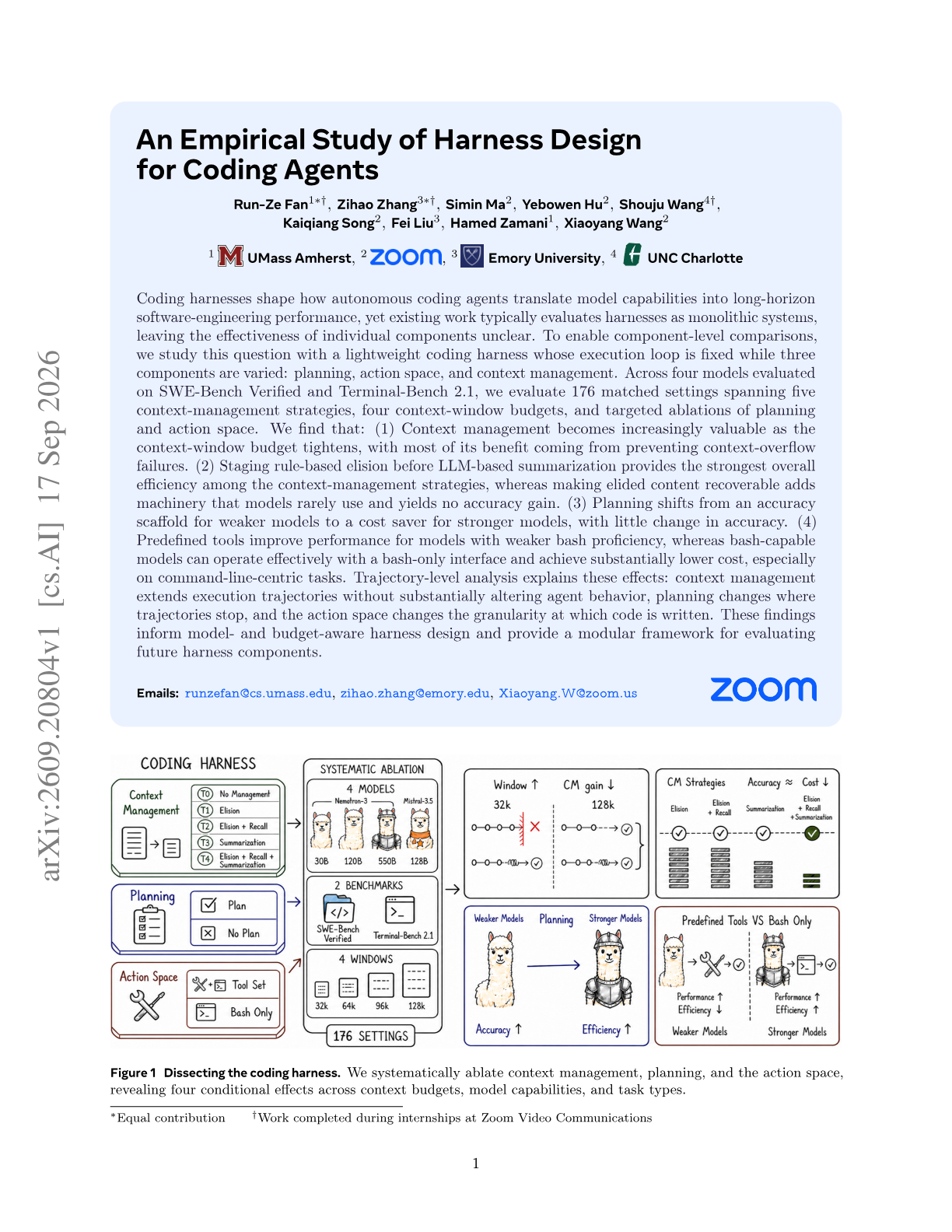
They held the execution loop of a coding harness fixed and varied planning, the action space, and context management one at a time.
They did across 176 matched settings, four models, SWE-Bench Verified and Terminal-Bench 2.1.
Context management pays off more as the context window tightens.
Most of its benefit comes from preventing overflow failures rather than from better reasoning.
Staging rule-based elision before LLM summarization gave the best accuracy to cost ratio of the five strategies tested.
Making elided content recoverable added machinery the models rarely used and produced no accuracy gain.
Planning changed role with model strength.
For the weakest model it raised the success rate. For stronger models accuracy barely moved and the gain showed up as lower cost, because planning shortened post-edit verification.
On the action space, predefined tools helped models with weak bash proficiency, while bash-capable models ran a bash-only interface at substantially lower cost on command-line tasks.
Paper: https://academy.dair.ai/papers/an-empirical-study-of-harness-design-for-coding-agents-2609.20804…
An Empirical Study of Harness Design for Coding Agents
Source: https://academy.dair.ai/papers/an-empirical-study-of-harness-design-for-coding-agents-2609.20804 Code · Agents · MemoryChat with Paper
First page
The curator’s take
Run-Ze Fan and colleagues at UMass Amherst, Emory, UNC Charlotte and Zoom hold a coding harness’s execution loop fixed and vary three components (planning, action space, context management) across 176 matched settings, four models, SWE-Bench Verified and Terminal-Bench 2.1.
Ask this paper
Question about this paper Key points01
Context management matters more as the window shrinks. Most of its measured benefit comes from preventing context-overflow failures rather than from improving reasoning, so its value is a function of the budget rather than of the model.
02
Rule-based elision before LLM summarization wins. Staging the two gives the best accuracy-to-cost trade-off of five strategies. Making elided content recoverable adds machinery the models rarely invoke and produces no accuracy gain.
03
Planning changes role with model strength. For the weakest model it raises the success rate; for stronger models accuracy barely moves and the gain shows up as lower cost, because planning shortens post-edit verification.
04
Action space trades scaffolding for cost. Predefined tools help models with weak bash proficiency; bash-capable models run a bash-only interface at substantially lower cost, especially on command-line-centric tasks.
05
Trajectory analysis explains each effect. Context management lengthens trajectories without changing behaviour, planning changes where trajectories stop, and the action space changes the granularity at which code gets written.
AbstractCoding harnesses shape how autonomous coding agents translate model capabilities into long-horizon software-engineering performance, yet existing work typically evaluates harnesses as monolithic systems, leaving the effectiveness of individual components unclear. To enable component-level comparisons, we study this question with a lightweight coding harness whose execution loop is fixed while three components are varied: planning, action space, and context management. Across four models evaluated on SWE-Bench Verified and Terminal-Bench 2.1, we evaluate 176 matched settings spanning five context-management strategies, four context-window budgets, and targeted ablations of planning and action space. We find that: (1) Context management becomes increasingly valuable as the context-window budget tightens, with most of its benefit coming from preventing context-overflow failures. (2) Staging rule-based elision before LLM-based summarization provides the strongest overall efficiency among the context-management strategies, whereas making elided content recoverable adds machinery that models rarely use and yields no accuracy gain. (3) Planning shifts from an accuracy scaffold for weaker models to a cost saver for stronger models, with little change in accuracy. (4) Predefined tools improve performance for models with weaker bash proficiency, whereas bash-capable models can operate effectively with a bash-only interface and achieve substantially lower cost, especially on command-line-centric tasks. Trajectory-level analysis explains these effects: context management extends execution trajectories without substantially altering agent behavior, planning changes where trajectories stop, and the action space changes the granularity at which code is written. These findings inform model- and budget-aware harness design and provide a modular framework for evaluating future harness components.
Similar Articles
An Empirical Study of Harness Design for Coding Agents
This paper empirically studies harness design for coding agents, evaluating components like planning and context management to improve performance in software engineering tasks.
best of the best agentic harnesses do this…
The author shares insights on building effective agent harnesses: the best ones minimize LLM reliance for trivial tasks and reserve LLMs for complex reasoning, distinguishing genuine harnesses from simple wrappers.
@omarsar0: // Self-Harness: Harnesses That Improve Themselves // (bookmark this one) Most of the agent scaffolds we rely on today …
This paper introduces Self-Harness, a new paradigm where LLM-based agents iteratively improve their own operating harness—prompts, tools, and control flow—without human engineers or stronger external agents, achieving significant performance gains across multiple models.
@a1zhang: Good harness designs can get around extreme token costs when information is structured. There's really no need to feed …
A discussion on how harness designs can reduce token costs by structuring information instead of feeding everything into a language model's context, citing an example of an RLM agent processing many lines of logs with few active tokens.
@dair_ai: Learn to build custom harnesses, folks! Here is a highly recommended paper from Google on recursive agent harnessing. G…
Google Cloud AI Research 提出 Harness2,一种递归式 agent harness 优化框架,可在无验证器的开放世界场景中通过任务级与 harness 级递归自我改进,在 WorkBuddy-Bench、JobBench 和 LAB 上持续提升 GLM-5 与 Gemini 3.5 Flash 的表现。