maestro: Lightweight, Linux-compatible kernel, written in Rust
Summary
Maestro is a lightweight Unix-like kernel written in Rust, aiming for safety and Linux compatibility. Currently supports x86 and x86_64 architectures with many features but still in early development.
View Cached Full Text
Cached at: 06/24/26, 01:52 AM
maestro-os/maestro
Source: https://github.com/maestro-os/maestro







About
Maestro is a lightweight Unix-like kernel written in Rust.
The goal is to provide a lightweight operating system able to use the safety features of the Rust language to be reliable.
This project is still in early stage development, thus it is highly unstable and misses a lot of features. Do not use it in production!
To stay updated with the project, follow the blog!
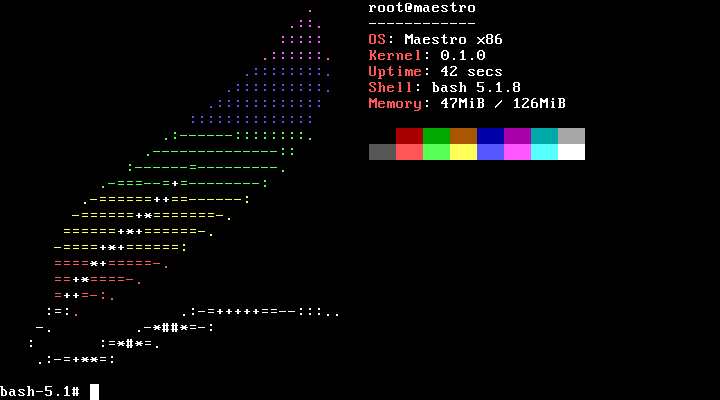
Neofetch and bash running on the OS.
Features
CPU architectures support
| Architecture | Status |
|---|---|
| x86_64 | ✅ |
| x86 | ✅ |
| AArch64 | 📅 |
- ✅ Supported
- 📅 Planned (not currently supported)
The following features are currently implemented (non-exhaustive):
- Linux’s system calls (roughly 30% are currently implemented)
- Kernel modules
- Drivers
- PCI devices enumeration
- Basic ACPI support
- Memory management
- Buddy allocator
- Internal memory allocator, with similarities with dlmalloc’s implementation
- Per-process virtual memory
- Over committing
- Copy-on-Write
- Page cache
- Unix processes
- CPU topology enumeration
- Preemptible scheduler (inspired by FreeBSD’s ULE scheduler)
- Symmetric MultiProcessing (SMP)
- POSIX signals
- Unix files
- ELF programs
- Terminal
- VGA text mode
- Partial support of ANSI escape codes
- Clocks
Quickstart
This repository is not a full operating system in itself but only the kernel.
You can either:
- Use the installer to build a full operating system from an ISO file
- Build the OS by hand. For this, you can check the kernel’s book
The OS can then be run by a virtual machine such a QEMU or VirtualBox, or on a physical machine.
Build
To build and/or run the OS, cd into the kernel’s crate:
cd kernel/
Then follow the instructions in README.md
Documentation
The kernel’s book contains general information on how to use the kernel.
mdbookandmdbook-mermaidare required:cargo install mdbook mdbook-mermaid
Build the book with:
mdbook-mermaid install doc/
mdbook build doc/
Then, it can be accessed at doc/book/index.html.
Similar Articles
zinnia: a modular 64-bit Unix-like kernel written in Rust
Zinnia is a modular 64-bit Unix-like kernel written in Rust, designed to boot on UEFI systems and run a modern desktop with Wayland or X11. It implements POSIX APIs and common Linux/BSD extensions.
Linux 0.11 rewritten in idiomatic Rust, boots in QEMU
A modern Rust rewrite of the Linux 0.11 kernel that boots in QEMU on i386, featuring a full userland with shell and coreutils, with one-command image building and devcontainer support.
This Month in Redox - May 2026 - Redox - Your Next(Gen) OS
Redox OS, a Unix-like microkernel OS written in Rust, shares its May 2026 updates including the announcement of Summer of Code projects, implementation of EEVDF scheduler, and significant performance improvements in I/O events and filesystem inode caching.
A Windows Kernel in a Browser Tab, Part I: Cold Boot, Fast Boot, and Four Megabytes
The article describes nanokrnl, a 64-bit Windows kernel written in Rust, and nanox, a 65KB WebAssembly emulator that boots it directly in long mode in a browser, achieving a running OS in about four megabytes.
yserver: A modern X11 server written from scratch in Rust
yserver is a modern X11 server written from scratch in Rust, capable of running full desktop environments like MATE, XFCE, and Cinnamon while dropping legacy baggage. It supports many X extensions and has been tested on various hardware.