Coherent breaks ground on an expanded facility in Texas, backed by a $50 million CHIPS Act grant, to scale production of optical components and compound semiconductors essential for AI infrastructure. NVIDIA CEO Jensen Huang highlighted the critical role of optics in enabling large-scale AI systems.
<div id="bsf_rt_marker"></div><p><span style="font-weight: 400;">AI runs at the speed of light. More and more, that light is made in Texas.</span></p>
<p><span style="font-weight: 400;">Coherent broke ground today on an expanded manufacturing building in Sherman, Texas. </span></p>
<p><span style="font-weight: 400;">The company makes the lasers, optical components and compound semiconductors that wire AI systems together — and runs what it calls the world’s first 6-inch indium phosphide fab. </span></p>
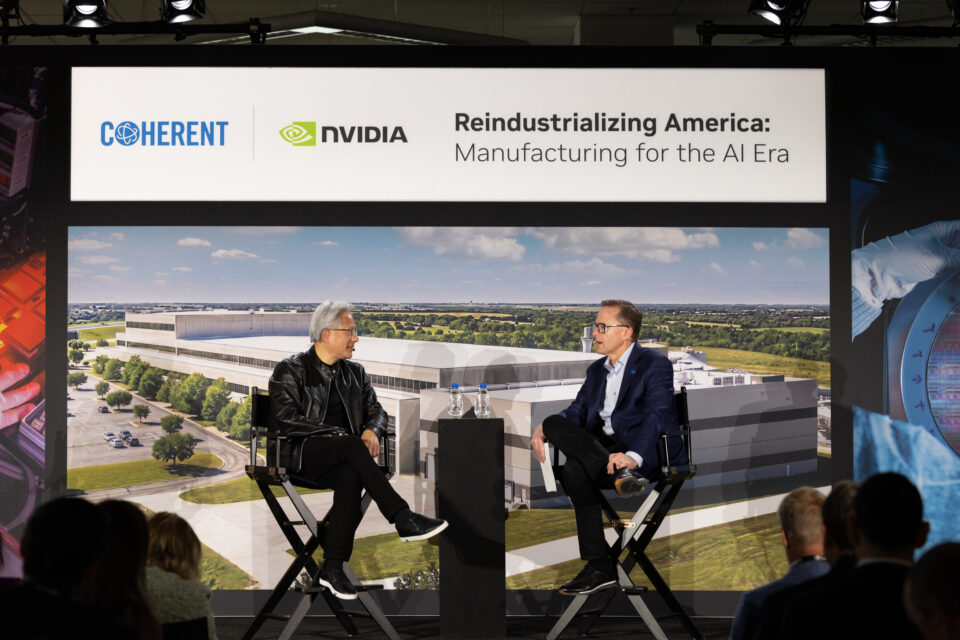
<p><span style="font-weight: 400;">NVIDIA founder and CEO Jensen Huang and Coherent CEO Jim Anderson were on hand for the ceremony, joined by Sherman Mayor Shawn Temann and Adriana Cruz, executive director of Texas Economic Development and Tourism, who delivered remarks. </span></p>
<p><span style="font-weight: 400;">The expanded building will scale production of the same InP wafers that carry data between chips, servers and data centers at the speed of light — the optical backbone of modern AI infrastructure.</span></p>
<p><span style="font-weight: 400;">It’s the kind of milestone that turns a commitment into construction: a concrete step in expanding advanced semiconductor manufacturing in the United States.</span></p>
<p><span style="font-weight: 400;">“AI is the ultimate general-purpose technology,” Huang said during a conversation with Anderson at the groundbreaking. “Because intelligence is fundamental — the ability to process information, to reason and solve problems — it affects every single industry.”</span></p>
<p><span style="font-weight: 400;">Public programs like the CHIPS Act, funded at roughly $50 billion, were designed to bring chip manufacturing back to the U.S. </span></p>
<p><span style="font-weight: 400;">As part of today’s event, </span><a target="_blank" href="https://www.coherent.com/news/press-releases/a-chip-letter-of-intent-for-50m-to-expand-world-leading-manufacturing-facility-for-ai-infrastructure"><span style="font-weight: 400;">Coherent is announcing a $50 million CHIPS Act grant</span></a><span style="font-weight: 400;"> to help finance the expanded Sherman facility — building on roughly $17 million in earlier support from the Texas CHIPS program and the Sherman Economic Development Corporation.</span></p>
<p><span style="font-weight: 400;">NVIDIA’s own </span><a href="https://blogs.nvidia.com/blog/nvidia-manufacture-american-made-ai-supercomputers-us/"><span style="font-weight: 400;">commitment</span></a><span style="font-weight: 400;"> to produce up to $500 billion of AI infrastructure in the U.S. through industry partnerships with new sites in Arizona and Texas adds private-sector momentum.</span></p>
<p><span style="font-weight: 400;">“Coherent is a world-class company, and the work you do is vital to our future, vital to the future of artificial intelligence and vital to reindustrializing the United States,” Huang said. </span></p>
<figure id="attachment_94662" aria-describedby="caption-attachment-94662" style="width: 960px" class="wp-caption aligncenter"><img fetchpriority="high" decoding="async" class="wp-image-94662 size-medium" src="https://blogs.nvidia.com/wp-content/uploads/2026/06/26tx-coherent-factory-DEB30745-960x640.jpg" alt="" width="960" height="640" srcset="https://blogs.nvidia.com/wp-content/uploads/2026/06/26tx-coherent-factory-DEB30745-960x640.jpg 960w, https://blogs.nvidia.com/wp-content/uploads/2026/06/26tx-coherent-factory-DEB30745-1680x1121.jpg 1680w, https://blogs.nvidia.com/wp-content/uploads/2026/06/26tx-coherent-factory-DEB30745-1280x854.jpg 1280w, https://blogs.nvidia.com/wp-content/uploads/2026/06/26tx-coherent-factory-DEB30745-1536x1025.jpg 1536w, https://blogs.nvidia.com/wp-content/uploads/2026/06/26tx-coherent-factory-DEB30745-scaled.jpg 2048w, https://blogs.nvidia.com/wp-content/uploads/2026/06/26tx-coherent-factory-DEB30745-630x420.jpg 630w" sizes="(max-width: 960px) 100vw, 960px" /><figcaption id="caption-attachment-94662" class="wp-caption-text">NVIDIA founder and CEO Jensen Huang and Coherent CEO Jim Anderson.</figcaption></figure>
<p><span style="font-weight: 400;">Compound semiconductors like indium phosphide and gallium arsenide — the materials behind the high-speed networking and optical interconnects that modern AI runs on — don’t get the headlines that logic chips do. But their domestic supply chains have been thin for years. Today’s event was an argument that the gap is closing.</span></p>
<p><span style="font-weight: 400;">When 576 GPUs span eight racks and operate as a single system — as they will in NVIDIA Vera Rubin Ultra NVL576, which links eight NVLink racks of 72 NVIDIA Rubin Ultra GPUs into one 576-GPU domain — copper can’t carry the signal across that distance. </span></p>
<p><span style="font-weight: 400;">To connect hundreds of thousands of processors separated by hundreds or thousands of feet across a data center, the only way to solve that problem is silicon photonics, Huang explained. </span></p>
<p><span style="font-weight: 400;">As signaling rates climb, the reach of a metal trace shrinks, and spanning eight racks in copper would burn power on retimers and signal conditioning that a data center would rather spend on compute. </span></p>
<p><span style="font-weight: 400;">Optics pays a one-time penalty to move from electrical to light, but once paid, distance is nearly free. At NVL576 scale, light is the most power-efficient option. </span></p>
<p><span style="font-weight: 400;">NVIDIA and Coherent aren’t new to each other — they’ve worked together for roughly two decades. </span></p>
<p><span style="font-weight: 400;">In March, they deepened the </span><a target="_blank" href="https://nvidianews.nvidia.com/news/nvidia-and-coherent-announce-strategic-partnership-to-develop-optics-technology-to-scale-next-generation-data-center-architecture"><span style="font-weight: 400;">relationship</span></a><span style="font-weight: 400;"> into a multiyear strategic partnership: NVIDIA is investing $2 billion in Coherent to support R&D, future capacity and U.S.-based manufacturing, alongside a multibillion-dollar purchase commitment for advanced laser and optical networking products.</span></p>
<p><span style="font-weight: 400;">Sherman, a city of roughly 45,000 people an hour north of Dallas, has become the latest dateline for the AI era — emblematic of a boom built as much on picks, shovels and manufacturing muscle as on software.</span><span style="font-weight: 400;"><br />
</span><span style="font-weight: 400;"><br />
</span><span style="font-weight: 400;">“When we get to full capacity, this site will support more than 550 direct jobs — and thousands of jobs, direct and indirect,” Anderson said.</span></p>
<p><span style="font-weight: 400;">What the factory ships isn’t a single product dropped into a single slot. It’s the lasers, transceivers and pluggable optical modules that move data across NVIDIA networking — each enabling a different part of the system.</span><span style="font-weight: 400;"><br />
</span><span style="font-weight: 400;"><br />
</span><span style="font-weight: 400;">“As AI systems grow larger and more powerful, connectivity is just as important as compute,” Anderson said. “AI runs on compute, but it scales on connectivity — and Sherman is where that connective tissue gets built.”</span></p>
<p><span style="font-weight: 400;">Today’s event made that visible.</span></p>
<p><iframe title="YouTube video player" src="https://www.youtube.com/embed/GsqW5MPFajw?si=b1h_HH12D76HcVv9" width="560" height="315" frameborder="0" allowfullscreen="allowfullscreen"></iframe></p>
<p><span style="font-weight: 400;">Before the groundbreaking, guests toured the existing fab and previewed the equipment that will populate the expanded building once it’s running. An NVIDIA rack stood on the factory floor, one of the six stops on the tour. </span></p>
<p><span style="font-weight: 400;">The tour was followed by a <a target="_blank" href="https://www.youtube.com/watch?v=GsqW5MPFajw">fireside chat with Huang and Anderson</a>, where the two CEOs discussed the partnership and what scaling domestic optical manufacturing means for the AI buildout ahead.</span></p>
<p><span style="font-weight: 400;">“Today marks an important milestone — not just for Coherent, but for American manufacturing and for the future of AI infrastructure,” Anderson said. </span></p>
<p><span style="font-weight: 400;">The semiconductor laser was born in U.S. labs — Bell Labs demonstrated a room-temperature version in 1970 — before the technology and its manufacturing largely migrated overseas.</span><span style="font-weight: 400;"><br />
</span><span style="font-weight: 400;"><br />
</span><span style="font-weight: 400;">“We were founded as a manufacturing company in 1971. We’ve always been a U.S. manufacturing company — and after 50 years, the most advanced 6-inch indium phosphide line in the world is right here in Sherman,” Anderson said. </span></p>
<p><span style="font-weight: 400;">That manufacturing gap shows up in the wafers themselves: while silicon fabs run on 12-inch wafers, most of the world’s InP production is still stuck on 3- and 4-inch wafers — lower yields and far fewer components per run. </span></p>
<p><span style="font-weight: 400;">Moving to 6-inch wafers roughly quadruples the usable area of a 3-inch wafer (area scales with the square of the diameter), driving down cost and unlocking the volume the AI buildout demands.</span><span style="font-weight: 400;"><br />
</span></p>
<p><img decoding="async" class="aligncenter size-medium wp-image-94690" src="https://blogs.nvidia.com/wp-content/uploads/2026/06/26tx-coherent-factory-DEB30788-1-960x640.jpg" alt="" width="960" height="640" srcset="https://blogs.nvidia.com/wp-content/uploads/2026/06/26tx-coherent-factory-DEB30788-1-960x640.jpg 960w, https://blogs.nvidia.com/wp-content/uploads/2026/06/26tx-coherent-factory-DEB30788-1-1680x1121.jpg 1680w, https://blogs.nvidia.com/wp-content/uploads/2026/06/26tx-coherent-factory-DEB30788-1-1280x854.jpg 1280w, https://blogs.nvidia.com/wp-content/uploads/2026/06/26tx-coherent-factory-DEB30788-1-1536x1025.jpg 1536w, https://blogs.nvidia.com/wp-content/uploads/2026/06/26tx-coherent-factory-DEB30788-1-scaled.jpg 2048w, https://blogs.nvidia.com/wp-content/uploads/2026/06/26tx-coherent-factory-DEB30788-1-630x420.jpg 630w" sizes="(max-width: 960px) 100vw, 960px" /><br />
<span style="font-weight: 400;">It took 50 years to build the first line, Huang said — and in one year, they’ve quadrupled it, a measure of the demand for accelerated computing.</span></p>
<p><span style="font-weight: 400;">Inside, the core processes are familiar: lithography, photoresist, depositing and etching materials, layer by layer. The difference is the material. On an InP substrate, engineers grow exotic compound-semiconductor layers and tune them for precise optical properties — the physics that lets a chip emit and modulate light.</span></p>
<p><span style="font-weight: 400;">Today, that InP travels inside Coherent’s pluggable optics — transceivers about the size of a USB stick that plug into the front of NVIDIA networking switches and move data between racks across the data center floor, where copper can’t reach. Each module carries an indium phosphide laser. </span></p>
<p><span style="font-weight: 400;">Those same modules now help enable </span><a target="_blank" href="https://www.nvidia.com/en-us/networking/products/silicon-photonics/"><span style="font-weight: 400;">NVIDIA Spectrum-X Photonics and Quantum-X Photonics</span></a><span style="font-weight: 400;"> switches with co-packaged optics: Coherent supplies the external laser module that plugs into the switch’s front plate. </span></p>
<p><span style="font-weight: 400;">And as NVIDIA works to keep optics from becoming the next bottleneck, demand for those lasers only climbs.</span></p>
<p><span style="font-weight: 400;">“Ten years from now, I think we’ll look back and realize AI is what made it possible to invest in sustainable energy, upgrade our energy grid and reconstitute a workforce,” Huang said. “You can’t have only information workers in an economy — you also have to have builders. We have an opportunity over the next 10 years to reshape our communities and be much more balanced.”</span></p>
# Coherent Breaks Ground on Expanded Texas Facility, Scaling AI’s Optical Backbone
Source: [https://blogs.nvidia.com/blog/coherent-texas-ai-optical/](https://blogs.nvidia.com/blog/coherent-texas-ai-optical/)
AI runs at the speed of light\. More and more, that light is made in Texas\.
Coherent broke ground today on an expanded manufacturing building in Sherman, Texas\.
The company makes the lasers, optical components and compound semiconductors that wire AI systems together — and runs what it calls the world’s first 6\-inch indium phosphide fab\.
NVIDIA founder and CEO Jensen Huang and Coherent CEO Jim Anderson were on hand for the ceremony, joined by Sherman Mayor Shawn Temann and Adriana Cruz, executive director of Texas Economic Development and Tourism, who delivered remarks\.
The expanded building will scale production of the same InP wafers that carry data between chips, servers and data centers at the speed of light — the optical backbone of modern AI infrastructure\.
It’s the kind of milestone that turns a commitment into construction: a concrete step in expanding advanced semiconductor manufacturing in the United States\.
“AI is the ultimate general\-purpose technology,” Huang said during a conversation with Anderson at the groundbreaking\. “Because intelligence is fundamental — the ability to process information, to reason and solve problems — it affects every single industry\.”
Public programs like the CHIPS Act, funded at roughly $50 billion, were designed to bring chip manufacturing back to the U\.S\.
As part of today’s event,[Coherent is announcing a $50 million CHIPS Act grant](https://www.coherent.com/news/press-releases/a-chip-letter-of-intent-for-50m-to-expand-world-leading-manufacturing-facility-for-ai-infrastructure)to help finance the expanded Sherman facility — building on roughly $17 million in earlier support from the Texas CHIPS program and the Sherman Economic Development Corporation\.
NVIDIA’s own[commitment](https://blogs.nvidia.com/blog/nvidia-manufacture-american-made-ai-supercomputers-us/)to produce up to $500 billion of AI infrastructure in the U\.S\. through industry partnerships with new sites in Arizona and Texas adds private\-sector momentum\.
“Coherent is a world\-class company, and the work you do is vital to our future, vital to the future of artificial intelligence and vital to reindustrializing the United States,” Huang said\.
NVIDIA founder and CEO Jensen Huang and Coherent CEO Jim Anderson\.Compound semiconductors like indium phosphide and gallium arsenide — the materials behind the high\-speed networking and optical interconnects that modern AI runs on — don’t get the headlines that logic chips do\. But their domestic supply chains have been thin for years\. Today’s event was an argument that the gap is closing\.
When 576 GPUs span eight racks and operate as a single system — as they will in NVIDIA Vera Rubin Ultra NVL576, which links eight NVLink racks of 72 NVIDIA Rubin Ultra GPUs into one 576\-GPU domain — copper can’t carry the signal across that distance\.
To connect hundreds of thousands of processors separated by hundreds or thousands of feet across a data center, the only way to solve that problem is silicon photonics, Huang explained\.
As signaling rates climb, the reach of a metal trace shrinks, and spanning eight racks in copper would burn power on retimers and signal conditioning that a data center would rather spend on compute\.
Optics pays a one\-time penalty to move from electrical to light, but once paid, distance is nearly free\. At NVL576 scale, light is the most power\-efficient option\.
NVIDIA and Coherent aren’t new to each other — they’ve worked together for roughly two decades\.
In March, they deepened the[relationship](https://nvidianews.nvidia.com/news/nvidia-and-coherent-announce-strategic-partnership-to-develop-optics-technology-to-scale-next-generation-data-center-architecture)into a multiyear strategic partnership: NVIDIA is investing $2 billion in Coherent to support R&D, future capacity and U\.S\.\-based manufacturing, alongside a multibillion\-dollar purchase commitment for advanced laser and optical networking products\.
Sherman, a city of roughly 45,000 people an hour north of Dallas, has become the latest dateline for the AI era — emblematic of a boom built as much on picks, shovels and manufacturing muscle as on software\. “When we get to full capacity, this site will support more than 550 direct jobs — and thousands of jobs, direct and indirect,” Anderson said\.
What the factory ships isn’t a single product dropped into a single slot\. It’s the lasers, transceivers and pluggable optical modules that move data across NVIDIA networking — each enabling a different part of the system\. “As AI systems grow larger and more powerful, connectivity is just as important as compute,” Anderson said\. “AI runs on compute, but it scales on connectivity — and Sherman is where that connective tissue gets built\.”
Today’s event made that visible\.
Before the groundbreaking, guests toured the existing fab and previewed the equipment that will populate the expanded building once it’s running\. An NVIDIA rack stood on the factory floor, one of the six stops on the tour\.
The tour was followed by a[fireside chat with Huang and Anderson](https://www.youtube.com/watch?v=GsqW5MPFajw), where the two CEOs discussed the partnership and what scaling domestic optical manufacturing means for the AI buildout ahead\.
“Today marks an important milestone — not just for Coherent, but for American manufacturing and for the future of AI infrastructure,” Anderson said\.
The semiconductor laser was born in U\.S\. labs — Bell Labs demonstrated a room\-temperature version in 1970 — before the technology and its manufacturing largely migrated overseas\. “We were founded as a manufacturing company in 1971\. We’ve always been a U\.S\. manufacturing company — and after 50 years, the most advanced 6\-inch indium phosphide line in the world is right here in Sherman,” Anderson said\.
That manufacturing gap shows up in the wafers themselves: while silicon fabs run on 12\-inch wafers, most of the world’s InP production is still stuck on 3\- and 4\-inch wafers — lower yields and far fewer components per run\.
Moving to 6\-inch wafers roughly quadruples the usable area of a 3\-inch wafer \(area scales with the square of the diameter\), driving down cost and unlocking the volume the AI buildout demands\.
 It took 50 years to build the first line, Huang said — and in one year, they’ve quadrupled it, a measure of the demand for accelerated computing\.
Inside, the core processes are familiar: lithography, photoresist, depositing and etching materials, layer by layer\. The difference is the material\. On an InP substrate, engineers grow exotic compound\-semiconductor layers and tune them for precise optical properties — the physics that lets a chip emit and modulate light\.
Today, that InP travels inside Coherent’s pluggable optics — transceivers about the size of a USB stick that plug into the front of NVIDIA networking switches and move data between racks across the data center floor, where copper can’t reach\. Each module carries an indium phosphide laser\.
Those same modules now help enable[NVIDIA Spectrum\-X Photonics and Quantum\-X Photonics](https://www.nvidia.com/en-us/networking/products/silicon-photonics/)switches with co\-packaged optics: Coherent supplies the external laser module that plugs into the switch’s front plate\.
And as NVIDIA works to keep optics from becoming the next bottleneck, demand for those lasers only climbs\.
“Ten years from now, I think we’ll look back and realize AI is what made it possible to invest in sustainable energy, upgrade our energy grid and reconstitute a workforce,” Huang said\. “You can’t have only information workers in an economy — you also have to have builders\. We have an opportunity over the next 10 years to reshape our communities and be much more balanced\.”
Supermicro and NVIDIA unveil turnkey “AI Factory” reference architectures combining Blackwell GPUs, certified servers, networking, storage and deployment services to let enterprises spin up cluster-scale AI infrastructure faster.
Coherent, a critical manufacturer of indium phosphide lasers for AI data centers, revealed it will withhold all production from external customers due to surging internal demand, signaling a new bottleneck in the AI supply chain.
Wistron opened a $700 million advanced manufacturing plant in Fort Worth, Texas to produce NVIDIA GB300 and Vera Rubin superchips, creating over 500 jobs and strengthening U.S. AI infrastructure.
Chinese researchers have developed an all-optical interconnect system that links standard electronic chips, boosting AI distributed inference speeds by over 100 times while using just one-ninth of typical computational resources. The breakthrough, published in National Science Review, uses silicon photonic transceiver chips and FPGAs to achieve dramatic efficiency gains.