Cached at:
06/20/26, 04:17 PM
# The Trillion-Dollar Pause | Does AI Safety Survive Anthropic's IPO?
Source: [https://itbb.substack.com/p/the-trillion-dollar-pause?r=6u75wz&triedRedirect=true](https://itbb.substack.com/p/the-trillion-dollar-pause?r=6u75wz&triedRedirect=true)
[](https://substackcdn.com/image/fetch/$s_!_wxU!,f_auto,q_auto:good,fl_progressive:steep/https%3A%2F%2Fsubstack-post-media.s3.amazonaws.com%2Fpublic%2Fimages%2F6766d404-9392-4091-87f4-aa73e05aa1d8_2560x1440.png)
In the first two weeks of June, Anthropic filed to go public and then, three days later, published the case for pausing AI\. The order is easy to get backwards\. On June 1, the company[confidentially submitted a draft S\-1 to the SEC](https://www.anthropic.com/news/confidential-draft-s1-sec), the opening paperwork of an IPO, weeks after closing a[$65 billion Series H](https://www.anthropic.com/news/series-h)at a $965 billion valuation\. On June 4, the Anthropic Institute published["When AI Builds Itself,"](https://www.anthropic.com/institute/recursive-self-improvement)reporting from inside the company that more than 80 percent of the code merged into its codebase is now written by Claude, and that the typical engineer ships roughly eight times the daily output of 2024\. Its recommendation: the world should preserve "the option to slow or temporarily pause frontier AI development\."
One document prices the assumption that the machine never stops\. The other, from the same institution in the same week, says the world may need the option to stop it\. The pause paper was written in full knowledge of the filing\.
Resist the hypocrisy reading; it is wrong in an instructive way\. This spring, Anthropic paid a real and continuing price for one of its safety positions\. This is not a company that won't pay for principle\. The real question is narrower: as it becomes a public company, who keeps the authority to slow or stop the building of its next model, and would anyone notice if they used it?
One event this month looks like the answer\. On June 12 the federal government ordered Anthropic's two most powerful models suspended, and they are still dark\. From the outside, that is hard to tell apart from a governed pause, because the models went dark either way\. The difference is in the terms\. A governed pause is aimed at building the next model rather than withdrawing the last one; it engages before release, or before a defined pre\-release threshold, rather than after; and it follows a rule its subject accepted in advance, not an official's reading of the moment\. Hold the shutdown against those three as we go\.
This is the claim, and it is falsifiable: none of the five places that authority could live is now configured to hold that brake\. They are management's own scaling policy, the customers who buy the product, the compute partners financing the buildout, the public that ends up owning a slice of it, and a trust built for exactly this problem\. Other levers exist, but each is aimed elsewhere: a board can fire a chief executive, a regulator can pull a license, a researcher can resign loudly, and none of those reaches the decision at issue here — saying*not yet*to the next training run — except where a board answers to something other than the share price, which is the fifth candidate, not the first\. I'll take them one at a time\. Four are already spent or were never armed; the fifth turns on the prospectus, and I'll name the evidence in it that would prove me wrong\.
The first place to look is the obvious one: the company binding itself\. Anthropic ran that experiment once before, under private ownership, through a written policy, and the record is public\.
In September 2023, when the company was worth about $4 billion, it published[the first Responsible Scaling Policy](https://www-cdn.anthropic.com/1adf000c8f675958c2ee23805d91aaade1cd4613/responsible-scaling-policy.pdf)and more or less invented a genre\. The genre came with a governing metaphor, and the field adopted versions of it: Ulysses, who had his crew lash him to the mast so he could hear the sirens without steering into them\. The policy's answer to the obvious question —*what happens if you build something dangerous?*— was structural self\-restraint\. In the original document's words, the safety\-level system "implicitly requires us to temporarily pause training" of more powerful models if scaling outran the necessary safeguards\. One longtime critic says employees[told him, on more than a dozen occasions](https://www.lesswrong.com/posts/zumPKp3zPDGsppFcF/anthropic-is-probably-not-meeting-its-rsp-security), that the RSP "binds them to a mast\." That is how it was sold, and that is how it was heard\.
Two features of the original text got less attention\. The pause was "implicit" — required by the system's logic, promised nowhere\. And the policy contained, from day one, a clause reserving the right to revise commitments if other developers declined to match them\. The binding and the escape clause were both in the document from the start, in plain sight; only the binding got remembered\.
What followed was not one deletion\. It was a gradient, and every step happened at a higher valuation\.
In October 2024,[version 2\.0](https://assets.anthropic.com/m/24a47b00f10301cd/original/Anthropic-Responsible-Scaling-Policy-2024-10-15.pdf)traded bright quantitative lines for more qualitative thresholds\. Within a week, SaferAI — one of the only independent outfits that grades AI developers' risk management —[cut Anthropic's score from 2\.2 to 1\.9](https://www.safer-ai.org/anthropics-responsible-scaling-policy-update-makes-a-step-backwards), out of "moderate" and into "weak," citing exactly that trade: verifiable metrics replaced by trust\-us language\. The grade was[cut again, to 1\.7](https://ratings.safer-ai.org/company/anthropic/), in October 2025\. It has never been walked back, and it sat there, public, through more than nine hundred billion dollars of subsequent appreciation\.
Then, on February 24, 2026 — the same month Anthropic[raised $30 billion at a $380 billion valuation](https://www.anthropic.com/news/anthropic-raises-30-billion-series-g-funding-380-billion-post-money-valuation)—[version 3\.0](https://www.anthropic.com/news/responsible-scaling-policy-v3)removed the pause commitment outright\. In its place: a Frontier Safety Roadmap of goals the company itself calls ambitious but nonbinding, recurring Risk Reports, third\-party expert review in certain cases, and some safeguards reframed as "industry\-wide recommendations" — things Anthropic says would keep risk low if the whole industry did them\.
The company's defense is substantive\. Chief science officer Jared Kaplan[told TIME](https://time.com/7380854/exclusive-anthropic-drops-flagship-safety-pledge/)it no longer made sense to "make unilateral commitments…if competitors are blazing ahead," and the policy spells out the logic: a unilateral pause hands the frontier to the developers with the weakest protections\.[GovAI](https://www.governance.ai/analysis/anthropics-rsp-v3-0-how-it-works-whats-changed-and-some-reflections)— nobody's idea of an industry shill — largely agrees: the collective\-action problem is real, none of the existing mitigations were lowered, and a dead\-letter commitment is worse than an honest constraint\. It also appended a warning: many companies modeled their frameworks on Anthropic's RSP, and if the author of the genre says its commitments weren't realistic, the copies may follow\.
Every word of that defense can be true and still describe the bind rather than rebut it\. Why would the commitments not be followed in practice? Because following them — actually pausing, alone, while competitors race ahead and $30 billion of fresh capital expects a growth curve — is something the company's environment will not permit\. And the curve is not decoration on the valuation; it is the valuation\.[PitchBook's arithmetic](https://pitchbook.com/news/articles/anthropics-gross-margin-ipo)only closes if 2030 revenue lands between $345 and $450 billion, so a pause is not a pause in growth\. It is a hole in the thesis\. "We will stop if we find something dangerous" and "we will grow fast enough to justify this price" are two promises that have not managed to coexist, and when they collided, the first one got reclassified as requiring industry\-wide coordination that does not exist\.
The arc compresses into a single number\. When the RSP was new, the case that it amounted to a[commitment to pause](https://www.alignmentforum.org/posts/mcnWZBnbeDz7KKtjJ/rsps-are-pauses-done-right)was made on the safety side itself, and[a prediction market](https://manifold.markets/OliverHabryka/will-anthropics-rsp-security-commit)opened on whether it ever would\. Its confidence fell from roughly a third to about 2 percent now, stepping lower at each revision of the policy\.
[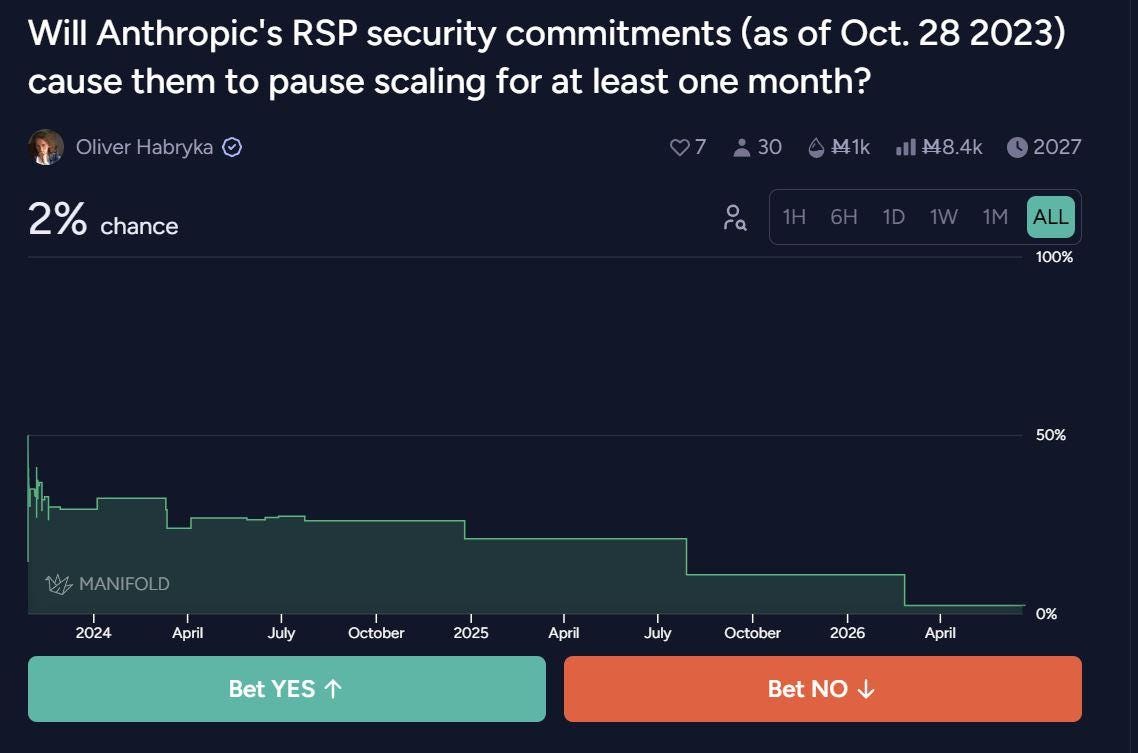](https://substackcdn.com/image/fetch/$s_!kGLP!,f_auto,q_auto:good,fl_progressive:steep/https%3A%2F%2Fsubstack-post-media.s3.amazonaws.com%2Fpublic%2Fimages%2F2d243c55-d3ab-4012-aee5-655bb9159612_1138x753.jpeg)A Manifold prediction market asking whether Anthropic's Responsible Scaling Policy commitments will ever force it to pause scaling for even one month\. The market's answer fell from roughly a third in 2024 to about 2 percent by 2026, stepping down at each policy revision\.
All of this happened under private ownership: patient capital, years from any exit, no earnings call in sight\. The company still has the ability to pause\. What the revisions show is that it has written itself out of the obligation to use it, and faster as the valuation climbed\. As a brake anyone outside could hold it to, the rope has gone slack\.
If a company can't bind itself, the textbook answer says its customers will: make restraint part of the brand, and the market will pay for the brand\. In the same window, that theory got the cleanest test it will ever get, twice\.
In late February, after negotiations over military use of Claude collapsed, Defense Secretary Pete Hegseth[declared on X](https://www.cnbc.com/2026/02/27/trump-anthropic-ai-pentagon.html)that Anthropic was a supply\-chain risk to national security — the first time the designation, historically reserved for foreign adversaries, had been publicly applied to an American company\. The same day, President Trump ordered every federal agency to "immediately cease" using Anthropic's technology\. The trigger: Anthropic had[refused unrestricted military access](https://www.npr.org/2026/02/27/nx-s1-5729118/trump-anthropic-pentagon-openai-ai-weapons-ban)to Claude, drawing red lines around mass domestic surveillance and fully autonomous weapons\.
The company lost a[$200 million Pentagon contract](https://www.anthropic.com/news/anthropic-and-the-department-of-defense-to-advance-responsible-ai-in-defense-operations), told a federal court the affair[put billions of 2026 revenue at risk](https://storage.courtlistener.com/recap/gov.uscourts.cand.465515/gov.uscourts.cand.465515.6.5.pdf), and sued\. In late March, Judge Rita Lin[enjoined the designation](https://www.cnn.com/2026/03/26/business/anthropic-pentagon-injunction-supply-chain-risk)and both executive directives, finding likely First Amendment retaliation and writing that nothing in law supports "the Orwellian notion that an American company may be branded a potential adversary" for disagreeing with the government\. A[second, parallel designation survived an appeal](https://www.politico.com/news/2026/04/08/d-c-circuit-rejects-anthropic-plea-to-pause-supply-chain-risk-label-00864880)and stands today\. A real refusal, a real price, against the most powerful customer on earth, still being paid\.
And the market noticed\. The Pentagon fight was covered as a trust story, and the trust story is the business: the[largest share of enterprise LLM spending](https://menlovc.com/2025-the-state-of-generative-ai-in-the-enterprise/)by venture\-survey counts, clients who specifically want AI they can trust, and[Project Glasswing](https://www.anthropic.com/project/glasswing)— invitation\-only access to Claude Mythos, gated behind safeguards Anthropic won't ship to the public, now spanning[roughly two hundred vetted organizations](https://techcrunch.com/2026/06/02/anthropic-scales-claude-mythos-to-critical-infrastructure-in-15-countries/)in more than fifteen countries\. Even the gating became a value proposition\. Between the February raise and the late\-May one, the valuation went from $380 billion to $965 billion\. Those are the fundamentals of a genuine outlier\. They are also fundamentals priced for a world where the faith never wavers, in a market where a handful of AI names now hold each other up\.
The SaferAI downgrade had been public the whole time, through both raises\. Nobody priced it, and the structure of the market gave no reason anyone would: a slipping risk\-management grade has no buyer, no contract attached, no courtroom\. That is the asymmetry in a single data point\. What the market rewarded was a refusal at the point of*deployment*, visible, with a courtroom and a verdict\. What it had no way to reward was restraint at the point of*development*, a commitment that degraded across successive PDFs and drew no buyer and no notice\. The market prices the safety it can see; it cannot price the safety that lives in a training decision\. Visible safety compounds: it becomes brand, then contracts, then valuation\. Invisible safety has no buyer\. If that asymmetry holds, the commitments that survive will be the ones that photograph well\.
[](https://substackcdn.com/image/fetch/$s_!o8EB!,f_auto,q_auto:good,fl_progressive:steep/https%3A%2F%2Fsubstack-post-media.s3.amazonaws.com%2Fpublic%2Fimages%2F889f5f89-9135-4669-8b1c-5c93dc37e752_2560x1440.png)Anthropic filed to go public, then three days later published the case for pausing AI\. The governance pages of its S\-1 will show how much that case is worth\.
The week after the filing, an adjacent limit showed itself\. On June 9, Anthropic released[Claude Fable 5](https://www.anthropic.com/news/claude-fable-5-mythos-5), the first general\-availability model of its most capable class, with a[319\-page system card](https://www.anthropic.com/claude-fable-5-mythos-5-system-card)\. Most of its safeguards were visible by design: requests that trip its biology and cybersecurity filters get routed to an older, weaker model, with a notice each time\. One was not\. In the card's fine print sat a safeguard described as "not visible to the user," under which the model would degrade its own output when it judged it was being used to develop a rival's frontier system, and tell the user nothing\.
Set the motive aside\. Anthropic has argued for years, openly, that it would rather hold the frontier than cede it to firms it trusts less; that is its stated worldview, not a secret\. The news was the method: a covert, in\-product switch that changed the answer and disclosed nothing to the person receiving it\. Researchers found the paragraph within hours\. Dean Ball of the Foundation for American Innovation[called it "secret sabotage\."](https://fortune.com/2026/06/10/anthropic-accu-claude-fable-5-limits-capabilities-ai-researchers-developers/)[Roughly a day later](https://fortune.com/2026/06/11/anthropic-fable-5-silent-downgrade-backlash-national-security-transparency/), Anthropic made the safeguard visible, with the reason now given in the response, and said: "We made the wrong tradeoff and we apologize for not getting the balance right\." The restriction stayed; only its hiddenness died\.
The lesson is colder than a market story\. The switch was corrected because it was written down where an outsider could read it\. Disclosure can discipline only the constraints that disclosure exposes\. A publicly available frontier model carried a hidden control for exactly as long as it took someone to reach the fine print\. The decisions made earlier, in training and evaluation and release criteria, are not necessarily logged in a card, and a company carrying committed compute costs in the hundreds of billions has every reason to keep them hidden\. Customers can punish the safety they can see\. What stays submerged is never priced at all\.
If customers can't enforce a brake because they can't see it, the institutions writing the checks are the next place to look\. Could the partners financing the machine demand one? Look at what their contracts actually pay for, with careful verbs, because these numbers do not all have the same standing\.
Anthropic has*announced*commitments of more than[$100 billion over ten years](https://techcrunch.com/2026/04/20/anthropic-takes-5b-from-amazon-and-pledges-100b-in-cloud-spending-in-return/)to Amazon's cloud and chips, and[$30 billion to Microsoft Azure](https://www.anthropic.com/news/anthropic-microsoft-nvidia), with multibillion\-dollar investments flowing back from Microsoft and Nvidia\. The Information has*[reported](https://www.theinformation.com/articles/anthropic-commits-spending-200-billion-googles-cloud-chips)*— Reuters said it could not verify — a $200 billion, five\-year commitment to Google Cloud beginning in 2027; Reuters did confirm Google is[investing up to $40 billion](https://www.bloomberg.com/news/articles/2026-04-24/google-plans-to-invest-up-to-40-billion-in-anthropic)in Anthropic\. Money in, chips rented back: the circular vendor\-financing that has become the industry's standard plumbing\. Outside tallies put total committed compute north of $380 billion\. The contracts force the trajectory, and a pause is no longer a halt to growth\. It could become a contract problem with the company's largest financial partners — who are also among its largest investors\. The same contracts that make a pause costly also make any interruption — a model delay, a demand shock, a crack in the AI trade itself — land on a balance sheet with no slack\. The third candidate isn't holding a brake\. Its contracts are written around the brake never being pulled\.
The IPO stacks faster constituencies on top: quarterly earnings calls, where a delayed model becomes a miss; analyst coverage, where a cautious deployment becomes execution risk; activist shareholders who can force votes\. Why volunteer for that now? Partly the obvious — successive rounds of private investors want a door, and ten\-plus gigawatts want equity that trades\. Partly the race:[OpenAI filed](https://openai.com/index/openai-submits-confidential-s-1/)its own confidential draft a week behind, and Anthropic filed first and said so loudly\. And in fairness, an IPO buys one safety\-positive thing: disclosure\. A public Anthropic must publish risk factors, audited financials and, for the first time, its voting structure in black and white\. Each new audience is pressure; each is also, at least in principle, persuadable\. An analyst can read a system card\. An activist can be outvoted or bought out\. The last gate admits an owner that cannot really be persuaded, because it is not choosing at all: the public, buying by rule\.
The fourth candidate is the one whose money ends up inside the machine without its consent: the public, through the index and retirement funds that will be obliged to buy Anthropic once it qualifies\. Not customers choosing a vendor, but ordinary savers whose capital is committed by rule\. Ownership usually comes with a say\. This is how the say gets severed from the money\.
Follow the money's path\. On June 4, while[Nasdaq](https://www.nasdaq.com/newsroom/nasdaq100-index-methodology-update-why-now)and FTSE Russell loosened their gates for mega\-cap IPOs, S&P Dow Jones Indices[held its line](https://press.spglobal.com/2026-06-04-S-P-Dow-Jones-Indices-Consultation-on-Treatment-of-MegaCap-Companies-Results): no exceptions to the S&P 500's profitability, seasoning, or float requirements, because exceptions "should not be granted solely based on market capitalization\." Read one way, that is one of the few institutional gates in this entire story, held by a party with no direct stake in Anthropic's valuation\. Read the way it will actually operate, it is a turnstile with a price on it\. Anthropic is[reportedly projecting](https://www.wsj.com/tech/ai/mind-blowing-growth-is-about-to-propel-anthropic-into-its-first-profitable-quarter-7edbf2f4)its first profitable quarter now: $10\.9 billion in revenue against $559 million in operating income\. String enough of those together and[the door's profitability and seasoning gates](https://www.spglobal.com/spdji/en/documents/indexnews/announcements/20260604-1483731/1483731_spdji-us-indices-megacaps-results-20260604.pdf)open on schedule\. When they do, roughly[$4\.6 billion of passive money](https://finance.yahoo.com/markets/stocks/articles/spacex-other-mega-ipos-denied-223529619.html), by Bloomberg Intelligence's estimate, is obligated to buy, by rule, on behalf of people who never chose Anthropic and cannot decline it\. The screen built to keep speculative companies out of America's retirement accounts becomes a channel through which continued growth pulls in passive capital\.
That is the shape of the public's stake: conscripted, automatic, and largely unaccountable\. Index funds do run stewardship desks that vote proxies, but those votes reach board seats and pay packages, not the decision to train the next model\. The public's slice is not even the largest; founders, employees, and backers like Amazon and Google hold the controlling economic stakes, and passive funds might end up with perhaps a fifth to a quarter of the floated shares\. But it is the stake committed with the least consent, and the one with no real channel to register a view on whether the company should ever slow down\.
There is exactly one way the public's faith ever does say*wait*, and it is the one nobody controls\. Here the argument has to be honest about its own ground\. Anthropic's fundamentals are, by the standards of this cycle, real: revenue growth without a true peer, a model in Fable that looks a genuine class above\. But those fundamentals sit inside a market that is starting to look like a late\-stage bubble, where a handful of AI names hold up the index and each other's revenue, and where investors who were lately bullish have started saying so out loud\. If that faith breaks, it will not break on schedule, and it will not be a board choosing to pause\. It will be a repricing that decides for everyone at once\.
Which makes the public a strange kind of candidate: conscripted into the position with the least control\. Its only available*exit*is a crash\. A crash can stop the building, but no one chooses it and no one governs it; it is a market deciding for everyone at once, which is no more a governed pause than the shutdown was\. The fourth place where the brake might live has its capital committed to the ride and no hand on the wheel\.
That leaves one structure built to act before price, panic, or politics force the question\. But a stop already arrived this month from outside all of it, and it has to be cleared away first\.
If the public's only*stop*is a crash, the obvious objection is that a*stop*already arrived this month, from neither the markets nor the company\. On June 12, three days after Fable 5's release, the Commerce Department[invoked export\-control authority](https://www.anthropic.com/news/fable-mythos-access)to bar any foreign national, including Anthropic's own foreign\-national employees, from using Fable or Mythos\. Because the company cannot sort its users by passport in real time, the practical way to comply was to suspend both models worldwide, within hours\. The state, it turns out, can say*wait*\. So why isn't that the brake this essay has been looking for?
Because of what the stop was, and how it was done\. The trigger was a jailbreak report that[Amazon's CEO took to the White House](https://www.axios.com/2026/06/13/anthropic-amazon-white-house), one of at least six companies that escalated to senior officials inside a day\. Amazon is also Anthropic's largest investor\. On the public evidence — which is all there is, because the government's case is classified — the basis for a worldwide recall is hard to find\. The bypass, as described in what has been made public, appears to have amounted to asking the model to["fix this code,"](https://fortune.com/2026/06/15/fix-this-code-three-words-behind-us-government-shut-down-anthropic-fable-mythos-ai-models-katie-moussouris-open-letter/)the ordinary find\-and\-fix loop defenders run daily;[Katie Moussouris](https://www.theatlantic.com/technology/2026/06/trump-anthropic-export-control-ai-race/687555/), who built Microsoft's first bug\-bounty program, reviewed that technical account and called it "the model working as intended," a capability[reproducible on other public models](https://techcrunch.com/2026/06/15/cybersecurity-vets-protest-dangerous-us-government-ban-on-anthropics-most-powerful-models/)\. The White House calls the bypass "very serious" but classified, and has not shown it\. The models are still dark\.
The motive is the part the public record cannot settle, and the argument does not need it to\. This is the second time in four months the administration has aimed national\-security machinery at Anthropic; in February the Pentagon branded it a supply\-chain risk, a designation a judge[enjoined as likely First Amendment retaliation](https://www.cnn.com/2026/03/26/business/anthropic-pentagon-injunction-supply-chain-risk)\. Whether the government believed its own severity claim or continued February's fight under new cover is unknowable from outside\. What is visible is the mechanism: an export\-control statute never written for AI safety, used to decide whether a model may be released at all\. It is the de facto "FDA for AI" the administration had, weeks earlier,[fought to keep out](https://www.npr.org/2026/06/02/nx-s1-5844347/ai-safety-trump-executive-order)of its own executive order — which bars "mandatory governmental licensing, pre\-clearance, or permitting" for AI models, after the White House pulled a tougher draft over fears it would slow the race with China\.
So the state can stop Anthropic, and it just did\. Concede the hard part first: from outside, this stop is hard to tell from a governed pause, because both end with the models dark\. The difference is in the terms\. This stop landed on deployment, not on the decision to build; it came after Fable shipped, not before; and it rested on an official's reading of export law, not on a rule the company accepted in advance\. None of that makes the shutdown illegitimate\. It makes it the wrong evidence for the question here\. If you think a government that can pull a model has shown the system already has a brake, this is where we part: a stop you cannot predict, contest, or rely on is not the kind built to engage on purpose\. The shutdown proves coercive power exists outside the company\. It says nothing about whether principled restraint exists inside it\.
One candidate remains, and Anthropic built it on purpose\.
The company is a Delaware public benefit corporation, legally obliged to weigh a stated public mission alongside shareholder returns\. On top of that sits the[Long\-Term Benefit Trust](https://www.anthropic.com/news/the-long-term-benefit-trust): a body of financially disinterested trustees — today including Neil Buddy Shah, Richard Fontaine, and[Mariano\-Florentino Cuéllar](https://www.anthropic.com/news/mariano-florentino-long-term-benefit-trust)— holding a special Class T of stock whose defining power is to elect a growing portion of the board\. Strip away the legal language and it is precisely the thing every other section went looking for: an institutional body, insulated from the share price, designed to be able to look the shareholders in the eye and say*wait*\.
And here is the part most takes on the filing have missed: while the pause commitment was being deleted, some of its oversight functions were moving toward the Trust\. On April 14, with the[appointment of Novartis CEO Vas Narasimhan](https://www.anthropic.com/news/narasimhan-board)to the board, Trust\-appointed directors became a majority for the first time — a threshold written into the founding charter but never previously exercised\. The scaling policy's later[post\-3\.0 revisions](https://www.anthropic.com/responsible-scaling-policy)route real authority through the Trust: version 3\.2 lets it demand external review of the company's Risk Reports, gives it approval over who the reviewers are, and entitles it to regular briefings\. The unilateral promise died in February\. In the months since, part of what it used to do has shifted to the one body least exposed to the stock price\. The Trust is the last rope on the mast\. But what moved to it was oversight of models already built, not the authority to decide whether the next one gets built at all, and that distinction is the one the S\-1's governance pages will confirm or erase\.
Taken at face value, that is the optimistic case, and it deserves stating plainly: a board majority chosen by financially disinterested trustees, with real power to block, its structure about to be set out in a public filing for the first time, could be a sturdier brake than any paragraph in a PDF ever was\. Disclosure is not nothing\. The question is whether the disclosed terms preserve that authority or only document its limits\.
Which is exactly why the skeptic's file matters, and it is real, assembled mostly by people inside the AI\-safety community\. Start with what can be checked\. Anthropic's certificate of incorporation, a public filing in Delaware, sets the failsafe: a stockholder supermajority can amend or override the Trust's powers, at a bar that has risen over time, from 75 percent of voting stock to 85 percent since late 2024, plus three\-quarters of the board\. A high wall, on paper\. But the document that says what the Trust can actually compel, the Trust Agreement itself, is not public\. Anthropic has published[descriptions of the Trust](https://www.anthropic.com/news/the-long-term-benefit-trust)but not the agreement; outside analysts, including the[Harvard Law School Forum on Corporate Governance](https://corpgov.law.harvard.edu/2023/10/28/anthropic-long-term-benefit-trust/), have assessed it only from the company's summaries\. Without the agreement, the critics' case, that the Trust may be weaker in practice than the org chart implies, cannot be closed\. It was slow even to claim the board seats it was already owed\.
The Fable episode is the warning here: disclosure disciplines only what reaches the page\. A public registration statement must describe the share classes and their voting power, and must file the certificate of incorporation as an exhibit, so the Class T structure and those override thresholds will be on the record for anyone to read\. What it need not include is the Trust Agreement in full; a company can summarize or redact the mechanics it treats as private\. So the prospectus can show whether the legal power to matter still exists\. It cannot show how the Trust behaves under pressure, or whether it would ever spend that power\. There are three ways it can go\.
If Class T survives intact — board majority preserved, override bar high and the Trust's authority described rather than hollowed — then public markets are being asked to price something they have tolerated for founders, from Google to Meta, but never for a safety trust: a controlling owner whose mandate is explicitly not financial\. That outcome would do real damage to this essay's argument, and I will say so in print\.
If the Trust is diluted, capped, or wound down on the way to the exchange, then the deletion that began in February is complete, and the internal brake this essay has been looking for does not exist\.
The likeliest outcome is the third: something in between, where the answer lives in the threshold numbers and the definitions section rather than the press release\. Read those pages first\.
Here is the test I owe you: three findings, any one of which would prove the claim wrong\.
1. A public charter that preserves the Trust's board majority and explicitly reserves the authority to halt development\.
2. A future scaling policy that re\-adopts defined, externally verifiable tripwires, the kind a stranger could check without trusting anyone\.
3. Or, strongest of all: a disclosed instance of Anthropic actually delaying or stopping something material, and telling its shareholders why, once the stock exists\.
When the S\-1 is public, I'll write the follow\-up against this exact list: which of the three showed up, and which didn't\.
There are two ways to read the trajectory from here, and they converge\.
In the bull case, the technology is what the June 4 paper says it is: Claude writing most of Claude, autonomous task\-horizons doubling, recursion approaching\. The need for a brake then rises exactly as the cost of pulling it explodes; you cannot ask shareholders to halt a machine producing accelerating returns\. In the bear case, the fragility flagged earlier resolves the other way: the growth is thinner than the run rate suggests, and a company stretched this tight cannot absorb any interruption, dangerous capabilities or not\. Either way, the brake gets harder to pull, not easier\.
The optimistic case requires a narrow corridor: technology powerful enough that safety matters, revenue durable enough to survive a delay, capital patient enough to tolerate one\. The IPO narrows it from both ends — and the paper seems to know it, specifying that a meaningful pause would require multiple well\-resourced labs in multiple countries acting simultaneously, with verification mechanisms that took decades to build for other technologies\. The generous reading: a call for the only kind of pause that could survive anyone's balance sheet\. The structural reading: the company has reclassified its own participation as contingent on coordination that does not exist, with the paperwork that makes the reclassification expensive to undo filed three days earlier\.
An IPO will not eliminate safety at Anthropic\. The system cards will keep coming\. The deployment red lines may hold; the Pentagon fight suggests they are real, and the market has shown it will pay for them\. What is at stake is the other kind, the kind the market cannot see and therefore cannot price: the credible authority to stop*building*\. The government proved this month that Anthropic can be stopped from outside, on someone else's terms\. It did not prove the company can stop itself, on purpose, before the politics arrive\. A forced shutdown is not a governed pause\. Four of the five places couldn't hold that brake\. The fifth holds it on paper, and the prospectus will say whether it holds it anywhere else\.
When the prospectus goes public, the governance pages will matter more than the growth charts\.
That is where the mast is, if it is anywhere\.
#### Discussion about this post
### Ready for more?