@HarshalsinghCN: yooo guys, the blog is up. i tried to break down the design of BarunLM(35M) in simple language while keeping as much te…
Summary
Announcement of a blog post explaining the design of BarunLM, a 35M-parameter language model, covering its architecture, training recipe, and dataset preparation, with a focus on efficiency and performance gains over other sub-100M models.
View Cached Full Text
Cached at: 08/03/26, 09:38 AM
yooo guys, the blog is up.
i tried to break down the design of BarunLM(35M) in simple language while keeping as much technical depth as possible without making it hard to follow.
i talked about the architecture, training recipe, and dataset preparation.
it should take about 6 to 7 minutes to read.
more posts on training, development, and other pos trained work are coming next week.
https://harrrshall.github.io/barunlm-35m/blog/…
design of BarunLM
Source: https://harrrshall.github.io/barunlm-35m/blog/
Why build a 35M model?
BarunLM has35,072,768 parameters. It is designed to train on a single24 GB GPUwith a2,048-token context window. On a frozen nine-task zero-shot evaluation suite, it achieves41.01% accuracy, outperforming every other sub-100M base model we evaluated under the same protocol. The paired bootstrap confidence interval for this lead lies entirely above zero, at**+0.92 to +2.71 percentage points**, indicating a statistically significant improvement.
These results motivate the central question behind BarunLM:how much capability can be extracted from a model with only 35 million parameters?
At this scale, every parameter matters. There is no room for unnecessary complexity or architectural indulgence. Every design decision must justify its cost through measurable gains rather than intuition alone.
The rest of this post explores the engineering decisions that made BarunLM possible: the architectural ideas that distinguish it, the data and training recipe that support them, and the trade-offs we intentionally made, as well as the ones we chose to avoid.
Architecture overview
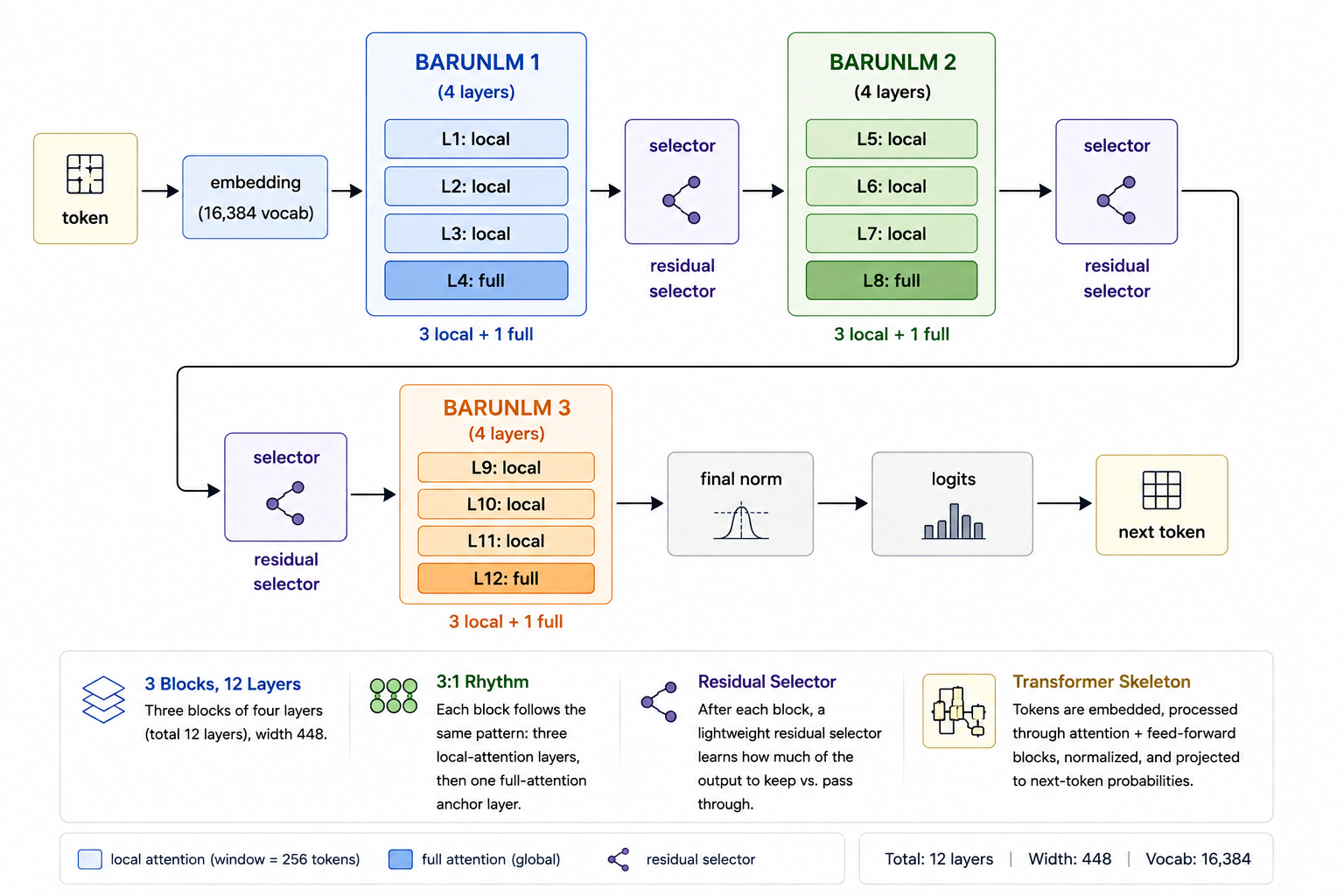 BarunLM consists of12 transformer layerswith a hidden dimension of448, organized intothree blocks of four layers each. Every block follows a consistent3:1 attention pattern: three local-attention layers followed by a single full-attention anchor layer. After each block, aresidual selectoradaptively determines how much of the block’s output should be carried forward.
At its core, the architecture remains a standard autoregressive transformer. Input tokens are embedded, processed through alternating attention and feed-forward layers, and finally projected into next-token probabilities.
What makes BarunLM different is not the overall framework, but the refinements within it. The innovations lie in how attention is structured, how information flows between blocks, and the design choices that maximize capability while operating under a strict 35-million-parameter budget.
Key architectural innovations
1. The attention system: a 3:1 local/global rhythm
Attention is where a token decides which other tokens matter to it. barunlm’s central idea is a fixed3:1 rhythm: three local-attention layers that each see a 256-token window, then one full-attention layer that sees the entire sequence.
Most of what predicts the next token is nearby: syntax, morphology, adjacent lines of code. Local attention handles that cheaply and at a bounded cache size. But some things are not nearby. A pronoun refers to a name from the opening paragraph. An API definition lives much earlier in the file. With local attention alone, that information degrades through repeated local compression. The periodic full layer is the guaranteed “zoom out and check the whole map” moment, a scheduled global information exchange that prevents local-only information loss by construction.
Three supporting decisions keep the rhythm cheap.Grouped-query attentionruns seven query heads against one shared key/value head, cutting the KV cache 7x.Partial RoPErotates only half of each head’s channels, keeping position and content in separate subspaces at zero parameter cost. Two stabilizers protect BF16 training.QK-normpins query and key scale so attention doesn’t saturate. Anoutput gate, a sigmoid projection that scales the attention result channel by channel, lets a layer decline an irrelevant update. The gate is the one supporting decision we tested removing. It was 2.3% faster, but 17.6% worse in perplexity, so it stays.
2. Bounded SwiGLU, and why no experts
Feed-forward layers are where most of a transformer’s computation happens. barunlm usesSwiGLUinstead of a plain MLP: a multiplicative gate that buys more expressivity per parameter, at width 1,228. The distinctive part is thebound. Gate values are capped above 10, and the linear branch is clamped to [-10, 10]. BF16 training is wrecked by extreme outlier activations, so bounding preserves SwiGLU’s expressivity while keeping training stable.
We also skippedMixture-of-Experts. MoE routes tokens to subsets of experts, which at 35M parameters means most weights sit idle behind routes that never see enough training. A small model can’t afford under-used weights. Dense layers mean every parameter sees every token, every time.
3. The residual selector: a learned “skip if unhelpful” path
After each four-layer block, the model RMS-normalizes the block’s input and output, scores both with a tiny linear layer, softmaxes the two scores, and returns their convex combination. The model literally learnshow much of each block to keep. It can bypass a block that didn’t help and let the pre-block representation flow through.
This is a cheap safety valve for depth: a four-layer block isallowedto fail without corrupting the whole stack. It costs 1,344 parameters. Removing it sped training 5.3% under Muon but worsened perplexity by 1.2%, so it’s kept in the quality reference model and disabled in the fast, slightly-lower-quality variant.
4. The tokenizer
Choosing the tokenizer turned out to be surprisingly important. We train a16,384-token byte-level BPEon the exact pretraining mixture. Byte-level means code, Unicode, and formulas never hit an unknown token. Small matters because a large vocabulary would outsize the network at width 448. Input and output embeddings aretied, sharing one table, which saves 7.3M parameters and regularizes rare tokens.
Data and training philosophy
A 35M model can’t brute-force knowledge with width. It has to learn patterns efficiently, which makesdata quality the highest-leverage decision in the project.
Capacity-aligned pretraining
Training used5,699,985,408 tokens, or roughly162 tokens for every parameter. That ratio is deliberate. Small models are data-hungry: they lack the capacity to compress broad knowledge, so they need a lot of clean signal to learn structure. The token budget was matched to the model’s capacity. Not more, which wastes compute. Not less, which underfits.
The mixture
SourceShareWhat it isWhy it’s thereFineWeb-Edu (deduplicated)50%High-quality educational web pagesBroad factual baseCosmopedia v220%Synthetic textbook-style textRepairs web fragmentation; coherent expositionFineMath-4+20%High-quality math with reasoning chainsTeaches long, step-by-step deductionDocumented Python (CodeSearchNet)10%Code paired with docstringsFormal structure; intent matched to implementation### Data synthesis: why generate text you could just scrape?
Web text is fragmented. Prose interleaves with boilerplate, navigation, and half-finished thoughts. A small model trained on that learns to reproduce the fragmentation: it starts sentences it doesn’t finish.
**Cosmopedia v2 is the antidote.**It’s generated by prompting a much larger, capable model to write complete educational passages: textbooks, stories, explanations, quizzes, across thousands of topics and reading levels. The result is text with a beginning, middle, and end.
The reasoning is simple. A small model learns by imitation, so the teacher’s writing quality is a ceiling on the student’s. Synthesis lets us manufacture the coherent signal the web doesn’t reliably provide, and tune its content deliberately instead of accepting whatever the web happens to contain.
Cleaning before training
Every token gets cleaned before admission: cross-stage deduplication, quality filtering, document-level held-out hashing so evaluation samples that leak into training can be detected, and tokenization on the exact mixture. The reported results excluded 1,854 samples found by a correctness-blind exact 13-token scan over the full training history. The model was evaluated on data it provably never saw.
Optimization
We ended up with a hybrid optimizer.Muonhandles the large weight matrices, whileAdamWupdates embeddings and normalization parameters. We evaluated Muon honestly against a full-AdamW run at the same peak learning rate: it improved perplexity by 0.6% but reduced throughput by 5.0%. So it stays as the reference optimizer, since the quality gain matters at this scale, while AdamW remains the practical speed option. The learning rate follows 5% warmup, an 80% plateau, then 15% cosine decay to 10% of peak.
The objective: next-token prediction, and the feature we rejected
We kept pretraining deliberately simple: plaincausal next-token cross-entropy. The interesting decision is what we tried and removed. An early candidate added amulti-token prediction (MTP)head that also predicted the token two positions ahead, weighted at 0.2. Removing it improved perplexity by3.0%, throughput by12.8%, and peak memory by11.2%. At this scale the extra head was wasted capacity; one clean objective trained better. MTP pays off at much larger scale, and the philosophy here is that every technique must earn its keep at 35M parameters, not at someone else’s.
Regularization
Regularization comes from deduplication, tied embeddings, weight decay 0.1, gradient clipping at 1.0, and bounded activations.Dropout is zero on purpose: the 5.7B-token stream dwarfs the model, so the train/validation gap is small by construction, and dropout would only slow learning and muddy throughput. It stays configurable in case a longer run shows a real gap.
Inference trade-offs
The 3:1 rhythm is a memory strategy as much as a quality one. The honest headline: it’s amemorywin, not yet aspeedwin.
During generation, a model has to remember previous tokens’ keys and values, the KV cache. GQA already cuts it 7x. Nine of twelve layers retain at most 256 positions. Only the three anchor layers keep full history. At an 8,128-token prompt, the measured cache is6.83 MBversus24.97 MBfor a dense GQA baseline, a3.7x reduction. That’s exactly what long prompts and streaming inference need on a memory-limited GPU.
The speed side is less flattering. In median-of-three L4 timings, prefill was 6.9% slower and decode 32.8% slower than the dense baseline. The compiled attention dispatch, the three selector operations, and the output gate all carry fixed overhead, especially during one-token decode. Weights are BF16 in research; quantization is deferred until accuracy is established. Closing the wall-clock gap is ongoing work, and the gate and selector earn their quality costs, while MTP did not.
We are working on the post-training of this model to make it more useful. Stay tuned for more of these.
harrrshall (@HarshalsinghCN): introducing BarunLM (35m) 🤗
i pretrained the world’s best small model under 100m parameters.
a 35m parameter language model that outperforms models over 6x larger, including LiquidAI’s lfm2.5-230m, while training on a single H200 gpu.
the gains come from a better
Similar Articles
@harshbhatt7585: https://x.com/harshbhatt7585/status/2063593933314113587
The author shares learnings from training a 160M parameter LLM from scratch, experimenting with architectures like multi-token prediction and hierarchical reasoning models. They emphasize the importance of fast iteration, simplifying ideas, and understanding why architectures work.
@pmddomingos: You can read hundreds of hype-filled posts about LLMs and still not know how they work. Or you can read this one and kn…
A tweet promotes a comprehensive blog post that explains the history of large language models, starting from the attention mechanism and distributed representations, aiming to demystify LLMs for readers.
@ChinmayKak: New blog! This blog is about whether we can RL a small model to catch LLMs in writing, and have a sense of which model …
This blog post explores using reinforcement learning to train a small model to detect writing styles of different LLMs, providing code and traces.
@pallavishekhar_: https://x.com/pallavishekhar_/status/2058460434035060758
Explains what large language models actually do (next-token prediction) and why they sound confident even when wrong. Offers a mental model and verification checklist for using LLMs safely.
@_rohit_tiwari_: This 115-page book unlocks the secrets of LLM fine tuning. https://drive.google.com/file/d/1cS5sWZw9XUDRI4uRh02-28Xq4-P…
A comprehensive 115-page guide to fine-tuning large language models, covering theory and practice.