@tavilyai: Every unnecessary search consumes a research agent’s tool-call budget, context, and compute. High-quality retrieval hel…
Summary
NVIDIA used Tavily to generate high-quality research trajectories for post-training Nemotron 3 Super, leading to top rankings on DeepResearch Benchmarks. The process highlights how specialized fine-tuning enhances research agent efficiency and performance.
View Cached Full Text
Cached at: 09/29/26, 01:54 PM
Every unnecessary search consumes a research agent’s tool-call budget, context, and compute. High-quality retrieval helps preserve all three while shaping the research behavior learned during post-training.
To post-train Nemotron 3 Super, @nvidia generated approximately 80,000 research trajectories, using Tavily to supply live web results when agents needed current information. After quality filtering, roughly 67,000 trajectories were retained for fine-tuning.
NVIDIA’s AI-Q system ultimately ranked first on DeepResearch Bench I and II.
In our latest blog, we cover: → How NVIDIA turned research runs into training data → Where the specialized model fits → Why the search tool matters → What specialization makes possible
See how NVIDIA used Tavily to post-train deep research agents: https://tavily.com/blog/how-nvidia-uses-tavily-to-post-train-deep-research-agents…
How NVIDIA Uses Tavily to Post-Train Deep Research Agents | Tavily Blog
Source: https://www.tavily.com/blog/how-nvidia-uses-tavily-to-post-train-deep-research-agents Every unnecessary search in a research agent costs more than an API call. The model has to process the results, decide what matters, and choose its next action. Across a long investigation, weak research behavior becomes expensive.
Post-training gives AI labs a way to improve that behavior and specialize models for valuable research tasks. The aim is frontier-level quality on a defined task, using a smaller model and less inference compute. NVIDIA researchers make the case forspecialized models in agentic systems. Getting there starts with training data that demonstrates effective research.
NVIDIA used Tavily to supply live web results for the trajectories used to fine-tune Nemotron 3 Super. In March 2026, its AI-Q system reached first place onDeepResearch Bench I and II, showing what specialized models can achieve when paired with a capable research workflow and tools.
How NVIDIA turned research runs into training data
NVIDIA started with open-source research questions and ran them through its AI-Q deep researcher, powered by GPT-OSS-120B. Each run produced a trajectory capturing the agent’s plans, searches, retrieved results, and final response. When the agent needed the live web, it queried Tavily and incorporated the returned results into the trajectory.
NVIDIA generated approximately 80,000 trajectories, then filtered them for quality using Qwen3-Nemotron-32B-GenRM-Principle. Approximately 67,000 passed the filter and became training data for supervised fine-tuning.
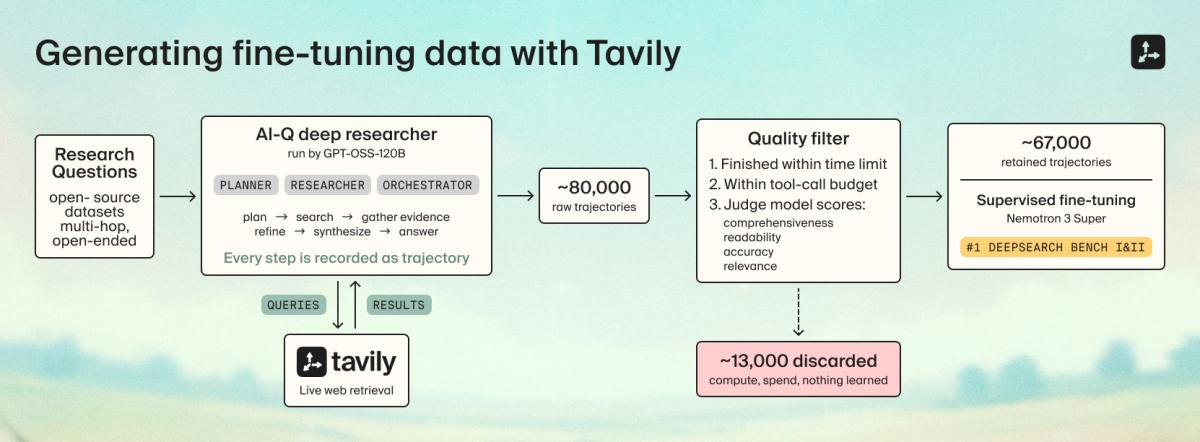 NVIDIA then fine-tuned Nemotron 3 Super on those trajectories for one epoch over 5,615 steps, taking approximately 25 hours on 128 H100 GPUs.
Where the specialized model fits
AI-Q divides the research process across a planner, researcher, and orchestrator. The planner determines how to approach the task, the researcher gathers and synthesizes evidence, and the orchestrator coordinates the work and determines when more research is needed.
For NVIDIA’s benchmark submission, the fine-tuned Nemotron 3 Super powered the researcher and its subagents. The researcher processed four times as many tokens as the planner and orchestrator combined, placing the specialized model in the most inference-intensive part of the system.
Why the search tool matters
The search tool helps determine what happens inside each trajectory. When retrieval returns noisy or off-target content, the agent may need to search again, spend more of its context processing irrelevant text, or reach its tool-call or time budget before finding enough evidence.
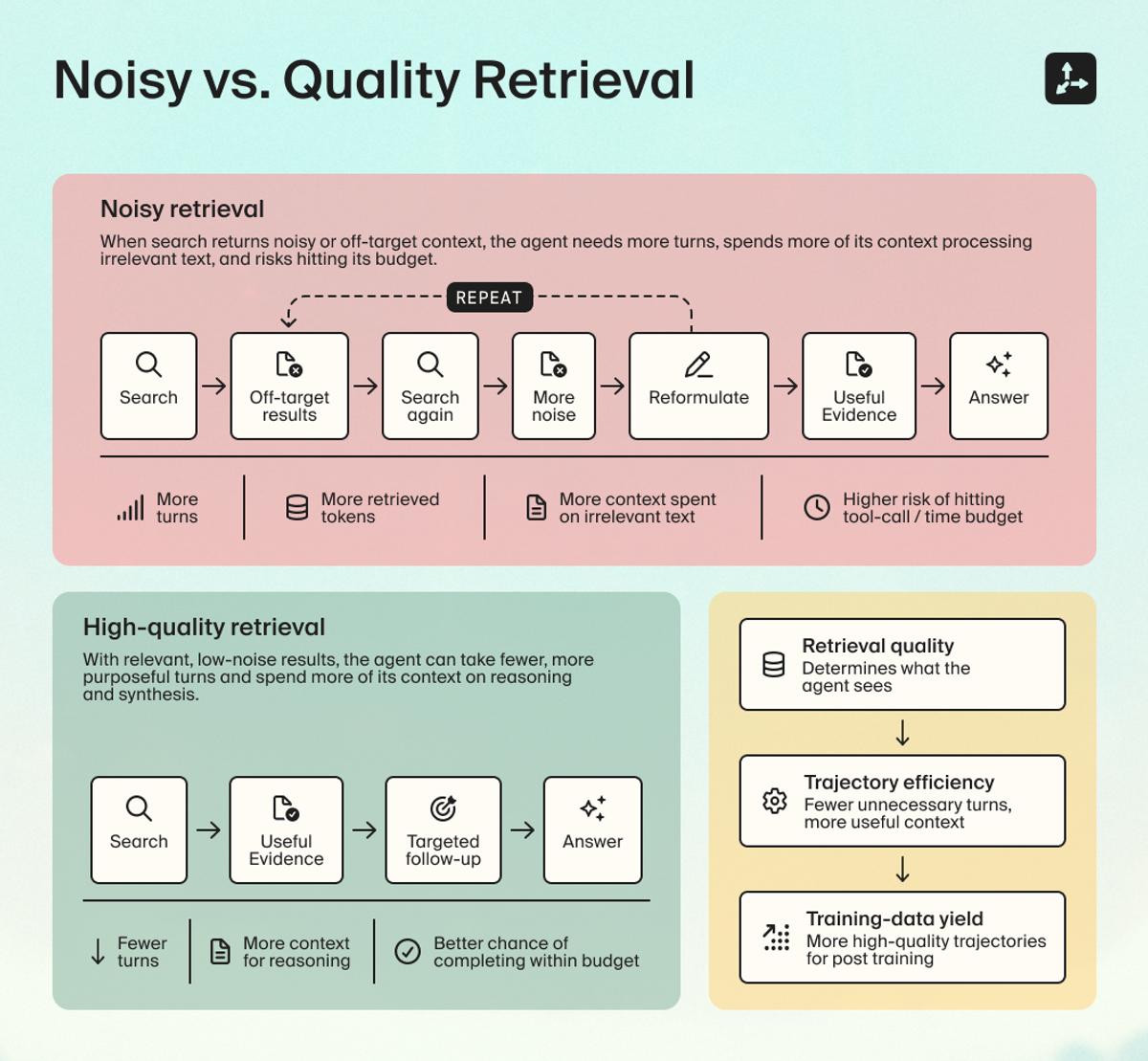 With high-quality retrieval, relevant content reaches the agent with less noise. That can mean fewer, more purposeful turns and more context available for reasoning and synthesis. This gives the agent a better chance of completing the task within budget and producing a trajectory that passes the quality filter.
At NVIDIA’s scale, this effect compounds. Across 80,000 research runs, every trajectory that fails the quality filter is wasted compute that never reaches the SFT dataset. Retrieval quality, therefore, shapes more than individual trajectories: it determines how much useful training data is produced, and ultimately, how capable the resulting model is.
There’s another reason the tool matters: the model is learning how to use it. Using the same retrieval tool during training and deployment keeps trajectories representative of the environment the model will encounter at inference time. The model learns research behavior against the search capabilities and responses it will actually use.
What specialization makes possible
The model can specialize in orchestrating retrieval and synthesizing findings, while external tools supply current information. A smaller model that becomes highly capable at those behaviors can deliver strong research performance with less inference compute. NVIDIA’s first-place results on DeepResearch Bench I and II show what’s possible when a specialized model is paired with a capable research workflow and tools.
NVIDIA isn’t an isolated example. At Tavily, we’re working with multiple AI labs on web retrieval for post-training, helping teams tune search and agent harnesses for trajectory generation and long-horizon research.
Training a research agent?Talk to Tavily about retrieval for your post-training workload.
Similar Articles
SlimSearcher: Training Efficiency-Aware Web Agents via Adaptive Reward Gating
SlimSearcher is a framework that improves efficiency in deep research agents by combining Pareto-efficient trajectory filtering and adaptive reward shaping, reducing tool-call rounds by 17-58% while maintaining accuracy on benchmarks like GAIA, BrowseComp, and XBenchDeepSearch.
S1-DeepResearch: Beyond Search, Toward Real-World Long-Horizon Research Agents
This paper introduces S1-DeepResearch-32B, an open-source model and 15K trajectory dataset for deep research agents, achieving state-of-the-art performance across 20 benchmarks by jointly modeling information acquisition, knowledge synthesis, and planning.
@tom_doerr: Generates 96,000 high-quality deep research trajectories and provides a fully open-source recipe for training agentic l…
OpenResearcher is an open-source project from TIGER-AI-Lab that provides 96,000 deep research trajectories and a recipe to train agentic language models for long-horizon web research without external APIs. It includes a dataset, model, and demo, and has been adopted by NVIDIA's Nemotron models.
@sunweiwei12: What do auto-research agents actually do differently from top human researchers? Despite all the excitement around auto…
TraceML is a tool for trajectory-level analysis of ML research agents, comparing Codex agent runs with Kaggle Grandmaster notebooks and finding that human experts explore broader strategy sets while agents collapse into narrow loops. Distilling human research skills into a ~1,000-token planning prompt lifted Codex scores on five of seven competitions; the work will be presented at NeurIPS 2026.
@tavilyai: Helping to put your pipeline on autopilot is what @Rox_ai agents do. But that requires them to know what's happening ri…
Rox uses Tavily's search and extraction services to power its AI agents for sales automation, significantly cutting down account research time from weeks to seconds. The case study highlights Tavily's reliability, cost-effectiveness, and accuracy in providing real-time data.