@GergelyOrosz: In 2025, it was rational to be skeptical about whether AI would change the future of software development. In 2026, it'…
Summary
Gergely Orosz shares a podcast conversation with Charity Majors about how AI is changing software development, arguing that skepticism is no longer rational in 2026, and discussing the shift from 'pets' to 'cattle' for code, increased need for validation, and the evolution of engineering management.
View Cached Full Text
Cached at: 08/13/26, 07:28 PM
In 2025, it was rational to be skeptical about whether AI would change the future of software development. In 2026, it’s not, anymore. With @mipsytipsy:
Timestamps:
00:00 Intro 02:56 How Parse led to Honeycomb 06:00 The limits of individual productivity metrics 09:08 How Charity’s perspective on AI has evolved 13:50 Rewriting code vs. editing code 19:20 Production as a stage of development 22:14 Code reviews 26:56 Non-deterministic systems 31:11 Sensible uses of AI 37:41 The two AI camps 44:40 Why AI works so well for building software 49:42 DevOps 55:13 Modern observability 1:00:40 Handling context overload 1:01:56 What’s new in Observability Engineering’s 2nd edition 1:07:45 What effective leadership looks like 1:10:25 Engineering management: what is changing? 1:16:31 Junior engineers 1:18:01 AI fatigue 1:21:39 Book recommendations
Brought to you by:
• @AntithesisHQ — turbocharge testing of your systems by running your whole system under aggressive fault injection. Teams like Jane Street, http://Fly.io, and the etcd community rely on Antithesis. https://lnkd.in/eyWErUbm
• @buildkite — the CI platform trusted by OpenAI, Anthropic, Cursor, Meta, Uber, NVIDIA, Airbnb and many more. Engineered to absorb whatever your coding agents throw at the build queue. https://lnkd.in/e2QtucFQ
• @WorkOS — make your app and agents Enterprise Ready, with SSO, SCIM, RBAC, and more. https://workos.com
- The question engineers need to answer: what would it take for you to be fully comfortable shipping code you have not read?
Charity believes it is a “when” and not an “if” that professional software engineers will ship code they never looked at – and thus do not understand – to production. Engineering is building the systems that validate this code, and allow shipping with full confidence.
- AI could have the software industry go through the “pets” to “cattle” change that compute infra went through in the 2010s.
Up to now, writing software from scratch was far more expensive than editing existing software. But now, generating hundreds of variants of a function can be done faster than how long it would take you to hand-write it once.
Charity believes that we might be at the beginning of the transition from “pets” to “cattle” that happened at the hardware infrastructure layer. Before the 2010s, configuring and repairing individual servers was commonly done. But with tools like Terraform and Kubernetes, individual servers having issues are no longer fixed up: they are re-created instead. Charity thinks the same might happen with code, sooner rather than later. When there’s an issue with the code, generate new code that solves it, and is verifyably correct.
- Non-deterministic systems require more engineering discipline versus before.
With code written by AI, we’re reducing the trust in the code (because we no longer wrote it), so we need to increase trust at the other part of the development process. Specifically, at validation: with things like tests, evals, and conformance testing.
Computers for agents
Source: https://fly.io/

Computers for agents
Sandboxes aren’t enough. Give your agent a real computer and get back to building.
Machines that Remember
Real hardware-isolated Linux computers for agents, evals, and tools. The bill goes to zero when nobody’s home.
Coding Agents
Every agent gets its own Linux box. A Sprite checkpoints itself while the agent works, so harnesses like Claude and Codex find everything where they left it.

Personal agents
Hermes, Pi, Openclaw… whatever your flavour, an agent with access to your inbox and calendar shouldn’t live on your laptop. Give it a Sprite that sleeps until it’s needed and wakes up remembering everything.

MCP servers
Run every MCP server in its own Sprite, with persistent disk, and egress policy. Pay only for the tool calls you use.

Untrusted code
Run it in a hardware-isolated VM. A clean baseline per request, so no two users ever share state. Egress-locked and disposable.
Agent-built apps
Every Sprite has an HTTPS URL. The app your agent built stays exactly where it was created and goes live. Nobody migrates anything.
A Real Durable Filesystem
Everything’s still there when you come back. The Sprite Block Device means Sprites can go to sleep without dying.
Sprites Block Device is currently in private beta.Sign upto receive early access.
Nothing to Manage
The agent does the setup, and you get your afternoon back.
 ### No disk sizing Your disk grows as you write it, up to 100 GB, and you’re only billed for the bytes you actually put there.
 ### Automatic checkpointing The Sprite checkpoints itself automatically, so there’s always a recent one waiting.
 ### Sprites Connectors Connect a service once for your whole org, and every Sprite can reach it. Nobody pastes a token.
Grow without drama
Scale from side project to production without rewriting your infrastructure.
Keep the same primitives at every scale: no rearchitecting when you grow, and no platform migration when you get big. The API you start with is the API you keep.
18+Regions worldwide<1 secondMachine boot time500msDeploy time, typical99.9%Uptime SLA
A Connection to Everything
*Sprites are social creatures. Your credentials shouldn’t be.*Your Sprites reach other services through the API gateway that holds the credential. The token never lands on the Sprite.
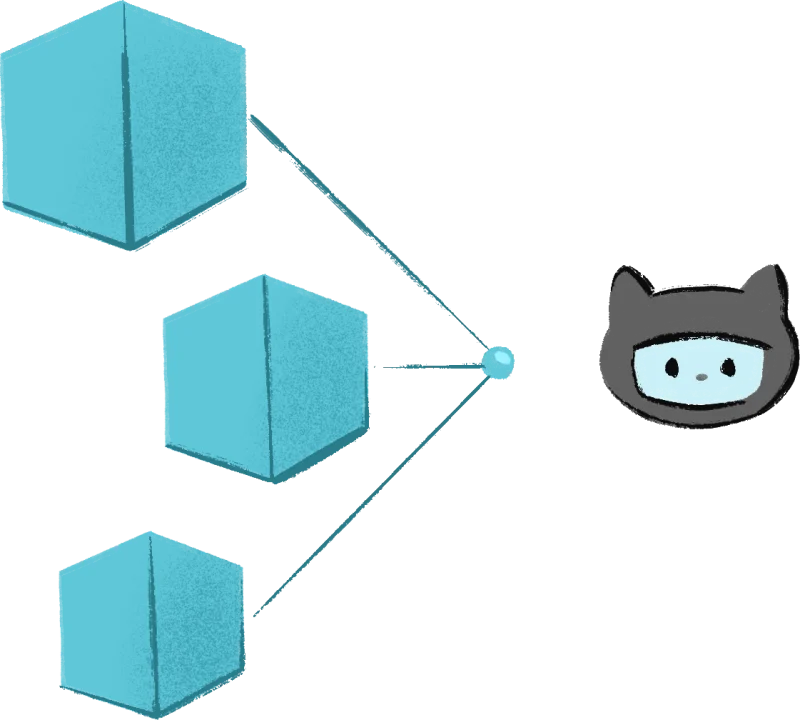 ### Configure a connector once Enable a connection to OpenRouter, Github, Slack, or any HTTP API. Configure once, connect as many Sprites as you like.
 ### Granular permissions Grant access on purpose: by Sprite name, by label, or down to a single endpoint, so a Slack bot can post messages and never touch admin.
 ### Auto key rotation Rotate once and every Sprite has the new credential. Cut off a single Sprite and the rest never notice.
Teams building on Fly.io
Support that knows the stack
Our support team writes code. When you hit a wall, you talk to someone who’s been there.
- “The Fly support team diagnosed a subtle networking issue in our multi-region setup in under an hour. Real engineers, real answers.” Platform Engineer Series B startup
- “Well, I have to say this is the best support I have ever received from any company. When I sent my initial request I expected to be brushed off as is the norm for non-standard, doesn’t fit the script tech problems. To have what is essentially a step-by-step guide in my inbox first thing in the morning is amazing, I can see why the devs like fly.io.”
- “It was useful to be able to speak to fly.io directly. I found [the team] to be very knowledgable and he helped me get clarity around areas I was stuck with, plus he offered me insight in areas I didn’t even know about. Fly.io has been a great experience from the moment I signed up. Keep it up!”
Similar Articles
@GergelyOrosz: Talked with a few folks inside of AI labs (OpenAI, Anthropic) about what they think of the future of software engineeri…
Gergely Orosz shares insights from conversations with people at AI labs like OpenAI and Anthropic, noting that engineers closer to production code are less convinced AI will fully solve software engineering.
Software's Centaur Era
The author argues that AI coding agents have not yet reached the level of replacing human software engineers, and predicts that we are entering a 'centaur era' of human-AI collaboration in software development that is still in its early stages.
@GergelyOrosz: How are tech interviews changing, what is wrong with the CAP theorem, and what skills are becoming more important than …
Gergely Orosz shares highlights from a podcast with Neetcode founder Navdeep Singh, discussing flaws in the CAP theorem, changes in tech interviews, and the ongoing value of coding skills despite AI advancements.
@GergelyOrosz: How is CI/CD changing because of AI, and what are sensible deployment practices more teams should be doing? Robert Erez…
A podcast conversation with CI/CD expert Robert Erez explores how AI is reshaping CI/CD practices, the nuances of GitOps, and trends like ephemeral environments and progressive delivery.
Who here would have believed in 2024 that by mid 2026 software enginneering would be dead?
A speculative discussion questioning whether AI will render software engineering obsolete by mid 2026.