@NikkiSiapno: 35 system design concepts developers should know: 1. Event-driven architecture ↳ https://lucode.co/event-driven-archite…
Summary
A Twitter thread listing 35 essential system design concepts with links to detailed explanations, aimed at helping developers learn and review key topics.
View Cached Full Text
Cached at: 06/10/26, 05:48 AM
35 system design concepts developers should know:
-
Event-driven architecture ↳ https://lucode.co/event-driven-architecture-lil1nlsm…
-
Redis ↳ https://lucode.co/redis-explained-lil1nlsm…
-
gRPC ↳ https://lucode.co/grpc-explained-lil1nlsm…
-
Database types ↳ https://lucode.co/database-types-lil1nlsm…
-
Circuit breakers ↳ https://lucode.co/circuit-breakers-lil1nlsm…
-
ACID vs BASE ↳ https://lucode.co/acid-vs-base-lil1nlsm…
-
Rate limiting ↳ https://lucode.co/rate-limiting-lil1nlsm…
PS - if you want a structured path, get my free 142-page System Design Handbook when you join my free weekly newsletter → https://lucode.co/system-design-handbook-dp1…
-
Microservices ↳ https://lucode.co/microservices-lil1nlsm…
-
System design quality attributes ↳ https://lucode.co/system-design-quality-attributes-lil1nlsm…
-
CAP theorem ↳ https://lucode.co/cap-theorem-lil1nlsm…
-
Idempotency ↳ https://lucode.co/idempotency-in-api-design-lil1nlsm…
-
REST APIs ↳ https://lucode.co/rest-api-protocol-li1…
-
Sync vs Async ↳ https://lucode.co/sync-vs-async-lil1nlsm…
-
Network protocols ↳ https://lucode.co/network-protocols-lil1nlsm…
-
Change Data Capture (CDC) ↳ https://lucode.co/change-data-capture-cdc-explained-lil1nlsm…
-
CI/CD pipelines ↳ https://lucode.co/ci-cd-lil1nlsm
-
SSO (single sign-on) ↳ https://lucode.co/sso-single-sign-on-li1…
-
JWT ↳ https://lucode.co/json-web-token-jwt-lil1nlsm…
-
Health checks vs heartbeats ↳ https://lucode.co/health-checks-vs-hearbeats-lil1nlsm…
-
API gateway vs load balancer vs reverse proxy ↳ https://lucode.co/api-gateway-vs-lb-vs-rp-lil1nlsm…
-
HTTPS ↳ https://lucode.co/https-explained-lil1nlsm…
-
Load balancing algorithms ↳ https://lucode.co/load-balancing-algorithms-lil1nlsm…
-
Database caching ↳ https://lucode.co/database-caching-strategies-lil1nlsm…
-
API protocols ↳ https://lucode.co/api-architecture-styles-lil1nlsm…
-
CDN ↳ https://lucode.co/cdn-lil1nlsm
-
Database indexing ↳ https://lucode.co/database-indexing-lil1nlsm…
-
Message Queues ↳ https://lucode.co/message-queues-lil1nlsm…
-
Hashing vs encryption vs tokenization ↳ https://lucode.co/hashing-vs-encryption-vs-tokenization-lil1nlsm…
-
Service Discovery ↳ https://lucode.co/service-discovery-in-distributed-systems-lil1nlsm…
-
Pub/Sub ↳ https://lucode.co/pub-sub-lil1nlsm…
-
Connection pooling ↳ https://lucode.co/connection-pooling-lil1nlsm…
-
Forward proxy vs reverse proxy ↳ https://lucode.co/forward-vs-reverse-proxy-lil1nlsm…
-
Consistent hashing ↳ https://lucode.co/consistent-hashing-lil1nlsm…
-
SQL vs NoSQL ↳ https://lucode.co/sql-vs-nosql-lil1nlsm…
-
Observability ↳ https://lucode.co/observability-clearly-explained-lil1nlsm…
What else should be on the list?
——
Save for later. Repost to help others learn and grow.
Event-Driven Architecture Clearly Explained
Source: https://blog.levelupcoding.com/p/event-driven-architecture

Presented by Sonar
 The question isn’t whether to use AI. It’s how to adopt itwithout quietly increasing risk and degrading code quality. That shift is exactly why conversations about software quality in the AI era matter right now. This is exactly the kind of conversation happening at**Sonar Summit**.
Thevirtual eventis ontoday. It’s free to watch / attend.
Most systems start as a neat chain of calls: service A calls B, B calls C, C returns.
Add one new downstream requirement, and suddenly you’re editing code three layers deep, redeploying half your stack, and praying the chain holds.
This is the hidden cost of direct coupling, every new feature tightens the knot. Event-Driven Architecture (EDA) cuts it.
Instead of services calling each other directly, they broadcast events: facts about things that happened. Any service that cares can react. The one that emitted the event never needs to know who listened.
Event-Driven Architecture (EDA) is a design style where components communicate by producing and reacting to events rather than calling each other directly.
Aneventis a message that describes something that happened: “Order Placed,” “Payment Received,” “Temperature Exceeded Threshold.”
It’s a fact, not a command.
Every EDA system has three main roles:
- Producers→ Detect a change and publish an event to the broker. They don’t know or care who receives it.
- Broker→ The central hub (Kafka, RabbitMQ, AWS EventBridge) that receives events from producers and routes copies to every interested subscriber. It can also buffer events during traffic spikes, ensuring consumers aren’t overwhelmed.
- Consumers→ Subscribe to specific event types and react asynchronously. One consumer’s slowdown doesn’t affect others or the producer.
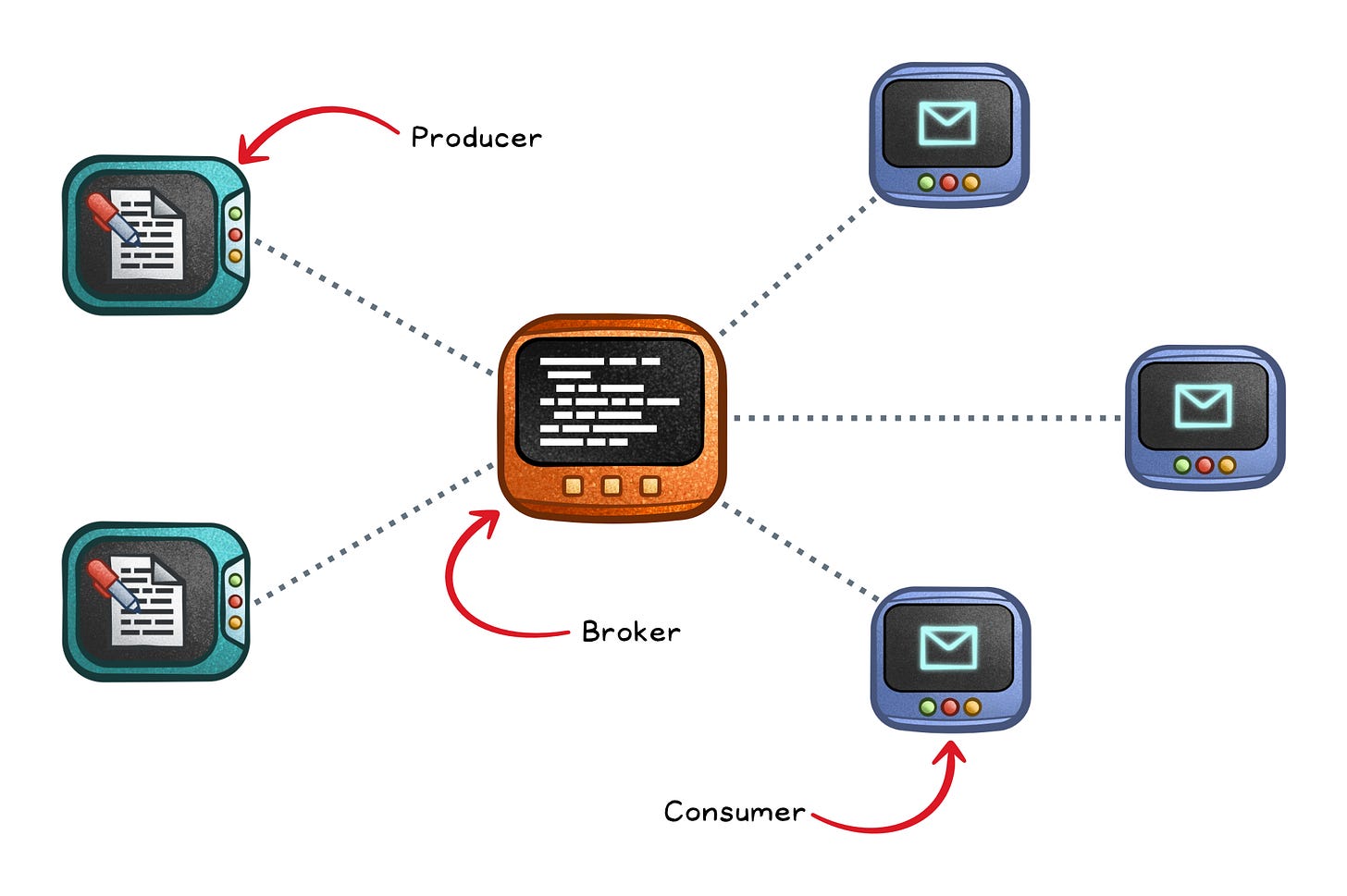
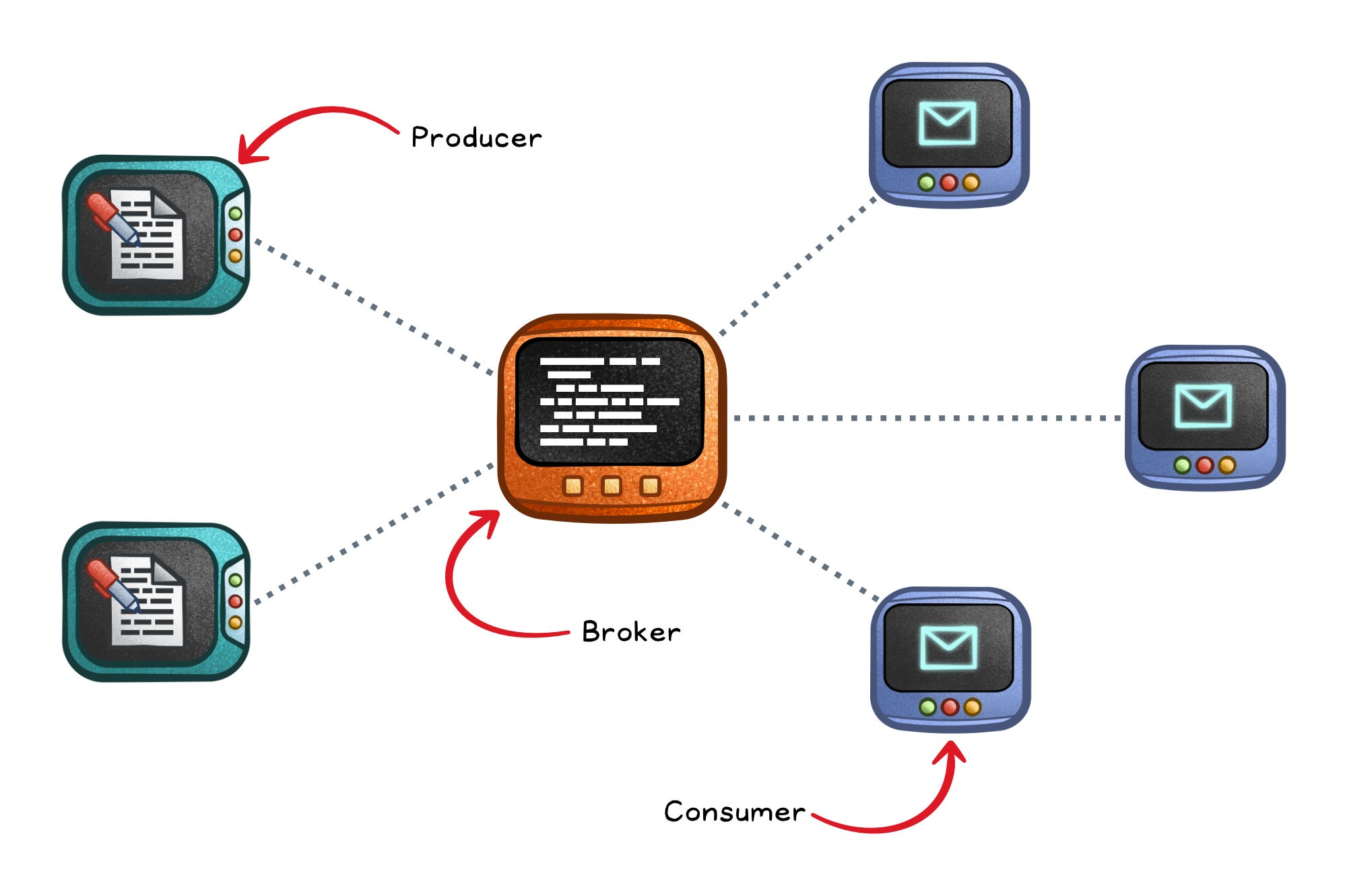
The flow looks like this:
- A customer places an order
- The Order Service publishes an “Order Placed” event
- The broker routes it
- The Inventory Service decrements stock
- The Notification Service sends a confirmation email
- The Shipping Service prepares a label
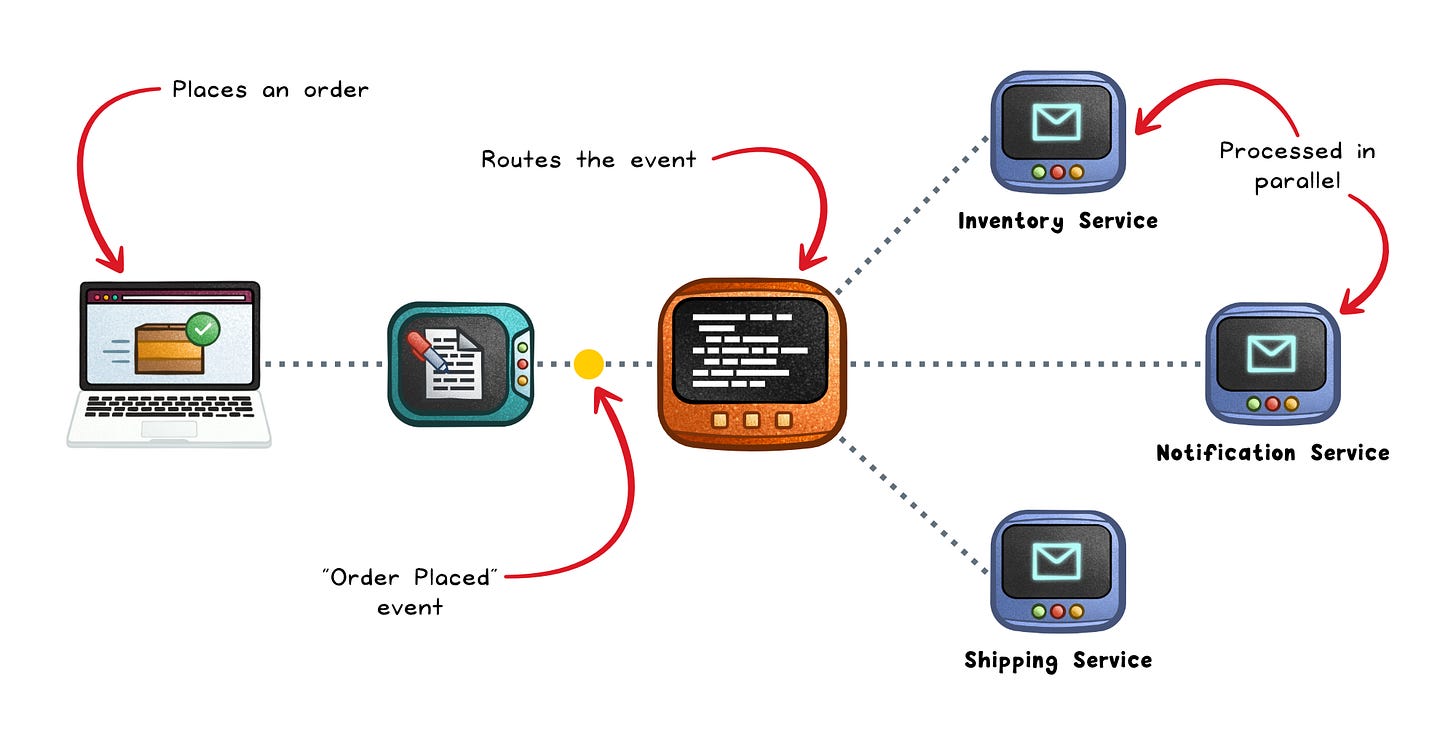
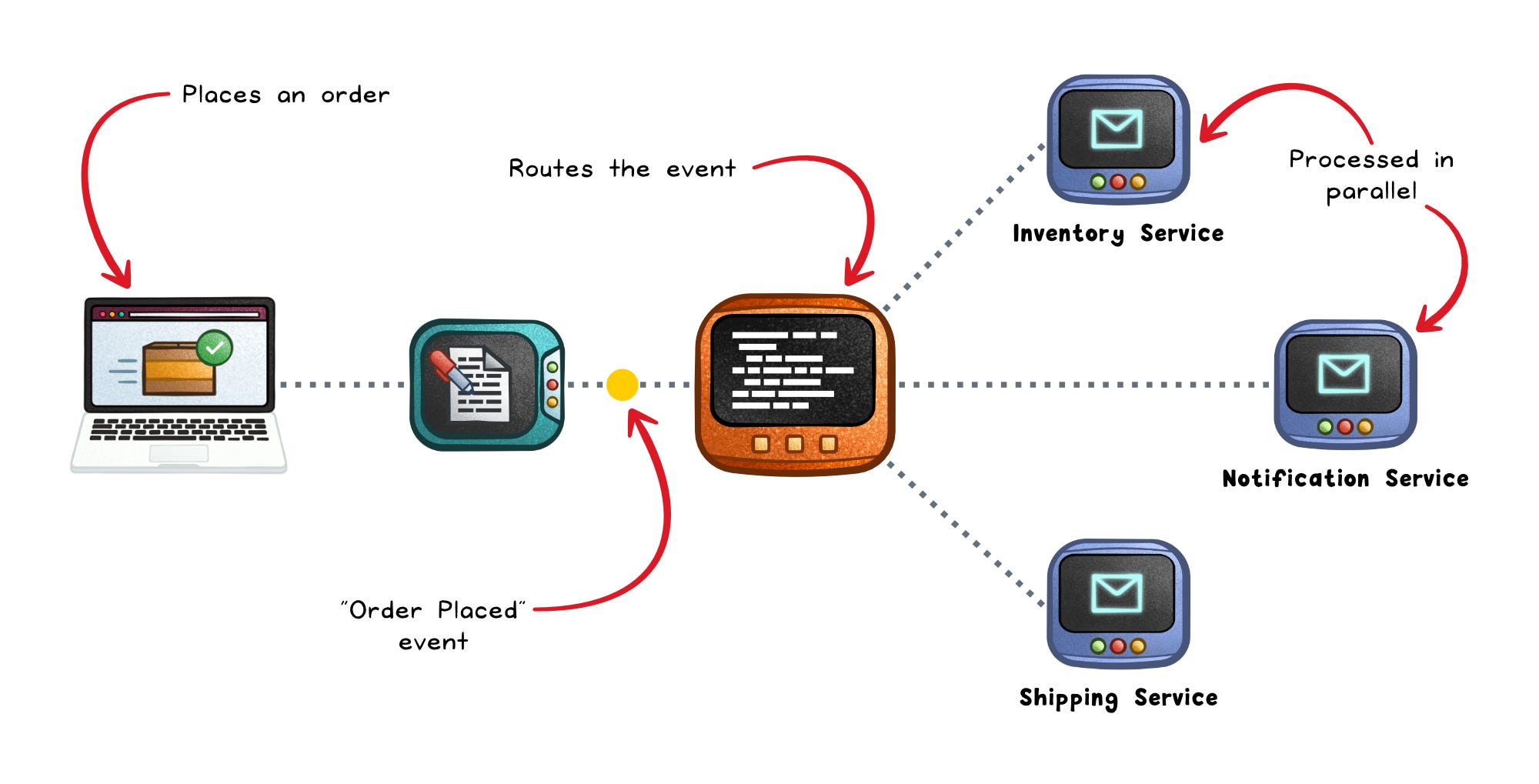
The Inventory Service, Notification Service, and Shipping Service all work in parallel, without the Order Service knowing any of them exist.
This is the core power:decoupling. Teams deploy independently. Services evolve independently. A new feature means adding a new consumer, not modifying existing ones.
Without EDA, coordination becomes the tax you pay for every new capability.
EDA earns its place the moment you feel how much friction it removes.
- Loose coupling→ Producers and consumers share only an event contract, so each side evolves independently without needing to know the other’s internals.
- Async fan-out→ One event triggers many parallel workflows instantly, so adding a new downstream step costs nothing in latency.
- Elastic buffering→ The broker absorbs traffic spikes so producers keep emitting while consumers scale at their own pace.
- Plug-in extensibility→ New features are new consumers, not modifications to existing services.
- Fault isolation→ A failed consumer doesn’t cascade; events queue until the service recovers.
EDA doesn’t eliminate complexity, it relocates it.
The architecture gets cleaner upstream; the responsibilities shift to event design, broker operations, and consumer reliability.
- Debugging complexity→ Failures don’t follow a clean call path. You see a missing outcome, not the cause. Tracing and centralized logging become essential.
- Delivery semantics→ Most brokers guaranteeat-least-once delivery. Duplicates happen. Consumers must beidempotentor you risk double charges and inconsistent state.
- Eventual consistency→ Services update asynchronously. Temporary disagreement is normal, but unsafe for flows needing immediate correctness.
- Broker dependency→ The broker is critical infrastructure. If it fails, events stop flowing; often silently.
EDA shines when your system needs to do many things at once in response to a single trigger, or when teams need to move independently without stepping on each other’s toes.
Use EDA when:
- One action should trigger multiple independent downstream reactions.
- Traffic is bursty or unpredictable and you need the broker to absorb spikes.
- You’re working in a microservices architecture where teams deploy independently.
- You need to integrate heterogeneous systems without tight API contracts.
- Requirements change frequently and you want to add behavior by subscribing, not by modifying.
Avoid EDA when:
- You need strict transactional atomicity; e.g. debit one account and credit another in one operation. Events introduce eventual consistency where ACID is required.
- You need guaranteed ordering across multiple consumers. Global ordering in distributed brokers is hard and expensive.
- You need immediate confirmation. If the workflow requires “did this succeed right now?”, request-response fits better.
- The system is small and simple. Introducing a broker, event schemas, and consumer infrastructure into a three-service app adds overhead without proportional benefit.
Getting the architecture right is only half the work. These practices determine whether it stays maintainable as it grows.
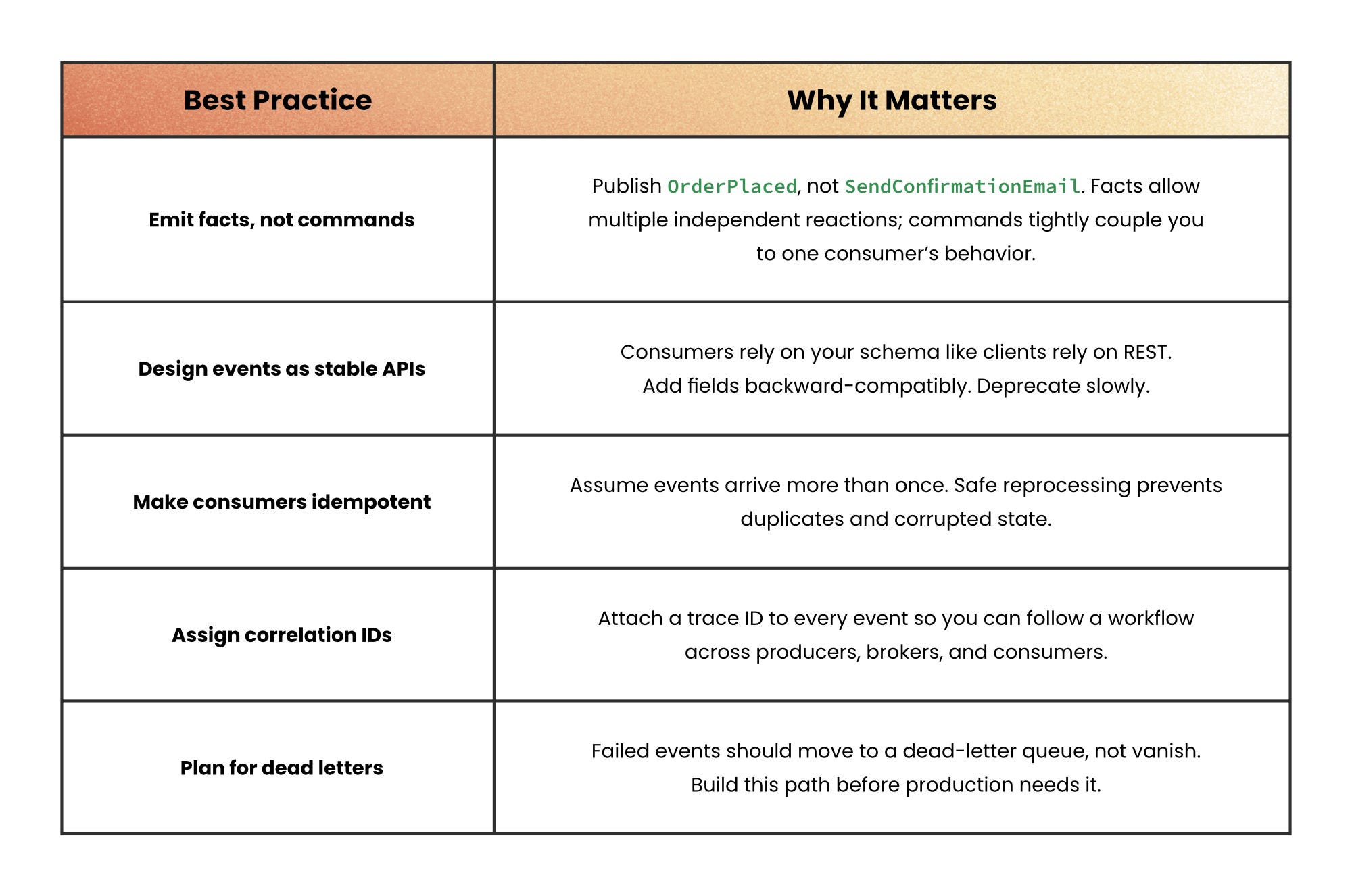 The coupling that slows teams down rarely announces itself.
It builds quietly: one extra call, one more dependency, one more coordinated deploy.
EDA breaks that pattern by making components responsible only for what they know: something happened.
What the rest of the system does with that is no longer your problem. That’s not just a cleaner architecture. It enforces clearer ownership.
👋 If you liked this post → Like + Restack + Share to help others learn system design.
Discussion about this post
Ready for more?
Level Up Coding (@LevelUpCoding_): 35 system design concepts developers should know:
Microservices: https://t.co/1g1muS2fw2
System design quality attributes: https://t.co/o7iPtNnY9b
Observability: https://t.co/jxXKHwFShu
CAP theorem: https://t.co/wIXbw7lQD8
Idempotency:
Similar Articles
@0xlelouch_: Top 10 system design resources I still point working devs to: 1) Designing Data-Intensive Applications (Kleppmann) — re…
A Twitter thread listing the top 10 system design resources, including books, blogs, and frameworks, with a link to Martin Fowler's website for further reading.
@swapnakpanda: Are you into System Design? SAVE THIS THREAD NOW I promise you'll be 100% better by the end of 2026.
A Twitter thread about system design that promises to improve skills by the end of 2026.
@techyoutbe: https://x.com/techyoutbe/status/2076189458869928324
A guide to 40 backend concepts organized into six stages, from HTTP basics to system architecture, designed to help engineers prepare for system design interviews.
@bibryam: Good system design starts before the architecture diagram. Donne Martin’s System Design Primer: 1. define use cases and…
The article is a tweet promoting Donne Martin's System Design Primer, an open-source GitHub repository that provides resources for learning system design and preparing for technical interviews.
@Franc0Fernand0: If I had to learn system design fundamentals from scratch, I would read the following 16 curated articles (links below)…
A curated list of 16 articles recommended for learning system design fundamentals from scratch.