Cached at:
10/14/26, 12:09 PM
# Introducing Firefox Enterprise | The Mozilla Blog
Source: [https://blog.mozilla.org/en/firefox/introducing-firefox-enterprise/](https://blog.mozilla.org/en/firefox/introducing-firefox-enterprise/)
*Institutions are recalculating who controls the technology they rely on\. Mozilla has an independent option to offer\.*
For years, organizations consolidated technology around a small number of providers to make things simpler\. Fewer systems\. Tighter integrations\. More economies of scale\. But that consolidation went well beyond technology\. It consolidated dependency, too\. The resulting risks have been debated, studied, and challenged along the way, but concentration continued\. More work, data and critical infrastructure kept moving to the same few providers, while credible alternatives narrowed\.
The deeper that dependency runs, the harder and more costly it becomes to change course\. When something fails, changes or falls outside an institution’s control, that dependency becomes a risk for CIOs and CISOs to manage\.
Nowhere are these stakes more visible than in Europe\. Now institutions are re\-assessing\. Governments are pushing for greater digital autonomy, while regulated industries face growing pressure to find and manage their dependencies\.
There’s a name for much of this debate about technological control: “sovereignty\.”
What digital sovereignty means in practice varies\. Across Europe, governments are investing in the security and resilience of critical IT infrastructure, reducing strategic dependencies and putting technological autonomy higher on national agendas\. Different approaches, same underlying concern\. Strip away the regional policy definitions and industry distinctions and a pretty practical, universal question emerges: how much technological dependency should we risk?
And a very specific, very important layer has been largely missing from that conversation: the browser\.
## The overlooked layer of modern business
The browser\. Applications run there\. Employees authenticate in it\. Sensitive data transits through it\. Files are uploaded and downloaded and AI tools are increasingly used through it\. That raises the same questions of dependency and control: whose browser technology are you relying on, and who controls the infrastructure used to manage it?
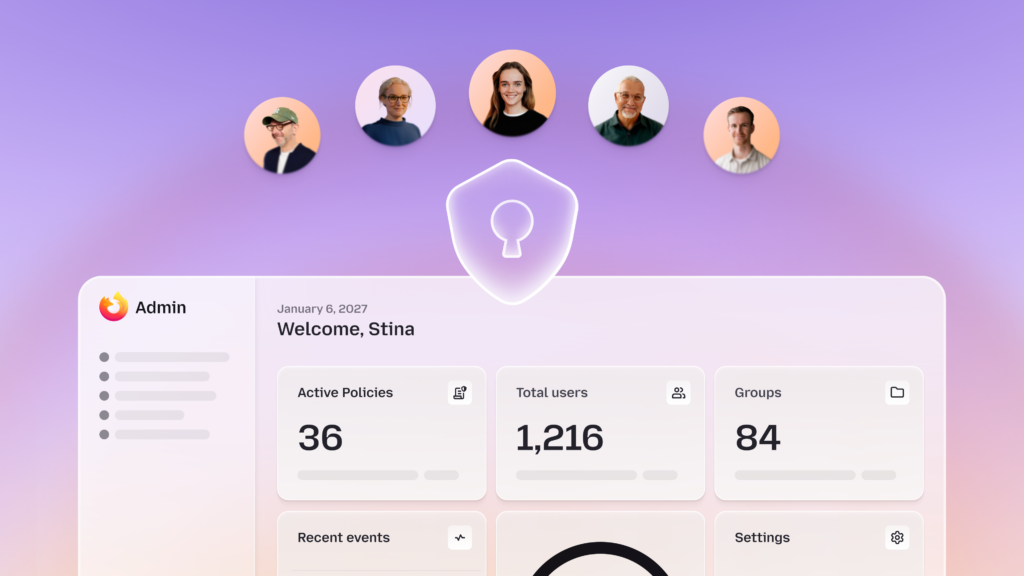
[Firefox Enterprise](https://www.firefox.com/enterprise/)is built for organizations with strict security, governance, and compliance requirements\. It pairs the Firefox browser, built on Mozilla’s independent[Gecko](https://blog.mozilla.org/netpolicy/2026/03/23/competition-innovation-and-the-future-of-the-web/)engine, with a management console organizations can run on their own infrastructure\. From that console, IT teams can centrally manage browser policy and access, govern how data moves through the browser and set controls around AI use\.
IT and security teams get more control over their data, IT infrastructure and browser environment — helping strengthen technological independence and operational resilience\.
“If all your options are built with the same technology underneath, ‘choice’ is a lie\. So is control,” said Anthony Enzor\-DeMeo, CEO of Mozilla\. “We built Firefox differently\. And we’re bringing its independent architecture to institutions that are ready to rethink their dependencies and risk\.”
## Bringing the browser under control
We’re starting with the browser because we see it as a key, but under\-governed, layer\. Firefox Enterprise gives institutions more control over the browser and the infrastructure managing it\.
And because Firefox runs on Gecko, the only major browser engine developed outside Google and Apple, institutions have another path towards reducing dependence on a single architecture\.
Finally, Firefox Enterprise is built to live alongside the systems that IT operations already use\. Keep your identity provider\. Keep your SIEM\. Keep your MDM\. Just add a browser whose management infrastructure you operate, so you decide where data lives and have greater visibility into how it moves\.
For us, supporting the goal of technological sovereignty comes down to four things: More control\. More transparency\. More choice\. More resilience\.
[Learn more](https://www.firefox.com/enterprise/firefox-enterprise/)about Firefox Enterprise\.
## A big bet on familiar ground
We know this territory\. Independence isn’t a new direction for Mozilla\. We’ve spent more than 25 years building and securing browser technology that intentionally works outside of the dominant architecture of the day\. Firefox is used by roughly 200 million people every month and is already deployed across thousands of organizations\.
That independence has always mattered to the web\. Now it has practical value for institutions looking to reduce technological concentration — and dependency — in their own environments\.
## This is the beginning
Our ambition is big but simple: make technology independence practical\.
That means putting institutions in real control of the infrastructure and data they depend on, without asking them to rebuild or start over\. Closing blind spots\. Defining where policies, access and data live\. Keeping core management within the institution’s environment\. And bringing an overlooked layer — the browser — under institutional control\.
Firefox Enterprise is unveiling across Europe with an initial sales focus on France, Germany, Austria and Switzerland, with more markets to follow\. Thunderbird Enterprise is also in development, extending this customer\-controlled approach to email and communications\. We’ll have more to share as that work progresses\.
If your organization wants greater control over its browser infrastructure, we’d like to[work with you](https://www.firefox.com/enterprise/contact/)\.
This post is also available in:[Deutsch\(German\)](https://blog.mozilla.org/de/firefox-de/firefox-enterprise/)[Français\(French\)](https://blog.mozilla.org/fr/firefox-fr/decouvrez-firefox-enterprise/)