@AdamShao: 正式开源我的漏洞挖掘工具:http://flounders.xyz 这是一个基于 AI Agent 的全自动漏洞挖掘工作流,你只要告诉 AI 你要找什么项目的漏洞,它就会自动下载代码和文档,深度审计代码,发现可疑漏洞,自动在本地和线上验证…
摘要
Flounder is an open-source AI agent-based tool that automates vulnerability discovery in codebases. Users describe the target and the tool autonomously downloads code, conducts deep code audits, tests vulnerabilities locally and online, and generates reports.
查看缓存全文
缓存时间: 2026/06/24 10:22
正式开源我的漏洞挖掘工具:http://flounders.xyz
这是一个基于 AI Agent 的全自动漏洞挖掘工作流,你只要告诉 AI 你要找什么项目的漏洞,它就会自动下载代码和文档,深度审计代码,发现可疑漏洞,自动在本地和线上验证漏洞,最后生成报告。
Alpha leak: 如果你有很多 AI token 用不完,你可以给 agent 一个 goal,让它去各大白帽平台搜索赏金任务,寻找漏洞,获得赏金。
Flounder — An autonomous white-hat security auditor
Source: https://flounders.xyz/ Agent-driven security audits
Install the skill once. Ask Codex, Claude Code, or another skills-aware agent to prepare the target, audit the code, run proof tests, and collect the report.
Works withCodexClaude CodeGemini CLICursorOpenCodeOpenHands
$npx skills add adshao/flounder \-g
Flounder skill — agent-driven audit
$npx skills addadshao/flounder-g
◇ skill installed for Codex / Claude Code
›Audit this repository with Flounder.
◇ target authorized boundary captured
◇ agent prepared workspace · mapped scope · dug promising regions
↳test runnerreturnedPASSwith command evidence
confirmed-executablereport package ready
✓sealed audit complete · network stayed off
Use it with an agent
Ask naturally. Flounder handles the audit contract.
The installed skill triggers from Flounder audit requests, daemon/provider setup, suspected-finding verification, real-finding confirmation, and report collection.
1install skillone-time setup
2ask agentCodex or Claude Code
3provesandboxed local tests
4reportprivate disclosure draft
agent owns strategy·Flounder owns safety and evidence
01natural language
Codex / Claude Code driver
No custom scenario pipeline
Ask for an authorized audit, verification, confirmation, or report package. The Flounder skill gives the agent the operating manual and keeps it on the workflow.
The source of truth isskills/flounder/SKILL\.md, not a marketing-only prompt.
02execution-backed
End-to-end audit system
Prep → audit → proof → report
Flounder can prepare the workspace, read source and corpus, map attack surface, dig promising regions, construct exploit paths, run proof tests, and collect reports.
The framework supplies sandboxing, command policy, durable state, gates, daemon execution, and reporting.
Local dashboard
Track audits while the agent works.
flounder uigives operators a localhost control plane for projects, daemons, provider profiles, runs, scopes, findings, live activity, and reports.
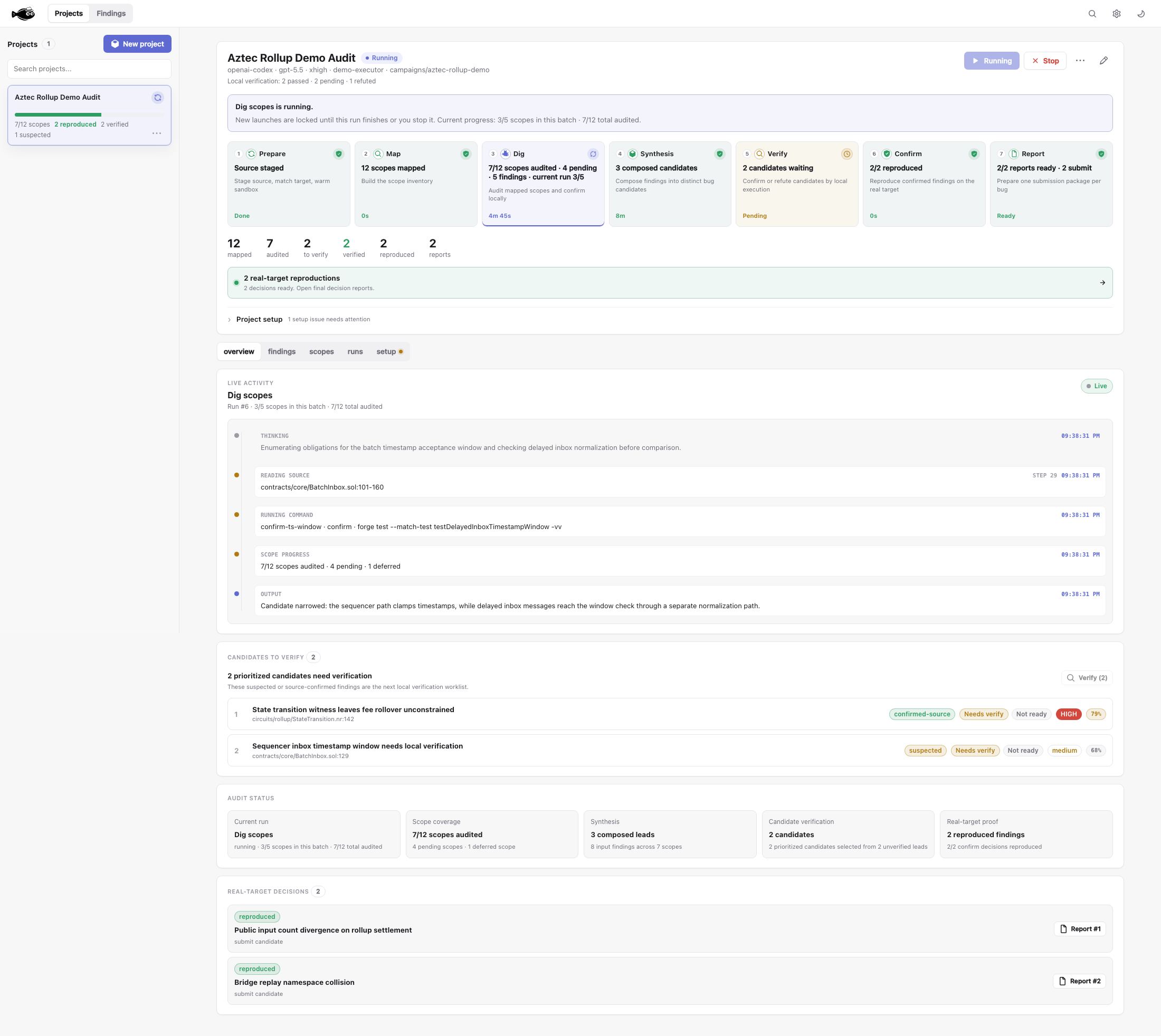
Project view: prepare → map → dig → synthesize → verify → confirm → report, with live model activity and finding-grained report actions.Daemon-owned executionLive tool and model activityFinding-grained Verify / Confirm / Report
Why Flounder
Thin framework. Strong guarantees.
Flounder is not a scanner, checklist runner, or set of hand-written bug rules. The model decides how to reason; Flounder makes the result usable.
Agent-native
Install the skill once. Codex, Claude Code, or another skills-aware agent can drive the workflow from a plain request.
Framework-agnostic
Source, corpus, and optional profiles are inputs. The audit strategy comes from the model, not a stack-specific scanner.
Execution-grounded
A finding is not real because the model says so. It must cite command evidence from a passing local proof test.
Blind then real
Discovery runs network-sealed. Reproduction can use real-world ground truth under white-hat no-broadcast rules.
Sandbox boundary
Model-written tests, PoCs, dependencies, and commands run in a copied workspace away from the host checkout.
Local control
The UI is a control plane. Audits run on a daemon, so target code and provider credentials stay on the executor host.
Use cases
Use Flounder when a security question needs proof.
Choose the path by what you already have: a clean target, a factual clue, a public bounty scope, local source, a suspected finding, or confirmed evidence.
blind capability audit### Measure unaided audit ability.
Start with an authorized project, repo, package, source tree, or project link and no bug hint.
Input: target only, no incident writeup incident investigation### Explain a suspicious transaction or exploit clue.
Use Prepare to collect chain facts, deployed source, official material, and reproduction requirements.
Input: transaction, address, exploit link open-world bounty### Audit with official public context.
Let Flounder gather bounty scope, docs, deployments, provenance, and package metadata before sealed audit.
Input: public program, repo, deployment source-provided audit### Audit code that is already staged locally.
Provide source paths, build root, and optional corpus to enter sealed map/dig directly.
Input: source, build root, docs targeted follow-up### Settle one claim or region.
Verify suspected findings, dig selected scopes, confirm a run, or continue from prior project state.
Output: confirmed, refuted, or narrowed disclosure prep### Package only evidence-backed bugs.
Consolidate duplicates, run real-target confirmation when needed, and regenerate selected reports.
Output: reports, decisions, command evidence
Prepare targetMap scopeDig deeplyRun proofCollect report
Proof boundary
Execution is the promotion rule.
A candidate stays suspected until it cites a passing confirmation-eligible command. The status is a framework verdict from command evidence, not the model’s assertion.
refuted
The claim failed reproduction or skeptic review.
suspected
Credible, but no passing cited test yet.
confirmed-executable
A real local test/build runner passed.
confirmed-differential
The same exploit is blocked by its own minimal fix.
-
1Model-owned strategy Flounder is not a stack scanner or checklist runner. Source, corpus, and optional profiles are inputs, not conclusions.
-
2Sandboxed execution Commands run in a copied workspace. The default OCI backend fails closed if the sandbox image is missing.
-
3Real test runners only Inspection commands cannot mint proof. Confirmation needs a command like
cargo test,forge test, orpytest. -
4Local control The control plane queues work; the daemon executes it. Target code and provider credentials stay on the executor host.
Quickstart
Install once. Ask your agent.
The Flounder skill is the product interface for Codex, Claude Code, and other skills-aware agents.
1. Install Skill
# add Flounder to your agent once
$ npx skills add adshao/flounder -g
Installs the operating manual, safety boundary, and workflow contract.
2. Ask Agent
# use plain language from Codex or Claude Code
› Audit this repository with Flounder.
› Verify this suspected finding with Flounder.
› Collect the execution-backed bug report package.
The agent handles setup, audit planning, proof runs, and report collection.
Dashboard, CLI, and REST API remain available when you want direct control.
White-hat by construction.
Flounder is forauthorizedauditing only — your own code or public bug-bounty scope. Discovery is network-sealed; reproduction may fork and read live networks butneverbroadcasts, moves funds, or writes to any live system — exploits replay against alocalfork only. Build the smallest proof needed, report privately, coordinate disclosure.
FAQ
Practical questions before you run it.
Answers for operators setting up their first agent-driven audit.
Is Flounder a local service or a cloud service?Flounder is local-first. The dashboard and control plane run on localhost by default, and audits execute on a daemon you control. That daemon can be on your machine or another executor host you connect; Flounder does not require uploading targets to a hosted Flounder cloud.
Is Flounder open source? What license?Yes. Flounder is open source under theGNU AGPL v3. The repository includes the full license text.
How do I use Flounder with Codex or Claude Code?Install the Flounder skill once, then ask a skills-aware coding agent to audit an authorized target, verify a suspected finding, confirm a real finding, or collect the final report package. The dashboard, CLI, and REST API are control surfaces; the skill is the recommended way to drive the workflow.
Is Flounder a scanner?No. The agent owns the audit strategy and target-specific reasoning. Flounder supplies the sandbox, command policy, durable state, execution gates, daemon control plane, and report package so the agent’s work can be resumed, checked, and proven.
Will Flounder use a lot of tokens?High-quality audits can be token-heavy. You can cap map, dig, and confirm budgets, but hard caps can stop a productive investigation. The default is unbounded: the agent stops when the work is done, and interrupted runs can resume. For serious use, plan around high-cap subscriptions such as ChatGPT Pro or Claude Max 20x, or set explicit budgets for API/pay-as-you-go usage.
Does my source code leave my machine?Flounder keeps its database, artifacts, workspaces, and provider auth under local control, with default state under~/\.flounder. Provider credentials stay on the executor host. Your chosen model provider still receives the prompts and context your agent sends, so keep sensitive material out of scope unless that provider and account are approved for it.
What do I need to run a real audit?Node.js 24.13 or newer on the current 24 LTS line, a skills-aware agent, the Flounder skill, a configured model provider on the daemon, and a sandbox backend. For execution-backed audits, use Docker or a Docker-compatible runtime with the Flounder sandbox image or a target-specific image. Host mode is for trusted local smoke tests.
What targets are a good fit?Flounder fits source audits where claims can be proven locally: repositories, packages, smart contracts, Solidity/EVM projects, ZK/proof systems, suspected findings, transactions, addresses, and prior reports. It is strongest when the target has tests, forks, fixtures, or harnesses that can turn a vulnerability claim into command evidence.
Is it safe to run model-written exploit code?Model-written files and commands run in a copied workspace. The default OCI sandbox fails closed if the sandbox image is missing, instead of silently falling back to the host. Use host execution only when you explicitly trust the target and the command environment.
Can Flounder be used on live targets?Only with authorization. Discovery stays sealed and local. Confirmation may fetch, search, fork, or read real-world ground truth, but it must never broadcast, move funds, submit writes, persist access, or go outside the approved scope.
Give your agent an authorized target.
Flounder turns the request into a sandboxed, evidence-gated audit workflow.
$npx skills add adshao/flounder \-g
相似文章
@geekbb: 用 Multi-Agent 自动跑完整个 CVE 挖掘流程,从挑项目、审代码、验证漏洞到生成可直接提交的漏洞报告。 https://github.com/larlarua/AutoCVE…
AutoCVE 是一个开源工具,利用多智能体协作自动完成从项目筛选、代码审计、漏洞验证到生成CVE报告的全流程,支持一键挖掘CVE漏洞。
@XAMTO_AI: 用过传统手动渗透测试的都懂!! 工具开一堆,Burp、Nmap、Metasploit来回切,recon半天exploit半天,PoC还得自己手写,报告写到怀疑人生,假阳性满天飞,真实漏洞反而漏掉…… 有位开发者实在看不下去了,直接开源了一…
Strix is an open-source AI penetration testing tool that uses autonomous AI agents to perform real vulnerability discovery and exploitation, generating working PoCs and compliance-ready reports. It supports multi-agent orchestration, CI/CD integration, and various LLMs, aiming to replace manual pentesting with AI-driven automation.
@vintcessun: 阿里开源了一个代码审查工具,核心思路很有意思——确定性工程 + Agent 混合架构。纯 LLM 做 review 常见的问题:覆盖不全、行号漂移、质量不稳定。它用确定性管道处理文件选择、分组和规则匹配,Agent 只负责动态决策和上下文…
阿里巴巴开源了Open Code Review,一个AI代码审查CLI工具,采用确定性工程与Agent混合架构,已在内部运行两年并发现数百万缺陷。
@servasyy_ai: 如果你一个人维护项目,没有安全团队,上线前心里总没底,那么这东西基本就是给你的礼物 说实话,市面上叫"AI 安全扫描"的东西我基本不信。 扫完给你报一屏警告,九成是误报,纯浪费时间。 直到我扒了下这两天 GitHub 日榜第一的 stri…
Strix 是一个开源的 AI 渗透测试工具,通过在 Docker 沙箱中动态运行应用、使用 Caido 代理拦截并利用 Python 沙箱编写实际可用的 PoC 来发现和验证漏洞,支持多 agent 协作、自动生成补丁和 CI/CD 集成,比传统误报率高的扫描器更实用。
@XAMTO_AI: 一个两人安全团队用AI挖出了代码里的真实漏洞,一笔赏金就赚了25万美元。 现在他们把这套系统开源了,叫Open-Kritt。它不是那种丢个仓库让AI瞎找的玩具,而是一个能把AI代理变成小规模安全团队的编排平台。 大多数人的做法是扔给AI一…
Open-Kritt 是一个开源的安全研究平台,通过编排多个 AI 代理并行分析代码,自动化发现真实漏洞,并支持去重、验证和优先级排序。背后团队用它曾获高额赏金并赢得 Firedancer 审计竞赛。