@MSFTResearch: Robots are getting smarter, but how can their hardware match that growth? New Microsoft Research findings show that mov…
Summary
Microsoft Research findings demonstrate that offloading AI inference from robots to edge or cloud systems enhances task success rates, efficiency, and battery life for physical AI applications.
View Cached Full Text
Cached at: 09/23/26, 06:09 PM
Robots are getting smarter, but how can their hardware match that growth? New Microsoft Research findings show that moving AI inference beyond the robot can improve task success, boost efficiency, and support more advanced physical AI workloads. https://t.co/Ks9cUCbn9r https://t.co/nMrI6xRX4t
What if robots didn’t need all their AI onboard?
Source: https://www.microsoft.com/en-us/research/blog/offloaded-inference-for-real-world-physical-ai-robotics/
 ## At a glance
- Challenges a core assumption in robotics AI: Our research shows that running physical AI inference exclusively on onboard GPUs can limit robot performance, battery life, and scalability, and that offloading inference to edge or cloud GPUs can offer significant advantages.
- Demonstrates measurable benefits of inference offloading: Across representative mobile manipulation workloads, offloading improved task success rates, enabled larger AI models, and helped robots respond more effectively in dynamic, real-world environments.
- Extends robot operating time: Replacing power-hungry onboard AI compute with lightweight onboard hardware and remote inference can substantially improve battery life, enabling robots to operate longer between charges.
- Introduces a new capability in the Physical AI Toolchain: Developers can now containerize, deploy, and orchestrate robotics AI workloads across robots, edge infrastructure, and the cloud using Kubernetes-based tooling for distributed inference.
Readily-available physical AI, with robotics assisting users in manufacturing, home, and warehouses scenarios, holds immense potential to improve safety, productivity, and assistance across a wide range of tasks. In many ways, AI for the physical world represents a major frontier for AI . Physical AI must operate in open, unpredictable environments, interact with both other robots and people, and work with a diversity of embodiments. Realizing this vision requires advances along three dimensions: robot hardware, embodied AI models, and systems infrastructure for training and inference. While robot hardware and the AI models have advanced rapidly in recent years, we turn our focus on a relatively under-addressed aspect:inference infrastructure of physical AI. Enabling robots to effectively and safely operate in the physical world will require sophisticated systems to handle large volumes of distributed inference compute.
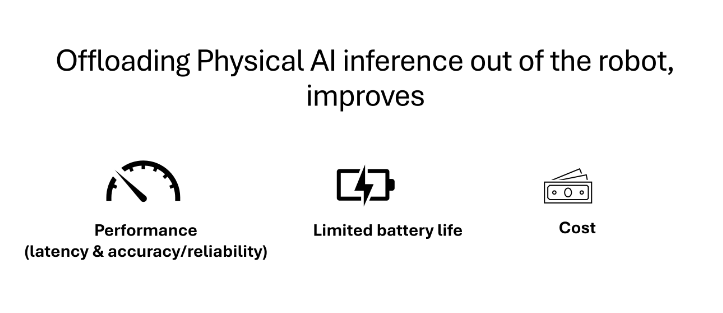
Today, the prevailing approach to physical AI is to provision a GPUonboardthe robot, e.g., by wiring a GPU to the robot. In this model, the robot’s inference will be confined to the onboard GPU, and provide the robot with the necessary chunks and sequence of actions for the execution of its tasks. While higher-level planning may be performed in the cloud, task execution typically remains tied to the robot itself. We challenge this assumption. As physical AI models grow in size and sophistication, the constraints of onboard compute become increasingly apparent. GPUs consume significant power, reduce battery life, add cost and weight, and can limit the ability to run the latest generation of AI models.
To better understand the systems implications of physical AI, we conducted the first systematic study of robotics workloads. We focused onmobile robotic manipulation, with the canonical task such as “check for rubbish in the kitchen and put it in the trash.” Such a task involves planning the path to the kitchen, perceiving the environment to find rubbish, navigating to the rubbish, picking up the rubbish, and navigating back to the trash can for disposal. We evaluated representative models across three core capabilities: semantic mapping and planning, navigation, and manipulation, as summarized in Figure 2.
 Figure 2: Details of the models used for the different components of mobile manipulation.Offloading physical AI inference out of the robot improved its response time and accuracy, along with battery lifetime and cost. We evaluated the inference models across a range of onboard, edge, and cloud compute configurations. Details of the specific test hardware are available in ourtechnical report.
 Benefits in task performance: Our evaluation shows offloading inference can significantly improve robot performance across mapping, planning, navigation, and manipulation workloads. Some smaller GPUs could not accommodate the mobile manipulation stack. On GPUs with sufficient memory, mapping and planning slowed by up to 383% compared to an A100, thus limiting the robot’s abilities in dynamic spaces. Navigation showed a 30% drop in its timely detection of obstacles with lighter GPUs. While the VLA models did not dramatically slow down with smaller GPUs, the slowdown was still sufficient to drop their accuracies by 50%. In other words, onboard GPUs limited the performance of the robots while offloading their inference to an on-premise or cloud GPU boosts their operations, as shown in the videos below and quantified in the graphs. As physical AI models continue to grow in size and complexity, the benefits of offloading are likely to become even more pronounced.
Figure 3a: The video shows the handover task with onboard GPUs.Figure 3b: The video shows the handover task when the inference is offloaded.
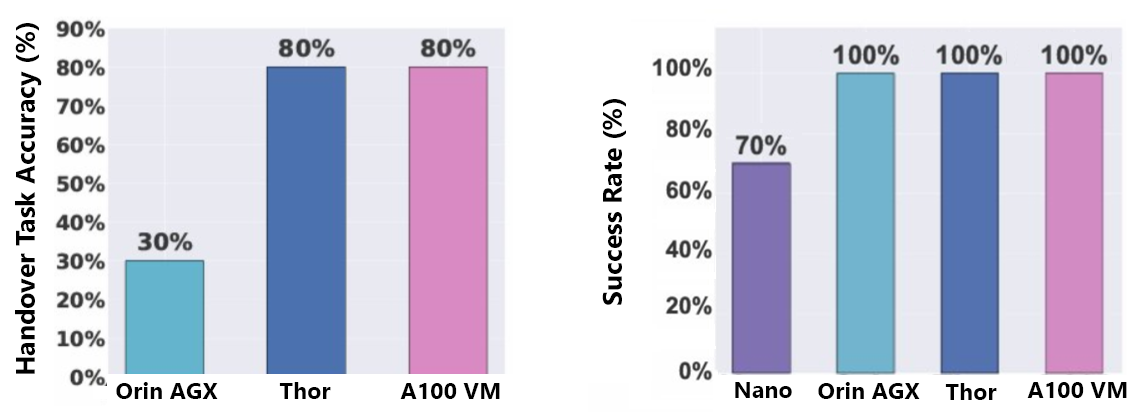 Figure 4: Success rates of robot arms handing over objects to each other when inference is performed with different GPUs (some onboard, and some offloaded). Offloading improves success rates.Benefits in battery lifetime: Beyond performance, onboard GPUs also significantly drained the battery life of the robot. We compared the increase in battery lifetime by replacing an onboard GPU with a Raspberry Pi-5 board and shipping all the data to the offloaded GPU. The larger onboard GPUs, such as Jetson Thor, drained robot batteries by up to 160% (or a few hours) for even the larger robots.
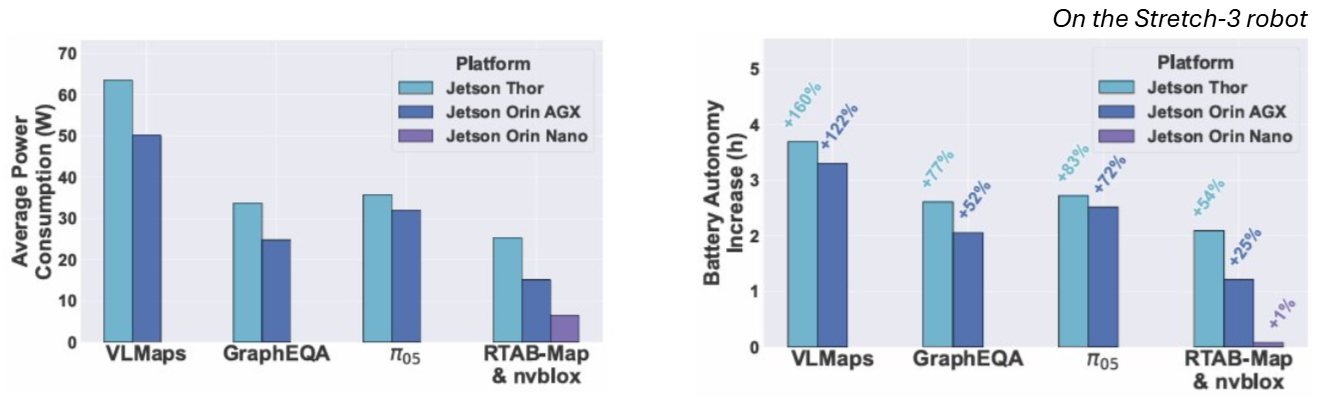 Figure 5: Impact of offloading GPU inference on the battery life of the robots; the above numbers are for the Stretch-3 robot.The above results show that offloading GPU inference out of the robot is critical for functioning in the open world with large models and long battery lifetimes. Nonetheless, offloading inference out of the robot involves a complex tradeoff involving performance, network latency and bandwidth, and available GPU resources. We believe that ourmeasurement studywill inform the design of physical AI inference systems.
Spotlight: Event Series

Microsoft Research Forum
Join us for a continuous exchange of ideas about research in the era of general AI. Watch the latest episodes on demand.
We have built a toolset for easy inference offloading out of the robot and distributing inference between the edge GPU and cloud. Kubernetes is a natural platform to provide a uniform abstraction to distribute robotic AI between the robot’s compute, edge GPU, and overflowing to the cloud. The toolset allows automatic containerization and offloading of robotics workloads using declarative specifications, distributes physical AI containers with smart policies using Kubernetes, and integrates with robotic simulators, LeRobot, and ROS2 for easy development. The sequence of steps below shows how the toolset can be prompted with what to offload, and how it creates a separate container for GPU inference and offloads the same.
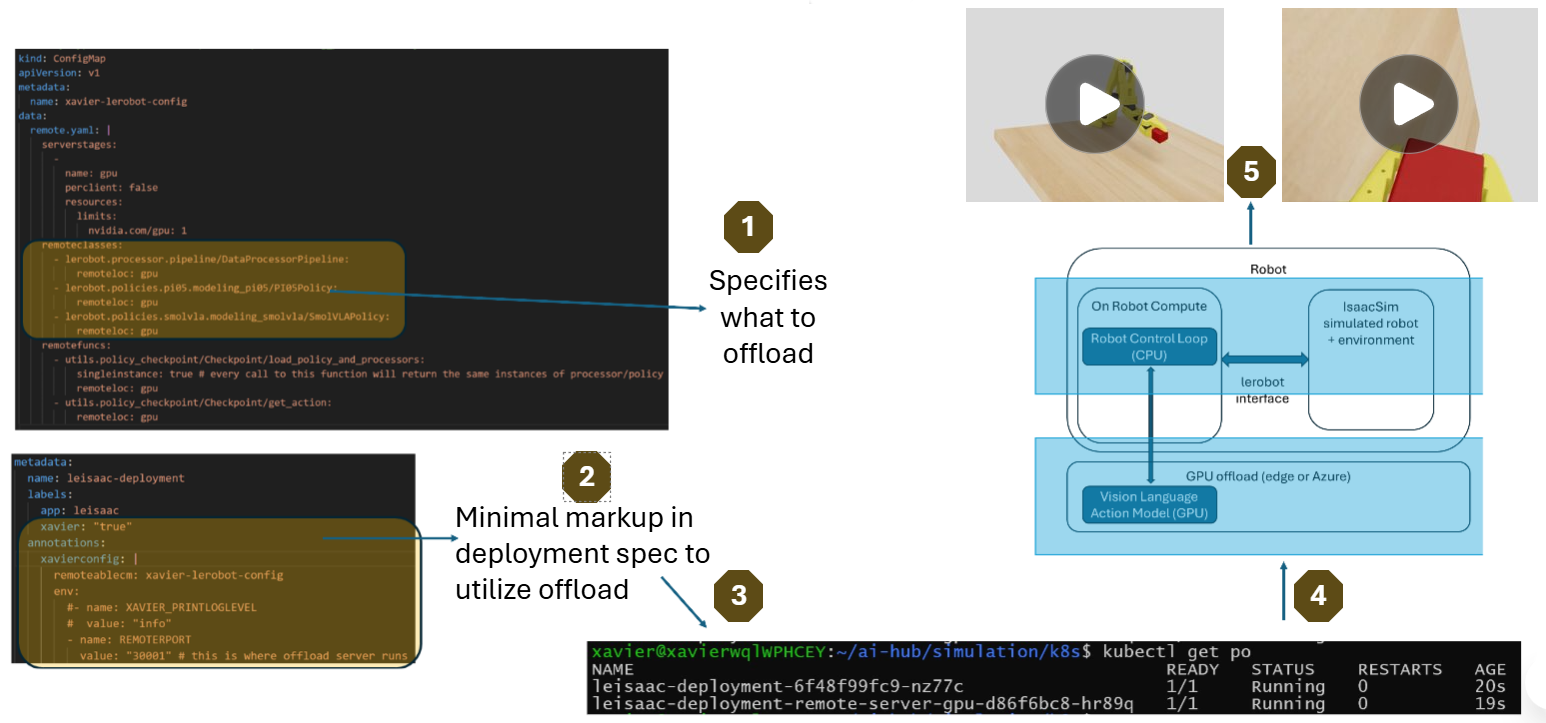 Figure 6: Steps in the offloading toolset with containerization and deployment.Microsoft has recently released thePhysical AI Toolchain(opens in new tab)for operationalizing physical intelligence at scale. Physical AI Toolchain is an open-source, production-ready framework that integratesMicrosoft Azure(opens in new tab)cloud services withNVIDIA’s(opens in new tab)physical AI stack, accelerating robotics and physical AI developers to automate and scale data curation, augmentation, and evaluation across perception, mobility, imitation learning, and reinforcement learning pipelines. We are announcing the addition of an industry-first capability for offloaded physical AI inference for robots as part of the Physical AI Toolchain. This release includes example projects for offloading inference of a SO-101 and a UR10e. The videos below show the offloading of the inference ofMicrosoft’s Rho model, targeted at dual-arm robots, to a Jetson Thor GPU, which controls the actions of theMobile Aloha robot(opens in new tab).
Figure 7a: Offloading of GPU inference of Microsoft’s Rho model controlling the Mobile Aloha robot for interactions with the BusyBox to press the blue button.Figure 7b: Offloading of GPU inference of Microsoft’s Rho model controlling the Mobile Aloha robot for interactions with the BusyBox to turn the knob to position 4. Check out the inference offload feature, look into the source code, and let us know your feedback. We have already tested it with many real-world use cases, and look forward to hearing about your deployment experiences.
Similar Articles
@MSFTResearch: 30x faster analytics, GPU kernels generated automatically from SQL, AI matched to lab-grown tumor models for cancer tre…
Microsoft Research highlights multiple advances including 30x faster analytics with CoddSpeed, AI wildlife re-identification, and LLMs that learn across tasks without retraining in the latest Research Focus newsletter.
@MSFTResearch: New tools, models, repos, and papers out of Microsoft Research are here. Use AI and agents? It's worth watching: • Mage…
Microsoft Research announced new tools, models, repositories, and papers, including MagenticLite, agentic GitHub workflows, verification-first agents, and meaning-matching fine-tuning, during the Microsoft Research Forum virtual series.
Improving the speed and energy-efficiency of AI agents
Researchers from MIT and Microsoft developed an intelligent system that automatically optimizes agentic workflows, reducing computational resources and energy usage while maintaining performance.
The AI war is moving from models to machines and I don’t think enough people are talking about it
A commentary arguing that the AI competition is shifting from model quality to hardware placement and infrastructure, highlighting Microsoft's Project Solara, NVIDIA's RTX Spark, and ByteDance's custom CPU efforts as signs that agentic workloads are driving new silicon and deployment strategies.
@MSFTResearch: The best AI doesn't just scale, it adapts to the languages, cultures, people and communities it serves. Explore three p…
Microsoft Research highlights three playbooks for designing, deploying, and evaluating AI systems with inclusivity in mind, emphasizing adaptation to languages, cultures, and communities.