@no_stp_on_snek: Real talk. Amazing work. adopting for my work. Credit will be in the readme: @haoailab https://github.com/z-lab/dflash …
Summary
DFlash 2, a lightweight block-diffusion model for flash speculative decoding from z-lab/haoailab, enabling efficient high-quality parallel drafting across a wide range of open LLM families with checkpoints released on Hugging Face.
View Cached Full Text
Cached at: 10/06/26, 09:46 AM
Real talk. Amazing work. adopting for my work. Credit will be in the readme: @haoailab https://github.com/z-lab/dflash https://arxiv.org/abs/2604.12989 https://github.com/hao-ai-lab/JetSpec…
z-lab/dflash
Source: https://github.com/z-lab/dflash
DFlash: Block Diffusion for Flash Speculative Decoding
DFlash is a lightweight block diffusion model designed for speculative decoding. It enables efficient and high-quality parallel drafting.
DFlash 2
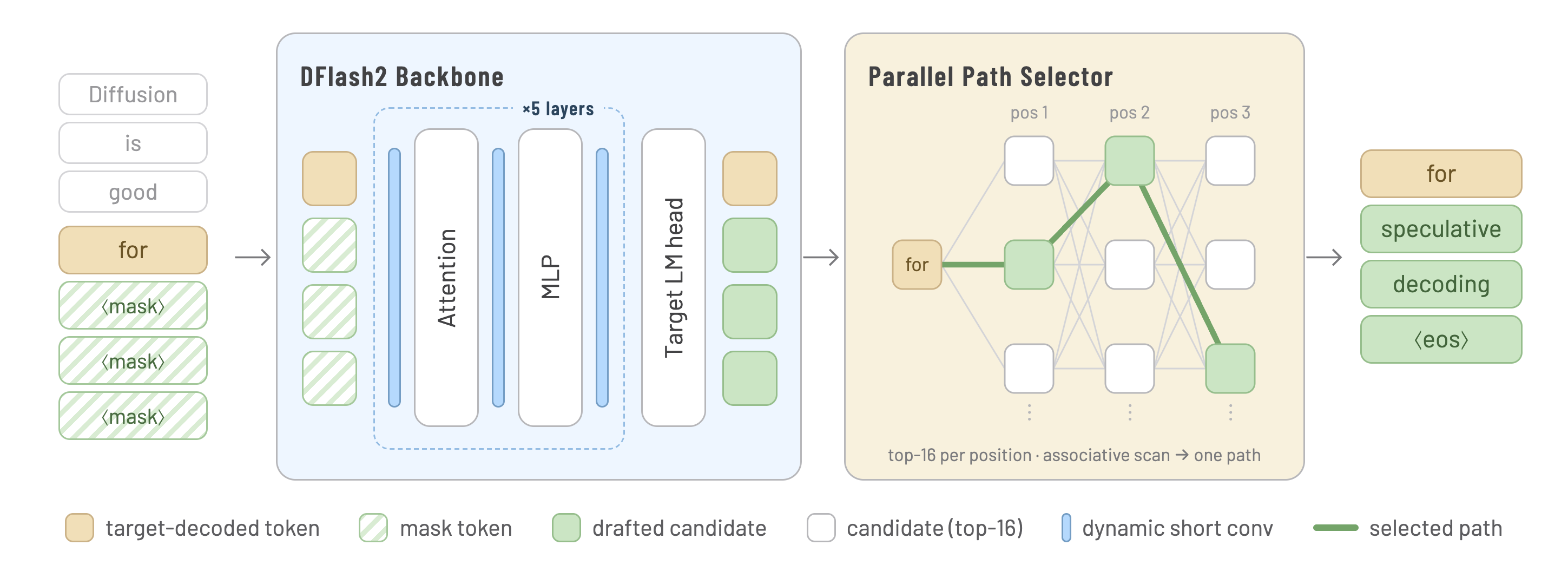
https://github.com/user-attachments/assets/f786e7c5-c2bc-47d4-8a32-1f730a689e1b
DFlash
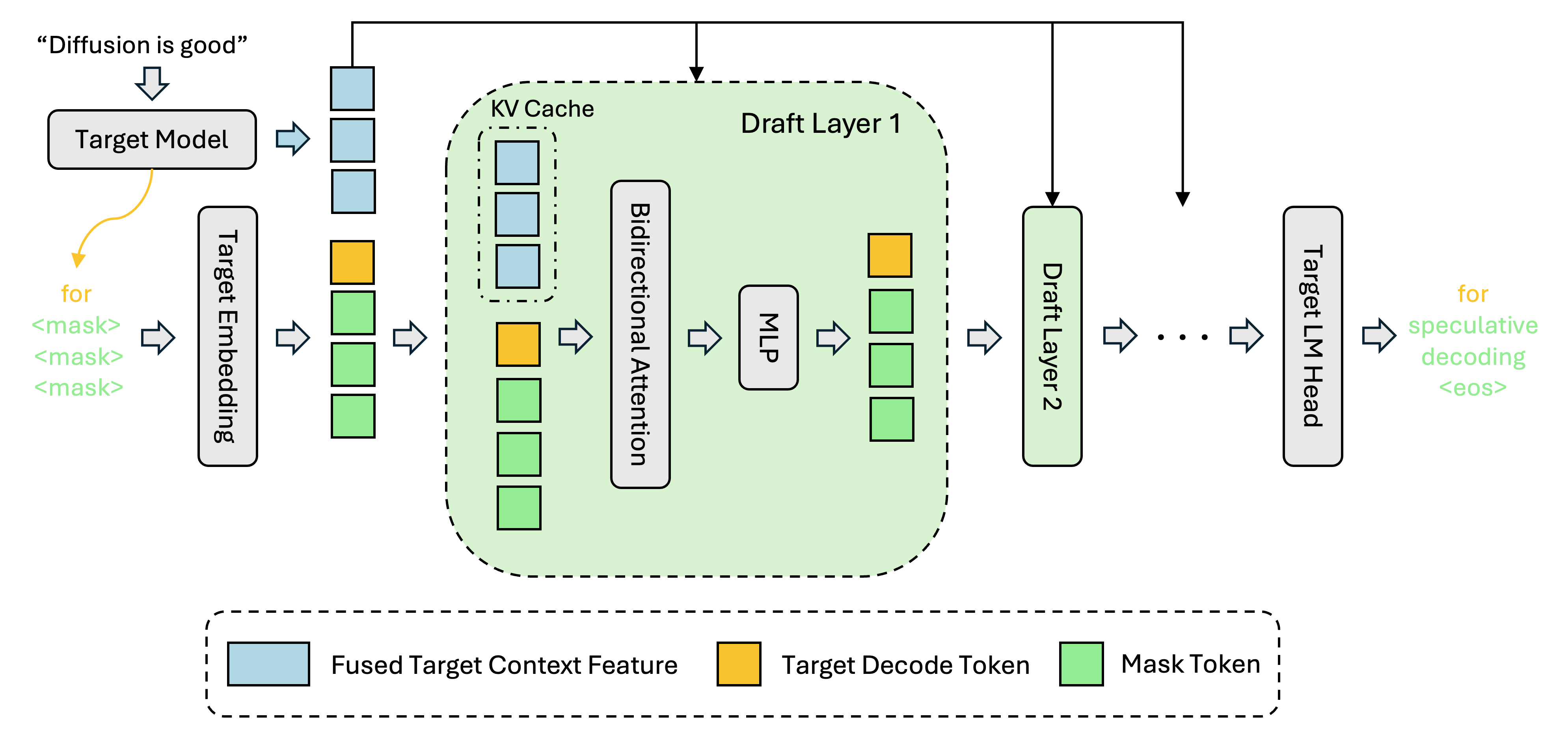
https://github.com/user-attachments/assets/5b29cabb-eb95-44c9-8ffe-367c0758de8c
Supported Models
DFlash 2
Available checkpoints: Muse-Glimmer-30B and Qwen3.8-27B. See the DFlash 2 collection for updates.
DFlash
Public checkpoints are available in the DFlash collection:
- Qwen: Qwen3.6 (27B, 35B-A3B), Qwen3.5 (4B, 9B, 27B, 35B-A3B, 122B-A10B, 397B-A17B), Qwen3 (4B/8B non-thinking, Coder-Next, Coder-30B-A3B)
- Gemma: Gemma 4 (12B, 31B, 26B-A4B)
- MiniMax: M2.5, M2.7
- Kimi: K2.5, K2.6, K2.7-Code
- Others: GPT-OSS (20B, 120B), Llama-3.1-8B, GLM 5.1, Alpamayo 1.5/R1 10B
Use the Transformers or MLX backends below for their explicitly listed model families. Other checkpoints can be benchmarked through an OpenAI-compatible SGLang or vLLM server.
📦 Installation
Install the base package for an OpenAI-compatible server, or include local inference dependencies. The local install uses MLX on Apple Silicon and Transformers on Linux.
pip install dflash
pip install "dflash[local]"  # local inference
For serving benchmarks, install a supported version of SGLang, vLLM, oMLX, or llama.cpp separately, launch its OpenAI-compatible server with DFlash, and pass its --base-url below.
🚀 Quick Start
Transformers
The Transformers backend supports DFlash 2 for Muse-Glimmer-30B, and DFlash for
Qwen3 and LLaMA-3.1-8B. Muse uses reasoning_strength: low, medium, high
(default), or xhigh.
dflash generate transformers \
    --model meta-models/Muse-Glimmer-30B \
    --draft z-lab/Muse-Glimmer-30B-DFlash2 \
    --reasoning high --temperature 1 --top-p 0.95 --top-k 64 \
    "How many positive whole-number divisors does 196 have?"
MLX (Apple Silicon)
The MLX backend supports DFlash 2 for Qwen3.8-27B, and DFlash for Qwen3,
Qwen3.5, Qwen3.6, and Gemma 4. Qwen3.8 uses reasoning_effort: low, medium,
or xhigh (default). For quantized targets or drafts, use block_size <= 5: MLX’s current
quantized matmul kernel becomes less efficient at larger verify widths.
The example below runs both the target and draft with 4-bit weights.
dflash generate mlx \
    --model mlx-community/Qwen3.8-27B-4bit \
    --draft z-lab/Qwen3.8-27B-DFlash2 \
    --draft-bits 4 --block-size 5 --reasoning xhigh \
    "How many positive whole-number divisors does 196 have?"
OpenAI-compatible server
Launch the latest SGLang or vLLM server separately, then run:
dflash generate openai \
    --base-url http://127.0.0.1:8000 --model Qwen/Qwen3.8-27B \
    "How many positive whole-number divisors does 196 have?"
📊 Evaluation
All benchmarks share the same datasets (gsm8k, math500, humaneval, mbpp, mt-bench), downloaded and cached by Hugging Face Datasets.
OpenAI-compatible server (SGLang or vLLM):
dflash benchmark openai \
    --base-url http://127.0.0.1:8000 --model Qwen/Qwen3.8-27B \
    --dataset gsm8k --num-prompts 128 --concurrency 1 --reasoning xhigh \
    --temperature 1 --top-p 0.95 --top-k 20
Transformers (Muse-Glimmer-30B DFlash 2):
dflash benchmark transformers \
    --model meta-models/Muse-Glimmer-30B --draft z-lab/Muse-Glimmer-30B-DFlash2 \
    --dataset gsm8k --max-samples 128 --reasoning high
MLX (Qwen3.8-27B 4-bit DFlash 2):
dflash benchmark mlx \
    --model mlx-community/Qwen3.8-27B-4bit --draft z-lab/Qwen3.8-27B-DFlash2 \
    --dataset gsm8k --max-samples 128 --reasoning xhigh --block-size 5 --draft-bits 4
Acknowledgement
Huge thanks to @dcw02, @gongy, and the team at @modal-labs for their fast, high-quality support in bringing DFlash to SGLang. And huge thanks as well to @benchislett at NVIDIA for his work in bringing DFlash to vLLM and helping make it available to the broader serving community.
Citation
If you find DFlash useful, please cite our work. To share feedback on DFlash or request new model support, please fill out this form: DFlash Feedback.
@article{chen2026dflash,
  title   = {{DFlash: Block Diffusion for Flash Speculative Decoding}},
  author  = {Chen, Jian and Liang, Yesheng and Liu, Zhijian},
  journal = {arXiv preprint arXiv:2602.06036},
  year    = {2026}
}

@misc{inco2026dflash2,
  title  = {DFlash 2: Keep Drafting Parallel},
  author = {{Inco AI}},
  year   = {2026},
  month  = {August},
  url    = {https://inco.ai/blog/dflash2/}
}
Similar Articles
@zhijianliu_: DFlash is now running in a production inference stack. More draft models coming soon. https://github.com/z-lab/dflash
DFlash is a lightweight block diffusion model for speculative decoding, now running in production with support for various LLMs like Qwen and Gemma.
DFlash: Block Diffusion for Flash Speculative Decoding
DFlash is a new speculative decoding framework that uses a lightweight block diffusion model for parallel token drafting, achieving over 6x acceleration compared to autoregressive methods. It significantly outperforms existing state-of-the-art methods like EAGLE-3 while maintaining high output quality.
DFlash and Spec V2 Decoding (14 minute read)
Z Lab, SGLang, and Modal release DFlash, a new speculative decoding model for Qwen 3.5 397B-A17B that uses block diffusion and KV injection to achieve over 4x throughput improvement over baseline and 1.5x over native MTP.
z-lab/dflash
DFlash introduces a block diffusion method for flash speculative decoding to enhance inference speed in large language models.
@charles_irl: Speculation Is All You Need. In this blog post, we announce the co-release (w/ Z Lab) of six more state-of-the-art DFla…
Modal and Z Lab release six new DFlash speculative decoding draft models for Qwen 3.x, achieving over 1000 tokens per second on a B200 and arguing that speculative decoding is the most impactful inference optimization.