EVOKE: Eliciting World Knowledge in Agents for Transferable Decision-Making
Summary
EVOKE is a post-training method that elicits world knowledge already present in pretrained LLM agents by contrasting alternative goals at fixed states, training policies to rank candidate actions by their consequences rather than contextual habits. It achieves state-of-the-art results across ALFWorld, WebShop, and search-based QA, and transfers well to unseen environments without needing world models or inference-time planning.
View Cached Full Text
Cached at: 10/01/26, 08:23 AM
Paper page - EVOKE: Eliciting World Knowledge in Agents for Transferable Decision-Making
Source: https://huggingface.co/papers/2609.38334
EVOKEis a post-training method that elicits the world knowledge already inside pretrained LLM agents, so that they decide by theconsequences of their actionsrather than by contextual habits. It holds the state fixed, swaps in alternative goals, and trains the policy to rank thesame candidate actionsunder each goal, with no world-model module and no inference-time planning.
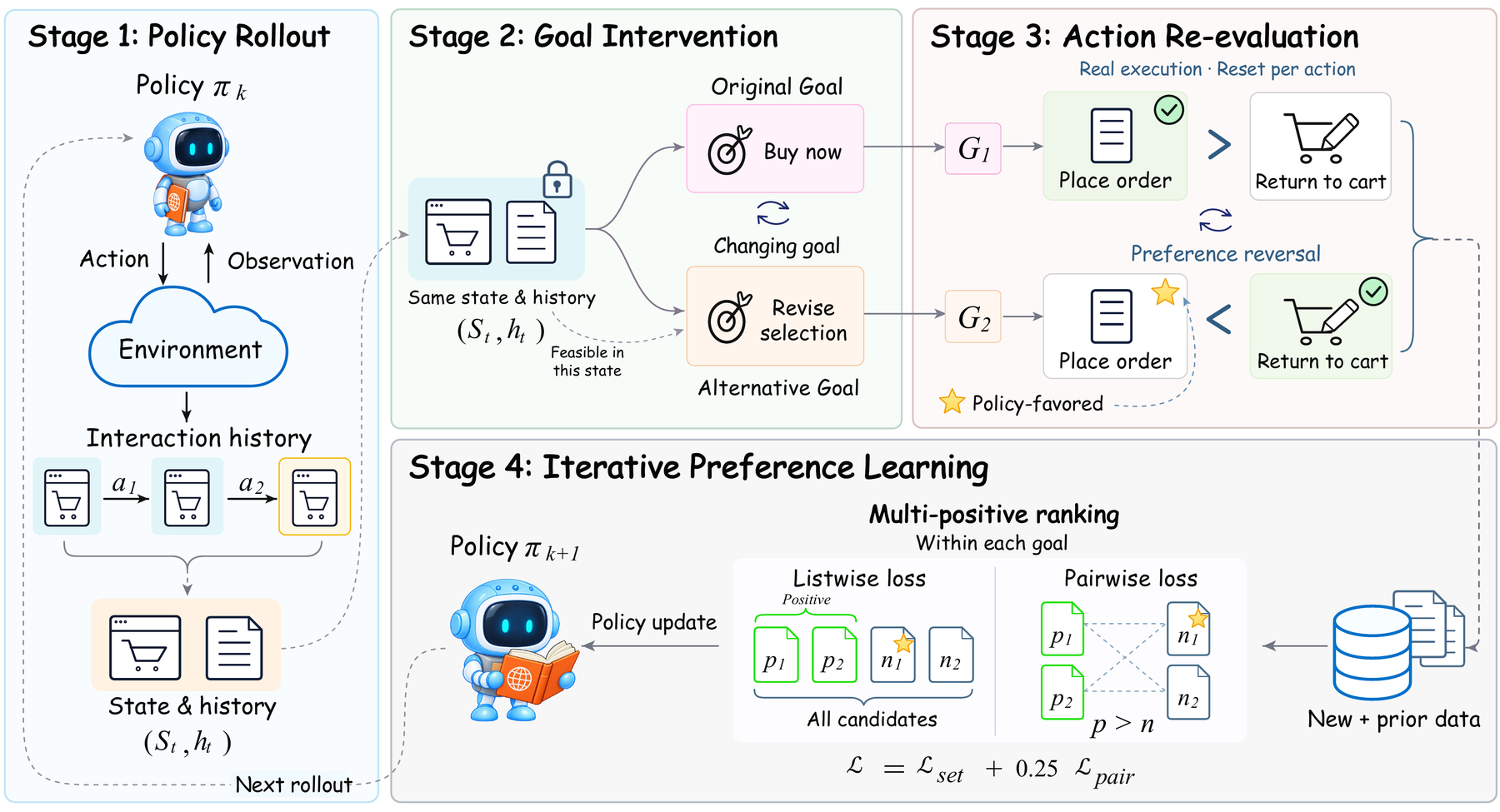 The EVOKE training loop. At collected states, actions are executed and assessed under alternative goals with the state, history, and available actions fixed. The policy learns by contrastive ranking on aggregated preferences; actions can switch between positive and competing across goals.
https://huggingface.co/papers/2609.38334#%E2%9C%A8-highlights✨ Highlights
- 🚀Best across the board— best average on ALFWorld, WebShop, and search-based QA with all three backbones.
- 🌍Transfers to unseen environments—**91.1% / 93.1% / 84.6%**on unseen ALFWorld games (Qwen2.5-3B / 7B / Qwen3-1.7B).
- 🧠Elicits, not adds, knowledge— the backbone already encodes action consequences; EVOKE makes the policy decide by the goal rather than by habit.
https://huggingface.co/papers/2609.38334#%F0%9F%92%A1-from-prediction-to-preference💡 From Prediction to Preference
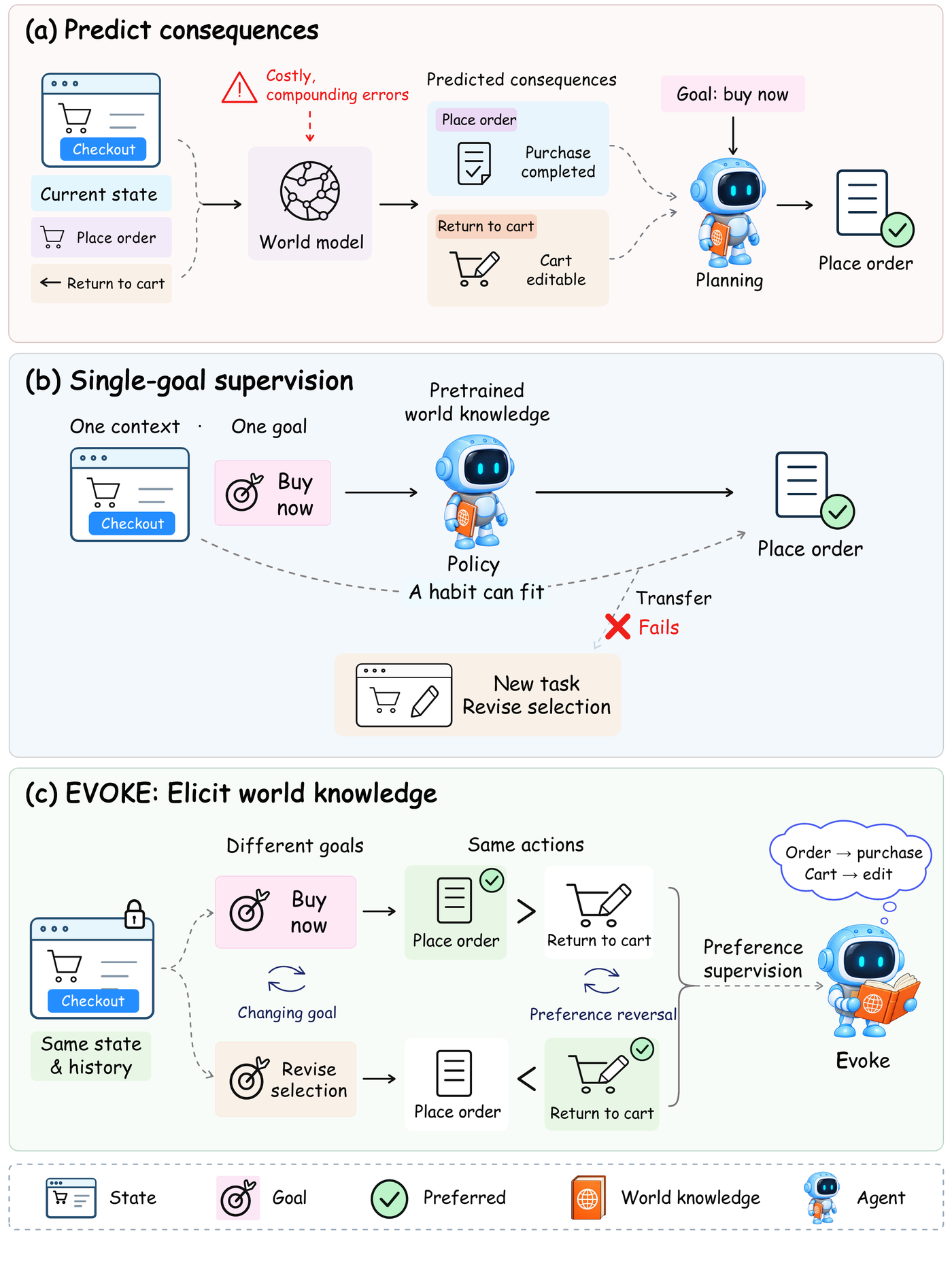 Do agents need topredictconsequences to use them?
**(a) Predict consequences.**World models learn to predict future observations, adding cost and compounding errors in planning.
**(b) Single-goal supervision.**The knowledge is already in pretrained LLMs, but one goal per state lets the policy fit habits that fail to transfer.
**(c) EVOKE.**Change the goal at a fixed state. Preferences flip, so habits fail and the policy must use its knowledge of consequences.
https://huggingface.co/papers/2609.38334#%F0%9F%93%8A-results📊 Results
https://huggingface.co/papers/2609.38334#main-resultsMain Results
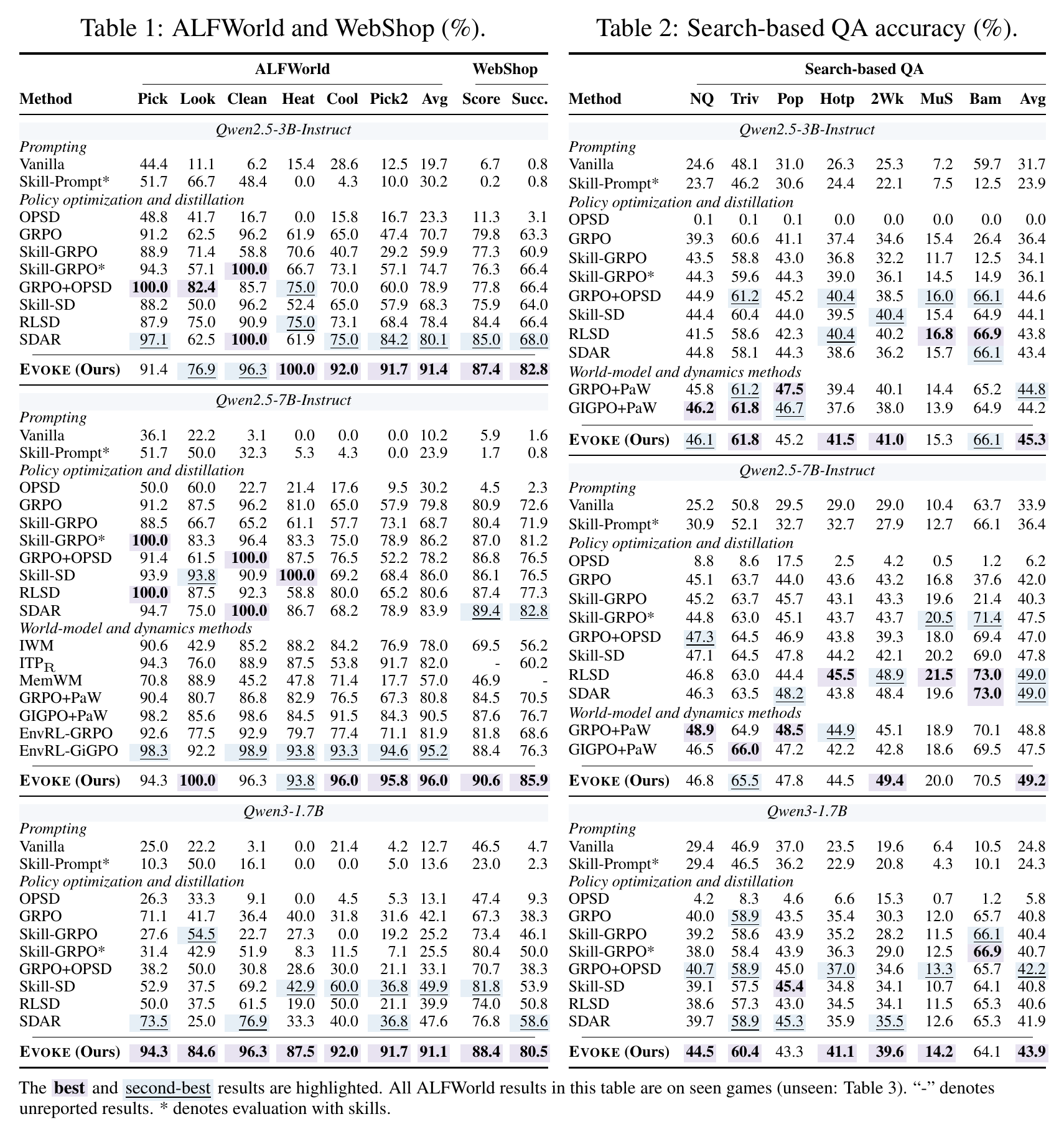 Main results on ALFWorld and WebShop (left) and search-based QA (right) across three backbones.
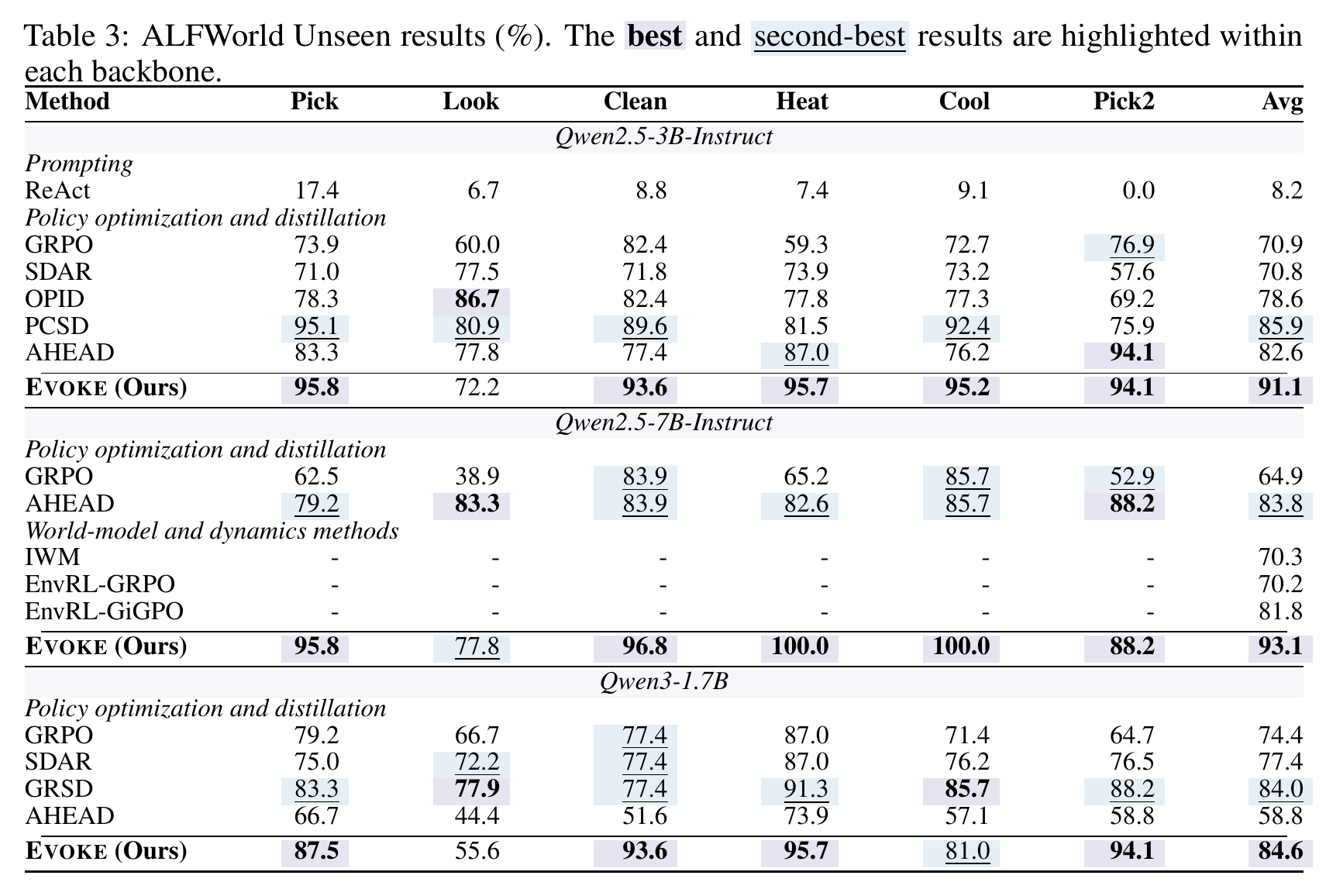 Generalization to unseen ALFWorld games.
https://huggingface.co/papers/2609.38334#analysisAnalysis
All analyses use Qwen2.5-3B on ALFWorld unless noted.
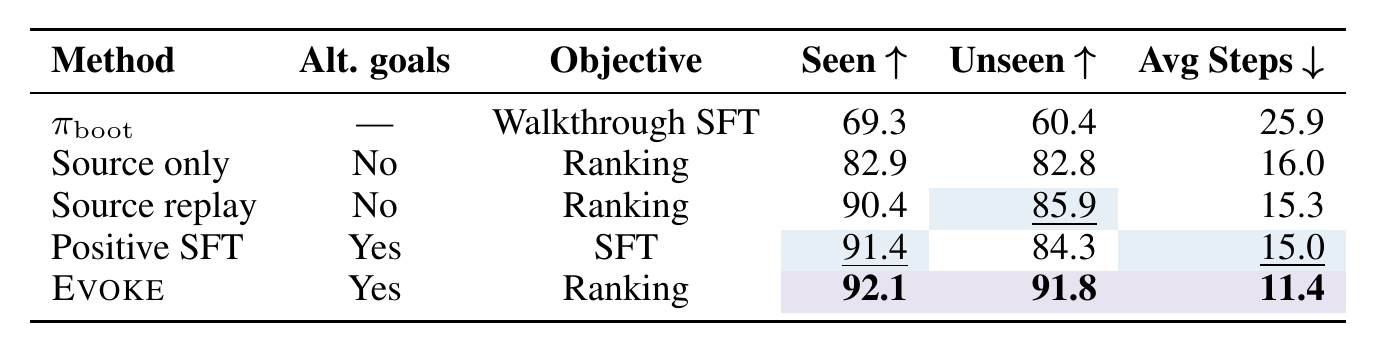 ***Decision-supervision ablations.*Removing alternative goals or replacing ranking with imitation hurts unseen success. Micro success (%) and average unseen steps, averaged over training seeds.
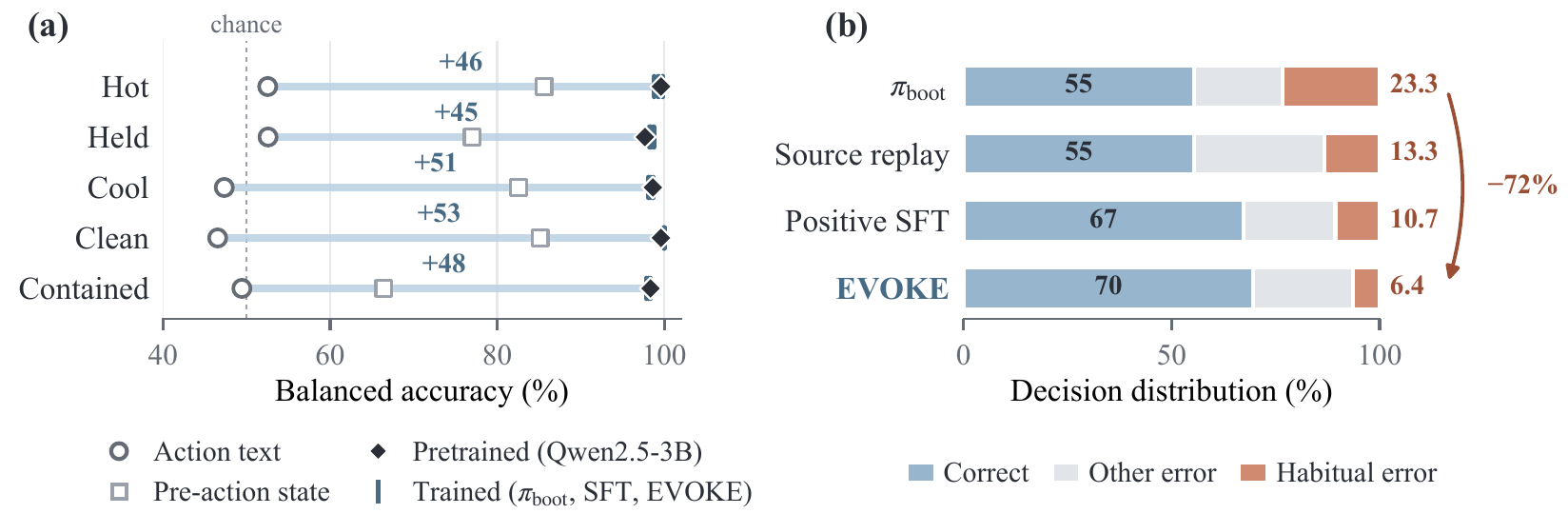 From knowledge to goal-directed decisions.(a) Action consequences are linearly decodable before any ALFWorld training. (b) EVOKE makes the fewest habitual errors, i.e., choosing the action that is correct for another goal in the same context.
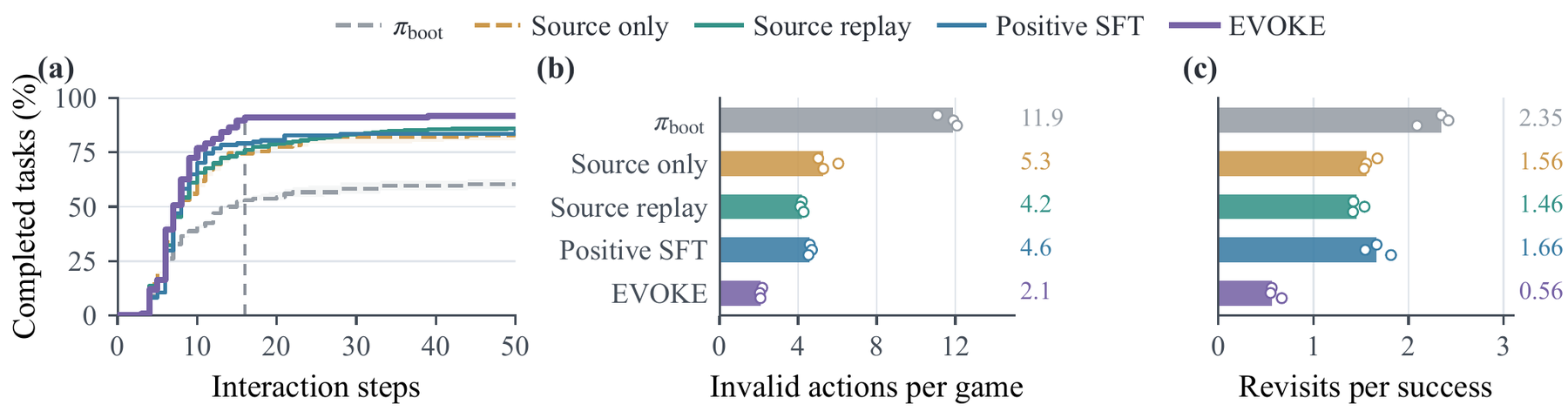 ***Execution on unseen games.*EVOKE succeeds earlier and wastes fewer actions: (a) cumulative success over steps, (b) invalid actions per game, (c) revisits per successful game.
https://huggingface.co/papers/2609.38334#%F0%9F%93%9D-citation📝 Citation
@article{guo2026evoke,
  title={EVOKE: Eliciting World Knowledge in Agents for Transferable Decision-Making},
  author={Guo, Yuhan and Liu, Jinming and Xu, Liang and Li, Ziqiang and Huang, Jianguo and Wang, Zhicheng and Zhu, Hu and Chen, Qiuyu and Wei, Yuntao and Jin, Xin and Zeng, Wenjun},
  journal={arXiv preprint arXiv:2609.38334},
  year={2026}
}
Similar Articles
Alaya-EVOKE: From Linear-Scaling Supervision to Endless World
Evoke is an interactive world model with external persistent memory and a redesigned long-horizon teacher, enabling open-ended video generation with bounded context and low latency. It achieves state-of-the-art performance on WBench while staying competitive on VBench-Long and VBench-2.0.
OPINE-World: Programmatic World Modeling with Ontology-error-Prioritized Interactive Exploration
OPINE-World introduces an LLM agent that learns an object-centric programmatic world model online through interaction, using ontology-error-prioritized exploration and cooperating hypothesis-test agents, achieving strong results on ARC-AGI-3.
Training LLM Agents for Spontaneous, Reward-Free Self-Evolution via World Knowledge Exploration
This paper proposes a method to train LLM agents with intrinsic meta-evolution capabilities, enabling spontaneous self-improvement without external rewards at inference time. Applied to Qwen3-30B and Seed-OSS-36B, the approach yields a 20% performance boost on web navigation benchmarks, with a 14B model outperforming Gemini-2.5-Flash.
Rethinking Experience Utilization in Self-Evolving Language Model Agents
This paper introduces ExpWeaver, a framework that optimizes how self-evolving language model agents utilize past experiences during runtime decision-making. It demonstrates that selectively invoking experience based on reasoning uncertainty improves performance across various environments and models.
Agent-Editing World Model: Rethinking World Modeling for LLM Agents
This paper proposes the Agent-Editing World Model (AEWM) to enhance LLM agents by modeling how reasoning and actions shape future task progress, achieving significant performance improvements on benchmarks across domains like search and software engineering.