The University of Manchester has used NVIDIA's Earth-2 AI models to develop a forecasting system for air pollution across the UK, aiming to improve public health responses and policy decisions.
<div id="bsf_rt_marker"></div><p><span style="font-weight: 400;">Air pollution is a serious public health risk, contributing to an </span><a target="_blank" href="https://www.rcp.ac.uk/news-and-media/news-and-opinion/air-pollution-linked-to-30-000-uk-deaths-in-2025-and-costs-the-economy-and-nhs-billions-warns-royal-college-of-physicians/"><span style="font-weight: 400;">estimated 30,000 deaths</span></a><span style="font-weight: 400;"> in the U.K. alone last year. Data-driven insights can help — but computing air quality with traditional chemistry-based models is expensive, which limits how detailed they can be and how regularly they can be run. </span></p>
<p><span style="font-weight: 400;">David Topping, a professor in the University of Manchester’s department of Earth and environmental science, saw that the </span><a target="_blank" href="https://www.nvidia.com/en-us/high-performance-computing/earth-2/"><span style="font-weight: 400;">NVIDIA Earth-2</span></a><span style="font-weight: 400;"> family of open AI models and tools had cracked a related problem for weather forecasting — and asked whether the same generative frameworks could work for pollution fields.</span></p>
<p><span style="font-weight: 400;">“The biggest challenge is the compute required to forecast air quality,” said Topping. “Once you put chemistry into weather models, they get really, really slow. So I said, why don’t we try using the generative frameworks that NVIDIA develops for climate and weather for pollution fields?”</span></p>
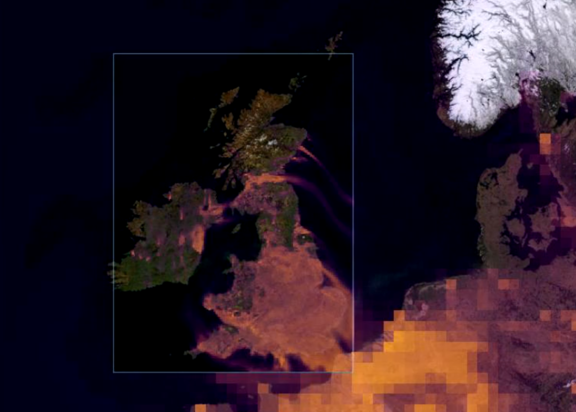
<p><span style="font-weight: 400;">Working with the NVIDIA Earth-2 team, Topping and colleagues generated training data from existing chemistry-climate simulations, then trained </span><a target="_blank" href="https://docs.nvidia.com/nim/earth-2/corrdiff/latest/overview.html"><span style="font-weight: 400;">Earth-2 CorrDiff</span></a><span style="font-weight: 400;"> — a generative downscaling model — on Isambard-AI, the U.K.’s national AI supercomputer in Bristol. </span></p>
<p><span style="font-weight: 400;">The model worked on the first attempt. </span></p>
<p><img fetchpriority="high" decoding="async" class="aligncenter wp-image-98316 size-full" src="https://blogs.nvidia.com/wp-content/uploads/2026/09/CorDiff-e1789533538712.png" alt="" width="576" height="412" /></p>
<p><span style="font-weight: 400;">The team has since added Earth-2 StormCast, a model that enables time-dependent forecasts that directly use air quality observations, and showed the test-training and inference workflows running on the </span><a target="_blank" href="https://www.nvidia.com/en-us/products/workstations/dgx-spark/"><span style="font-weight: 400;">NVIDIA DGX Spark</span></a><span style="font-weight: 400;"> personal AI supercomputer.</span></p>
<p><span style="font-weight: 400;">“To improve human health, it’s essential that we understand the impact of environmental stressors in the air we breathe,” said Topping. “Our U.K.-wide pollution model allows us to model potential future scenarios, such as predicting what would happen if different pollution-related government policy changes went into effect.</span></p>
<div class="center-video">
<div style="width: 640px;" class="wp-video"><video class="wp-video-shortcode" id="video-98313-1" width="640" height="800" poster="https://blogs.nvidia.com/wp-content/uploads/2026/09/Screenshot-2026-09-15-at-9.32.58-PM.png" preload="metadata" controls="controls"><source type="video/mp4" src="https://blogs.nvidia.com/wp-content/uploads/2026/09/Adobe-Express-UKairpollution-4.mp4?_=1" /><a href="https://blogs.nvidia.com/wp-content/uploads/2026/09/Adobe-Express-UKairpollution-4.mp4">https://blogs.nvidia.com/wp-content/uploads/2026/09/Adobe-Express-UKairpollution-4.mp4</a></video></div>
</div>
<p><em>Video credit: Bristol Centre for Supercomputing (BriCS) @ University of Bristol</em></p>
<p><span style="font-weight: 400;">Another potential application is proactive air quality insights for healthcare organizations. Topping envisions a scenario where regional and national healthcare services could reach out to patients with conditions like asthma to let them know that air pollution is going to be high in their area tomorrow, or next week. </span></p>
<p><span style="font-weight: 400;">The team is also exploring how the air pollution model could pair with data from edge AI devices to ingest real-time air quality data and drive real-time decision making, such as in the event of a wildfire. </span></p>
<p><span style="font-weight: 400;">“The fact that this model trained in two days on Isambard-AI — and can now run on a DGX Spark sitting on a desk — changes who can do this science and how quickly,” said Niall Robinson, developer relations manager for weather and climate at NVIDIA. “We’re just at the beginning of what these open workflows can do globally.” </span></p>
<p><span style="font-weight: 400;">“The ability to switch from one NVIDIA framework to another was really impressive,” said Hao Zhang, a doctoral student at the University of Manchester who trained StormCast on Isambard-AI. “We’re only just starting to explore how to use these frameworks in different ways to model complex pollution fields.”</span></p>
<h2><b>From National Supercomputer to the Desktop</b></h2>
<p><img decoding="async" class="aligncenter size-large wp-image-98318" src="https://blogs.nvidia.com/wp-content/uploads/2026/09/Is-AI-Poll-02-1680x938.jpg" alt="" width="1200" height="670" srcset="https://blogs.nvidia.com/wp-content/uploads/2026/09/Is-AI-Poll-02-1680x938.jpg 1680w, https://blogs.nvidia.com/wp-content/uploads/2026/09/Is-AI-Poll-02-960x536.jpg 960w, https://blogs.nvidia.com/wp-content/uploads/2026/09/Is-AI-Poll-02-1280x715.jpg 1280w, https://blogs.nvidia.com/wp-content/uploads/2026/09/Is-AI-Poll-02-1536x858.jpg 1536w, https://blogs.nvidia.com/wp-content/uploads/2026/09/Is-AI-Poll-02-scaled.jpg 2048w, https://blogs.nvidia.com/wp-content/uploads/2026/09/Is-AI-Poll-02-630x352.jpg 630w, https://blogs.nvidia.com/wp-content/uploads/2026/09/Is-AI-Poll-02-300x169.jpg 300w" sizes="(max-width: 1200px) 100vw, 1200px" /><br style="font-weight: 400;" /><span style="font-weight: 400;">To retrain the Earth-2 model for air pollution, Topping and the team used a year’s worth of U.K. pollution data simulated at hourly intervals to generate a detailed, U.K.-wide pollution model at a resolution of 2-3 square kilometers.</span></p>
<p><span style="font-weight: 400;">Running on a single, eight-GPU node on </span><a href="https://blogs.nvidia.com/blog/isambard-ai/"><span style="font-weight: 400;">Isambard-AI</span></a><span style="font-weight: 400;"> — the U.K.’s most powerful AI supercomputer, packed with 5,448 NVIDIA GH200 Grace Hopper Superchips delivering 21 exaflops of AI performance — the process took just two days.</span></p>
<p><span style="font-weight: 400;">“Earth-2 CorrDiff has shown an incredibly efficient use of the world-class NVIDIA hardware inside Isambard-AI,” said Simon McIntosh-Smith, director of the </span><a target="_blank" href="https://www.youtube.com/@brics-uob"><span style="font-weight: 400;">Bristol Centre for Supercomputing</span></a> <span style="font-weight: 400;">at University of Bristol and cofounder of Isambard-AI. “It’s fitting that, for a climate-based project, the GPU hours used were relatively low, requiring less power from the supercomputer to run the workloads.”</span></p>
<p><span style="font-weight: 400;">In addition to providing a look back at air pollution over the past year, the model can help predict future air pollution scenarios for the U.K. The team plans to further increase the resolution of its model by incorporating additional open data, enabling researchers to understand air pollution at street scale. </span></p>
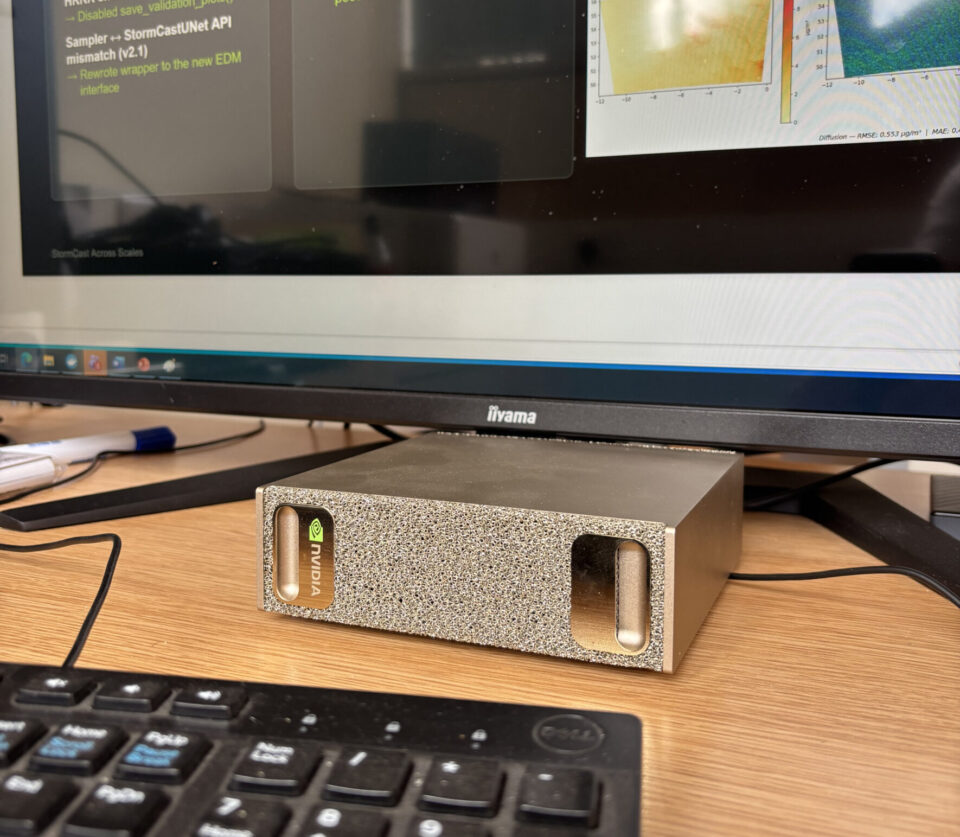
<p><span style="font-weight: 400;">The same generative pollution workflow also runs on the NVIDIA GB10 Grace Blackwell superchip-powered DGX Spark desktop AI system for inference and smaller training runs. Topping now has an DGX Spark system in his office retraining models.</span></p>
<p><span style="font-weight: 400;">“You can now invest a few thousand dollars to get started developing powerful AI models,” Topping said.</span></p>
<p><img decoding="async" class="aligncenter wp-image-98320 size-medium" src="https://blogs.nvidia.com/wp-content/uploads/2026/09/IMG_2629-1-scaled-e1789533733316-960x837.jpeg" alt="" width="960" height="837" srcset="https://blogs.nvidia.com/wp-content/uploads/2026/09/IMG_2629-1-scaled-e1789533733316-960x837.jpeg 960w, https://blogs.nvidia.com/wp-content/uploads/2026/09/IMG_2629-1-scaled-e1789533733316-1680x1465.jpeg 1680w, https://blogs.nvidia.com/wp-content/uploads/2026/09/IMG_2629-1-scaled-e1789533733316-1280x1116.jpeg 1280w, https://blogs.nvidia.com/wp-content/uploads/2026/09/IMG_2629-1-scaled-e1789533733316-1536x1339.jpeg 1536w, https://blogs.nvidia.com/wp-content/uploads/2026/09/IMG_2629-1-scaled-e1789533733316-630x549.jpeg 630w, https://blogs.nvidia.com/wp-content/uploads/2026/09/IMG_2629-1-scaled-e1789533733316.jpeg 1770w" sizes="(max-width: 960px) 100vw, 960px" /></p>
<h2><b>Open Science, Agentic Future</b></h2>
<p><span style="font-weight: 400;">The team plans to release open source training data and workflows for the pollution models will be released so that similar models can be trained for other countries and regions. </span></p>
<p><span style="font-weight: 400;">“Our aim is to offer this workflow to the entire world,” he said. “We hope that every global country and every major city with a small burst of supercomputer AI time will be able to produce their own detailed pollution models with their own local data.” </span></p>
<p><span style="font-weight: 400;">Looking five years out, Topping sees the endpoint as something simpler still: an agentic interface where a clinician or government agency asks the question and the chain of models handles everything else. </span></p>
<p><span style="font-weight: 400;">“With better open access to air quality observations, someone could ask our pollution model running on DGX Spark: what’s the pollution going to be like in this neighborhood tomorrow?” he said. “And a whole chain of interactions will deliver an answer, grounded on the science these frameworks represent.”</span></p>
<p><i><span style="font-weight: 400;">Learn more about </span></i><a target="_blank" href="https://www.nvidia.com/en-us/high-performance-computing/earth-2/"><i><span style="font-weight: 400;">NVIDIA Earth-2</span></i></a><i><span style="font-weight: 400;"> climate and weather AI.</span></i></p>
# University of Manchester Uses NVIDIA Earth-2 to Forecast Air Pollution Across the UK
Source: [https://blogs.nvidia.com/blog/uk-air-pollution-research-earth-2/](https://blogs.nvidia.com/blog/uk-air-pollution-research-earth-2/)
Air pollution is a serious public health risk, contributing to an[estimated 30,000 deaths](https://www.rcp.ac.uk/news-and-media/news-and-opinion/air-pollution-linked-to-30-000-uk-deaths-in-2025-and-costs-the-economy-and-nhs-billions-warns-royal-college-of-physicians/)in the U\.K\. alone last year\. Data\-driven insights can help — but computing air quality with traditional chemistry\-based models is expensive, which limits how detailed they can be and how regularly they can be run\.
David Topping, a professor in the University of Manchester’s department of Earth and environmental science, saw that the[NVIDIA Earth\-2](https://www.nvidia.com/en-us/high-performance-computing/earth-2/)family of open AI models and tools had cracked a related problem for weather forecasting — and asked whether the same generative frameworks could work for pollution fields\.
“The biggest challenge is the compute required to forecast air quality,” said Topping\. “Once you put chemistry into weather models, they get really, really slow\. So I said, why don’t we try using the generative frameworks that NVIDIA develops for climate and weather for pollution fields?”
Working with the NVIDIA Earth\-2 team, Topping and colleagues generated training data from existing chemistry\-climate simulations, then trained[Earth\-2 CorrDiff](https://docs.nvidia.com/nim/earth-2/corrdiff/latest/overview.html)— a generative downscaling model — on Isambard\-AI, the U\.K\.’s national AI supercomputer in Bristol\.
The model worked on the first attempt\.
The team has since added Earth\-2 StormCast, a model that enables time\-dependent forecasts that directly use air quality observations, and showed the test\-training and inference workflows running on the[NVIDIA DGX Spark](https://www.nvidia.com/en-us/products/workstations/dgx-spark/)personal AI supercomputer\.
“To improve human health, it’s essential that we understand the impact of environmental stressors in the air we breathe,” said Topping\. “Our U\.K\.\-wide pollution model allows us to model potential future scenarios, such as predicting what would happen if different pollution\-related government policy changes went into effect\.
*Video credit: Bristol Centre for Supercomputing \(BriCS\) @ University of Bristol*
Another potential application is proactive air quality insights for healthcare organizations\. Topping envisions a scenario where regional and national healthcare services could reach out to patients with conditions like asthma to let them know that air pollution is going to be high in their area tomorrow, or next week\.
The team is also exploring how the air pollution model could pair with data from edge AI devices to ingest real\-time air quality data and drive real\-time decision making, such as in the event of a wildfire\.
“The fact that this model trained in two days on Isambard\-AI — and can now run on a DGX Spark sitting on a desk — changes who can do this science and how quickly,” said Niall Robinson, developer relations manager for weather and climate at NVIDIA\. “We’re just at the beginning of what these open workflows can do globally\.”
“The ability to switch from one NVIDIA framework to another was really impressive,” said Hao Zhang, a doctoral student at the University of Manchester who trained StormCast on Isambard\-AI\. “We’re only just starting to explore how to use these frameworks in different ways to model complex pollution fields\.”
## **From National Supercomputer to the Desktop**
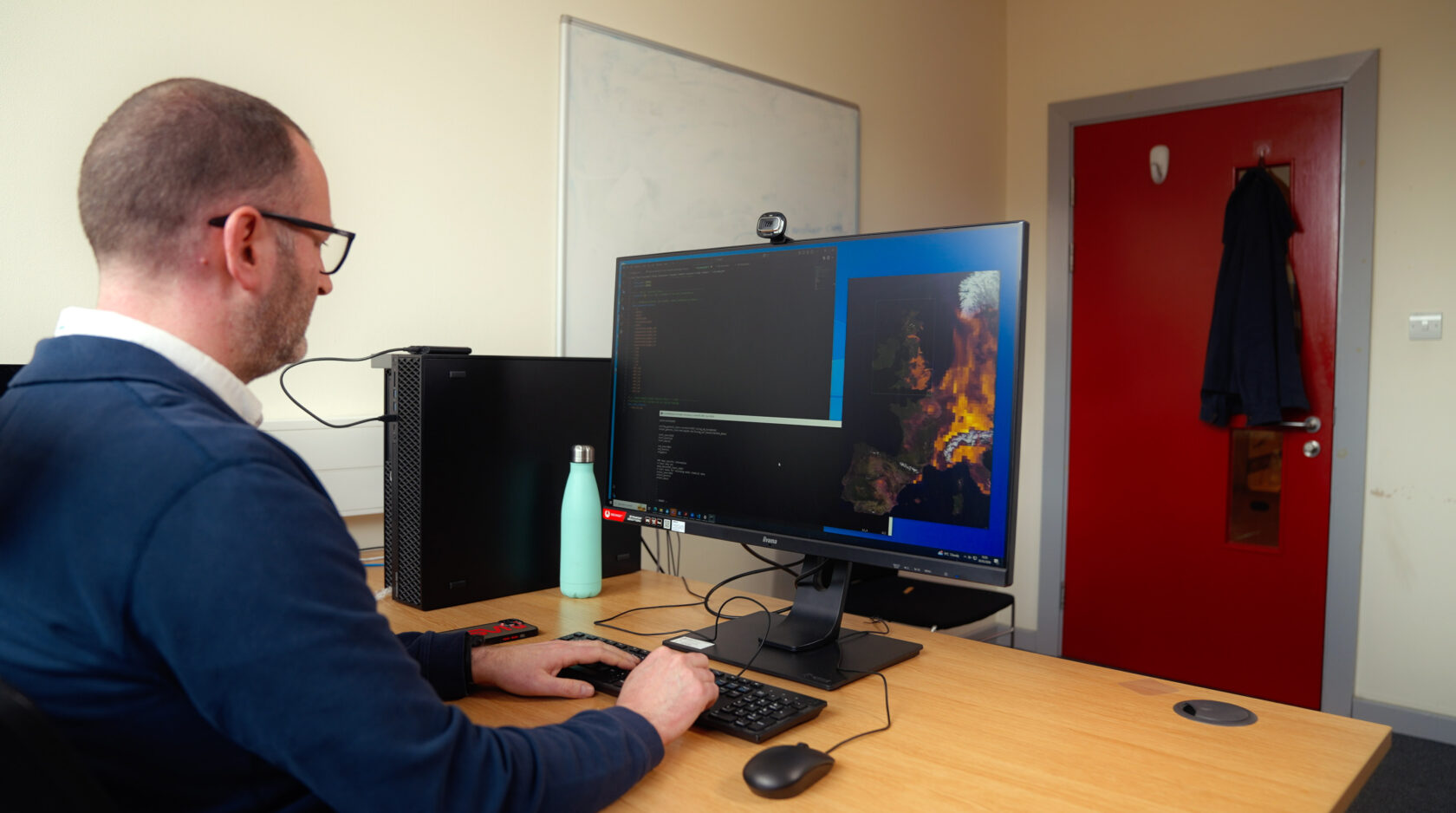 To retrain the Earth\-2 model for air pollution, Topping and the team used a year’s worth of U\.K\. pollution data simulated at hourly intervals to generate a detailed, U\.K\.\-wide pollution model at a resolution of 2\-3 square kilometers\.
Running on a single, eight\-GPU node on[Isambard\-AI](https://blogs.nvidia.com/blog/isambard-ai/)— the U\.K\.’s most powerful AI supercomputer, packed with 5,448 NVIDIA GH200 Grace Hopper Superchips delivering 21 exaflops of AI performance — the process took just two days\.
“Earth\-2 CorrDiff has shown an incredibly efficient use of the world\-class NVIDIA hardware inside Isambard\-AI,” said Simon McIntosh\-Smith, director of the[Bristol Centre for Supercomputing](https://www.youtube.com/@brics-uob)at University of Bristol and cofounder of Isambard\-AI\. “It’s fitting that, for a climate\-based project, the GPU hours used were relatively low, requiring less power from the supercomputer to run the workloads\.”
In addition to providing a look back at air pollution over the past year, the model can help predict future air pollution scenarios for the U\.K\. The team plans to further increase the resolution of its model by incorporating additional open data, enabling researchers to understand air pollution at street scale\.
The same generative pollution workflow also runs on the NVIDIA GB10 Grace Blackwell superchip\-powered DGX Spark desktop AI system for inference and smaller training runs\. Topping now has an DGX Spark system in his office retraining models\.
“You can now invest a few thousand dollars to get started developing powerful AI models,” Topping said\.
## **Open Science, Agentic Future**
The team plans to release open source training data and workflows for the pollution models will be released so that similar models can be trained for other countries and regions\.
“Our aim is to offer this workflow to the entire world,” he said\. “We hope that every global country and every major city with a small burst of supercomputer AI time will be able to produce their own detailed pollution models with their own local data\.”
Looking five years out, Topping sees the endpoint as something simpler still: an agentic interface where a clinician or government agency asks the question and the chain of models handles everything else\.
“With better open access to air quality observations, someone could ask our pollution model running on DGX Spark: what’s the pollution going to be like in this neighborhood tomorrow?” he said\. “And a whole chain of interactions will deliver an answer, grounded on the science these frameworks represent\.”
*Learn more about*[*NVIDIA Earth\-2*](https://www.nvidia.com/en-us/high-performance-computing/earth-2/)*climate and weather AI\.*
Windborne Systems launched WeatherMesh 6, an AI weather forecasting model that claims to outperform the European Centre for Medium-Range Weather Forecasting (ECMWF) in accuracy and frequency, thanks to direct ingestion of sensor data from its balloons.
Google DeepMind releases WeatherNext 2, an advanced AI model that generates faster, higher-resolution global weather forecasts and hundreds of scenarios in under a minute using a single TPU.
WeatherNext 3 is DeepMind's most advanced global weather AI model, capable of generating hourly forecasts with 5-10km resolution for applications like renewable energy and integration into Google products.
NVIDIA highlights five initiatives using AI and accelerated computing to address climate change, wildlife conservation, and recycling efficiency. Key features include Earth-2 climate models, orangutan nest detection, and robotic waste sorting.
DeepMind's WeatherNext AI model, published in Nature, can predict hurricanes with unprecedented accuracy, giving forecasters about a day more lead time than existing models.