Cached at:
08/26/26, 03:11 AM
# Accelerated Understanding
Source: [https://acceleratedunderstanding.com/](https://acceleratedunderstanding.com/)
Accelerated Understanding
## AI that can*simulate and understand physics*to invent and discover\.
01 / Mission
## We are building AI with universal physical understanding\.
As AI keeps improving and intelligence gets more abundant, the bottleneck is shifting from coming up with new ideas to executing and improving them\. Automating lab work and physical experiments streamlines this a little but doesn’t actually remove the bottleneck\. We are replacing the experiments with AI that can simulate and understand physics\.
Having this capability helps both with the “what if” of an experiment, and more importantly, with getting directional feedback\. A real\-world experiment can tell you what happened, but not why or how to improve\. Our AI can\.
a\.
### Language models lack grounding
LLMs can form intuitions about physics but they have no intrinsic ability to simulate or verify\.
b\.
### Experiments are the bottleneck
While intelligence improves, experiments don't get faster\. Most R&D cycles are bottlenecked by that lab work or slow numerical simulation\.
c\.
### Observations lack directional feedback
An experiment tells you what happened, not why or how to change it\. Our models are able to provide direction of improvement\.
02 / Approach
## Physical AI in 4D\.
We train models that take the state of a physical system and predict how it will evolve over time for a wide range of areas of physics\. Training those capabilities into the same model lets us learn across domains\.
3D space1D time4D trajectory01
### Direct 4D
Our models are 3D in space and directly predict the full time rollout,*4 dimensions at once*\. Flattening space would lose quality and observation detail\. Predicting step by step over time would make errors compound\.
02
### Native super\-resolution
Our models are resolution invariant\. We can switch to*any level of detail*anytime, both during training and inference\. We have tested up to 5 Trillion context\.
03
### Multiple areas of physics in the same model
Just as large universal models beat smaller narrow ones for language, a model trained on a multitude of physics tasks doesn't just solve the tasks but*outperforms models trained on them individually*\. We've observed cross\-physics uplift\.
04
### Directional feedback
Experiments and simulations return an outcome\. Our models can provide a*direction of improvement*\. We optimize to solve tasks in a loop, while staying physically valid\.
### Why existing approaches fall short
LLM \+ Lab ExperimentsVideo “world models”Narrow surrogatesAccelerated UnderstandingRepresentation1D textFlattened 2D frames over timeReduced: 2\.5D, static 3DFull 4D: 3D \+ timePredictionIntuition onlyAutoregressive: errors compoundAutoregressive: errors compoundFull trajectoryFeedbackSparse, lab results,
no directionSparse, partially observed,
no directionDense, limited to in\-distribution,
sometimes directionalDense, broad,
directionalResolutionn/aFixed at trainingOften fixed at trainingAny, nativelyScaleLimited by physical labLimited by dataTiny1T\+ model size
5T\+ context at inference
03 / Scale
## What we've built so far\.
We have been training frontier physical AI models for over a year and completed hundreds of pre\-training runs of model sizes up to 1 Trillion parameters\. We've also done scaling experiments up to 35T\.
0\+
large\-scale training runs
0T\+
parameters in our largest model
0T\+
context length at inference
2–6 PB
data in the average training run
What matters is the context length, meaning how much information can be processed at a time\. For language, context is 1\-dimensional, a sequence of text tokens\. For physics, context length scales in[4 dimensions](https://acceleratedunderstanding.com/explainer.html)\. Our architecture is optimized for this\. We have achieved up to a Trillion context at training and exceeding 5 Trillion at inference without resorting to tricks like patching or sub\-sampling\.
Model outputs from one of our recent smaller \(sub 100B\) training runs\. The 4D output is played back sequentially to make it accessible for human consumption\. The model itself was producing the full rollout one shot\. All different areas of physics come from the same model\. The model has also not seen heat sink shapes at training time\. We picked these areas of physics for diversity since they all come with their unique challenges and yet our model is able to learn to simulate all of them\.
04 / Self\-Improvement
## Model improvement\.
Physical laws for most areas are known\. It is easy to test that a result satisfies the governing equation, it is just hard to satisfy, until now\. But getting that signal lets us drive our improvement loop without relying on data alone\.
## Improvement loops for invention\.
The same hill\-climbing approach that helps train the model can be applied to invention and discovery\. Simulate, understand, improve, repeat\.
setup
### Define
Engineers set up the task they want to achieve and a baseline candidate design\.
loop step 1
### Simulate
Our model simulates what would happen\. This replaces days or weeks of waiting for a lab experiment\.
loop step 2
### Improve
Our model provides the direction of improvement\. A small step is taken to change the candidate design in the improvement direction, rather than guessing\.
05 / About
## First principles, at frontier scale\.
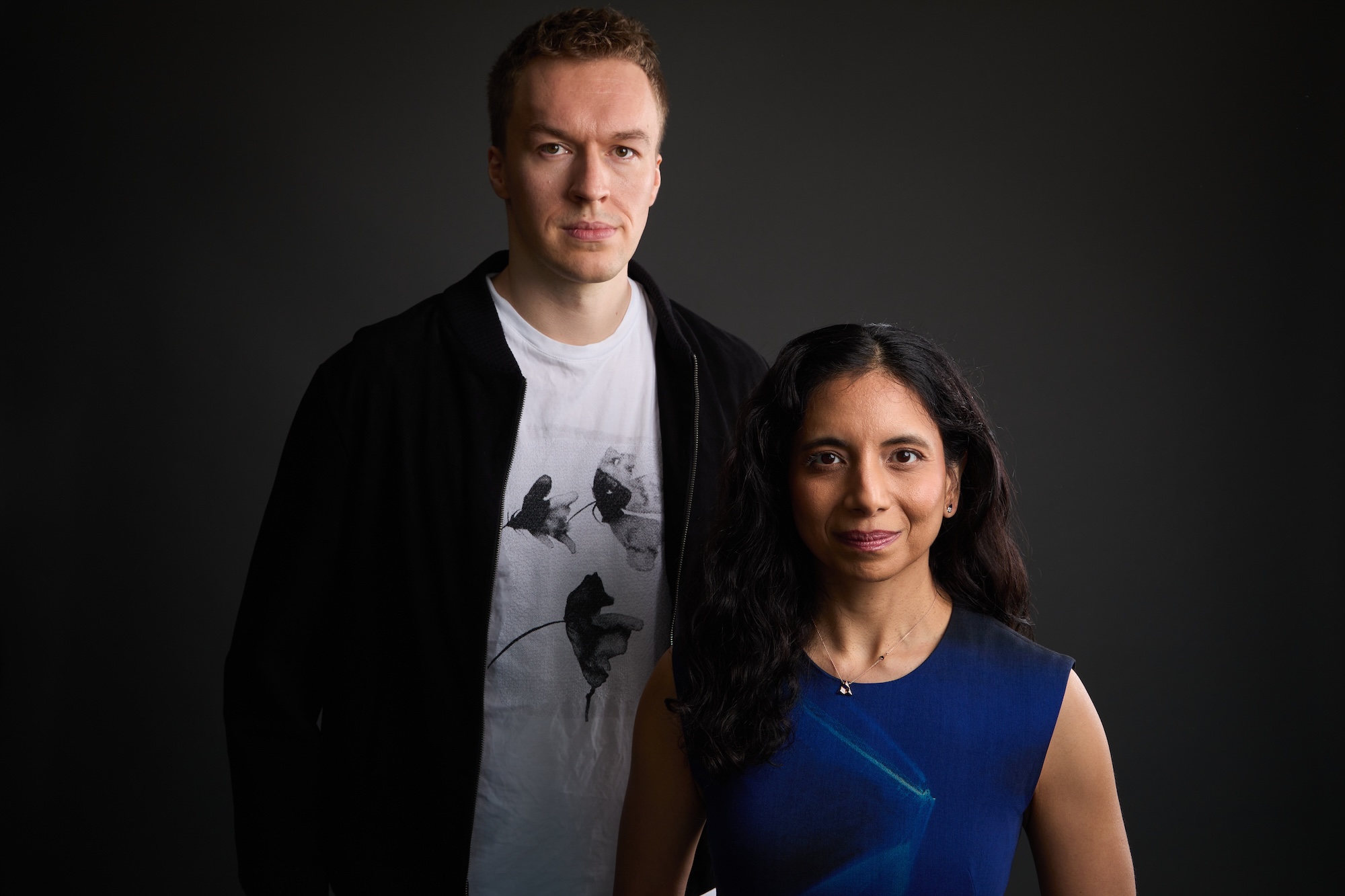
Our founders have extensive experience training large\-scale models, and building and maintaining critical systems\. They had a hand in inventing many of the methods and algorithms for AI\-based simulation that are now used across the industry\.
They have built FourCastNet, the first large\-scale high resolution AI weather model, that sparked the revolution in AI\-based weather and climate modeling\. Their work has covered everything from AI for self\-driving cars, to inventing medical devices and even helping simulate fusion at previously unprecedented speeds\. Their dream of combining physical capabilities in one universal model is now becoming a reality\.
## The path to Physical AI
A scroll\-driven explainer on why physical intelligence requires 4D, and what we've already built\.