@sentient_agency: 10 FREE TOOLS BUILT BY UNIVERSITIES THAT BEAT MOST PAID SAAS Bookmark every single one. Universities quietly fund softw…
Summary
A tweet highlights 10 free, open-source software tools developed by universities that outperform or rival expensive paid alternatives, covering reference management, text analysis, network visualization, GIS, statistics, speech analysis, biological networks, data cleaning, research archiving, and note-taking.
View Cached Full Text
Cached at: 06/27/26, 07:59 PM
10 FREE TOOLS BUILT BY UNIVERSITIES THAT BEAT MOST PAID SAAS
Bookmark every single one. Universities quietly fund software that outperforms products companies charge a fortune for, then give it away to anyone. Most people have no idea these exist.
- http://zotero.org Built by George Mason University.
The reference manager that crushes EndNote, which costs around $275. Capture any source with one click, organize thousands of papers, and generate citations in 10,000+ styles inside Word or Google Docs. EndNote’s maker sued to kill it and lost. Free, open, and trusted by millions of researchers.
- http://stanfordnlp.github.io/stanza Built by the Stanford NLP Group.
A text-analysis toolkit that does what companies sell as expensive APIs: break down language, tag parts of speech, pull out names and places, parse meaning, across 70+ languages. Built by Christopher Manning’s lab. The foundation under a huge slice of academic and industry NLP, free.
- http://gephi.org Built by university researchers in France.
Map any network, social graphs, citation webs, how money or influence flows, in stunning interactive visuals. The tool investigative journalists used on the Panama Papers. Network-analysis software companies charge thousands for, given away to anyone who wants to see the connections.
- http://qgis.org Built by a global academic and open community.
A full geographic mapping platform that does what ArcGIS charges thousands per seat for. Layer data onto maps, run spatial analysis, build professional cartography. Universities, governments, and NGOs run on it. The paid mapping monopoly, broken by open source.
- http://jamovi.org Built at the University of Amsterdam and beyond.
Two free statistics platforms that replace SPSS, which costs over $1,000 a year. Clean, modern interfaces for real statistical analysis, built by academics who were tired of charging students for the privilege of doing their homework.
- http://praat.org Built at the University of Amsterdam.
The tool every linguist on earth uses to analyze speech and sound, visualize pitch, formants, and waveforms. Niche, powerful, and completely free. Decades of phonetics research run on this one program, and nobody outside the field knows its name.
- http://cytoscape.org Built at the Institute for Systems Biology and academic partners.
A platform for visualizing complex biological networks and any other interconnected data. The tool behind countless papers in genetics and medicine. The kind of specialized visualization software that would be a five-figure enterprise license anywhere else.
- http://openrefine.org Born at Google, now community and academia run.
The best tool in existence for cleaning messy data. Point it at a chaotic spreadsheet and it finds the duplicates, fixes the inconsistencies, and reconciles the gaps. The unglamorous step every data project needs, that paid tools charge monthly for.
- http://zenodo.org Built by CERN.
A free home for your research, data, and code that gives you a permanent citable link forever, backed by the institution that runs the Large Hadron Collider. The kind of durable infrastructure that outlives any startup, run by physicists who think in centuries.
- obsidian.md and the academic plugin world Used and extended across universities.
A free knowledge base that links your notes into a web you can actually think inside, the digital version of the slip-box system a German scholar used to out-write entire universities. Researchers built a whole ecosystem of academic plugins on top of it.
Companies sell you software and rent you the result. Universities build the tool and hand you the keys.
Zotero | Your personal research assistant
Source: https://www.zotero.org/ ZoteroBibJust need tocreate a quickbibliography?## Your personal research assistant
Zotero is a free, easy-to-use tool to help youcollect, organize, annotate, cite, and share research.
Available for Mac, Windows, Linux,iOS, andAndroid
Just need to create a quick bibliography? TryZoteroBib.
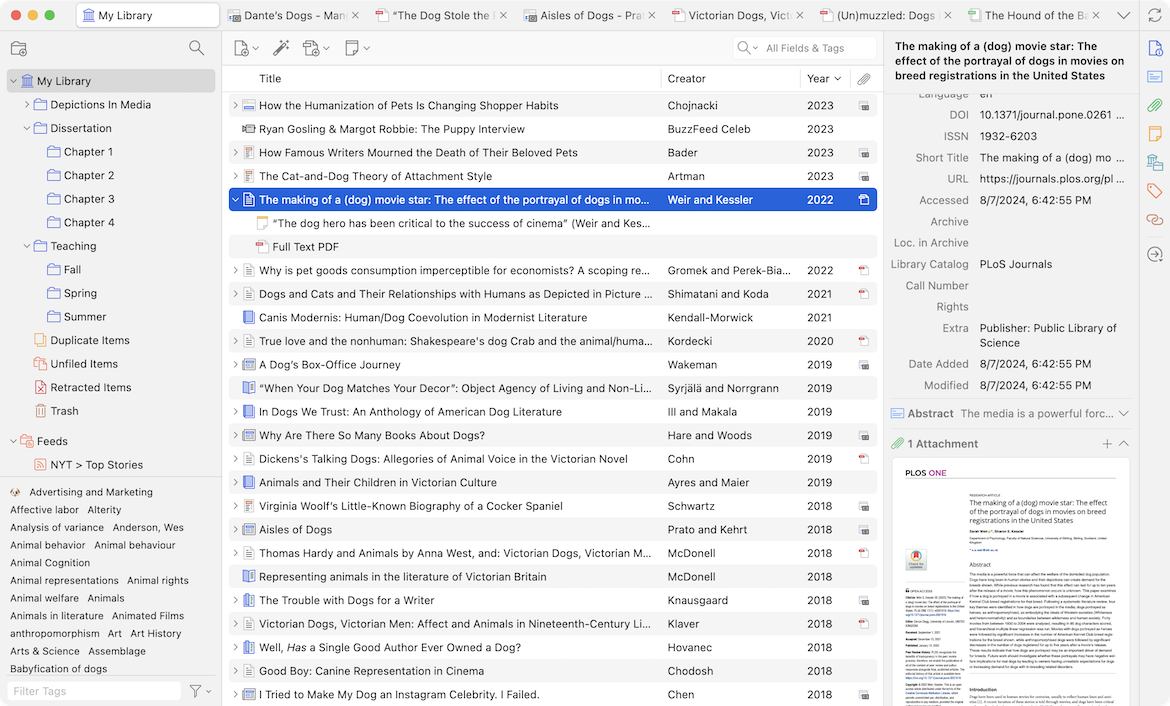
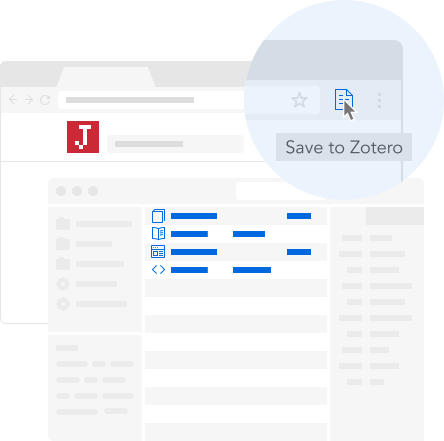
Collect with a click.
Zotero automatically senses research as you browse the web. Need an article from JSTOR or a preprint from arXiv.org? A news story from the New York Times or a book from a library? Zotero has you covered, everywhere.
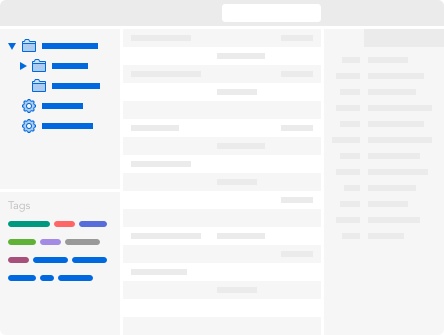
Organize your way.
Zotero helps you organize your research any way you want. You can sort items into collections and tag them with keywords. Or create saved searches that automatically fill with relevant materials as you work.

Cite in style.
Zotero instantly creates references and bibliographies for any text editor, and directly inside Word, LibreOffice, and Google Docs. With support for over 9,000 citation styles, you can format your work to match any style guide or publication.
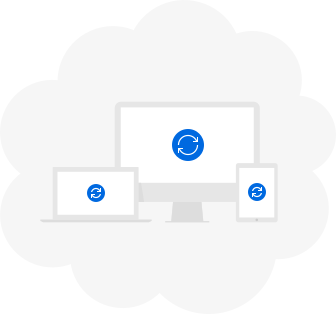
Stay in sync.
Zotero can optionally synchronize your data across devices, keeping your files, notes, and bibliographic records seamlessly up to date. If you decide to sync, you can also always access your research from any web browser.

Collaborate freely.
Zotero lets you co-write a paper with a colleague, distribute course materials to students, or build a collaborative bibliography. You can share a Zotero library with as many people you like, at no cost.

Rest easy.
Zotero isopen sourceand developed by an independent, nonprofit organization that has no financial interest in your private information. With Zotero, you always stay in control of your own data.
Similar Articles
@0xQiYan: These 10 free tools can each outperform commercial software costing tens of thousands of dollars annually. Save this! And they all come from universities and research institutions—without costing you a cent, yet powering half the internet. --- 1. Zotero by George Mason University. Helps you save and organize every paper you read with one click…
A curated list of 10 free, open-source tools developed by universities and research institutions that rival expensive commercial software, covering reference management, databases, big data, scientific computing, machine learning, document preparation, online learning platforms, and statistical analysis.
@DAIEvolutionHub: 10 free github repos that can replace major SaaS with subscriptions. all free. open-sourced. some are MIT licensed. — o…
A tweet thread curates 10 free open-source GitHub repositories that can replace popular paid SaaS subscriptions, including tools for screen recording, voice cloning, video clipping, LLM APIs, browser automation, trading, scheduling, transcription, social media management, and password management.
@Fluyeporlaweb: 10 GitHub Repositories So Powerful I Can't Believe They're Still FREE [save this, buddy] 1. Maybe It was a personal fin…
A tweet curates 10 powerful open-source GitHub repositories that serve as free alternatives to popular paid software, covering finance, AI, customer support, document signing, business intelligence, automation, and more.
@aiwithjainam: 10 WEBSITES THAT FEEL TOO USEFUL TO BE FREE Bookmark every single one. No account, no trial, no card. Things people sel…
A list of 10 free websites offering powerful tools for math, design, research, and more, all without requiring accounts or payments.
@emrullahai: SITES THAT ACADEMICS AND PhD STUDENTS ALWAYS USE BUT DON'T WANT EVERYONE TO KNOW ABOUT. Save this for sure. You don't n…
A list of 11 free academic tools and resources for PhD students and researchers, covering open-access articles, AI search, citation mapping, and fact-checking.