@dair_ai: Banger paper from MIT and Sakana AI. They show that self-improving coding agents work. The best part is that their appr…
Summary
The paper introduces Self-Improvement via Fast Tree-search (SIFT), a framework that uses an LLM-as-a-judge to efficiently evaluate self-modifications in coding agents, achieving better benchmark performance with significantly reduced CPU hours and API costs.
View Cached Full Text
Cached at: 09/19/26, 11:06 PM
Banger paper from MIT and Sakana AI.
They show that self-improving coding agents work.
The best part is that their approach, Self-Improvement via Fast Tree-search (SIFT), runs at a tenth of the CPU hours of DGM.
They reach 35.1 percent on Polyglot with o3-mini after 30 expansions. DGM reaches 30.7 percent after 80 nodes of tree search.
SIFT does it in under 50 CPU hours and under 5 hours of wall clock. The Qwen3-30B configuration runs its full search at 224 CPU hours and $34 of API spend, a tenth of the DGM baseline.
The saving comes from where the money goes.
Benchmark evaluation is the runtime bottleneck, so an LLM judge ranks candidate self-modifications first and only promising candidates get evaluated.
Judge quality decides the run.
On TerminalBench, gpt-5.4-high as the pairwise judge finds a 36.7 percent agent against a 29.2 percent starting point. gpt-5 finds 34.5 percent, and its top-ranked candidate is not the best agent its search produced.
Paper: https://academy.dair.ai/papers/self-improvement-via-fast-tree-search-2609.19526…
Self Improvement via Fast Tree-search
Source: https://academy.dair.ai/papers/self-improvement-via-fast-tree-search-2609.19526 EvaluationChat with Paper
First page
The curator’s take
Xinghong Fu, Aravinth Kulanthaivelu and Yutaro Yamada introduce SIFT, which identifies candidate evaluation as the runtime bottleneck in recursive self-improvement and replaces most of it with a judged tournament.
Ask this paper
Question about this paper Key points01
Pairwise judging drives exploration. An LLM judge compares candidate patches, the win-loss record is aggregated with a regularized Bradley-Terry model, and the resulting strength scores drive rank-based parent sampling inside a disaggregated tree search.
02
Expensive evaluations are reserved for promising nodes. Only the most promising candidates get real downstream task runs, so the search is not gated by slow evaluation.
03
It beats prior tree-search self-evolution on Polyglot. With substantially lower CPU hours, wall-clock time and API cost, which is the constraint the paper sets for itself.
04
The bottleneck claim is the reusable part. Prior self-improvement loops estimate a modification’s value by re-running benchmark subsets; naming that as the cost centre points at where any such loop should be optimised.
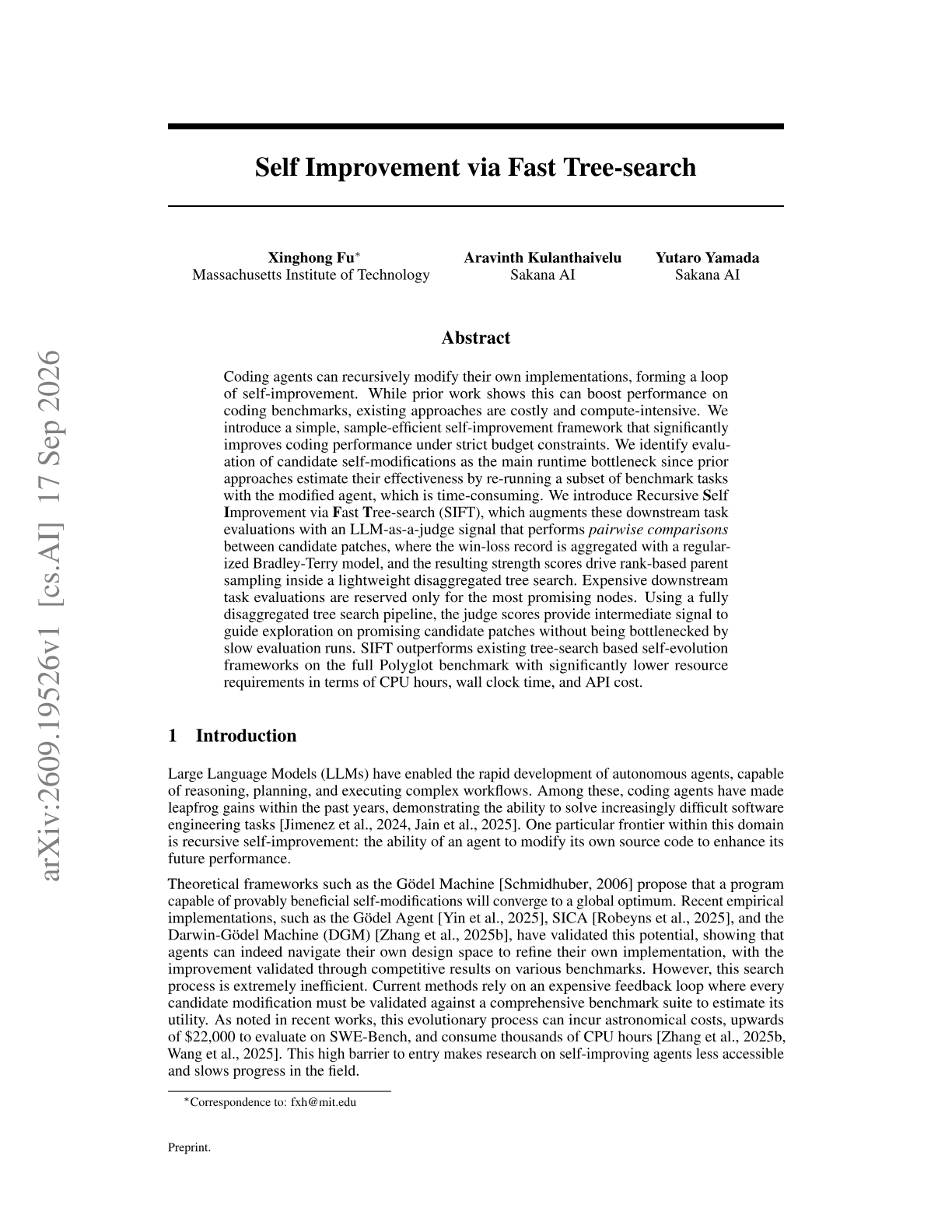
AbstractCoding agents can recursively modify their own implementations, forming a loop of self-improvement. While prior work shows this can boost performance on coding benchmarks, existing approaches are costly and compute-intensive. We introduce a simple, sample-efficient self-improvement framework that significantly improves coding performance under strict budget constraints. We identify evaluation of candidate self-modifications as the main runtime bottleneck since prior approaches estimate their effectiveness by re-running a subset of benchmark tasks with the modified agent, which is time-consuming. We introduce Recursive Self Improvement via Fast Tree-search (SIFT), which augments these downstream task evaluations with an LLM-as-a-judge signal that performs pairwise comparisons between candidate patches, where the win-loss record is aggregated with a regularized Bradley-Terry model, and the resulting strength scores drive rank-based parent sampling inside a lightweight disaggregated tree search. Expensive downstream task evaluations are reserved only for the most promising nodes. Using a fully disaggregated tree search pipeline, the judge scores provide intermediate signal to guide exploration on promising candidate patches without being bottlenecked by slow evaluation runs. SIFT outperforms existing tree-search based self-evolution frameworks on the full Polyglot benchmark with significantly lower resource requirements in terms of CPU hours, wall clock time, and API cost.
Similar Articles
Self Improvement via Fast Tree-search
This paper introduces RecursiveSelfImprovement via Fast Tree-search (SIFT), a sample-efficient framework that uses a lightweight tree-search guided by LLM-as-a-judge evaluations to improve coding agents' performance under budget constraints, outperforming existing methods with lower resource costs.
@dair_ai: Great paper on self-improving agents:
A prominent AI paper from the week addresses whether self-improving agents are truly discovering new knowledge or merely remixing existing information.
Recursive self-improvement of AI research agents
This paper introduces AIDE^2, a system that enables AI research agents to autonomously improve their own code through recursive self-improvement, leading to performance gains across various AI research tasks.
@dair_ai: https://x.com/dair_ai/status/2104263416252625124
This weekly article summarizes top AI research papers, including HySparse2 for efficient long-context attention, SIFT for cost-effective self-improvement in coding agents, and GAVEL for enhancing robot planning with graph-based world models.
@HuggingPapers: Self-Improvements in Modern Agentic Systems A survey of 239 papers on how AI agents self-improve — by updating the mode…
A survey of 239 papers analyzing how AI agents self-improve by updating the model itself or the scaffold (prompts, memory, tools).