Cached at:
07/21/26, 08:48 PM
# Natural-density logarithmic Collatz descent | ProofAtlas
Source: [https://www.proofatlas.ai/formalizations/natural-density-log-time-collatz/](https://www.proofatlas.ai/formalizations/natural-density-log-time-collatz/)
[ProofAtlas](https://www.proofatlas.ai/)[Formalizations](https://www.proofatlas.ai/formalizations/)Natural\-Density Collatz Descent in Logarithmic TimeNumber theory · dynamical systems · formal theorem
For thresholds tending to infinity along odd inputs, odd\-relative\-density\-one many odd starts descend within 145 · log N Syracuse steps; for thresholds tending to infinity on all positive inputs, ordinary\-natural\-density\-one many positive starts descend within 436 · log N raw Collatz steps\.
Recorded declarations**2**
Unfinished proof steps**None**
Formal result**Accepted**
The theorem at a glance
## Two logarithmic\-time density conclusions at a glance
The proof uses a global power\-law phase gap and fixed quantitative rate, turns fixed\-target control into an odd\-relative Syracuse conclusion, then uses the two\-adic lift to obtain the ordinary\-density raw Collatz conclusion\.
[**Read the exact theorem and checked proof**Main theorem · expanded proposition · proof walkthrough · Lean evidence](https://www.proofatlas.ai/proofs/artifact.known-nd-rhin-log-time.paper-package.v002.html)
[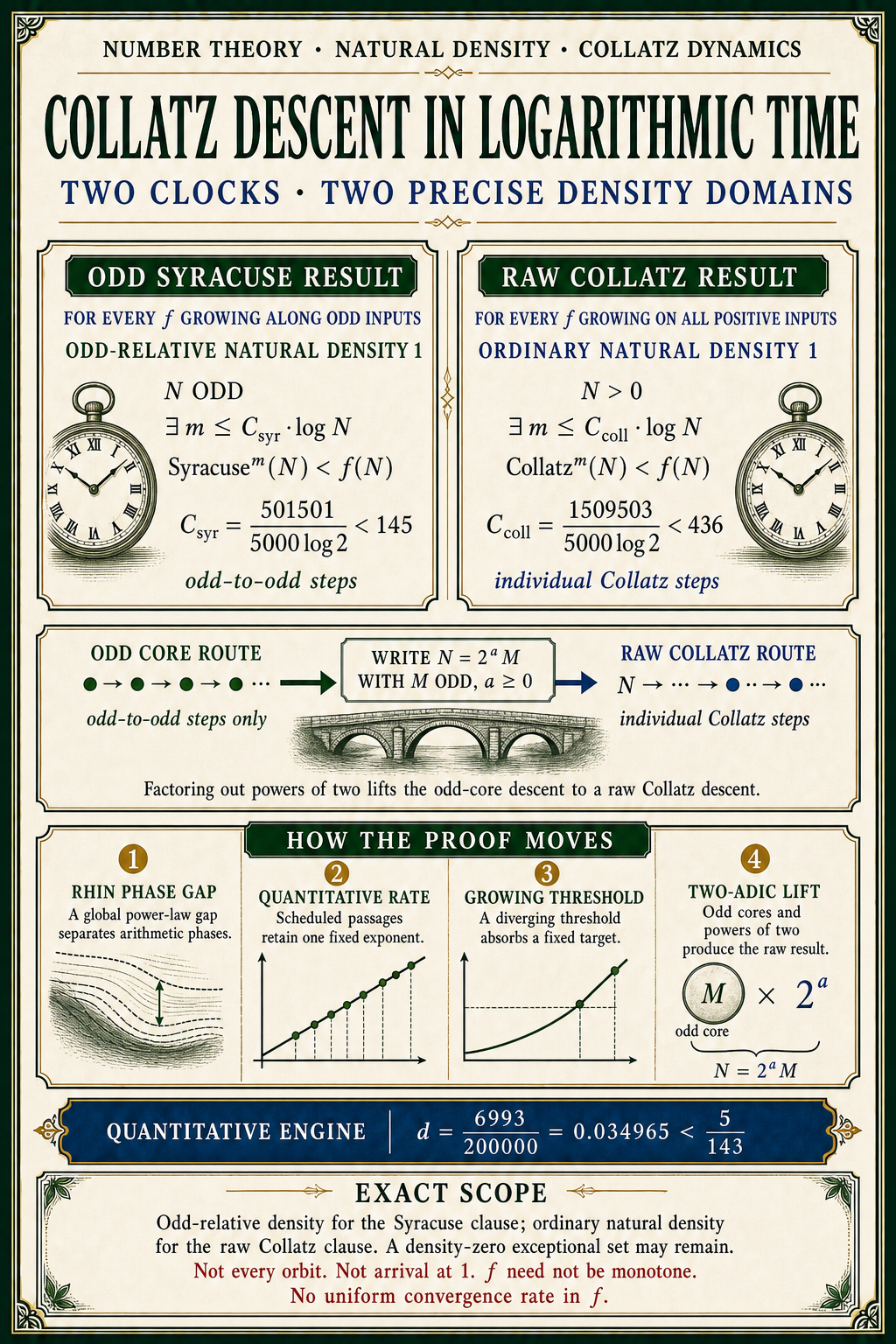](https://www.proofatlas.ai/assets/theorem-visuals/natural-density-log-time-collatz/theorem-poster-v3.png)
Theorem schematic
## Two density domains within two logarithmic clocks
[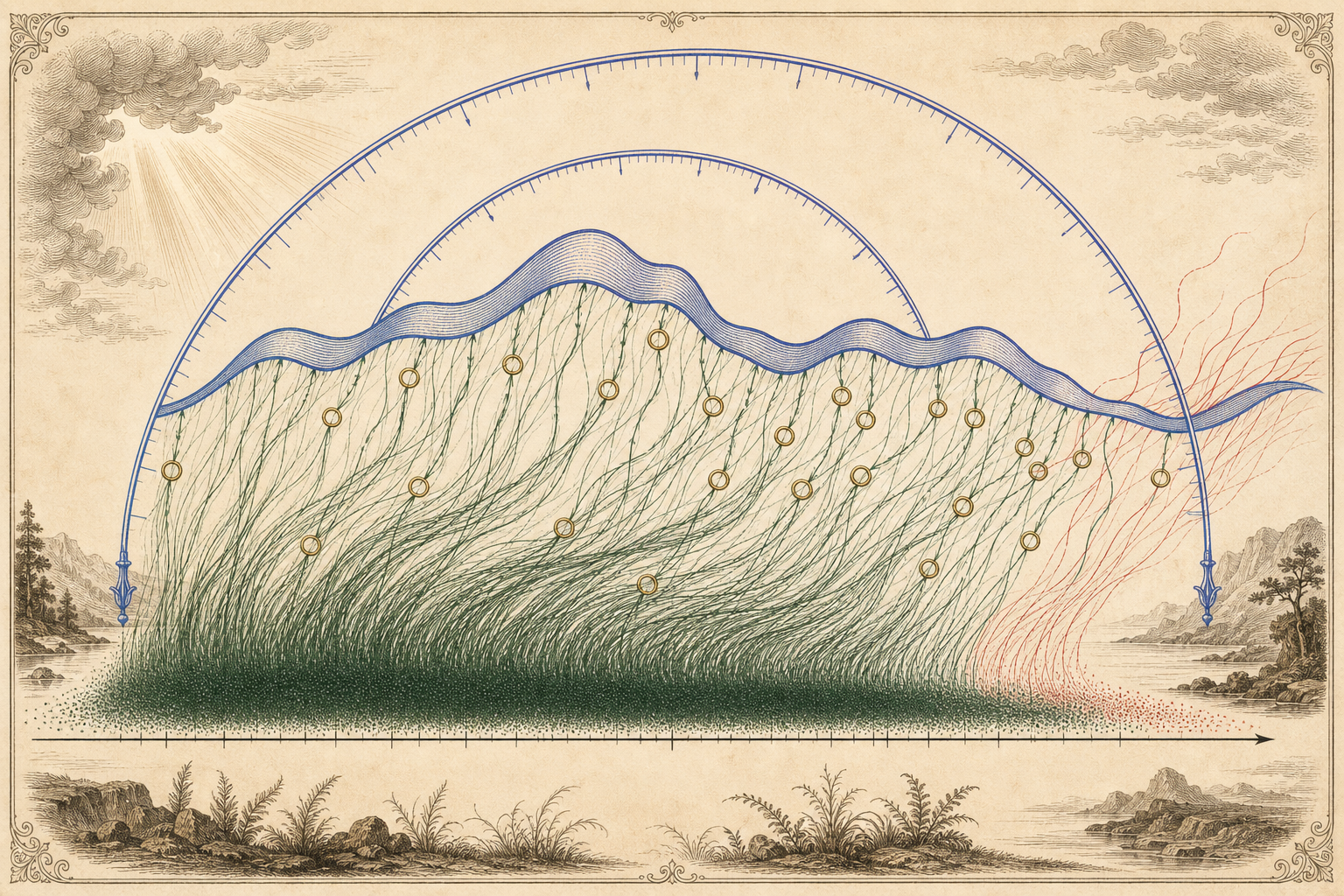](https://www.proofatlas.ai/assets/theorem-visuals/natural-density-log-time-collatz/theorem-schematic-v1.png)The Syracuse endpoint uses odd\-relative density among odd starts; the raw Collatz endpoint uses ordinary density among positive starts\.`odd\-relative density\(Syracuse hit\) = 1 with C\_syr < 145; ordinary density\(raw Collatz hit\) = 1 with C\_coll < 436`
For thresholds growing along odd inputs, odd\-relative\-density\-one many odd starts have a Syracuse hit before 145 · log N odd\-to\-odd steps\. For thresholds growing on all positive inputs, ordinary\-natural\-density\-one many positive starts have a raw Collatz hit before 436 · log N individual steps\.
The theorem at a glance
## Square\-root logarithmic time window at a glance
The natural\-density theorem supplies the upper clock for the square\-root threshold\. A deterministic halving argument supplies the strict lower clock, and the checked corollary retains one witness satisfying both inequalities\.
[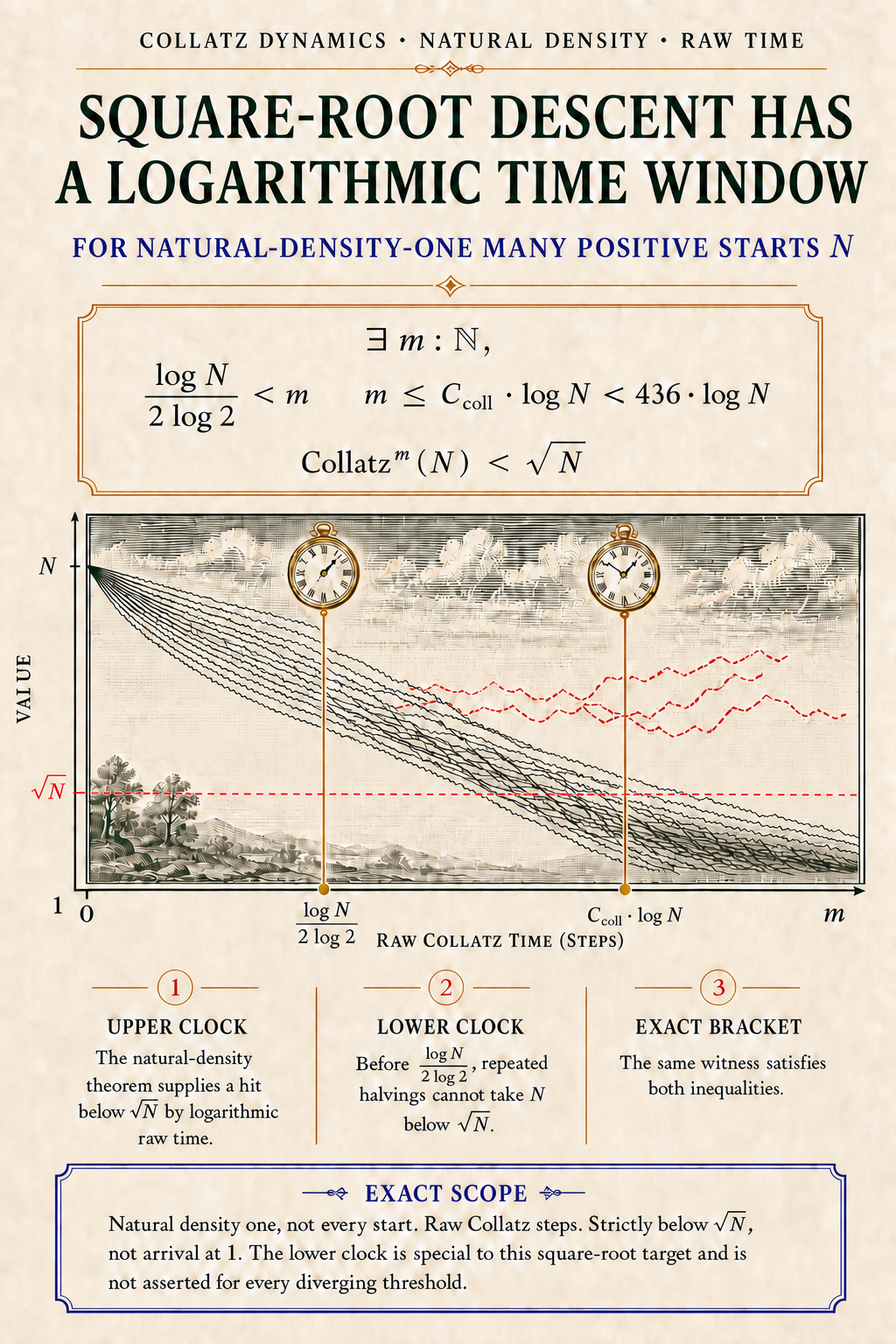](https://www.proofatlas.ai/assets/theorem-visuals/natural-density-log-time-collatz-sqrt-bracket/theorem-poster-v6.png)
Theorem schematic
## A square\-root hit inside a logarithmic window
[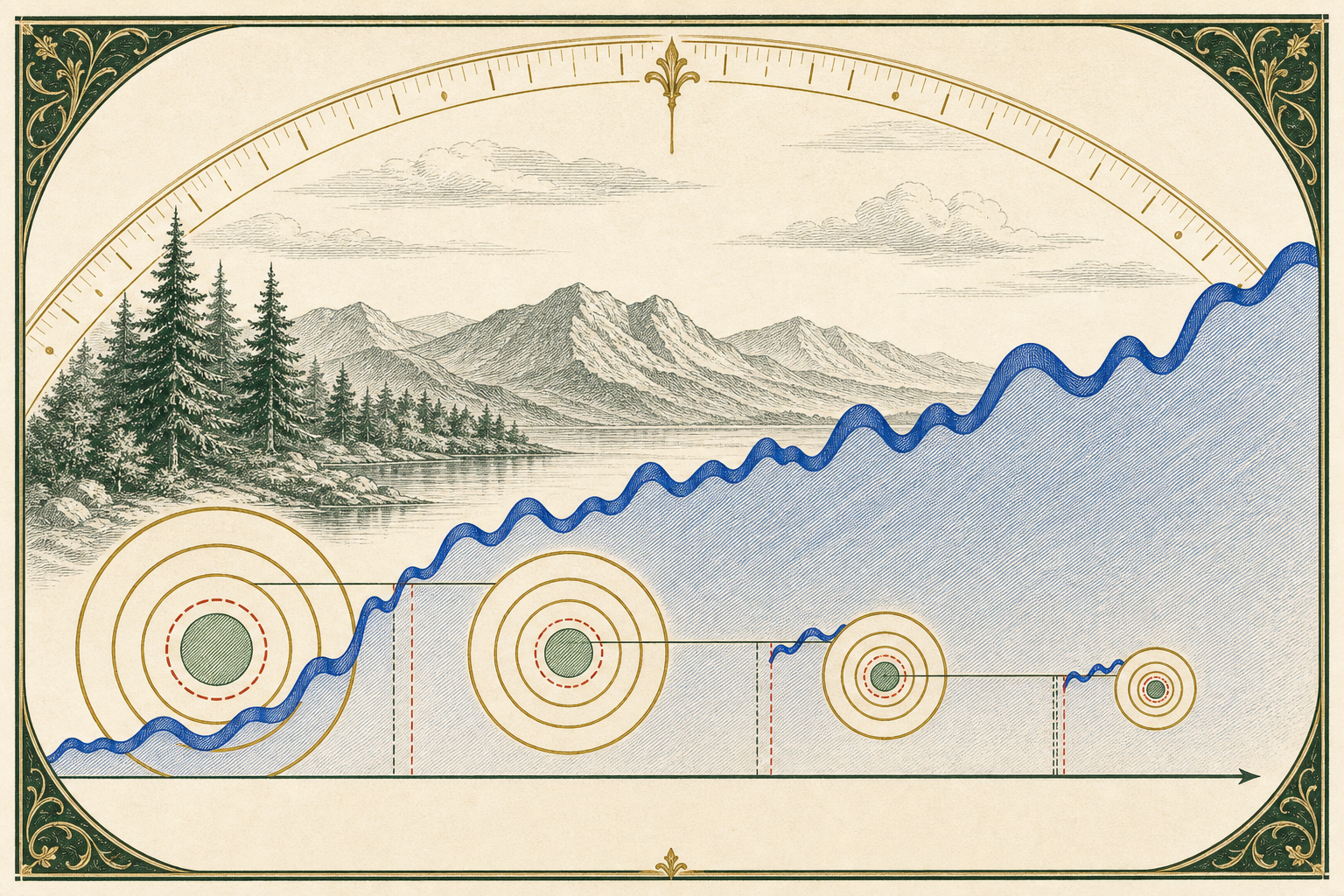](https://www.proofatlas.ai/assets/theorem-visuals/natural-density-log-time-collatz-sqrt-bracket/theorem-schematic-v1.png)For natural\-density\-one many starts, a raw Collatz hit below √N occurs inside a genuine logarithmic time window\.`log N/\(2 log 2\) < m ≤ C\_coll log N < 436 log N and Collatz^m\(N\) < √N`
The same witness time is strictly greater than log N divided by 2 log 2 and no greater than the checked raw Collatz clock, which is below 436 · log N\. The lower bound is special to the square\-root target\.
About these visual explanationsThese AI\-generated visuals explain the theorem and proof route; they are not proof evidence\. Their publication review was completed separately from review of the formal result\. The exact Lean proposition and checked source remain authoritative\.
[](https://www.proofatlas.ai/papers/natural-density-log-time-collatz/Mazur_Natural_Density_Collatz_Orbits_in_Logarithmic_Time_v1.pdf)Companion research paper
## [Natural\-Density Almost\-Bounded Collatz Orbits in Logarithmic Time](https://www.proofatlas.ai/papers/natural-density-log-time-collatz/Mazur_Natural_Density_Collatz_Orbits_in_Logarithmic_Time_v1.pdf)
A mathematical paper developing the natural\-density\-one logarithmic\-time Collatz descent theorem, its Rhin phase\-gap input, the quantitative rate architecture, the Syracuse\-to\-raw\-time bridge, and the square\-root time\-window corollary\.
Paper, rights, and source relationship**Hosting authorized by the rightsholder\.**Original ProofAtlas metadata cover; not a reproduction of a paper page\.
Lech Mazur, “Natural\-Density Almost\-Bounded Collatz Orbits in Logarithmic Time,” version 1, 16 July 2026\.
- The paper is mathematical exposition linked to the same theorem family; the exact checked Lean declarations and pinned source remain authoritative if wording differs\.
- The paper discusses a theorem that permits a density\-zero exceptional set and does not claim the full Collatz conjecture or convergence of every orbit\.
Collatz results landscape
## How these results relate
depends onstrengthenscomparison only
The atlas keeps proof dependencies separate from stronger sibling results and useful comparisons\. The two lanes below are disconnected: neither predecessor\-count family is an input to the density\-and\-time family\.
Predecessor\-count bounds
### Three exact 0\.90 theorem variants
Density and logarithmic time
### Rhin feeds the quantitative rate engine
Exact relationship evidence- **Reviewed dependency path:**Rhin phase gap → ND31 main → ND31 bounds → same\-exponent rate → fixed rate → the two sibling density\-family endpoints\. Six retained`depends\_on`edges support this contracted path\.
- **Comparison only:**the Terras result is explicitly recorded as a separate companion, not an input to the natural\-density proof\.
- **No inferred edge:**shared source files, a common subject, or historical background do not create a theorem dependency\.
Scope limits
## What this formalization does not claim
- This does not prove the Collatz conjecture, convergence for every start, or arrival at 1; a density\-zero exceptional set may remain\.
- The threshold must tend to infinity but need not be monotone, and the hit below it is strict\.
- The odd\-relative Syracuse conclusion and ordinary\-density raw Collatz conclusion have different domains and must not be collapsed into one claim about all positive starts\.
- The 145 bound counts odd\-to\-odd Syracuse steps, while the 436 bound counts raw Collatz steps including halvings\.
- The square\-root lower clock belongs only to the companion square\-root corollary, not to the general growing\-threshold theorem\.
- The separate Terras power\-saving finite\-stopping theorem is a companion comparison, not an input to this proof\.
The exact formal theorems
## Open the checked proofs
Each theorem page includes its expanded exact proposition, visual explanation, complete checked source, and checker evidence\. Longer proof routes also include a step\-by\-step walkthrough\.
Lean proof
### [Natural\-Density Almost\-Bounded Collatz Orbits in Logarithmic Time](https://www.proofatlas.ai/proofs/artifact.known-nd-rhin-log-time.paper-package.v002.html)
For thresholds tending to infinity along odd inputs, odd\-relative\-density\-one many odd starts descend within 145 · log N Syracuse steps; for thresholds tending to infinity on all positive inputs, ordinary\-natural\-density\-one many positive starts descend within 436 · log N raw Collatz steps\.
Lean check passedNo unfinished proof stepsAccepted formal result
Lean proof
### [Square\-Root Descent Has a Logarithmic Raw\-Time Window](https://www.proofatlas.ai/proofs/artifact.known-nd-rhin-log-time.raw-sqrt-bracket.v002.html)
For natural\-density\-one many positive starts N, a raw Collatz iterate falls strictly below √N after more than log N / \(2 log 2\) steps and by at most 436 · log N steps\.
Lean check passedNo unfinished proof stepsAccepted formal result
Continue the mathematics
## Build from the checked theorem
Use the checked natural\-density theorem to study stronger time constants, explicit density\-convergence rates for restricted threshold classes, or other dynamical systems where arithmetic phase gaps feed quantitative mixing and descent\.
Each ZIP contains the checked first\-party Lean import closure, exact statements and boundaries, license, notice, evidence, source\-footprint manifest, and an agent continuation file\. Mathlib and other third\-party dependencies are not bundled\.
Declarations covered by evidence2First\-party Lean files599Lean source lines182,625Main recorded file224 linesExplanatory proof route8 curated stages**How counting works:**Line counts exclude blank lines; comments and documentation count\. The total is the deduplicated, commit\-pinned first\-party Lean import closure; Mathlib and other third\-party dependencies are excluded\. Declaration count means names covered by the artifact's recorded evidence; it is not a count of every declaration in the source\. Source footprint is not a difficulty or proof\-quality score\.
Formal\-result publication and review detailsIndependent publication review
## The formal theorem's publication gates are accepted
**Lean checks the proof\.**Independent AI review separately accepted evidence completeness, statement alignment, result boundary, and the retained theorem wording\. Those gates apply to the formal result; generated media is reviewed and promoted separately\. Neither review replaces Lean's proof check or broadens the theorem\.
01### Formal evidence
Independent review accepted the recorded build, exact declarations, unfinished\-step scan, and axiom evidence\.
02### Statement alignment
The formal declaration was accepted against the named theorem and its exact variant\.
03### Result boundary
The accepted boundary keeps nearby stronger or commonly confused claims out of scope\.
04### Public wording
Independent review accepted the retained theorem explanation and source presentation\. Generated media follows a separate review and promotion gate\.
05### Canonical source
The first\-party source link is pinned to the checked package commit and exact Lean file\.
06### Accepted result
A validated accepted\-result record binds the four reviews to the checked formalization\.