beszel
Summary
Beszel is a lightweight, open-source server monitoring platform that tracks Docker/container stats, system metrics, and alerts, with a web interface, multi-user support, and OAuth authentication.
View Cached Full Text
Cached at: 08/13/26, 03:27 PM
henrygd/beszel
Source: https://github.com/henrygd/beszel
Beszel
Beszel is a lightweight server monitoring platform that includes Docker statistics, historical data, and alert functions.
It has a friendly web interface, simple configuration, and is ready to use out of the box. It supports automatic backup, multi-user, OAuth authentication, and API access.




Features
- Lightweight: Smaller and less resource-intensive than leading solutions.
- Simple: Easy setup with little manual configuration required.
- Docker stats: Tracks CPU, memory, and network usage history for each container.
- Alerts: Configurable alerts for CPU, memory, disk, bandwidth, temperature, load average, and status.
- Multi-user: Users manage their own systems. Admins can share systems across users.
- OAuth / OIDC: Supports many OAuth2 providers. Password auth can be disabled.
- Automatic backups: Save to and restore from disk or S3-compatible storage.
Architecture
Beszel consists of two main components: the hub and the agent.
- Hub: A web application built on PocketBase that provides a dashboard for viewing and managing connected systems.
- Agent: Runs on each system you want to monitor and communicates system metrics to the hub.
Getting started
The quick start guide and other documentation is available on our website, beszel.dev. You’ll be up and running in a few minutes.
Screenshots
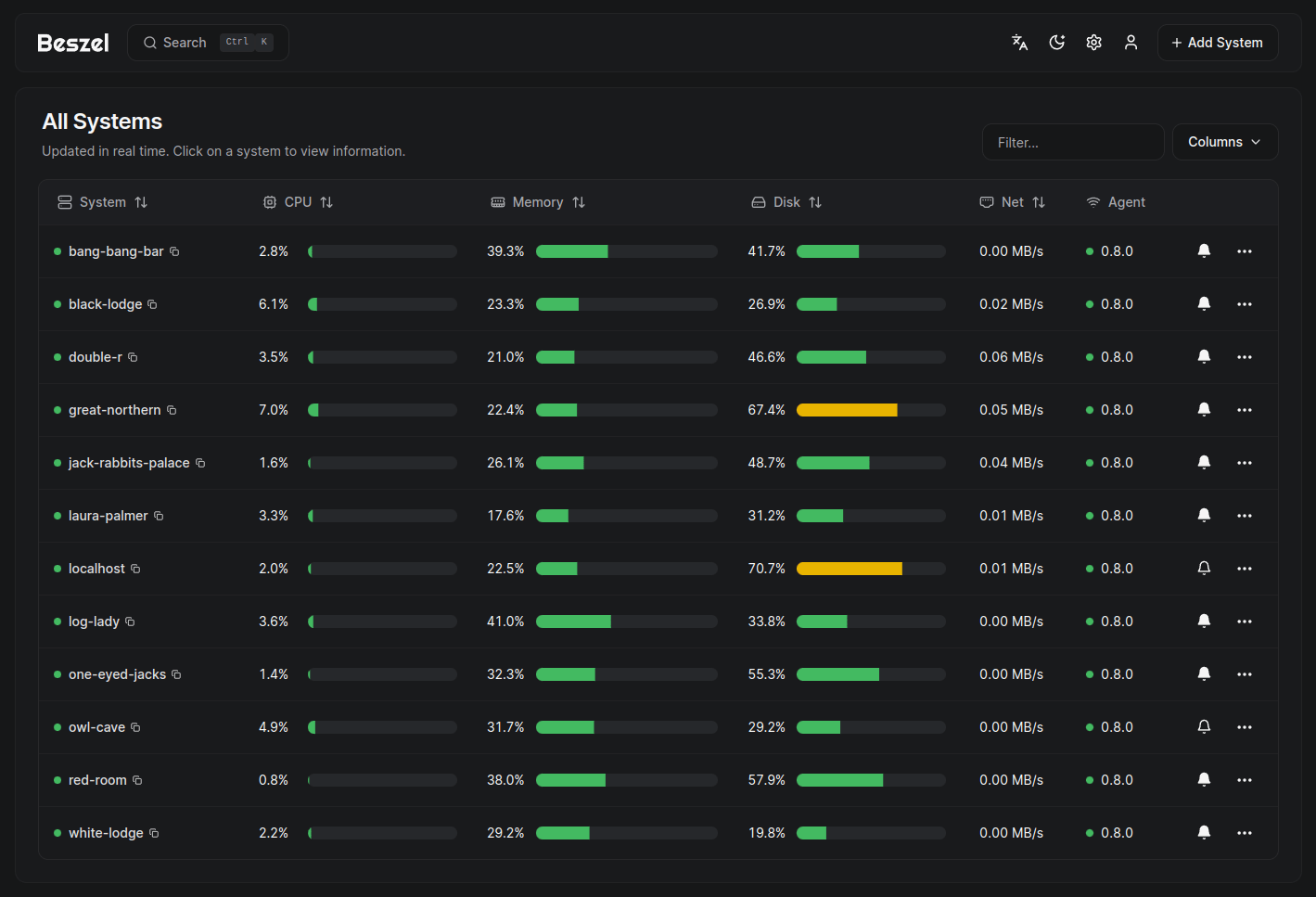
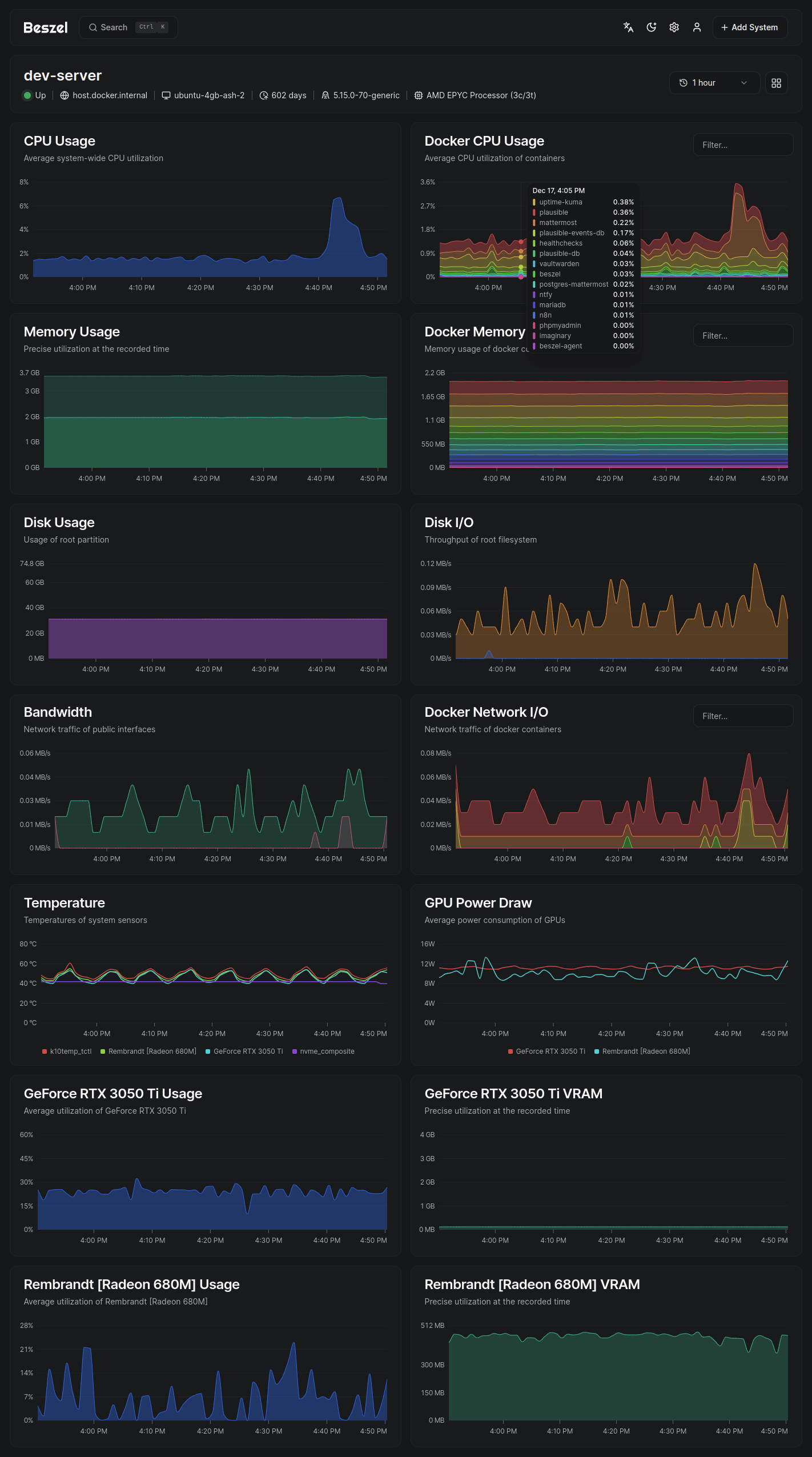
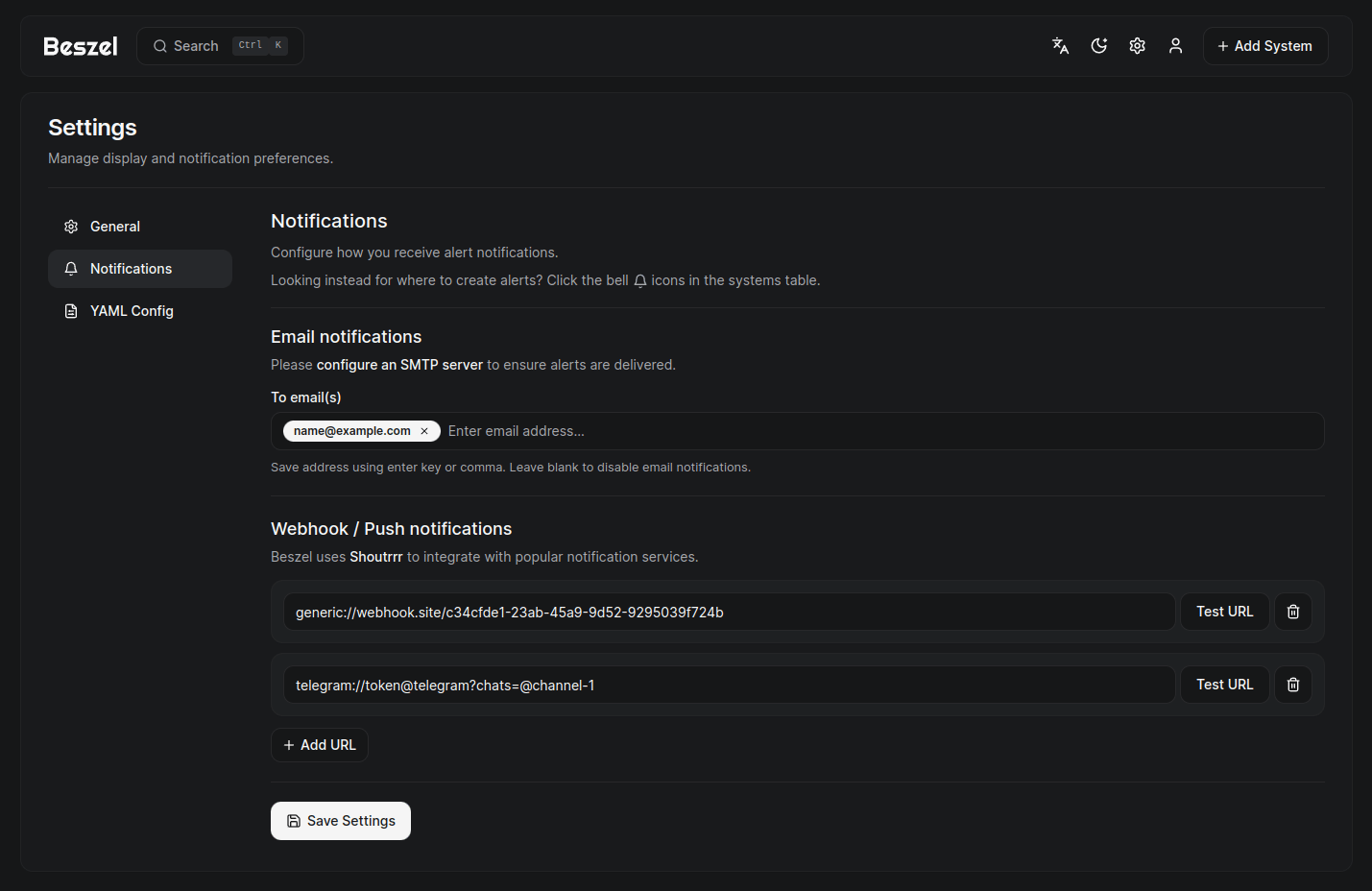
Supported metrics
- CPU usage - Host system and Docker / Podman containers.
- Memory usage - Host system and containers. Includes swap and ZFS ARC.
- Disk usage - Host system. Supports multiple partitions and devices.
- Disk I/O - Host system. Supports multiple partitions and devices.
- Network usage - Host system and containers.
- Load average - Host system.
- Temperature - Host system sensors.
- GPU usage / power draw - Nvidia, AMD, and Intel.
- Battery - Host system battery charge.
- Containers - Status and metrics of all running Docker / Podman containers.
- S.M.A.R.T. - Host system disk health (includes eMMC wear/EOL and Linux mdraid array health via sysfs when available).
Help and discussion
Please search existing issues and discussions before opening a new one. I try my best to respond, but may not always have time to do so.
Bug reports and feature requests
Bug reports and feature requests can be posted on GitHub issues.
Support and general discussion
Support requests and general discussion can be posted on GitHub discussions or the community-run Matrix room: #beszel:matrix.org.
License
Beszel is licensed under the MIT License. See the LICENSE file for more details.
Similar Articles
@DanKornas: Server monitoring shouldn’t require stitching together several tools just to see what a host or container is doing. Bes…
Beszel is an open-source, lightweight server-monitoring platform for self-hosted systems and containers, offering CPU, memory, disk, and network metrics with configurable alerts.
@QingQ77: One Docker Container to Monitor Your Entire Homelab: GPU, Containers, Services, Disks, Multi-Machine, No Prometheus/Grafana Needed https://github.com/SikamikanikoBG/homelab-monitor……
HomeLab Monitor is a self-hosted, single Docker container that aggregates GPU stats, container memory, disk usage, and service health across multiple machines via SSH, without requiring Prometheus/Grafana or agents.
oblien/openship
Openship is an open-source, self-hostable deployment platform with built-in CI/CD, supporting any stack, databases, domains, SSL, and more, accessible via desktop app, web dashboard, or CLI.
Servor
Servor 在 Product Hunt 发布:一个统一控制台用于运行和监控所有服务器,提供网页终端、文件编辑器、定时任务、批量命令、150+ 安装脚本以及监控、手机告警和状态页,且无需开放端口,所有命令在浏览器本地签名。
Show HN: Mezz, a curl-able WiFi sandbox for IoT pentesting
Mezz is a self-contained WiFi sandbox tool for inspecting IoT device traffic, providing an isolated network with DNS logging and optional MITM proxy, all deployable via Docker on a Linux host with AP-capable WiFi.