Cached at:
08/24/26, 07:49 PM
# World's oceans hit highest temperature on record as El Niño grows
Source: [https://www.bbc.com/news/articles/c62m4gpnp78o](https://www.bbc.com/news/articles/c62m4gpnp78o)
Getty Images
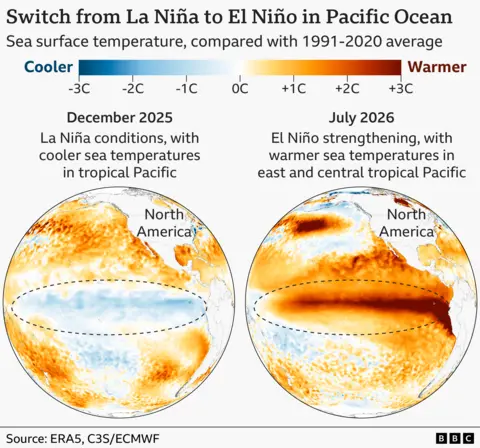
The world's oceans are hotter than ever recorded, new data suggests, as they suffer from human\-caused climate change and the growing El Niño weather phenomenon\.
The average surface temperature of the planet's seas outside the polar regions hit 21\.1C \(70F\) on Saturday, according to figures from the European Copernicus climate change service\.
That edges past the 21\.09C recorded on three separate days in March 2024, and is far above average for the time of year\.
Warmer oceans can have wide\-reaching consequences, including supercharging extreme weather, raising sea levels and harming marine life\.
"This record is another clear signal of an ocean under growing stress," said Dr Samantha Burgess, deputy director of Copernicus\.
"El Niño is adding heat to the system, but it is doing so on top of decades of human\-driven warming," she added\.
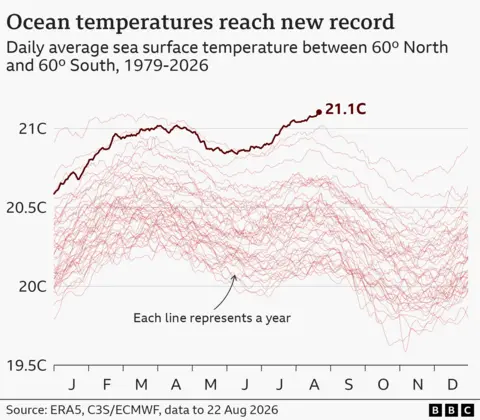
The data is based on sea temperatures 10m \(32ft 10in\) below the surface, using measurements from buoys, ships and satellites, which are combined to produce a global estimate\.
While the margin of record is currently very small and any global estimate comes with uncertainties, scientists say its timing is particularly notable\.
Average worldwide sea temperatures tend to reach their yearly peak in March or April, which corresponds to the end of summer in the southern hemisphere \- and not in August\.
The southern hemisphere contains more of the planet's ocean surface than the northern hemisphere and so exerts a bigger influence on average sea temperatures\.
What is especially concerning to scientists is that the oceans are already so hot when the natural El Niño weather phenomenon is still some way off its expected peak\.
This could see ocean temperatures climb yet further\.
"The fact that we are already breaking records is an early indicator of how strong the El Niño is becoming," said Dr Jeremy Grist, senior research fellow at the National Oceanography Centre in Southampton\.
"All things being equal we might expect the ocean temperature record to be broken again in March \[or\] April 2027," he added\.
The waters far away from El Niño's Pacific hunting ground are also extremely warm, including around the UK and Europe\.
The western English Channel has seen almost continuous marine heatwave conditions for more than three years, peaking at 7C above normal in July, according to Prof Tim Smyth, director of science at Plymouth Marine Laboratory\.
“This is unprecedented,” he added\.
Scientists say such widespread warmth around the planet is a clear sign of the growing effect that human\-caused climate change is having on the world's seas\.
"The latest Copernicus data reinforce the troubling upward trend in ocean temperatures,” said Smyth\.
Warmer seas help to fuel more extreme weather\. They can provide storms with extra moisture and energy, and can intensify heatwaves on land in some coastal regions by reducing the cooling effect of sea breezes\.
Warmer water also takes up more space, raising sea levels and bringing a greater risk of coastal flooding \- while intense ocean heat can be devastating for sea habitats, such as coral reefs\.
The increasing frequency of marine heatwaves is already "putting increasing pressure on marine ecosystems and the communities that depend on them", Burgess said\.
Watch: How does El Niño affect world weather?

