Cached at:
08/18/26, 03:33 PM
# The Deadline Dividend
Source: [https://deadline-dividend.onrender.com/](https://deadline-dividend.onrender.com/)
In 1946, the 30\-ton ENIAC filled a gymnasium\-sized room\. Fifty years later, Penn students reproduced its architecture and capacity on a fingertip\-sized chip\. Computing’s familiar story sent yesterday’s machine from room to desk to pocket\.[Penn’s ENIAC retrospective](https://almanac.upenn.edu/archive/v42/n19/020696.html)
But engineers spent density in another direction too\. ASCI Red kept the room and crossed one teraFLOP\. Internet companies filled warehouses with coordinated servers; by 2009, Google engineers called the data center a “warehouse\-scale computer\.” Density could put yesterday’s workload in less space, or more workload inside yesterday’s walls\.[DOE on ASCI Red](https://www.energy.gov/science/doe-explainsexascale-computing)[Google on the warehouse\-scale computer](https://research.google/pubs/the-datacenter-as-a-computer-an-introduction-to-the-design-of-warehouse-scale-machines/)
Give several AI endpoints the same hard question and ten seconds\. One uses most of it\. Another replies almost at once, and we call it “blazingly fast\.” But that familiar shorthand conflates speed with time and quietly treats the early answer as the end of the experiment\. We describe latency in the language of speed: what impressed us was the short wait\. Decode speed measures output tokens per second; latency measures time to a useful result\. Keep every endpoint working until ten seconds expire\. Higher speed can finish fixed work sooner, or fit more work before the same deadline\. Call that useful extra work the**deadline dividend**\. It can fund another strategy, a critic, a verification pass, or recovery after failure\.
On August 13, the thought experiment became a product\. OpenAI opened a limited API preview of Ultrafast for GPT\-5\.6 Sol and reported up to 750 output tokens per second, as much as 14 times Standard speed\. In Cerebras’s six\-task GDP\-Val comparison at medium reasoning, GPT\-5\.6 Sol finished in 83\.0 seconds on Ultrafast and 464\.2 seconds on Standard, a 5\.59\-times end\-to\-end gain under settings Cerebras describes as quality\-matched\. The faster path runs on Cerebras\.[OpenAI on Ultrafast](https://openai.com/index/previewing-ultrafast/)[Cerebras benchmark](https://www.cerebras.ai/blog/accelerating-gpt-5-6-sol-ultrafast-with-openai)
Artificial Analysis supplies a wider comparison for gpt\-oss\-120b\. In its August 13 snapshot, Cerebras decoded at 1,790\.3 tokens per second\. SambaNova, the next\-fastest listed endpoint, reached 701\.3; Groq reached 476\.1; and the 16\-endpoint median was 170\.7\. Cerebras ran 2\.55 times as fast as the runner\-up and 10\.49 times as fast as the median\.[Live provider comparison](https://artificialanalysis.ai/models/gpt-oss-120b/providers)[Captured endpoint vector](https://deadline-dividend.onrender.com/data/aa-gpt-oss-120b-2026-08-13.json)
The snapshot also scored the configured Cerebras endpoint at 87\.28% accuracy and SambaNova at 98\.15%\. For capability, the stronger comparison is Sol: GPT\-5\.6 Sol ran at medium reasoning on both paths, under settings Cerebras describes as quality\-matched\.
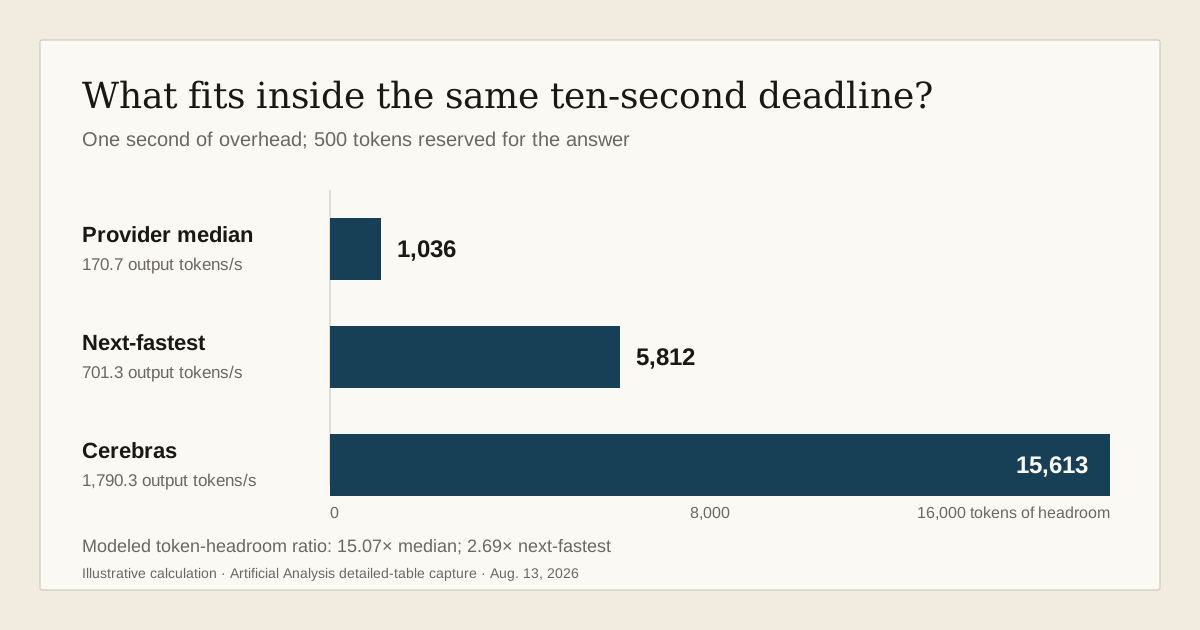
Suppose one second goes to overhead, 500 tokens go to the answer, and the observed output rate stands in for serial token execution\. Before the same ten\-second deadline, the median endpoint has room for about 1,036 reasoning tokens, the runner\-up 5,812, and Cerebras 15,613\. That gives Cerebras 2\.69 times the runner\-up’s modeled serial\-reasoning budget and 15\.07 times the median’s\. How much more capability can that budget buy? The deadline dividend opens three opportunities: current models can spend more compute immediately; future models can learn to exploit larger test\-time\-compute budgets as another scaling lever; serial agents can turn inference speed into execution speed\.
## What the speed test measures
The gpt\-oss comparison uses a 10,000\-token prompt and rolling 72\-hour medians\. Each configured endpoint combines hardware, quantization, software, scheduling, and provider settings\. The captured Cerebras row recorded the first chunk at 0\.53 seconds and the first answer token at 1\.65 seconds\.
**Time to first token**includes request handling, queueing, prefill, and initial generation\. Once text starts,**inter\-token latency**measures the gap between decoded tokens; its inverse gives the displayed rate\.**End\-to\-end latency**measures the full wait for a useful result\. Batching can raise fleet**throughput**independently of the stream speed seen by one user\.
Artificial Analysis runs one request at a time and measures decode after the first chunk, so its test directly captures single\-stream decode\. For serial reasoning, where each token waits on the previous one, that rate governs how much generation fits before a deadline\.[Performance methodology](https://artificialanalysis.ai/methodology/performance-benchmarking)
## Spending the dividend
Researchers call computation spent after a prompt**test\-time compute**, or TTC\.**Intrinsic TTC**lengthens one sequential autoregressive path, so single\-stream decode directly governs it\.**Extrinsic TTC**adds samples, critics, verifiers, or tools around the model\. Parallel branches trade concurrency and aggregate compute for less wall\-clock time; a selector must still turn candidate coverage into one answer\.
Training determines whether extra inference compute becomes useful; the request\-time budget determines how much of that learned process a model can exercise\. Current systems can spend the dividend on another strategy, a contradiction check, a verification pass, or recovery after failure\.
OpenAI’s o\-series paired larger TTC budgets with a generational jump in reasoning performance\. OpenAI says large\-scale reinforcement learning taught o1 to reason productively and that performance improved with both training compute and time spent thinking\. On AIME 2024, single\-sample accuracy rose from GPT\-4o’s 12% to o1’s 74% at its highest TTC setting\. For o3, OpenAI later reported another order of magnitude in both reinforcement\-learning compute and inference\-time reasoning while gains continued\. Snell and colleagues made prompt\-adaptive TTC over four times as efficient as best\-of\-N on tested math problems; in some FLOPs\-matched cases, a smaller PaLM 2 beat one roughly 14 times larger\.[OpenAI on o1](https://openai.com/index/learning-to-reason-with-llms/)[OpenAI on o3](https://openai.com/index/introducing-o3-and-o4-mini/)[Snell et al\.](https://arxiv.org/abs/2408.03314)
Cerebras packages this approach as CePO: plan, sample, compare inconsistencies, then choose through structured Best\-of\-N\. Cerebras reports spending 10 to 20 times the one\-shot budget, generating about 100 tokens per second on Llama 3\.3\-70B, and beating Llama 3\.1\-405B on selected benchmarks\. OptiLLM can send the workflow to several providers\. CePO shows one concrete way to spend inference speed on additional reasoning and selection\.[CePO](https://www.cerebras.ai/blog/cepo)[Documentation](https://inference-docs.cerebras.ai/capabilities/cepo)[OptiLLM](https://github.com/algorithmicsuperintelligence/optillm)
## When inference becomes execution
Karpathy calls natural\-language programs executed by an LLM “Software 3\.0\.” When a model decides what a live application does next, inference latency becomes execution latency\. One decision can create value: a fraud signal before a transaction clears can block it; an incident diagnosis during a failure can guide the response\. Faster frontier inference can move those decisions from a background process onto the live path\. Tool use compounds the effect: the model emits a call, the client executes it, and the result becomes the next state\. Cost determines how many calls a product can afford; latency determines how many it can put in a row\. Routing can send routine steps to a smaller model and hard turns to a frontier model\.[“Software Is Changing \(Again\)”](https://www.youtube.com/watch?v=LCEmiRjPEtQ)[Tool calling](https://inference-docs.cerebras.ai/capabilities/tool-use)[RouteLLM](https://arxiv.org/abs/2406.18665)
Codex\-Spark shows what happens when model generation stops dominating the clock\. OpenAI runs the smaller real\-time coding model on Cerebras above 1,000 tokens per second\. API overhead became material, prompting caching, fewer network hops, and persistent WebSockets; OpenAI reports agent loops up to 40% faster end to end\. Developers can interrupt, redirect, edit, test, and retry midstream\.[Codex\-Spark](https://openai.com/index/introducing-gpt-5-3-codex-spark/)[OpenAI on agent loops](https://openai.com/index/speeding-up-agentic-workflows-with-websockets/)
`plan → search → inspect → edit → test → diagnose → retest → report`
Give each step 0\.75 seconds of fixed overhead, 1,000 output tokens, and a 1\.5\-second tool round trip\. At the 170\.7\-token\-per\-second provider median, the loop takes 64\.9 seconds\. At Cerebras’s captured 1,790\.3\-token rate, it takes 22\.5 seconds\. Under those assumptions, a 30\-second deadline requires at least 667 tokens per second\. At that threshold, speed decides whether the program runs in the request path or a background job\.
Spark and Sol show the range\. Cerebras’s public API lists three tool\-capable models; its dedicated catalog adds 43 configurations from 12 publishers plus custom weights, from Qwen 0\.6B through GPT\-OSS, Llama, Mistral, GLM, Kimi, DeepSeek, and Gemma\. Enterprises can route routine turns to smaller models and hard turns to larger ones on Cerebras\.[Public model API](https://api.cerebras.ai/public/v1/models)[Dedicated model catalog](https://inference-docs.cerebras.ai/dedicated/overview)
## Exhibit: when raw speed survives the clock
**Under the stated assumptions:**the base ten\-second case yields 2\.69 times the runner\-up’s modeled serial reasoning budget and 15\.07 times the provider median’s\.Show the model and sensitivity tableA fixed deadline has to accommodate overhead, tools, verification, and the answer\. A completion cap can further constrain the reasoning budget\.
For one serial path, let
T = F \+ \(B \+ A\) / s \+ U \+ V
Let`T`denote deadline;`F`, request, queue, prefill, and first\-token overhead;`B`, serial\-reasoning tokens;`A`, answer tokens;`s`, decode rate;`U`, tool time; and`V`, verification or selection\. With completion cap`C`,`B = max\(0, min\{s\(T\-F\-U\-V\)\-A, C\-A\}\)`\. Fitting`m`times the baseline budget requires
Srequired = \(mB₀ \+ A\) / \(B₀ \+ A\)
Parallel branches can overlap in wall time, but each adds total compute\. The table sets`U`and`V`to zero to isolate serial work; the loop above includes tool time\. Rates come from the capture\. Deadlines, overhead, answer lengths, the four\-times target, and constant rates are assumptions\.
SensitivityAssumptions`T / F / A`Baseline to fast rateBaseline to fast`B``B`multipleRequired / observed speedupLow tolerance, next\-fastest2s / 0\.5s / 100701\.3 to 1,790\.3952 to 2,5852\.72 times3\.71 / 2\.55 timesBase, next\-fastest10s / 1s / 500701\.3 to 1,790\.35,812 to 15,6132\.69 times3\.76 / 2\.55 timesBase, provider median10s / 1s / 500170\.7 to 1,790\.31,036 to 15,61315\.07 times3\.02 / 10\.49 timesHigh tolerance, capped60s / 1s / 1,000170\.7 to 1,790\.39,070 to 39,9604\.41 times3\.70 / 10\.49 times
At ten seconds, the modeled reasoning room grows 2\.69 times versus the runner\-up and 15\.07 times versus the median\. At 60 seconds, Cerebras’s 40,960\-token completion cap leaves 39,960 reasoning tokens after the assumed answer\.[Cerebras model metadata](https://inference-docs.cerebras.ai/api-reference/models/public-models)
## The next scaling lever
Current models can spend that room on longer thought, another candidate, a check, or another action\. Training models to use larger budgets well could add a scaling lever\.
Training scaling followed a simple recipe: add parameters, data, and compute\. DeepMind found model size and training tokens should grow together, increasing data demand\. Epoch AI estimates frontier developers could use the quality\- and repetition\-adjusted public human\-text stock between 2026 and 2032 if trends hold; synthetic, private, multimodal, and repeated data extend the runway\.[OpenAI’s scaling\-law paper](https://openai.com/index/scaling-laws-for-neural-language-models/)[Chinchilla](https://arxiv.org/abs/2203.15556)[Epoch AI on public human text](https://epoch.ai/publications/will-we-run-out-of-data-limits-of-llm-scaling-based-on-human-generated-data)[Scaling data\-constrained models](https://arxiv.org/abs/2305.16264)[Epoch AI’s 2030 synthesis](https://epoch.ai/files/AI_2030.pdf)
Pretraining commits compute and data before deployment\. TTC allocates compute after a request, giving harder problems larger budgets\. Reasoning\-oriented training can make that compute more productive; faster infrastructure keeps it usable; future training can then target the newly available budget\.
## From a fast endpoint to a market position
Speed becomes a large business when answers lose value while the model works\. OpenAI highlights incident response, finance, voice, commerce, and research\. Crossing from a background job to a live interaction enables a different product; commercial value follows all\-in cost per correct, timely outcome\.[OpenAI on Ultrafast](https://openai.com/index/previewing-ultrafast/)
Cerebras credits WSE\-3: 900,000 cores, 44 GB of SRAM, and 21 PB/s of memory bandwidth on one wafer\. It pipelines model layers across wafers, keeping weights close to compute\. Artificial Analysis measures the complete endpoint; OpenAI’s launch puts its flagship model behind that architecture\.[Prospectus](https://www.sec.gov/Archives/edgar/data/2021728/000162828026035214/cerebras-424b4.htm)[Ultrafast architecture](https://www.cerebras.ai/blog/accelerating-gpt-5-6-sol-ultrafast-with-openai)
OpenAI committed to buy 750 MW through 2028, advanced about $1\.0 billion, and holds an option for another 1\.25 GW by 2030\. It already runs Codex\-Spark and Sol Ultrafast on Cerebras, putting its flagship model on wafer\-scale inference through OpenAI’s API\.[Q2 10\-Q](https://www.sec.gov/Archives/edgar/data/2021728/000162828026056357/cbrs-20260630.htm)[OpenAI partnership](https://openai.com/index/cerebras-partnership/)[Codex\-Spark](https://openai.com/index/introducing-gpt-5-3-codex-spark/)[Ultrafast](https://openai.com/index/previewing-ultrafast/)
Cerebras says it agreed with OpenAI to co\-design future models for future Cerebras hardware, a path for training and hardware to adapt to a shared latency envelope\.[SEC prospectus](https://www.sec.gov/Archives/edgar/data/2021728/000162828026035214/cerebras-424b4.htm)
Amazon plans a similar split: Trainium for parallel prefill, Cerebras CS\-3 for serial decode\. Its agreement carries a multiyear lease and purchase options; Cerebras targets production in Q1 2027\. That split defines a valuable wedge: Cerebras can specialize in serial decode while other hardware handles training, prefill, or batched serving\.[AWS](https://press.aboutamazon.com/aws/2026/3/aws-and-cerebras-collaboration-aims-to-set-a-new-standard-for-ai-inference-speed-and-performance-in-the-cloud)[Q2 release](https://www.sec.gov/Archives/edgar/data/2021728/000162828026056186/cbrsannouncesfinancialresu.htm)
At June 30, Cerebras held $8\.6 billion in cash, cash equivalents, restricted cash, and short\-term investments\. It says more than 600 MW was live or contracted for delivery by year\-end 2027, 2026 manufacturing capacity would grow more than tenfold, and required TSMC wafers were secured\.[Q2 release](https://www.sec.gov/Archives/edgar/data/2021728/000162828026056186/cbrsannouncesfinancialresu.htm)
For the measured gpt\-oss\-120b endpoint, Artificial Analysis lists Cerebras at $0\.75 per million output tokens, 25% above the median\. Four times the base reasoning room at equal output\-token spend requires a 33\.1% price ratio\. The premium can pay when extra work lowers the all\-in cost of a correct, timely result\.[Provider pricing](https://artificialanalysis.ai/models/gpt-oss-120b/providers)
Competitors attack other parts of the clock\. Batching raises throughput; smaller models, caching, and routing reduce work; faster tools and pipelines cut external and first\-token delays\. For supported models on which Cerebras sustains a matched\-quality decode lead, it accelerates serial generation directly\.[Provider comparison](https://artificialanalysis.ai/models/gpt-oss-120b/providers)[Codex\-Spark](https://openai.com/index/introducing-gpt-5-3-codex-spark/)
The OpenAI contract has begun turning into revenue\. Cerebras recorded $180\.1 million of GAAP Q2 revenue, including $126\.0 million from cloud and other services and $56\.8 million under the OpenAI arrangement\. Remaining performance obligations reached $25\.4 billion\. Core cloud gross margin rose from 26\.0% to 41\.8%; GAAP cloud gross margin was 19\.5% after customer\-warrant amortization, stock\-based compensation, and pass\-through revenue and costs\.[10\-Q](https://www.sec.gov/Archives/edgar/data/2021728/000162828026056357/cbrs-20260630.htm)[Q2 release](https://www.sec.gov/Archives/edgar/data/2021728/000162828026056186/cbrsannouncesfinancialresu.htm)
Cerebras sits at the junction: CePO spends speed today; future models can train against larger TTC budgets; its broad portfolio serves Software 3\.0\. OpenAI distributes Spark and Sol; AWS adds a future cloud channel\.[Catalog](https://artificialanalysis.ai/providers/cerebras)[CePO](https://www.cerebras.ai/blog/cepo)[Ultrafast](https://openai.com/index/previewing-ultrafast/)[OpenAI agreement](https://www.sec.gov/Archives/edgar/data/2021728/000162828026056357/cbrs-20260630.htm)[AWS](https://press.aboutamazon.com/aws/2026/3/aws-and-cerebras-collaboration-aims-to-set-a-new-standard-for-ai-inference-speed-and-performance-in-the-cloud)
As components grew denser, engineers could spend the gain in two directions: put the same computation in a smaller machine, or keep the building and put more computation inside it\. Fast inference recreates that choice in time: finish the same work sooner, or keep the deadline and fill it with more reasoning and action\.
By the end of 2028, Cerebras must beat the best matched\-quality commercial alternative by at least twofold at p95 end\-to\-end latency under the same output contract and disclosed concurrency\. Decode must account for the largest reducible delay, added TTC must lower all\-in cost per correct result, and paid service must produce a positive contribution margin\. Clear those hurdles on one serial workload, and Cerebras has a wedge\. Repeat the result, and the company sells something much larger than speed: more capability and more action before the clock runs out\.
## Linked source notes
> **Evidence key\.**Factmarks directly reported data within its stated scope\.Interested\-party claimflags a vendor, customer, or issuer with commercial incentives\.Calculationfollows displayed assumptions\.Inferenceinterprets evidence\.Speculationnames a testable possibility\. Sources were accessed August 11 through 17, 2026; Artificial Analysis figures use the August 13 capture\.
1. **Historical sources:**[Penn](https://almanac.upenn.edu/archive/v42/n19/020696.html)[DOE](https://www.energy.gov/science/doe-explainsexascale-computing)[Google Research](https://research.google/pubs/the-datacenter-as-a-computer-an-introduction-to-the-design-of-warehouse-scale-machines/)
2. **Benchmark scope:**Artificial Analysis measures single requests and rolling medians\. The capture preserves 16 raw rates, the calculated 170\.7 median, endpoint\-accuracy scores, and configuration details as the live window rolls\.[Live table](https://artificialanalysis.ai/models/gpt-oss-120b/providers)[Capture](https://deadline-dividend.onrender.com/data/aa-gpt-oss-120b-2026-08-13.json)[Method](https://artificialanalysis.ai/methodology/performance-benchmarking)
3. **Research scope:**Additional or adaptive TTC improved the cited models on the cited tasks, budgets, and verifiers\. Serial reasoning, sampling, and selection have distinct scaling curves\.[o1](https://openai.com/index/learning-to-reason-with-llms/)[o3](https://openai.com/index/introducing-o3-and-o4-mini/)[Snell](https://arxiv.org/abs/2408.03314)[Brown](https://arxiv.org/abs/2407.21787)OpenAI and Chinchilla cover training scaling; Epoch projects public\-text scarcity but no overall 2030 data bind; Muennighoff et al\. test reuse\.[OpenAI scaling](https://openai.com/index/scaling-laws-for-neural-language-models/)[Chinchilla](https://arxiv.org/abs/2203.15556)[Epoch data](https://epoch.ai/publications/will-we-run-out-of-data-limits-of-llm-scaling-based-on-human-generated-data)[Data\-constrained scaling](https://arxiv.org/abs/2305.16264)[Epoch 2030](https://epoch.ai/files/AI_2030.pdf)
4. **Commercial and contract scope:**OpenAI reports Ultrafast at up to 750 output tokens per second and 14 times Standard; Cerebras reports the quality\-matched six\-task result\. Price, loaded tail latency, concurrency, and energy complete the commercial test\. Three customers accounted for 76% of Q2 revenue\. OpenAI’s warrant covers up to 33,445,026 shares at $0\.00001; 10,033,508 were exercised in July\. The 750 MW arrives through 2028\. Specified delivery delays or service failures can let OpenAI terminate part or all of the agreement; such termination, except for OpenAI’s uncured material breach, may accelerate the loan\. Cerebras expects 22% of the $25\.4 billion obligation through June 2028, 43% in months 25 through 48, and the balance later\.[OpenAI](https://openai.com/index/previewing-ultrafast/)[Cerebras](https://www.cerebras.ai/blog/accelerating-gpt-5-6-sol-ultrafast-with-openai)[10\-Q](https://www.sec.gov/Archives/edgar/data/2021728/000162828026056357/cbrs-20260630.htm)
5. **Financial scope:**Cerebras guided to roughly $194 million of Q2 core revenue and reported $209\.9 million; it reported $180\.1 million under GAAP, below the $194 million LSEG consensus cited by CNBC\. The company then raised full\-year core revenue guidance to $880 million to $890 million\. Customer\-warrant amortization reduced Q2 reported revenue by $44\.3 million, tying part of shareholder dilution to commercial milestones\. Against $8\.6 billion of reported liquidity, Cerebras had $1\.5 billion of uncommenced data\-center lease payments at quarter\-end and contracted another $753\.4 million afterward\.[Q1 guidance](https://www.sec.gov/Archives/edgar/data/2021728/000162828026044941/cbrsannouncesfinancialresu.htm)[Q2 release](https://www.sec.gov/Archives/edgar/data/2021728/000162828026056186/cbrsannouncesfinancialresu.htm)[10\-Q](https://www.sec.gov/Archives/edgar/data/2021728/000162828026056357/cbrs-20260630.htm)[CNBC/LSEG comparison](https://www.cnbc.com/2026/08/12/cerebras-cbrs-q2-earnings-report-2026.html)
6. **Reproducibility:**Calculations use the full\-precision captured rates; printed values are rounded\. The eight\-step reliability sensitivity assumes independent 95% per\-step success, yielding 66\.3% full\-loop success; faster cycles create room for retries\. TokenArena supplies a modeled service\-energy framework\.[Captured endpoint vector](https://deadline-dividend.onrender.com/data/aa-gpt-oss-120b-2026-08-13.json)[Model metadata](https://inference-docs.cerebras.ai/api-reference/models/public-models)[TokenArena](https://arxiv.org/abs/2605.00300)