Cached at:
10/27/26, 01:58 AM
# A faster way to compute signed 64-bit floor division by constants
Source: [https://www.benjoffe.com/fast-floordiv](https://www.benjoffe.com/fast-floordiv)
**See also, other optimisation articles:**- [Faster day\-of\-week functions](https://www.benjoffe.com/fast-day-of-week)
- [Faster time\-of\-day functions](https://www.benjoffe.com/fast-time-of-day)
## *The missing chapter of Hacker's Delight*
27 October 2026
**What is signed integer floor division?** *Signed integer floor division*is where you do`a/b`and get a result that rounds towards`−∞`, whereas standard \(*“truncated”*\) signed division rounds towards`0`\. As stated in Hacker's Delight:*“\[I suspect that\] floor division more often gives the result you want”*\.
This article is about floor division where the**divisor is known at compile time**\.
Despite the usefulness of this function, the world of*integer floor division*is in shambles:
- Mainstream compilers and many languages do not provide it natively*\(eg\. C/C\+\+/Go/Swift\)*\.
- Languages and software libraries that*do*implement it seem to almost never use the fastest algorithms\.
- At least one highly prominent software library had a buggy overflowing implementation for over 4 years\!*\(detailed later\)*
- Typical online searches and LLM prompts usually only surface the slow algorithms
- And finally, Hacker's Delight*\(basically the bible on low\-level computer math\)*, has almost nothing to say about it\!
This blog post aims to not only shine light on the fast algorithms, but will also**introduce a new fast approach**which, with ideal compilation:
- **On ARM**, benches 10–20% faster throughput than existing algorithms for most 64\-bit divisors \(occasionally tied\), with equal or better latency
- **On x86**, benches:- ~5\-10% faster throughput for around 80% of positive 64\-bit divisors \(60% of negative divisors\) - slower in the remaining x86 cases, and*usually*worse \(but competitive\) latency
The[benchmark](https://www.benjoffe.com/fast-floordiv#benchmarks)section has a detailed overview showing per\-divisor results over many platforms, for throughput and latency\.
It works in all bit\-widths, and may find use on some 32\-bit or SIMD applications, but the biggest benefit is in 64\-bit\. It also can be used for faster positive\-modulus, and faster "Euclidean" division*\(differs to floor division for negative divisors\)*\.
**Floor division can be much faster than you probably realise\.** Below is a snapshot*throughput*benchmark for division**by 86400***\(the number of seconds in one day\)*, the kind of performance you can expect using most languages' built\-in methods, vs fast alternatives outlined in this blog\.
Note: in the bar chart:lower = faster\.
ARMx86
***Floor Div86400throughput \-ARM64Chips***As tested on MacBook Pro M4 Pro and Snapdragon X1\-26\-100
**Common***\(Rust\*, Zig, etc\.\)*
**~2×**
**Granlund\- Montgomery***\(1994\)*
**1×**
ARMx86
***Floor Div86400throughput \-X86Chips***As tested on AMD Ryzen 9 9950X3D and Intel Core i7 \(MacBook Pro 2016\)
**Common***\(Rust\*, Zig, etc\.\)*
**~2×**
**Granlund\- Montgomery***\(1994\)*
**1\.05×**
*\*Rust provides "div\_euclid", which matches floor\-div for positive divisors\. See the[benchmark section](https://www.benjoffe.com/fast-floordiv#benchmarks)for a deeper comparison across over 40 divisors\.*
Since some people visiting this page will be just looking to copy/paste code, I'll start with this function builder on the right:
**New Fast Division Functions:**Bit\-Width:64\-bit32\-bit16\-bit8\-bit Divisor:
29. ``` inline int64_t fast_i64_floordiv_86400(int64_t x) { ```
30. ``` const int64_t M = ((__int128(1) << 79) / 86400 + 1); ```
31. ``` const int64_t m = M + (x >> 63); ```
32. ``` return (__int128) x * m >> 79; ```
33. ``` } ```
For the avoidance of doubt, the license only applies if you copy/paste the comment and code verbatim\. No license is required if you re\-write the same logic in your code\.
**Testing** A set of 65535 divisors from \-32768 to 32767 for 64\-bit can be generated into a single self\-contained C\+\+ file\. It includes a boundary test in the same file\. See the comment at the top of the download for how to build and run it\.
Using this form, you can choose any bit\-width and any divisor to get a copy/paste function ready to go\.
There is also[reference algorithm](https://github.com/benjoffe/fastdiv/blob/main/algorithms/benjoffe.hpp)*\(a reusable C\+\+ template with additional microarchitectural performance tweaks\)*\.
*As you can see, the technique is so simple that I'd expect that*somebody*has done this before, but I've looked around and not found it documented anywhere\. If it turns out to have been done before, at least this page will make it discoverable\.*
For the rest of us, I'll cover a narrative about floor division, which matches my process of discovery\.\.\. And if you want to create a fast library or compiler/language implementation, this will be your one\-stop shop\.
If you want to skip the history lesson, you can[jump straight to the new stuff](https://www.benjoffe.com/fast-floordiv#new)\.
**Article Sections:**
- [Starting with Truncated \(Standard\) Division](https://www.benjoffe.com/fast-floordiv#starting)
- [Fixing the Bug](https://www.benjoffe.com/fast-floordiv#fixing-the-bug)
- [What Hacker's Delight Has to Say About It](https://www.benjoffe.com/fast-floordiv#hackers-delight)
- [Faster Techniques](https://www.benjoffe.com/fast-floordiv#other)
- [The Positive Divisor XOR Trick](https://www.benjoffe.com/fast-floordiv#xor)
- [Robison's Multiply Add Technique](https://www.benjoffe.com/fast-floordiv#robison)
- [**Finally, on to the new stuff**](https://www.benjoffe.com/fast-floordiv#new)
- [Never Roll Your Own Fast Floor Division Algorithm](https://www.benjoffe.com/fast-floordiv#tensorflow-bug)
- [Benchmarks](https://www.benjoffe.com/fast-floordiv#benchmarks)
- [Which algorithm should I use?](https://www.benjoffe.com/fast-floordiv#which)
- [Annexure A\. Proof](https://www.benjoffe.com/fast-floordiv#proof)
---
## Starting with Truncated \(Standard\) Division[Deep link](https://www.benjoffe.com/fast-floordiv#starting)
Let's suppose you want to convert a Unix timestamp measured in seconds, to*rata\-die*\(a day count\)\. And let's also suppose you forgot how to do this properly, and you use standard*\("truncated"\)*division\.
We need to divide by`86400`*\(60×60×24\)*\. We'll use a 64\-bit timestamp, since a 32\-bit timestamp can only hold about ±68 years\.
You'll be very happy with this implementation on the right until somebody hands you a timestamp before 1970\!
**C\+\+ Standard Division \(not floor\-div\)Given:`x`—*signed 64\-bit integer***
1. ``` const int64_t rd = x / 86400; ```
2. ``` return rd; ```
The above function returns incorrect results for most negative values\.
Of course, you should be using*floor division*, the type of division that's useful for tracking repeating patterns like timestamps, angle rotations, tile positions etc\. This is the type of division where the associated`"%"`operation is a proper*positive modulus*, not that fake modulus that "`%`" provides in C\+\+, JavaScript etc\.
Nonetheless, it's useful to understand what is going on under the hood when doing standard division like this\. The pseudocode below shows what the compiled assembly is actually doing\. It's essentially a mul‑shift and bump\-by\-1 for negatives\.
**Standard Division Compiled Steps \(pseudocode\)**
1. ``` const i64 M = (i128(1) << 77) / 86400 + 1 ```
2. ``` const i128 wide = i128(x) * M ```
3. ``` const i64 tbit = wide >> 77 ```
4. ``` const i64 sign = u64(x) >> 63 ```
5. ``` return tbit + sign ```
x86\-64 Latency StepsStepComputation 1Computation 21`wide = ts \* M`2*mul\-latency*`sign = u64\(ts\) \>\> 63`3*mul\-latency*4`high64bits\(wide\) \>\> 13`5`\.\.\. \+ sign`
If you haven't bit twiddled much, the step`u64\(ts\) \>\> 63`might seem odd\. This is just moving the highest\-bit down to the bottom\. Since the top bit is the sign\-bit on 2's complement computers, this leaves a 1 for negative numbers and a 0 for positive numbers\.
### Aside on*Uncooperative*Divisors[Deep link](https://www.benjoffe.com/fast-floordiv#uncooperative-aside)
Btw, if you're new to all this, you might think:*"Great\! I now understand how signed division works at the compiler level\!"* Sorry to burst the bubble, but here's what the same thing looks like for 64\-bit division by 100:
**Divide by 100 \(C\+\+\)Given:`x`—*signed 64\-bit integer***
1. ``` return x / 100; ```
**Divide by 100 low level steps \(pseudocode\)Given:`x`—*signed 64\-bit integer***
1. ``` const i64 M = (i128(1) << 70) / 100 + 1 ```
2. ``` const i128 wide = i128(x) * M ```
3. ``` const i64 tbit = ((wide >> 64) + x) >> 6 ```
4. ``` const i64 sign = u64(x) >> 63 ```
5. ``` return tbit + sign ```
You should notice we now have some extra junk in there:`\(\(wide \>\> 64\) \+ x\) \>\> 6`\. This is required because the magic multiplier for`100`happens to require all 64\-bits for`M`\.This causes the top bit to be`1`, making`M`a negative number, and as computed, the value of`M`ends up`2^64`lower than it should be\. Since we compute`x \* M`, the value of`wide`is thus`2^64 \* x`lower than it should be\. By adding`x`to the upper\-register of the wide double\-register result, we correct for it perfectly\. Divisors that require these corrections are referred to by some authors as*uncooperative divisors*\.
x86\-64 Latency StepsStepComputation 1Computation 21`wide = x \* M`2*mul\-latency*`sign = u64\(x\) \>\> 63`3*mul\-latency*4`high64bits\(wide\) \+ x`5`\.\.\. \>\> 6`6`\.\.\. \+ sign`
The main takeaway here is that regular division is usually the cost of around 1 multiplication \+ 2\-3 cycles\.
## Fixing the Bug[Deep link](https://www.benjoffe.com/fast-floordiv#fixing-the-bug)
Okay,*back to div 86400*; you get bitten by the bug, and decide to patch it\. It's pretty clear that the bug can occur when`x < 0`, but not always\. If it's negative*and*divisible by 86400, it still works\. So therefore, it needs adjusting when`rem < 0`, like so:
**C\+\+**
1. ``` const int64_t div = x / 86400; ```
2. ``` const int64_t rem = x % 86400; ```
3. ``` return div - (rem < 0); ```
But you think to yourself, surely there must be a faster way? Computing the modulus is almost as expensive as the division itself, and it gets thrown away after the bump in our theoretical use\-case\.
The 2nd example below is perhaps the first simplification that may come to mind, but it's actually slower\! You can visit the GodBolt link to see that it produces more assembly lines\.\.\.
Okay, screw this unintuitive nonsense, let's Google*"fast floor division in c\+\+"*, and get an[AI summary like this](https://www.benjoffe.com/resources/FastDivision-GoogleAISummary.pdf)*\(cached PDF export\)*\.
**This AI summary is very misleading**, as it falsely claims*"Here are the fastest, branchless methods for each scenario\."*, before presenting a constant floor division routine that is no better than our attempt here, despite faster ways being known for 30 years\+*\(although it handles negative divisors at least\)*\.
In any case, the code to the right is what it suggests\.
At least now we can have a flexible utility function, and it seems GCC and Clang can compile this into the same assembly as our previous version when the divisor is hard\-coded*\([see on Godbolt](https://godbolt.org/z/jvqv4b74a)\)*\.
This is basically the same function used by[Java Math\.floorDiv](https://github.com/openjdk/jdk/blob/2365ecc5fd83cf27c6c55aaca5aa6bad6ae9dbbf/src/java.base/share/classes/java/lang/Math.java#L1475),[Python's numpy](https://github.com/numpy/numpy/blob/2f1eca306857b641fb0fef0ab854a2d4137e1581/numpy/_core/src/umath/loops_arithmetic.dispatch.c.src#L346-L369),[Zig](https://codeberg.org/ziglang/zig/src/tag/0.17.0/src/codegen/llvm/FuncGen.zig#L3535),[Ruby](https://github.com/ruby/ruby/blob/v4.0.7/internal/fixnum.h#L122)and many other libraries\.
**Common Solution for signed divisorsGiven:`x, y`—*Signed Integers*Compute`x FLOOR\_DIV y`**
1. ``` const int64_t div = x / y; ```
2. ``` const int64_t rem = x % y; ```
3. ``` return div - (rem != 0 && (x ^ y) < 0); ```
## What Hacker's Delight Has to Say About It[Deep link](https://www.benjoffe.com/fast-floordiv#hackers-delight)
Hacker's Delight, 2nd Edition, has a section listed in the table of contents:*"10–12 Applicability to Modulus and Floor Division"*\. That sounds promising\!
It comes immediately after*dozens*of awesome pages with fancy tricks for other types of division \(signed, unsigned etc\.\)\.
**The entire contents of Section 10–12:**
> *“*It might seem that turning modulus or floor division by a constant into multiplication would be simpler, in that the “add 1 if the dividend is negative” step could be omitted\. This is not the case\. The methods given above do not apply in any obvious way to modulus and floor division\.Perhaps something could be worked out; it might involve altering the multiplier m slightly, depending upon the sign of the dividend\.*”*
That's the whole section\.\.\.
Normally, it might be copyright infringement to duplicate an entire section from a book, but in this case it's so short I think I'm covered by fair use\.
Although Warren doesn't offer any solutions, the section highlighted in yellow perfectly predicts the new approach I'll introduce later\.
## Faster Techniques[Deep link](https://www.benjoffe.com/fast-floordiv#other)
At this point, you would be forgiven in thinking this can't be optimised any further; maybe it can't for runtime divisors \(I have not investigated, since I've focused mainly on compile\-time\)\. Looking further, the first Google Search result: the archaeological remains of the once bustling Stack Overflow\. The title looks promising:[Fast floor of a signed integer division in C / C\+\+](https://stackoverflow.com/questions/46265403/fast-floor-of-a-signed-integer-division-in-c-c)\.
The post is from 2017, and has 6 answers\. The OP and the top five up\-voted results all use variations of the above technique\.
Finally, if you scroll to the bottom, you see after seven years, user*ufoguy*finally posts an answer that is notably faster for compile\-time divisors: *"\[Not\] sure why this one wasn't mentioned; just one division, no modulo, branch\-less:"*
**C\+\+ \- Floor division**\(where b \> 0\)****
1. ``` int floor_div(int a, int b) { ```
2. ``` return (a + (a < 0)) / b - (a < 0); ```
3. ``` } ```
By my benchmarks this gives a neat improvement, it runs**around 50% greater throughput**on most devices\.
What does*ufoguy*get for adding this? No thanks, no up\-vote, just a comment pointing out that this does not account for negative numbers\. A fair caveat\. If we're going to make a fast general purpose lib, it might as well be flexible\.
Luckily, the general case was solved at least as far back as the 90s\. It is documented clearly on page 6 of*[Division by Invariant Integers using Multiplication](https://gmplib.org/~tege/divcnst-pldi94.pdf)\- Granlund, Montgomery, 1994*\.
Using the technique from that paper, we can create a simple flexible template function \(non\-zero divisor known at compile time\)\. I've prepared an example using that technique which can be called like this in C\+\+:`floor\_div<int64\_t\(86400\)\>\(timestamp\);`\.
Note that the paper demonstrates a fully branchless version, but I prefer the one above for division by constants, as it's just blindly clear what's going on, and also given the branch is compile\-time, it's guaranteed to simplify\. Compilers readily recognise the repeated comparison eg\.`\(x < 0\)`and reuse the result\. However see a[GodBolt](https://godbolt.org/z/K56YedWGe)comparison of the fully branchless version to see how MSVC struggles to simplify it\.
Seems like floor\-div is solved right? We're only just getting started\.\.\.
**C\+\+ Granlund Montgomery floor div \(v1\)**
1. ``` #include <type_traits> ```
3. ``` template <auto D> ```
4. ``` constexpr decltype(D) floor_div(decltype(D) x) { ```
5. ``` static_assert(std::is_integral_v<decltype(D)> && ```
6. ``` std::is_signed_v<decltype(D)> && D != 0, ```
7. ``` "divisor must be a signed non-zero integer"); ```
9. ``` if constexpr (D > 0) ```
10. ``` return (x + (x < 0)) / D - (x < 0); ```
11. ``` else ```
12. ``` return (x - (x > 0)) / D - (x > 0); ```
13. ``` } ```
*Code highlighted in green is compile\-time only and has no runtime impact\.*
## The Positive Divisor XOR Trick[Deep link](https://www.benjoffe.com/fast-floordiv#xor)
The division in the previous section was, at best, a mul\-shift plus 5\-6 cycles\. Why so many?
1. One for`x < 0`\(or`x \> 0`\)\.
2. One to add that to the numerator\.
3. One to subtract that from the result\.
4. Two or three for the division itself*\(remember earlier we showed division is a mul\-shift \+ 2\-3 cycles?\)*
Luckily for us,*Granlund and Montgomery*have another trick up their sleeve, but it's only specified for positive divisors:
**Floor Div \- Positive Fast Path \(v1\)Given:`D`—*Positive 64\-bit integer* Pre\-Solve:`M`—*Magic\-multiplier* Pre\-Solve:`S`—*Magic\-shift***
1. ``` i64 s = x >> 63 ```
2. ``` u64 a = x ^ s ```
3. ``` u64 b = (u128) a * M >> S ```
4. ``` i64 c = b ^ s ```
5. ``` return c; ```
The diagram to the right is my attempt at visualising this\. It's a bit crazy\!
The operation`x ^ s`moves negative inputs to the non\-negative domain, specifically negative values become`\-1 \- x`;*\(now`\>= 0`\)*\.
This is the same as reflection around`\-0\.5`, hence the pivot point of the arcs all lie along this vertical dashed line\.
The big saving here comes from the fact that`a`is not only unsigned, but also only has a range of`0\.\.2^63\-1`\(half of the usual range\)\. This means that a mul\-shift will work in all cases, even for*uncooperative divisors*\.
I've found one library in the wild that uses this technique,[PyPy](https://github.com/pypy/pypy/blob/ae52d3468efe6546a099374a7b505a9a0b12e31a/rpython/rtyper/rint.py#L400), but it falls back to div/mod algorithm for negative divisors\.
If you're counting along, this looks like a**mul\-shift plus 3 cycles**, a clear improvement\. On ARM it could theoretically be a mul\-shift plus 2 cycles, as the right\-shifts can fuse with the XORs, but in practice on the machines I've tested, these fused operations don't result in the speed gain that raw cycle\-counting would suggest\.
## Robison's Multiply Add Technique[Deep link](https://www.benjoffe.com/fast-floordiv#robison)
The next really great paper on floor division seems to be:[N\-Bit Unsigned Division Via N\-Bit Multiply\-Add](http://www.acsel-lab.com/arithmetic/arith17/papers/ARITH17_Robison.pdf), 2005, by Arch D\.**Robison**\. The paper is primarily about unsigned division, but*Section 4\.3*covers floor division\.
The idea presented in the paper is amazing, it almost seems like a magic bullet\. There's no branch or ternary, it's a simple mul\-add\-shift in many cases\.
You can use the form to the right to configure any division you like\. Below is an example of the simplicity of it in the best of cases:
**Floor Div 100 \(Robison\)Given:`x`—*Signed 32\-bit integer***
1. ``` i32 A = 1374389535 ```
2. ``` i32 B = 0x28F50000 ```
3. ``` return (i64(x) * A + B) >> 37; ```
Note that in that example above, I'm using an additive value of`0x28F50000`, which is different to the paper, which uses`M / 2`\(where`M`is the multiplier\)\. This is the same hex\-value with the bottom 2\-bytes zeroed out, which makes for more compact ARM assembly\. Not all divisors can have this optimisation applied, it must be made carefully\.
### Robison Function Builder
Bit\-Width:64\-bit32\-bit16\-bit8\-bit Divisor: Wide cases:Wider MultiplyAdd\-Back\(N/A for this divisor\)
30. ``` inline int32_t robison_i32_floordiv_100(int32_t x) { ```
31. ``` int32_t A = ((1ll << 37) / 100 + 1); ```
32. ``` int32_t B = (A / 2) & ~0xFFFF; ```
33. ``` return (int32_t) (((int64_t)x * A + B) >> 37); ```
34. ``` } ```
For the avoidance of doubt, the license only applies if you copy/paste the comment and code verbatim\. No license is required if you re\-write the same logic in your code\.
**Testing** A set of 65535 divisors from \-32768 to 32767 for 32\-bit can be generated into a single self\-contained C\+\+ file\. It includes a simple exhaustive test in the same file\. See the comment at the top of the download for how to build and run it\.
On ARM devices, this compiles to a single fused "multiply\-accumulate" operation, followed by right\-shift\. Even on ARM32, it can use the`smlal`operation to multiply, add the constant, and obtain the upper 32\-bit result, without ever needing any 64\-bit emulation\.
Of course, x86\-64 devices can run this fine: mul, add, shift\. 32\-bit x86 is where it becomes less clean \(but not terrible\)\. On this platform, the addition is performed on the lower 32\-bit result, followed by`adc`to the upper 32\-bit result \(adds the "carry flag", which holds a "1" or "0" depending on whether the lower register overflowed or not\)\.
So, what's the problem with this formula? Well, there's**two problems**\.\.\.
**Floor Div 101 \(Robison\)[See GodBolt](https://godbolt.org/z/M896vasnx)Given:`x`—*Signed 32\-bit integer***
1. ``` i64 A = 2721563435 ```
2. ``` i32 B = 0x511B0000 ```
3. ``` return (i64(x) * A + B) >> 38; ```
**Problem \#1: It often requires a wider multiply\.** To the right is how things change for division by`101`\. *There's a big difference here, see if you can spot it\.\.\.*
Notice that`A`is no longer`i32`but`i64`? This is an instance of*this formula's*uncooperative divisor; a case where the number of bits required in the multiplier is just one\-too\-many\.
- You might notice that`A`is still between 231and 232, so why does it need a 64\-bit type? Well, if this number were represented as`i32`the upper bit would be`1`, causing it to wrap\-around to`\-1,573,403,861`\.
- You might further notice that if you write it as`u32`, the code still runs right, does that make it 32\-bit native? Unfortunately no, I have deceived myself several times into thinking this kind of thing over time\. It will still run as a 64\-bit multiplication on ARM and x86, as they do not have a built in`i32 \* u32 ➜ i64`operation*\(nor do they have`i64 \* u64 ➜ i128`etc\)\.*
**Problem \#2: Wider multiplication gets clunky at 64\-bit** In the previous examples we talked of using wider types\. This doesn't really work in 64\-bit, you can use a type of "128\-bit" in code, but it will be "emulated" using pairs of 64\-bit registers\. The below is how the Robison formula works out for our usecase`86400`:
**Floor Div 86400 \(Robison\) \- "Add Back v1"Given:`x`—*Signed**64\-bit**integer***
1. ``` i64 A = -4454547087429121353 ```
2. ``` i64 B = 0x6117 << 48 ```
3. ``` i128 w = i128(x) * A ```
4. ``` i64 h = (w + B) >> 64 ```
6. ``` return (h + x) >> 16 ```
You can visit the Godbolt link to see that this compiles fairly reasonably on x86, the main hindrance is the "add back": it's only a couple of operations on x86 \(`adc`\), but on ARM64 it's a double\-whammy: there's two multiplication operations \(`mul`and`smulh`\)\. This is because ARM64 requires a separate multiplication for each high and low 64\-bit half\-result\.
The "add back" is needed for the same reason as noted in the*[“Aside on Uncooperative Divisors”](https://www.benjoffe.com/fast-floordiv#uncooperative-aside)*earlier\.
These "issues" aren't terrible, this is still a*really fast*floor division function\. It just leaves more left on the table to optimise\.
*Note: in case you haven't realised yet, problem \#1 and \#2 are really the same\.*
There's a second way to write the same math, which spells out the carry by hand instead of leaving it to a 128\-bit addition\. An example is in the code block below\.
In theory the compiler should emit equivalent assembly for either form; in practice the two shapes don't always compile the same, so it's useful to know both and swap in whichever your compiler handles better\. The ideal output for the carry form is an`add`followed by a carry\-consuming instruction*\(`adc`on x86,`cmp`\+`cinc`on ARM64\)*; the failure mode is a longer dependent chain on the critical path\.
**Floor Div 86400 \(Robison\) \- "Add Back v2"[See GodBolt](https://godbolt.org/z/h59Yn1Ej9)Given:`x`—*Signed**64\-bit**integer***
1. ``` i64 A = -4454547087429121353 ```
2. ``` u64 B = 0x6117 << 48 ```
3. ``` i128 w = i128(x) * A ```
4. ``` u64 lo = u64(w) ```
5. ``` i64 hi = i64(w >> 64) + x ```
6. ``` hi += (lo + B < lo) ```
7. ``` return hi >> 16 ```
You can see the assembly for each approach on[Godbolt here](https://godbolt.org/z/4onK1P1q9)\. GCC and Clang each produce tighter assembly for a different variant\. Since compilers treat these differently, both of them are included in the benchmarks for a more thorough comparison\.
There's one more compiler quirk worth knowing about: when the multiplier*A*is a compile\-time constant, clang will rewrite`smulh\(x, A\)`into`umulh\(x, A\) \+ \(x \>\> 63\) \* A`, adding two instructions to every divide\. A one\-line inline\-asm barrier that holds*A*in a register but hides its value from the optimiser is enough to shut this down — the constant still gets materialised once and hoisted out of the loop\.
Nonetheless, where widening is possible, Robison's approach is great\. This includes 32\-bit floor division on ARM \(even SIMD in this case\)\. It's ideal in all 8\-bit scenarios, as all mainstream chips seem to require doubling width anyway for 8\-bit multiplication\. It can also lead to some really cool special cases, such as: `fast\_i8\_floordiv\_51 =\> \(x \* 5 \+ 2\) \>\> 8` That function above can compile to just 2 assembly operations on x86\!*\(`LEA`\+ arithmetic right\-shift\)\.*
## Finally, on to the new stuff[Deep link](https://www.benjoffe.com/fast-floordiv#new)
> “These computer division algorithms are all just fancy mul\-shifts at the end of the day\.” — Sun Tzu, The Art of War
Let's try to go down to bare metal, and see what we get if we do a plain mul\-shift for division by 3\. No corrections, no nothing\.
We choose`3`, because it's the first non\-trivial divisor*\(power\-of\-2 divisors are solved with a simple arithmetic right\-shift\)\.*
**Raw 64\-bit mul\-shift: "pseudo\-division by 3" \(Round\-Up Mul\)Given:`x`—*signed 64\-bit integer***
1. ``` i64 M = u64(-1) / 3 + 1 ```
2. ``` i64 y = (i128) x * M >> 64 ```
The round\-up multiplier gives a perfect sequence of sets\-of\-3 in the positive direction, and just one discontinuity in the negative direction with a set of \-1 and \-2*\(everything negative is shifted right\)*\.
**Round\-up:**
x:\-10\-9\-8\-7\-6\-5\-4\-3\-2\-1012345678910y:\-4\-4\-3\-3\-3\-2\-2\-2\-1\-100011122233
Note: visualising this makes clear why*standard truncated*division is implemented for cooperative divisors like this with a simple mul shift, with a \+1 bump for negatives, that gives five values of zero centred around the origin\.
But, we are not here for truncated division\.\.\. **— forget about that chart below\!**
Anyway, if we use the round\-down multiplier:
**Raw 64\-bit mul\-shift: "pseudo\-division by 3" \(Round\-Down Mul\)Given:`x`—*signed 64\-bit integer***
1. ``` i64 M = u64(-1) / 3 ```
2. ``` i64 y = (i128) x * M >> 64 ```
\.\.\.we get the opposite result: the negative direction has a perfect sequence, and the positive direction has a broken quadruple set at 0\-3*\(everything positive is shifted right\)*:
**Round\-down:**
x:\-10\-9\-8\-7\-6\-5\-4\-3\-2\-1012345678910y:\-4\-3\-3\-3\-2\-2\-2\-1\-1\-100001112223
It turns out that`3`is a very flexible divisor, and for now you'll just need to take my word for it that in 64\-bit, the neat half of each continues over the entire signed\-64 bit range\. So the answer here is simple, we can just use a different multiplier for positives and negatives:
**Floor Division by 3 \(Sign Selected Multiplier\)Given:`x`—*signed 64\-bit integer***
1. ``` i64 M = MAX_U64 / 3 + 1 ```
2. ``` i64 m = M + (x >> 63) ```
3. ``` i64 y = (i128)x * m >> 64 ```
**Sign\-selected\-round:**
x:\-10\-9\-8\-7\-6\-5\-4\-3\-2\-1012345678910y:\-4\-3\-3\-3\-2\-2\-2\-1\-1\-100011122233
Now it's clean in both directions\.
I've tried other 64\-bit floor division algorithms for throughput, this one’s the best\.
This is the ideal scenario, as the value`M \+ \(x \>\> 63\)`can be computed very cleanly\. It involves no extra constant materialisation, no flag\-to\-register conversion, and on ARM64 chips it can be computed with a single shift\-add assembly operation \(`add x0, x1, x2, asr \#63`\)\.
GCC compiles this well, however in my benchmark loops Clang seems to bungle it a little\. One can force better compilation on Clang in C\+\+ by writing`asm\("" : "\+r"\(m\)\);`after the 2nd line, which stops the compiler from proving that`m \>= 0`, which fixes the bungled optimisation\. *Note: similar asm\-hacks were required in the benchmark to get the best out of the Robison algorithm\.*
However, it's not the only way we can implement it\. Two other options are available in the case of floor division by 3:
1. Use a round\-up value of`M`, and bump`x`for every value that is less than`\-1`;*or –*
2. Use a round\-down value of`M`, and bump`x`for every value in this range:`0 <= x < MAX\_INT64`*\(a positive "saturating increment"\)*\.
**Floor\-div\-3: Negative Bump \(x < \-1\)Given:`x`—*signed 64\-bit integer***
1. ``` i64 M = MAX_U64 / 3 + 1 ```
2. ``` i64 t = x + (x < -1) ```
3. ``` i64 y = (i128)t * M >> 64 ```
**Floor\-div\-3: Positive Bump \(0 <= x < MAX\_INT64\)Given:`x`—*signed 64\-bit integer***
1. ``` i64 M = MAX_U64 / 3 ```
2. ``` i64 t = x + (u64(x) < 0x7FFFFFFFFFFFFFFF) ```
3. ``` i64 y = (i128)t * M >> 64 ```
In the first case, we don't want to bump`x = \-1`because that will give an incorrect result of`y = 0`\. In the second case, we don't want to bump`x = MAX\_INT64`because that will overflow\. The reason we don't*need*to bump`x = MAX\_INT64`*`\(x = 2^63\-1\)`*, is because`\(2^63\-1\) FLOOR\_DIV d = \(2^63\) FLOOR\_DIV d`for any divisor`d`that is not a power‑of‑2\. These would only differ if`2^63`was divisible`d`, but it's clearly not since the prime factors of`2^63`are all just`2`\. That identity is about exact division though, and the round\-down multiplier is only approximate\. If`d`divided`2^63\-1`, then skipping the bump would leave`INT\_MAX`an exact multiple nudged slightly downward, and the result would be one too low\. Those divisors are safe to ignore here only because the`INT\_MIN`check*\(see Implementation\)*already rules them out at register\-sized shifts\. This is the same reason a saturating increment is used in fast*unsigned*division of certain divisors*\(see ridiculousfish / libdivide\)*\.
It is fortunate that the two bounds for the latter approach can be implemented with a sign cast and single comparison\. Both constants of`\-1`and`0x7FFFFFFFFFFFFFFF`can also materialise in a single ARM assembly operation due to their repeating bit\-patterns\. In a tight loop, such constants would typically be materialised once outside of the loop\.
Anyway, why talk about all this when the case of`3`was already solved? Well it turns out that not all divisors are as flexible as`3`\.
All non\-power\-of\-2 integer divisors come in two overlapping sets:
- those that can do*Round\-Up \+ Negative Bump*; and –
- those that can do*Round\-Down \+ Positive Bump*\.
Divisors that can use both, are eligible for the*Sign\-Selected\-Multiplier*version\.
Below you can see the first 100 divisors, and what method is selected\. The pattern is quite chaotic, but easily computed at compile\-time:
- *“**\>\>**”*denotes a trivial power\-of\-2 divisor
- *“**↑**”*round\-up multiplier \(negative bump\)
- *“**↓**”*round\-down multiplier \(positive bump\)
- *“**↑↓**”*sign\-selected multiplier
- *“**↑\***” and “**↓\***”*: selected\-multiplier works at a larger shift\-size, but a specific rounding direction gives a register\-sized shift*\(disabled for 8\-bit\)*\.
The number under this denotes the shift\-size, highlighted when it's a clean register\-sized shift\.
Bit\-Width:64\-bit32\-bit16\-bit8\-bitDivisor Sign:PositiveNegative
1. 1\>\>
2. 2\>\>
3. 3↑↓64
4. 4\>\>
5. 5↓\*64
6. 6↑\*64
7. 7↑65
8. 8\>\>
9. 9↑\*64
10. 10↑↓66
11. 11↑65
12. 12↑↓66
13. 13↑66
14. 14↓\*64
15. 15↓64
16. 16\>\>
17. 17↓\*64
18. 18↑\*64
19. 19↑\*64
20. 20↑↓67
21. 21↓66
22. 22↑66
23. 23↓66
24. 24↑↓67
25. 25↓67
26. 26↑67
27. 27↑\*64
28. 28↑↓67
29. 29↑67
30. 30↓65
31. 31↓65
32. 32\>\>
33. 33↑↓68
34. 34↑↓68
35. 35↑↓68
36. 36↑↓68
37. 37↑↓68
38. 38↑\*64
39. 39↑↓68
40. 40↑↓68
41. 41↑↓68
42. 42↓67
43. 43↑\*64
44. 44↑67
45. 45↑↓68
46. 46↓67
47. 47↑↓68
48. 48↑↓68
49. 49↑68
50. 50↓68
51. 51↓64
52. 52↑68
53. 53↑↓68
54. 54↑\*64
55. 55↑68
56. 56↑↓68
57. 57↑\*64
58. 58↑68
59. 59↓68
60. 60↓66
61. 61↓66
62. 62↓66
63. 63↓66
64. 64\>\>
65. 65↑↓69
66. 66↑↓69
67. 67↑↓69
68. 68↑↓69
69. 69↑↓69
70. 70↑↓69
71. 71↑↓69
72. 72↑↓69
73. 73↑69
74. 74↑↓69
75. 75↑↓69
76. 76↑↓69
77. 77↑↓69
78. 78↑↓69
79. 79↑↓69
80. 80↑↓69
81. 81↑↓69
82. 82↑↓69
83. 83↑68
84. 84↓68
85. 85↓\*64
86. 86↑\*64
87. 87↓68
88. 88↑68
89. 89↓66
90. 90↑↓69
91. 91↑↓69
92. 92↓68
93. 93↑↓69
94. 94↑↓69
95. 95↓67
96. 96↑↓69
97. 97↓67
98. 98↓\*64
99. 99↓69
100. 100↓69
*Whoops, the above widget lets you select "Negative" divisors, but I haven't talked about those yet\.\.\.*
### Negative Divisors
Everything we have gone through works the same with negative divisors\. We just have to be careful with signs, comparisons etc\. I'll refer to "round down" multipliers as those that round towards zero, and "round up" multipliers as those that round away from zero\.
The divisor`\-3`happens to not be flexible, it requires "round down", but`\-5`works both ways with bit\-shift of 65:
**Floor Div \-5: Sign Selected MultiplierGiven:`x`—*signed 64\-bit integer***
1. ``` i64 M = -((i128(1) << 65) / 5) ```
2. ``` i64 m = M + (x >> 63) ```
3. ``` i64 y = (i128)x * m >> 65 ```
Below are the two alternative approaches for`\-5`:
**Floor Div \-5: Positive Decrement`\(x \> 1\)`Given:`x`—*signed 64\-bit integer***
1. ``` i64 M = -((i128(1) << 65) / 5 + 1) ```
2. ``` i64 t = x - (x > 1) ```
3. ``` i64 y = (i128)t * M >> 65 ```
**Floor Div \-5: Negative Decrement`\(MIN\_INT64 < x < 0\)`Given:`x`—*signed 64\-bit integer***
1. ``` i64 M = -(MAX_U64 / 5) ```
2. ``` i64 t = x - (u64(x) > (1 << 63)) ```
3. ``` i64 y = (i128)t * M >> 64 ```
*Note: This variant works with a clean 64\-bit shift*
*The term`\(1 << 63\)`can alternatively be written`0x8000000000000000`\.*
### **Fast Floor\-Modulus and Euclidean Division**
*Floor modulus*flows naturally from floor\-division, and is a*"positive modulus"*function for positive divisors:
**General Floor\-Modulus Identity**
1. ``` const int64_t pos_mod = x - fast_floor_div<Divisor>(x) * Divisor ```
For certain divisors of the form, I have a faster alternative that uses an add\-shift\-mask:
*See the[day\-of\-week article](https://www.benjoffe.com/fast-day-of-week)and[time\-of\-day article](https://www.benjoffe.com/fast-time-of-day)for more details about this identity\.*
Euclidean division is the same as floor division for positive divisors\. For negative divisors, we can use the following identity \(except at INT\_MIN\) which results in just one extra cycle for the subsequent negation \(the first negation for the`floor\_div`call is performed at compile\-time\)\. The second runtime negation can in some cases be absorbed for "free" in subsequent operations, such as in obtaining Euclidean modulus:
**Euclidean Division and Modulus for Negative Divisors**
1. ``` const i64 floor_div = fast_floor_div<-Divisor>(x) ```
2. ``` const i64 euc_div = -floor_div ```
3. ``` const u64 euc_mod = x + floor_div * Divisor ```
### Implementation
The simplicity of these functions above comes with extra compile\-time complexity to solve the constants and variant, but it builds fast\.
Basically it boils down to iteratively testing the worst\-case scenario for both the round\-up and round\-down versions, starting with an ideal register\-sized shift\. A solution is valid if it passes the worst\-case numerator\. Eg:
- for the round\-up version, the largest numerator equal to
- for the round\-down version, the largest numerator equal to
One detail matters here: the worst case for round\-down is`INT\_MIN`, and its product must not land exactly on an integer, or the result comes out one too high\. That happens exactly whendivides*\(in 64\-bit: 7, 49, 73, 127, 337, 511, …\)*\. For these divisors, writing,at every register\-sized shift, so round\-down never passes and they are**forced to round\-up**\.*\(For negative divisors it's the other way around: round\-up is the one that can land on an integer, for \|D\| dividing, in 64\-bit: 3, 9, 19, 27, 43, 57, …\)*
If solutions are found for both, then the sign\-selected variant will also work, at a shift equal to the greater of the two solutions found\.
My benchmarking \(in 64\-bit\) suggests it is fastest to choose sign\-selected when possible, except for some rare cases:
1. If*round\-down*has a perfect 64\-bit shift, but*sign\-selected*does not, then*round\-down*variant is faster everywhere\.
2. If*round\-up*has a perfect 64\-bit shift, but*sign\-selected*does not, then*round\-up*variant is faster on ARM, but either equal or slower on x86\.
On x86, round\-up loses to sign\-selected because its bias is a signed compare`\(x < \-1\)`\. The result of a signed compare isn't left in the carry flag, so the compiler needs`cmp → setl → add`, one more instruction than round\-down's`cmp → adc`, and that extra cycle cancels the saving from skipping the extra shift\. On an Intel Mac I got equal performance between them, but on an AMD processor I saw the sign\-selected version run faster\. As such, my benchmarks and the[reference implementation](https://github.com/benjoffe/fastdiv/blob/main/algorithms/benjoffe.hpp)alter the choice here for x86\.
These exceptions noted above \(register\-sized shifts\) are somewhat common for small divisors, eg`5`,`6`,`9`,`14`etc\., however, over the full set of possible 64\-bit divisors, it is a vanishingly small set\. The Venn diagram below shows the distribution of divisors, and this tiny set is noted in the lower right\.
64\-bit32\-bit16\-bit8\-bitRandom sample of 2^32 divisors
The problem of finding out which variant works for a given divisor boils down to the same problem as finding an unsigned divisor in a bit\-width one\-size smaller than usual, i\.e\.: 63, 31, 15, or 7; and others have written at length about this, hence I'd like to keep this section brief\. The more important thing is the proof that the negative side works given the positive side is well studied*\(see[Annexure A \- Proof](https://www.benjoffe.com/fast-floordiv#proof)\)\.*
> “When it comes to signed floor division, there are no cooperative divisors, or uncooperative divisors, just**these united divisors**\.” — Barack Obama, 2004 Democratic National Convention
## Never Roll Your Own Fast Floor Division Algorithm[Deep link](https://www.benjoffe.com/fast-floordiv#tensorflow-bug)
Well, by all means feel free to, but make sure to test it thoroughly, otherwise you might end up with a bug like in Google's TensorFlow\.
If you're interested, you can[view the source](https://github.com/tensorflow/tensorflow/blob/v2.5.3/tensorflow/core/kernels/cwise_ops.h#L391)to try to figure out yourself what was wrong with it\.
The source uses templates, but I've written a simpler 64\-bit pseudocode version to the right\.
There's two reasons this implementation is not great for division by constants known at compile\-time\. One is a bug, one is a performance issue\.
1. On performance: since the if/else statement is branching on both`x`and`y`, and the formulas in both branches are quite different, the compiler won't typically reduce this to a branchless form for a given divisor's sign\.
2. But more importantly, it has an overflow bug\! The term`abs\_x \+ abs\_y \- 1`specifically will overflow the signed 64\-bit range for many extreme\-valued inputs\.
**TensorFlow, 2021 version \(pseudocode equivalent\) Given:`x, y`—*Signed 64\-Bit integers***
1. ``` if ((x < 0) != (y < 0)) { ```
2. ``` const i64 abs_x = abs(x) ```
3. ``` const i64 abs_y = abs(y) ```
4. ``` return -(abs_x + abs_y - 1) / abs_y ```
5. ``` } else { ```
6. ``` return x / y ```
7. ``` } ```
The buggy implementation of this floordiv function was present in the[1\.0 release](https://github.com/tensorflow/tensorflow/blob/r1.0/tensorflow/core/kernels/cwise_ops.h#L241)in Feb 2017\. **This bug then remained in place for over 4 years**until it was[fixed in May 2021](https://github.com/tensorflow/tensorflow/commit/b47be308c4b5ac7babd6400a8fb40c3d8bf163d6)\.
No shade to the author, this is fiddly to get right\. The main reason I wanted to highlight this was to show how easy it is to get wrong, even in a mature, heavily\-reviewed codebase\.**This is all the more reason for languages and standard libraries to provide this function outright\.**
A fix to avoid the overflow could be[to do what CPython does](https://github.com/python/cpython/blob/3.14/Objects/longobject.c#L4297), by using unsigned integers, and factoring out the`abs\_y`term\. This might still cause issues at`INT\_MIN`though\.
This mostly solves the bug, but given you've read this far you probably know a few faster ways to do it by now\.
**CPython Floor Div \(pseudocode equivalent\) Given:`x, y`—*Signed Integers***
3. ``` if (x != 0 && (x < 0) != (y < 0)) { ```
4. ``` const u64 abs_x = abs(x) ```
5. ``` const u64 abs_y = abs(y) ```
6. ``` return -1 - (abs_x - 1) / abs_y ```
7. ``` } else { ```
8. ``` return x / y ```
9. ``` } ```
## Benchmarks[Deep link](https://www.benjoffe.com/fast-floordiv#benchmarks)
Tests used for validating the functions in this article can be found in the testcase code:[https://github\.com/benjoffe/fastdiv](https://github.com/benjoffe/fastdiv)\.
The same repository is used for benchmarking, and you can run them yourself like this:
```
git clone https://github.com/benjoffe/fast-floordiv.git
cd fast-floordiv
cmake -B build -DCMAKE_BUILD_TYPE=Release
cmake --build build -j
./build/bin/div_bench -batch=8
./build/bin/div_bench -latency
```
The benchmarks run for all non\-power\-of\-2 divisors between`\-2^4`and`2^5`, as well as a handful of*cherry\-picked*larger positive divisors \(100, 360, 86400, 105, 107, 86400000, 108\)\. The reason is detailed in the x86 section below\.
In the charts, the x\-axis represents these various divisors, and the y\-axis is the*nanoseconds\-per\-division*\(lower = faster\)\.
All results were obtained by running the benchmark with`\-repeat=10`and recording the*median*results\. The`\-batch=8`command runs each divisor 8 times before loading the next entry from memory\. This ensures that the processor is not bottlenecked by memory access\. Latency results use the same command but replace the batch flag with`\-latency`\. This mode feeds the result of each computation into the next division, so there is no parallelisation\.
To avoid making this page huge, I have grouped the benchmarks by chip type \(ARM, x86\) and benchmark type \(throughput, latency\)\.
### ARM Throughput
On Clang, the`New`algorithm has highest throughput for all divisors, and occasionally tied with`gm\-v2`\. The fastest alternatives are`gm\-v2`for positive divisors and`Robison`for negatives\. MSVC appears to produce sub\-optimal assembly for negative divisors for a few of the algorithms\.
ARM: MBP M4 Pro \- ClangARM: Snapdragon \- ClangARM: Snapdragon \- MSVC
\(pinch to zoom\)
**Device and Compiler:**MacBook Pro M4 Pro \- macOS 15\.6\.1 \- Apple Clang 17\.0\.0
ARM: MBP M4 Pro \- ClangARM: Snapdragon \- ClangARM: Snapdragon \- MSVC
\(pinch to zoom\)
**Device and Compiler:**Lenovo IdeaPad Slim 5 \(Windows 11 25H2\) \- Snapdragon X1\-26\-100 @ 2\.956 GHz \- Clang 23\.1\.3
ARM: MBP M4 Pro \- ClangARM: Snapdragon \- ClangARM: Snapdragon \- MSVC
\(pinch to zoom\)
**Device and Compiler:**Lenovo IdeaPad Slim 5 \(Windows 11 25H2\) \- Snapdragon X1\-26\-100 @ 2\.956 GHz \- MSVC 19\.51\.36260
### ARM Latency
We get similar results for latency, with the`New`algorithm performing best, or tied\-best\.
ARM: MBP M4 Pro \- ClangARM: Snapdragon \- ClangARM: Snapdragon \- MSVC
\(pinch to zoom\)
**Device and Compiler:**MacBook Pro M4 Pro \- macOS 15\.6\.1 \- Apple Clang 17\.0\.0
ARM: MBP M4 Pro \- ClangARM: Snapdragon \- ClangARM: Snapdragon \- MSVC
\(pinch to zoom\)
**Device and Compiler:**Lenovo IdeaPad Slim 5 \(Windows 11 25H2\) \- Snapdragon X1\-26\-100 @ 2\.956 GHz \- Clang 23\.1\.3
ARM: MBP M4 Pro \- ClangARM: Snapdragon \- ClangARM: Snapdragon \- MSVC
\(pinch to zoom\)
**Device and Compiler:**Lenovo IdeaPad Slim 5 \(Windows 11 25H2\) \- Snapdragon X1\-26\-100 @ 2\.956 GHz \- MSVC 19\.51\.36260
### x86 Throughput
x86 processors are where we have more of a mixed bag\. For throughput, the fastest algorithm seems to fluctuate between`Robison`and the`New`algorithm\. Sometimes`gm\-v2`comes out tied as fastest \(eg\. divisors`6`and`9`\)\. You can see now why some larger divisors were cherry\-picked: they demonstrate that*some*useful divisors perform well in the`New`algorithm\.
The cases where the`New`algorithm does*not*win follow a clear pattern:
- Positive:`7, 11, 13, 22, 26, 29`\. These are all round\-up\-only divisors \(~20% of all 64\-bit positive divisors\)
- Negative:`\-3, \-5, \-9, \-11, \-13, \-15`\. These are divisors that don't use sign\-selected where Robison is cooperative \(~40% of all 64\-bit negative divisors\)
x86: AMD \- Clangx86: AMD \- GCCx86: Intel Mac \- Clang
\(pinch to zoom\)
**Device and Compiler:**AMD Ryzen 9 9950X3D \- Ubuntu 24\.04\.1 \- Clang 18\.1\.3
x86: AMD \- Clangx86: AMD \- GCCx86: Intel Mac \- Clang
\(pinch to zoom\)
**Device and Compiler:**AMD Ryzen 9 9950X3D \- Ubuntu 24\.04\.1 \- GCC 13\.3\.0
x86: AMD \- Clangx86: AMD \- GCCx86: Intel Mac \- Clang
\(pinch to zoom\)
**Device and Compiler:**2016 MacBook Pro \- macOS 12\.7\.6 \- Apple Clang 14\.0\.0
### x86 Latency
Latency benchmarks are where we start to see a clearer winner on x86\. While there was a lot of fluctuation before, now`Robison`wins for nearly all divisors\. Rarely, the`New`algorithm seems to win on both throughput and latency, as seen for`14, \-7, \-14`*\(round\-down with 64\-bit shift\)*\.
x86: AMD \- Clangx86: AMD \- GCCx86: Intel Mac \- Clang
\(pinch to zoom\)
**Device and Compiler:**AMD Ryzen 9 9950X3D \- Ubuntu 24\.04\.1 \- Clang 18\.1\.3
x86: AMD \- Clangx86: AMD \- GCCx86: Intel Mac \- Clang
\(pinch to zoom\)
**Device and Compiler:**AMD Ryzen 9 9950X3D \- Ubuntu 24\.04\.1 \- GCC 13\.3\.0
x86: AMD \- Clangx86: AMD \- GCCx86: Intel Mac \- Clang
\(pinch to zoom\)
**Device and Compiler:**2016 MacBook Pro \- macOS 12\.7\.6 \- Apple Clang 14\.0\.0
Finally, I note that if you need the modulus, the gap between "traditional" and the faster algorithms will close, but they still remain faster\. I would like to actually finish this blog post one day so I'll skip these benchmarks\.
## Which algorithm should I use?[Deep link](https://www.benjoffe.com/fast-floordiv#which)
The points below may be worth considering for anyone looking to make a fast floor division library or language/compiler feature:
- I would generally recommend`Robison`for 8, 16 and 32\-bit\.
- If you're not interested in absolutely maximising the performance,`Robison`is also very good for 64\-bit, and it will keep your code simplest to have only one implementation\.
- If you are interested in optimisation, using the`New`algorithm in all ARM 64\-bit cases will be ideal, as it's better \(or tied\) on all metrics there\.
- For x86 64\-bit, there's a more complicated choice:- Continuing to use the`New`algorithm here is a reasonable choice, as it wins on throughput most of the time, and it keeps the tests reproducible across platforms\. - Using`Robison`for x86 is worth considering, given it still wins fairly often, and has better latency\. - Or, a highly optimised library targeting maximum throughput might choose to use`New`for x86 only in the cases where the throughput appeared to win, namely*sign\-selected*and*round\-down*for positive divisors, and a similar selection process for negative divisors\. This is a fairly aggressive level of optimisation though, so whether it's worth it is up to you\.
- I haven't tested on 32\-bit processors, but I believe that 32\-bit ARM will remain strong with`Robison`due to its multiply\-accumulate instruction \(the paper itself was motivated by the existence of this type of instruction\), and 32\-bit x86 might warrant a similar decision as 64\-bit x86 \(although this is probably not a very important target these days\)\.
Two further points worth noting are:
- `Robison`did not seem very easy for me to optimise in C\+\+ across different platforms for all 64\-bit divisors, hence why the benchmarks have two different implementations\. Direct assembly, or some kind of per\-platform logic might be required to get it perfect\.
- The performance benefit of auto\-vectorised code using the`New`algorithm on ARM SVE2 SIMD chips*might*be higher than shown in the benchmarks, as that SIMD instruction set has a built\-in instruction that obtains the high 64\-bit result of a 64\-bit product without widening\. In these cases,`Robison`might end up widening the lanes or causing the compiler to not auto\-vectorise\. Unfortunately I don't have ready access to such a computer, so I haven't had a chance to try this myself\. SIMD optimisation in general is an exercise left to the reader\.
---
If you found this interesting, you might also like to see the below two recent blog posts\. They both discuss a new trick for faster positive\-modulus for divisors of the form`2^A \- 2^B`*\(eg\. 12, 24, 60 etc\.\)*, which might be worth including in any library that does both floor division and positive\-modulus\.
**See also, other optimisation articles:**- [Faster day\-of\-week functions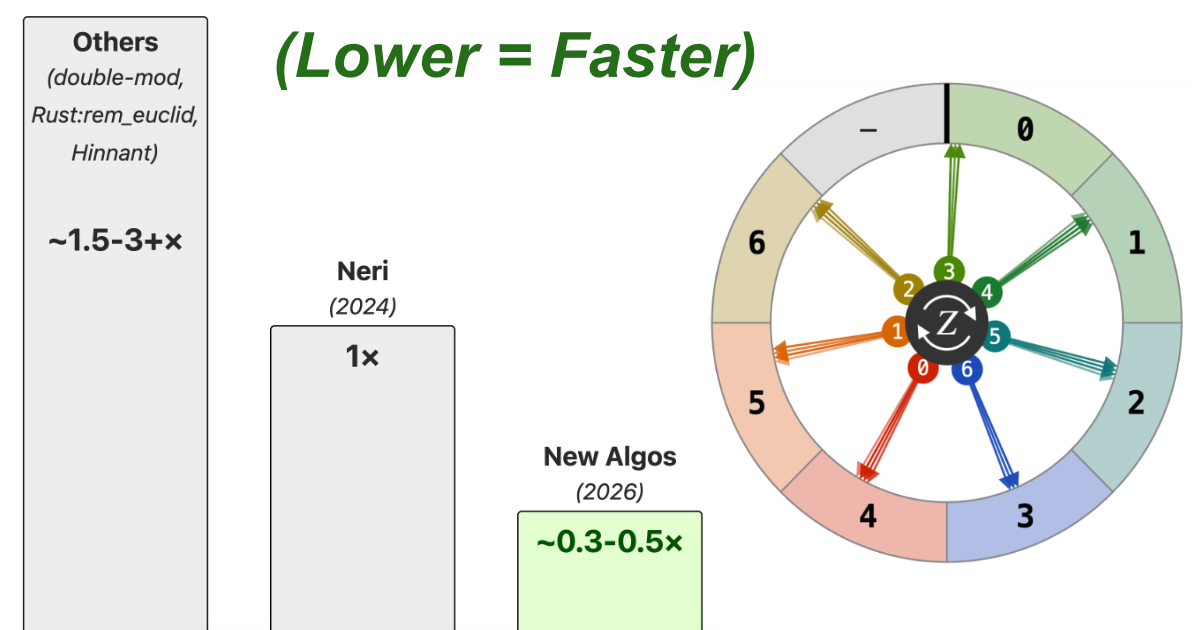](https://www.benjoffe.com/fast-day-of-week)
- [Faster time\-of\-day functions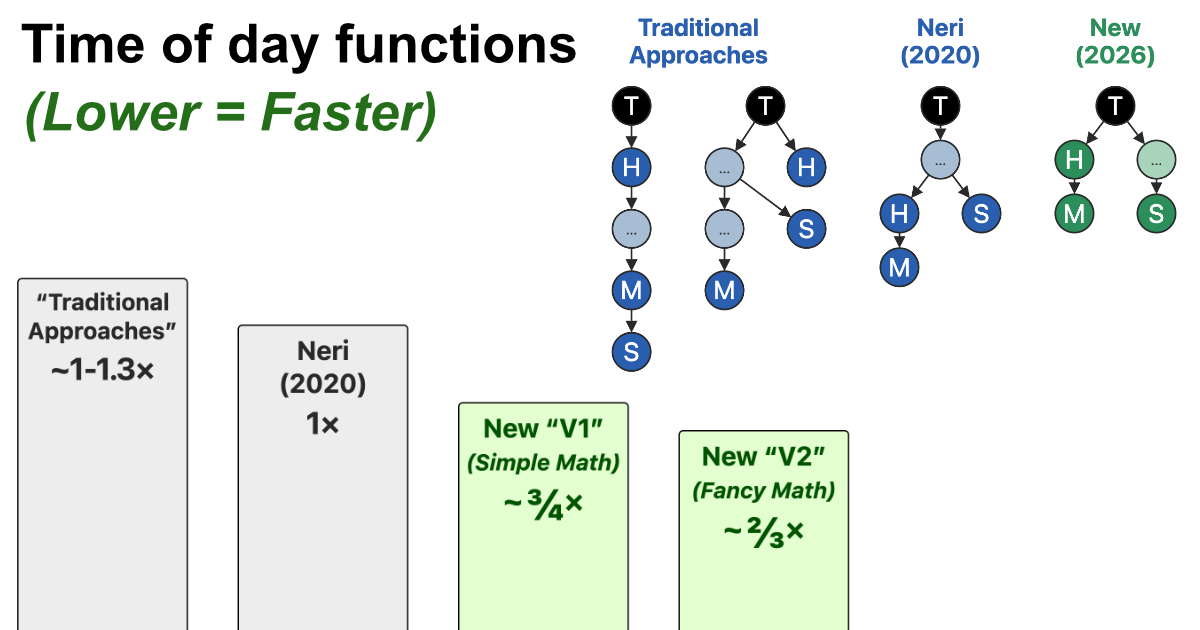](https://www.benjoffe.com/fast-time-of-day)
You should[follow me on X](https://x.com/benjoffe)to get notified when I publish more optimisation articles\.
Revision history:
- 25 October 2026 \- Soft release draft
- 27 October 2026 \- First release
---
## Annexure A \- Proof[Deep link](https://www.benjoffe.com/fast-floordiv#proof)
**Positive divisor, non\-negative\.** For,is just an unsigned\-bit number, so the unsigned results \(Granlund–Montgomery, ridiculousfish\) apply directly with\. Either the round\-up multiplierworks directly, or the round\-down multiplierworks with an increment\. At least one of the two always does, using an\-bit multiplier, at a shift no larger than:
Writingfor an unsigned\-bit input, both variants land strictly betweenandwhenever:
These inequalities are strict \(not\), and this is a requirement rather than a free fact\. Thatisn't a power of 2 only tells us neither multiplier is exactly\. For round\-up the strictness then follows from the bound\. For round\-down, the product atlands exactly onwhen, since for those divisorsat every register\-sized shift\. The solver rejects round\-down for them, which forces them to round\-up\.
In simple terms, these mul\-shifts slowly "drift" away from the true ratio\. Apart from at, the non\-rounded terms are never an integer*\(the check above ensures this\)*\. The reason to point this out is that we will use the below identity which relies on that fact:
\.
**Negative\.** Let\. Bitwise NOT maps the negatives one\-to\-one onto— exactly the rangeranges over above — and also satisfies:
Combined with the standard floor/negation fact \(for non\-integer\), each case of the bump follows:
- **Round\-up,\.**Here— squarely in the strict range above — and, so:
- **Round\-up,\.**This value is*not*covered by the case above \(it has, outside the strict range\), which is exactly why the bump skips it and uses the plain, unbumpedinstead\. Since:, solies strictly inside, giving\.
- **Round\-down,\.**Here— the full unsigned domain, no exclusion needed, since the increment variant's bound above only ever needs, true for every\. Since:Atthis needs the increment atwithout saturating, and needsnot to be a whole number for the negation identity to apply\. Given the unsigned round\-down bound,, it is a whole number only whenand, in which case the product is exactly, so those divisors cannot use round\-down\. The same exclusion is what makes skipping the increment at`INT\_MAX`safe in the saturating variant\.
So whichever rounding works for unsigned\-bit division also works across the whole signed\-bit range, with the same multiplier and shift\.
**Sign\-selected\.**This uses round\-up's unbumped half and round\-down's unbumped half, so it works at any shift where both roundings work\. A rounding that works at some shift keeps working at larger shifts, so it's enough that each works somewhere within the\-bit multiplier limit\.
**Negative divisors\.**
So this is the positive\-divisor problem applied to\. The one difference is the range:runs fromup to\. The non\-negative side holds one value more thanbits allow \(the image of INT\_MIN\), and the negative side holds one value less\. That extra value is where round\-up can land on an integer, which it does for, so those divisors can't use round\-up\. The missing value on the other side is the one that ruled out round\-down for, so for negative divisors that exclusion goes away\. That's why the reference implementation adjusts the bounds based on the divisor's sign\.