@rsalakhu: Congrats to the @browser_use team for taking the #1 spot on Odysseys, a highly challenging benchmark for long-horizon w…
Summary
The browser_use team achieved the #1 spot on the Odysseys benchmark, a challenging evaluation for long-horizon web agents, outperforming models like Opus 4.6 and GPT-5.4.
View Cached Full Text
Cached at: 06/16/26, 09:40 PM
Congrats to the @browser_use team for taking the #1 spot on Odysseys, a highly challenging benchmark for long-horizon web agents:
https://odysseys-website.pages.dev/leaderboard
Odysseys evaluates realistic, multi-hour web workflows that require sustained planning, memory, reasoning, and verification across numerous websites and tools, far beyond short single-step browser tasks.
Exciting progress toward truly capable long-horizon agents.
Leaderboard — Odysseys
Source: https://odysseys-website.pages.dev/leaderboard Nine entries on all 200 Odysseys tasks. Eight CUA models were evaluated by us under identical settings — 100-step budget, maximum reasoning effort, Google Chrome in an OSWorld Ubuntu VM.
ModelTypeAgentO-M2W JudgeRubric AvgPerfectAvg. StepsTraj. Eff.
*Notes.Rubric Avgtreats each task rubric pair as an independent observation and averages them.Perfectmarks a task as passing only if every rubric is satisfied.O-M2W Judgeis the trajectory-level holistic LLM judge from Online-Mind2Web.Avg. Stepsis the mean number of interaction steps the agent takes per task, where lower is more efficient.Traj. Eff.(Trajectory Efficiency) is\(1/N\) · Σ sᵢ / nᵢ, wheresᵢis the averaged rubric score on taskiandnᵢis the number of agent steps. Higher values mean stronger outcomes achieved in fewer steps.AgentdistinguishesCUA(computer-use agents that consume screenshots and emit GUI actions) fromTerminalagents that drive the browser by writing code (e.g. Playwright). Cells marked—*are metrics not reported by the source. CUA scores are reproduced from Table 2 of the paper; WebWright is reproduced from the WebWright article.
Breakdown by difficulty
Tasks come in three tiers. Easy tasks use at most 5 steps and 3 domains, medium tasks use 6 to 8 steps or 4 or more domains, and hard tasks exceed both thresholds. Each bar shows the perfect rubric rate, the share of tasks a model solves with every rubric item satisfied.
Steps vs perfect score
Each model’s perfect rubric rate plotted against its average number of steps per task, with the Pareto frontier overlaid. Opus 4.6 sits at the capability end of the frontier, with GPT-5.4 and GPT-5.4 Mini trading off step budget for perfect rate. Each additional step of compute buys progressively smaller gains.
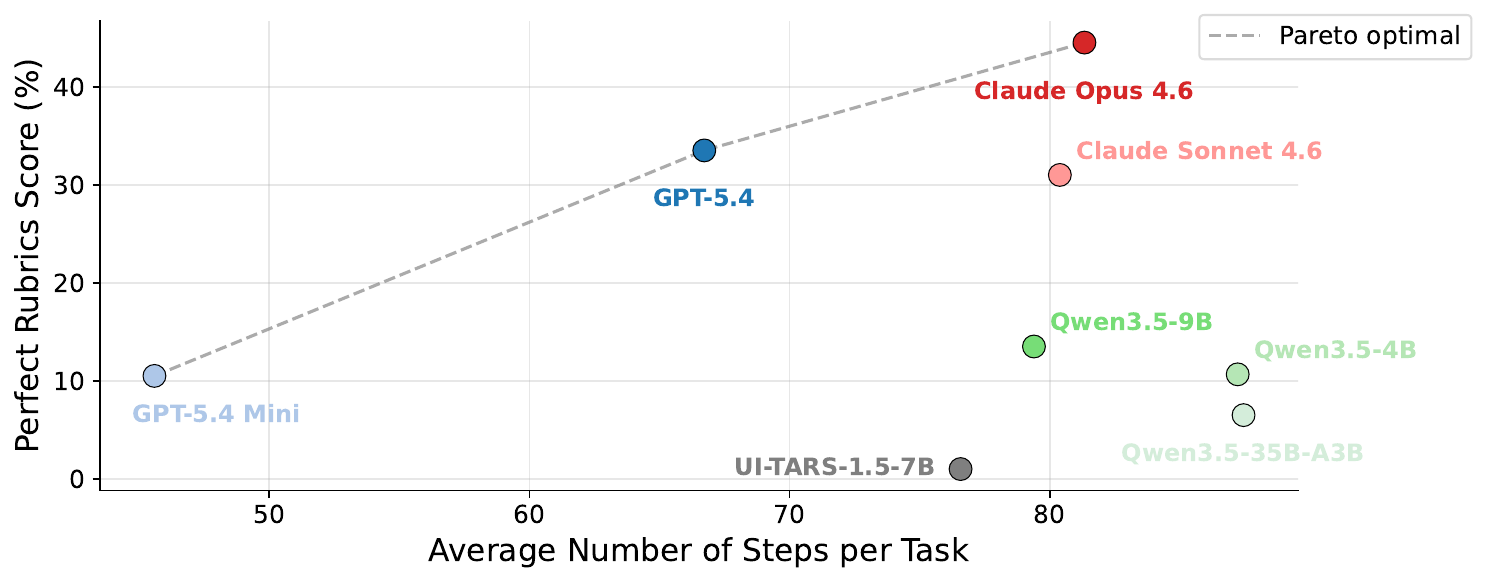 Figure.Sonnet 4.6 is Pareto-dominated by both Opus 4.6 and GPT-5.4, which achieve higher perfect rates with fewer steps. Open-weight models sit well inside the frontier, spending more steps for substantially lower perfect rates, pointing to capability ceilings rather than step-budget shortfalls.
Similar Articles
@browser_use: BrowserCode is incredibly good at long-running tasks It orders pizza for us
BrowserCode achieves #1 spot on Odysseys benchmark for long-horizon web agents, demonstrating strong performance in multi-hour web workflows.
@JangLawrenceK: We partnered with Browser-Use to release a new live web eval as a followup to the original Odysseys paper Odysseys2 ser…
Browser-Use partnered with Carnegie Mellon researchers to release Odysseys2, a hard long-horizon live web-agent benchmark built from real user tasks, where the best SOTA agent completes only 47/100 tasks.
@browser_use: Browser Use Bench v2 Pareto frontier got completely redrawn today > Claude Opus 5.5: 59.4 > GPT‑6 Sol medium: 66.9 (3.5…
The Browser Use Bench v2 benchmark has updated its Pareto frontier, showcasing GPT-6 models from OpenAI outperforming and being more cost-effective than Claude Opus 5.5 from Anthropic.
@browser_use: Astra is a monster at browser use
Astra achieved 77.3% on the Browser Use Benchmark v2, far surpassing Opus 5 (50.5%) and GPT-5.6 Sol xhigh (49.1%), with 22 of 60 tasks earning full marks compared to zero for Opus 5.
@browser_use: Opus 5 and GPT-5.6 Sol are neck-and-neck on this!
Alexander Yue introduces a new browser-use benchmark where Opus 5 and GPT-5.6 Sol show similar performance, emphasizing the benchmark's robust design with verified rubrics for LLM judges.