@Modular: Modular 26.6 is here. Mojo 1.1 opens the compiler to external contributions and adds developer experience improvements,…
Summary
Modular 26.6 release opens the Mojo compiler for external contributions, adds developer experience improvements, and expands MAX with audio generation, new model support, and faster performance.
View Cached Full Text
Cached at: 09/17/26, 10:29 PM
Modular 26.6 is here. Mojo 1.1 opens the compiler to external contributions and adds developer experience improvements, while MAX 26.6 brings audio generation, new model architectures, and faster performance.
Release blog: https://t.co/drffR0WRr9
Modular 26.6: Open compiler contributions, audio generation, and expanded model support
Source: https://www.modular.com/blog/modular-26-6-open-compiler-contributions-audio-generation-and-expanded-model-support?utm_campaign=26_6&utm_source=x Modular 26.6 is our first release since open sourcing the Mojo compiler at ModCon. With Mojo 1.1, we’re taking the next step in that journey by opening the compiler to external contributions and moving more of our development into the GitHub repository.
MAX 26.6 expands to support audio generation, new frontier models, and delivers significant performance improvements across NVIDIA and AMD GPUs. We’re also actively working on our ecosystem alliance program and plan to launch it toward the end of 2026 (reach out to[email protected]for more information).
Mojo 1.1: the compiler now accepts contributions
At ModCon in August, we announced the open sourcing of theMojo compiler under the Apache 2.0 license. Making source code available was the first step and today we’re happy to announce that we’reaccepting contributions to the Mojo compiler!
This was one of the top requests we received after open-sourcing the Mojo compiler, and we appreciate your patience while we got the right infrastructure in place. To make it even easier to follow work in progress and collaborate directly with the Modular team, we’ve migrated our internal issues topublic GitHub issues.
Mojo 1.1 builds on the foundation of Mojo 1.0 with a number of compiler, language, and developer experience improvements:
- Compilation time speedup: Compilation of implicit conversions and use of t-string literals has improved.
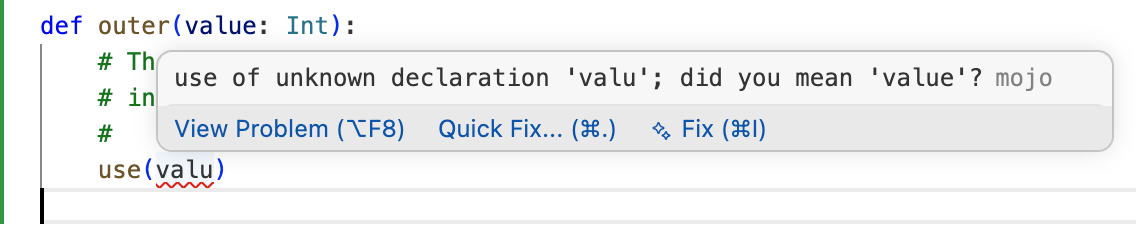
- LSP improvements: Compiler suggestions for common off-by-one typos.
 - Contextual type inference: Allows declarations such as
DType\.float32to be shortened to\.float32when the type can be inferred.
- **OSS directory organization:**A unifiedtop-level Mojo directorycontaining the compiler and standard library, along with anew guide to working with Mojo in open source.
See theMojo 1.1 changelogfor the complete list of language and tooling improvements.
MAX 26.6: new modalities and models with faster performance
MAX development continues rapidly and we are committed to making MAX source available. In 26.6, we expanded MAX to support audio output modality, added additional frontier models, and made significant performance improvements across NVIDIA and AMD GPUs.
**Audio model generation support:**MAX now supports audio generation, expanding beyond text, vision, and image generation. Theaudio\_generationpipeline launches with support for MiniMax-Music3 (MiniMaxAI/MiniMax\-Music3), a text-to-music model that generates 44.1 kHz stereo audio from a style prompt and lyrics. Audio generation is available through the/v1/audio/speechand/v1/responsesAPI endpoints, with controls for duration, denoising steps, guidance scale, and output format.
**Model architecture support:**MAX 26.6 adds support for new frontier model architectures while expanding capabilities across existing model families. This includes support for Thinking Machines’ Inkling (InklingForConditionalGeneration) architecture, along with improvements to the Kimi, Qwen, Gemma, and GLM model series. Speculative decoding techniques (such as DFlash and DSpark) are now supported within MAX, along with improved tool calling and datatype support.
**Performance improvements:**MAX improves performance across hardware and workloads, delivering broad gains across representative benchmarks. On NVIDIA B200, these optimizations deliver up to 4.8× faster Gemma 4 decode attention, up to 7.9× faster MoE routing, and up to 16× faster low-batch NVFP4 quantization. On AMD MI355, the optimizations deliver up to 6.6× faster performance for decode attention projections, while and the MXFP8 QKV projection is up to 4.8× faster than the previous release.
For the complete list of updates, including additional model support, serving improvements, and speculative decoding controls, see theMAX 26.6 changelog.
Get started with 26.6 and Mojo 1.1
Install or upgrade to get started in minutes:
bash
uv pip install --upgrade mojo

uv pip install max[all]
As announced in 26.5, themodularpackage is retired in this release. Instead installmax\["all"\]for everything, ormax\["serve"\]if you just need an endpoint, ormax\["benchmark"\]if you just need to benchmark an endpoint (usemax\-serveormax\-benchmarkwith conda).
The compiler is open to your patches now, andthe standard libraryandcompiler issue trackersshow what our teams are working on, so the contributing guide and the open issues are the place to start if you want to pick something up. If 26.6 breaks something for you, file it there too. For questions about the release, thehttps://forum.modular.com/Modular forumis the best place to get an answer from the team, and ourDiscord serveris the best place for real-time conversation with other developers building on Mojo and MAX.
Similar Articles
@Modular: We're the #1 trending repo on @github today. The Mojo compiler went open source at ModCon this week, and developers not…
Modular announces that the Mojo compiler has gone open source, the platform now supports six hardware architectures including NVIDIA, AMD, and new ASICs, and Modular Cloud is officially launched.
@Modular: Mojo 1.0 beta is out! Now we want to hear from you. Share questions and start discussions in the Mojo 1.0 subcategory o…
Modular has released the beta version of Mojo 1.0 and is inviting the community to provide feedback and report issues on their forum and GitHub.
Mojo v1.2.0
Mojo v1.2.0 has been released, marking a new version update for the Mojo programming language developed by Modular.
Mojo v1.0.0b1
Mojo, the high-performance programming language from Modular, has reached version 1.0.0 beta 1.
Mojo 1.0
Modular announces the 1.0 release of the Mojo programming language, offering a stable foundation for developers building libraries, tools, and applications with enhanced features like Python-style lambdas, improved LSP, and memory safety diagnostics.