@omarsar0: Banger report on building faster memory for AI Agents. If your agent's memory layer is slow, this design is worth a loo…
Summary
The article presents Jev-Mem, a new agentic memory architecture that uses a System-One controller for fast memory operations and System-Two for reasoning, achieving 6.6x faster memory construction and 36.7% lower query latency while improving accuracy by 11% on the LoCoMo benchmark.
View Cached Full Text
Cached at: 09/26/26, 07:00 AM
Banger report on building faster memory for AI Agents. If your agent’s memory layer is slow, this design is worth a look. Great weekend read. It proposes a new agentic memory architecture, Jev-Mem, inspired by System-One/System-Two cognition. This builds agent memory 6.6x faster and cuts query latency by 36.7% while scoring higher on LoCoMo. In this system, a lightweight controller makes the memory decisions. It assigns memory types and relations when storing, and handles routing, retrieval budget, graph traversal, scoring and stopping when reading. The LLM is called only for final reasoning and answer writing. On LoCoMo, it scores 0.777 overall with an LLM judge, an 11.0% relative improvement over the strongest baseline. Memory construction takes 158 seconds, and average query latency drops to 0.93 seconds. Paper: https://academy.dair.ai/papers/jev-mem-system-one-controlled-agentic-memory-for-efficient-ai-agents-2609.23986…
Jev-Mem: System-One-Controlled Agentic Memory for Efficient AI Agents
Source: https://academy.dair.ai/papers/jev-mem-system-one-controlled-agentic-memory-for-efficient-ai-agents-2609.23986 Agents · Memory · ReasoningChat with Paper
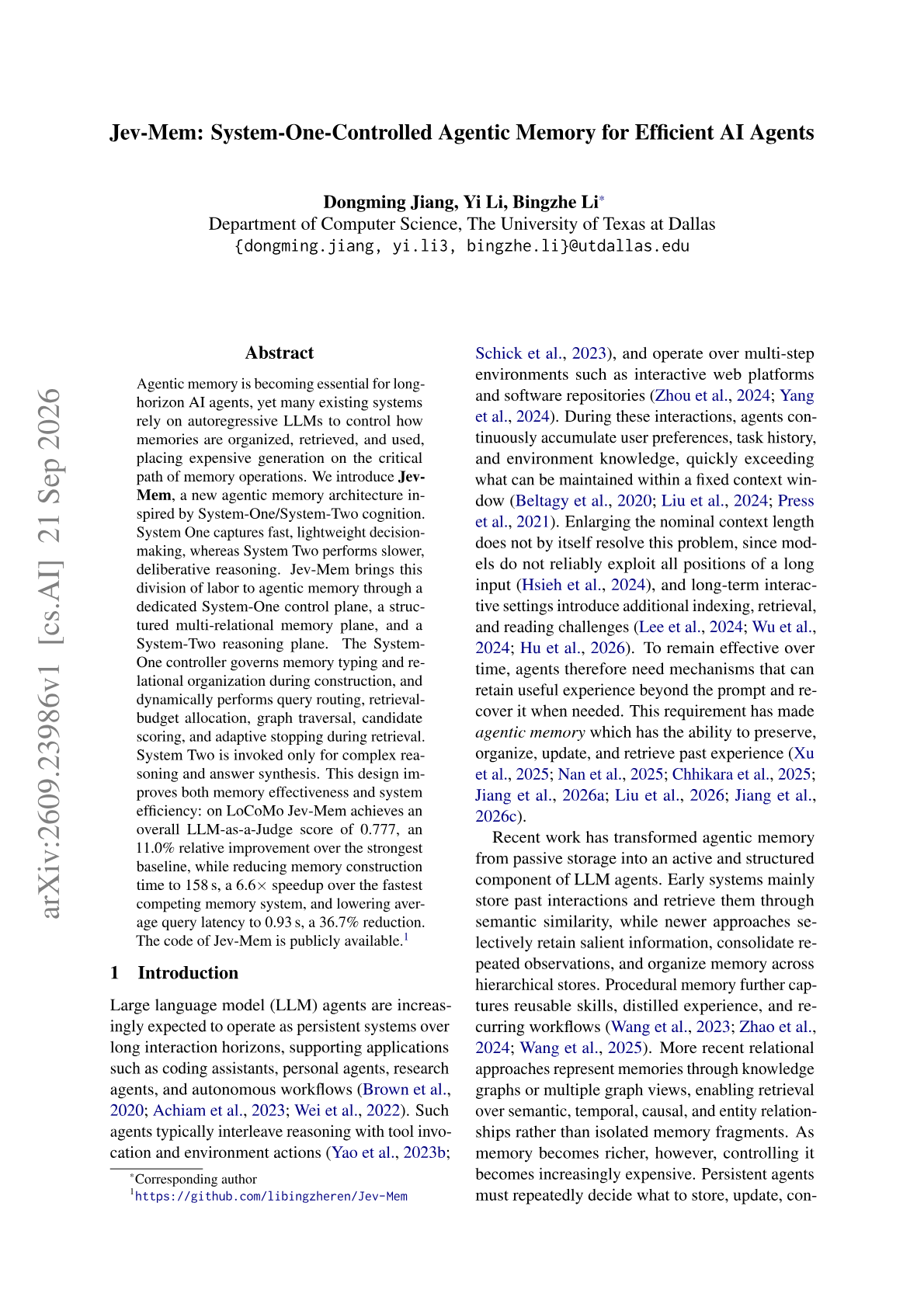
First page
The curator’s take
Dongming Jiang, Yi Li and Bingzhe Li (UT Dallas) build Jev-Mem, an agent memory system that hands memory organization and retrieval control to a lightweight System-One controller and calls an LLM only for final reasoning.
Ask this paper
Question about this paper Key points01
Three planes. A System-One control plane, a structured multi-relational memory plane and a System-Two reasoning plane split fast control from slow deliberation.
02
What the controller does. It assigns memory types and relations during construction and handles query routing, retrieval budget, graph traversal, candidate scoring and adaptive stopping during retrieval.
03
LLM off the critical path. System Two runs only for complex reasoning and answer synthesis, so memory operations no longer wait on autoregressive generation.
04
Accuracy. On LoCoMo it scores 0.777 overall with an LLM judge, an 11.0% relative improvement over the strongest baseline.
05
Speed. Memory construction takes 158 s, 6.6x faster than the fastest competing system, and average query latency drops 36.7% to 0.93 s.
AbstractAgentic memory is becoming essential for long-horizon AI agents, yet many existing systems rely on autoregressive LLMs to control how memories are organized, retrieved, and used, placing expensive generation on the critical path of memory operations. We introduce \textbf{\method}, a new agentic memory architecture inspired by System-One/System-Two cognition. System One captures fast, lightweight decision-making, whereas System Two performs slower, deliberative reasoning. Jev-Mem brings this division of labor to agentic memory through a dedicated System-One control plane, a structured multi-relational memory plane, and a System-Two reasoning plane. The System-One controller governs memory typing and relational organization during construction, and dynamically performs query routing, retrieval-budget allocation, graph traversal, candidate scoring, and adaptive stopping during retrieval. System Two is invoked only for complex reasoning and answer synthesis. This design improves both memory effectiveness and system efficiency: on LoCoMo Jev-Mem achieves an overall LLM-as-a-Judge score of 0.777, an 11.0\% relative improvement over the strongest baseline, while reducing memory construction time to 158\,s, a 6.6\\times speedup over the fastest competing memory system, and lowering average query latency to 0.93\,s, a 36.7\% reduction.
Similar Articles
Jev-Mem: System-One-Controlled Agentic Memory for Efficient AI Agents
Jev-Mem introduces an agentic memory architecture inspired by System-One/System-Two cognition, enhancing efficiency and effectiveness for long-horizon AI agents with improved scores and faster operations.
@omarsar0: // AutoMem // I quite like this idea of metamemory. (bookmark it) This new research from Stanford treats agent's memory…
This Stanford research paper introduces AutoMem, a framework that treats agent memory management as a trainable skill. By optimizing memory structure and proficiency separately, AutoMem improves base agent performance 2x-4x on long-horizon tasks, enabling a 32B open-weight model to compete with frontier systems like Claude Opus 4.5 and Gemini 3.1 Pro Thinking.
I've built a memory system for my agent and it's actually working
A developer shares MnemoBrain, a memory system that enables AI agents to automatically remember context using hooks and semantic search, removing the need for explicit memory commands.
rohitg00/agentmemory
agentmemory is an open-source persistent memory layer for AI coding agents (Claude Code, Cursor, Gemini CLI, Codex CLI, etc.) that uses knowledge graphs, confidence scoring, and hybrid search to give agents long-term memory across sessions via MCP, hooks, or REST API. Built on the iii engine, it requires no external databases and exposes 51 MCP tools.
@0xMovez: https://x.com/0xMovez/status/2101007482919227841
The article provides a 10-step guide to building the fastest AI Agent Brain using Jev, a System One model by TypeSafe AI, which offers faster and cheaper decision-making compared to LLMs.