Cached at:
05/17/26, 03:23 AM
# Florida Considers Closing “Alligator Alcatraz” Detention Center & DeSantis Limits AI Data Center Costs
Source: [https://centralflorida.substack.com/p/alligator-alcatraz-closure-ai-data-center-restrictions?open=false](https://centralflorida.substack.com/p/alligator-alcatraz-closure-ai-data-center-restrictions?open=false)
*Welcome to this week’s edition of the Central Florida Times\. We are an independent, reader\-supported newsletter focusing on the most important local news stories from Florida\.*
**Florida’s week reveals a state wrestling with big decisions and their consequences\. Florida officials are quietly exploring the shutdown of “Alligator Alcatraz,” the swampy detention center in the Everglades that has cost Florida taxpayers more than $600 million\. Governor Ron DeSantis moved to rein in water‑ and energy‑hungry data centers before they take root\. And in Tampa, Mayor Jane Castor touted growth and infrastructure wins while sidestepping the complexities of the $2\.3 billion Rays stadium saga\. The Rays, meanwhile, are scrambling for a nonbinding stadium agreement to unlock state funding\. Wildlife advocates sounded alarms after revelations that 55\+ sloths died in the collapse of Orlando’s Sloth World attraction, prompting calls for criminal charges\. FEMA reform proposals seek to lean on local governments to speed disaster aid, and the Hillsborough County school board moved to renew its half‑cent sales tax to keep long‑overdue campus repairs on track\.**
[](https://substackcdn.com/image/fetch/$s_!9Y3w!,f_auto,q_auto:good,fl_progressive:steep/https%3A%2F%2Fsubstack-post-media.s3.amazonaws.com%2Fpublic%2Fimages%2F4ec6218e-1544-41bf-85da-66bf34e3c381_2500x1668.jpeg)Reuters
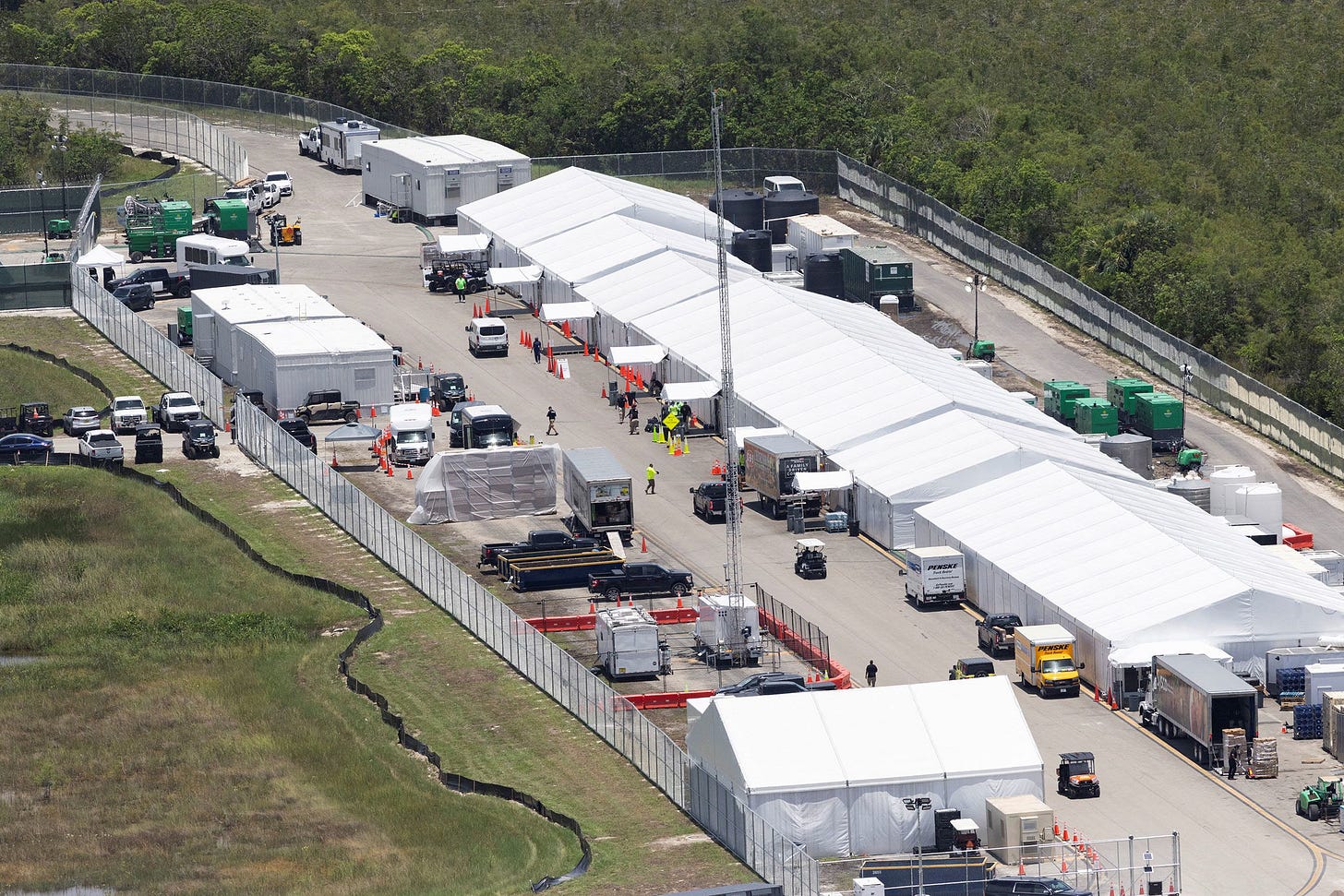
Florida officials are reportedly in early discussions with the Trump administration about shutting down the controversial “Alligator Alcatraz” immigrant detention facility in the Everglades amid mounting operational costs and ongoing criticism\. According to reports, the state has spent roughly $600 million on the temporary detention center and is still awaiting federal reimbursement\. Operating expenses reportedly exceed $1 million per day\. While Governor Ron DeSantis has acknowledged that conversations about closing the facility have occurred, no formal request has been made by the Department of Homeland Security\. DeSantis defended the site’s legacy, stating it was always intended to be a temporary operation that has already fulfilled its purpose by processing nearly 22,000 immigration detentions\. Since the facility opened in July 2025, it has drawn intense scrutiny from immigrant advocates, environmental groups, and Democratic lawmakers over alleged mistreatment of detainees and poor living conditions\. Former detainees described overcrowding, delayed medical care, and inadequate food\. Legal challenges against the facility continue, while advocacy groups are demanding accountability and a full investigation into detention practices and environmental impacts tied to the Everglades site\.
[](https://substackcdn.com/image/fetch/$s_!TKct!,f_auto,q_auto:good,fl_progressive:steep/https%3A%2F%2Fsubstack-post-media.s3.amazonaws.com%2Fpublic%2Fimages%2F322b7aa1-ab85-4ef1-a82d-c84a164fc68c_1600x900.jpeg)*Facebook/Gov\. Ron DeSantis*
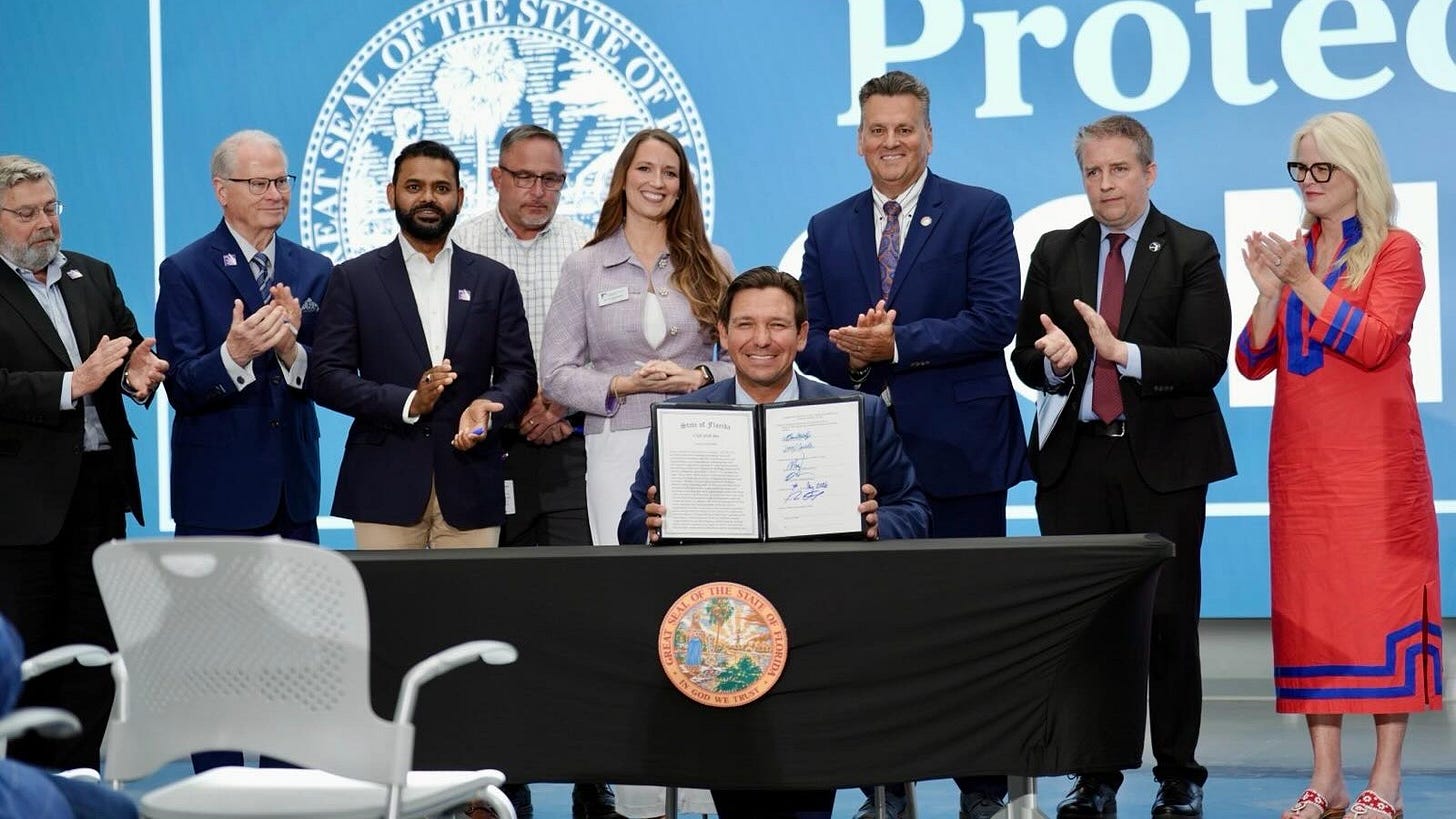
Gov\. Ron DeSantis has signed legislation establishing first\-of\-its\-kind regulations for large\-scale data centers, saying the measure is designed to protect Florida residents from rising utility costs and strain on water supplies driven by the artificial intelligence industry\. DeSantis said Floridians should not be forced to subsidize major technology companies through higher electric bills or reduced access to natural resources\. The new law requires data centers consuming over 50 megawatts of electricity to cover their own infrastructure and utility service costs without shifting expenses onto consumers\. The legislation also directs Florida water management districts to deny permits if a project would harm local water resources and encourages the use of reclaimed water whenever possible\. Communities in several rural Florida counties have recently pushed back against proposed AI\-focused operations known as hyperscale data centers over concerns involving land use, water consumption, noise, and transparency\. Earlier versions of the bill included stricter transparency rules, but lawmakers removed a ban on nondisclosure agreements after pushback from business groups\. No hyperscale data centers are currently operating in Florida, though industry interest continues to grow\.
[](https://substackcdn.com/image/fetch/$s_!hFUg!,f_auto,q_auto:good,fl_progressive:steep/https%3A%2F%2Fsubstack-post-media.s3.amazonaws.com%2Fpublic%2Fimages%2F9c32c303-dae6-46aa-a01f-6a7451770036_1100x733.jpeg)City of Tampa
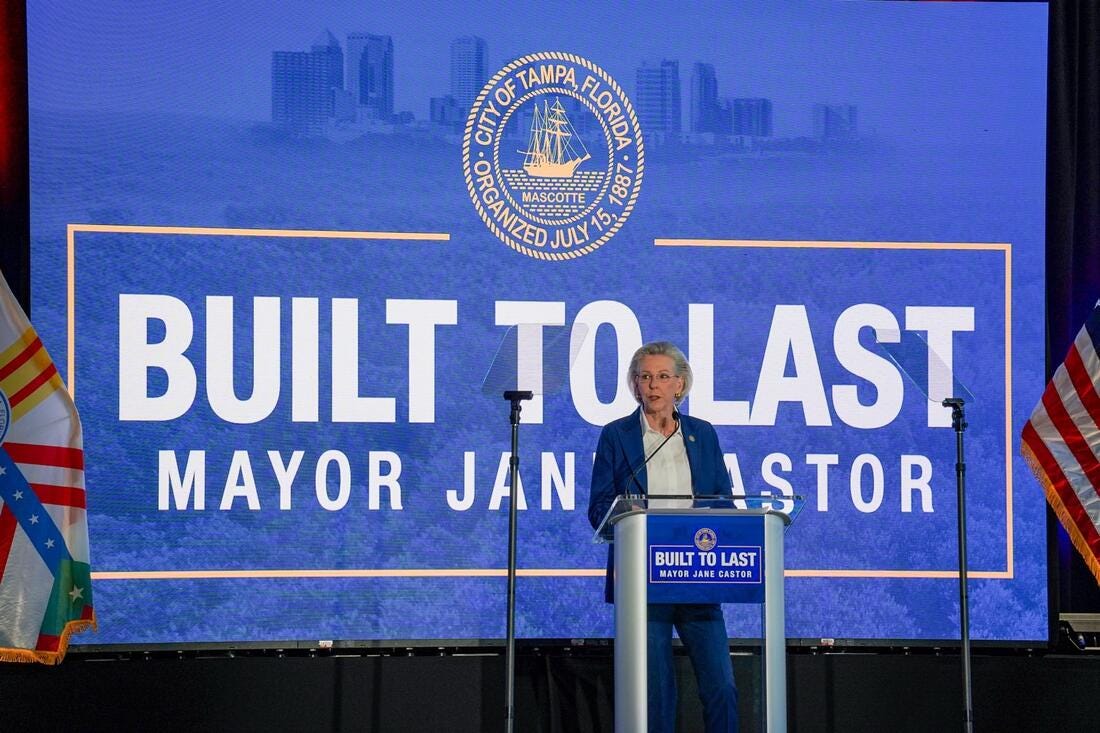
Tampa Mayor Jane Castor used her annual State of the City address Tuesday to spotlight major development projects, infrastructure upgrades, and public safety investments, declaring that Tampa is “built to last” as she enters the final stretch of her administration\. Speaking at the newly opened Fair Oaks Recreation Complex in East Tampa, Castor highlighted the city’s rapid growth and emphasized long\-term investments in housing, transportation, and resilience projects\. The $34\.7 million Fair Oaks facility, featuring classrooms, a gymnasium, sports fields, community spaces, and a splash pad, was presented as a symbol of the city’s commitment to historically underserved neighborhoods\. Castor also pointed to large redevelopment efforts, including Robles Park Village and West River, alongside the city’s significant progress toward the goal of adding 10,000 affordable housing units before Castor’s term ends in 2027\. Storm resiliency and infrastructure upgrades ahead of hurricane season remained another central focus\. The mayor defended costly flood mitigation projects and ongoing improvements to Tampa’s water and wastewater systems, including Tampa PIPES and the city’s new SIX water treatment system, which treats up to 140 million gallons per day\. Castor praised transit improvements, street repaving projects, the 30\-year Tampa MOVES multimodal transportation plan, and the scheduled return of the Tampa Bay Ferry by the end of 2026\. She called for a mass transit connection between Tampa International Airport, downtown, and other key destinations\. The mayor additionally announced increased investment in Tampa Fire Rescue through new equipment purchases and firefighter hiring\. Notably absent from her remarks, however, was mention of the proposed Tampa Bay Rays $2\.3 billion stadium project and ongoing funding negotiations\.
[](https://substackcdn.com/image/fetch/$s_!rP7M!,f_auto,q_auto:good,fl_progressive:steep/https%3A%2F%2Fsubstack-post-media.s3.amazonaws.com%2Fpublic%2Fimages%2F77391a43-d612-49d0-9713-654b325637d8_5000x2810.jpeg)Tampa Bay Rays
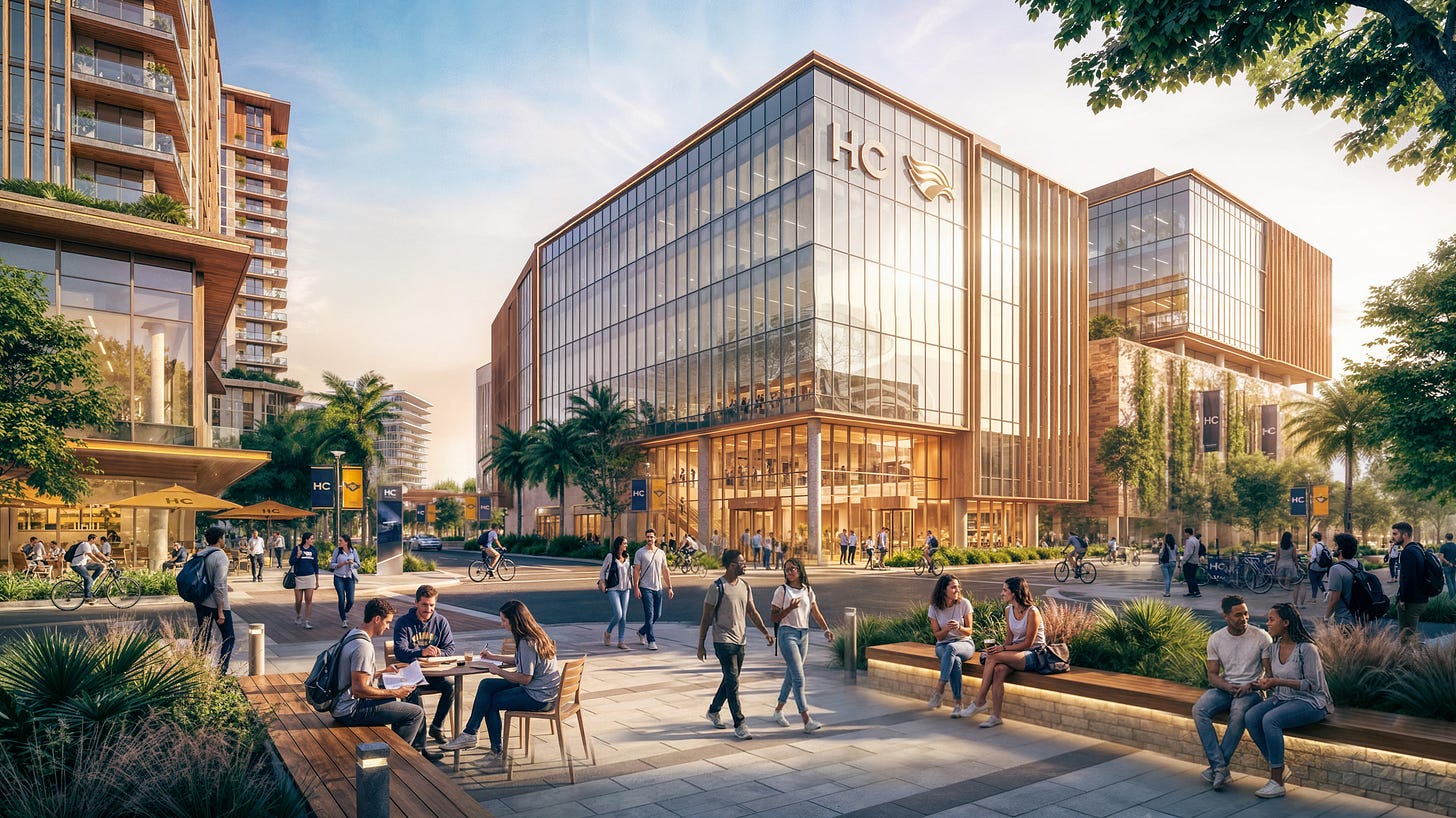
The Tampa Bay Rays are now prioritizing a non‑binding memorandum of understanding with Hillsborough County and the city of Tampa by the end of May, a shift from the team’s earlier push for definitive agreements by June 1\. CEO Ken Babby told the*Tampa Bay Times*the immediate goal is simply to show a unified commitment to the proposed $2\.3 billion ballpark planned for Hillsborough College’s Dale Mabry campus\. The Rays’ draft agreement, released last month, outlined a $1 billion public funding request and warned that missing the June deadline could jeopardize “critical state funding\.” The team’s shift is tied to the Florida Legislature’s May 12 special session, where lawmakers will begin budget negotiations, including consideration of $150 million for redevelopment of the college campus tied to the stadium site\. Babby cautioned that without this state support, the project would be “economically infeasible\.” Whether a non‑binding MOU is enough to unlock that funding remains unclear, but Babby said it would at least signal progress: “The state needs to know that the county, the city, and the Rays are committed\.” While county officials estimate that finalized agreements could take another 60 to 90 days to negotiate, the Rays remain focused on a May MOU to stay on track for a 2029 debut\.
Wildlife experts said that at least 55 sloths died after being imported for the now\-defunct Sloth World attraction in Orlando—a far higher toll than previously known—prompting renewed calls for criminal charges and tighter animal welfare regulations in Florida\. Speaking alongside Central Florida lawmakers, representatives from the Sloth Conservation Foundation and the Sloth Institute said their review of veterinary and necropsy records revealed a significantly higher death toll than previously reported\. The experts also questioned the accuracy of import records tied to the attraction, noting that it hides the full extent of the tragedy\. The controversy erupted after reports surfaced that dozens of sloths were housed in poor conditions inside an unheated warehouse before the attraction ever opened\. The experts described horrific conditions, including sloths found sitting in crates of their own waste and 21 animals dying from a “cold stun\.” Thirteen surviving sloths were later transferred to the Central Florida Zoo, where three have since died despite intensive care\. While a criminal investigation is underway, state officials are urging prosecutors to pursue criminal charges under animal abuse statutes\. Additionally, advocates are calling for a ban on commercial sloth imports and stricter reporting of captive animal deaths to prevent similar incidents in the future\.
[](https://substackcdn.com/image/fetch/$s_!US-h!,f_auto,q_auto:good,fl_progressive:steep/https%3A%2F%2Fsubstack-post-media.s3.amazonaws.com%2Fpublic%2Fimages%2Fbf63a7ee-9fed-42e9-accd-0430c43e8cfb_1080x1350.png)Florida Division of Emergency Management
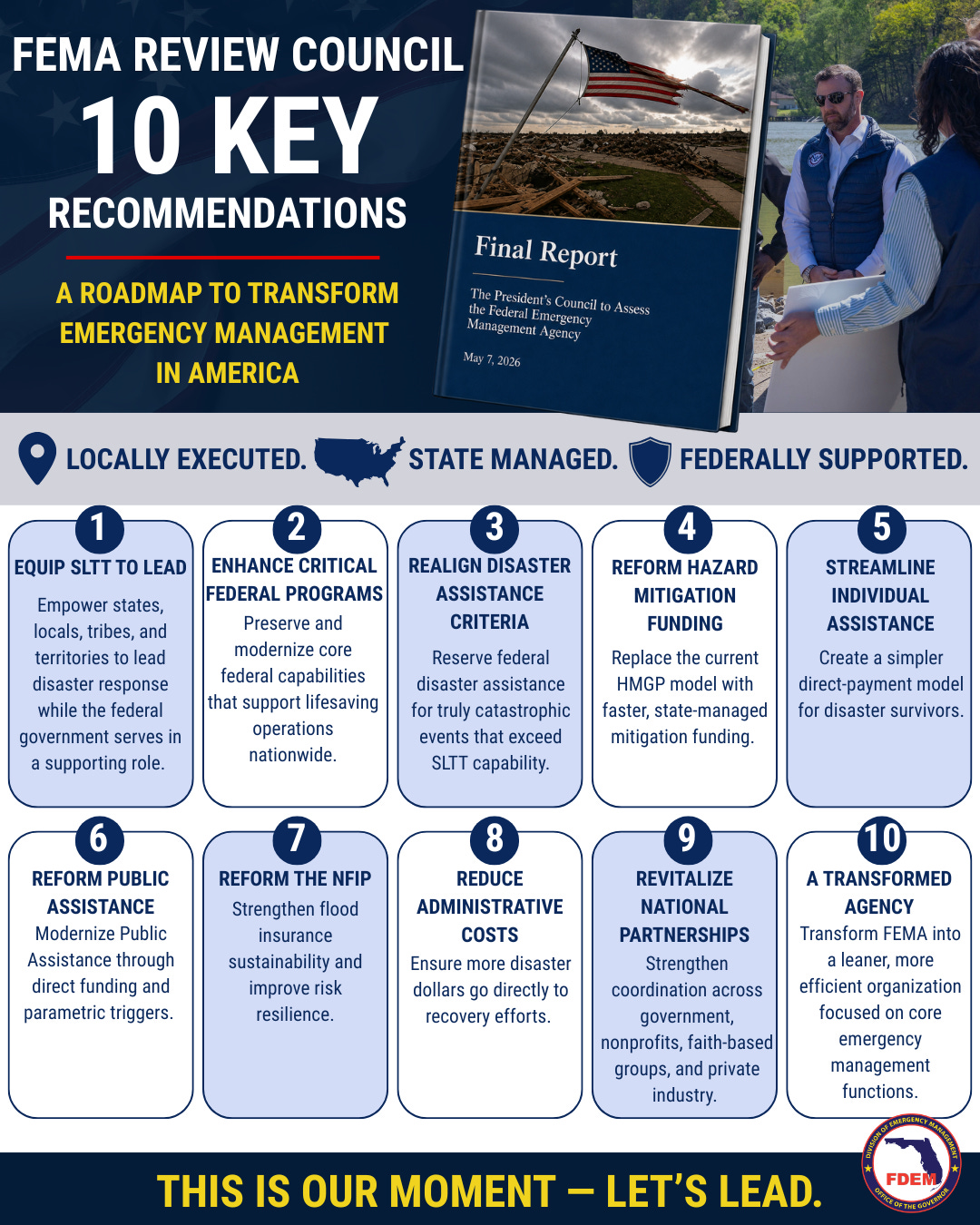
The FEMA Review Council, appointed by President Trump and including Tampa Mayor Jane Castor, is urging Congress to adopt 10 major reforms aimed at speeding disaster assistance and modernizing the agency’s response system\. The recommendations, outlined in a 75‑page final report, call for shifting more responsibility for storm recovery to state and local governments while creating national preparedness standards\. The council proposes a new model in which FEMA provides aid automatically when damage exceeds preset thresholds tied to factors such as wind speed, flooding levels, population, and infrastructure density\. Castor said the standardized approach could allow federal funding for housing and transportation to reach communities more quickly after disasters without lengthy evaluations\. The report also recommends restructuring housing assistance into direct payments to prioritize residents whose homes become uninhabitable and urges reforms to the National Flood Insurance Program through expanded private\-market involvement and updated flood maps\. Critics, however, warned that the recommendations could place greater financial strain on local governments without guaranteeing enough federal support\. Most of the proposed reforms would require congressional approval before taking effect\.
Supporters and critics of the Tampa Bay Rays’ proposed $2\.3 billion stadium recently packed Tampa City Hall as city leaders held a lengthy workshop examining the ambitious redevelopment proposal and its financial complexities\. Residents, union leaders, and local officials spent hours discussing the project, which would place a new stadium near Hillsborough College’s Dale Mabry campus\. Rays CEO Ken Babby said the team is pursuing a nonbinding memorandum of understanding with Tampa and Hillsborough County by the end of May to help secure $150 million in state funding\. Fans praised the effort as a major investment in Tampa’s future\. One speaker told council members the city has a passionate baseball culture and urged leaders to keep the Rays in the region\. Meanwhile, skeptics warned against a $1\.065 billion public subsidy that could jeopardize core services, including police and fire unions and the tax collector’s office, demanding safeguards to protect public resources and existing facilities from displacement\. Others pushed back against neighborhood impacts and traffic associated with a new ballpark and mixed\-use commercial development\.
[](https://substackcdn.com/image/fetch/$s_!cS3L!,f_auto,q_auto:good,fl_progressive:steep/https%3A%2F%2Fsubstack-post-media.s3.amazonaws.com%2Fpublic%2Fimages%2F74796b45-f5a5-4dd8-804b-cd11d16c699e_5000x3043.jpeg)Dirk Shadd/Tampa Bay Times
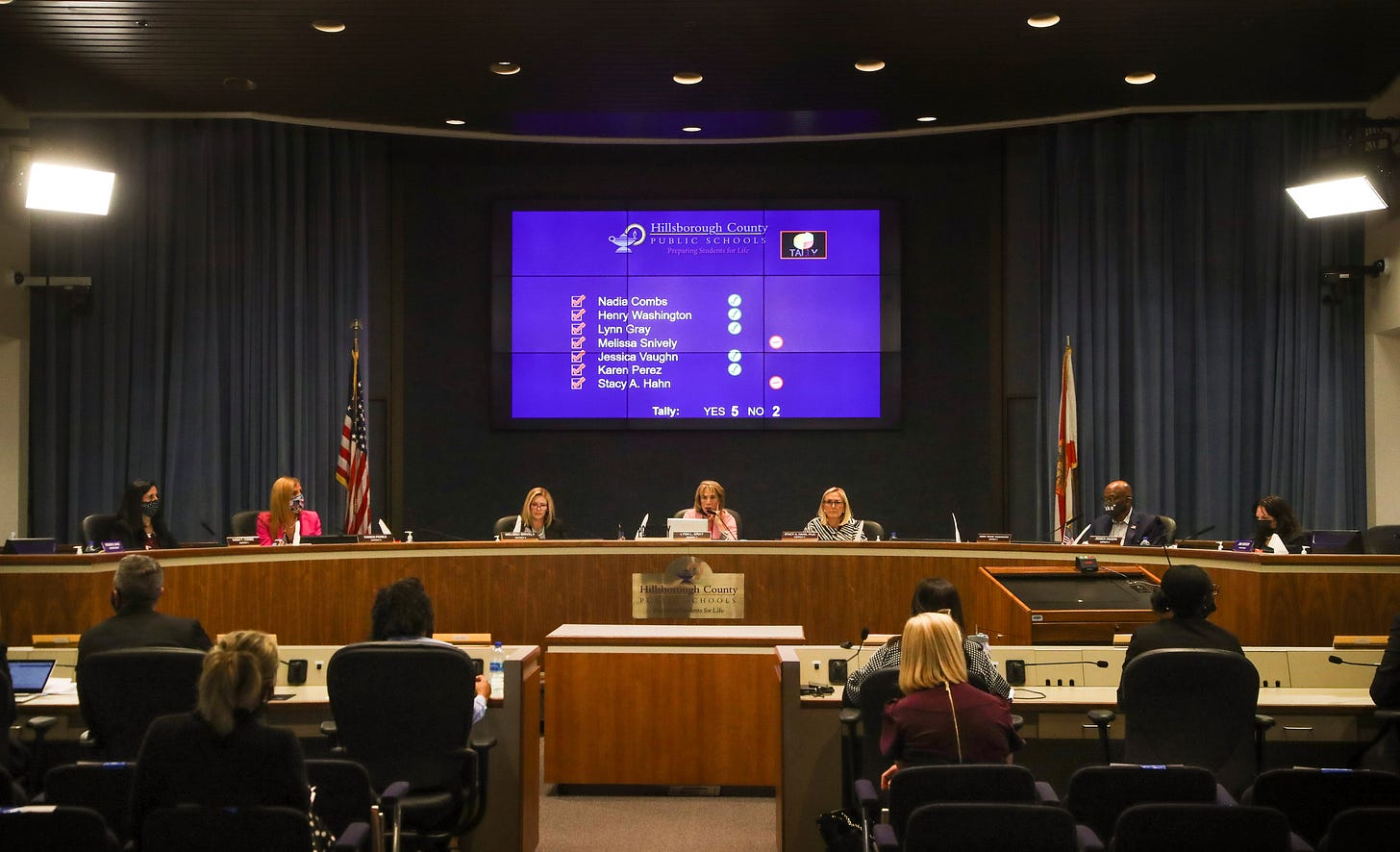
The Hillsborough County School Board has voted unanimously to pursue a renewal of the district’s half\-cent sales tax, aiming to secure another decade of critical facility funding\. Originally approved in 2018 and scheduled to expire in 2028, the measure must now pass through the County Commission to reach the November 3 ballot\. School Superintendent Van Ayres highlighted the success of the initial tax, which fueled over $1\.25 billion in investments across 910 completed projects\. These funds addressed essential infrastructure, with improvements having included roof replacements, air\-conditioning systems, technology and security upgrades, playgrounds, and athletic facilities\. With more than 1,700 future projects already identified, board members emphasized that recurring revenue is vital for ongoing maintenance\. School officials noted that roughly 40% of the sales tax revenue is generated by tourists and visitors, offsetting the burden on local residents\.
*To never miss an update, subscribe to the Central Florida Times by clicking the banner below:*
[](https://centralflorida.substack.com/subscribe)
***If you learned something or found this read interesting, please consider sharing it to grow our community\!***
[Share](https://centralflorida.substack.com/p/alligator-alcatraz-closure-ai-data-center-restrictions?utm_source=substack&utm_medium=email&utm_content=share&action=share)
#### Discussion about this post
### Ready for more?