Cached at:
05/14/26, 06:21 AM
# Avoiding and reducing microplastic false positives from dry glove contact
Source: [https://pubs.rsc.org/en/content/articlelanding/2026/ay/d5ay01801c](https://pubs.rsc.org/en/content/articlelanding/2026/ay/d5ay01801c)
[Author affiliations](https://pubs.rsc.org/en/content/articlelanding/2026/ay/d5ay01801c#)
\*Corresponding authors
aDepartment of Chemistry, University of Michigan, Ann Arbor, MI 48109\-1055, USA **E\-mail:**[ajmcneil@umich\.edu](mailto:
[email protected])
bDepartment of Statistics, University of Michigan, Ann Arbor, MI 48109\-1107, USA
cMacromolecular Science and Engineering Program, University of Michigan, Ann Arbor, MI 48109\-2102, USA
dDepartment of Electrical Engineering and Computer Science, University of Michigan, Ann Arbor, MI 48109\-2122, USA
eProgram in the Environment, University of Michigan, Ann Arbor, MI 48109\-1041, USA
### Abstract
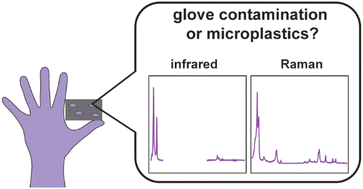
To attenuate microplastics pollution, we first must quantify the number and types of microplastics found in the natural environment and identify their sources\. Quantifying environmental microplastics requires distinguishing synthetic polymers from other naturally occurring species\. Quality assurance and control measures – including wearing gloves when handling laboratory materials and samples – seek to reduce overestimating microplastic abundance\. However, commonly used laboratory gloves release non\-volatile residues, including stearate salts, that exhibit vibrational spectra similar to microplastics\. In this work, we illustrate that dry surface contact with nitrile and latex laboratory gloves can cause overestimations of microplastics \(mean 2000 false positives per mm2\) when using traditional library matching approaches\. We recommend a nitrile cleanroom glove \(mean 100 false positives per mm2\) to reduce contamination\. For existing contaminated infrared and Raman spectral datasets, we outline workflows that differentiate between microplastics and stearate contamination from gloves\. Applying these workflows to a case study of glove\-contaminated environmental data, we illustrate that the proposed solutions reduce MP false positives at the smallest size ranges \(<10 µm\)\. By using this approach in conjunction with our included spectral libraries of stearate standards, researchers can address glove\-based contamination in environmental datasets and provide more accurate estimates of environmental microplastic abundance\.
## Supplementary files
- [Supplementary informationXLSX \(11K\)](https://www.rsc.org/suppdata/d5/ay/d5ay01801c/d5ay01801c1.xlsx)
- [Supplementary informationXLSX \(11K\)](https://www.rsc.org/suppdata/d5/ay/d5ay01801c/d5ay01801c2.xlsx)
- [Supplementary informationPDF \(3582K\)](https://www.rsc.org/suppdata/d5/ay/d5ay01801c/d5ay01801c3.pdf)
- [Supplementary informationXLSX \(2320K\)](https://www.rsc.org/suppdata/d5/ay/d5ay01801c/d5ay01801c4.xlsx)
- [Supplementary informationXLSX \(3024K\)](https://www.rsc.org/suppdata/d5/ay/d5ay01801c/d5ay01801c5.xlsx)
## Article information
DOI[https://doi\.org/10\.1039/D5AY01801C](https://doi.org/10.1039/D5AY01801C)**Article type**PaperSubmitted29 Oct 2025Accepted11 Mar 2026First published26 Mar 2026**This article is Open Access**[](http://creativecommons.org/licenses/by-nc/3.0/)
### DownloadCitation
***Anal\. Methods***, 2026,**18**, 2914\-2926
### Permissions
[](https://pubs.rsc.org/en/content/articlelanding/2026/ay/d5ay01801c#)
### Avoiding and reducing microplastic false positives from dry glove contact
M\. E\. Clough, E\. Ochoa Rivera, A\. M\. Ayala, R\. L\. Parham, J\. Pennacchio, H\. E\. Thurber, A\. P\. Ault, A\. Tewari and A\. J\. McNeil,*Anal\. Methods*, 2026,**18**, 2914**DOI:**10\.1039/D5AY01801C
This article is licensed under a[Creative Commons Attribution\-NonCommercial 3\.0 Unported Licence](https://creativecommons.org/licenses/by-nc/3.0/)\.**You can use material from this article in other publications, without requesting further permission**from the RSC, provided that the correct acknowledgement is given and it is not used for commercial purposes\.
To request permission**to reproduce material from this article in a commercial publication**, please go to the[Copyright Clearance Center request page](https://marketplace.copyright.com/rs-ui-web/mp/search/all/10.1039%2fD5AY01801C)\.
If you are**an author contributing to an RSC publication, you do not need to request permission**provided correct acknowledgement is given\.
If you are**the author of this article, you do not need to request permission to reproduce figures and diagrams**provided correct acknowledgement is given\. If you want to reproduce the whole article in a third\-party commercial publication \(excluding your thesis/dissertation for which permission is not required\) please go to the[Copyright Clearance Center request page](https://marketplace.copyright.com/rs-ui-web/mp/search/all/10.1039%2fD5AY01801C)\.
Read more about[how to correctly acknowledge RSC content](https://www.rsc.org/journals-books-databases/journal-authors-reviewers/licences-copyright-permissions/#acknowledgements)\.
[](https://pubs.rsc.org/en/content/articlelanding/2026/ay/d5ay01801c#)
### Social activity
### Spotlight
### Advertisements