Ars Technica reports on a study showing AI coding agents boost code output but slow overall delivery, with pull request review times rising 49%, changes-requested rates nearly doubling, and no significant employment changes attributable to AI so far.
<p>Anyone who has even tangentially associated with computer programming knows that modern AI coding assistants and agents <a href="https://arstechnica.com/ai/2026/01/developers-say-ai-coding-tools-work-and-thats-precisely-what-worries-them/">can be incredibly efficient at generating huge amounts of functional code</a>. But coders making use of those tools also <a href="https://arstechnica.com/ai/2025/07/developer-survey-shows-trust-in-ai-coding-tools-is-falling-as-usage-rises/">know better than to trust the accuracy of that code</a>, meaning <a href="https://arstechnica.com/ai/2025/05/time-saved-by-ai-offset-by-new-work-created-study-suggests/">substantial effort needs to be spent</a> reviewing any AI-generated output.</p>
<p><a href="https://fion.ac/jellyfish.pdf">A recent study</a> of actual coding practices across hundreds of firms finds that human code review forms a significant "bottleneck" for the overall efficiency of AI coding tools, resulting in "little evidence that firms increase software output or reduce employment" by using them. Any efficiency increased during the actual coding phase, the study authors find, is "absorbed by downstream constraints in the production process"; as "the code review process significantly increases in length, pull requests are more likely to require revisions, and reviewers leave more comments."</p>
<h2>Cut once, measure twice</h2>
<p>To come to these conclusions, Harvard University researchers Fiona Chen and James Stratton made use of aggregated analytics data from <a href="https://jellyfish.co/">Jellyfish</a>, which measures the granular output of engineering teams. That data encompasses 300 million individual "work events" (e.g., commits and pull requests) and issue management software data across more than 700,000 employees at over 700 relevant software development firms from 2021 through March of 2026.</p><p><a href="https://arstechnica.com/ai/2026/10/ai-coding-agents-generate-more-code-but-not-more-software/">Read full article</a></p>
<p><a href="https://arstechnica.com/ai/2026/10/ai-coding-agents-generate-more-code-but-not-more-software/#comments">Comments</a></p>
# AI coding agents generate more code, but not more software
Source: [https://arstechnica.com/ai/2026/10/ai-coding-agents-generate-more-code-but-not-more-software/](https://arstechnica.com/ai/2026/10/ai-coding-agents-generate-more-code-but-not-more-software/)
The reason for that discrepancy can be found directly in the code review process, which takes markedly longer on average after the introduction of AI coding agents\. Overall, the average “review process” time between a pull request getting submitted and it being merged into the codebase balloons 49 percent on average after AI agents are introduced\. That effect can be seen in more granular data, too, with “the share of pull requests with changes requested nearly doubl\[ing\], and the number of comments per pull request increas\[ing\] by 35%” following the AI agent shift, the researchers write\.
In response to this change, the researchers found a 14 percent increase in the share of workers performing code reviews after AI agents’ introduction\. They also write that they “cannot attribute significant employment changes to AI” after looking at total active workers across Jellyfish and cross\-referencing with LinkedIn data at those firms\.
[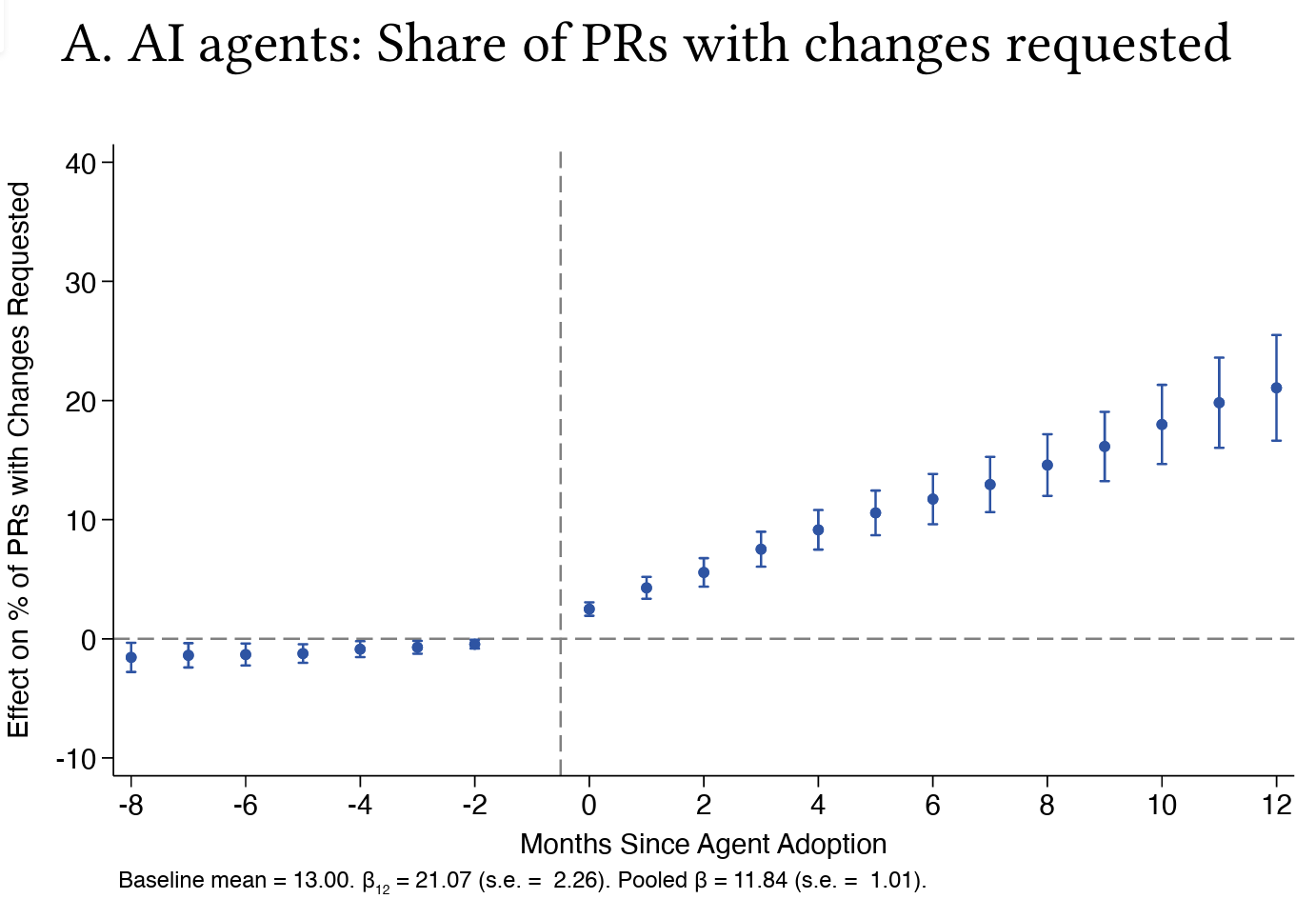](https://cdn.arstechnica.net/wp-content/uploads/2026/10/aiagentpr.png)
Pull requests need changes a lot more often in the “agentic coding” era\.
Pull requests need changes a lot more often in the “agentic coding” era\.Credit:[Chen and Stratton](https://fion.ac/jellyfish.pdf)
While AI could also theoretically help with this review process, the researchers found that, so far, that impact has been marginal\. Although 80 percent of measured firms used some form of AI code review by March 2026, AI agents were only responsible for 23\.3 percent of all review comments and 10\.8 percent of all pull requests, suggesting humans were still responsible for the vast majority of this work\.
AI agents are still a relatively new part of the coding world, of course, and there have been significant updates and upgrades to their output even since this study’s March 2026 data cutoff\. And while 95 percent of firms in the study have implemented AI coding agents by this point, many are doubtlessly still going through a learning process regarding when and how to best deploy them\. These kinds of “coding time versus review time” trade\-offs could improve as software engineering teams gain more experience with the pros and cons of siccing an AI agent on particular coding problems\.
For now, though, letting AI write your code looks like a double\-edged sword, with increases in coding speed counteracted by similar increases in human code review time and effort\. It’s the kind of result that makes us wonder if the considerable time and expense to get AI coding agents working is really worth it for most companies\.
An analysis of how AI coding agents have shifted the bottleneck from writing code to reviewing it, with data showing a 861% increase in code churn and a rise in defect rates, making code review the most leveraged skill in software engineering.
The author, running a small dev team, shares mixed real-world results from using AI coding tools: they speed up boilerplate and onboarding, but produce confident wrong answers on complex problems and increase code review workload, yielding modest net gains far below the often-cited 10x improvement.
An MIT study of over 100,000 GitHub developers finds that AI coding tools increase code volume by up to 300% but only boost shipped software by 30%, highlighting bottlenecks in human review and integration.
A report synthesizes field studies to argue that while AI coding agents increase code output, gains shrink in shipping reliable software due to bottlenecks in review, integration, and cost management.
This article examines the gap between hype and reality for AI coding agents, arguing that they are effective for accelerating workflow parts but still require human oversight for architecture, debugging, and review, and questioning whether current benchmarks measure the right things.