@OpenAI: Maria tested the idea across 10,080 reactions, and human chemists later validated representative results by hand. Under…
Summary
OpenAI and Molecule.one collaborated to have their AI systems (GPT-5.4 and Maria) autonomously select research areas, generate proposals, and run experiments in organic chemistry, achieving yield improvements for 88% of tested reactions — a first for AI-driven open-ended scientific discovery.
View Cached Full Text
Cached at: 06/17/26, 06:00 PM
Maria tested the idea across 10,080 reactions, and human chemists later validated representative results by hand.
Under the optimized conditions, yields improved for 88% of the boronic acids and 83% of the sulfonamides tested.
Human chemists then repeated 14 representative https://t.co/9ElXbkDYBW
Chemistry AI for Autonomous Discovery
Source: https://molecule.one/ Molecule.one’s Maria™ unites AI, Lab, and Data to power near-autonomous research for drug discovery & manufacturing. Commercially proven.
OpenAI and molecule.one collaboration:
 Chan-Lam Synthesis Discovery OA1-M1-003
 In a first for organic chemistry, Molecule.one & OpenAI have successfully put AI to work on an open-ended scientific problem. GPT-5.4 & Maria AI picked the research area, generated proposals, rated them, and ran the experiments in the Maria Lab. OpenAI post|Preprint
The Maria™ AI platform
 ### Maria AI Frontier chemistry models combined in an agentic framework to solve chemical problems and discover new chemistry
 ### Maria Lab The revolutionary, micro-liter scale HTE lab directed by Maria AI and tailored for her workflows
 ### Maria Data The industry leading, novel data set generated at Maria AI’s direction in her purpose-built lab
Press Highlights
 Grace and Molecule.one to Transform Peptide Building Block Synthesis with AI and Automation December 8, 2025
 Standard Industries Announces Molecule.one as Winner of $1 Million AI Challenge June 12, 2025
 TechBio Spotlight – Molecule.one by Mason Victors October 15, 2024
 CAS and Molecule.one Announce a Strategic Collaboration to Accelerate Drug Discovery August 11, 2023
Papers
- JCIM, 2021
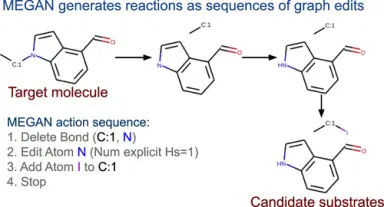 Molecule Edit Graph Attention Network: Modeling Chemical Reactions as Sequences of Graph Edits 2021
 - EFMC-ASMC 2025
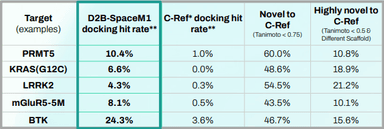 10× Higher Hit Rates At 3–10× Lower Cost: Accelerating Ligand Discovery With ML-Guided Synthesis & Screening 2025
 - NeurIPS Workshop AI4Science, 2025
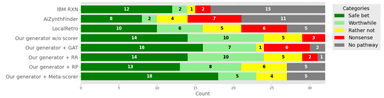 Trustworthy Retrosynthesis: Mitigating Hallucinations with Reaction Plausibility Filtering and Retrieval-Augmented Scoring 2025
 - NeurIPS Workshop AI4Science, 2025
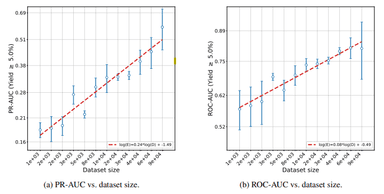 Scaling High-Throughput Experimentation Unlocks Robust Reaction-Outcome Prediction 2025
 - Journal of Cheminformatics, 2024
 Relative molecule self-attention transformer 2024
Case studies
- Engineering Serendipity: Rapid Single-Iteration Hit Discovery using Plate Analogs in μSpaceM1 Case Study
 First Application of AI-Driven Small Molecule Synthesis in a Non-Pharmaceutical Industry Case Study
 Accelerating Hit-to-Lead Campaigns with molecule.one Case Study
 Rapid, Single-Iteration Hit Identification for CLK1 using Direct-to-Biology Case Study
Posts
- How Did a Startup End Up Running World’s Largest Microliter-Scale HTE Reaction Campaign? October 31, 2025
- Trustworthy Retrosynthesis: How a Culture of Chemist-AI Collaboration Won $1M and Led to a Strategic Partnership with W.R. Grace December 11, 2025
Stay in touch, join our newsletter
Similar Articles
@OpenAI: GPT-5.4 helped drive a medicinal chemistry project from literature review to a validated experimental result. Paired wi…
GPT-5.4, in collaboration with Molecule.one's Maria AI platform, autonomously drove a medicinal chemistry project from literature review to validated experimental result, proposing an unexpected improvement to a widely used reaction in drug discovery.
A near-autonomous AI chemist improves a challenging reaction in medicinal chemistry
OpenAI connected GPT-5.4 to an autonomous chemistry AI (Maria) to improve Chan-Lam coupling of primary sulfonamides, achieving significant yield improvements in medicinal chemistry reactions.
Measuring AI’s capability to accelerate biological research
OpenAI demonstrates GPT-5's capability to accelerate biological research by autonomously optimizing a molecular cloning protocol in collaboration with Red Queen Bio, achieving a 79-fold improvement in cloning efficiency through novel enzymatic mechanisms. The work showcases AI's potential to support experimental iteration and empirical validation in wet lab settings while highlighting biosecurity considerations.
AI lets chemists design molecules by simply describing them
EPFL researchers developed Synthegy, an AI framework that uses large language models to guide chemical retrosynthesis and reaction mechanism analysis through natural language instructions, significantly improving strategic planning for chemists.
Building AI models that understand chemical principles
MIT Associate Professor Connor Coley discusses his work developing AI models to understand chemical principles and accelerate drug discovery by predicting reaction pathways and analyzing vast numbers of potential compounds.