Cached at:
05/09/26, 12:30 AM
# Understanding Wi-Fi 4/5/6/6E/7/8 (802.11 n/ac/ax/be/bn)
Source: [https://www.wiisfi.com/](https://www.wiisfi.com/)
0\. Introduction
★*Learn about Wi\-Fi and how to obtain real Wi\-Fi throughput in excess of 1 Gbps today\.\.\.*> **Faster website navigation TIP:**As you scroll through this paper, headers are 'sticky' and remain docked at the top of the web browser window\. Clicking anywhere on a header takes you back to the index at the top of this paper\.
**This paper details how Wi\-Fi works in the United States\.**While most of this paper also applies to other countries, there will be subtle Wi\-Fi differencessupported channels, Tx power allowed, etcfor other countries, for which[Wikipedia](https://en.wikipedia.org/wiki/List_of_WLAN_channels)has the details\. 1\.95 Gbps real Wi\-Fi throughput \-\- Intel AX210 client to TP\-Link AX80 \(2402 PHY \-\- 5 GHz band 160 MHz channel 114\)
**Fast Internet:**So you just got fast Internet\. Congratulations\. But now how are you going to obtain that fast speed*wirelessly*to*your*client devices? Because if you can't, are you then wasting moneyevery month\!on an ISP speed that can't actually be fully utilized?**Fast Wi\-Fi:**Seen right is an example of obtaining
1\.95 Gbps in Wi\-Fi throughputfrom a Wi\-Fi 6 client devicenote that this is 'best case' speed \-\- a more 'typical' 160 MHz channel speed is 1\.5\+ Gbps\.See[Terminology](https://www.wiisfi.com/#terminology)\[§T\] for help with terminology used in this paper\.
1\. Executive Summary
**The best router/AP \(Access Point\)valuetoday:**Amid\-range Wi\-Fi 6 router supporting \(1\) 4×4[MIMO](https://www.wiisfi.com/#MIMO)\[§7\], \(2\) all[DFS](https://www.wiisfi.com/#DFS)\[§15\] channels, \(3\) 160 MHz \(HE160\) wide channels, and \(4\) beamformingis a greatvaluetoday\(as of October 2025; one example is seen right\)for the needs of most people, either \(a\) as a single centralized main router, or \(b\) as an additional 'access point' node in a growing network\. See the[Recommendation](https://www.wiisfi.com/#recommendation)\[§22\] chapter far below for details and other recommendations\.**Wi\-Fi speeds vs\. broadband speeds:**Wi\-Fi speeds have lagged behind ever increasing Internet speeds\. As a result, there has been a*very rapid switch*in Wi\-Fi from[Wi\-Fi 4](https://www.wiisfi.com/#wifi4)\[§9\]2\.4 GHz 802\.11nto[Wi\-Fi 5](https://www.wiisfi.com/#wifi5)\[§10\]5 GHz 802\.11ac, to[Wi\-Fi 6](https://www.wiisfi.com/#wifi6)\[§11\]5 GHz 802\.11ax, and now to[Wi\-Fi 6E](https://www.wiisfi.com/#wifi6e)\[§12\]802\.11ax extended into 6 GHzin an attempt to keep up\. And now even the next generation[Wi\-Fi 7](https://www.wiisfi.com/#wifi7)\[§13\] is out\.
**Router Manufacturers' Marketing Hype:**Don't be fooled by the marketing[hype](https://www.wiisfi.com/#routerhype)\[§6\] of router manufacturers advertising outrageously high aggregate \(
all Wi\-Fi bands maximum speeds added together\) Gbps wireless speedslike "11 Gbps", and for client devices that the industry does not yet make4×4 MIMO client devices\. What really matters is the realistic speed that[YOUR Wi\-Fi client devices](https://www.wiisfi.com/#wifispeeds)\[§3\] can actually achieve todayoften that means a 2×2 MIMO limit,*for a single Wi\-Fi band\.*> *The dirty little secret in the router industry is that virtually ALL routersof the same Wi\-Fi generationhave the SAME maximum PHY speed to YOUR 2×2 MIMO client device\. And likely very similar throughput speeds when standing right next to the router\. So the real differentiator is how the router performs 'at distance' for your devicesDFS, MIMO, etc, at your locationcontention, interference, etc\.*

**Wi\-Fi's first weakest link \-\- your client devices:**Wi\-Fi throughput to a Wi\-Fi 6 wireless client device using an 80 MHz channel will likely 'max out' at around 900 Mbps ±100 for 2×2 MIMOand around 650 Mbps ±60 for Wi\-Fi 5no matter what new router is usedwhen right next to the router; and slower at distance\. And the far majority of ALL wireless client devices todaysmartphones, tablets, laptops, etcare still only 2×2 MIMO\.So[your client device](https://www.wiisfi.com/#PHY)\[§4\] is almost certainly causing 'slow' Wi\-Fi PHY speedsand maybe not your existing AP/router\.
> For Wi\-Fi 6 client devices, throughput can 'max out' at around 1 Gbps1201 Mbps PHY speed for an 80 MHz channel,*provided your 2×2 client device is very close to the router*, and even faster speedsor an extended range for obtaining 1 Gbpsare possible with 160 MHz channels\.
**Wi\-Fi's second weakest link \-\- distance/obstacles:**If you are very close to a Wi\-Fi access point and line\-of\-sight, you CAN expect top Wi\-Fi speedsbut limited to the capabilities of your client device\. However, as your 'distance from the router' increaseswhich honestly, is very typical, there are more obstacleswalls, floors, etc, and it is 100% normal that Wi\-Fi throughput drops off quickly\. In Wi\-Fi, you really do always want 'full bars'\.[](https://www.wiisfi.com/#accesspoint)
**Installing an Access Point is often a GREAT way to get 'full bars':**Wi\-Fi can work great, but only if you are physically close to the router or an access point\. The closer you are to the Wi\-Fi signal source, the better\. Do not try to extend Wi\-Fi signals wirelessly\. Instead, installing an[access point](https://www.wiisfi.com/#accesspoint)\[§19\]most often a regular router configured as an access point, wired/Ethernet back to the main router, and placing it where needed the most, is an easy and very effective way to dramatically improve Wi\-Fi speeds for far away 'at range' client devices\.**So, upgrade Wi\-Fi, or not?:**The only question that really matters when upgrading Wi\-Fi is: What are YOUR[client PHY speeds](https://www.wiisfi.com/#PHY)\[§4\] and[throughput](https://www.wiisfi.com/#speedtest)\[§D\] now and what will they be after an upgrade? Because, ifthe majority ofclient speeds will not increase after an upgradeespecially for 'at range' client devices, what is the point in spending money on a new router that won't actually improve Wi\-Fi speeds*for YOUR client devices*?
★**The goal of this paper:**This paper was written to help everyone understand current Wi\-Fi technology better,
so that YOU can make educated Wi\-Fi upgrade decisions\-\- because there is WAY too much[hype](https://www.wiisfi.com/#routerhype)\[§6\] out thereespecially about Wi\-Fi speeds\-\- and router manufacturers are directly to blame\.So, let's dig in and learn more about Wi\-Fi\.\.\.
2\. A quick overview of Wi\-Fi
**Why is it called "Wi\-Fi":**See[Here's Why It's Called 'Wi\-Fi'](https://www.huffpost.com/entry/why-called-wi-fi_l_5cace3f7e4b01bf960065841)\(huffpost\.com\) \-\-*"The origin story is all about marketing"*\. Yes, "Wi\-Fi" actually didoriginallymean "Wireless Fidelity" because that is what the[Wi\-Fi alliance](https://www.wi-fi.org/)\(wi\-fi\.org\) actually placed on their websitesee right, a capture from May 10, 2000\. But the claim today is that "Wi\-Fi" has no specific meaninga tiny bit of revisionist history\-\- and that "Wi\-Fi" is just a 'brand' name\. And the branding has worked spectacularly\! Today, virtually everyone in the world has heard ofand uses the term"Wi\-Fi"\.> [Other examples of brand names](https://www.mentalfloss.com/article/56667/41-brand-names-people-use-generic-terms)\(mentalfloss\.com\) now used by most as 'generic terms' due to wildly successful brandingeg: Jet Ski, Jacuzzi, Kleenex, etc\.**Wi\-Fi, or WiFi, or Wifi, or wifi?**The alliance that created the "Wi\-Fi" brand to promote Wi\-Fi throughout the industry clearly states in their["Brand Style Guide"](https://www.wi-fi.org/wi-fi-download/7717)available only to members of that alliancethat the correct spelling is \-\-*a capital "W" and "F", lowercase "i", with a hyphen between "Wi" and "Fi"*\. Also, see[Microsoft's Writing Style Guide](https://learn.microsoft.com/en-us/style-guide/a-z-word-list-term-collections/w/wi-fi)\(microsoft\.com\)\.
**First steps:**Wi\-Fi 1 came out in 1997 and supported PHY speeds of 1 Mbps to 2 Mbps in the 2\.4 GHz band\. A couple of years later, in 1999, Wi\-Fi 2 increased 2\.4 GHz band PHY speeds to 11 Mbps\.**The big change in 2002:**And then everything changed in 2002, when the new[Wi\-Fi 3](https://www.wiisfi.com/#legacy)\[§8\] running in 5 GHz was extended back into the 2\.4 GHz band, increasing PHY speeds from 11 Mbps to 54 Mbps\. Wi\-Fi 3 introduced the core technologies of Wi\-Fi that are STILL very much used today, like QAM modulation\.
**Wi\-Fi speeds by Wi\-Fi generation:**Compare the "Wi\-Fi 4 20 MHz 1×1" row to the "Wi\-Fi 6/7 20 MHz 1×1" rowin table below\. 'At the same distance' and channel widthsay the "16\-QAM 1/2" column, Wi\-Fi PHY speeds have NOT improved that much since 2006just 19%, from 28\.88 to 34\.41\! An overview of Mbps PHY speed by Wi\-Fi generation:
> [](https://www.wiisfi.com/images/wifi-phy-table.jpg) **Fig 2\.1:**'Distance' from the router/AP plays a major role in Wi\-Fi PHY speed
So upgrading from "Wi\-Fi 4" to "Wi\-Fi 6/7" alone \-\- with all other factors the same \-\- does NOT in and of itself increase Wi\-Fi PHY speed very much\.Instead, other factors play a MUCH larger role in the dramatic PHY speed increases seen in Wi\-Fi\.\.\.
**Dramatic PHY speed increases:**Modulation and coding has only changed slightly over all Wi\-Fi generations\. Instead, the dramatic speed increases seen in Wi\-Fi over the last 20 years is coming from: \(a\) increasing channel widths, \(b\) increasing MIMO, \(c\) higher MCS levels, and \(d\) other improvements, summarized above, and in this table:
> **Typical Wi\-Fi 'client device' maximum throughput****Version****Sym****Bits****QAM****Enc****MIMO****MHz****PHY****Mbps**Wi\-Fi 1[802\.11](https://www.wiisfi.com/#legacy)11\.02\-1/11\-2221Wi\-Fi 2[802\.11b](https://www.wiisfi.com/#legacy)11\.08\-1/8\-22115Wi\-Fi 3[802\.11a/g](https://www.wiisfi.com/#legacy)12\.06643/4\-205430Wi\-Fi 4[802\.11n](https://www.wiisfi.com/#wifi4)14\.46645/62×22014411540300240Wi\-Fi 5[802\.11ac](https://www.wiisfi.com/#wifi5)14\.482565/61×1804333752×280866750Wi\-Fi 6[802\.11ax](https://www.wiisfi.com/#wifi6)17\.21010245/62×2801201100016024021900Wi\-Fi 7[802\.11be](https://www.wiisfi.com/#wifi7)17\.21240965/62×232057653800Sym=Millions of symbols per second Bits=bits per symbol MHz=channel width Mbps=Max throughput expected
★**Wi\-Fi Coverage, Distance, and Speed:**Wi\-Fi signal strength decreases at an*exponential rate*as you move further away from a router\. The net result is that Wi\-Fi speeds 'step down' to a slower speed 'much more quickly'distance wisenear to a router than they do far away from a router\. To 'see' this, look at the 'Coverage' row in the[Fig 2\.1](https://www.wiisfi.com/#fig2.1)above, which refers to the percentage of 'maximum router distance'in free space, with no obstacles, ignoring walls, etc\.that a particular QAM level will be active for\.> In other words, as you move farther away from a routerand QAM levels are decreasingtotal distance*at each QAM step*is NOT growing linearlylike \+1, as in 2 to 3 to 4 to 5, etcbut distances are growing multiplicatively, byvery roughly×sqrt\(2\)every MCS step, or ×2 every other MCS step\. This ×2 in QAM step distances can be seen in the[Fig 2\.1](https://www.wiisfi.com/#fig2.1)above in the 'Coverage' row moving from '1024\-QAM 5/6'0\.7%to '256\-QAM 5/6'1\.3%to '64\-QAM 2/3'2\.4%to '64\-QAM 2/3'4\.2%to '16\-QAM 1/2'8\.4%to 'QPSK 1/2'16\.7%\.*But please do note that obstacleswalls, floors, etccan significantly alter these percentages*\.**Fundamental theorem of Wi\-Fi:**Wi\-Fi speeds decreasevery quicklyas 'distance from the router' increases\. *The only way to obtain "best" speeds in each newer Wi\-Fi generationhighest new QAM levelis to be ever closer to the Wi\-Fi router / access point\.*Like 4096\-QAM in Wi\-Fi 7\.[More details](https://www.wiisfi.com/#mwdistance)\[§I\] about signal strength vs distance\.
**TIME:**All Wi\-Fi devicesin the same Wi\-Fi generationare sending/receiving the same 'symbols', using*the same amount of time*to send each symbol\. See "Sym"symbols per secondcolumn in the table above\. But what DOES change is the modulation\+codingMCSwithin those symbols \-\- or, how many 'bits of information' is sent in each time slot\. The closer a device is to an access point, the clearer symbols can be 'heard' \-\- and that translates to more bits that can be sent per symbol\. And if you are too far away from an access point, maybe only one bit can be 'heard' per symbol\.> So frankly, Wi\-Fi works best when you are physically close to a Wi\-Fi access point,as that reduces TIME spent on the channel\.
**Digital Modulation:**The technique that Wi\-Fi 3 used to transmit symbolsbits of information, OFDM, remained largely unchanged until[Wi\-Fi 6](https://www.wiisfi.com/#wifi6)\[§11\], when a new technique was introduced, OFDMA\.**MCS Encoding:**Each new generation of Wi\-Fiso farhas increased the maximum amount of bits that can be conveyed every symbolbut that requires client devices to be ever closer to the router\. See "Bits"bits per symbolcolumn in the table above\.
**Spectrum/Bands:**Wi\-Fi started in the 2\.4 GHz band with only 70 MHz of spectrum\! And then later expanded into the 5 GHz bandwith 560 MHz of spectrum\. Supporting the 'need for speed'increasing channel widths, the FCC recently allowed Wi\-Fi to expand into 1200 MHz of spectrum in the 6 GHz band \([Wi\-Fi 6E](https://www.wiisfi.com/#wifi6e)\[§12\]\) for supporting 320 MHz channel widths\.
> [The Radio Spectrum \-\- United States Frequency Allocations \(2016\)](https://www.ntia.gov/sites/default/files/publications/january_2016_spectrum_wall_chart_0.pdf)\(ntia\.doc\.gov\)
**In Wi\-Fi, spectrum/channels are shared / half\-duplex:**It is remarkable that Wi\-Fi actually works as well as it does, because every device using a particular channelspectrummust*cooperate and SHARE*the time on that channel with every other device using the same channelyou and close neighbors\. It is exactly like using a Walkie\-Talkie \-\- everyone on the same channel can either talkTxor listenRx, but can not do both at the same time\. So Wi\-Fi works best when all Wi\-Fi access pointsfor you and close neighborsare evenly spread out across all available channelsnot everyone using the same channel\.**The big 'gotcha' \-\- only maximum 'common functionality' can be used:**So just because a new router supports a crazy high speed does NOT mean that your client devicecamera, tablet, phone, laptop, etcwill all of a sudden support that new fast speed\. Instead, your client device is often the[weak link limiting factor](https://www.wiisfi.com/#wifispeeds)\[§3\] and may support a smaller channel width, a lower MIMO level, or an older version of Wi\-Fi\.*The 'greatest common factor' of capabilities between any two devices is what is used\.*
> [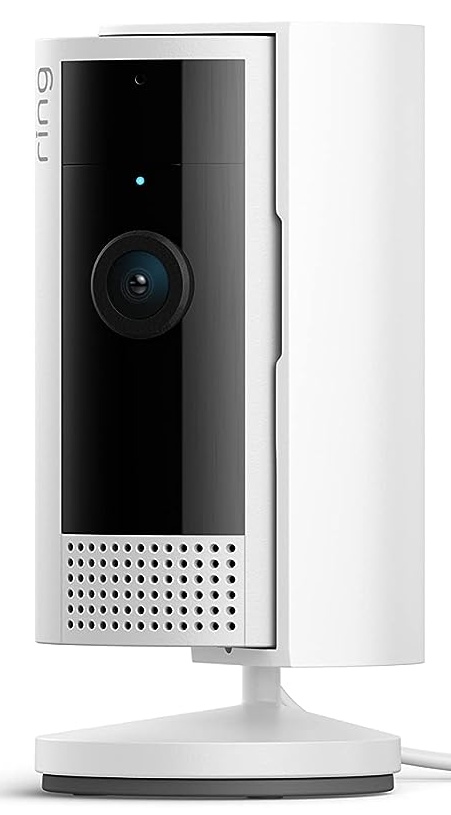](https://amzn.to/3SmnMaI) **Key 'weak link' example:**In mid\-2023, Ring introduced a brand new $60[Ring Indoor Cam](https://amzn.to/3SmnMaI)\(amazon\.com\) that only supportsthe now very old and slowWi\-Fi 4\. So even with the latest and greatest new Wi\-Fi 7 router, this Ring camera only supports "HT20" \-\- so can only communicate to that new router at a maximum PHY speed of 72\.2 Mbps and in only the 2\.4 GHz bandno 5 GHz band\-\-[Source: document Ring filed with the FCC](https://fccid.io/2AEUPBHAIC011/Test-Report/2AEUPBHAIC011-TR-DTS-WIFI-2-4G-6457562.pdf#page=5)\(fccid\.io\)\.
*The 'weak link' in Wi\-Fi is often YOUR client device\.\.\.*3\. Wi\-Fi's weakest link \- YOUR client device\!
 YOUR client device often limits Mbps speeds, not the router/AP \(maximum PHY speed when right next to the router\)
**In summary:**Each client device has its own 'maximum speed' at which it can communicate with a router\. Wi\-Fi can only operate as fast as the least capable device in a two\-way 'conversation', which almost always is your client devicecamera, tablet, phone, laptop, etc, and NOT the router\.> **KEY Wi\-Fi concept:***Client device capabilities often limit Wi\-Fi speeds, not the router/AP\.*
> **Analogy:**Just because the speed limit on a highway is 65 does not mean that yourspeed limitedmoped can go that fast\. Your actual speed will be the speed limit of the moped\. Similarly, in Wi\-Fi, your speed is often limited by your client device\.
**The weakest link in Wi\-Fi is YOUR client device:**You have 1 Gbps Internet, and just bought a very expensive AX11000 class router with advertised speeds of up to 11 Gbps, but when you run a speed test from your iPhone XS Maxat a distance of around 32 feet, you only get around 450 Mbps±45 Mbps\. Same for iPad Pro\. Same for Samsung Galaxy S8\. Same for a Wi\-Fi 5 laptop computer\. Same for most Wi\-Fi 5 wireless clients\. Why? Because that is the speed expected from these Wi\-Fi 52×2 MIMOdevices\! This chapter explains in great detail exactly why that is\.> Another example: The Galaxy Tab A8a 10\.5" tablet, even when connected to the latest and greatest Wi\-Fi 7 router, is limited to a PHY speed of 433 Mbpsand max throughput around 300 Mbps\-\- because this 'affordable' class Wi\-Fi 5 tablet intentionally only supports 1×1 MIMO\.
You may[safely skip to the next chapter](https://www.wiisfi.com/#PHY)\[§4\] for a shortcut if this chapter is too detailed/technical for you\. The rest of this chapter is a "deep dive" into everything that limits speed when a Wi\-Fi 5 client device communicates with a Wi\-Fi 5 router\.AC5300 4×4 Router to 2×2 Client
\(at a distance of 32 feet\)**5300**➤ 2166 ➤ 1083 ➤ 866 ➤ 650 ➤**455**

AC5300 4×4 Router to 4×4 Client
\(at a distance of 32 feet\)**5300**➤ 2166 ➤ 1733 ➤ 1300 ➤**910**
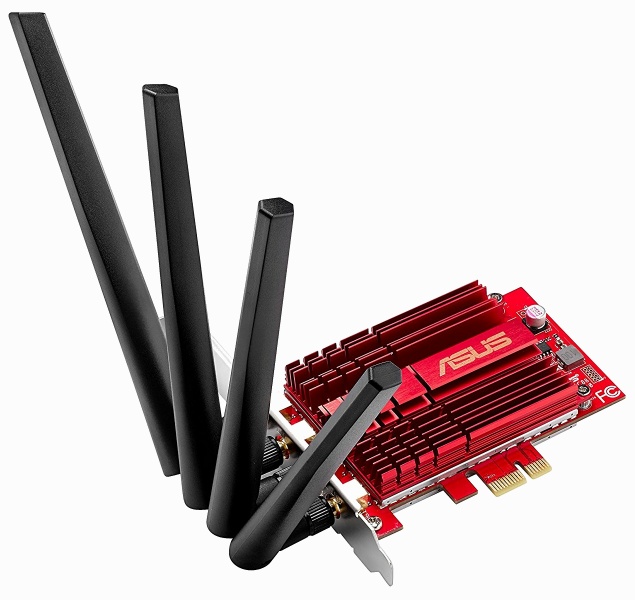
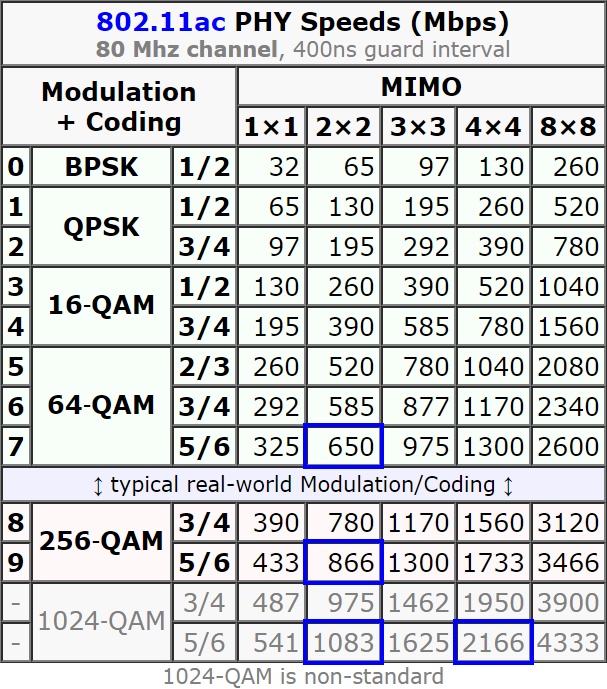
**AC5300 rating:**How did your router even get a 'rating' of 5300 Mbps in the first place? Router manufacturers combine/add the maximum physical network speeds for ALL Wi\-Fi bandsusually 2 or 3 bandsin the router to produce a single aggregategrossly inflatedMbps number\. But your client device only connects to ONE bandnot all bandson the router at once\. So, '5300 Mbps' is all[marketing hype](https://www.wiisfi.com/#routerhype)\[§6\]\.*The following details how the grossly inflated speed of 5300 Mbps is reduced down to a 'real\-world' speed of only 455 Mbps\.\.\.*
◆**5300 ➤ 2166:Maximum ONE band speed:**The only thing that really matters to you is the maximum speed of a
single5 GHz bandusing all MIMO antennas\. You find out by looking at the 'tech specs' for an AP/router\. 5300 is just 1000 \+ 2166 \+ 2166, where 1000 is the 2\.4 GHz band speed and 2166 is the 5 GHz band speed\. 2166 also is a tip\-off that this router is a 4×4 MIMO routerby looking for '2166' in the speed table, right\.> More on bands in the[Beware tri\-band marketing hype](https://www.wiisfi.com/#tribandhype)chapter far below\.
◆**2166 ➤ 2166:Realistic 80 MHz channel width:**Router manufacturers cite speeds for 2\.4 GHz using 40\-MHz channel widths, but a 20\-MHz channel width is much more realisticthat cuts cited speeds in half\. For 5 GHz 802\.11ac, speeds are typically cited for an 80\-MHz channel width, which all AC clients are required to support\. But if cited speeds are for a 160\-MHz channel widththat is starting to happen for the new Wi\-Fi 6 routers, cut the cited speeds in halfas most clients won't support that\.◆**2166 ➤ 1083:Client 2×2 MIMO:**Which MIMO column do you use in the Wi\-Fi speed tableupper right\-\- The MIMO of the router or the MIMO of the client device?*You must use the minimum MIMO common to both devicesoften the client*\. So if you have a 4×4 router, but use a 2×2 clientlike the Apple iPhone XS Max or Samsung Galaxy S8to connect to it, maximum speeds will be instantly cut in half2/4from cited router speeds\.
> Wi\-Fi specifications for[iPhone](https://support.apple.com/guide/deployment/iphone-wi-fi-specification-details-dep268652e6c/1/web/1.0)\(apple\.com\) or[iPad](https://support.apple.com/guide/deployment/ipad-wi-fi-specification-details-depf9bb7e412/1/web/1.0)\(apple\.com\)\. Virtually all newer iOS devices are 2×2 MIMO and older iOS devices are 1×1no MIMO\.
◆**1083 ➤ 866:Client 256\-QAM:**You can only use the maximumcommonQAM supported by both the router and the client\. Router manufacturers may cite speeds for 1024\-QAMwhich the router DOES support, but you will only get that if your clients supports that QAMmany do notand you are very close to the routersometimes only just feet away\. So reduce to a much more realistic maximum of 256\-QAM 5/6\.◆**866 ➤ 650:32 feet from router \(Modulation/Coding\):**Router manufacturers love to cite the maximum PHY speed possible, which you will only get when you are very closejust feetto the router\. But as you move farther away from the router, speeds gradually decrease\.*The 'distance' issue is represented by rows in the PHY speed tableseen upper right\.*At just 32 feet away from the routera very typical distance, 64\-QAM 5/6 was actually observed, so use that\. For more details, see the[next chapter](https://www.wiisfi.com/#PHY)\[§4\]\.
> **Analogy: Understanding Modulation/Coding:**Imagine that once a secondthe 'symbol rate' for this channel, you hold up your arms in various positions to convey a message to someone else\. If you were only ten feet away from that person, the number of arm positions reliably detected would be very high\. But now move 100 feet away\. The number of arm positions reliably conveyed would be reduced\. Now move 500 feet way\. The number of arm positions reliably conveyed might be reduced to just 'did the arm move at all'\. The same thing happens in Wi\-Fi\. If you are close to the AP/router, a large number of bits can be conveyed 'at once'within each symbol\. But as you move away, a smaller and smaller number of bits can be reliably conveyed 'at once'\. So 'modulation/coding' is simply how much information can be conveyed at once, and is directly related to distance from the AP/router\.
◆**650 ➤ 455:Wi\-Fi overhead \(MAC efficiency\):**What is the overhead at the network level? All of the speeds we have discussing so far are for PHYphysicalnetwork speeds\. But due to Wi\-Fi protocol overhead, speeds at the application level are around 60% to 80% the physical network level\. So use 70% as a*fair estimate*of throughput you can expect to see\. 70% of 650 is 455 Mbps\.> Just Google[802\.11ac MAC efficiency](https://www.google.com/search?q=802.11ac+MAC+efficiency)\(google\.com\) to understand this issue\. In short, there are 'housekeeping' packets that MUST be sent at the SLOWEST possible modulation, and that takes time and slows everything downalong with other issues, see[understanding Wi\-Fi overhead](https://www.wiisfi.com/#wifioverhead)\[§5\]Analogy: You are on a road going 60 mph, but every 100 feet you must slow down to 1 mph for 1\.5 feet\. Do the math \- your average mph is deceptively much lower than you might think\. Because what matters is not theminimaldistance traveled at the slow speed, but the TIME that it takes\.
◆**455 ➤ ???:Interference/Contention:**So, the final number is 455 Mbps for a 2×2 deviceat a fair distance away from the router,*but only if your device gets exclusive use of ALL time left in the Wi\-Fi channel\.*But there mayor may notbe other Wi\-Fi userseither local, or even neighbors on the same spectrumwhich will decrease your speed by some unknown amount\.**Results:**2×2 MIMO devices get a realisticmaximumdownload speed of 455 Mbps±45 Mbpsat around 32 feet, which is dramatically lower than the '5300 Mbps' advertised by router manufacturers\.
**A lesson learned:**The critical factors that greatly impact and determine*maximum*real\-world speed for a single client are: \(1\) lowest common MIMO level, \(2\) lowest common channel width, and \(3\) MAC efficiency\.
> **An analogy for all of the above:**What if I built a three lane toll road from Washington, DC to New York, NY, and sold passes for chauffeured rides with speeds "up to 74 mph"AC5300\. But after you pay for a ride, you discover that the speed limit is 30 mphAC2166on two of the lanes and 14 mph on the third lane\. So you take the 30 mph lane, but find out your chauffeur is only driving at 10 mphMIMO level and QAMand worse yet, every 100 feet the chauffeur slows down to 1 mph for 10 feetMAC efficiency\. Your average speed is 5 mph\.And yet, that is exactly what router manufacturers are doing to you \-\- an advertised 5300 Mbps router is really only 455 Mbps for most wireless devices \-\- just like 74 mph is really 5 mph\.
4\. Client 'PHY' speed is the key \(limiting\) factor
YOUR client device is the keylimitingfactor for the speedand maximum distanceat which your device connects to a router\. A modern router is rarely the limit; for technical details, see[prior chapter](https://www.wiisfi.com/#wifispeeds)\[§3\]\. Stay in this chapter for a fast shortcut\.> **KEY Wi\-Fi concept:***Client device capabilities often limit Wi\-Fi speeds, not the router/AP\.*
For a*modern*2×2[MIMO](https://www.wiisfi.com/#MIMO)\[§7\] client device, expect 'top PHY speeds' standing right next to a modern router of:- [Wi\-Fi 1](https://www.wiisfi.com/#legacy)\[§8\],**2**Mbps
- [Wi\-Fi 2](https://www.wiisfi.com/#legacy)\[§8\],**11**Mbps
- [Wi\-Fi 3](https://www.wiisfi.com/#legacy)\[§8\],**54**Mbps
- [Wi\-Fi 4](https://www.wiisfi.com/#wifi4)\[§9\],**144**Mbps20 MHz, or 300 Mbps40 MHz\-\- 64\-QAM, 2×2 MIMO
- [Wi\-Fi 5](https://www.wiisfi.com/#wifi5)\[§10\],**866**Mbps80 MHz, or 1733 Mbps160 MHz\-\- 256\-QAM, 2×2 MIMO
- [Wi\-Fi 6](https://www.wiisfi.com/#wifi6)\[§11\],**1201**Mbps80 MHz, or**2402**Mbps160 MHz\-\- 1024\-QAM, 2×2 MIMO
- [Wi\-Fi 6E](https://www.wiisfi.com/#wifi6e)\[§12\],**2402**Mbps160 MHz\-\- 1024\-QAM, 2×2 MIMO
- [Wi\-Fi 7](https://www.wiisfi.com/#wifi7)\[§13\],**5764**Mbps320 MHz\-\- 4096\-QAM, 2×2 MIMO
and then according to the fundamental theorem of Wi\-Fi:*Wi\-Fi speed decreasesvery quicklyas 'distance from the router' increases*\.> IMPORTANT: After you find PHY speedbelow, it is best to run[speed tests](https://www.wiisfi.com/#speedtest)\[§D\] to validate actual throughput\.
**The limit:**With a new modern Wi\-Fi 6 router, it is virtually never the router that has the speed limit, but rather, it is the client devicethat is NOT as capable as the routerthat limits speeds\. For example: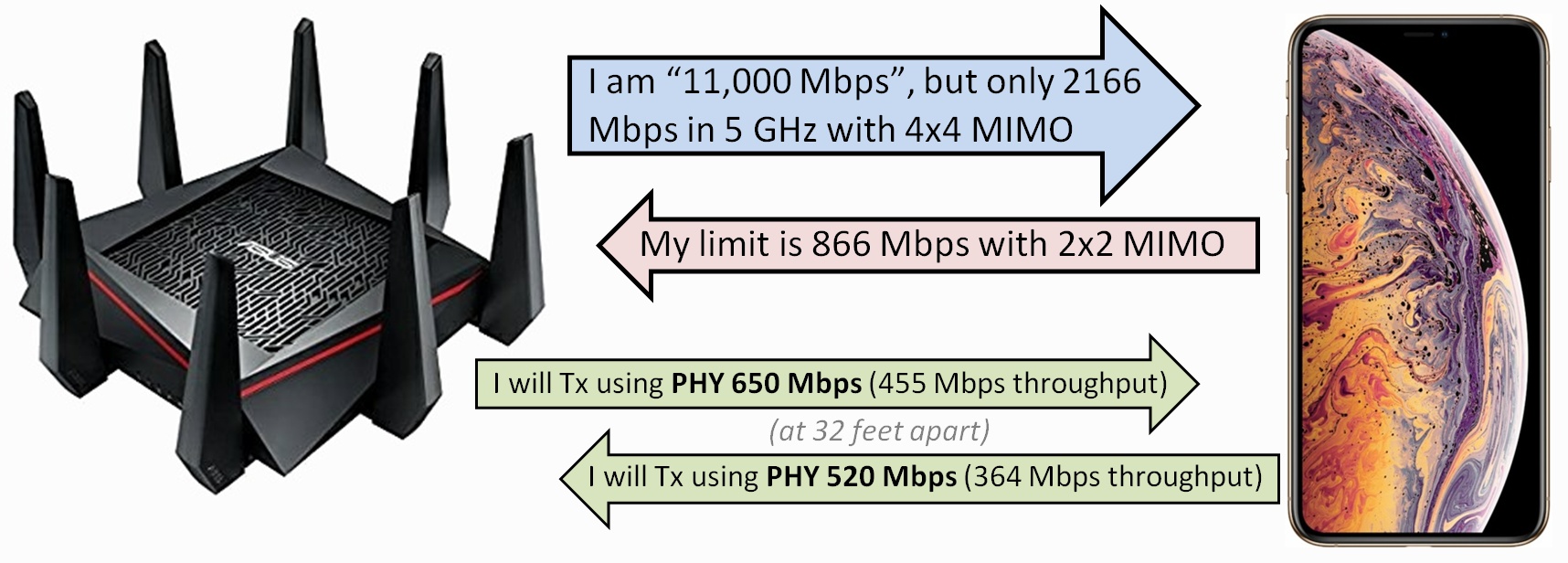 Your devicenot the routeris almost certainly limiting Wi\-Fi speeds
**The problem \(of finding maximum speed\):**So how do you find the maximumrealisticwireless speed of a client to an AP/router? You could just run a speed test, but if the speed is not what you expected, where is the problem \-\- the client, the router, the Internet, interference, elsewhere, or is the speedtest accurate?**The solution:**Go to your wireless device and find the PHY speedthe maximum raw bitrate between the device and your AP/routerand take 70% of that PHY speed to*estimate*maximum application speedthe[next chapter](https://www.wiisfi.com/#wifioverhead)\[§5\] explains why the overhead is so large\. Then lookup the PHY speed number in the[PHY speed tables](https://www.wiisfi.com/#phytables)\[§F\] to then find which MIMO level is currently being used\.
> Expect throughput anywhere from 60% to 80% of PHY speed\. So use 70%±10%as a*fair estimate*\. If you don't see 60% to 80% of the PHY speed in a throughput test, then either: \(1\) the PHY speed you have is not accurate, or \(2\) there is contention and/or interference on the channel, like another device is actively using the channel\.> *UPDATE: The more testing I do, the more it seems like the throughput speed test is more informative about what actual PHY speed was, than the other way around\. Namely, throughput speed divided by around 0\.7 to 0\.8 is a great estimate of what average PHY speed was\. Why? Because for me, there are times that reported PHY speed is great, but as soon as I saturate the channel with a speed test, reported PHY takes a dipduring the test, and then after the test, reported PHY goes back to being great\. The lesson learned is to scrutinize and collect reported PHY speed during a speed testnot before and not after\.* **New client devices often outperform older devices:**In a real\-world test, with Wi\-Fi 5 client devices reporting a 2×2 866\.6 Mbps PHY link, I measured 461 Mbps53%download speeds on onevery oldcomputer, 540 Mbps62%on a second computer, and 673 Mbps78%on a thirdbrand newcomputer\. All tested just feet away from the same R7800 router\. And when testing Wi\-Fi 6E devices running in Wi\-Fi 5 mode, I get 700 Mbps81%\.*So brand new client hardware seems to perform much better than years old client hardware\.***PHY speed:**When any Wi\-Fi device reports a PHY speed to you, take that value with a huge grain of salt\. Due to how Wi\-Fi works, a device is often constantly adjusting PHY speedsadapting to noise and interference, so the single PHY speed you see is often a best case*maximum*PHY speed\. Namely a device could be using PHY speeds of 78, 104, and 52 Mbps every single second, but will report a PHY speed of 104 Mbpsthe maximumto you\. PHY speed also reveals: \(1\) channel width, \(2\) modulation/codingdistance from router, and \(3\) minimum MIMO level support\.*Please note that the PHY speed displayed is not a static value, but changes over time, depending upon distance from AP/router, interference, etc\.* **PHY speed tables:**If you don't find your PHY speed in the PHY tables in this paper[below](https://www.wiisfi.com/#wifi5)\[§10\], look up the speed in the full[PHY speed tables](https://www.wiisfi.com/phy)\(docs\.google\.com\)\.
TIP: Before looking up PHY values on your devicebelow, cause some Internet activity\. You want an up\-to\-date PHY value displayed, and not an old stale valuewhich can happen with no Internet activity\. And when possibleeg: Windows, lookup the PHY value at the same time that a speed test is actively running\.
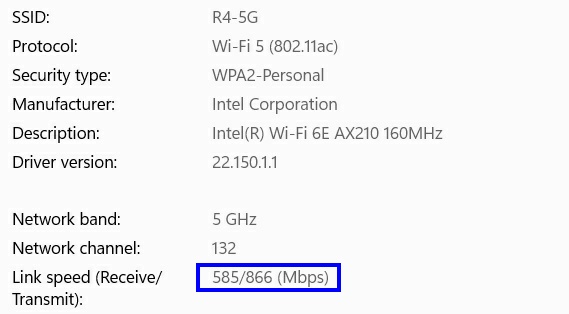
**Windows 10/11 \(Wi\-is\-Fi way\):**Run the[WI\.BAT tool](https://www.wiisfi.com/#tools)\[§E6\]\. Best because the information is constantly refreshed \-\- especially helpful during speed tests\. Also, the[tools](https://www.wiisfi.com/#tools)\[§E6\] section provides some helpful commands to run manually from a Windows 'command prompt'\.**Windows 11 \(new way\):**Right\-click on the Wi\-Fi icon in the taskbar\. Click on "Network and Internet Settings"\. Click on "Properties" and scroll down to "Link speed \(Receive/Transmit\)"\. You will see something like this:
> 
**Windows 10 \(new way\):**Go to the 'Settings' app, click on 'Networking & Internet', click on the 'View your network properties' link and find the transmit/receive speed under your 'Wi\-Fi' adapter\.However, I suspect that sometimes transmit/receive are just a single value displayed twice instead of two actual speeds\.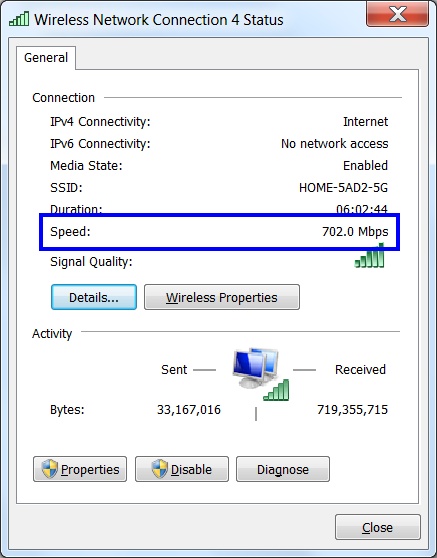 Windows PHY Speed
**Windows 11/10/8/7 \(legacy mode\):**In the Windows "Control Panel", search for and then click on "Network and Sharing Center", then click on the named wireless connectionwhich opens a 'status' dialog, and look for the 'Speed'example seen right\.> **Example:**Lookup 702 Mbps speedrightin the PHY tables[far below](https://www.wiisfi.com/#wifi5)\[§10\] and it is not found\. So, go to the full[PHY speed tables](https://www.wiisfi.com/phy)and you will find various matches, but only one makes logical sense: 80 MHz channel, 2×2 MIMO, 256\-QAM\.The PHY speed reported by Windows appears to actually be the maximum of both the Tx PHY and the Rx PHY speeds\. Some tests showed the speed reported as the Rx PHY speed\. Other tests showed the speed reported as the Tx PHY speed\. Also, if Windows is getting the PHY speed from the Wi\-Fi driver, this observation could be very Wi\-Fi deviceand vendorspecific\.
**Mac:**\(1\) Hold the option/alt key down and click the Wi\-Fi icon in the menu bar and look for the "Tx Rate"\. \(2\) Run the "Network Utility"under Applications / Utilities; or use Spotlight to findand look for the Wi\-Fi "Link Speed"\.[More info on finding Link Speed on a Mac](https://www.tweaking4all.com/os-tips-and-tricks/macosx-tips-and-tricks/determine-wifi-connection-speed/)\(tweaking4all\.com\)\.**iOS \(iPhone/iPad\):**Not known within iOS itselftell me if you know how\. However, to find the maximum PHY speed and MIMO level for your iOS device, visit the Wi\-Fi specification details for[iPhone](https://support.apple.com/guide/deployment/iphone-wi-fi-specification-details-dep268652e6c/1/web/1.0)\(apple\.com\) or[iPad](https://support.apple.com/guide/deployment/ipad-wi-fi-specification-details-depf9bb7e412/1/web/1.0)\(apple\.com\), All modern iOS devices are 2×2 MIMO\. Here are some tips I received from readers of this paper:
> **Reader TIP \#1:**if you happen to use Apple's AirPort Wi\-Fi base station:*"Install Apple's 'AirPort Utility' and then open it\. Click on the Wi\-Fi base station\. Click on 'wireless clients' and then click on your iOS device and then 'connection'\. This will give you the iOS device 'PHY' connection speed\."***Reader TIP \#2:**Consider using the "nOversight" appfree version, which shows Tx/Rx rates, plus a lot of other detailed Wi\-Fi information\.

**Android \(BEST way\):**Install the["WiFiAnalyzer \(open\-source\)"](https://play.google.com/store/apps/details?id=com.vrem.wifianalyzer)\(play\.google\.com\) Android app to get a ton of detailed Wi\-Fi information\.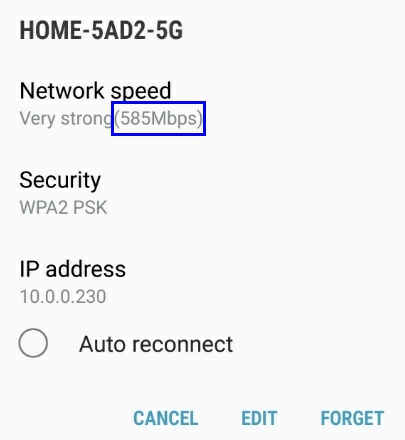 Android PHY Network Speed
**Android \(may no longer work\):**Go into "Settings / Connections / Wi\-Fi", click on the connected Wi\-Fi network, and find the 'Network Speed'example right\. Or, it may also be called 'Link Speed'\. But it looks like this method no longer works \-\- Android removed displaying the speed, so use the app methodabove\.> **Example:**Lookup 585 Mbpsrightin the[PHY tables](https://www.wiisfi.com/#wifi5)\[§10\], and you will find it in multiple columns, but given the client, what makes the most sense is: 80 MHz channel width, 2×2 MIMO, and 64\-QAM\.It appears that Android reports the "Tx PHY" as the 'link speed'\. This is preliminary and needs more research\.
**Kindle:**Under Settings, click on "Wireless", then click on the connected Wi\-Fi network, and look for "Link speed"\.**Chromebook:**Open "crosh" on your ChromebookCTRL\-ALT\-Tand type
"connectivity show devices"and look for the Link Statistics Transmit Bitrate\. You should see: \(1\) the Mbps transmit bitrate, \(2\) the MCS index number, \(3\) the channel width in MHz, and \(4\) the number of spatial streams\.Type "exit" to exit/close the crosh window\.**★ OR, find IoT device PHY speeds in your router's web interface \(or app\):**Instead of looking on the client device for the PHY speeds usedwhich can be impossible for IoT devices, an alternative is to look at your router's web interfaceor appfor the PHY speeds that a particular client is using:
-  **TP\-Link TIP:**In the TP\-Link router web interface, under "Network Map", click on 'Clients' to see a list of all clients, along with "Tx/Rx Rate\(Mbps\)" PHY speedsexample seen right\.*Very helpful information to see all devices in a single list, along with PHY information, and Wi\-Fi band used\!*Most accurate when client devices are actively using the Internet\. So seeing "1225 / 865", in the example above, means a Tx PHYrouter to clientof 1225 Mbps and a Rx PHYclient to routerof 865 Mbpsthese are 802\.11ax 160 MHz speeds, with an expected max PHY of 2402 Mbps\.
- **Netgear TIP:**In the Netgear 'Nighthawk' router app, click on 'Device Manager', then click on a client device, and a "Link Rate" will be displayed\. But Netgear displays a 'link rate' that is slightly too small\. To correctto bps, multiply by 1024/1000thanks to reader Matthew S\. for pointing out that correction\.
- **Comcast TIP:**If you use a Comcast provided cable modem / gateway device, connecting to the http administration interface, signing in, and clicking on the 'View Connected Devices' button will take you to a page that shows the "RSSI Level"in dBmfor all Wi\-Fi connected devices\. Very helpful for quickly spotting devices 'in trouble'\.
**Wi\-Fi 7 Devices****Device****MIMO**OnePlus[11 5G](https://www.oneplus.com/us/11/specs)2×2EHT320iPhone[16, 17](https://support.apple.com/guide/deployment/wi-fi-specifications-for-apple-devices-dep268652e6c/web)2×2EHT160Google Pixel[8](https://support.google.com/pixelphone/answer/7158570)2×2EHT160
**Wi\-Fi 6E Devices****Device****MIMO**Apple iPhone[15 Pro](https://support.apple.com/guide/deployment/wi-fi-specifications-for-apple-devices-dep268652e6c/web)2×2HE160Apple iPad[Pro](https://www.apple.com/ipad-pro/specs/)\(high end\)2×2HE160Dell Laptops \(high end\)2×2HE160Samsung Galaxy[S22](https://www.samsung.com/global/galaxy/galaxy-s22/specs/)/[S23](https://www.samsung.com/us/smartphones/galaxy-s23/)2×2HE160Google Pixel[6/7](https://support.google.com/pixelphone/answer/7158570)2×2HE160
**Wi\-Fi 6 Devices****Device****MIMO**Apple iPhone[11](https://www.apple.com/iphone-11/specs/),[12](https://www.apple.com/iphone-12/specs/),[13](https://www.apple.com/iphone-13/specs/),[14](https://www.apple.com/iphone-14/specs/)2×2HE80Apple iPad[Pro](https://www.apple.com/ipad-pro/specs/)\(low end\)2×2HE80Apple iPad[Air](https://www.apple.com/ipad-air/specs/)2×2HE80Dell Laptops \(high end\)2×2HE160Samsung Galaxy[S20](https://www.samsung.com/us/mobile/galaxy-s20-5g/specs/)2×2HE80
**Wi\-Fi 5 Devices****Device****MIMO**Apple iPhone X,8,7,6s2×2VHT80Apple iPhone 61×1VHT80Apple iPad \+ Air22×2VHT80Apple iPad Air1×1VHT80Dell Laptops \(high end\)2×2VHT160Dell Laptops \(low end\)1×1VHT80Fire TV \(gen 2 and later\)2×2VHT80Galaxy S9,S8,S7,S62×2VHT80Google[Pixel](https://support.google.com/pixelphone/answer/7158570)5,4,3,2,12×2VHT80MacBook Pro \(some?\)3×3VHT80
**Wi\-Fi 4 Devices****Device****MIMO**Ring Indoor Cam 20231×1HT20
**MOST client devices today are 'stuck' at 2×2 MIMO:**As can be seen from the tablesright, most client devices today are STILL only 2×2[MIMO](https://www.wiisfi.com/#MIMO)\[§7\]\. Why haven't devices switched to 4×4? Because: \(1\) there iscurrentlyno compelling need for that speed todaythere is no app that 'requires' faster Mbps speeds to functionand more importantly \(2\) the increased speed is not worth the tradeoff in greatly reduced run time for battery powered devices\.> Supporting 4×4 MIMO takes more power, and for battery powered devices, runtime is FAR more important\.You will see the spec sheets for many modern phones that MIMO is 4×4, but look closely and notice that this is only for cellular, not Wi\-Fi\. However, of note is that many Wi\-Fi 6/6E devicesfor Apple, only[iPhone 15 Pro](https://support.apple.com/guide/deployment/wi-fi-ethernet-specifications-apple-devices-dep268652e6c/web)\(apple\.com\) and laterDO support 160\-MHz channelsHE160, which instantly doubles throughput vs Wi\-Fi 5 using 80\-MHz channelsVHT80\. So speed is increasing dramatically via wider channels, not increased MIMO levels\.
You can expect a maximum PHY speed of 866 Mbps, and around 650 Mbps \(±60 Mbps\) throughput, from a Wi\-Fi 5 \(802\.11ac\) 2×2 client device\. It is noteworthy to point out that Dell apparently had a 3×3 laptop in the past, but today, I can't find anything other than 2×2 laptops on Dell's website\.**A final warning:**This discussion about 'the' PHY speed of your device is slightly over simplified, as for every Wi\-Fi device, there is actually a TxtransmitPHY speed and a RxreceivePHY speed, and those two speeds are almost always differentasymmetric\. But even when different, the two speeds are relatively close to each other, so the asymmetry is rarely noticed\. See the[PHY speed is asymmetric](https://www.wiisfi.com/#phyasymmetric)\[§E\] appendix below for more details\.
> A final wrench in the PHY puzzle: And PHY speed is not 'constant'\. Unless you are right next to the routerwith a fantastic signal strength and PHY speed is highest possible speed, PHY speed is actually constantly changing up and down between MCS levels, adapting to changing signal strength conditions\. It is not uncommon with a single second to see 3 to 4 different MCS levelsPHY speedsused\. Are you highly technical? Then use the[Router deep dive](https://www.wiisfi.com/#deepdive)\[§L\] appendix below to determine exactly what MCS indexes are being used for both Tx PHY and Rx PHY\.
**Another client device limitation: Range:**The maximum distance at which a device can connect to an AP/router isalmost alwaysdetermined NOT by the power output of the AP/routeraround 950 mW is typical, but the power output of the client devicearound 50 mW to 250 mW typical,as client devices almost always operate at lower power levels than the AP/router\.*The implication of this is that the Tx PHY speed from a client device to an AP/router is almost always lowerhits the limit soonerthan the Tx PHY speed from the AP/router to the client\.*[Full details](https://www.wiisfi.com/#range)\[§G\]\.5\. Understanding Wi\-Fi overhead
**Throughput to PHY Ratio \(TPR\):**The TPR for a Wi\-Fi connection is the ratio between \(a\) measured 'throughput speed' and \(b\) rated 'PHY speed':> 
Under ideal Wi\-Fi conditions, expect TPR to be around 70%±10%\. The restup to 100%is 'overhead'\. So why is overhead 20% to 40%?> **KEY Wi\-Fi concept:***Expect TPR \(throughput to PHY ratio\) to be around 70% \(±10%\) \-\- or anywhere from 60% to 80%\.*
For example, obtaining a throughput of 1955 Mbps for a PHY speed of 2402, means a TPR of 1955/2402, or 81%or around 19% overhead, a great result\. And seeing a TPR of 50% is a huge tip\-off that the Wi\-Fi connection is having issues, like interference, contention, etc\.> What I am beginning to realize is that the PHY speed reported by Wi\-Fi devices is often a 'best case' maximum valueand may not accurately reflect the actual PHY speed used\. The[MCS Spy tool](https://www.duckware.com/mcsspy/index.html)\(duckware\.com\) has been invaluable in detecting and visualizing this during a throughput speed test\. PHY speed also can fluctuate a lot up and down, and is not a 'fixed' single value\. Also, the newer the device the better\. There appears to be some issues with older 802\.11ac devicesnot achieving top rated speeds\.With both a modern client device and a modern router, and no one else using Wi\-Fi \-\-*so NO contention*\-\- I regularly measure a TPR of 80%\.
**Wi\-Fi overhead can be surprisingly 'large':**So, if your smartphone connects to your AP/router at a PHY speed of 702 Mbps, why doesn't your smartphone get that full speed? Instead, 70% of your PHY speed70%×702=491 Mbpsis a fair estimate of actualmaximumMbps seen, but why?> PHY speed in Wi\-Fi is exactly like the speed limitsignon a local road\. You can go that fast some of the time but clearly not all the time\. Because you must take into account known slow downs: stop signs, turns, traffic lights, traffic, school zones, weather conditions, etc\. And in Wi\-Fi, there are a lot of 'slow downs' that also add up\.
**TIP:**The efficiency of TCP/IP over Ethernet, with a MTU of 1500, is 1460/1538, or \(1500\-20\-20\) / \(1500\+38\)\), which translates to a maximum possibleapplication levelspeed of 949\.28 Mbps for Gigabit Ethernet50\.72 Mbps overhead\.[Details](https://en.wikipedia.org/wiki/Jumbo_frame#Bandwidth_efficiency)\(wikipedia\.org\)
**First, there is TCP/IP and Ethernet overhead:**On wired Ethernet, you can expect around 5% overhead for TCP/IP and Ethernet, or 95% throughput at the application level\. As a ballpark figure, assume something very similar for Wi\-Fi\. Just remember that partaround 5%of the total overhead you are seeing in Wi\-Fi is actually coming from TCP/IP and Ethernet protocol overhead,*and not Wi\-Fi itself*\.**Management transmissions must be sent at the 'slowest' possible modulation:**In order to guarantee that ALL devices on a channelAP and clientscan receive\+decode management transmissions, those transmissions must be transmitted at the slowest possible modulation \-\- so that devices that are furthest away from the APand hence, running at the slowest speedcan receive*and successfully decode*those transmissions\. For example, 802\.11 'Beacon Frames'typical send rate is once every 102\.4 ms\. And this 'slow' speed can be as slow as 1 Mbps2\.4 GHz bandor 6 Mbps5 GHz band\. When compared to 433 Mbps and 866 Mbps, that 'slow' speed is a hit\.
> **SSID overhead:**The overhead*per SSID*on one channelcan be anywhere from 3% to incredibly high\. See[this article](https://web.archive.org/web/20190308103847/https://www.revolutionwifi.net/revolutionwifi/p/ssid-overhead-calculator.html)\(archive\.org\), using a 802\.11b 1 Mbps beacon rate, for details\.**A striking analogy:**You are on a road going 120 mph for 5240 feet, and then 1 mph for 40 feet \-\- What is your average mph for the entire mile5280 feet? \-\- MUCH lower than you might initially expect\. The answer is 5280/\(5240/120\+40/1\), or 63 mph\! It is not the distance that you slowed down that is important, but rather the*time*you spend slowed down that really mattersas compared to the*time*you spend going fast\.
**Half Duplex:**There is no separate download spectrum and upload spectrum in Wi\-Fiwhereas Ethernet is full duplex \- can send and receive at the same time\. Instead, there is only a common spectrumchannelthat ALL Wi\-Fi devicesrouter and clientsoperating on that channel must use in order to transmitand receive\!\.> So when you are running an ISP download throughput speed test, your device is mostly receiving,*but it is also transmitting*acknowledging data sent\! Using the MCS Spy tool, a PC downloaded at 120 Mbps, but was uploading at 1\.8 Mbps at the same time\. See[Router deep dive](https://www.wiisfi.com/#deepdive)\[§L\] appendix below\. This is simply due to how TCP/IP works\. And almost always, the client transmits back to the AP at a slower MCS than the MCS the router uses to transmit to the client\. So because Wi\-Fi is half duplex, there may be around 1% to 3%relative'overhead' simply due to how TCP/IP worksacknowledgements\.**Analogy:**A Wi\-Fi channel is just like a Walkie\-Talkie, where you can either talk, or listen, but not both at the same time\. OR, just like a narrow bridge, where carsWi\-Fi trafficcan either go one way or the other, but not both ways at the same time\. Consider the impact on a Wi\-Fi channel of a video conference call that is both transmitting and receiving 5 Mbps 1080p HQ video streams\. More than 10 Mbps of channel capacity is used\.
**CSMA/CA:**The Wi\-Fi spectrum is a shared resource\. So how does a device know that it is OK to transmit? Wi\-Fi uses something called[CSMA/CA](https://en.wikipedia.org/wiki/Carrier-sense_multiple_access_with_collision_avoidance)\(wikipedia\.org\) , or Carrier\-Sense Multiple Access with Collision Avoidance\. So any device on a channel that wants to transmit must first 'sense' that the spectrum is available/unused\. And to ensure 'fairness' to all Wi\-Fi stations that want to transmit, all 'want to transmit' stations wait a random amount of time before transmittingif the spectrum is still unused at that point, transmit, and hope for no collisions\.[More info](https://web.archive.org/web/20200714101430/https://robrobstation.com/2016/06/09/what-does-802-11-contention-look-like-part-2-how-contention-works/)\(archive\.org\)\.> And if you have a lot to transmit, that 'wait for a random amount of time' over and over adds up\. But that random wait is necessary to ensure 'fairness' to other Wi\-Fi devices\.CSMA/CA works very well when there are not many devices all wanting to transmit at the same timewhich IS typical in Wi\-Fi, which is why Wi\-Fi mostly works so well\. But overhead can increase dramatically if there are too many devices all wanting to transmit at the same timedue to collisions; see below\.
**Collisions/Retransmissions:**When multiple devices want to transmit at onceas the channel gets busy, the possibility of collisionsmore than one device transmitting at the same timeincreases, causing that entire transmission to be lost, and a future retransmission\. Or a transmitted packet just did not make ittoo much interference\.> From a test AP, there were 1,519,932 packets transmitted and 48,878 packets retransmitted\. So, around 3% of the data packets had to be retransmitted\.
**Acknowledgements:**Every Wi\-Fi packet sent must be 'acknowledged' at the Wi\-Fi levelto confirm receipt\. To accomplish this, each sent packet has a little bit of an extra reserved spacea 'time window'appended to the end of the packet, for the receiver to transmit backduring the empty 'time window'an 'I got it' acknowledgementto the sender\.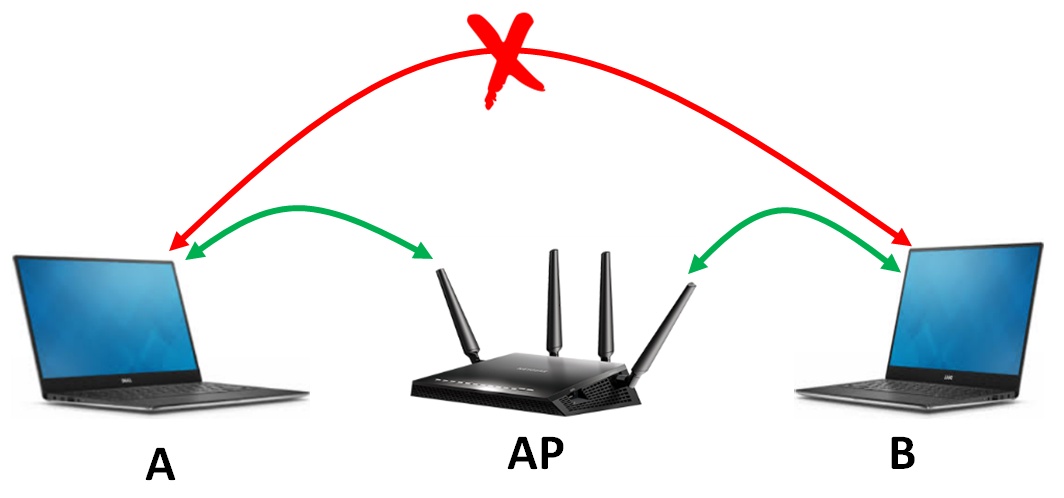 Wi\-Fi hidden node problem
**Hidden Node Issue:**There is something called the[Hidden Node Problem](https://en.wikipedia.org/wiki/Hidden_node_problem)\(wikipedia\.org\) that canpotentiallycause a large number of collisions in Wi\-Fi \-\- where device 'A' and device 'B' can both hear transmissions from the AP, but device 'A' and device 'B' can NOT hear each other's transmissions\. So both device 'A' and device 'B' might transmit at the same timeas seen at the AP, a 'collision'and both transmissions are lostat the AP\.> A mitigating factor is that even if your network has the hidden node problem, the hidden nodes will not impact each other, unless they attempt to use Wi\-Fi and transmit at the exact same time\. If both hidden nodes are sporadically using Wi\-Fi, the problem will not happen that often\.NOTE that OFDMA in Wi\-Fi 6 can eliminate the "Hidden Node" problem\. Because with OFDMAand Wi\-Fi 6 clients using OFDMA, it is the router, not the client, that decides when a client transmits\.
**Coexistence with 802\.11 a/b/g/n:**For an 80 MHz 802\.11ac channel to properly coexist with older 20 MHz radios operating within the channel, there is a 'request to send' and 'clear to send' exchange before each real message is sent\. And that slows everything down\.[More information](https://www.computerweekly.com/news/2240101850/What-is-80211n-Greenfield-mode)\(computerweekly\.com\)**Beamforming overhead:**The sounding frames for beamforming adds some overhead\.*Exactly how much overhead this causes needs to be researched\.*
**CRITICAL: Don't forget that Wi\-Fi is a shared resource:**After all of the abovewhich assumes you have the Wi\-Fi channel all to yourself, if you are unlucky enough to have a router set to the same channel as your neighborand your neighbor is using Wi\-Fi, you are sharing spectrum/time/bandwidth with your neighbor\!
> How is Wi\-Fi spectrum shared? By bandwidth? By time? By something else? In general, by TIME \-\- if 'N' users all want to use Wi\-Fi at the same time, on average, they will all get to use the channel '1/N' of the time\. For example, if two users want to use the same channel, and first user at a PHY of 6 Mbps, and the second user at a PHY of 866 Mbps, the first user will get to use the channel 50% of the timeso 6/2, or around 3 Mbps, and the second user will get to use the channel the other 50% of the timeso 866/2, or around 433 Mbps\.This 'a channel is shared' concept is easy to gloss over and not fully understand\. But if you seein a Wi\-Fi analyzer appthat your wireless router and other wireless routersneighborson the same channelor overlapping channels,*you are potentially sharing the SAME Wi\-Fi spectrum*\. **A striking example:**A laptop in the same room as an APon the second floor of a housewith an unobstructed view of the AP gets real\-world Tx average throughput of 92 Mbps \-\- measured using[TxRate](https://www.duckware.com/txrate/index.html)\(duckware\.com\)\. But when the laptop is moved downstairsso now the Wi\-Fi signal has to go through walls/floors, Tx throughput*increases*to a rock solid 116 Mbps\. But how is that possible? \-\- throughput should have decreased\! The surprising answer is that downstairs, neighboring Wi\-Fi signals were greatly attenuated, so the laptop transmitted more often\. And yes, that means the laptop WAS actually transmitting at the same time as a far away station but all that did is raise the noise floor for those local transmissions, which were still successfully received\.
**A final caveat:**PHY speed is a very complicated thing\. Tx PHY and Rx PHY can not only be asymmetric \(more details in[appendix below](https://www.wiisfi.com/#phyasymmetric)\[§E\]\) but also be highly variable\. The 'link speed' your device reports to you is a highly over\-simplified 'computed' single number\. You should only use that speed as a 'ballpark' figure of actual PHY speeds used\. Or, when you run a throughput test and attempt to calculate the 'overhead' at the PHY level, that 'overhead' is only an estimate\.> A prime example: A Windows laptop with an 'older' 802\.11ac 2×2 MIMO four feet from the router reportsan expected'speed' of 866\.6 MbpsMCS9\. A throughput tests shows download speeds of 475 Mbps\. That is a MAC efficiency around 55%\. But the MCS Spy tool \(see[Router deep dive](https://www.wiisfi.com/#deepdive)\[§L\] appendix below\) clearly shows that the router is transmitting to the PC using only MCS7 \(650 Mbps\), which is actually a much better MAC efficiency of around 75%\.There is still the problem of why MCS9 is being reported and MCS7 used, but MAC efficiency is much better than it initially appears\.Take the PHY speed reported by your client device with a huge 'grain of salt'\.In fact, download and upload speed test results, divided by 0\.75, in many cases is likely a*better estimate of the average download/upload PHY speeds*, than the PHY speeds being reported by a device\.
**Learn More:**- [Wi\-Fi Overhead, Part 1: Sources of Overhead](https://www.cwnp.com/wi-fi-overhead-part-1-sources-of-overhead/)\(cwnp\.com\)
- [Wi\-Fi Overhead, Part 2: Solutions to Overhead](https://www.cwnp.com/wi-fi-overhead-part-2-solutions-to-overhead/)\(cwnp\.com\)
- [RTS/CTS enhanced with bandwidth signaling](https://www.cisco.com/c/en/us/products/collateral/wireless/aironet-3600-series/white_paper_c11-713103.html#page=12)\(cisco\.com\)
6\. Cutting through router marketing hype
**The bottom line:**The AX\#\#\#\# naming conventionAX6000, AX11000and AC\#\#\#\# naming conventionAC1900, AC2600, AC5300, AC7200used in the router industrywhere the \#\#\#\# is a maximum*combined*Mbps for all bandsis nothing more than marketing hype / madness\.The naming convention impliesincorrectly\!that the larger the number, the better and faster the router \-\- and the faster Wi\-Fi will be for your wireless devices\.
Also, speeds are cited for hypothetical wireless devices that DO NOT EXIST \-\- can you actually name a single smartphone, tablet, or laptop computer that has 4×4 MIMO for Wi\-Fi?> **KEY Wi\-Fi concept:***There is a lot of marketing hype in the claims made by router companies\.*
 iPhone XS Max
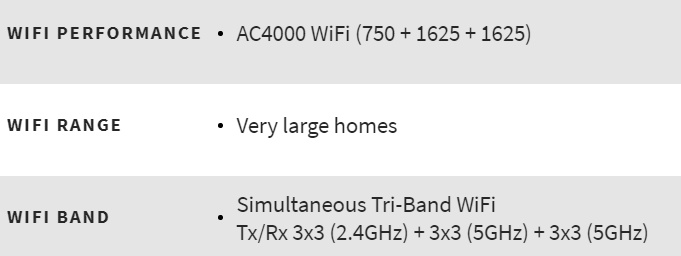
**Wi\-Fi 5 Example:**Seen upper right are the specifications for an AC40004000 Mbpsclass router\. But realistically, what speed can YOU expect from your "iPhone XS Max", a 2×2 MIMO device, at a reasonable distance of 32 feet?**Bands/MIMO:**AC4000 is 750\+1625\+1625\. So what do those numbers mean? It is the 'maximum' speedsbest modulation possible with highest MIMOof all 'bands' in the router added*together*as follows:
1. **Band One:**750 is the maximum PHY speed for MIMO 3×3 in the 2\.4 GHz band, but for an unrealistic 1024\-QAMsee PHY table far below\. A much more realistic PHY speed for a 2×2 MIMO wireless device is 300 Mbps\.
2. **Band Two:**1625 is the maximum PHY speed for MIMO 3×3 in the 5 GHz band, but for an unrealistic 1024\-QAMsee PHY table far below\. A much more realistic PHY speed for a 2×2 MIMO wireless device**is 650 Mbps**about 32 feet from the router\.
3. **Band Three:**same as band two\.
**MAC Overhead:**Take the 5 GHz PHY speedfor one 5 GHz band, not both bands, so 650and multiple by 70% to get an estimate of the Mbps speeds that you will see within speed test applications running on your wireless device\.**Conclusion:**At 32 feet, you will get a maximum speed of around 455 Mbps±45 Mbpsfrom your iPhone XS Max from this '4000 Mbps' router\. With a second AC band, you 'might' get up to 455 Mbps from another wireless device at the same time\. However, see also the[tri\-band router](https://www.wiisfi.com/#tribandhype)\[§N\] appendix below\.
> So upgrading to a faster router will increase your iPhone XS Max speeds, right? No\! What about an AC5400 4×4 tri\-band router? Same speed\. What about an ultra\-fast Wi\-Fi 6 AX6000 8×8 router, marketed as being 4x faster than Wi\-Fi 5? Same speed\. Understand router manufacturers' marketing hype\.
A faster router only gets you half way there\. But in order to get the high advertised speeds from a routerfor only one band; not the published aggregate number, you need a 4×4 MIMO client wireless device that the industry does not yet make\. Virtually all wireless client devices today are still 2×2 MIMO \-\- so the maximum speeds for 2×2 MIMO are what you should realistically expect*no matter how powerful the router*\.*The only known exceptions to this general rule are an older Dell laptop that did have 3×3 MIMObut I can't find any new Dell laptops that do nowand some MacBook Pros that have 3×3 MIMO\. If you know of any other exceptions, please[let me know](https://www.wiisfi.com/#contact)\[§Y\]*
7\. MIMO \- a wireless revolution
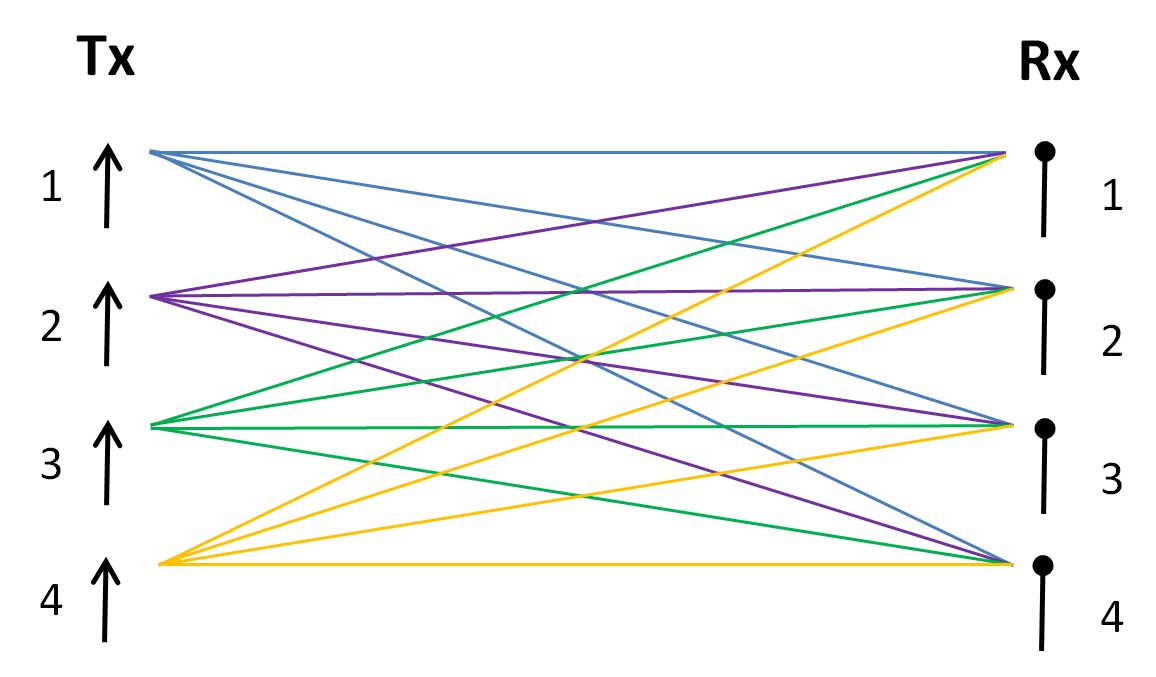 4×4 MIMO illustration
**MIMO:**What is partly driving the dramatic increase in wirelessWi\-Fi, cellular, etccapacity in the last few years is MIMO, an acronym for[Multiple Input, Multiple Output](https://en.wikipedia.org/wiki/MIMO)\(wikipedia\.org\), or spatial multiplexing, or spatial streams \-\- by using multiple antennas*all operating on the same frequency at the same time*\. Most smartphones today are capable of 4×4*cellular*MIMO \-\- so they arepotentiallyfour times as fast as a single antenna phone\. But MIMO for client devices is 2×2 MIMO for most devices\.> Analogy: Think of MIMO as adding 'decks' to a multi\-lane highway\. More lanescapacityare added without using more landspectrum\. 2×2 MIMO is a highway with one more highway deck above it\. And 4×4 MIMO is a highway with three more highway decks above it\.
**What is the big deal:**The reason MIMO is such a huge deal is becauseit is a direct capacity multiplier \(×2, ×3, ×4, ×8, etc\)**while using the SAME \(no more\) spectrum**\. This is accomplished by simply using more antennasbutboththe router and client must have the additional antennas\.> MIMO adds more capacity*without using more spectrum\!*Regardless of the MCS level used \(distance between router and router\), 2×2 MIMO can transmit twice as much data as 1×1 MIMO can, and 4×4 MIMO can transmit four times as much data as 1×1 MIMO \-\- in the same amount of time\. This is why MIMO is such a big deal \-\- a direct capacity multiplier\.The huge caveat, of course, is that BOTH the transmitter and receiver must support MIMO\. And if each supports different levels of MIMO, the minimum MIMO level common to both devices will be used\. For example, a 2×2 MIMO tablet connecting to an 8×8 MIMO router will only use 2×2 MIMO\. But as a very significant bonus, the 'extra' antennasif there is a mismatch in MIMO levels between the client and routerdo not go unused, but are used for 'diversity' and 'beamforming', which extends range, and improves speed at range\. NOTE: The 'number of visible antennas' does NOTnecessarilyindicate MIMO level\. It may, but it may not\. Sometimes antennas are shared between Wi\-Fi bands\. Sometimes antennas are dedicated to just a single Wi\-Fi bandso 2× or 3× as many antennas as MIMO level\. Some routers use a mix of both internal and external antennas\. Some Wi\-Fi 6E routers are moving to all internal antennas\.
**Example:**On a*single*80 MHz 802\.11ac Wi\-Fi 5 channel operating at a PHY of 433 Mbps:- 1×1 MIMO yields a PHY of 433 Mbps
- 2×2 MIMO yields a PHY of 866 Mbpsmost wireless clients are 2×2
- 3×3 MIMO yields a PHY of 1300 Mbps
- 4×4 MIMO yields a PHY of 1733 Mbpsmost higher end routers are 4×4
- 8×8 MIMO yields a PHY of 3466 Mbps
all on the same 80 MHz channel\.**Notation:**You might see the MIMO level written as T×R:S, where 'T' is the number of transmit antennas, 'R' is the number of receive antennas, and 'S'an optional componentis the number of simultaneous 'streams' supported\. If the 'S' component is missing, it is assumed to be the minimum of 'T' and 'R'\. OR, some devices will just say '2 streams'for 2×2:2or 'quad stream'for 4×4:4\.
**Diversity:**If there are more antennas than streamseg: 2×2 client to 4×4 router, the 'extra' antennas can then be used to improve link quality, and
increase range\. With multiple antennas receiving the same transmitted signal, the receiver can recombine all of the received signals into a better estimate of the true transmitted signal\.> FCC documents discuss that the 'maximum' gain when doubling antennas is10×log\(NANT/NSS\)dBi, which for a 2×2 client to a 4×4 access point, would result in a diversity gain of 'around' 3 dBi\. OR a 4×4 access point to a 1×1 client means a diversity gain 'around' 6 dBi\.*★ This explains why you really do want a 4×4 MIMO router, even though there may only be 1×1 and 2×2 client devices connecting to it\!*
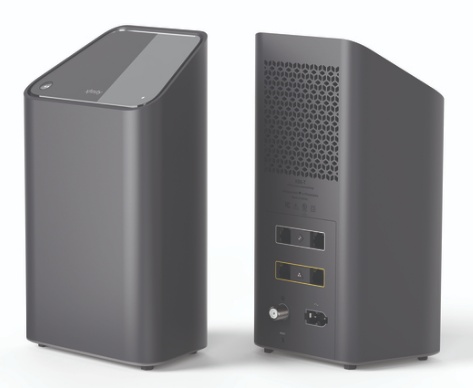Comcast XB6 gateway \- 8×8 MIMO
**Beamforming:**This Wi\-Fi technology uses multiple antennas to 'focus' the transmitted RF signals more towards a deviceinstead of just broadcasting the signal equally in all directions\. The end result is a slightly stronger signalin the direction of the device, which typically causes a slightly higher modulation to be used, which in turn increases Mbps speed by a little bit\.> Video:[A very nice explanation of beamforming\!](https://www.youtube.com/watch?v=A1n5Hhwtz78)\(youtube\.com\)
> **KEY Wi\-Fi concept:***It is easy to overlook and miss, but beamforming and diversity are the key reasons why you want a4×4 MIMO routereven though most clients are still only 2×2 MIMO\. The extra antennas are actually used and offer significant value \(a stronger signal, which translate to better connect speeds for far\-away users\)\!*
**Client MIMO:**Almost all battery powered wireless devices are stuck at 2×2 MIMO for Wi\-Fi, and this seems unlikely to change anytime soon\. The extra power requirements of 4×4 MIMO causing reduced run times is just not worth the tradeoffyet\. But for devices with lots of powerlike a PC on AC power, you can buy 4×4 MIMO adapters\.**Must a client device with MIMO always use MIMO?**No, it does not have to\. I have a Dell laptop with an "Intel Wi\-Fi 6E AX210" card that I have documented flipping back and forth between 1×1 and 2×2 data rateskeeping the MCS level the samedepending upon conditions\. This needs more researchis this a bug or a feature\.
**A final note:**You will only get the dramatic speed benefits of MIMO if you have a client devicephone, tablet, TV, computer, etcthat actually supports MIMO\. Most client devices todayOctober7:45 PM 10/1/2025 2025are STILLat best2×2 MIMO\. It is very rare to see abattery poweredclient device that supports MIMO higher than that\.
> **AX 'Stream' Deception:**Router vendors' are now being incredibly deceptive when it comes to advertising in their new "AX" class of routers\.[Details](https://www.wiisfi.com/#stream)\[§Q\]\. Netgear is using "spatial streams" to[describe their new AX routers](https://kb.netgear.com/000060370/What-is-an-8-stream-router-and-why-should-I-buy-one)\(netgear\.com\), but this is NOT the same thing as "spatial streams" in MIMO in the 802\.11ax standard \-\- which is what most people willwronglyconclude \-\- and that is outright deceptive, and Netgear knows it*because when I mentioned this in a Netgear forum post, a Netgear moderator deleted my post*\. Netgear claims their new RAX80 4×4 four\-antennafour spatial streamsrouter is "[8 streams](https://www.netgear.com/home/products/networking/wifi-routers/RAX80.aspx)" \(netgear\.com\)\. So, do your research, and buyer beware\.Netgear's "spatial stream" logic is provably wrong\. The maximum number of 'streams' in a router can not be larger than the number of antennas in the router\. because*"In the T×R configuration the maximum number of spatial streams is limited by the lesser of either T or R"*\.[Source](https://meraki.cisco.com/blog/2011/02/mimo-why-multiple-antennas-matter/)\(cisco\.com\)\. **A pattern emerges:**Router vendors are incredibly 'creative' in their marketing of new routers\. They are constantly figuring out creative ways to make new hardware sound 'so much better' than older*similar*hardware\.
**Learn More:**- [EXCELLENT: 802\.11ax Frequently Asked Questions](https://web.archive.org/web/20190309171057/https://blog.aerohive.com/802-11ax-frequently-asked-questions/)\(aerohive\.com via archive\.org\)
- [MIMO: Why multiple antennas matter](https://meraki.cisco.com/blog/2011/02/mimo-why-multiple-antennas-matter)\(cisco\.com\)
- [FAQ: MIMO, MRC, Beamforming, STBC, and Spatial Multiplexing](http://support.huawei.com/enterprise/en/knowledge/KB1000079062)\(huawei\.com\)
- [MIMO Communications](https://www.youtube.com/watch?v=TC19gMQ6azE)\(youtube\.com\)
- [Interaction between MIMO and TxBF](https://www.emperorwifi.com/2015/04/a-simplified-explanation-of-80211nac.html)\(emperorwifi\.com\)
8\. Wi\-fi 1/2/3 \-\- Legacy 802\.11
**Historical note:**There were many wireless products that existed well before the 802\.11 specification\. For example,[WaveLAN](https://en.wikipedia.org/wiki/WaveLAN)\(wikipedia\.org\) in 1990, and others\. But the "802\.11" specification created a*single standard*with the goal that products from different vendors could interoperate with each other\. And thankfully, there was a[Wi\-Fi Alliance](https://www.wi-fi.org/)ultimately formed to build consensus and move Wi\-Fi forwardtogetheras an industry \-\- which by any measure, has been very successful\.**Reference:**A brief look at past legacy Wi\-Fi generationsand while not official names, Wi\-Fi 1, Wi\-Fi 2, and Wi\-Fi 3:
> **Gen****Spec****Year****PHY Speeds****Unofficial name****Band**First[802\.11](https://en.wikipedia.org/wiki/IEEE_802.11_(legacy_mode))19972 MbpsWi\-Fi 12\.4 GHzSecond[802\.11b](https://en.wikipedia.org/wiki/IEEE_802.11b-1999)[1999](https://www.reddit.com/r/wireless/comments/5077tc/80211a_vs_80211g/)11 MbpsWi\-Fi 22\.4 GHzThird[802\.11a](https://en.wikipedia.org/wiki/IEEE_802.11a-1999)[2001](https://www.reddit.com/r/wireless/comments/5077tc/80211a_vs_80211g/)54 MbpsWi\-Fi 35 GHzThird[802\.11g](https://en.wikipedia.org/wiki/IEEE_802.11g-2003)[2002](https://en.wikipedia.org/wiki/Linksys_WRT54G_series)54 MbpsWi\-Fi 3E2\.4 GHz
**802\.11 \(Wi\-Fi 1\)**: PHY data rates of**1 or 2 Mbps**with 11,000,000 symbols/sec, using direct sequence spread spectrumDSSSwith three non\-overlapping 22 MHz channels in 2\.4 GHz1, 6, 11\.**802\.11b \(Wi\-Fi 2\)**: PHY data rates of**1, 2, 5\.5, or 11 Mbps**with 11,000,000 symbols/sec, using direct sequence spread spectrumDSSSwith three non\-overlapping 22 MHz channels in 2\.4 GHz1, 6, 11\.[How rates are calculated](https://80211notes.blogspot.com/2013/08/wi-fi-80211-phy-data-rates.html)\(blogspot\.com\)\.
PHY speed2 Mbps
5\.5×
11 Mbps
★**The PHY speed increases in Wi\-Fi 2 \(802\.11b\):**Most Wi\-Fi 2 client devices saw a 5\.5× maximum PHY speed change from 2 Mbps to 11 Mbps, from:- 450% \- a bitrate encoding change increased speeds from 2 Mbps to 11 Mbps
**Throughput:**For an 11 Mbps PHY, expect: \(1\)[throughput speed tests](https://www.wiisfi.com/#speedtest)\[§D\] to peak at 'around'**6\.5 Mbps**when very close to the router, and \(2\) speeds to decrease quickly with distance and obstacles\.
**Symbols: A key concept in Wi\-Fi:**All Wi\-Fi devices within the same generation of Wi\-Fi transmit data via the SAME 'symbols' \-\- or essentially, a very tiny slot in timewith a tiny pause, or guard interval, or GI, at the end of the symbol\. And that is it\! End of story\. However, client devices very close to a router can 'hear' those symbols very clearly, and client devices far away from the router can barely 'hear' those symbols\. So Wi\-Fi leverages this fact and always encodes/modulates the maximum amount of information into each symbol that can be successfully 'heard' \-\- and this takes place for each client device, individually\. The result is the "Modulation \+ Coding" tables you see in thisand followingchapters\. The tables define how data will be encoded in Wi\-Fi, and the MCS levels directly correlate to how well symbols can be hearddistance from the router\.[More Information](https://www.wiisfi.com/#phytables)\[§F\]> **KEY Wi\-Fi concept:***Wi\-Fi works BEST \(fastest\) when you are close to an access point\.*
---
*The START of modern Wi\-Fi\.\.\.*
---
**802\.11a/g PHY Speeds**
**20 MHz**channel
**800ns**guard interval**Modulation \+ Coding****Mbps****0****BPSK****1/2**6\.0**1****3/4**9\.0**2****QPSK****1/2**12\.0**3****3/4**18\.0**4****16‑QAM****1/2**24\.0**5****3/4**36\.0**6****64‑QAM****2/3**48\.0**7****3/4**54\.0
[More PHY tables](https://www.wiisfi.com/phy)
**802\.11a \(Wi\-Fi 3\):**PHY data rates**6 Mbps to 54 Mbps**see table rightwith 12,000,000 symbols/sec, using orthogonal frequency\-division multiplexingOFDMwith 12 non\-overlapping 20 MHz channels in 5 GHz36, 40, 44, 48, 52, 56, 60, 64, 149, 153, 157, 161, but some channels52\-64had DFS restrictions\.[Details](https://www.motorolasolutions.com/content/dam/msi/docs/business/_documents/static_files/interference_tb_0809.pdf#page=6)\(motorolasolutions\.com\)\.But 802\.11a really never 'took off'in the consumer marketsince initial 802\.11a devices worked*only*in the 5 GHz banddid NOT support existing 802\.11b clients in the 2\.4 GHz bandand were expensiveas compared to 802\.11b products\.
> The router industry learned a very hard lesson about the 'consumer market' \-\- that any new router/AP must also be fully backward compatible, and must support most, if not all, of the old client devices out there\!New routers today support ALL prior generations of Wi\-Fi back to 802\.11b\. *Note that 64\-QAM 5/6 is not a part of Wi\-Fi 3and not shown in table right\. That arrives in the next Wi\-Fi generation, Wi\-Fi 4*which interestingly, then also removes BPSK 3/4\.
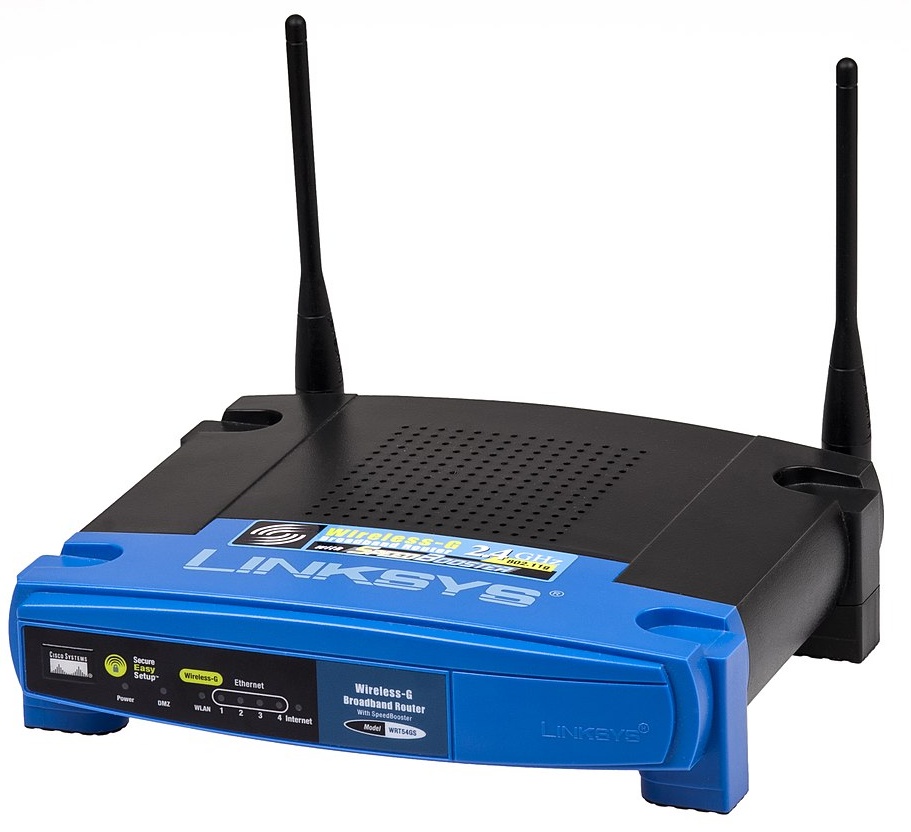 Linksys WRT54G \(a big hit back in the day\)
**802\.11g \(Wi\-Fi 3E\)**: Wi\-Fi 3 802\.11a technology in 5 GHz was moved/extended back into the 2\.4 GHz band\. PHY data rates**6 Mbps to 54 Mbps**see table upper rightwith 12,000,000 symbols/sec, using orthogonal frequency\-division multiplexingOFDMwith three non\-overlapping 20 MHz channels in 2\.4 GHz1, 6, 11\-\- see the[next chapter](https://www.wiisfi.com/#wifi4)\[§9\] for channel details\. Wi\-Fi 3 also could revert to 802\.11b mode to support older clients \-\- so 802\.11g was highly successful\. And it worked incredibly well considering that typical residential broadband Internet download speeds back then were around 3 Mbps\. It is remarkable that today you can still today buy a brand new Linksys WRT54GL router802\.11g\.> **A note about channels:**In the U\.S\. there are 11**overlapping**Wi\-Fi channels in 2\.4 GHz\. The only way to get non\-overlapping channels is for all routers/AP to cooperate and set their channels to either 1, 6, or 11\. But when I use a Wi\-Fi analyzer, I see routers operating on other channels all of the time\.*Be a nice neighbor and only use channels 1, 6, or 11*\. See the drawing in the[next chapter](https://www.wiisfi.com/#wifi4)\[§9\] for more details\.
PHY speed11 Mbps
4\.9×
54 Mbps
★**The PHY speed increases in Wi\-Fi 3 \(802\.11g\):**Most Wi\-Fi 3 client devices saw a 4\.9× maximum PHY speed change from 11 Mbps to 54 Mbps, from:- 391% \- The introduction of OFDMvs DSSSincreased speeds from 11 Mbps to 54 Mbps
**Throughput:**For a 54 Mbps PHY, expect: \(1\)[throughput speed tests](https://www.wiisfi.com/#speedtest)\[§D\] to peak at 'around'**30 Mbps**when very close to the router, and \(2\) speeds to decrease quickly with distance and obstacles\.
**Learn More:**- [Wi\-Fi \(802\.11\) PHY Data Rates](https://80211notes.blogspot.com/2013/08/wi-fi-80211-phy-data-rates.html)\(blogspot\.com\) \-\- Understand*how*PHY rates are computed
- [Different Wi\-Fi Protocols and Data Rates](https://www.intel.com/content/www/us/en/support/articles/000005725/network-and-i-o/wireless-networking.html)\(intel\.com\)
9\. Wi\-Fi 4 \(802\.11n\) 2\.4 GHz and 5 GHz \(HT: High Throughput\)
★ The big advance in Wi\-Fi 4 was the introduction of[MIMO](https://www.wiisfi.com/#mimo)\[§7\]multiple antennas, instantly doublingfor 2 antennasor triplingfor 3 antennasthroughput over the prior Wi\-Fi 3, and channel bonding, which has the potential to double throughput again\. But both client and AP must implement MIMO\.
802\.11n in 2\.4 GHz is a legacy wireless band that has been replaced by much faster Wi\-Fi in the 5 GHz and 6 GHz bands\. This chapter is provided for reference only\. You should be using 'newer' Wi\-Fi for all of your 'new' wireless Internet devices\. Only use 2\.4 GHz when you are forced to \-\- by a device that does not support newer versions of Wi\-Filike many low bandwidth IoT devices only support Wi\-Fi 4\.
> **Gen****Spec****Year****PHY Speeds****New Name**Fourth[802\.11n](https://en.wikipedia.org/wiki/IEEE_802.11n-2009)[2006](https://www.networkcomputing.com/networking/arrival-draft-80211n-wireless-products)72 to 217 Mbps**Wi\-Fi 4**
**2\.4 GHz Wi\-Fi channels****Channel****MHz center****20 MHz channel****1****2412****2402\-2422**224172407\-2427324222412\-2432424272417\-2437524322422\-2442**6****2437****2427\-2447**724422432\-2452824472437\-2457*microwave ovens: 2450 MHz ±50 MHz*924522442\-24621024572447\-2467**11****2462****2452\-2472**12not available
in the U\.S\.1314
**217 Mbps speed:**The 217 Mbps maximum PHY speed is for a 20 MHz channel to a 3×3 MIMO client\.However, a much more realistic maximum PHY speed is**144 Mbps**for a 20 MHz channel to a 2×2 client\.> 802\.11n is called**"HT"**forHighThroughput
**Spectrum:**There is ONLY 70 MHz of spectrum2402\-2472 MHzavailablefor Wi\-Fi to use in the U\.S\. in the 2\.4 GHz band, supporting only three non\-overlapping 20MHz channels\.> Let that sink in\. Only 70 MHz of spectrum in 2\.4 GHz must be shared between you, your family, and a bunch of neighbors\.
**There are elevenOVERLAPPING2\.4 GHz Wi\-Fi channels:**In the US, Wi\-Fi routers allow you to set the 2\.4 GHz Wi\-Fi channel anywhere from 1 to 11\.[More information](https://en.wikipedia.org/wiki/List_of_WLAN_channels)\(wikipedia\.org\)\. So there are 11 Wi\-Fi channels, right? NO\! These eleven channels are only 5MHz apart \-\- and it actually takes a contiguous 20MHzand a little 5 MHz buffer between channelsto make one 20MHz Wi\-Fi channel that can actually be actively used\. Because of this, in the US, these restrictions result in onlythree usable non\-overlapping 20MHz Wi\-Fi channelsavailable for use1, 6, or 11; seen right\.> Technically, channels 12 and 13 could be used in the US, but under significant restrictions that in reality, cause virtually all routers/clients to elect to NOT touch those channels\.[Details](https://en.wikipedia.org/wiki/List_of_WLAN_channels#endnote_B)\(wikipedia\.org\)
**The THREE non\-overlapping channels:**You CAN set the Wi\-Fi channel to*any*channel and it will work\. However, if you don't select 1, 6, or 11, the 20 MHz channel you create will almost certainly impact TWO other 20 MHzneighborchannels operating on 1, 6, 11\. And more importantly, maybe TWO neighbor channels will impact your one channel\. Not good\!If your AP/router uses channel 2, 3, 4, 5, or 7, 8, 9, 10, that is an error to fix\!*So be a nice neighbor and only use one of the three non\-overlapping channels: 1, 6, or 11\!*
2\.4 GHz Wi\-Fi has only THREE non\-overlapping channels
> More Info:[Video about channels 1/6/11 from MetaGeek](https://www.youtube.com/watch?v=X3ykmJco-kI)\(youtube\.com\)**An analogy:**A router using channel 2, 3, 4, 5, or 7, 8, 9, 10instead of channel 1, 6, or 11is exactly like a car on a three lane Intestate driving directly over the dashed lane divider lines and refusing to move over fully into a lane\. That 'car' gets to its destination, but in the process, then impacts TWO lanes on the Interstate, instead of just one laneand vise\-versa \-\- the car itself is impacted by two lanes, not one\.
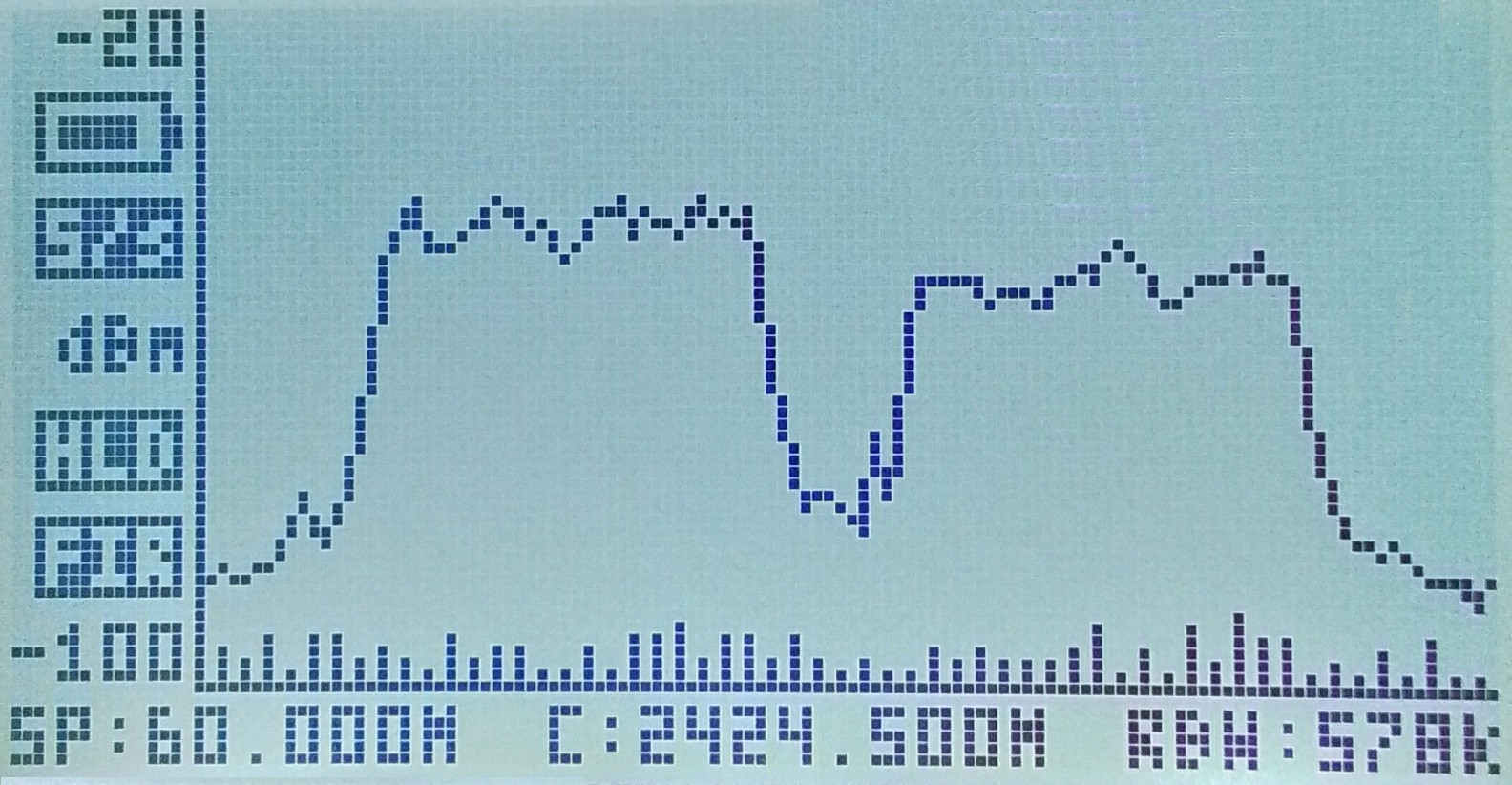Screenshot from 'RF\-Explorer Handheld Spectrum Analyzer' \(showing 2\.4 GHz channel 1 and channel 6 active\)
**A small \(intentional\) gap between channels:**Notice the very small 5 MHz gap between channels 1, 6, and 11\. This is very intentional and designed so thathopefullytraffic on one channel does not interfere with traffic on an adjacent channel\.The gap is***needed***because there IS a small amount of 'bleed\-over' of signal past the limits of the channel width and this tiny gap between adjacent channels helps to greatly minimize the impact of that bleed over\. See[Spectral Masks](https://www.wiisfi.com/#spectralmasks)\[§S\]\. This subtle 'bleed over' can be clearly seen in a capture from a spectrum analyzerseen upper rightof Wi\-Fi devices operating on channel 1left humpand 6right hump\. Notice that \(a\) the edges of each channel are not a vertical drop\-off, but rather slant down, and that \(b\) the valley between humps does NOT go all the way down to the noise floorthe 'floor' is seen as small vertical lines on the X\-axis in the graph\.
> **Four channel plan?**But what about the 'four\-channel plan' overseas using channel 1, 5, 9, 13? That can only work well*when adjacent channels are not actively being used\!*\. There is now NO 5 MHz space between channels, so the[bleed over](https://www.wiisfi.com/#spectralmasks)\[§S\] from the sideband signal in adjacent channels will be even more pronounced \-\- and be even more impactful\. When Wi\-Fi is heavily used,adjacent channels active at the same timeit is best to stick with only using channels 1, 6, 11\.
**Symbols/sec:**802\.11n uses either 14,444,444 symbols/sec400ns short GI, or 13,000,000 symbols/sec800ns long GI, for a 20 MHz channel\.**Shared spectrum:**All Wi\-Fi devices on the same spectrum must SHARE that spectrum\. Ideally, all Wi\-Fi devices decide to operate on either channel 1, 6, or 11 \-\- the only true non\-overlapping channels\. Then all devices operating on a channel share that channel\. But I have seen routers operate on channel 8, which means that router is being a 'bad neighbor' and*interfering*with 20 MHz channels operating on 6 and 11\.
**Protocol Overhead:**Each 20MHz Wi\-Fi channel has maximum PHY bitrate of around 72Mbps, but due to Wi\-Fi protocol overhead, real throughput will only be around 60% to 80% of that\.
> In a very 'clean' Wi\-Fi environment, I have seen[throughput](https://www.wiisfi.com/#speedtest)\[§D\] around 54\.2 Mbps for a PHY speed of 72\.2 Mbps, which comes out to 75% efficiency \-\- pretty good\. Another time, when I was just feet from the router, I measured a peak throughput of around 118 Mbps for a PHY speed of 144\.4 Mbps82% efficiency\-\- very good\.
**802\.11nPHY Speeds \(Mbps\)**
**20 MHz**channel,**400ns**guard interval**Modulation \+ Coding****MIMO****1×1****2×2****3×3****4×4****0****BPSK****1/2**7\.214\.421\.628\.8**1****QPSK****1/2**14\.428\.843\.357\.7**2****3/4**21\.643\.365\.086\.6**3****16‑QAM****1/2**28\.857\.786\.6115\.5**4****3/4**43\.386\.6130\.0173\.3**5****64‑QAM****2/3**57\.7115\.6173\.3231\.1**6****3/4**65\.0130\.0195\.0260\.0**7****5/6**72\.2144\.4216\.6288\.8\-256‑QAM3/486\.6173\.3260\.0346\.6\-5/696\.2192\.5288\.8385\.1\-1024‑QAM3/4108\.3216\.6325\.0433\.3\-5/6120\.3240\.7361\.1481\.4256\-QAM and 1024\-QAM are non\-standard**802\.11nPHY Speeds \(Mbps\)**
**40 MHz**channel,**400ns**guard interval**Modulation \+ Coding****MIMO****1×1****2×2****3×3****4×4****0****BPSK****1/2**15304560**1****QPSK****1/2**306090120**2****3/4**4590135180**3****16‑QAM****1/2**60120180240**4****3/4**90180270360**5****64‑QAM****2/3**120240360480**6****3/4**135270405540**7****5/6**150300450600\-256‑QAM3/4180360540720\-5/6200400600800\-1024‑QAM3/4225450675900\-5/62505007501000256\-QAM and 1024\-QAM are non\-standard
[More PHY speed tables](https://www.wiisfi.com/phy)
**Understanding channel widths:**The standard Wi\-Fi channel width is 20 MHz\. So a 40 MHz channel is TWO 20 MHz channels put together2× capacity\.> Analogy: Think of channel width as how many 'lanes' you can use at once on a multi\-lane highway\. 20 MHz is a car using a single lane\. 40 MHz is a 'wide' load trailer using two full highway lanes\.
**Channel bonding / 40MHz channels:**This is the biggest marketing rip\-off everin 2\.4 GHz\. Routers can then advertise 2x higher speeds, even though in virtually all circumstances, you will only get 1/2 of the advertised speedonly be able to use a 20 MHz channel\! For example, The Netgear N150implying 150Mbps, which is the result of taking TWO 20MHz Wi\-Fi channels and combining them into one larger 40MHz channel, doubling the bitrate\. This actually does work, and works well BUT ONLY in 'clean room' testing environmentswith NO other Wi\-Fi signals\. However, for Wi\-Fi certification, the required 'good neighbor' implementation policy prevents these wider channels from being used in the real world when essentially the secondary channel would interfere with neighbors' Wi\-Fi \-\- which unless you live in outer Siberia, you WILL 'see' neighbors' Wi\-Fi signals and the router will be required to automatically disable channel bonding\.> Great article on the subject:["Bye Bye 40 MHz Mode in 2\.4 GHz"](https://www.smallnetbuilder.com/wireless/wireless-features/31743-bye-bye-40-mhz-mode-in-24-ghz-part-1)\(smallnetbuilder\.com\)I am curious if this issue had anything to do with why Netgear stopped getting their routers 'Wi\-Fi Certified'? Or, if there is a*single*20 MHz only client that connects to the AP, the AP willshoulddrop from 40 MHz operation to 20 MHz operation, disabling channel bonding\. This situation is actually VERY likely to happenfor example, my daughter's very inexpensive laptop that is not that old, but only supports 20 MHz channels in 2\.4 GHz\. Virtually allinexpensiveIoT devices only support 20 MHz channels\. Also, in the real world, things are MUCH more complicated, because many routers don't always follow 'good neighbor' standardstry to force and use 40 MHz channels when they should only be using 20 MHz channels\. Of note is that 40 MHz channels in the 5 GHz band for 802\.11n does work \-\-*very well*\.
**256\-QAM and 1024\-QAM HYPE:**These are non\-standard extensions to 802\.11n, so most client devices will never be able to get these speeds\. And even if you have a device that is capable of these speeds, are you close enough to the router to get these speeds? Understand that advertised speeds in these ranges are mostly marketing hype\. See Broadcom[TurboQAM](https://web.archive.org/web/20180201103020/https://wikidevi.com/wiki/Broadcom_TurboQAM)\(archive\.org\) and[NitroQAM](https://web.archive.org/web/20191012060551/https://wikidevi.com/wiki/Broadcom_NitroQAM)\(archive\.org\)\.> The reason why 256\-QAM and 1024\-QAM are included in the PHY tables here is for reference/convenience \-\- because these PHY tables ARE ALSO the PHY speed tables for 802\.11ac for 20 MHz and 40 MHz channel widths\. The PHY speeds for an 80 MHz channel is far below in the next chapter\.
**Interference:**The entire 2\.4 GHz Wi\-Fi band is plagued by interferencea victim of the success of that spectrum, or other devices using the SAME frequency range\. For example, cordless phones, baby monitors, Bluetooth, etc\. Even microwave ovens operate at 2450 MHz ± 50 MHz,[Source](https://web.archive.org/web/20190717120600/https://bethesignal.com/wp/2017/02/why-do-microwave-ovens-operate-at-2-45-ghz/)\(archive\.org\), which is the*entire*Wi\-Fi space, and very likely impacting two of the Wi\-Fi channels,[and in some cases, even all three Wi\-Fi channels](https://www.zdnet.com/article/why-2-4-ghz-is-a-dead-end-for-wi-fi)\(zdnet\.com\)\.> 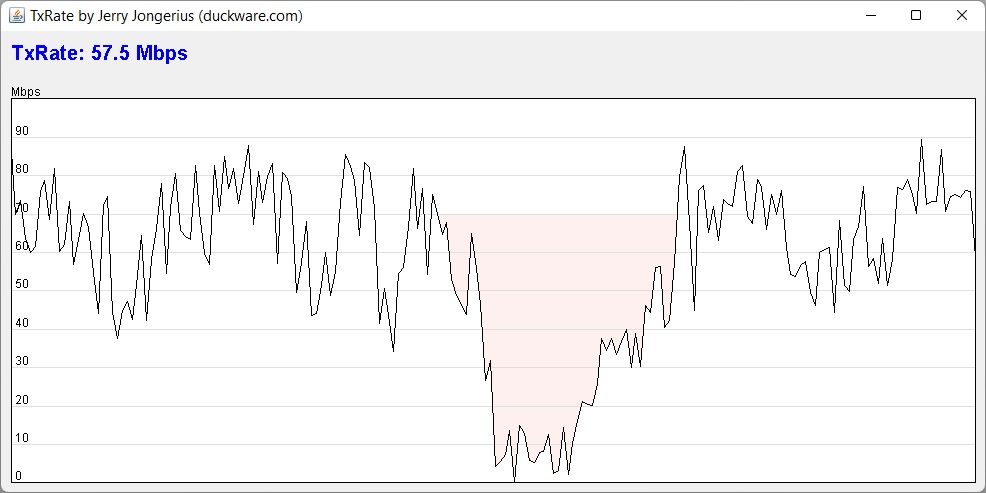 Major interference caused by a Microwave Oven \(in red; on for a couple seconds\) Microwave ovens are licensed in the entire ISM \(Industrial, Scientific and Medical\) band from 2\.4 GHz to 2\.5 GHz, which covers all 2\.4 GHz Wi\-Fi channels\.[Example](https://fccid.io/VG8XM044KYY-GE)\(fccid\.io\)\.How bad the interference is totally depends upon the specific microwave\. Some microwaves are very bad, while others seem to have very little impact\. At one house, using the microwave oven causes Wi\-Fi clients to disconnect from the AP, while in another house, using the microwave oven only causes a slight slowdown in bandwidth to Wi\-Fi clients\. Years ago I was testing a Wi\-Fi security camera \(base station and cam connected via 2\.4 GHz\), and just happened to use the microwave oven, and noticed the cam was unable to record any video\. I learned my lesson and immediately returned the camera\. Is your house near a busy road? If so, you are likely getting some interference from all the cars driving by that are operating a 'hotspot' \(likely always enabled, although maybe not with Internet activated\)\. And the worst part is, you can NOT plan for that channel usage, because the cars are mobile\!
**Proprietary beamforming:**Some 802\.11n devices did support 'beamforming', but these were proprietary extensions that required matching routers and clientsone vendor's implementation would not interoperate with a second vendor's implementation\.**The BOTTOM LINE:**The 2\.4 GHz band is just WAY too crowded\. Today, it is a victim of its own success\. Use a modern dual\-band2\.4 and 5 GHzrouter/AP and switch over to the 5 GHz band \-\- for all devices that support 5 GHz\. All quality devices made in the last few yearsphones, tablets, laptop computers, TVs, etcwill absolutely support 5 GHz for Wi\-Fi\.
> The real impact of overcrowding: In a beach resort community, with homes very close to each other, a Wi\-Fi analyzer app shows well over fifteen 2\.4 GHz networks within range\. At night, Wi\-Fi performanceactual throughputon the 2\.4 GHz band was horribleeven though PHY speed was greatdue to contentionsharing bandwidthwith many neighbors\. However, performance on the 5 GHz band was excellent\.
**A final warning:**I am glossing over the fact that*802\.11n can also operate in the 5 GHz band*, using 20 MHz and 40 MHz channelsbut not 80 MHz channels and not 256\-QAM, because 802\.11ac is so common place today\. Just be aware that 802\.11n using 5 GHz is possible using 'dual\-band 802\.11n' Wi\-Fi devices \-\- don't assume a Wi\-Fi device operating in 5 GHz is 802\.11acit may only be 802\.11n\. There are still brand new dual\-band 802\.11n routers and devicessmartphones, doorbell cameras, etcbeing sold today that are only 802\.11n dual\-bandand not 802\.11ac\](https://amzn.to/3SmnMaI)
**So why is 2\.4 GHz Wi\-Fi 4 not considered 'legacy' Wi\-Fi:**Frankly, Wi\-Fi 4 is 'too old' and should be considered legacyand not used much anymore\! But the surprising fact is that many brand\-new IoT devicesespecially 'battery' devicesbeing sold today come with only 2\.4 GHz Wi\-Fi 4 support\.> Example: In mid\-2023, Ring introduced a new $60[Ring Indoor camera](https://amzn.to/3SmnMaI)\(amazon\.com\) that supports ONLY 2\.4 GHzand no MIMO\. And since it is plugged in all the time to an outlet, that seems very short\-sightedespecially when I can find smart plugs for $8 on Amazon that support 5 GHz Wi\-Fi\. If the 2\.4 GHz Wi\-Fi band still works OK for you, then no problem\. But if 2\.4 GHz is too congested at your physical location,*then this camera will not work well for you*\. Buyer beware\.
PHY speed54 Mbps
2\.7×
144\.4 Mbps
★**The PHY speed increases in Wi\-Fi 4 \(802\.11n\):**Most Wi\-Fi 4 2×2 MIMO client devices saw a 2\.7× maximum PHY speed change from 54 Mbps to 144\.44 Mbps, from:- 8\.3% \- 54 Mbps becomes 58\.5 Mbps by using 52 subcarriers out of 64instead of just 48
- 11\.1% \- which then becomes 65 Mbps by reducing the guard intervalGIfrom 800ns to 400ns
- 11\.1% \- which then becomes 72\.2 Mbps via a new QAM64\-QAM 5/6modulation
- 100% \- which then becomes 144\.44 Mbps with 2×2[MIMO](https://www.wiisfi.com/#mimo)\[§7\]
- *not counting 40 MHz channels in 2\.4 GHz because in reality it can rarely be used\. But if using in the 5 GHz band, that can double throughput\.*
- *not counting MIMO past 2×2 because that is not seen in battery\-powered client devices*
**HT20 Throughput:**For a 144\.4 Mbps PHY2×2 MIMO client; 20 MHz channel, expect: \(1\)[throughput speed tests](https://www.wiisfi.com/#speedtest)\[§D\] to peak at 'around'**115 Mbps**when very close to the router, and \(2\) speeds to decrease quickly with distance and obstacles\.
**Learn More:**- [Understanding High Speed 802\.11n Wireless Networks in Depth \(cisco\.com\)](https://www.cisco.com/c/dam/global/sk_sk/assets/expo2009/docs/c1UnderstandingHighSpeerWirelessMichalRemper.pdf)
10\. Wi\-Fi 5 \(802\.11ac\) 5 GHz \(VHT: Very High Throughput\)
★ The big advance in Wi\-Fi 5 was the introduction of 80 MHz channels into the 5 GHz band, instantly quadrupling throughput over the prior Wi\-Fi 4 with 20 MHz channels \-\-*but both client/AP must implement 80 MHz channels*160 MHz channels were also added, but it was rare for client devices to support\.
**Wi\-Fi 5:**The fifth generation of Wi\-Fi is 802\.11ac2013on 5 GHz\. It provides a maximum PHY speed of 3\.4 Gbps on an 80 MHz channel using 8×8 MIMOand fully backward compatible with prior Wi\-Fi generations\. However, a much more realistic maximum PHY speed is 1\.7 Gbps on an 80 MHz channel using 4×4 MIMO\. Wi\-Fi 5 has now been 'officially' replaced by 802\.11ax Wi\-Fi 6see next chapter\.> **Gen****Spec****Year****PHY Speeds****New Name**Fifth[802\.11ac](https://en.wikipedia.org/wiki/IEEE_802.11ac)[2013](https://www.zdnet.com/home-and-office/networking/gigabit-wi-fi-802-11ac-is-here-five-things-you-need-to-know/)433 to 1733 Mbps**Wi\-Fi 5**
5 GHz Wi\-Fi channels \(U\.S\.\)**Channel \#****20 MHz center****20 MHz channel****160****80****40****20**50**42**383651805170\-51904052005190\-5210464452205210\-52304852405230\-5250**58**545252605250\-52705652805270\-5290626053005290\-53106453205310\-5330GAP \(160 MHz\)114**106**10210055005490\-551010455205510\-553011010855405530\-555011255605550\-5570**122**11811655805570\-559012056005590\-561012612456205610\-563012856405630\-5650**138**13413256605650\-567013656805670\-569014214057005690\-571014457205710\-5730GAP \(5 MHz\)163**155**15114957455735\-575515357655755\-577515915757855775\-579516158055795\-581517116716558255815\-583516958455835\-585517517358655855\-587517758855875\-5895More info from[Wikipedia](https://en.wikipedia.org/wiki/List_of_WLAN_channels)
**1733 Mbps speed:**The 1733 Mbps maximum PHY speed is for an 80 MHz channel to an 4×4 client\. You can find 4×4 Wi\-Fi cards for your PC\.However, a much more realistic maximum PHY speed \(for 'on battery' devices\) is**866 Mbps**for an 80 MHz channel to a 2×2 client, and in the real\-world, a PHY speed of 780 Mbps is reasonable\.> 802\.11ac is called**"VHT"**forVeryHighThroughput
**Spectrum:**There is 560 MHz of spectrum5170\-5330, 5490\-5730, 5735\-5895 MHzavailable for Wi\-Fi to use in the U\.S\., supporting seven non\-overlapping 80 MHz channels\. If a device is labeled as supporting 802\.11ac, you KNOW it also supports 80 MHz channels\.> BEWARE: Many entry\-level low\-end routers only support 33%, or 180 MHz of the 5 GHz spectrumnot all 560 MHz\.NOTE: One 80 MHz channel in 5 GHz has more spectrum than ALL 2\.4 GHz channels, combined\!
**Channels:**Channels in 5 GHz are messy and complicated\. The 5 GHz Wi\-Fi band has seven 80 MHz channelssee table right, bolded numbers; 42, 58, 106, 122, 138, 155, 171*BUT ONLY if you have an AP that supports ALL of the[DFS channels](https://www.wiisfi.com/#DFS)\[§15\]the channels in red\.*> **Channel Use Restriction:**16seen in red, rightof the 25 channelsor 64%come with a critical FCC restrictionDFS \- dynamic frequency selectionto avoid interference with existing devices operating in that bandweather\-radar and military applications\.*Very few 'consumer\-grade' access points support ALL of these 'restricted' channels, whereas many 'enterprise\-grade' access points DO support these channels\.*More on this later in this chapter\. 802\.11h defines \(1\) dynamic frequency selectionDFSand \(2\) transmit power controlTPC\.**Channel 144:**This channel was added as part of FCC changes in 2014\. So this channel will be problematic for older devices that don't recognize this channel\.*Worst of all is that some brand new devices also mess up and don't support channel 144, so it is best to avoid selecting 144 as a 'primary' channel in most routers \-\- because if you do, a small subset of clients will not be able to connect to your router\.*Devices that don't recognize 20 MHz channel 144, also by definition don't recognize 40 MHz channel 142 and 80 MHz channel 138so a client device may have limited channel width when connecting to an AP using primary channels 132, 136, or 140\.> For example, Ring video doorbell cams that operate in 5 GHz don't understand that channel 144 exists\(the cam will NOT connect to an AP on channel 144, and will only connect to an AP on channel 140 using a 20 MHz channel \-\- not 40 MHz\. **120/124/128: Terminal Doppler Weather Radar \(TDWR\):**If you are 'near' a major metropolitan airport, you*might not*be able to use 20 MHz channels 120, 124, or 128and hence 80 MHz channel 122due to use of Terminal Doppler Weather Radar operating within 5600\-5650 MHz at a peak power of 250,000 watts\.[TDWR locations and frequencies](http://www.wispa.org/Resources/Industry-Resources/TDWR-Resources/TDWR-Locations-and-Frequencies)\(wispa\.org\)\. See also[Terminal Doppler Weather Radar](https://en.wikipedia.org/wiki/Terminal_Doppler_Weather_Radar)\(wikipedia\.org\) and a[Weather Radio Channels](https://blogs.cisco.com/wireless/winning-back-the-weather-radio-channels-adds-capacity-to-5ghz-wi-fi-spectrum)\(cisco\.com\) on the TDWR issue\. Channels affected are in dark redabove right\.**New channels:**In mid December 2019,[the FCC voted](https://docs.fcc.gov/public/attachments/DOC-361339A1.pdf)\(fcc\.gov\) to move forward on allocating an additional 45 MHz to the end of U\-NII\-3 in 5\.9 GHz to Wi\-Fiseen in yellow in table right\. This results in three NEW 20 MHz channels169, 173, 177\. See also[FCC 19\-129](https://www.govinfo.gov/content/pkg/FR-2020-02-06/pdf/2020-02086.pdf)\(govinfo\.gov\)\. This also creates two additional 40 MHz channels167, 175, one new 80 MHz channel171, and one new non\-DFS 160 MHz channel163\.**BUT**, note that these new channels are restricted for INDOOR USE ONLYso no outdoor\-rated device can support these channels\. See[FCC guidelines](https://apps.fcc.gov/eas/comments/GetPublishedDocument.html?id=480&tn=194007)\(fcc\.gov\)\. Also, given that Wi\-Fi 6E now existswith 1200 MHz of new spectrum, the value of these new channels in 5 GHz is GREATLY diminished \-\- because existing Wi\-Fi 5 devices don't know about these new channelsand will FAIL to connect to a router using themand new devices capable of recognizing the new channels will likely elect to just use the Wi\-Fi 6E channels instead\. **Center Frequency TIP:**The 'center frequency'in MHzof any 5 GHz channel number is simply that channel number multiplied by five added to 5000\. For example, the center frequency of channel 60 is 5000 \+ 60×5 = 5300 MHz\. Or, reverse to compute channel number from center frequency\.
**Understanding 160/80/40/20 MHz channel selection:**Your router will NOT present a list of the 160/80/40 MHz channels to youeg: 42, 155\. Instead, your router presents a list of ALL 20 MHz channels supported, and you select one channel as the 'primary' channeland 20 MHz channel support\. Then to support 160/80/40 MHz channel clients, the router just automatically selects the appropriate 160/80/40 MHz channels as per the table seen upper right\.> **Channel 165:**ONLY select channel 165 when the router is configured for 20 MHz channel widths\. Because if you select channel 165 when the router is configured to use 160/80/40 MHz channel widths, there are actually NO available 160/80/40 MHz channels \-\- NONE\! Wi\-Fi clients will ONLY be able to connect to 20 MHz channel 165\! This behavior was first noticed on a Netgear R7800 router\. Please note that this applies only to routers not supporting the new indoor channels 169, 173, 177and most routers don't support these new channels\.Other routers are smart enough to not show channel 165unless the router is configured to only use 20 MHz channels\. This 'automatic' selection of the appropriate 160/80/40 channel from a single 20 MHz channel that you select totally sidesteps the problem of onemisalignedwide channel straddling two other wide channels\.
**Symbols/sec:**802\.11ac uses either 14,444,444 symbols/sec400ns short GI, or 13,000,000 symbols/sec800ns long GI, for a 20 MHz channel \-\- this is the same as the prior 802\.11n\.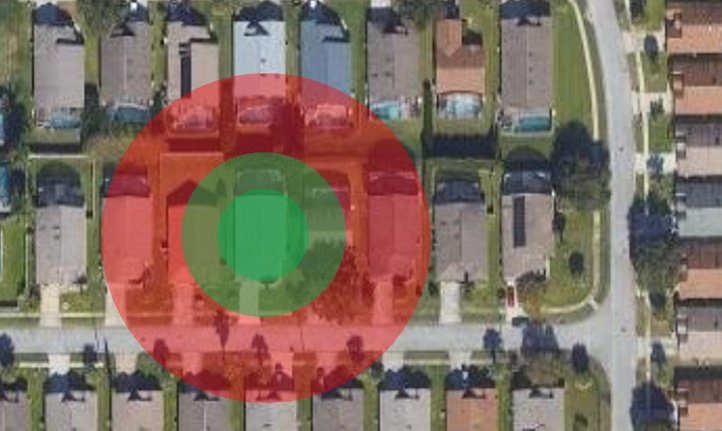
**Range:**It is true that the range/distance of 5 GHz is reducedin 'on paper' calculationsas compared to 2\.4 GHzaround 6 dB difference at same distance, but counterintuitively, that can be a significant benefit when it comes to actual throughput\. The problem with 2\.4 GHz is too much rangeinterference\-\- I always see the SSID of lots of neighborsred highlight right, and that is a very bad thing because it means that I am*sharing*spectrum and bandwidth with my neighborsor if not outright sharing a channel, increasing the 'noise floor' so your throughput suffers\. With 5 GHz the number of neighbor's networks I can see is dramatically reducedgreen highlight right\. Then, 5 GHz uses a much wider channel width80MHz vs 20MHzand with a "wave 2" 4×4 MIMO access point with beamforming, you will see*actual useable bandwidth greatly increased*\.> With 5 GHz, neighbors canoften timesbe on the same channel and typically not interfere with each othernearly as much as 2\.4 GHz, because with reduced range, neighbors can't see as many neighbors Wi\-Fi anymore\. Of course, all of this depends upon how 'close' your neighbors are\.Think about it\. Since 5 GHz band signals attenuate more quickly than 2\.4 GHz band signals, that can actually be a very good thing for your throughputwhen there is interference, because 'more attenuation' means that by the time a competing interfering signal reaches youas 'noise', that the signal will have less of an impact \-\- meaning a better SINR for you\.
**Protocol Overhead:**The Mbps seen at the application level will be around 60% to 80% of the Mbps at the Wi\-FiPHYlevel\. This is just due to Wi\-Fi protocol overhead\. See the chapter on[PHY client speed](https://www.wiisfi.com/#PHY)\[§4\]\.**FCC Channel Plan:**Here is the 5 GHz[802\.11 Channel Plan](https://apps.fcc.gov/kdb/GetAttachment.html?id=1K3EcgPRatUcWMwkA%2BuROw%3D%3D)\(fcc\.gov\) from the FCC itself, also seen below\. Of note is that on April 1, 2014 the FCC[changed the rules](https://www.fcc.gov/document/5-ghz-u-nii-ro)\(fcc\.gov\) for usage in the 5 GHz band, to increase availability of spectrum for Wi\-Fi use\.[Summary of the new rules](https://transition.fcc.gov/bureaus/oet/ea/presentations/files/oct14/51-New-Rules-for-UNII-Bands,-Oct-2014-TN.pdf)\(fcc\.gov\)\. Channel 144 was addedbut older 5GHz clients will not be aware of this, power levels for channels 52 to 64 were increased, and other miscellaneous changes\.
[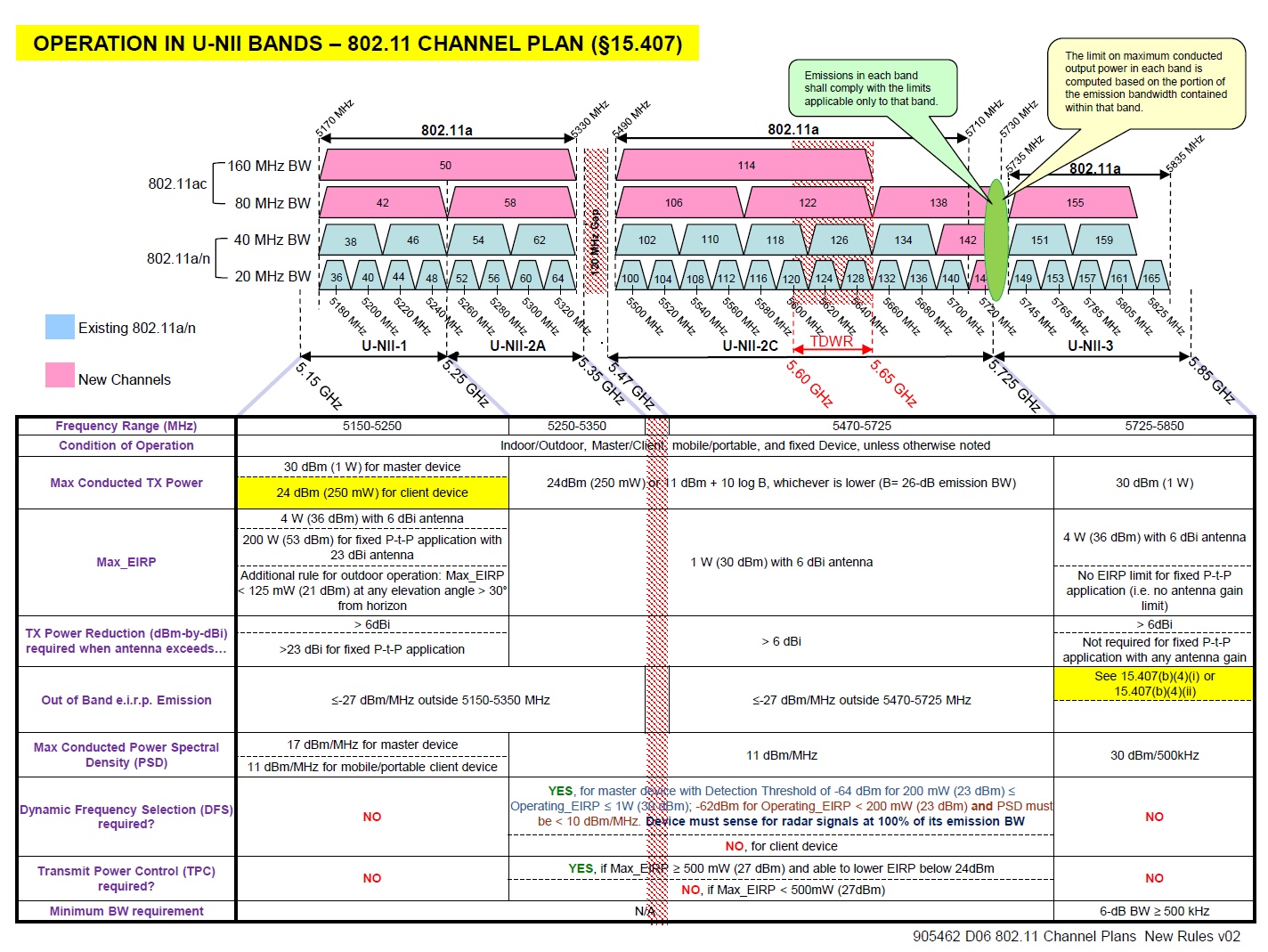](https://apps.fcc.gov/kdb/GetAttachment.html?id=1K3EcgPRatUcWMwkA%2BuROw%3D%3D)
**Helpful FCC reference documents:**Here are some helpful documents RE spectrum usage:- [802\.11 Channel Plans New Rules v02](https://apps.fcc.gov/kdb/GetAttachment.html?id=1K3EcgPRatUcWMwkA%2BuROw%3D%3D)\(fcc\.gov\) \- This is just the chart above
- [Code of Federal Regulations](https://www.ecfr.gov/current/title-47/chapter-I/subchapter-A/part-15/subpart-E/section-15.407)\(ecfr\.gov\) \- The actual Federal Code governing the Wi\-Fi spectrum
- [Straddle channels](https://transition.fcc.gov/oet/ea/presentations/files/may17/31-Part-15-Panel-UNII-UpdatesDT.pdf)\(fcc\.gov\) \- treatment of channels that straddle U\-NII bands
**Transmit Power:**Channels 149\-165 allow for both router/client to transmit at 1000 mW\. Channels 36\-48 allow for the router to transmit at 1000 mWand clients at 250 mW\. For all other DFS channels, both the router/client can transmit at 250 mW\. However, this does NOT necessarily mean that channels 149\-165 are the best channels to usebecause everyone wants to use them\. The 'reduced signal strength' for the other channels can actually be a huge advantage, because it means there is a much higher likelihood that you will NOT see neighbors Wi\-Fi channelsas frequently as 2\.4 GHz channels, which translates directly to less interferencethe channel is all yoursand higher Wi\-Fi speedsprovided you are close to a router/AP\.> Many residential routers have a transmit power around 995 mW\. Manybattery poweredWi\-Fi clients have a transmit power anywhere from 90 mW to 250 mW\.Client devices often transmit at power levels below the maximum power level permittedto conserve battery\.[More information](https://www.wiisfi.com/#range)\[§G\]
**802\.11acPHY Speeds \(Mbps\)**
**80 MHz**channel,**400ns**guard interval**Modulation \+ Coding****MIMO****1×1****2×2****3×3****4×4****8×8****0****BPSK****1/2**326597130260**1****QPSK****1/2**65130195260520**2****3/4**97195292390780**3****16‑QAM****1/2**1302603905201040**4****3/4**1953905857801560**5****64‑QAM****2/3**26052078010402080**6****3/4**29258587711702340**7****5/6**32565097513002600↕ typical real\-world Modulation/Coding at distance ↕**8****256‑QAM****3/4**390780117015603120**9****5/6**433866130017333466\-1024‑QAM3/4487975146219503900\-5/654110831625216643331024\-QAM is non\-standard**802\.11acPHY Speeds \(Mbps\)**
**80 MHz**channel,**800ns**guard interval**Modulation \+ Coding****MIMO****1×1****2×2****3×3****4×4****8×8****0****BPSK****1/2**295887117234**1****QPSK****1/2**58117175234468**2****3/4**87175263351702**3****16‑QAM****1/2**117234351468936**4****3/4**1753515267021404**5****64‑QAM****2/3**2344687029361872**6****3/4**26352678910532106**7****5/6**29258587711702340↕ typical real\-world Modulation/Coding at distance ↕**8****256‑QAM****3/4**351702105314042808**9****5/6**390780117015603120\-1024‑QAM3/4438877131617553510\-5/64879751462195039001024\-QAM is non\-standard
[More PHY speed tables](https://www.wiisfi.com/phy)
**Another big thing is beamforming / more antennas:**After playing around with a new 4×4 "wave 2" routeras compared to a 2×2 "wave 1" router, wow\! A very noticeable increase in speeds at range\. 802\.11ac beamforming really works\.> Your mileage will vary depending upon construction materials\. In one homesingle level; sheetrock with aluminum studs, I saw a dramatic increase in speeds at range\. But at an older second home with very thick brick walls, range improved just a little\.
**256\-QAM:**This modulation requires a very good SNRsignal to noise ratio, that is very hard to get with entry level routers\. With a consumer\-grade 802\.11ac 2×2 "wave 1" AP I never got 256\-QAM, even feet from the router\. However, with a much higher quality 802\.11ac 4×4 "wave 2" AP, I now regularly see 256\-QAM 3/4 being usedat 25ft, through two walls\.**1024\-QAM HYPE:**This modulation is a non\-standard extension to 802\.11ac, so most client devices will often never be able to get these speeds\. And even if you have a device that is capable of these speeds, are you close enough to the router to get these speeds? Understand that advertised speeds in these ranges are marketing hype\. See[Broadcom NitroQAM](https://web.archive.org/web/20191012060551/https://wikidevi.com/wiki/Broadcom_NitroQAM)\(archive\.org\)\.
**802\.11ac Wave 2:**The[next generation \(wave 2\)](https://www.wi-fi.org/news-events/newsroom/wi-fi-certified-ac-brings-new-advances-in-wi-fi-performance)\(wi\-fi\.org\) of 802\.11ac is already here\. With feature like: \(1\) four or more spatial streams, \(2\) DFS 5 GHz channel support, \(3\) 160 MHz channels, and \(4\) MU\-MIMO\.[Cisco Wave 2 FAQ](https://www.cisco.com/c/en/us/solutions/collateral/enterprise-networks/802-11ac-solution/q-and-a-c67-734152.html)\(cisco\.com\)\.
> Buyer beware: Not all 'wave 2' products will support the restrictive 5 GHz DFS channels\! Wi\-Fi certification for 'wave 2' only '[encourages](https://www.wi-fi.org/news-events/newsroom/wi-fi-certified-ac-brings-new-advances-in-wi-fi-performance)' \(wi\-fi\.org\) devices to support this \-\-*so NOT required\.***160 MHz channels:** Support for 160 MHz channels in some routers reduces MIMO support\.For example, in Netgear's R7800, there is 4×4 MIMO support for 80 MHz channels, but for 160 MHz channels, MIMO is reduced to 2×2\.**MU\-MIMO issues:**There are a lot of issues with MU\-MIMO\. So it may or may not work for you\. MU\-MIMO \(1\) sometimes[disables client MIMO](https://www.smallnetbuilder.com/wireless/wireless-features/33100-why-you-don-t-need-mu-mimo)\(smallnetbuilder\.com\) \(where a 2×2 client switches to 1×1; Broadcom chipset\) \(2\) requires[spatial diversity \(physical distance\)](https://web.archive.org/web/20190309162555/https://blog.aerohive.com/does-the-number-of-spatial-streams-in-802-11ax-really-matter/)\(archive\.org\) between clients \(3\)[has significant sounding overhead](https://www.youtube.com/watch?v=pHN2VEdWXgI)\(youtube\.com\) \(4\) a client device must be MU\-MIMO awaremany are not\(5\) only works with high SNRvery strong signalsand \(6\) works best with completely stationary clients\. For more details, read["A MU\-MIMO Reality Check"](https://www.networkcomputing.com/wireless-infrastructure/mu-mimo-reality-check)\(networkcomputing\.com\)\. Aruba Networks says*"Experience from 802\.11ac MU\-MIMO in real\-world deployments revealed some limitations"*\.[Source](https://www.arubanetworks.com/assets/wp/WP_802.11AX.pdf#page=14)\(arubanetworks\.com\)\.[More info](https://youtu.be/r_ERuoLBFoM?t=1264)\(youtube\.com\)\.
**Interference:**It is a lot less common to find devices that use the 5 GHz bandvs the 2\.4 GHz band, causing interference for Wi\-Fi,*but it is still possible*\. Just Google 'Panasonic 5\.8 GHz cordless phone' for a cordless phone that uses the upper 5 GHz channels 153 \- 165\.[FCC info on Panasonic phone](https://fccid.io/ACJ96NKX-TG6051)\(fccid\.io\)\.**Minimum Sensitivity \(dBM\) for each MCS:**Here is a graph of information that comes from the IEEE spec\. Keep in mind that these are minimums \-\- a vendor can spend the money to make their hardware better than this\. Also note that each time you double channel width, that there is a[3 dB 'penalty'](https://www.wiisfi.com/#channelwidthrange)\[§J\]:
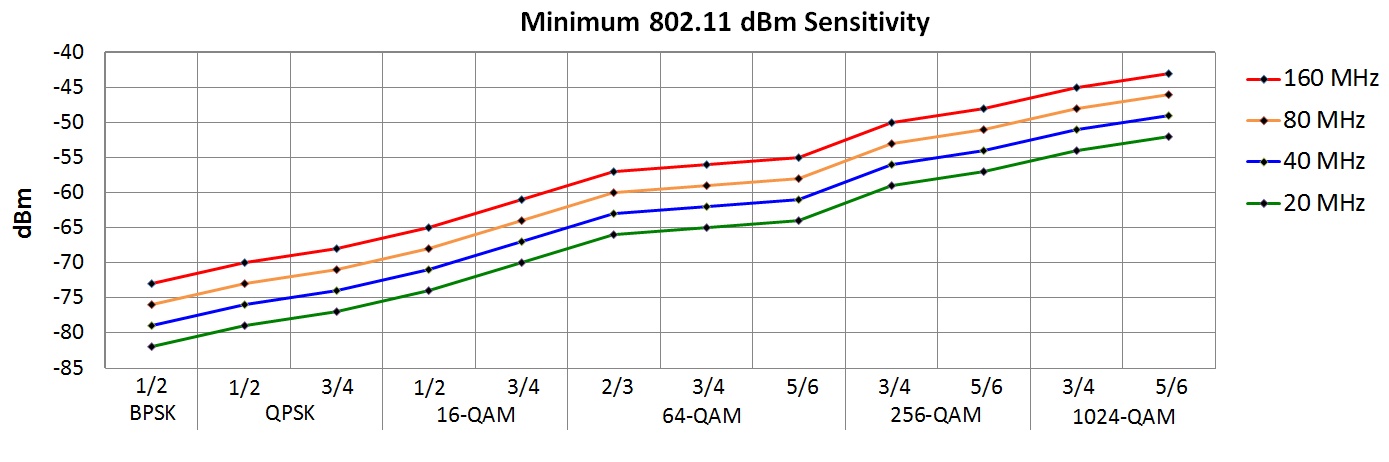
**A final warning and caveat regarding 802\.11n in 5 GHz:**I have glossed over the fact that 802\.11n can operate in the 5 GHz band, so DO NOT ASSUME that just because a device operates in 5 GHz that the device must be 802\.11ac\. That is NOT necessarily true\. For example, the Motorola E5 Playvery low endsmartphone does NOT support 802\.11ac, but does support dual\-band 802\.11n, so it connects to the 5 GHz band, but only using 20/40 MHz channelsin 1×1 mode, not the 80 MHz channels of 802\.11ac, and not using 256\-QAM\.> **Another example:**An older Dell laptop using[Centrino Advanced\-N 6230 dual\-band](https://ark.intel.com/content/www/us/en/ark/products/59472/intel-centrino-advanced-n-6230-dual-band.html)\(intel\.com\) Wi\-Fi\. The laptop 'sees' the 5 GHz SSID being broadcast from a 802\.11ac router, but when the laptop connects to the router, it is only doing so using 802\.11n, 2×2 MIMO, and 40 MHz channelsmax PHY of 300 Mbps; no 256\-QAM
PHY speed144\.4 Mbps
6\.0×
866\.6 Mbps
★**The PHY speed increases in Wi\-Fi 5 \(802\.11ac\):**Most Wi\-Fi 5 2×2 MIMO client devices saw a 6\.0× maximum PHY speed change from 144\.4 Mbps to 866\.6 Mbps, from:- 350% \- 144\.44 Mbps becomes 650 Mbps by increasing channel widths from 20 MHz to 80 MHz
- 33\.3% \- which then becomes 866\.6 Mbps via a new 256\-QAM modulation
- *not counting 160 MHz channels because support was rare in mostbatteryclient devices\.*
**VHT80 Throughput:**For an 866\.6 Mbps PHY2×2 MIMO client; 80 MHz channel, expect: \(1\)[throughput speed tests](https://www.wiisfi.com/#speedtest)\[§D\] to peak at 'around'**750 Mbps**when very close to the router, and \(2\) speeds to decrease quickly with distance and obstacles\.> VHT160: For a 1733\.3 Mbps PHY2×2 MIMO client; 160 MHz channel, expect: \(1\)[throughput speed tests](https://www.wiisfi.com/#speedtest)\[§D\] to peak at 'around' 1300 Mbps when very close to the router, and \(2\) speeds to decrease quickly with distance and obstacles\.
**Learn More:**- [O'Reilly '802\.11ac: A Survival Guide' by Matthew S\. Gast](http://euro.ecom.cmu.edu/resources/elibrary/auto/802dot11ac_A_Survival_Guide.pdf)\(cmu\.edu\) \-\- 154 page book
- [802\.11ac In\-Depth](https://www.arubanetworks.com/assets/wp/WP_80211acInDepth.pdf)\(arubanetworks\.com\)
- [Technical White Paper: "802\.11ac: The Fifth Generation of Wi\-Fi"](https://www.cisco.com/c/en/us/products/collateral/wireless/aironet-3600-series/white_paper_c11-713103.html)\(cisco\.com\)
- [802\.11ac](https://en.wikipedia.org/wiki/IEEE_802.11ac)\(wikipedia\.org\)
- [Clients List](https://clients.mikealbano.com/)\(mikealbano\.com\) \- lists common Wi\-Fi clients and the channels they support
- [United States Frequency Allocations Chart](https://www.ntia.doc.gov/files/ntia/publications/2003-allochrt.pdf)\(ntia\.doc\.gov\) \- Who is using what parts of the radio spectrum
- [Eero 160MHz over 5GHz FAQ regarding Apple devices](https://support.eero.com/hc/en-us/articles/4888632388123-160MHz-over-5GHz-FAQ)
- [802\.11ac and Wi\-Fi Radio Fundamentals](https://www.youtube.com/watch?v=5Ouf2oSbYN8)\(youtube\.com\)
- [Implicit Beamforming Technology](https://cdn-www.mediatek.com/page/iBF-Technology.pdf)\(mediatek\.com\)
11\. Wi\-Fi 6 \(802\.11ax\) 2\.4 GHz and 5 GHz \(HE: High Efficiency\)
★ The big advance in Wi\-Fi 6 was \(1\) efficiently transmitting to a large number of users at the same timevia OFDMA, but only for new Wi\-Fi 6 clients, not prior Wi\-Fi generation clientsand \(2\) 1024\-QAM modulation\.> ***NOTE:**160 MHz channel support in battery powered Wi\-Fi 6 client devices is MUCH more common than in Wi\-Fi 5 devices \-\- So while 160 MHz channels are NOT a new feature of Wi\-Fi 6, as a practical matter, Wi\-Fi 6 will be the first version of Wi\-Fi that regularly delivers on 160 MHz channels for client devices, and allows 1 Gbps throughput to be regularly achieved\.Also note that Wi\-Fi 6 means Wi\-Fi version six and does NOT mean Wi\-Fi in the 6 GHz spectrum \-\- Instead, Wi\-Fi 6E \(next section\) means Wi\-Fi in the 6 GHz spectrum\.*
*"The bottom line is until Wi\-Fi 6 / 802\.11ax clients reach critical mass,**the benefits of 11ax are minimal**and will have low impact\."*[Source](https://blogs.cisco.com/wireless/what-to-expect-when-expecting-802-11ax)\(cisco\.com\)\. The key reason why: Wi\-Fi 6 was designed from the ground up to provide speed improvementsHE: High Efficiencyto a group of Wi\-Fi 6 clients as a whole, NOT an individual Wi\-Fi 6 client\!
**Wi\-Fi 6:**The sixth generation of Wi\-Fi is 802\.11ax2019\. It provides a maximum PHY speed of 9\.6 Gbps on an 160 MHz channel using 8×8 MIMO\. There are many new features in Wi\-Fi 6 that are not backward compatible \-\-so you need Wi\-Fi 6 clients to take advantage of Wi\-Fi 6 features\.However, any Wi\-Fi 6 router will be able to revert back to Wi\-Fi 4/5 to support your older deviceswith NO speed advantage over Wi\-Fi 5\.> **Gen****Spec****Year****PHY Speeds****New Name**Sixth[802\.11ax](https://en.wikipedia.org/wiki/IEEE_802.11ax)[2019](https://www.cnx-software.com/2018/11/08/buy-802-11ax-wifi-6-routers/)600 to 4804 Mbps**Wi\-Fi 6**
**802\.11axPHY Speeds \(Mbps\)**
**80 MHz**channel,**800ns**guard interval**Modulation \+ Coding****MIMO****1×1****2×2****3×3****4×4****8×8****0****BPSK****1/2**3672108144288**1****QPSK****1/2**72144216288576**2****3/4**108216324432864**3****16‑QAM****1/2**1442884325761152**4****3/4**2164326488641729**5****64‑QAM****2/3**28857686411522305**6****3/4**32464897212972594**7****5/6**360720108014412882↕ typical real\-world Modulation/Coding at distance ↕**8****256‑QAM****3/4**432864129717293458**9****5/6**480960144119213843**10****1024‑QAM****3/4**5401080162121614323**11****5/6**6001200180124014803**802\.11axPHY Speeds \(Mbps\)**
**80 MHz**channel,**1600ns**guard interval**Modulation \+ Coding****MIMO****1×1****2×2****3×3****4×4****8×8****0****BPSK****1/2**3468102136272**1****QPSK****1/2**68136204272544**2****3/4**102204306408816**3****16‑QAM****1/2**1362724085441088**4****3/4**2044086128161633**5****64‑QAM****2/3**27254481610882177**6****3/4**30661291812252450**7****5/6**340680102013612722↕ typical real\-world Modulation/Coding at distance ↕**8****256‑QAM****3/4**408816122516333266**9****5/6**453907136118143629**10****1024‑QAM****3/4**5101020153120414083**11****5/6**5671134170122684537
[More PHY speed tables](https://www.wiisfi.com/phy)
**4804 Mbps speed:**The 4804 Mbps maximum PHY speed is for an 160 MHz channel to an 4×4 client\.However, a much more realistic*maximum*PHY speed is**1201 Mbps**for an 80 MHz channel to a 2×2 client \(840 Mbps throughput\),and for a realistic distance away from the router, a PHY speed of 864 Mbps600 Mbps throughput\.> 802\.11ax is called**"HE"**forHighEfficiency
**The goal of Wi\-Fi 6:**The primary goal of Wi\-Fi 6 is 'high efficiency'HE\. In a nutshell, Wi\-Fi 6 adds 'cellular'\-like multi\-user technology into Wi\-Fi\. This was accomplished by adding OFDMAchanging the Wi\-Fi protocol to directly support many users at once\. The result is greatly improvedoverallaggregatecapacity in highly 'dense'lot of devicesenvironmentslike schools, stadiums, convention centers, campuses, etc\.> **Multi\-user support is baked into OFDMA:**This is a critical concept to fully understand about Wi\-Fi 6\. In Wi\-Fi 5, 'multi\-user' was accomplished via MU\-MIMO using multiple antennas\. HOWEVER, in Wi\-Fi 6, there is a SECONDand now primary'multi\-user' method 'baked' into the protocols called MU\-OFDMA\.[Don't confuse MU\-OFDMA with MU\-MIMO\!](https://web.archive.org/web/20190627035145/https://blog.aerohive.com/what-does-multi-user-mu-mean/)\(archive\.org\) Also, see this interesting[MU\-OFDMA vs MU\-MIMO](https://web.archive.org/web/20190627035023/https://blog.aerohive.com/what-benefits-does-dual-5-ghz-bring-to-802-11ax/)\(archive\.org\) article\.Video:["Dissecting OFDMA"](https://www.youtube.com/watch?v=JC3tX0huMtA)\(youtube\.com\) \-\- a really good overview of what OFDMA is\.
**MU\-OFDMA \(Multi\-User OFDMA\)**: The 'efficiency' gains in 802\.11ax primarily come from using OFDMA in 'dense'lots of usersenvironments \-\- breaking up a channel into smaller Resource UnitsRU\-\- where each RU ispotentiallyfor a different user\. There are up to 9 users per 20 MHz channelso up to 36 users per 80 MHz channel\.So, 802\.11ax has high efficiency multi\-user transmission built into the protocol, meaning that the user must be 'Wi\-Fi 6' to take advantage of this\.Capacity to a large number of users at onceas a wholeshould increase\.> This multi\-user support is a big deal, and will greatly improve Wi\-Fi for all \-\- but it may be a while before most of your clients are Wi\-Fi 6 capable\.
**But what about peak speed to ONE user:**Please note that'peak' speed for one user using the entire channel*at distance*changes very little \(around 11% improvement over 802\.11ac with 80 MHz channel\)\.So, if you are looking for much higher Mbps download speedsbenefiting just one user, 802\.11ax is not, on paper, the solutioneg: PHY speed at 256\-QAM 3/4 in 802\.11ac of 780 Mbps changes to 864 Mbps in 802\.11ax\. Instead, find a way to increase the MIMO levelor channel widthof the one user\.> The goal of every prior version of Wi\-Fi was dramatically increasing 'peak' speedsfor one user\. And by looking at Wi\-Fi generation Mbps speeds, you can see this: 2 \-\> 11 \-\> 54 \-\> 217 \-\> 1733 \-\> 2401, except for the last jump, which is Wi\-Fi 6\. Instead, by changing to MU\-OFDMA in Wi\-Fi 6, there will be dramaticoverallcapacity gains to a dense set of usersas a whole, but only whenallclients fully support Wi\-Fi 6\.
**Keep all of the marketing hype in perspective:***In order to take advantage of Wi\-Fi 6 improvements, you need client devices that support Wi\-Fi 6 and you must be very close to the router\.*Until this happens, Wi\-Fi 5 will do just fine in most homes\. Most of the speed advances in 802\.11axMU\-OFDMAwill NOT materialize until ALL client devices are 802\.11ax, which will take a LONG time\. So an 802\.11ax AP used today will actually be operating inrevert back to802\.11acWi\-Fi 5mode for many clients\.
**1024\-QAM:**This higher order QAM is now officially part of the standard,but you will need to be very close to the router/AP to actually obtain this QAM\.Also, this modulation can only be used when a client is using an entire 20\-MHzor widerchannel \-\- so NOT available for small RU's\. In order to achieve 1024\-QAM, you will need an excellent signalbe very close to the router\. Note that each time you double channel width, that there is a[3 dB 'penalty'](https://www.wiisfi.com/#channelwidthrange):
**Channels:**The channels in Wi\-Fi 6 are exactly the same as the available channels in Wi\-Fi 4 and Wi\-Fi 5\. However, since there is so much more spectrum in 5 GHz than 2\.4 GHz, what matters the most for Wi\-Fi 6 are the available channels in 5 GHz\.**Channel Width:**Unlike 802\.11ac, which required clients to support 80 MHz channels, 802\.11ax permits 20 MHz channel only clients\. This was done to better support low\-throughput low\-power IoT deviceseg: those devices powered by batterythat would take a range/power hit using wider channel widths\.
**160 MHz Channel WARNING:**There are currently only two 160 MHz channels in the 5 GHz band, and they both intersect with DFS channels\. 160 MHz channels MAY be used, but the router, upon sensing a DFS conflict, may automatically revert the router back to a non\-DFS 80 MHz channel\.
> NOTE: Support for 160 MHz channels in some routers reduces MIMO support\.For example, in Netgear's RAX120, there is 8×8 MIMO support for 80 MHz channels, but only 4×4 MIMO support for 80\+80 channels\.
**Bands:**Technically, 802\.11ax does also operate in 2\.4 GHz, but since there are NO 80 MHz channel there, most peopleespecially home installationswill stay in 5 GHz\. It has been said that 802\.11ax is in 2\.4 GHz mainly for the benefit of IoT device support, but it remains to be seen if that will happen at all \-\- as most low power IoT devices stuck with Wi\-Fi 4 and never even implemented Wi\-Fi 5\.> **6 GHz spectrum:**The FCC opened up the 6 GHz and for Wi\-Fibut this requires new hardware\. See[Wi\-Fi 6E](https://www.wiisfi.com/#wifi6e)\[§12\] in the next chapter\. This will make 160 MHz channels commonplace\.
**WPA3:**For a device to be Wi\-Fi 6 'certified', it was[announced](https://www.wi-fi.org/news-events/newsroom/wi-fi-certified-6-delivers-new-wi-fi-era)\(wi\-fi\.org\) that WPA3 support is a mandatory feature of Wi\-Fi 6 \-\-*so anything labeled as supporting Wi\-Fi 6 must also support WPA3*\.**TWT:**Target Wake TimeTWTis new feature that is supposed to improve battery life for IoT devices by better scheduling a time in the future when the device needs to wake up\. However, a warning: some people are having issues with TWT and are forced to turn TWT off to get their devices to work\. It seems this feature will take time to mature and work properly\.
**Works better outdoors:**802\.11ax changed symbol timingsfrom 3\.2µs to 12\.8µs; and increased GI times, which allows for Wi\-Fi to operate much better in outdoor environments, where signal reflections take more time and can potentially cause major problems\. The increased timingssymbols\+GIaccount for these reflections\. This needs research to verify the impact\.
**Symbols/sec:**802\.11ax uses either 17,205,882 symbols/sec800ns short GI, or 16,250,000 symbols/sec1600ns medium GI, or 14,625,000 symbols/sec3200ns long GI, for a 20 MHz channel\.
**HERE COMES THE HYPE:**Manufacturers are touting incredible speed claims regarding 802\.11axexample seen immediately below\. However, we know that an 802\.11ac 2×2 client at 256\-QAM 3/4 has a PHY speed of 780see table above chapter\. And with 802\.11axand everything else the same \-\- like same distance from router, then PHY speed is 864see table immediately above\. YES, that is better by a little11%, but not nearly as much as you are led to believe\.
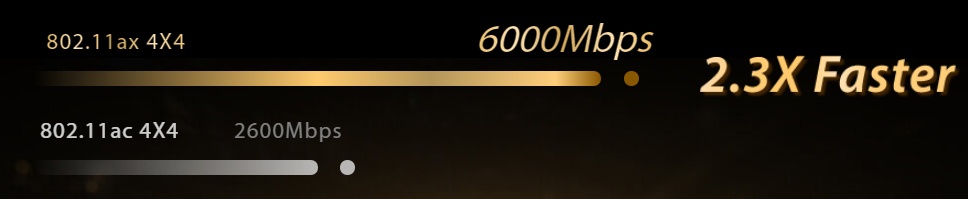
Very deceptive router manufacturer speed comparison
The above "2\.3X" above is comparing 'apples to oranges' \-\- different channel widths and different modulation\+coding, and combining the total of two bands2\.4 GHz and 5 Ghz\. When you compare 'apples to apples'the raw PHY speed advantage of 802\.11ax over 802\.11ac is 38%, and 'at distance' only 11%\.> **Analogy:**It should be painfully obvious by now that router manufacturers are selling you on hype\. They are selling you on a 'dragstrip'the router, where you can 'legally' go '1000 mph' \-\- and that sounds fantastic, so you buy the dragstriprouter\. But then you step back and realize that \(1\) all the vehiclesWi\-Fi devicesyou own don't go over 120 mph, \(2\) you can buy faster cars but they are not legal for youdesktops have faster Wi\-Fi than smartphones, and \(3\) 1000 mph was obtained by adding the speeds of multiple dragstrip lanes togetheraggregating multiple Wi\-Fi bands\.
**Is an upgrade from Wi\-Fi 5 to Wi\-Fi 6 worth it?**The conventional wisdom is that Wi\-Fi 6 offers very little advantage over Wi\-Fi 5\. And technically, that is 100% true 'on paper' for client devices 'at distance' that only use 80 MHz channels\.> *"The bottom line is until Wi\-Fi 6 / 802\.11ax clients reach critical mass, the benefits of 11ax are minimal and will have low impact"*\.[Source](https://blogs.cisco.com/wireless/what-to-expect-when-expecting-802-11ax)\(cisco\.com\)\.*"For \[most enterprise customers\], we recommend installing 802\.11ac wave 2 access points today, because of the sheer value of 802\.11ac wave 2"*\.[Source](https://www.cisco.com/c/dam/en/us/products/collateral/wireless/white-paper-c11-740788.pdf)\(cisco\.com\)\. [Consumer Reports concludes](https://www.consumerreports.org/wireless-routers/wifi-6-router-is-it-time-to-buy/)\(consumerreports\.org\) that*"there is very little point in buying a new Wi\-Fi 6 router, especially if your smartphone, TV, laptop, etc\. only support Wi\-Fi 5"*\.
*However*, for whatever reason, support for 160 MHz channels in Wi\-Fi 6 in client devices is now very commonin Wi\-Fi 5, it was rare, which means that actually regularly obtaining 1 Gbps throughput in the 5 GHz band is now much more likely\.So technically, while 160 MHz channel support arrived in Wi\-Fi 5, realistically, support for 160 MHz channels in most client devices was delivered in Wi\-Fi 6, which then can make a switch to Wi\-Fi 6 very worth it\.> Also, if your client device is in the same room as a Wi\-Fi 6 wireless routerso not 'at distance', you may see a modest speed boost using Wi\-Fi 6 over Wi\-Fi 5, as higher MCS/QAM levels are used\.
Regardless of what I and others say, be informed with the factsand not hypeand make your ownfully educatedupgrade decisions\. Look at your PHY speed before and after a router upgrade and decide for yourself if the change was worth it\.★ ★ ★**UPDATE March 2022: When Wi\-Fi 6 CAN deliver the goods to a single client:**If you have a brand new Wi\-Fi 6 client device and a brand new Wi\-Fi 6 router supporting DFS channels, and are using both*in the same roomso both devices are very close to each other*there is a high likelihood that the two devices will negotiate an initial 160 MHz channel widthWindows laptops and Android; not iOS\. Throughput can be as high as 80% of the 2402 Mbps PHY speedor around 1900 Mbps\-\- which is very nice\! However, this only happens when the client device and router are very close to each otherin my testing, four feet awayand only if 1024\-QAM can actually be used\-\- and once you start adding distance or walls, the two Wi\-Fi 6 devices will 'slow down' significantlyuse lower QAM levelsand communicate with each other at much closer to Wi\-Fi 5 speeds\.> Warning: For Apple, only[iPhone 15 Pro](https://support.apple.com/guide/deployment/wi-fi-ethernet-specifications-apple-devices-dep268652e6c/web)\(apple\.com\) class devices and later support HE160 in Wi\-Fi 6\.**WARNING:**Pay close attention to PHY speeds, because the ability to successfully use QAM\-1024or notwill impact throughput results, which is mostly 'out of your control'just the RF environment at your location\.
PHY speed866\.6 Mbps
2\.8×
2402 Mbps
★**The PHY speed increases in Wi\-Fi 6 \(802\.11ax\):**Most Wi\-Fi 6 2×2 MIMO client devices,*newly supporting 160 MHz channels*, saw a 2\.8× maximum PHY speed change from 866\.6 Mbps to 2402 Mbps, from:- 11% \- 866\.6 Mbps in 802\.11ac becomes 960\.8 Mbps by improving both \(a\) number of subcarriers and and \(b\) symbol timing/duration\.
- 25% \- which then becomes 1201 Mbps via a new 1024\-QAM modulation,
- 100% \- which then becomes 2402 Mbps by using a 160 MHz channel widthinstead of 80 MHz,*but this requires a router with DFS channel support*\.
**HE160 Throughput:**For a 2400 Mbps PHY2×2 MIMO client; 160 MHz channel, expect: \(1\)[throughput speed tests](https://www.wiisfi.com/#speedtest)\[§D\] to peak at 'around'**1900 Mbps**when very close to the router, and \(2\) speeds to decrease quickly with distance and obstacles\.> *This comes with the huge caveat that 160 MHz channels are actually usable for you in 5 GHz \(that there are no DFS channel conflicts\)\.Technically, the increase from 160 MHz channels belongs under Wi\-Fi 5, but I am now moving that here under Wi\-Fi 6 \(as of December 2023\) \-\- because these 'speed increase' sections are for what most 2×2 client devices experience\. Support for 160 MHz channels in Wi\-Fi 5 for battery powered client devices was rare\. But now in Wi\-Fi 6, support is very common \(for Apple, only[iPhone 15 Pro](https://support.apple.com/guide/deployment/wi-fi-ethernet-specifications-apple-devices-dep268652e6c/web)\(apple\.com\) and later\)\.*
---
PHY speed866\.6 Mbps
1\.4×
1201 Mbps
Most Wi\-Fi 6 2×2 MIMO client devices,*still only supporting 80 MHz channels \(eg: Apple in devices before[iPhone 15 Pro](https://support.apple.com/guide/deployment/wi-fi-ethernet-specifications-apple-devices-dep268652e6c/web)\(apple\.com\)\)*, only saw a modest 1\.4× maximum PHY speed change from 866\.6 Mbps to 1201 Mbps\. What a mess \-\- speeds in Wi\-Fi depend heavily upon client device capabilities\.**HE80 Throughput:**For an 1201 Mbps PHY2×2 MIMO client; 80 MHz channel, expect: \(1\)[throughput speed tests](https://www.wiisfi.com/#speedtest)\[§D\] to peak at 'around'**1000 Mbps**when very close to the router, and \(2\) speeds to decrease quickly with distance and obstacles\.
**Learn More:**- [802\.11ax High Level Overview](https://youtu.be/9PcRwuto_1Q)\(youtube\.com\) \-\- Video by Ruckus
- [White paper on 802\.11ax](https://www.arubanetworks.com/assets/wp/WP_802.11AX.pdf)\(arubanetworks\.com\)
- [Technical White Paper: "802\.11ax: The Sixth Generation of Wi\-Fi"](https://www.cisco.com/c/dam/en/us/products/collateral/wireless/white-paper-c11-740788.pdf)\(cisco\.com\)
- [White Paper: IEEE 802\.11ax, The Sixth Generation of Wi\-Fi](https://docs.broadcom.com/docs/80211ax-WP)\(broadcom\.com\)
- [Dual\-Band 11AX](http://www.quantenna.com/wp-content/uploads/2018/01/WP-Dual-Band-11ax.pdf)\(quantenna\.com\)
- [802\.11ax](https://en.wikipedia.org/wiki/IEEE_802.11ax)\(wikipedia\.org\)
- [802\.11ax Resource Units](https://en.wikipedia.org/wiki/Resource_Unit)\(wikipedia\.org\)
- [What is 802\.11ax Wi\-Fi](https://www.ruckusnetworks.com/solutions/80211ax)\(ruckusnetworks\.com\)
- [High Efficiency Wi\-Fi\- 802\.11ax \- WLPC US Phoenix 2017](https://youtu.be/r_ERuoLBFoM)\(youtube\.com\)
- [10 things you need to know about MU\-MIMO Wi\-Fi](https://www.wifisurveyors.com/wifi-mu-mimo)\(wifisurveyors\.com\)
- [Wi\-Fi 6 release 2 adds new features](https://www.wi-fi.org/news-events/newsroom/wi-fi-certified-6-release-2-adds-new-features-for-advanced-wi-fi-applications)\(wi\-fi\.org\) \-\- uplink MU\-MIMO is the big new addition
12\. Wi\-Fi 6E \-\- Wi\-Fi 6
Extended into the 6 GHz band
★ The big advance in Wi\-Fi 6E is a TON more spectrum/channelsthe entire 6 GHz spectrum\-\- adding 14 new 80\-MHz channels\! Thiswill make 160 MHz channels actually usable and very commonplace\.> *The best 6 GHz band use case is for client devices that are close toeg: in the same room asan access point \-\- expect excellent PHY speeds and throughput\.Also, expect most devices to restrict 6 GHz band usage to "indoor use only"no outdoor support\.*

**Wi\-Fi 6E:**Wi\-Fi 6EHigh Efficiency Wi\-Fi 6Extendedinto the 6 GHz bandhas the potential to be a game changer\. It adds 1200 MHz5925 MHz \- 7125 MHzof new spectrum to Wi\-Fi\. So, to be clear, Wi\-Fi 6E is NOT a new version of Wi\-Fi protocols, but rather it only moves existing Wi\-Fi 6802\.11axinto a very large section of new spectrum\.> Wi\-Fi 6 in the 5 GHz band DOES have 160 MHz channels, but usage is not guaranteed since 160 MHz channels overlap with DFS channels\. Meaning that you can attempt to use the channels, but that the router may detect a DFS conflict and automatically revert back to a non\-DFS 80 MHz channel\.There is only 560 MHz of spectrum currently available to Wi\-Fi in 5 GHzand only 70 MHz in 2\.4 GHz\. So adding an additional 1200 MHz in 6 GHz is a very welcome and significant jump in spectrum\. Warning: For Apple, only[iPhone 15 Pro](https://support.apple.com/guide/deployment/wi-fi-ethernet-specifications-apple-devices-dep268652e6c/web)\(apple\.com\) class devices and later support HE160 in Wi\-Fi 6\.
**Wi\-Fi 6E spectrum****GHz****MHz****Name****AFC?**5\.925\-6\.425500U\-NII\-5**YES**6\.425\-6\.525100U\-NII\-6no6\.525\-6\.875350U\-NII\-7**YES**6\.875\-7\.125250U\-NII\-8no
**The big deal:**TONS of new spectrum\! The additional spectrum allows for 14 additional 80 MHz channelsor seven additional 160\-MHz channelsin Wi\-Fi, which means the chances of sharing spectrum with another device/neighbor will be greatly reduced\. You should then have your own 160 MHz channel all to yourself, potentially doubling throughputvs an 80 MHz channel\.> Many entry\-level Wi\-Fi 5 routerswith no DFS supportonly support 180 MHz of spectrum\. But I expect entry\-level Wi\-Fi 6E routerswith no AFC supportto support all 1200 MHz of spectrum\.Also of note is that Wi\-Fi currently has no 160 MHz channel that is not subject to DFS restrictions, meaning that currently, actually being able to use a 160 MHz channel today in 5 GHz is hit or miss\. This new spectrum shouldhopefullymake it much easier to find and actually use*multiple*160 MHz channels\.
**The gotcha:**New hardwarerouters/clientswill be required\. Current Wi\-Fi 6 devices don't support Wi\-Fi 6E\!**Two power modes:**Wi\-Fi 6E routers have two different power modes\. "Low\-power" mode and "Normal\-power" mode\.
> Expect most routers to only support "Low\-power" modefor now\.
6 GHz Wi\-Fi channels \(U\.S\.\)**Channel \#****20 MHz center****20 MHz channel****320****160****80****40****20**311573159555945\-5965**5**59755965\-598511959955985\-60051360156005\-602523191760356025\-6045**21**60556045\-6065272560756065\-60852960956085\-61054739353361156105\-6125**37**61356125\-6145434161556145\-61654561756165\-618555514961956185\-6205**53**62156205\-6225595762356225\-62456162556245\-6265957971676562756265\-6285**69**62956285\-6305757363156305\-63257763356325\-634587838163556345\-6365**85**63756365\-6385918963956385\-64059364156405\-6425111103999764356425\-644510164556445\-646510710564756465\-648510964956485\-650511911511365156505\-6525**117**65356525\-654512312165556545\-656512565756565\-658515914313513112965956585\-6605**133**66156605\-662513913766356625\-664514166556645\-666515114714566756665\-6685**149**66956685\-670515515367156705\-672515767356725\-674517516716316167556745\-6765**165**67756765\-678517116967956785\-680517368156805\-682518317917768356825\-6845**181**68556845\-686518718568756865\-688518968956885\-690520719919519369156905\-6925**197**69356925\-694520320169556945\-696520569756965\-698521521120969956985\-7005**213**70157005\-702521921770357025\-704522170557045\-706522722570757065\-7085**229**70957085\-710523371157105\-7125More info from[Wikipedia](https://en.wikipedia.org/wiki/List_of_WLAN_channels)and[here](https://www.litepoint.com/blog/wi-fi-6e-standard-and-channels/)
**Low\-power mode:**In 'low\-power' mode, access points are permitted to use the entire 1200 MHz of spectrum with no AFC restrictions, but range is less, and use is restricted toINDOOR USE ONLY\.> Wi\-Fi 6E access points*in low\-power mode*are permitted to operate at 24 dBm EIRP6 dB BELOW 5 GHz DFS power levels, and Wi\-Fi 6E clients at 18 dBm EIRP6 dB BELOW that of the AP\. Many Wi\-Fi 5 clients today already operate 'around' this power level, so Wi\-Fi 6E range will be affected by the slightly higher operating frequencies, and the 6 dB power differencebelow DFS\.A change in Wi\-Fi 6E, for the 6 GHz spectrum, is that clients will now operate at a constant 5 dBM/MHz PSDPower Spectral Density\.
**Normal\-power mode:**In normal power mode, access points are only permitted to use 850 MHz of spectrumsee table upper right, but are required to use something called AFCsee below, which requires the access point to report its geo locationGPS, as well as serial number to a centralized database\.It remains to be seen if customers will accept this 'invasion of privacy'\.> Wi\-Fi 6E access points*in normal\-power mode*are permitted to operate at 36 dBm EIRPthe same power levels of 5 GHz U\-NII\-1 power levels, and Wi\-Fi 6E clients at 30 dBm EIRP6 dB BELOW that of the AP\. Most Wi\-Fi 5 devices already operate below these levels, so Wi\-Fi 6E range will be affected only by the slightly higher operating frequencies\.
**Automated Frequency Coordination \(AFC\):**The[FCC docs](https://docs.fcc.gov/public/attachments/DOC-354364A1.pdf)\(fcc\.gov\) extensively discuss an 'Automated Frequency Coordination'AFCsystem to avoid conflicts between existing licensed usepoint to point microwaveand new unlicensed devicesaccess points\. It appears that the[FCC has settled](https://www.govinfo.gov/content/pkg/FR-2020-05-26/pdf/2020-11236.pdf)\(govinfo\.gov\) \(May 26, 2020\) on a centralized AFC system whereby an access point must contact the AFC*"to obtain a list of available frequency ranges in which it is permitted to operate and the maximum permissible power in each frequency range"*\. But in order for this to work properly, the access point MUST report its geo\-locationeg: GPS location, as well as antenna height above the ground, to the centralized AFC system\. The FCC will also require the 'FCC ID' of the access point, as well as the serial number of the access point\.> **Privacy mitigating factors:**An access point can operate in 'low power mode' and then NOT be subject to AFCbut then signal range WILL sufferOR, the access point can reduce the GPS quality and then report a larger general 'area' to the AFC instead of an exact locationbut then frequencies and power levels that can be used might be reduced\.
**PSC \(Preferred Scanning Channels\):**Because there are so many channels in 6 GHz, some channels are designed as PSC or "Preferred Scanning Channels", that are designed to 'speed up' client devices discovering Access Points\. They full list of PSC channels are 5, 21, 37, 53, 69, 85, 101, 117, 133, 149, 165, 181, 197, 213, and 229\. PSC channels are 80 MHz apart\.**A major concern: Range:**A major concern is what range will be for Wi\-Fi 6E devices\. Based upon raw specifications, range will be reduced over what is possible in 5 GHz\.
> In some of my speed testing 'at distance', 5 GHz channels are providing much better real Mbps throughput than 6 GHz channels\. This needs more research\.
**Another concern: the spectrum is already heavily used:**The 6 GHz spectrum that the FCC wants to open upfor unlicensed Wi\-Fi useis already being*"heavily used by point\-to\-point microwave links and some fixed satellite systems"*by existing licensed services\.[Source](https://docs.fcc.gov/public/attachments/DOC-354364A1.pdf)\(fcc\.gov\)\. So, it remains to be seen how many channels can actually be used in real\-life with AFC for normal\-power devices\.> **Incumbent Services:**The FCC did not just have 1200 MHz of spectrum laying around unused\. Instead, this spectrum is already heavily used by 'incumbent services', such as:1. Fixed Microwave Services \(FS\): You have probably seen these towers around with a 'dish' pointed in a fixedhorizontaldirection\. Just Google[microwave tower](https://www.google.com/search?q=microwave+tower)\(google\.com\)\. 2. Fixed Satellite Services \(FSS\): Ground to satellite communicationand vice\-versa\. 3. Radio Astronomy: The study of celestial objects at radio frequencies\. 4. Other miscellaneous services: Mobile services, etc\. Interesting:[Video showing FS usage in the US](https://youtu.be/knFsQAoIw1I?t=1397)\(youtube\.com\)
So how well Wi\-Fi 6E actually works for you will literally depend upon your physical locationand if there are any nearby incumbent services\.**Best use case:**The first wave of Wi\-Fi 6E devices are operating in only 'low\-power' modeas no AFC is required and the entire 1200 MHz can be used; but restricted to indoor use only, but range will be reduced\. When combined with effective range decreasing with channel width, the best use case for Wi\-Fi 6E 160 MHz channels is between two devices in the same room\.
> The thinking is that with Wi\-Fi 6E and 160 MHz channels, a 2 Gbps PHY connection with*reliable*1 Gbps actual throughput becomes commonplaceinstead of hit or misswhen are you in the same room as the access point \-\- with only a 2×2 MIMO client device\.
**Interesting observations**about Wi\-Fi 6E[from this FCC doc](https://www.govinfo.gov/content/pkg/FR-2020-05-26/pdf/2020-11236.pdf)\(govinfo\.gov\):- Low\-power access points can use the entire 1200 MHz spectrum, but use is restricted toindoor use only, and range will be limited\. These low\-power devices can not be weather resistant,must have permanently attached integrated antennas, can not be battery powered, and must be labeled "for indoor use only"\.
- Normal\-power access points can be used outdoors, but must use AFC, and are restricted to using U\-NII\-5 or U\-NII\-7\.
- *Client devices are prohibited from being used as a mobile hotspot\.*
- Access points are prohibited in moving vehicles such as cars, trains, ships, or small aircraftbut with an exception for large passenger aircraft operating over 10,000 feet, but may only use U\-NII\-5\.
- Access points are prohibited on ships and oil platforms\.
- Use is prohibited on unmanned aircraft systems\.
- Devices using AFC must report geo\-location, geo\-location accuracy, antenna height above ground, device FCC ID, and device serial number to a centralized AFC database, which then returns frequencies and power levels that may be used\. The device must contact the AFC database at least once per dayfailure means stop working; with one day grace period
- Assumes that there will be 17 dB in signal loss when a 6 GHz signal from an indoor access point travels outside through a building's walls\.
- Sets a maximum channel width of 320 MHz\.
- Client devices are prohibited from transmitting anything until the device hears something from an access pointso no probe requests\.
- Client devices must operate at 6 dB*below*the power level of the access point power level\.
- An underlying AFC presumption is that access points are at a fixed locationnot mobile nor moving around\.
**Well, that was fast:**Wi\-Fi 6E was[announced](https://www.wi-fi.org/news-events/newsroom/wi-fi-alliance-brings-wi-fi-6-into-6-ghz)\(wi\-fi\.org\) on January 3, 2020\. Days later, Broadcom[announced chipsets](https://investors.broadcom.com/node/52836/pdf)\(broadcom\.com\) supporting Wi\-Fi 6E in 6 GHz\. Then on April 24, 2020, the[FCC moved forward](https://docs.fcc.gov/public/attachments/FCC-20-51A1.pdf)\(fcc\.gov\) in supporting this\.[Summary](https://docs.fcc.gov/public/attachments/FCC-20-51A2.pdf)\(fcc\.gov\)\. First Wi\-Fi 6E routers started shipping in 2021[Source](https://dongknows.com/netgear-nighthawk-raxe500-wi-fi-6e-router-review/)\(dongknows\.com\)\. Today, all new high\-end client devicesphones, laptops, etcfully support Wi\-Fi 6E\.PHY speed2402 Mbps
0×
2402 Mbps
★**The PHY speed increases in Wi\-Fi 6E:**There is technically NO speed increase in Wi\-Fi 6E over Wi\-Fi 6\. However, Wi\-Fi 6E will make 160 MHz channels much more commonplace for 2×2 MIMO client devices\.> However, if you did not see the 2× speed changefrom 80 MHz to 160 MHz channelsin Wi\-Fi 6, you should hopefully now see that speed increase with Wi\-Fi 6Ebut only when using the 6 GHz band\.
**Throughput:**Same as[Wi\-Fi 6](https://www.wiisfi.com/#wifi6)\[§11\]\. However, expect speeds to be impacted even more by 'distance from router'\. Wi\-Fi 6E excels when you are very close to the router\. But, when not, you will likely see better throughput using Wi\-Fi 5/6 in the 5 GHz band\.
**Learning More:**- [FCC Opens 6 GHz Band to Wi\-Fi and Other Unlicensed Uses](https://www.fcc.gov/document/fcc-opens-6-ghz-band-wi-fi-and-other-unlicensed-uses-0)\(fcc\.gov\)
- [FCC Technical Report and Order 20\-51](https://docs.fcc.gov/public/attachments/FCC-20-51A1.pdf)\(fcc\.gov\)
- [Power Spectral Density and Wi\-Fi 6E](https://blogs.juniper.net/en-us/industry-solutions-and-trends/power-spectral-density)\(juniper\.net\)
13\. Wi\-Fi 7 \-\- 802\.11be \(EHT: Extremely High Throughput\)
**BEWARE ALL WI\-FI 7 ROUTERS:**Watch this[very informative YouTube video](https://www.youtube.com/watch?v=-5o_Qu3XToQ)\(youtube\.com\) that all Wi\-Fi 7 routers today are not delivering the MLO that you are expecting\!

There are Wi\-Fi 7 routers for sale on Amazon, right now, and phone/tablets are starting to support Wi\-Fi 7\.**BUT, just be patient**, because it will take time for Wi\-Fi 7 implementations to mature, become stable, and actually implement all Wi\-Fi 7 features, because some routers being sold today:- promise to implement MLO in a future firmware version
- state*"This router may not support all the mandatory features as ratified in the IEEE 802\.11be specification"*
So frankly, buyer beware\!*Often times, first generation devices have some limitations and "wave2" second generation devices fully implements the spec*\.> **Gen****Spec****Year****PHY Speeds****New Name**Seventh[802\.11be](https://en.wikipedia.org/wiki/IEEE_802.11be)[2023](https://www.tomshardware.com/news/wi-fi-7-faq)≈4800 Mbps**Wi\-Fi 7**
★ The big changes in Wi\-Fi 7 are:- 320 MHz channels, either contiguous320 MHzor non\-contiguous160\+160 MHz
- 240 MHz channels, either contiguous240 MHzor non\-contiguous160\+80 MHz
- allows 16×16 MIMO / spatial streamsvs prior 8×8 limit\-\-but only expect 2×2 in virtually all client devices, and 4×4 in most mid to higher end routers
- 4096\-QAM modulationvs prior 1024\-QAM\-\-*but it is uncertain if 4096\-QAM can ever be reliably obtained in the real world*maybe only in 'the lab', or maybe in the next generation of devices
- Multi\-Link Operation, or MLO, uses multiple bands/channels at the SAME time \-\- for example using 2\.4 GHz, 5 GHz, and 6 GHz all concurrently\. However, according to[this article](https://dongknows.com/wi-fi-7-mlo-multi-link-operation-explained/)\(dongknows\.com\), real\-world MLO client tests are very disappointingtests show that speed in MLO is limited to the maximum speed of the single fastest individual band\.
- Preamble Puncturing \- if part of a 'wide' channel is being used by an old legacy client device, the rest of the channel can still be used by a modern Wi\-Fi device
- plus other potential new features
> 802\.11be is called**"EHT"**forExtremelyHighThroughput
TP\-Link has a[nice web page](https://www.tp-link.com/us/wifi7/#:~:text=How%20Does%20WiFi%207%20Work%3F)\(tp\-link\.com\) explaining all new Wi\-Fi 7 featuresscroll down to the "How Does WiFi 7 Work" section\.**Windows MLO support:**If you want MLO support under Windows, you must use Windows 24H2\.[source](https://support.microsoft.com/en-us/windows/faster-and-more-secure-wi-fi-in-windows-26177a28-38ed-1a8e-7eca-66f24dc63f09#:~:text=Windows%2011%2C%20version%2024H2)\(microsoft\.com\)
[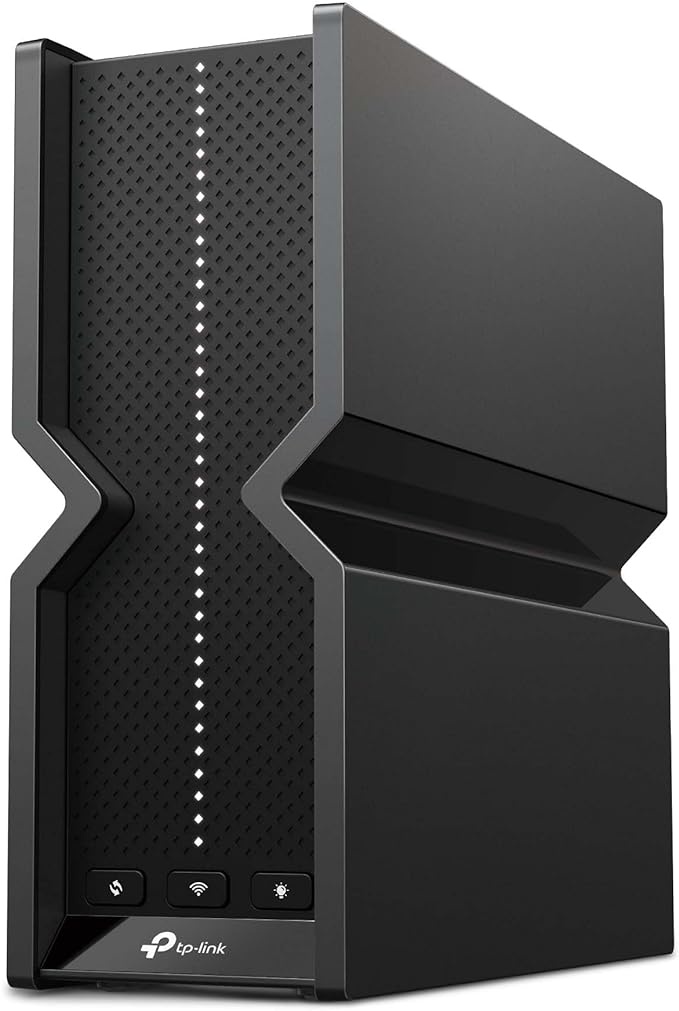](https://amzn.to/3O27kdi) TP\-Link BE550
**Prices are starting to drop:**Prices are finally starting to drop\! TP\-Link is selling a very solid entry level 2×2 MIMO tri\-band Wi\-Fi 7 router now for around $200, the[BE550](https://amzn.to/3O27kdi)\(amazon\.com\), seen right, with all 2\.5 Gbps Ethernet portsWAN\+LAN\. A very good value\.Please note that Wi\-Fi 7 routers will only benefit Wi\-Fi 7 clientsnot Wi\-Fi 4/5/6 clients\. And once you do actually have Wi\-Fi 7 clients,
there is very little point in upgrading your router to Wi\-Fi 7 if you are not currently noticing any speed issues\.> **The bottom line:***Give Wi\-Fi 7 technology time to mature\!*Wi\-Fi 6 can easily deliver 1 Gbps of throughput\. So unless you really have arealpressing need for multi\-Gigabit Wi\-Fi speeds, simply give Wi\-Fi 7 technology time to mature\. Why? Because I find it absurd that some early Wi\-Fi 6 routers are today already marked as 'end\-of\-life'meaning technically, that router is a security risk and should be replaced \-\- since new vurnerabilities will not be fixed\. You may pay a price if you jump into the Wi\-Fi 7 boat too early\.
**The 'distance' issue:**The benefit for Wi\-Fi 7 will be mainly for devices that are very 'near to'in the same roomas the router/AP \-\- expect a maximum PHY speed of around 4\.8 Gbps for a 320 MHz 2×2 channel\.> *And then expect speeds to drop very quickly with distance\.*
**Symbols/sec:**802\.11be uses either 17,205,882 symbols/sec800ns short GI, or 16,250,000 symbols/sec1600ns medium GI, or 14,625,000 symbols/sec3200ns long GI, for a 20 MHz channel \-\- the same as the prior 802\.11ax\.**4096\-QAM HYPE:**I have some very strong reservations about how often 4096\-QAM in Wi\-Fi 7 can actually be used\. Because even today with Wi\-Fi 6E, with 1024\-QAM, I sometimes find that being just feet from the router is NOT good enough to even use 1024\-QAMso there is no hope to use 4096\-QAM, which requires an even better signal\. Maybe I just need to be patient and wait for the second generation of Wi\-Fi 7 devices?
> But, the increase from 1024 QAM to 4096 QAM allows for 'marketing' to advertise faster speeds\!**Is 4096 QAM even possible?***"The answer is a mixed bag\. Possible? Yes, as Wi\-Fi 7 Extremely High Throughput does add the features needed, it is possible to achieve this in the wild\. Is it probable?Probably not in many scenarios\. While very cool and very fast, it's also fragile and we expect to only see this level of modulation in a small number of instances\."*[Source](https://www.ruckusnetworks.com/blog/2023/wi-fi-7-extremely-high-throughput-unleash-the-power/#:~:text=Is%204096%20QAM%20even%20possible%20in%20WiFi%3F)\(ruckusnetworks\.com\) So we are being 'sold' something that \-\- for all practical purposes \-\- can almost never actually be used\! For now, 1024\-QAM is a reasonable maximum QAM\. Q: Can any reader point me to an online review and Wi\-Fi 7 speed test that shows 4096\-QAM actually being successfully used?
[](https://www.wiisfi.com/#accesspoint)
**Mesh network systems Wi\-Fi 7 MLO conundrum:**Mesh network systems often use a backhaul operating simultaneously on a different channel/band\. But Wi\-Fi 7 MLO is already using all antennas for MLO\. It will be interesting to see how mesh systems ultimately deal with this\.> I see one mesh network system dealing with this by adding a non\-MLO 240 MHz backhaul channel in 5 GHzquad\-band\. Don't expect mesh systems to deliver MLO throughput speeds all the way from client device to the main router from a satellite mesh node\. The speed advantages that[Access Points](https://www.wiisfi.com/#accesspoints)have over mesh systems will become much more obvious with Wi\-Fi 7\.
PHY speed2402 Mbps
2×
≈4800 Mbps
★**The PHY speed increases in Wi\-Fi 7 \(802\.11be\):**The speed increases came from:- 100% \- doubling channel width from 160 MHz to 320 MHzbut only for 6 GHz band
- 20% \- via a new 4096\-QAM modulationbut only when VERY close to the router
- MLO \- \(todo\)
- *this section is a work\-in\-progress \-\- waiting to see what becomes 'common' in client devicesespecially phones*
**EHT Throughput:**to be determined, but expect very high PHY speeds and great throughput \(3\+ Gbps\) right next to the router, which then decreaseVERYquickly with distance and obstacles\.
14\. Wi\-Fi 8 \-\- 802\.11bn \(UHR: Ultra\-High Reliability\)
Wi\-Fi 8 is expected to arrive sometime in 2028 and promises to add*reliability*\. Wi\-Fi 8 promises to add:- ELR \(Enhanced Long Range\)
- UEQM \(Unequal Modulation\)
- New MCS \(New Modulation and Coding Schemes\)
- DSO \(Dynamic Sub\-band Operation\)
- NPCA \(Non\-Primary Channel Access\)
- Improved Seamless Roaming
- Multi AP \(Access Point\) Coordination
Frankly, it is too early to comment on the impact of any of these new features\.See[TP\-Link](https://www.tp-link.com/us/wifi8/)and[Wikipedia](https://en.wikipedia.org/wiki/IEEE_802.11bn)for more information about Wi\-Fi 8\.
15\. DFS channels in 5 GHz
*This chapter applies to ALL versions of Wi\-Fi operating in the 5 GHz Wi\-Fi banddoes not apply to 2\.4 GHz and 6 GHz bands\.***DFS:**DFS stands for**D**ynamic**F**requency**S**election\. The 5 GHz band is already used by othernon Wi\-Fi'incumbent' services, so the FCC allows a Wi\-Fi router to use a 5 GHz channel only when the router detects that the channel is 'free'\. And if the router later detects an 'incumbent' service using the channel, the router must immediately stop using the channeland switch to another channel\.
**In a nutshell:**First, you need DFS channels if you want 160 MHz channel support\. Next, if you buy a router that does not support DFS channels, you are limited to only having TWO 80 MHz channels available in 5 GHzinstead of six/seven channels, greatly increasing the likelihood of sharing that channel with othersa close neighbor\-\- meaning that you are sharing bandwidth\. If your router supports DFS channels, your likelihood of being on your own channel all by yourself is much higher \-\- meaning all channel bandwidth is yours\.
> UPDATE: Beware that some very inexpensive routers might only support a SINGLE 5 GHz channel\. Just do your research before a purchase\!
The 5 GHz 80\-MHz channels**Channel \#****MHz****Info****42**36\+40\+44\+485170\-5250OK**58**52\+56\+60\+645250\-5330**DFS****106**100\+104\+108\+1125490\-5570**DFS****122**116\+120\+124\+1285570\-5650**DFS**, TDWR**138**132\+136\+140\+1445650\-5730**DFS**\(1\)**155**149\+153\+157\+1615735\-5815OK**171**165\+169\+173\+1775815\-5895Indoor\(2\)
**Background:**There are SEVEN core 80\-MHz Wi\-Fi channels in 5 GHz\. Two channels can always be usedgreen highlight, right, and one is new as of 2019and for indoor use only\. But, for the other four DFS channels to be used, a router must include special processing to avoid interference with existing usageweather radar and military applications; red highlight, rightand pass FCC certification tests\.> \(1\)Many Netgear Wi\-Fi 5 routers do not support CH 144, and as such, can't support 80 MHz channel 138\. This flaw was fixed in Netgear Wi\-Fi 6 routers\.\(2\)The FCC added 20 MHz channels 169, 173, and 177 in 2019for indoor use only, which also creates a new 80 MHz channel 171\. But don't expect support in very many devicesyetfor the new channels\.
**Why DFS support in a router is important to have:**Support for all channels becomes critically important to avoid interferencesharing bandwidthwith a neighbor's Wi\-Fi\. Ideally, every AP/routeryours and neighborsshould be on a*unique/different*Wi\-Fi channel\.> Also, this is especially important if you can see several other 5 GHz AP's, which happens when you \(1\) have close neighbors like in an apartment building, or \(2\) want to install multiple AP/routers\.So, only consider AP/routers that support ALL the DFS channels\.
**160 MHz channels:**DFS channel support is needed in order to support contiguous 160 MHz channels in 5 GHz\. If you need 1 Gbps throughput speeds, then DFS channel support becomes a 'must have' feature\.**Range:**An AP/router for DFS channels has a transmit power limitation of 250 mWvs 1000 mW for non\-DFS channels\. However, this rarely limits range to clients, as virtually all client devices already transmit at less the 250 mW for ALL 5 GHz channelsso the client device limits range, not the AP/router\.[More information on range](https://www.wiisfi.com/#range)\[§G\]\.
**Avoid AP/routers with NO DFS channels:**It is very common to find 'consumer\-grade' routers that support NONE of the DFS channelsthey only support TWO channels\. Buyer beware\. Also beware brand new routers with NO DFS channel support, as the vendor may not release a firmware update that adds support for these DFS channelsdon't buy a device on the hope that DFS support will be added later via a firmware update\.
**Some 'consumer\-grade' AP's DO support some DFS channels:**Some consumer grade routers DO support some or all of the DFS channels\. Just do your research\. Support is becoming more common\.
> **Netgear ALERT:**Most Netgear routers don't support 80 MHz channel 138\. But this is slowly changing\. The R7800 is a rare exception, supporting channel 138, but only via firmware 1\.0\.2\.68\. Also, it appears that Netgear is finally 'aware' of the issue as some of the newer 'AX' hardware also supports channel 138\.
**Some business\-grade AP's DO support 5 GHz DFS channels:**Some business\-grade 5 GHz devices DO support the DFS channels, so you get the full advantage of a LOT more channels in 5 GHz\.> Most of the Netgear business access pointsNetgear ProSafe Access Pointsdo NOT support the restricted 5 GHz channels\. But I did find ONE that did\. Just do your research\.
**Many Enterprise\-grade AP's DO support 5 GHz DFS channels:**According to[this data sheet](https://dl.ubnt.com/datasheets/unifi/UniFi_AC_APs_DS.pdf#page=4)\(ubnt\.com\) ALL of the Ubiquiti*UniFi AC*models802\.11AC Dual\-Radio Access Pointsare DFS certified\.> For example, I was in a Drury Hotel and from my room, I could see the Drury SSID on channels 48, 64, 100, 104, 108, 140\. So the hotel was clearly using DFS certified 5 GHz access points \-\- successfully\.
**Beware some 'best router' reviews:**Watch out for 'best router' reviews online that select a 'best overall' router that do NOT support ANY DFS 5 GHz channelsonly TWO channels supported\.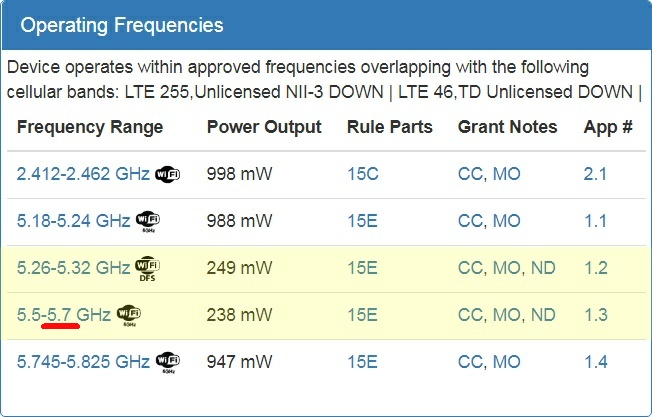 FCC Operating Frequencies show DFS support
**How to research DFS support for any router/AP \(check the FCC filings\):**1. Google 'fccid\.io' and 'FCC' and the router vendor name and model\.
2. Look for a google search result to the fccid\.io web site with 'FCC' in the link and click on the link\. If not on the 'home page' for the router, there will be link near the top of the page home page for that device\.
3. As best you can, confirm that you found the correct router by looking at the 'external photos' document\. Once confirmed, go back to the previoushomepage\.
4. In the resulting home web page, look for the "Operating Frequencies" sectionexample seen upper right\.
5. Look for frequencies that cover the DFS channel rangehighlighted in yellow right\. \[Frequency ranges are usually based upon '20 MHz center' values\]\. If so, that router/AP HAS DFS channel support\. Otherwise, there is NO DFS channel support\. For the RAX80, notice that it appears that DFS channels are supportedexcept for channel 144, which then also excludes channels 142 and channel 138 \-\- because the GHz range stops at 5\.7 GHz instead of 5\.72 GHz\)\.
6. Look for the 'DFS Test Report' and see if the device is a master or a slave, or bothsee immediately below\. You are looking for 'master'routersupport\.
**DFS Master/Slave:**When looking at FCC filed documents, look for and open up the "Test Report \(DFS\)"\. The report will then talk about the EUTEquipment Under Testbeing certified as a 'Master' or a 'Slave'or both\. Master means a router/APbroadcasts a SSIDand Slave means a device that connects to a MasterWi\-Fi client\. A device is not allowed to use any DFS channels unless the proper paperwork is filed with the FCC\.> **Netgear was plain lazy:**Netgear got the R6700v3[certified as a DFS Master](https://fccid.io/PY316200342/Test-Report/Test-Report-DFS-3348693.pdf)\(fccid\.io\), or Wi\-Fi router mode, but failed to get the router certified as a DFS SlaveWi\-Fi client mode\. This matters if you use the R6700v3 as a 'wireless bridge'to connect 'ethernet only' devices to your main Wi\-Fi router, because all of a sudden, in that mode, the R6700v3 no longer supports DFS channels \-\- meaning that if you bought the R6700v3 to connect to your main routerbroadcasting/using a DFS channel, the R6700v3 will NOT work\!
**Warning: Just because a router allows for DFS channels does not mean DFS channels can be used:**Be aware that when a DFS channel is selected, the router MUST look for conflicts on that frequency, and if a conflict is found, the router must automatically change the channellikely to a non DFS channel\. You won't know until you try\. Often times, one or two of the DFS channels can not be usedbut the other DFS channel can\. And each physical location is different\. You won't know until you try\.> I have even selected a DFS channel and seen it work for weeks, only for the router to then all of a sudden auto select a non\-DFS channelmeaning the router detected a 'conflict'\. Was this a real radar signal detected, or a false alarmmost likely? You just need to be patient finding a DFS channel that works long\-term for you\.**TIP:**Often times, when a router automatically switches to a non\-DFS channel, that change is temporary \-\- as simply power cycling the router will cause the router to once again use theconfiguredDFS channel\.
**Warning: Not all Wi\-Fi clients are DFS channel capable\!**All of the above is discussing DFS support in routers, because that is where ALL of the hard work takes placelike scanning for radar, etc\. Wi\-Fi clients have it easy \-\- just follow the lead of the router\. And yet, it is possible that a Wi\-Fi client never got DFS certifiedwith the FCC, and therefore is NOT permitted to use DFS channels, and can NOT connect to a router using any DFS channel\.> A Wi\-Fi client not supporting DFS channels is very rare \-\- and is definitely incredible laziness on the part of the device manufacturer\. Often times,*you will never actually notice*, because the problem device will just connect to the router's slower 2\.4 GHz band, ignoring the faster 5 GHz DFS band\. **Roku:**Multiple readers have told me that most Roku devices do not support DFS channels\! And Roku's own[support article](https://support.roku.com/article/21332729601687)\(roku\.com\) confirms this\. That is crazy laziness on Roku's part, and is not at all customer friendly\.**UPDATE:**It appears that many newer Roku devices now DO fully support DFS channels\.
16\. Router/Wi\-Fi setup tips
**Setup: Web Browser vs App?**There is no right or wrong answer\. Just use whatever method works best for you\. I personally setup new routers via the web browser interface because I don't want the hassle of having yet one more app installed on my phone\. Just be aware that some companiesNetgearseem to add more features in their apps vs web browser interface\.**Placement:**Take the time to correctly[place your main router](https://www.wiisfi.com/#placement)\[§P\] in your home\.
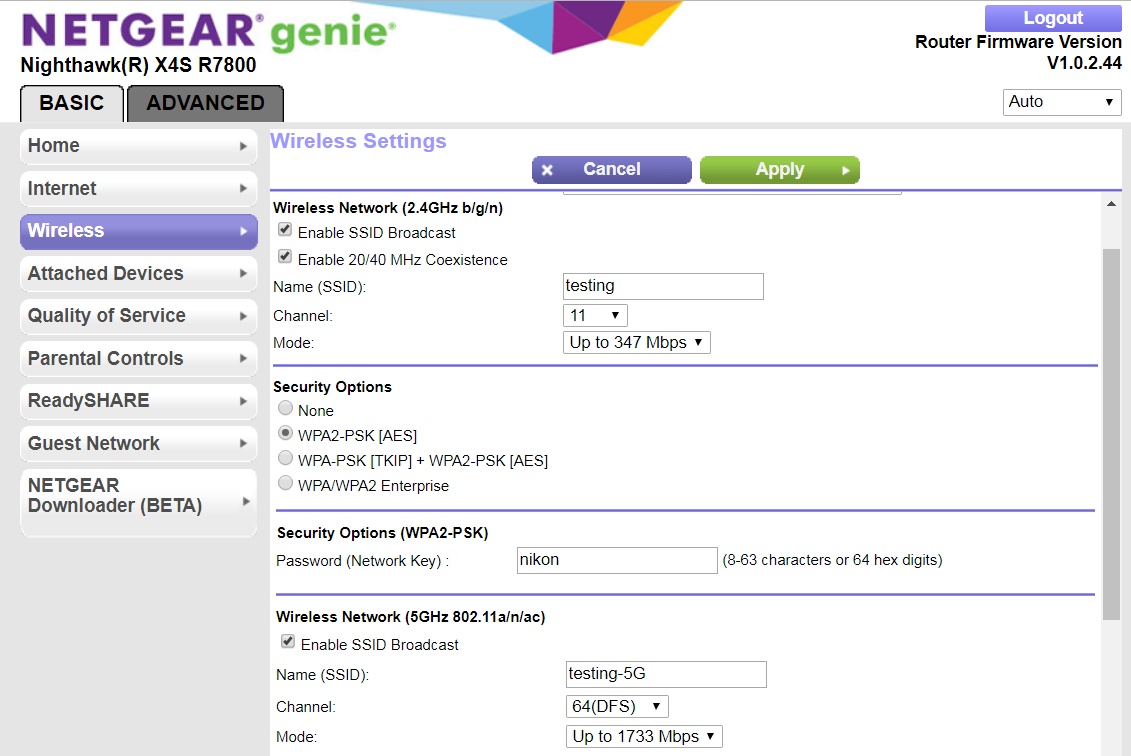 Netgear R7800 wireless setup
**SSID:**SSID is simply the Wi\-Fi network NAME\. When you connect to a Wi\-Fi network in a client, you must select this network namecalled SSID\. At home, you typically will only have one router with that ONE network name\.However, if you add another Wi\-Fi[access point](https://www.wiisfi.com/#accesspoint)\[§19\], you want it to use the SAME network nameand password \+ security, as this allows for Wi\-Fi roaming\. Your wireless devices simply connect to the strongest Wi\-Fi signal with a matching SSID name\.
> You can use different SSID names, but then you don't get Wi\-Fi roaming\.
**2\.4 GHz and 5 GHz SSID names \-\- split or combined?:**There is a big debate \-\- should your 2\.4 GHz band network and 5 GHz band network have the SAME SSID namesbe 'combined'or be 'split', using different namesoften with a "\-5G" appended to the 5 GHz band SSID name? If named the same, your client device decides which band to connect to\. If named differently, then you must select which band to connect to\.>  Windows Wi\-Fi Preferred Band The problem with the 'same name' technique is that many client devices are very 'dumb' and incorrectly connect to the 2\.4 GHz band instead of the 5 GHz bandand then speeds are much slower than they should be\. I had this problem with a laptop that would initially start out connected to thefast5 GHz band, but after about 10 minutes, it would then switch to themuch slower2\.4 GHz bandfor unknown reasons\. Yes, the 5 GHz RSSI signal was weaker, but throughput from 5 GHz was MUCH better\. I fixed by appending a "\-5G" to the 5 GHz band SSID, and connecting to that SSID\. I also had this[same problem](https://www.wiisfi.com/#casestudies)\[§E13\] with a Ring Floodlight Pro\.TIP: Under Windows, look at your Wi\-Fi device in the 'Device Manager' \-\- there may be an option called 'Preferred Band' that is set to 'auto' or 'no preference', etcexample seen right\. Change to attempt to force your device to use a particular Wi\-Fi band\. The bottom line: Be practical\. Just use whatever SSID naming method works*best for you and your devices\.* **Router "Smart Connect" TIP:**If you want to 'split' the SSID names for your Wi\-Fi bands, first turn the 'Smart Connect' feature OFFas that feature 'on' forces the SSID band names to be the same\. Alternatively, instead of splitting the network bands, add a Guest/IoT network that is only active on the 5 GHz band\.
**Disabling 'SSID Broadcast' is NOT a form of security:**Do not think that disabling 'SSID Broadcast' will improve the security of your wireless network\. It will not\. Because anyone with the right tools can still discover your network SSID name\.> Because any client device connecting to your network must include the SSID name in the 'I want to connect' request, that any Wi\-Fi sniffer can capture and then see\.There is nothing wrong with not broadcasting a SSID\. But, don't fall into the trap of thinking that is somehow increasing network security\.
**BSSID:**This is the MAC address of the AP that your client actually connects tobecause you can't tell which AP you connected to from only the SSID\. This is very useful when you have more than one AP using the same SSID, because the BSSID identifies the unique AP that you actually connected toa must for debugging\.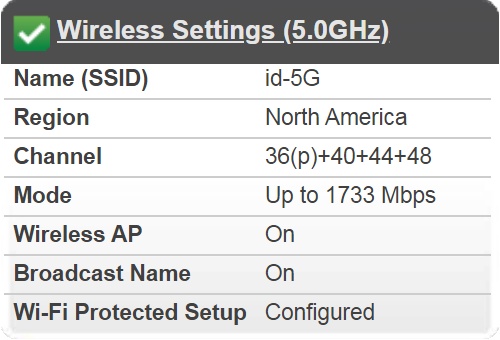 80 MHz 5 GHz channel 42 is made by combining four 20 MHz channels \(only one considered 'primary'\)
**Channel:**ALL Wi\-Fi access pointsin your house and visible neighbors networkscovering the same frequency mustsharethe Wi\-Fi bandwidth\. Because of this, assign channels 1, 6, 112\.4 GHzand 42, 58, 106, 122, 138, 1555 GHzto your APs in a manner to best avoid conflictswith yourself and neighbors\. Try to set/use a DFS channel that is stabledoes not kick you off the channel after some time\. There is nothing special about channel selection\. Any channel can be selected\. However, to maximize throughput, you want Wi\-Fi usage spread aroundnot everything running on the same channel\.> **Analogy:**A channel is like a lane on an Interstate highway\. All carsAPcan use the same lanechannel, but that is slow and inefficientlanes go unused\. Everything works best when carsAPuse all laneschannels\-\- as evenly as possible\.Could you put 10 APs in your house and configure them to all use the same SSID and the same channel? Yes, and it would work \-\- albeit slowly\. But that would not be the best and most efficient way to use the available spectrum, since all 10 APs are attempting to use the same 'lane' of a superhighway\. Instead, distribute all 10 APs across all available laneschannelsof the superhighway\. Just remember that 2\.4 GHz Wi\-Fi has overlapping channels and that the only realnon\-overlappingchannels available are 1, 6, 11\. **Channel Planning:**A full discussion on channel planning is beyond the scope of this paper, but in short, always try to leave a full channel of unused spectrum between actively used channels\. In other words, if you have a main router on 80 MHz channel 42, never put another nearby AP on 80 MHz channel 58\. Instead, you would select a higher channel for the nearby AP\. If possible, you want a 'gap' between active channels to avoid Adjacent Channel InterferenceACI\. See the appendix on[spectral masks](https://www.wiisfi.com/#spectralmasks)\[§S\] showing the impact of a sideband ACI signal on throughput\. **Beware the 'automatic' channel:**Some AP/routers improperly set the 2\.4 GHz channel to some channel other than one of the three non\-overlapping channels\. This can be corrected by not using 'automatic' and instead manually selecting either channel 1, 6, or 11\.
**TIP: Static IP Addresses:**In your main router, assign a fixedstaticIP address to IoT devices that are always connected to your network\. This actually works around some known connectivity bugs in IoT deviceseg: Ring camerasthat go into a 'deep sleep mode' in order to extend battery life, but this 'deep sleep' sometimes causes the router to not 'find' the devicethe Ring camera does not respond to the routers ARP request to 'find' the camera\. Assigning a fixed known IP address allows the router to always 'find' the camera, even when the camera is in 'deep sleep' mode\.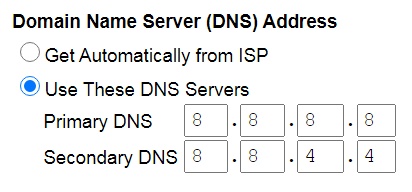 Customize Router DNS servers
**DNS Servers:**I configure all of my routers to use[Google's Public DNS](https://developers.google.com/speed/public-dns)\(google\.com\) servers at8\.8\.8\.8and8\.8\.4\.4\. In your router, the setting for DNS servers is usually found in the 'Internet Setup' section\.> Another fast DNS service is provided by[CloudFlare](https://1.1.1.1/dns/), with DNS servers1\.1\.1\.1and1\.0\.0\.1\.TIP: And there are many more public DNS servers\. Just Google "[public dns servers](https://www.google.com/search?q=public+dns+servers)" \(google\.com\)\.
The default DNS setting in a router is typically 'automatic' \-\- which means "use the ISP's DNS servers"your client device queries the main router, which in turn queries the ISP's DNS servers\. But the problem with an ISP's DNS servers is that they \(1\) can be slow, \(2\) often improperly redirect on DNS errorslike 'server ip can not be found'to some 'self\-promotion' web pageand this can cause some software programs that rely upon 'not found' DNS replies to fail \-\- not good, and \(3\) frankly, sometimes work incorrectly \-\- violate TTLtime to liverules\. I trust Google more than the ISP's to properly follow 'time to live' rules\.> I actually ran into this 'TTL' problem while at a vacation property\. Long story short is that something I depended upon was failing and that I tracked down a problem to the ISP incorrectly caching a DNS entry WAY past the TTL expiration time\. When I used the ISP DNS servers, I received an old very stale DNS entryto a server that no longer existed\. When I used Google's DNS servers, I got a fresh, correct DNS entry\. I don't trust ISP DNS servers anymore to 'follow the rules'\. They can save money by breaking the TTL rulescaching information longer than allowed\.
When you make this change, all devices locally on your network willeventuallyautomatically use the new DNS serversexcept for those devices that manually override the 'get automatically from the router' behavior\.**Turn UPnP OFF \(maybe\):**There have been so many security vulnerabilities with "Universal Plug and Play" in routers over the years, that the first thing you might want to do is turn UPnP off\. Then just see if everything in your network still worksit will for most people\. If so, great\. But if not, then consider turning UPnP back onor manually fixing what stopped working\.
**Change the router password\!**Change the 'administrator' password on your router\! You don't want a guestor hackergaining easy access to your router and making changes\. I am surprised how often I visit a vacation home only to find the router set to default credentialsoften 'admin/password', which opens up the router to unauthorized changes\.
> **Giant Xfinity security hole:**Xfinity gateway's are the worst\! They always seem to be 'wide open' via the HTTP interfaceoften http://10\.0\.0\.1\. Anyone visiting your home can make 'hacker like' changes to your Internet connection\! Why? Because the default login username"admin"and password"password"are often unchanged\! Are Xfinity customers using the Xfinity appwhich does require your account username and passwordand unaware that the 'web interface' to their gateway is stillwide openand still set to the default username and password?
**Do NOT turn 'Enable WMM' off:**"Enable WMM" is ON by default on ALL routers, because it is actually required for any speed past 54 Mbps\. Turn if off if you want to see what I meanyour Wi\-Fi speeds will tank\.[More Information](https://www.smallnetbuilder.com/wireless/wireless-features/dont-mess-with-wmm/)\(smallnetbuilder\.com\)**Firmware updates:**If your router does not update firmware automatically, stay on top of keeping the firmware up\-to\-date, as there are security vulnerabilities fixedand new firmware releasesall the time\.
> BUT also, a huge warning \-\- 'automatic' firmware updates can also potentially be VERY dangerous\. I have been burned so many times by Netgear automatic firmware updates breaking functionality that I use/NEEDfor example, breaking DFS channel support\-\- that I now manually update firmwareand then extensively TEST and revert as needed\.
17\. ★How to improve Wi\-Fi speeds
Are Wi\-Fi speeds 'at range' not as fast as you would like? So, how do you go about improving Wi\-Fi speeds?**FIRST**, follow these initial steps:1. **Your client device:***This chapter assumes that your client device, when right next to a 'modern' router, is capable of good Wi\-Fi speeds\. If you have an older client device that is not capable of good Wi\-Fi speeds, then the rest of this chapter won't help youbecause you first need to upgrade your client device, not the router\.*
2. **Reboot everything:**Reboot ALL Internet connected devices\. But rirst, start with your modem, router, and Wi\-Fi networkextenders, AP, mesh, etcand then WAIT 5 minutesfor all Wi\-Fi bands to be fully operational, especially DFS channels\. Then next, reboot ALL other Wi\-Fi connected devicesgame consoles, smart TV's, tablets, phones, cameras, etc\. In some rare cases, this may fix your problem and you are then done\.
3. **Router Placement:**Check for proper[placement](https://www.wiisfi.com/#placement)\[§P\] of your existing Wi\-Fi devices, especially your main router, and any mesh nodes\. A single main Wi\-Fi router is good enough for many people,*but only if it is properly centrally located and not obstructed in any way*\.
**THEN**, if problems persist, you are left with fixing either \(a\) the easy wayimmediately below; buy new hardware, or \(b\) the hard wayfarther below; try to fix what you have\.**The EASY way:**The 'easy' way to improve Wi\-Fi speeds often involves buying new hardwarefrom a store/site with a great return policy\. Follow the advice for the first question below where you answer 'yes'\.\.\.> **Q1: Are you already using a mesh Wi\-Fi network system?**> If yes,**improve your existing Mesh network:**Either \(a\) move your mesh nodes around \-\- see[placement](https://www.wiisfi.com/#placement)\[§P\], or \(b\) add another mesh node, or \(c\) if your mesh network is oldWi\-Fi 4 or 5, first consider upgrading to a new Wi\-Fi 6or better[mesh network](https://www.wiisfi.com/#mesh)\[§20\]\.If that does not fix the issue, then you MUST find a way to place the mesh nodes where they are needed most AND add/use a wired/Ethernet backhaul for your mesh network\. That WILL 100% fix the problem\. Either \(a\) directly extend Ethernet, or \(b\) indirectly extend Ethernet via[MoCA](https://www.wiisfi.com/#moca)\[§E5\] or other similar technologysee farther below in this chapter\. **Q2: Are you already using a Wi\-Fi extender?**> If yes,**remove any Wi\-fi extender\(s\):**Either \(a\) replace your router and extender\(s\) with a modern Wi\-Fi 6or better[mesh network](https://www.wiisfi.com/#mesh)\[§20\],and go back to the start of this chapter, OR \(b\) remove the Wi\-Fi extender and continue with the next questionstry a Router\+AP solution\.\.\. **Q3: Are you already using a4×4 MIMOandWi\-Fi 6 \(or better\)main router?**> [](https://www.wiisfi.com/#accesspoint) If yes, then**add an Access Point:**Add another[recommended](https://www.wiisfi.com/#recommendation)\[§22\] 4×4 MIMO Wi\-Fi 6or betterrouter \-\-*but configured as an[access point](https://www.wiisfi.com/#accesspoint)\[§19\]*\-\- precisely where it is needed most*and wired/Ethernet back to your main router*\. That WILL 100% solve the problem\.If unable to run an Ethernet cable from the router to the AP locationor you just don't want to use Access Points, then replace your router with a modern Wi\-Fi 6or better[mesh network](https://www.wiisfi.com/#mesh)\[§20\], and go back to the start of this chapter\. **Q4: Are you willing to spend \(around\) $200?**> If yes, then**UPGRADE your main router:**Try a brand new[recommended](https://www.wiisfi.com/#recommendation)\[§22\] 4×4 MIMO Wi\-Fi 6or betterrouter,and go back to the start of this chapter\.For most people, a great*modern*router[centrally located](https://www.wiisfi.com/#placement)\[§P\] in the home will be good enough\.*Please note that you really do want a 4×4 MIMO router, as it will have both a range and signal quality advantage over cheaper 2×2 MIMO routers\.* Otherwise, if unwilling to buy new hardware, your only option is to consider improving your current Wi\-Fi setup the 'hard way' \-\- see the rest of this chapter below\.
**The HARD way:**The 'hard way' is to try to improve the Wi\-Fi network that you already have\.> This assumes that your network is capable of fast speeds, but is currently not obtaining fast speeds\. If you are not using modern Wi\-Fi devices, the gains in speed you can achieve will be minimal\.
Wi\-Fi is a TIME shared resource\. So, the goal for improving things is to get every Wi\-Fi client to use that resource in as little*time*as possible,*especially those few devices that are 'heavy users'*\. So, target the 'heavy users' first with the goal being to 'free up Wi\-Fi time' for other Wi\-Fi users:1. Use Ethernet whenever possible
2. Improve wireless PHY speeds
Consider these options\.\.\.1\) Use Ethernet whenever possible
> For any device using Wi\-Fi nowsmart TV, game console, desktop PC, etcthat has a RJ45 jack, try to switch over to using Ethernet instead of Wi\-Fi for that device\. Your goal is to free up Wi\-Fi for use by devices that can only connect wirelessly\.**a\) Best v1: Go direct wired:**Gigabit ethernet via Cat 5/5e/6/etc is still the gold standard of speed and reliability\. If you have a Wi\-Fi device that also has ethernet/RJ45smart tv, game console, etc, find a way to run a wired Cat 5/6 from your main router to the device\. Expect 1000 Mbps PHY and 949 Mbps throughput from 1 Gigabit Ethernet\. > TIP: If you are out of ports on your main router, add a Gigabit switch\. Be aware that while 1GbE switches are very common, there ARE switches that support 2\.5GbECat5e, 5GbECat6, and even 10GbECat6aspeeds\.[Interesting video](https://youtu.be/b4Wp4SzdNj4)\(youtube\.com\) on*cheaply*adding 10 Gigabit Cat6a/RJ45 to your home network\.**TIP:**If you don't have Ethernet jacks in your house, investigate if your home's phone jacks were wired using 'structured wiring' techniques \-\- where Cat5 was run to all phone jack locations and back to a single structured wiring panel\. If so, you likely have a golden opportunity to convert some of the unused phone line locations to Ethernet\. **b\) Best v2: MoCA 2\.5 Ethernet:**If you can't use/run Ethernet wire, but have access to RG6CATVin every room,[MoCA adapters](https://www.wiisfi.com/#moca)\[§E5\] may be for you\. This adds Ethernet, but over existing coax wiring in a home\. If you have 'cut the cord' with the cable company, and coax in your house is unused, MoCA is a very EASY and fast way to create a wired Ethernet backbone in your home\. And you can install MoCA yourelf\. See[Case Study \#4](https://www.wiisfi.com/#mocacordcutter)\[§E13\]\.**c\) Best v3: Convert some telephone jacks to Ethernet and Go direct wired:**It may be possible to[convert some telephone jacks to Ethernet](https://www.wiisfi.com/#pots2ethernet)\[§E9\] \-\- everything depends upon what cable is 'in the walls'\. **d\) Fair: Wireless bridge:**Many high\-end routers can be configured as a 'wireless bridge', meaning that they use wireless to connect to the main router, and provide that Internet to ONLY all of the wired Ethernet LAN portsdoes NOT allow for wireless clients\. Best when a 4×4 bridge is connected to a 4×4 router\. Under good conditions, expect 1500 Mbps PHY and 750 Mbps throughputWi\-Fi 5\. > Yes, you are trading one Wi\-Fion the device, for another Wi\-Fion the bridge\. But the PHY speed of Wi\-Fi on the bridge ishopefullyseveral times faster than Wi\-Fi on the devices you replaced\. Only use this option if PHY speeds go up 2x or more\.Another easy way to do this is to connect your PC wired/Ethernet to a mesh node that has a 4x4 MIMO wireless backbone\. You are then likely exchanging your 2x2 wireless for the mesh network's 4x4 wireless backbone, which can double speeds\. **e\) OK to Bad: Powerline Networking/Ethernet:**PLC is a very fast and easy way to obtain slower, but reliable, speeds\. See[Powerline Networking](https://www.wiisfi.com/#powerline)\[§E8\]\.
2\) Improve wireless PHY speeds
> **a\) Move as many devices as possible from wireless to wired:**Avoid spectrum usage and contention whenever possiblefree up TIME on the spectrum\. Is there a smart tv that is heavily used for streaming? If so, try to move that to a wired connection, freeing up wireless*time*for those devices that are forced to be wireless onlylike tablets\. See this chapter immediately above\.**b\) Try different channels and TEST:**Wi\-Fi is a shared resource\. If you have neighbors you may actually be sharing spectrum with them\. Especially important at night when people come home from work and start streaming\. > Every router and client device has a different amount of 'antenna gain' that varies based upon frequency/channel being used\. Just test and see if you notice a difference\.In reality, selecting the 'right' channel is crazy hard to dowell\-\- because a channel with many access points may actually be the 'most unused' channel, if those access points rarely transfer datavs a channel with one other access point that is transferring data all the time\. Often times you just need to change the channel and[test \(a lot\)](https://www.wiisfi.com/#speedtest)\[§D\]\. TIP: The non\-DFS 5 GHz channelsat 80 MHz, there are only twoare allowed to operate at a higher power level than the DFS channels\. You should see betterdownloadPHY speeds at distance from these non\-DFS channels, but everyoneyou, neighbors, etcwant to use those channels\. Whereas on a DFS channel, you likely will have the channel to yourself\. *So try to find an unused DFS channel, which will result in the channel being all yours\!*A DFS channel is a must if you are in an apartment/condo buildinghave a lot of close neighbors\. **Inexplicably low PHY speeds?:**If you see PHY speeds from your client devicewhen standing right next to your routerthat are strangely 'too low', that is a huge tip off that you may be running into some 'interference' \-\- try changing Wi\-Fi channels on the AP/router\. [](https://www.wiisfi.com/#accesspoint) **c\) Several low\-PHY 'heavy' users can significantly slow down everyone else:**Devices operating at a very low PHY speed, and using the channel a lot, can slow down an entire Wi\-Fi channel\. Because what is critical is TIME spent on a channelwhich increases as PHY speed decreases\. Adding an[access point](https://www.wiisfi.com/#accesspoint)\[§19\]and hopefully on a new unique channel, and greatly improving the PHY speed for those devices, can free up time needed by other Wi\-Fi clients\.> Analogy: Imagine a highwayWi\-Fi channelwhere a carsmartphoneis going 5 mphPHY 65 Mbpswhen the speed limit is 55 mphPHY 866 Mbps\. That one car will drastically slow down all other carsWi\-Fi deviceswanting to use the highwayWi\-Fi channel\. Adding a new lanevia AP on new channelto the road not only puts the slow carsmartphoneonto a new lanechannel, potentially causes the car to all of a sudden start driving 55 mphPHY 866 Mbps\. **d\) Get a 4×4 MIMO network adapter:**If on a PC with 2×2 MIMO, try using a 4×4 MIMO network adapterto a 4×4 router\. The expectation is that PHY speeds will increasebut not quite double\.> *But honestly, with a PC, always try to find a way to use Ethernet wired to your main router\.* **e\) Upgrade your client device:**If your client device is 1×1 MIMO, get a brand new client device that supports at least 2×2 MIMO\. The expectation is that PHY speeds should roughly doublemoving from 1×1 MIMO to 2×2 MIMO\.> **Brand new hardware might help:**I have also seen 2×2 MIMO devices made in the last year outperformconsistently stay on a higher PHY speedthan 2×2 MIMO devices that are five years old\. This can not be overstated\. If you are looking for top speeds, always use modern/new devices\. Each generation of newer hardware performs just a little bit better than prior generations\. **f\) Investigate 160 MHz channels:**If your 2×2 client devices support 160 MHz channelsthis was rare, but it is becoming a lot more common for Wi\-Fi 6, look into a router that also supports 160 MHz channels\. This is not always possible, but when possible and there are no DFS channel conflictsor spectrum conflicts with neighbors, this has the 'potential' to double your PHY speedswhen compared to 80 MHz channels\-\- but for only the few devices that actually support 160 MHz channels\. But 160 MHz channels require a high SNRyou may need to be very close to the router\. Also, remember that wider channels have slightly less rangethan smaller channel widths\-[details](https://www.wiisfi.com/#channelwidthrange)\[§J\] \-\- so this works best when very close to the router/AP\.> For example, the Netgear R7800 when it first came out was cutting edge, but this solid Wi\-Fi 5 router is now showing its age\. But this router supports 160 MHz channelswhen the router first came out, very few client devices supported 160 MHz channels, which means that with modern client devices, over 1 Gbps Wi\-Fi throughput speedswith Wi\-Fi 5\!can now be easily achieved\! I tested and immediately obtained 1\.4 Gbps throughput over Wi\-Fi\. **g\) Reserve 5 GHz for true 802\.11ac devices:**A requirement of any device being able to call itself 802\.11ac capable is that it must support 80 MHz channels in 5 GHz\. However, dual\-band 802\.11n devices can see your 5 GHz SSID and connect to it using 20 MHzor 40 MHzchannels\. If that 802\.11n device is a heavy Internet user, this could slow down all of your 80 MHz channel devices\. Move that problem device to the 2\.4 GHz band SSID\. This frees up*time*on the much faster 80 MHz 802\.11ac channel for 80 MHz capable devices\.> **Analogy**: A 802\.11n device operating at 20 MHz in 5 GHz is like a car using one lane of a four lane Interstate and simultaneously preventing the three other lanes beside it from being usedmost devices operating in 5 GHz want to use 80 MHz channels\.But if the dual\-band 802\.11n device is a lightweight when it comes to Wi\-Fi usage, then keep it on 5 GHz, as it is 'doing no harm'\. It is all a balancing act \-\- because if the 802\.11n device does not work properly in 2\.4 GHztoo slow or unreliable due to congestionthen you may need to keep the device in 5 GHzeg: a Ring camera, where reliable video is critical\. **h\) Update firmware:**\(1\) Make sure that your router/AP is running the latest firmware\. It is rare, but there have been times that a performance problem is found and corrected and new firmware is released that fixes the problem For example,[this WAN to LAN performance bug](https://www.duckware.com/tech/router-wan-to-lan-throughput-test.html)\(duckware\.com\)\. \(2\) And if on a Windows laptop, check for any updates to the Wi\-Fi drivers\.**i\) Switch Wi\-Fi bands:**Often timesbut not always, PHY speed increases dramatically when there is a switch from 2\.4 GHz to 5 GHz\. This is because the SINR for 5 GHz is often much better than the SINR in 2\.4 GHz\. This improved SINR together with wider channels20 MHz to 80 MHzoften results is a big speed improvement\. Confirm that your dual\-band device is connecting to 5 GHz and using 80 MHz channels\. If not, consider upgrading your client device and/or router\.
**Remember that everything in Wi\-Fi is about TIME on the channel:**It all comes down to 'time' spent on the Wi\-Fi channel \-\- So target the devices that spend the most time on the Wi\-Fi channel, and conversely, don't worry aboutignorelow channel width, low PHY devices, that don't use Wi\-Fi that mucheg: thermostat\. The worst 'time' offenders will be high usage devices with low PHY rates \-\- so target those devices first\.> Analyze your client devices that download/upload the most data\. They should be running at high[PHY speeds](https://www.wiisfi.com/#PHY)\[§4\]; and if not, fix by moving devices around, or by adding an[access point](https://www.wiisfi.com/#accesspoint)\[§19\]\.
**First, did PHY speed increase?:**Always[check the PHY speed](https://www.wiisfi.com/#PHY)\[§4\] of your client devices both before and after an upgrade to confirm that there was an actual improvement in PHY speeds\. Otherwise, there was no point in upgrading\.**Next, did throughput increase?:**Improving PHY speed is the first step\. The second step is a[throughput test](https://www.wiisfi.com/#speedtest)\[§D\] to verify overall Wi\-Fi speeds increased\. Why? Because you could have the best PHY speed ever, but if you are sharing that channel with othersa heavy usage neighbor, overall speeds could go down\.
[](https://www.wiisfi.com/#accesspoint)
★**The easy way \(restated again\):**One of the fastest, easiest, and BEST ways to dramatically improve Wi\-Fi speeds to 'the maximum speed possible' is to install a brand new[recommended](https://www.wiisfi.com/#recommendation)\[§22\] routerconfigured as an[access point](https://www.wiisfi.com/#accesspoint)\[§19\] and wired/Ethernet back to the main routerin the same room where you want to improve Wi\-Fi speeds\. Wi\-Fi works best when the Wi\-Fi signal does not have to go through walls/floors/etc and does not have to travel too far\. In Wi\-Fi, distance matters\.18\. Wi\-Fi Range Extenders
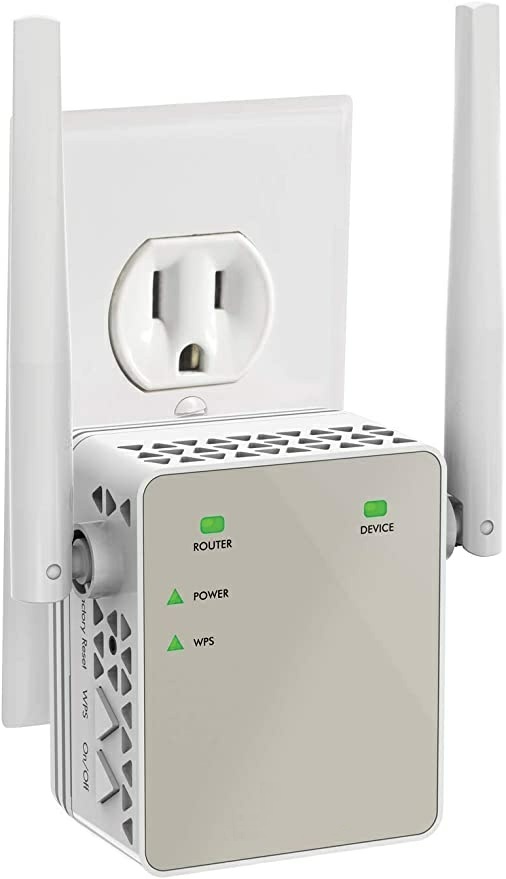 A typical Wi\-Fi range extender
So you have a weak Wi\-Fi signal on one side of your house\. Will a "Wi\-Fi range extender / booster / repeater" solve the problem?❌
NO, do NOT use a Wi\-Fi range extender / booster / repeater\.Only use Wi\-Fi extenders as a last resort\. Why? Because Wi\-Fi extenders are an old technology and today, there are other much betterand modernalternatives, like[access points](https://www.wiisfi.com/#accesspoint)\[§19\] and[mesh networks](https://www.wiisfi.com/#mesh)\[§20\]\.★ A GREAT way to experience first hand 'what is wrong' with Wi\-Fi extenders is install one where it is NOT neededlike right next to your main router, connect to the extender,*and observe Wi\-Fi throughput speeds cut in halfor much worse*, even with a great PHY speed\.
> Don't confuse great signal and PHY speedat range\-\-*that a Wi\-Fi extender does give you*\-\- with great speedat that range\.Instead, you likely traded a more reliable signal for a slow speedbecause there is still the 'extender to main router' path that packets must traverse\-\-*which in some edge cases, is a good tradeoff to make*sometimes a slow, but reliable, connection is better than an unreliable connection\.
**Limited throughput:**Don't expect great throughput from a cheap Wi\-Fi range extender, even in the best case of connected to Ethernet and running in Access Point mode\. The typical $50 Wi\-Fi extender hardware is simply not capable of handling top\-notch Gbps speedslike a $200 router can\.**How Wi\-Fi extenders work \(aka: the core problem with extenders\):**
*Wi\-Fi extenders work by retransmitting every single packet received*\-\- so packets in a "Wi\-Fi extended" network are transmitted TWICE\. This only puts even MORE pressure on an already weak Wi\-Fi network\.> Many extenders 'on paper' are a 'zero\-sum game'\. Because they aretypicallylocated in the middle between the main router and a client device, they improve the signal strength between the two pathsextender to router and extender to client deviceonly enough to make up for doubling Wi\-Fi utilizationpacket transmitted twice, and no more\. Packets areoftenre\-transmitted on the same channel, band, and channel width\. So not muchif anythingis gained speed wise other than possibly a more reliablebut slowWi\-Fi path\.★ Where extenders may actually workand help a little bit is if the device connecting to the extender is using slow 2\.4 GHz Wi\-Fi 4, but the extender backhaul to the main router is using the much faster 5 GHz Wi\-Fi 5\. Especially when the extender implements a MIMO leveleg: 2×2that is higher then the device you are trying to extendeg: 1×1\.Also, sometimes extenders can help to 'bend' a Wi\-Fi signal around a major physical obstructioneg: an elevator shaft\. But in all cases, if an extender helps a little, then an access point or mesh network would work even better\.
**Wi\-Fi extender Placement:**Proper placement of an extender is VERY important in order to properly maximize throughput\. See the[Router/AP Placement](https://www.wiisfi.com/#placement)\[§P\]\.**PHY warning:**Wi\-Fi extenders do improve PHY speed, but the other half of that story is throughputbecause an extender must re\-transmit packets and has its own 'PHY' speed to the main router\. Use a[speed test](https://www.wiisfi.com/#speedtest)\[§D\] program to confirm the impact on throughput\.
> Namely, if you are standing right next to the Wi\-Fi extender, the PHY speed will be fantastic, but remember that there is still a hidden PHY speed between the extender and main router that you can't see that comes into play and limits throughput\.
**Alternative One \-\- Improve your main router:**First, are you using a modern high quality[recommended](https://www.wiisfi.com/#recommendation)\[§22\] router4×4 MIMO Wi\-Fi 6? If not, try one\. Next, check router[placement](https://www.wiisfi.com/#placement)\[§P\]\. By improving the routeror placement, you may improve signal strength enough that you don't need an extender\.[](https://www.wiisfi.com/#accesspoint)
**Alternative Two \-\- Add an Access Point:**A GREAT way to improve the Wi\-Fi signal strengthand speed\!is to place an[access point](https://www.wiisfi.com/#accesspoint)\[§19\]wired/Ethernet back the main routerexactly where it is needed most\. And of course, with the major caveat that you have the ability to run a new Ethernet cable from your main router to the new AP\.> So the huge advantage that a wired/Ethernet Access Point has over Range Extendersand mesh networks with a wireless backhaulis that \(1\) packets are only transmitted ONCE over Wi\-Fi AND that \(2\) the AP can be placed exactly where needed most so that client devices near that AP now get maximum Wi\-Fi speedsno more need to place extender devices 'mid\-way'\!
**Alternative Three \-\- Mesh Wi\-Fi network:**Wi\-Fi extenders typically workre\-transmiton the SAME Wi\-Fi channel/band/width as the main router \-\- and that is a major weakness of Wi\-Fi extenderschannel utilization\. Instead, consider replacing your main router with a[mesh network](https://www.wiisfi.com/#mesh)\[§20\], where the 'retransmissions' between the nodes in the network happen on a much faster 'backhaul' network*oftenon a different Wi\-Fi channel/band/width*\.> Mesh networks DO also re\-transmit packets, but theyoftenuse a 'backhaul' channel/band/width that \(1\) is often different than the main channel and \(2\) much faster than the main channelhigh end mesh networks use 4×4 MIMO for the backhaul\. A huge bonus is if you can find a way to wire each mesh node back to the main mesh node/router via 2\.5 Gigabit Ethernettry to avoid using a wireless backhaul\.
**Price: You get what you pay for \- but only to a point:**Do you really think that a $40 to $70 Wi\-Fi extender is going to take the Wi\-Fi signal from your $200 router and make it that much better at range? No\. You get what you pay for\. And if you spend more, then the alternatives discussed above are a better option\.**End note:**Yes, Wi\-Fi extenders may sometimes work for you\. But they turn a low speed unreliable weak Wi\-Fi connection into a stronger, more reliable, higher PHY \-\-*but still low speed*\-\- connection\. And that 'low speed' issue is my core problem with Wi\-Fi Range Extenders\. My expectation for Wi\-Fi is to always have both great signal strength AND great speed\.
> Another situation where Wi\-Fi extenders can sometimes help is when the extender is*dual\-band*and connects to the router using 5 GHz, and then a client that only supports 2\.4 GHz connects to the Wi\-Fi extender\. In effect, upgrading the client from 2\.4 GHz to 5 GHz\. But at that point, just install an Access Point or mesh network\.
**If you still really want a Wi\-Fi extender:**Review "[The 3 Best Wi\-Fi Extenders for Your Home Network](https://www.wsj.com/buyside/electronics/best-wifi-extender-1f66ab1a)" \(wsj\.com\), a BuySide article by the Wall Street Journal\.
---
◆ The math behind transmitting a packet twiceSay your Wi\-Fi 4 client device is connected to your router using HT20 MCS114\.44 Mbps, but it is unreliable\. So you add a Wi\-Fi 4 extender perfectly mid\-way\. That change in distancein halfcauses both the 'router to extender' and 'extender to client' PHY links to each improve by around 6dB \([see why](https://www.wiisfi.com/#mwdistance)\[§I\]\), which bumps the SINR levels on both links 'around' 6dBapprox two MCS levels, to MCS328\.88 Mbps\. But now all packets need to be transmitted twice, and over the SAME channelso there is now contention\. What effective speed is obtained depends upon the channel usage over the two paths\.\.\.
**CASE 1 \-\- Same channel \(or serialized access model\):**The*best\-case*effective PHY for an overall path composed of 'N' individual PHY links, operating on the same channel isignoring the small latency introduced by each node along the path:
> 
In other words, for each node in a path, convert PHY Mbps to 'time taken', sum up the timesbecause access to the same channel is serialized due to contention, and convert total time back to a PHY rate\.> For example: With two PHY links, each at 28\.88, acting as one link, the effective PHY is 1/\(1/28\.88\+1/28\.88\), or 14\.44\. The SAME as transmitting one packet once at 14\.44 Mbps,*but hopefully now more reliably*\. Using a 'same channel' extender is often a zero\-sum game, that just consumes Wi\-Fi bandwidth\.
**CASE 2 \-\- Different channels \(or concurrent access model\):**BUT, if we now switch to an extender with much better Wi\-Fi capabilitiesWi\-Fi 5 and 2×2 MIMOthan the client deviceat Wi\-Fi 4, operating on a different band and channeleg: 5 GHz and PHY at 130 or 190, then the effective PHY changes to:> 
In other words, when each node in a path is using a unique channel, the overall path speed is reduced, or bottlenecked, to just the slowest node along the path\.> Example: Using the example above, the overall path speed increases to the minimum of 28\.88no channel contention\. And because Wi\-Fi 5 PHY speeds are so much better than Wi\-Fi 4, we can move the extender even closer to the Wi\-Fi 4 client devicemax PHY 72\.22, and increase the PHY speeds even more\.*To be very technical, this 'effective PHY' is only for transmitting a bunch of packets, as this takes advantage of the fact that both links can operate simultaneously\. However, if you are computing the effective PHY for just a single isolated packet, then are back to using the 'serialized' formula far above\.*
With Wi\-Fi extenders, the position of devices matters a lot, and best placement depends upon knowing the PHY speeds of each link, AND which channels/bands will most often be used\!**More Information:**
- [No, Even the Best Wi\-Fi Extender Isn't Worth Your Time](https://www.wired.com/story/best-wi-fi-extenders/)\(wired\.com\)
- [Techquickie: DON'T Buy A Wi\-Fi Range Extender\!](https://www.youtube.com/watch?v=WW4wT7gob7s)\(youtube\.com\)
- [Consumer Reports: "Should you buy a Wi\-Fi Range Extender"](https://www.consumerreports.org/wifi-extenders/should-you-buy-a-wifi-range-extender/)\(consumerreports\.org\)
- [CNET: "Mesh Wi\-Fi vs\. range extenders: The best option for your home"](https://www.youtube.com/watch?v=eaWrtRheVxQ)\(CNET on youtube\.com\)
19\. Wireless Access Points

**Access Point \(AP\):**A Wireless Access Point \(WAP\), or just Access Point \(AP\), is a device that allows a wireless client device, like your phone/tablet/laptop/etc, to connect to a wired network, like your LAN and Internet\.*And as a bonus, many access points also have extra LAN ports for connecting any Ethernet\-only devices directly to the AP\.*> **TIP / Use a router:**There are dedicated 'access points' that you can buy, but it is often much easier to just buy a normal[recommended](https://www.wiisfi.com/#recommendation)\[§22\] routeror re\-use an old routerand configure it in 'Access Point' mode \-\- so that 'Router' functionality is disabledas that is still handled by your main router, while keeping the 'wireless' AP functionalityand LAN Ethernet portsintact\. Also, using a 'router as an Access Point' is a great way to recycle and re\-use older routers when the main router is upgraded\.
**What about DHCP and NAT in an AP:**The purpose of an 'Access Point' is to provide access to all the services running in an existing network, so there isintentionallyno DHCP and no NAT in an access point itself\. Instead, client devices connecting to the AP are actually using DHCP and NAT from the 'main router' on the network\.> A good way to think of an 'access point' is that it is similar to connecting an Ethernet cable to your client device \-\- you are just connecting to the 'local network' wirelessly via the AP, instead of using an Ethernet cable\.
**The AP must be wired/Ethernet back to your main router:**An Access Point is the BEST way to 'extend' Wi\-Fi \-\-*provided the AP can be wired/Ethernet back to your main router*\-\- because this guarantees \(1\) the fastest PHY speed possible for client devices, and \(2\) the fastest possible*consistent*backhaul speed back to the main router\.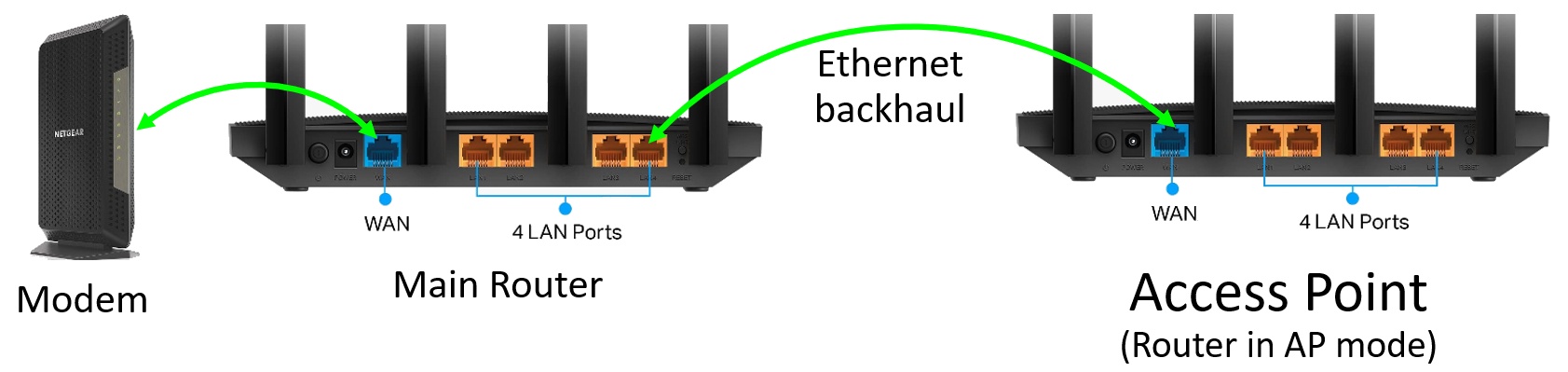
How to connect a new 'Access Point' to your Main Router \-\- green lines are Ethernet cables
**Ethernet backhaul:**Please note that the AP's 'Ethernet backhaul' is not required to be literally only CAT5\+ and Ethernet\. While it often is, it could also be[MoCA 2\.5](https://www.wiisfi.com/#mocacordcutter)\[§E13\], a Fiber link,[powerline networking](https://www.wiisfi.com/#powerline)\[§E8\],[a 60 GHz point\-to\-point link](https://www.wiisfi.com/#mikrotikwirelesswire)\[§E10\],[long distance EoC](https://www.wiisfi.com/#EoC)\[§E10\]Ethernet over coax, etc\.> For example, your 'main router' is in your living room, but you then also have an access pointwired/Ethernet back to your main routerin your home office\. In your office, you will get the fastest Wi\-Fi speeds that are possible for your client devices, and because there is Ethernet back to the main router, packets are never re\-transmitted twiceas they would be with extenders or mesh\.
**EASY: How to configure a Router in 'access point' mode:**Here are some instructions on how to set 'AP mode' for various router brands\.*Please note that some vendors use the term 'Bridge' to describe their router running in 'Access Point' mode\.*- TP\-Link:[How to configure the TP\-Link wireless router as Access Point](https://www.tp-link.com/us/support/faq/1384/)\(tp\-link\.com\)
- Netgear:[How do I change my NETGEAR router to AP mode?](https://kb.netgear.com/20927/How-do-I-change-my-NETGEAR-router-to-AP-mode)\(netgear\.com\)
- Eero:[How to change the Eero router to AP mode](https://support.eero.com/hc/en-us/articles/208276903-How-do-I-bridge-my-eeros)\(eero\.com\)
- Asus:[How to set up access point mode?](https://www.asus.com/us/support/FAQ/1015009)\(asus\.com\)
- Linksys:[How to use a Linksys router as an Access Point](https://store.linksys.com/support-article?articleNum=48721)\(linksys\.com\)
- Wavlink:[How to set up WAVLINK router to AP\(Access point\) mode?](https://www.wavlink.com/en_us/faq/details/How-to-set-up-WAVLINK-router-to-AP-Access-point-mode.html)\(wavlink\.com\)
- Tenda:[How to change a Tenda router to AP mode](https://www.bitdefender.com/consumer/support/answer/3604/)\(bitdefender\.com\)
An example of how easy it is to change a 'router' into an 'access point':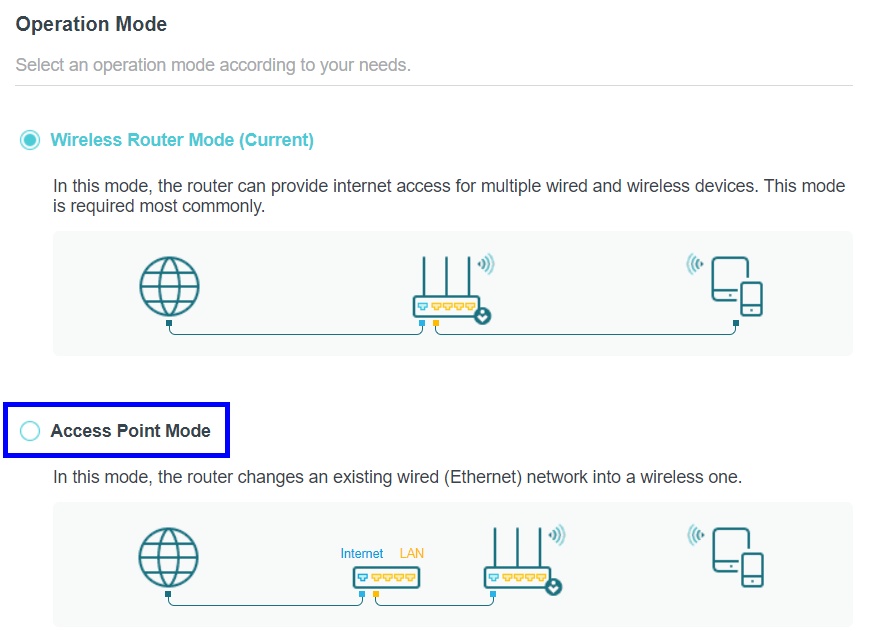
Configuring a TP\-Link "Router" as an "Access Point"
**NOTE: AP Wi\-Fi throughput will be limited to Ethernet LAN port speeds:**If you do go down this path, please be fully aware that Wi\-Fi throughput to/from the access point will be 'limited' to the 'weakest link' speed, which is likely to be the Ethernet LAN port speed on the main routerlikely 1 Gbps\.> But let's also be realistic \-\- Wi\-Fi speeds maxing out at 1 Gbps is a very good problem to have\. The 'solution' is a better main router with all LAN ports at 2\.5 Gbpsor higher\.
**SSID / password / encryption:**All access points in a house are virtually always configured to use the SAME Wi\-Fi name, password, and encryptioneg; WPA2 or WPA3as your main router\. In this way, you will only ever see a SINGLE Wi\-Fi name in Wi\-Fi lists on your client devices no matter how many access points you have installed\. Client devices will automatically connect to the access pointmain router or access pointthat provides the 'best' signal\.> You can name access points uniquely if you want to, but then all of those SSID show up in Wi\-Fi lists on client devices \-\-*and that creates a lot of name pollution*\.The only time I have used a unique SSID name for an access point is when I added an APan old Wi\-Fi 4 router, on a unique channeldedicated to service a single wireless Ring camera, and I wanted only that one camera \-\- and no other clients in the home \-\- using that access point\.
★ ★**Setup order tip:**Changing the SSID on a 'router as AP' is the LAST step\. In other words, when setting up a router as an AP:1. Power on the new router/AP, configure and connect into your network and confirm it worksthere will be double NAT and a SSID different than your main network\.
2. Change the new router/AP operation mode to "Access Point", and confirm that this change worksthis removes double NAT, but the SSID is still different\.
3. As a last step, change the SSID/password/encryption to be the same as your main routerthis enables client devices to fully roam between your main router and the new AP\.
Why in this order? Because if anything 'goes wrong' during the setup process, you want the ability to easily connect directly toonlythe new router/AP you are setting up\. And having a unique SSID until that last minute allows you to more easily do that\.**Channels:**When you have more than one AP in a house, manually configure the channel used in each APdon't use 'auto' channel selection\. You want each AP to have its own dedicated channel \(not overlapping with other AP channels\), so that all AP can operate simultaneously\.
- For 2\.4 GHz, only use non\-overlapping channels 1, 6, or 11\.
- For 5 GHz, only use channels that fall into different 80 MHz channelsfor example, 36, 40, 44, 48 are all in the same 80 MHz channel\. Also, try using DFS channels first\.
- For 6 GHz, only use channels that fall into different 160 MHz[channels](https://www.wiisfi.com/#wifi6e)\[§12\]\.
**Ethernet backhaul \-\- WAN or LAN port?**Access points must plug into your[Ethernet](https://www.wiisfi.com/#ethernet)\[§E1\] network somewhere \-\- because they provide an interface from 'wireless' to 'wired' for your client devices\. The big advantage of using an access point is that they can then be placed precisely where they will do the most good \-\- as Ethernet cables can be up to 100 meters328 feetlong\.But, what Ethernet port on the AP should be usedfor a router configured as an access pointto wire/Ethernet the 'access point' back to your wired network \-\- the WAN port or a LAN port? Technically, it should not matter at all \-\- as every port 'should' work equally well\. However, be aware that some routersespecially older onesdo have some bugs in properly routing ALL packets across the WAN to LAN interfacewhen the router is in AP mode\. So, AFTER configuring a router in "Access Point Mode", consider switching the Ethernet cable from the WAN port on the AP to a LAN port on the APand no longer use the WAN port\.
> Example: I had an older router I had setup as an AP and a Ring camera was failing to connect to the Internet\. But my laptop connected just fine\. When I switched the Ethernet backbone on the AP from the WAN port to the LAN port, the Ring camera all of a sudden worked\.
**An AP adds more Wi\-Fi capacity:**One of the huge advantages that access points have over meshor a single main routeris that they allow you to add more 'overall' Wi\-Fi 'bandwidth' when Wi\-Fi is over\-utilized\. Instead of everyone in the house connected to Wi\-Fi on a SINGLE channel, that Wi\-Fi usage is instead spread over multiple access points, as long as each access point is on its own unique channeland as long as people using Wi\-Fi are also spread throughout the house\. Each unique Wi\-Fi channel can operate independently*and concurrently*\.> At one house, I added an access point into the 'kids playroom'on channels not used by the rest of the house\-\- so that any streaming or game play inor nearthat room will go through that access pointand not impact Wi\-Fi in the rest of the house\. Plus, everyone in the kids playroom obtains maximum PHY speeds, which results in the fastest Wi\-Fi speeds possible\.The kids can max out their Wi\-Fi channelto 100%*without impacting*Wi\-Fi speeds for any other users in the rest of the house\.
**TIP: In your main router, configure a 'fixed' IP address for your new access point:**Your new access point will dynamically obtain an IP address from the main router\. But since that IP address can change over time, it is much easier to manage the access point if the IP address never changes\. So in the main router, assign a fixed IP address for the AP\. When a router is configured as an access point, and you are connected to the AP's wireless SSID, most router companies provide a URL that automatically connects to the AP\. Here are some of the most common ones:- **TP\-Link:**tplinkwifi\.net
- **Asus:**www\.asusrouter\.com
- **Netgear:**routerlogin\.net
- **Tenda:**tendawifi\.com
> *WARNING: But 'ping' these names from a Command Prompt window to 'find' the IP Address\. If you type these names into Chrometo access the router's web interface, that may FAIL\. You may NOT get the correct name resolved if Chrome is using 'secure DNS', which bypasses normal DNSwhere a router maps these special names to itself*\.
**A real\-world example:**This housebelowalready had Internet for the main housecable modem \+ 4×4 wireless main router; green "Internet" boxand a single Ring cameragreen dot\. The owner wanted to add four more Ring cameras around the entire propertyblue dots\. Wi\-Fi needed to be extended to the garage and storage shed\. The BEST solution was to add a 4×4 APaccess point; blue "Access Point" boxin the garageusing a channel different than the main router, wired/Ethernet back to the main routerdotted blue line\.>  Access Point added on non\-overlapping 5 GHz channel 58 \-\- Main Router on 5 GHz channel 122
Running the Ethernet cable to the new AP admittedly was a painthrough a partial basement and a very tight crawl space, but the end result \-\- the 'best' Wi\-Fi possible for all cameras \-\- was well worth it\.> The significant advantage this 'Access Point' configuration has over many 'Mesh' systems is that there is NO overlap in Wi\-Fi channel usage between the 'Internet' and 'Access Point' nodes on any band, meaning that both nodes operate 100% independently \-\- both Wi\-Fi nodes can Tx/Rx*at the exact same time*whereas for many mesh systems, only one node can be actively transmitting at a time, because mesh nodes use the same channels\-\- meaning that*there is now twice the Wi\-Fi bandwidth capacity*\.
**Your choice:**Once you have Ethernet wired into your house, you have a choice to make\. Use Access Points or use a Mesh Networkwhich can also work great with a wired/Ethernet backhaul\. There is no right or wrong answer \-\- it all depends upon your needs and requirementsand budget\.**What about 'business\-class' access points?:**If they work for you, great, go for it\. But if I need to add two AP's into a homean office and a kids game room, that: \(a\) has no existing PoE switches, \(b\) needs to plug in multiple wired devices at each AP location, and \(c\) requires 1\.5\+ Gbps Wi\-Fi throughput to the main router \-\- then a 'router as AP' is very attractive, because this eliminates purchasingfor a business AP solution:
- a more expensive 'premium' product to fully support the throughput requirement
- a 'controller'or cloud service rentalto manage the business AP's \-\-*and higher end business AP's require a controller*
- multiple PoE switches or adapters to power the business AP's and/or regular switches
Having a*single independent devicea router configured as an APwith a single power plug*that quickly solves the problem \-\-*and does not need to be mounted on the ceiling*\-\- is a very attractive option to many\.**More 'roaming behavior' research is needed:**Apparently some client devices are 'limited' and can only successfully roam/hunt/switch to another access point that is*on the SAME Wi\-Fi channel*as the currently connected access pointbut if disconnected from the current AP, then a full search is possible\. This is a client device limitation\. This need more research on how common this is, and the impact of this\. Note that this is really only a concern for client devices that are 'mobile' and actively moving aroundso not a concern for mobile devices that are stationary, and not a concern for IoT devices installed at a fixed location\.
20\. Mesh Wi\-Fi Network Systems
**Ultra Convenient:**Mesh Wi\-Fi Network Systems are ALL about*incredible convenience*super fast setup\-\-*but are NOTnecessarilyabout top notch performance*\.[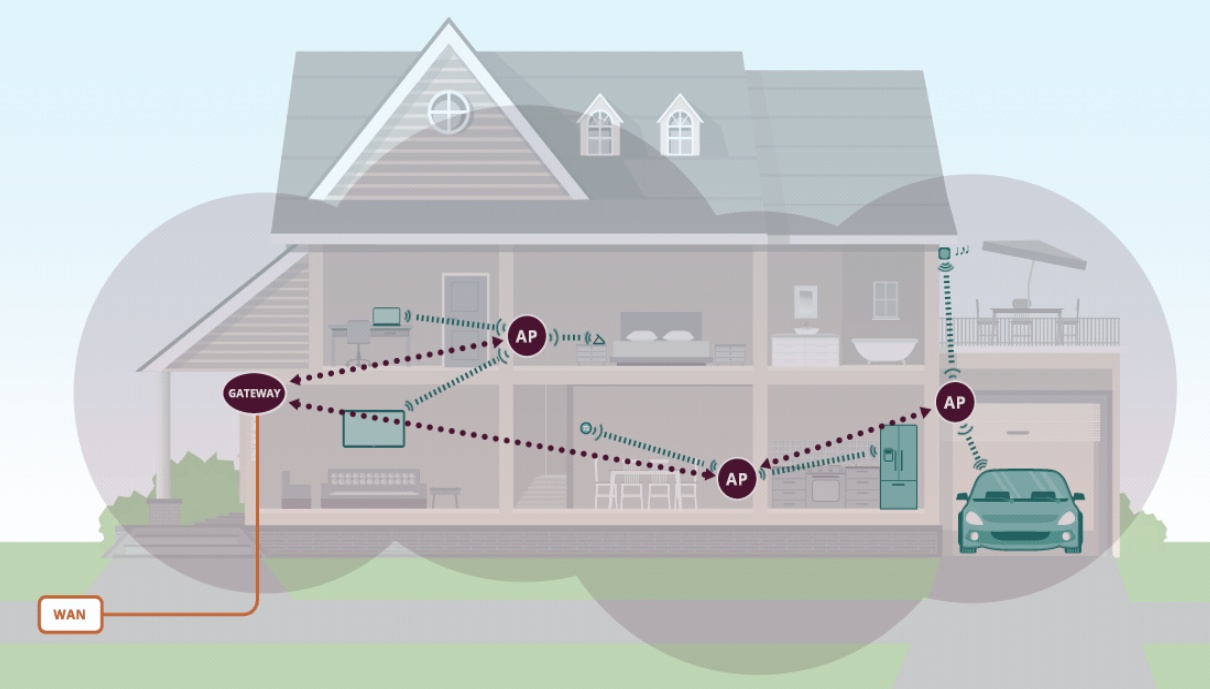](https://www.wi-fi.org/discover-wi-fi/wi-fi-easymesh)Wi\-Fi EasyMesh \-\- Wi\-Fi Alliance
**What is a Mesh Network?**Just place mesh nodes around your home and power them on\. Your client devices connectgreen lines; rightto the nearest mesh node and all mesh nodes communicate with each otheralmost always wirelessly, but can be wired/Ethernet; red lines; rightto access the Internet\. One mesh node must be physically connectedwired/Ethernetto your modem/Internet\.**The 'price' of mesh:**So, mesh networks do work, but that setup convenience comes at a price \-\- \(1\) in actual cost, as they can be very expensive, \(2\) in reduced MIMO level support to client devices, and \(3\) in moderatenot top notchperformancewhen packets must traverse through multiple mesh nodes\.
> Mesh networks often are only 2×2 MIMO for the backhaul and 2×2 MIMO to client devices\. And if 4×4 MIMO is supported, most often that is only for the backhaul, with client device communication still only at 2×2 MIMO\.*"An access point always delivers better performance than a wireless mesh satellite of the same Wi\-Fi grade\."*\-\- from[Dong Knows Tech](https://dongknows.com/mesh-wi-fi-system-explained/#:~:text=An%20access%20point%20always%20delivers%20better%20performance%20than%20a%20wireless%20mesh%20satellite%20of%20the%20same%20Wi%2DFi%20grade.)\(dongknows\.com\)\. A wired/Ethernet Access Point will ALWAYS have a significant guaranteed performance advantage over a wireless mesh network\. Why? Because mesh satellite nodes: \(1\) transmit every packet twiceor morewirelessly, and \(2\) all use the SAME backhaul channel, creating a bottleneck when multiple mesh nodes actively need to use Wi\-Fi at the same time\.
**Mesh Networks:**Some of the more popular and capable 3\-pack mesh networks arein alphabetical order; price ballpark value as of October 2025; 2\-packs also available\. These do not support the 6 GHz band, but in exchange they include a**dedicated backhaul**channelin 5 GHz:And then you have mesh systems that DO support the 6 GHz bandand 2\.4 GHz and 5 GHz, but in exchange, they have NO dedicated backhaul channel\. This means these mesh systems can behave like a mesh network, or a Wi\-Fi extender, depending upon which band your client device is using, because they are using a**shared backhaul**:**Mesh Wi\-Fi Usage:**Mesh networks typically use a wireless backhaul which doubles/triples Wi\-Fi usageevery packet must be transmitted two/three times\. So increased Wi\-Fi usage is one tradeoff\.> But unlike[Wi\-Fi extenders](https://www.wiisfi.com/#extenders)\[§18\]which typically operate on the same channel as the main router, 'better' mesh networks use a**dedicated backhaul**\-\- on a different Wi\-Fi channeland often a different Wi\-Fi band, which results in mesh networks being much faster then Wi\-Fi extenders\.However, notice what happens when multiple mesh nodes all need to use the wireless backhaul network all at the same time \-\- they must do so serially\. And very likely at speeds well below Ethernet speeds\. This is why a wired/Ethernet backhaul is greatly preferredfaster and operates concurrentlyover a wireless backhaul\. You just can't beat the speed of a dedicated copper wire\.**WARNING:**Watch out for inexpensive 'Mesh' systems with only two Wi\-Fi bands and NO backhaul\. They claim to be 'Mesh', but without a dedicated wireless backhaul in place,these mesh systems are little more than just expensive Wi\-Fi extenders\!
 Mesh can be VERY expensive
**Mesh 'Fast Roaming' advantage:**A slight advantage that mesh networks have over access points is something called 'Fast Roaming'\. If you find yourself walking around the house a lot and require the 'fastest' switch possible between wireless access pointslike in 50ms instead of 500ms, then mesh systems 'on paper' have a 'switching nodes' speed advantage over access points, as mesh systems usually implement \(1\) 802\.11k "Neighbor Reports", \(2\) 802\.11v "BSS Transition Management Frames" and \(3\) 802\.11r "Fast BSS Transition"\.[More Information](https://learn.microsoft.com/en-us/windows-hardware/drivers/network/fast-roaming-with-802-11k--802-11v--and-802-11r)\(microsoft\.com\)\.> Also, some mesh systems use "proactive 802\.11k/v client steering" that cause client devices to switch to a different mesh node*before*a client would normally decide by itself to switch mesh nodes\.Note that there is no mesh 'fast roaming' advantage for stationary devices\.
**Mesh networks wireless 'same channel' problem:**I am not impressed with the**shared backhaul**channel usage that I see in manyespecially inexpensivemesh network systems \-\- where the SAME Wi\-Fi channel is used*for both front\-haul and back\-haul*\. And once you start to label all channel usage, the "contention problem" with this becomes crazy obviousyou just paid a premium for what is only a simple Wi\-Fi extender:> **Analogy:**Using the same channel for everything is like building a six\-lane highway but then forcing all cars to SHARE just a single lane \-\- is very inefficient\! Instead, it makes a lot more sensein capacity and throughputto use access points, where each AP is operating 100% independently \-\- on a unique non\-overlapping front\-haul Wi\-Fi channel AND using a wired backhaul\. And even if your mesh system does have a dedicated 'backhaul' channel different than the 'front\-haul' channelnot all mesh do, there is STILL only a*single backhaul channel that all mesh satellite nodes must share*\. And on a busy network, that means contention, which means waiting\. **TIP: Use wired/Ethernet backhaul with Mesh whenever possible:**The better mesh networks add an Ethernet jack on satellite mesh nodes, which allows for a wired/Ethernet backhaul\. So, whenever possible, plug mesh network devices into an Ethernet networkwired/Ethernet back to the primary mesh node\.
[](https://www.wiisfi.com/#accesspoint)
**My personal preference \(a great alternative to mesh\):**When I setup a Wi\-Fi network, I want to \(1\) have 4×4 MIMO to client devices, \(2\) eliminate Wi\-Fi backhaul usage, \(3\) minimize cost, and \(4\) most importantly, maximize throughput\. Which is why my preferred network configuration is a 4×4 MIMO main router, and as needed, 4×4 MIMO[access points](https://www.wiisfi.com/#accesspoint)\[§19\]on unique Wi\-Fi channelswired/Ethernet back the main router, like the following:> In this setup, every 'front\-haul' AP node is on a unique Wi\-Fi channel, and the 'back\-haul' is wired Ethernet\. *AP's never compete with each other for time on a channel \-\- each AP can be used concurrently\.*No contention and no waitingthe lowest wireless latency possible\.*This AP configuration has three times the Wi\-Fi bandwidth capacity as most mesh systemssince there are three AP's on three independent channels*Admittedly, running Ethernet cable is not always possible or cost effectivemay need to pay someone else to install it\. But, it is cost effective*for me*because I am willing to do all of the installation work myself\. For me, this maximizes Wi\-Fi speeds, overall performance, and minimizes costs\.
**The bottom line:**The choice is yours\. Mesh IS incredibly convenient to install, but alternatives can often provide MUCH faster speeds\. Maybe try a mid\-range[recommended](https://www.wiisfi.com/#recommendation)\[§22\] 4×4 MIMO router[properly placed](https://www.wiisfi.com/#placement)\[§P\] first and if that does not provide the Wi\-Fi coverage you need, then consider either \(1\) adding an access point into the networkIF you can install it wired/Ethernet back to the main routeror \(2\) switch to a mesh Wi\-Fi network\. See 'the easy way' at[How to improve Wi\-Fi speeds](https://www.wiisfi.com/#improvewifi)\[§17\]\.> I was in a rental property where the main router was at the far end of the house and the owner installed a mesh network\. Internet speeds in the middle of the home were a reliablebut dismal40 Mbps\. This is the advantage of Mesh \-\- incredible convenience to install, but not always great speeds\. A far better solutionto obtain top speedswould have been to install a centralized main router, and then, as needed, a wired backbone and access points \-\- which would have resulted in wireless Internet speeds around 1 Gbps throughout the entire home\.
**If you still really want a mesh network:**Review "[The Best Mesh Wi\-Fi Systems for Your Home](https://www.wsj.com/buyside/electronics/best-mesh-wi-fi-system-f6d543bb)" \(wsj\.com\), a BuySide article by the Wall Street Journal\.> Regarding this WSJ article and Eero: I also have measured poor Wi\-Fi performance with Eero and also find it unacceptable that even basic Wi\-Fi settingslike channel number or SSID name per bandcan NOT be changed in an Eero\.
**Wi\-Fi EasyMesh:**[EasyMesh](https://www.wi-fi.org/discover-wi-fi/wi-fi-easymesh)is a new industry "mesh" standard being promoted the Wi\-Fi Alliance to standardize how mesh nodes communicate with each other\. The huge advantage will be that you can mix and match products from different vendorsinstead of being forced to buy all mesh nodes from the same vendor\. Only time will tell to see how that plays outif most vendors really will implement it, or not\.> Look for mesh network systems that support "EasyMesh"\. Avoid mesh systems that refuse to support EasyMesh\.
**More Information:**- [Compare Eero models](https://eero.com/compare)\(eero\.com\) \-\- "Radio Frequency" section lists MIMO level for each band
- [More details on Eero](https://eero.com/technology)\(eero\.com\)
21\. A Reality Check
◆**Advertised router speeds are pure fiction:**Consider this claim from a manufacturer for a Wi\-Fi 5 router:*"enjoy combined wireless speeds of up to 7\.2Gbps"*\. The speeds advertised for routers are pure fiction because they are based upon various maximum capabilities*added together*, and for hypothetical client wireless devices that DO NOT exist\. Can you name any laptop computer, smartphone, or tablet that has 4×4 MIMO Wi\-Fi?> Router manufacturers' wireless speed claims are just like a used car salesman trying to sell/convince you that a Formula 1 racecar will reduce the time of your morning commute to work\. But what really matters more is the actual speed you can achieve for the roads you are driving on \(your client device\), NOT the 'maximum' potential vehicle speed \(the router\)\.
◆**Most wireless client devices are 2×2 MIMO:**The capabilities of YOUR wireless deviceand not the routeralmost always limits speeds, and today, that limit is 2×2[MIMO](https://www.wiisfi.com/#MIMO)\[§7\]\. The reason for lack of 3×3 and 4×4 MIMO in client devices is due to the negative impact increased MIMO has on battery life\.◆**But, 2×2 MIMO on client devices is actually good enough \(for most people\):**You can expect throughput of 455 Mbps±45 Mbpson a 2×2 MIMO client device at a medium distanceand much faster speeds when right next to a router\. Until there is some compelling app that actually requires throughput greater than 455 Mbps, you can bet MIMO will remain at 2×2 on these mobile devicesas this conserves battery\.
◆**You are NOT likely to obtain 1024\-QAM \(and 4096\-QAM\) speeds:**Don't expect to be able to use 1024\-QAM \-\- UNLESS you are very closeand line\-of\-sightto the access point / router\. For right now, these higher QAM levels are all about marketingmaking new routers sound so much better than older routers\. Maybe higher QAM levels can be more reliably used in a few years as higher quality devices are released\. But for right now, for a client 'at distance', no, don't expect to obtain 1024\-QAM\.
◆**Some people accessing 1 Gbps Internet \-\-*using only Wi\-Fi*\-\- are wasting their money:**It is possible to get Wi\-Fi throughput to 1 Gbps \-\-*but only by being very close to a Wi\-Fi AP*\. The 'weakest' link is often Wi\-Fidistanceand your client devicecapabilities, and not the router or ISP \-\- meaning that with Wi\-Fi speeds below 1 Gbps, the 1 Gbps ISP speed is unattainable\. Run a[throughput test](https://www.wiisfi.com/#speedtest)\[§D\] to see if your Wi\-Fi is actually reaching 1 Gbps\.
> But as soon as you plug a PC into gigabit Ethernet and connect to your router, yes, you will easily obtain 1 Gbps speedstechnically, 949 Mbps throughput, max\-\- and get what you are paying for\.I have been in several vacation rental properties where the owner brags that they have Gigabit Internet, only to arrive at the property and discover that Wi\-Fi throughput is around 200 to 400 Mbpsbecause the main router, with Wi\-Fi, is located several rooms away from the main living area, or is too far away from the provided work desk\.*The only way to get reliable Gigabit throughput wirelessly is to be very close to an AP*plus it helps to have a router and client device that both support 160 MHz channels\. OR, the owner is paying for 1 Gbps Internet, but then only has a Comcast XB6 gateway*with maximum Wi\-Fi throughput of around 700 Mbps to a 2×2 MIMO client positioned right next to the router*again, the weakest link in the chain is the speed you get\.
◆**Wi\-Fi 5 is still good enough for 400 Mbps Internet:**For anyone with ISP Internet speeds 'around' 400 Mbpsor less, Wi\-Fi 5 is still actually good enough\. But if you do have Wi\-Fi 6 router/devices, great, even better\.> And frankly, it is actually pretty hard for most people to notice any speed difference between 100 Mbps and 1 Gbps for 'typical' Internet usageemail, web browsing, streaming, etc\. Of course, if you are downloading a huge file you will notice, but for what most people use the Internet for, they simply won't notice the speed difference\.
◆**Client PHY speed is the key:**The speed at which your wireless devices connect to a router is called the PHY speed and it is easily found \([see chapter far above](https://www.wiisfi.com/#PHY)\[§4\]\)\.That 'PHY speed' is what you should look at, in all your wireless devices, to evaluate if a new router is helping you to achieve any faster speeds \(or not\)\.> And of course, PHY speed only indicates*potential*speed\. You should then run[throughput speed tests](https://www.wiisfi.com/#speedtest)\[§D\] to confirm that the Wi\-Fi channel performs wellnot sharing bandwidth with others, or experiencing interference\.
◆**Beamforming/diversity \(extra antennas\) really works \-\- so you WANT a router with 4×4 MIMO:**The one advanced feature in Wi\-Fi that really does work well is beamforming/diversity\. A wireless device connected to a 4×4 MIMO router with beamforming/diversity can expect better speeds at a greater distancethan a non\-beamforming router, or even a 2×2 router\. But how can you tell that it is helping? As per above, by examining the[PHY speed](https://www.wiisfi.com/#PHY)\[§4\] at which 'at range' devices connect to your router, and by running[throughput speed tests](https://www.wiisfi.com/#speedtest)\[§D\]\.> What router provides better 'range' for your 2\.4 GHz only IoT devices \-\- a cheap $50 Wi\-Fi 5 AC2600 class router, or an expensive $700 Wi\-Fi 7 BE20800 class router? Well, it depends upon the actual routers, but in general, and 'on\-paper', the cheaper router wins \-\- because it provides 4×4 MIMO for 2\.4 GHz\. The 'gotcha' is that the expensive router only has 2×2 MIMO in 2\.4 GHzit has 4×4 MIMO, but only in 5 GHz and 6 GHz\. The bottom line lesson is to always fully research router technical specs and make informed decisions \-\- don't blindly assume that a higher 'class number' means a 'better' router\.*Please note that this analysis also overlooksto make a pointthe signal sensitivity advantage some newer Wi\-Fi chipsets can sometimes have over older Wi\-Fi chipsetsin which case, using 4×4 would improves things even more*\.
◆**MU\-MIMO is mostly hype:**Yes, you can get it to work in lab situations, but in the real world \-\- no, it may not work very well todaywill it in the future?\. There are just too many caveats and 'gotchas'\. Do NOT go out of your way looking for this feature, but if it just happens to come with a new router, great\.◆**WAN port speed limit:**Some routers claim 10\+ Gbps wireless speedsan aggregate speed you can never achieve, BUT then have a WAN port that is only 1 Gbps\. Hilarious\. Because what do you think your maximum speed to the Internet is? Your 1 Gbps link to the WAN\.*Always look for the weakest link in the chain\.*
> Other crazy examples of thisfrom the pastare the[Netgear R6120](https://www.netgear.com/home/wifi/routers/r6120/)\(netgear\.com\),[Linksys E5400](https://www.linksys.com/linksys-wifi-5-router-dual-band-ac1200-e5400/E5400.html)\(linksys\.com\), and[TP\-Link Archer A54](https://www.tp-link.com/us/home-networking/wifi-router/archer-a54/)\(tp\-link\.com\) \-\- all with advertised wireless speeds "up to 1200 Mbps"\. However, ALL Ethernet portsboth LAN and WAN ports\!are only Fast Ethernet \-\- meaning 100 Mbps maximum speed to/from the LAN*and to/from the Internet*\.Notice that many higher end Wi\-Fi 6/6E/7 routers now offer 2\.5 Gbpsor higherWAN ports\. Nice\.
◆**Many 'enterprise' installations only use 20 MHz channels:**You can almost always get by with an 80 MHzor even 160 MHzchannel at home, but most 'enterprise' installations still only use 20 MHz channels, and that reduces/limits throughputa PHY of 173 Mbps to a 2×2 MIMO Wi\-Fi 5 client with real throughput 'around' 100 Mbps is typical\.> The main reason for using only 20 MHz channels is that businesses often install a bunch of access points, and need each AP operating on a unique channel, that is not too close in frequency to that used by a neighboring access point\. Otherwise, performance would tank with too much adjacent channel interference\. And in 5 GHz there are simply not enough 80 MHz or 40 MHz channels to effectivity provide separation\. But there are enough 20 MHz channels\.

◆**Don't overlook Ethernet:**[Wired Ethernet](https://www.wiisfi.com/#ethernet)\(§E1\) is still the gold standard of speed and reliability\. It is not always easy or realistic to use/add, but whenever possible, always use Ethernet\. Try to run Ethernet to every device with an Ethernet jacksmart tv's, Blu\-rays, game consoles, Chromecast, desktop computers, etc\. I did this in one house and Wi\-Fi usage plummetedand the only devices left on Wi\-Fi were low bandwidth wireless only devices \-\- like smart thermostats and tablets\. This left Wi\-Fi in the house wide open for devices that can only connect via Wi\-Fi\.> Ethernet all of a sudden looks pretty cool when every smart TV in the house can*RELIABLY stream 4K at the same time*because NO Wi\-Fi is being used\!Also note that mostif not all?HDTV's have only a Fast Ethernet10/100port, and not Gigabit, as a cost savings measure \-\- since 100 Mbps is more than 'fast enough', even for 4K streaming\.
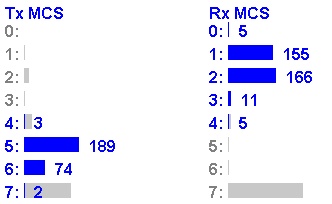R7800 to Galaxy S6 long range
◆**YOUR client device often limits Wi\-Fi range \(not the router\):**Client devices almost always transmit at power levels*well below*that of the maximum permitted \-\- whereas an AP/router may transmit at much nearer to the maximum power level permitted\. The two key reasons why clients limit transmit power is: \(1\) to improve battery life, and \(2\) client Wi\-Fi is mostly downloadAP/router transmit power, not uploadclient transmit power\.[Details](https://www.wiisfi.com/#range)\[§G\]\.> This observation was confirmed by using the[MCS Spy tool](https://www.duckware.com/mcsspy/index.html)\(duckware\.com\), which shows that clients are often transmittingto the AP/routerat lower MCS levelsRx MCS seen rightthan the AP/routerTx MCS seen rightis transmitting to the client\.Have you ever tried to connect to a weak Wi\-Fi network, only to have your client device complain that it failed to connect? And then you wonder,*'but my device can clearly see the Wi\-Fi network name, so why is a connect failing'?*You move slightly closer to the AP/router and your device connects? This is almost certainly caused by the client transmitting at lower power levels than the AP/routeris transmitting\.

◆**Increased range is actually NOT a good thing:**I was reading a post by someone in a forum exclaiming the merits of some new router being installedat an airportbecause range was twice that of the prior Ruckus AP's\. That increased range might be true, but counterintuitively, increased range in denselots of clientsenvironments is absolutely NOT a good thing\. And once analyzed, the reason makes sense\. Everyone on an AP shares that AP's Wi\-Fi bandwidth\. Period\. Which is exactly why you want shorter Wi\-Fi range AND more AP's*in dense environments*\-\- so fewer people per APon different channelsmeans INCREASED Wi\-Fi bandwidth per person\.> TIP: The same principle applies to large homes, where you want everyone evenly connected to several different AP's, not everyone connected to one AP\. When each AP is on its own uniqueand non\-overlappingWi\-Fi channel, this 'creates' more bandwidthas unique Wi\-Fi channels all operate independently and concurrently\.
[](https://youtu.be/GC27vw-Cwd0?t=582) Unrealistic test setup
◆**Beware reviews testing unrealistic 'ideal' situations:**I have seen too many online reviews test to a new router that is only inches awaysee example right, or 'line\-of\-sight' in the same room as the router\. Of course the router should always get maximum speeds in those situations\! But what really matters is the performance of the router in YOUR real world environment, which almost always means the signal must go through walls, floors, deal with local interference, etc\. \-\- which can significantly impact throughput\. Plus, YOUR client devices will likely limit maximum speed capabilities, not the router\.> Online reviews often do demonstrate 'maximum' router capabilities\. But you may experience something different with your client devices\. If you want those fast speeds, now you know how to obtain them \-\- with the router, or an[access point](https://www.wiisfi.com/#accesspoint)\[§19\] installed in the same room,*but NOT literally right next to you\.\.\.***Hey Linus \-\- Radiation hazard\!**Routers must publish a "FCC RF Radiation Exposure Statement" stating the minimum safe distance that people must keep their body away from the router\30 cm≈12 inches\.[Netgear says](https://www.netgear.com/images/pdf/Notification_of_Compliance.pdf)70 cm≈28 inches\. One TP\-Link router manual I checked said 20 cm≈8 inches\. These are minimums \-\- It can't hurt to increase that distance for an extra margin of safety\.
◆**Most vendors implement Wi\-Fi using the SAME chipsets:**There are NOT a ton of companies making Wi\-Fi chipsets\. Instead, there is only a very small handful of companies\. The two giants in the consumer router Wi\-Fi chipset game are Broadcom and Qualcommwith over 50% market share\. Other players are Intel, MediaTek, Realtek, etc\. All chipsets are widely used\. So baring some major bug, all AP/routers within a 'class / generation / wave' are comparable\. So other factors, like vendor firmware/software, quality of support, antenna design, etc, are the differentiator\.> And it even goes further\. For example, Qualcomm makes 'reference designs' \(actual working products\), allowing other companies \(like Netgear\) to then use the reference designs to make their own routers\. An example of this is the Netgear Nighthawk R7800, which is just a "Qualcomm Atheros AP161 reference board"\.But also, each new wave/generation of hardware/chips does seem to perform just a little bit better than prior generations\. So sometimes, just being 'newer' can be better\.
**64\-QAM 3/4, 20 MHz****Wi\-Fi version****Speed**Wi\-Fi 3 \(802\.11a/g\)54\.0MbpsWi\-Fi 4 \(802\.11n\)65\.0MbpsWi\-Fi 5 \(802\.11ac\)65\.0MbpsWi\-Fi 6 \(802\.11ax\)77\.4MbpsWi\-Fi 7 \(802\.11be\)77\.4Mbps
◆**Fully understand where Wi\-Fi speed increases are coming from:**Look at the[PHY speed tables](https://www.wiisfi.com/#phytables)\[§F\] for the*same*64\-QAM 3/4 'modulation and encoding scheme' \(MCS\) for the*same*20 MHz wide channel between Wi\-Fi versions, and you will find only small modest speed increases \(table right\)\.*The core 'encoding' techniques in Wi\-Fi have actually NOT changed that much\.*Instead, the dramatic increases in speeds in Wi\-Fi are coming from:- **Increased channel width**: over 2x \(HT40\), over 4x \(VHT80\), over 8x \(HE160\), or over 16x \(EHT320\)
- **MIMO**: 2x \(2×2[MIMO](https://www.wiisfi.com/#MIMO)\[§7\]\) or 4x \(4×4 MIMO\)
- **Higher MCS levels**: 2x \(Wi\-Fi 4 to Wi\-Fi 6, due to higher QAM encoding\)
The result can easily be an 18x to 36x to 72x improvement in speed from just these other factors\. And if you are operating your device 'at distance', then these factors reduce down to just \(a\) MIMO level and \(b\) channel widthas higher MCS levels can only be used when close to the router/AP\!
◆**Distance from AP really does matter, A LOT \(you WANT full bars\):**Using the[TxRate throughput measurement tool](https://www.wiisfi.com/#speedtest)\[§D\], when my laptop connects to my centralized main house Wi\-Fi 5 routerone room away; 5 GHz; 80 MHz channel; 866\.6 PHY max, I get 'around' 390 Mbps of real throughputleft graph below\. And if I move farther away, throughput drops to around 200 Mbpsdue to more floor\+wall obstacles\. But when connecting to the AP*in the same room*, I get 'around' 730 Mbps of real throughputright graph below\. Throughput is MUCH faster when using the closer AP\.*In Wi\-Fi, distance matters, a LOT\!*Admittedly, very few people will actually notice this speed difference, but if your goal is maximum real Wi\-Fi throughputand minimum latency, then you now know how to accomplish that\.> When I repeat this speedtest exercise with Wi\-Fi 6 client devices and Wi\-Fi 6 APusing 160 MHz channels, I get 'around' 1800 Mbps of real throughput to the 'same room' AP\.
◆**Wi\-Fi also works bestfor everyone elsewhen YOU are physically close to an Access Point:**It is all aboutreducingTIME spent on the channel\. Wi\-Fi*does*work through walls, floors, etc\., and at distance, but often at reduced speeds and reduced channel widthsmore time on the channel\. However, Wi\-Fi works BEST \-\-*for you and everyone else*\-\- when YOU are physically close to an access point\.[](https://www.wiisfi.com/#accesspoint)
If you want the best Wi\-Fi possiblefor you and others, find a way to add an[access point](https://www.wiisfi.com/#accesspoint)\[§19\]wired/Ethernet back to your main routerin the same room where you spend most of your time \-\- like in a home office\. Why is this best? Because:- You get the fastest Wi\-Fi PHY speeds possiblereal throughput\- directly benefiting you
- This frees up TIME on the channel for all other Wi\-Fi devices \- indirectly benefiting everyone else
And the need to be close to an AP is critical if you have Gigabit Internet\. To actually achieve that speed wirelessly, you want a Wi\-Fi 6/6E access point in the room with you so that your client device can obtain an excellent[PHY speed](https://www.wiisfi.com/#PHY)\[§4\] with a real throughput of just over 1 Gbps\. You must be close to an AP if you want to take advantage of Wi\-Fi features that require a high SNR:- higher QAM encodings like 1024\-QAM and 4096\-QAM
- [wider channel widths](https://www.wiisfi.com/#channelwidthrange)\[§J\]
◆**You still want the fastest Wi\-Fi speeds possible, even with 'slow' Internet:**By minimizing the amount of time your devices are on Wi\-Fiby being very fast, that frees up TIME for other*much slower client devices at range*operating on the same channel to use Wi\-Filike a Wi\-Fi 4 camera 'at distance'\.◆**Your physical location impacts your Wi\-Fi experience:**Test a Wi\-Fi router and client device at your location and obtain great/good/fair/horrible results and everyone else will experience the same results from that router, right? No, not necessarily\. Some people will see very different results, but how is that possible? The root cause is often a very different 'noise floor'spectrum usagebetween the two physical locations\. See the[Noise Floor](https://www.wiisfi.com/#SNR)\[§K\] appendix\. Stated another way, channel usage all around you will impact how wellor notyour Wi\-Fi works\.
> For example, you may easily obtain QAM\-1024 data ratesbecause you experience a low noise floor, but your friend with the same setupbut at a different locationmay never get QAM\-1024 data ratesbecause they experience a high noise floordue to[adjacent channel interference](https://www.wiisfi.com/#spectralmasks)\[§P\], or some other factor\.The spectrum usage*all around you*from ALL of your neighborsfrom Wi\-Fi, and other sources, will impact how you perceive and experience Wi\-Fi*at your location*\. Don't assume that everyone else experiences Wi\-Fi the same way that you experience it\.
◆**Wi\-Fi will*never*fully compete with wired Ethernet:**Ethernet uses a*dedicated full\-duplex*channel for every device, so each connected device individually obtains the maximum speedthis then becomes a potential capacity multiplier\. Whereas Wi\-Fi uses a*shared half\-duplex*channel, where all devices connected SHARE a single common maximum speed\.◆**You get what you pay for:**Most dirt\-cheap inexpensive routers and access points<$50will have performancethroughputlimitations\. Don't expect top level sustained performancelike 80% of PHYfrom an entry level router/AP\. So keep this in mind when looking for new equipment\. But if you don't need top level performanceright next to the router you are OK with only a couple hundred Mbps max, then a cheap router could be a great value, for you\.
◆**If you 'cut the cord', you likely have an unused 2\.5 Gbps backhaul in your house:**If you 'cut the cord' with your cable TV companyand some coax cables 'in the walls' are now unused, then you actually have an unused 2\.5 Gbps wired/ethernet backbone in your house, which can be used to add a Wi\-Fi Access Point or Mesh Node wired/Ethernet back to your main router\. Just use/install a couple of[MoCA adapters](https://www.wiisfi.com/#moca)\[§E5\]\. See also[Case Study \#4](https://www.wiisfi.com/#mocacordcutter)\[§E13\]\.
22\. Recommendations
**Be very critical:**There is no point in replacing your router/AP if PHY speeds to/from your wireless devices do NOT improveby at least some reasonable amount\. So, be very critical\. Take note of[client PHY speeds](https://www.wiisfi.com/#PHY)\[§4\] and[throughput speed tests](https://www.wiisfi.com/#speedtest)\[§D\] before and after an upgrade\. If you see an improvement in speeds you wanted, great, job accomplished\! However, if not, then you have to ask the serious question: Did you just spend a bunch of money and not get the benefit/improvement you needed/wanted?> When updating a router, verify that client device PHY speedsand throughput speed testsactually increase,*especially for devices 'at range'\.*
When buying a new router,*what features do you need to best support 1 Gbps throughput wirelessly?***The attainable goal:**The goal is to find a the best Wi\-Fi speeds*for the best price*namely, the best value\. And today that means Wi\-Fi throughput 'around' 1 Gbps for around $200\. To achieve this, you will need modern Wi\-Fi 6or laterdevices and*be close to the router/AP*\.\.\.
> *For example, if you have high\-end Wi\-Fi 6 client devices supporting HE160 and upgrade your VHT80 Wi\-Fi 5 router to an HE160 Wi\-Fi 6 routerlike those recommended below, I would expect to see maximum PHY speeds increase from 866 Mbps to 2400 Mbps and over 1 Gbps throughputstanding right next to the router, and then only modest speed increases over Wi\-Fi 5 'at distance'\. Warning: For Apple, only[iPhone 15 Pro](https://support.apple.com/guide/deployment/wi-fi-ethernet-specifications-apple-devices-dep268652e6c/web)\(apple\.com\) class devices and later support HE160 in Wi\-Fi 6\.*
**The features you WANT in a new Router/AP:**Virtually all Wi\-Fi devices todaylaptops / tablets / smartphones / smart tv's / etcare STILL only 2×2 MIMOat best; some are even still at 1×1\. And THAT limits the PHY speed at which those devices will connect to*any*router/APnot the max speed of the router\. However, to maximize range and throughput from ALL of your devices, get a 'whole house' router/AP with a*minimum*of:- 4×4 MIMO\- increases signal quality, reliability, and range for ALL devices, especially 2×2 MIMO client devices\. If you require top\-most speeds, and best range, get a 4×4 MIMO router \(avoid 2×2 or 3×3\)\. Watch why[4×4 is better than 2×2](https://youtu.be/fiPemgOGrfM?t=523)\(youtube\.com\)
- DFS channels\- you need a router that supports ALL 5 GHz 80 MHz DFS channels, to increase the likelihood of NOT sharing a channel \(and therefore bandwidth\) with a neighbor, and needed for great 160 MHz channel support\.
- HE160 \(160 MHz channels\)\- you need a router that supports HE160, because support for 160 MHz channels in Wi\-Fi 6 client devices is now very common \(so you want to take advantage of that\)\.
- Multi\-Gigabit Ethernet\- you want a router with a multi\-gigabit WAN port \(eg: 2\.5 Gbps, or higher\)\. If your Internet speeds are not above 1 Gbps, then a 1 Gbps WAN port is just fine \-\- but expect max throughput around 949 Mbps\.
- A mid\-range Wi\-Fi 6 \(802\.11ax\) router\-this is the best VALUE today \(October 2025\) \-\- expect to spend 'around' $200 plus/minus $50\. In general, avoid routers below $100 \(the low end\) and above $300 \(the higher end\)
- Beamforming\- improves signal strength, which increases the range at which devices stay at fast speed \-\- beamforming 'should' be a standard feature of any new mid\-range Wi\-Fi 6 router\. Avoid any router without this critically important feature\.
- Access Point Mode\- look for a router that supports "access point mode" \(most routers will\)\. Because when you do upgrade to a newer version of Wi\-Fi years from now, you may want to reuse the old router as an 'AP' in your new network \(and not have the old router sit on a shelf unused\)\.
- L2TP VPN Server\- Completely optional, and only present in better routers, but having the ability to turn on a 'VPN server' in your main routerand don't confuse with L2TP VPN Client, allowing you to remotely 'connect to' and fully access your home network is a VERY NICE feature to have\. For example, you are on a trip and use your Windows PC to VPN into your home router/network to access/control NAS, a managed PoE switch, etc\. Note that you want a router that supports newer more robust VPN Server protocols like "L2TP/IPSec" \-\- and avoid older outdated protocols, like PPTP, with known vulnerabilities\.
- Wi\-Fi Certified\- not absolutely required, but if the router is certified, this guarantees "interoperability, security, and reliability\."[Product Search](https://www.wi-fi.org/product-finder)\.Also, watch out for routers certified to a lower specification than expected \(eg: a 802\.11ax router certified for only 802\.11ac is a red flag\)\. Interestingly, Netgear routers are not certified\.
- well\-known brand\- Stick with the well known established brand names, because you want a company that is capable of \-\-*and has an established history of*\-\- fixing security vulnerabilities and releasing new firmware*in a timely manner*\.
**Critical features to have:**The most important criteria to look for in a new router are \(1\) 4×4[MIMO](https://www.wiisfi.com/#MIMO)\[§7\], \(2\)[DFS channel](https://www.wiisfi.com/#DFS)\[§15\], and \(3\) HE160 support\. This eliminates so many entry\-level routers from consideration,as there are a LOT of cheap non\-DFS \+ 2×2 MIMO \+ HE80 routers out there\.> Also, it is easy to find these criteria in high\-endrather expensiverouters, but the real challenge is to find that combination in an*affordable mid\-range*router\!
**Purchase TIP:**Always buy electronics from a vendor with a great return policy\. For purchases on Amazon, look for "Sold by Amazon\.com" under the "Add to cart" button, because Amazon itself has a great return policy\.Third party sellers on Amazon may have a very different \(and much more restrictive\) return policy \-\- so be careful\.>  **Use Coupons\!**And don't forget tokeep an eye out for clickable 'coupons'example seen righton Amazon product pages\. You do NOT get the discount unless you click on the 'Apply coupon' link\. Also, keep an eye out for a 'promo code' that must be clicked on to obtain a discount\.
★**Wi\-Fi 6 4×4 Router Recommendations:**Most people will find a Wi\-Fi 6 4×4 router to be a great value today\. Find a*mid\-range*router that supports 4×4 MIMO for*both*the 2\.4 GHz and 5 GHz bands:> **Wi\-Fi 6 4×4 Recommendations**[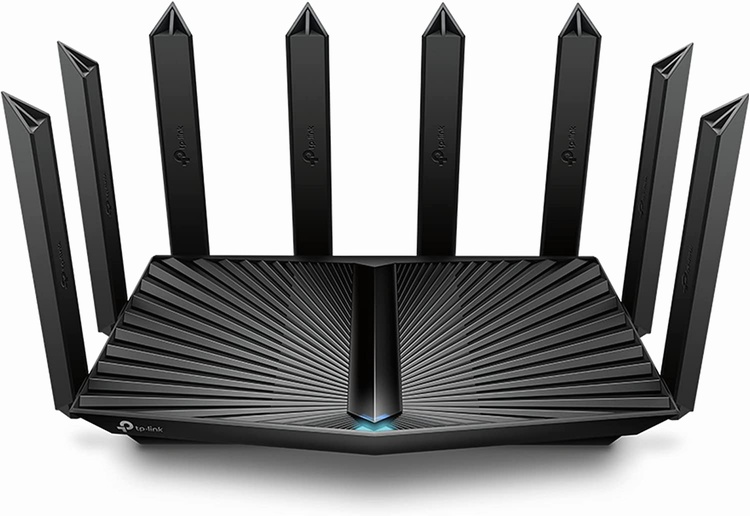 TP\-Link Archer AX80](https://amzn.to/3S4hYS7)Now ≈**$170** ✓ WAN: 2\.5 Gbps Ethernet ✓ Max Throughput: 1\.8\+ Gbps ✓ 2\.4 GHz: 4×4 MIMO ✓ 5 GHz: 4×4 MIMO ✓ DFS channels ✓ HE160 [specifications](https://www.tp-link.com/us/home-networking/wifi-router/archer-ax80/#specifications)\(tp\-link\.com\) [ GL\.iNet Flint 2](https://amzn.to/3D6HJNZ)Now ≈**$170** ✓ WAN: 2\.5 Gbps Ethernet ✓ Max Throughput: 1\.8\+ Gbps ✓ 2\.4 GHz: 4×4 MIMO ✓ 5 GHz: 4×4 MIMO ✓ DFS channels ✓ HE160 [datasheet](https://static.gl-inet.com/www/images/products/datasheet/mt6000_datasheet_20240325.pdf)\(gl\-inet\.com\)[ Asus RT\-AX88U Pro](https://amzn.to/3vJDpQI)Now ≈ $230 ✓ WAN: 2\.5 Gbps Ethernet ✓ Max Throughput: 1\.6\+ Gbps ✓ 2\.4 GHz: 4×4 MIMO ✓ 5 GHz: 4×4 MIMO ✓ DFS channels ✓ HE160 [tech specs](https://www.asus.com/us/networking-iot-servers/wifi-routers/asus-gaming-routers/rt-ax88u-pro/techspec/)\(asus\.com\)
★**A Wi\-Fi 6E 4×4 recommendation:**There is currently NOT a Wi\-Fi 6E 4×4 recommendation because a MUCH better solution today is to get a Wi\-Fi 7 4×4 router with 6 GHz band support insteadsee section further below\.**Wi\-Fi 6E 2×2 Value**[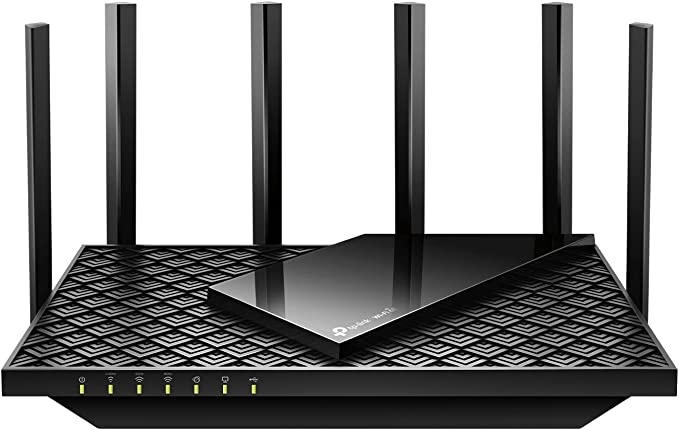TP\-Link AXE75](https://amzn.to/48Mq8VY)Now ≈**$113**
1\.0 Gbps Ethernet
2\.4 GHz: 2×2 MIMO
5 GHz: 2×2 MIMO
6 GHz: 2×2 MIMO
✓ DFS channels
✓ HE160
[specifications](https://www.tp-link.com/us/home-networking/wifi-router/archer-axe75/#specifications)\(tp\-link\.com\)★**A Wi\-Fi 6E 2×2 honorable mention:**However, there is a 2×2 'honorable mention' \-\- the[TP\-Link Archer AXE75](https://amzn.to/48Mq8VY)\(amazon\.com\)seen rightdeserves to be pointed out due to the low cost and value it offers\. It is an entry\-level Wi\-Fi 6E router supporting ALL three Wi\-Fi bands2\.4 GHz, 5 GHz, and 6 GHz, 160 MHz channelsHE160, and DFS channels\. And of note is that it only has 1 Gbps WAN\+LAN portsnot 2\.5 Gbps\.> However, let's also be very realistic\. If you have less than 1 Gbps Internet and don't need extended rangeor if you do, are willing to install as a main router and as an access point elsewhere where needed, then this router, at a very reasonable price, is actually a FANTASTIC value, due to support for all three Wi\-Fi bands2\.4 GHz, 5 GHz, 6 GHz\.Another 'honorable mention' is the[TP Link Archer AXE95](https://amzn.to/3vrF4ec), but availability of this router always seems very limited\. It is very similar to the AXE75 above, but adds \(1\) 4×4 to only the 5 GHz bandother bands remain 2×2, and \(2\) a 2\.5 Gbps WAN port\.[specifications](https://www.tp-link.com/us/home-networking/wifi-router/archer-axe95/#specifications)\(tp\-link\.com\)\.
**Wi\-Fi 7 4×4**[ TP\-Link BE800](https://amzn.to/3S45hqi)Now ≈**$373**
✓ 2\.4 GHz: 4×4 MIMO
✓ 5 GHz: 4×4 MIMO
✓ 6 GHz: 4×4 MIMO
✓ DFS channels
✓ HE320 \+ HE160
[specifications](https://www.tp-link.com/us/home-networking/wifi-router/archer-be800/#specifications)\(tp\-link\.com\)
★**A Wi\-Fi 7 4×4 recommendation:**4×4 MIMO Wi\-Fi 7 routers can be expensive\. If you can afford it, the[TP\-Link BE800](https://amzn.to/3S45hqi)\(amazon\.com\) at around $400 is 'recommended'\. It has incredibly nice specs: \(a\) 10 Gbps WAN port, \(b\) 2\.5 Gbps LAN ports, \(c\) a 10 Gbps SFP\+ port, and \(d\) 4×4 MIMO on all three bands2\.4 GHz, 5 GHz, 6 GHz\.> *I personally find it very hard to justify this cost\. Because for the same price, you can purchase two Wi\-Fi 7 honorable mentions \(below\), configure one as your main router, and other other as an access point wired/Ethernet to your main router \-\- and when both are placed correctly in your home, have more of a positive impact on throughput than a single expensive router\.But admittedly, a single router is*very convenient*\. You just need to decide on a solution that works best for your needs and your budget\. Instead of a single expensive router, think**Wi\-Fi "AIR"**\(**A**rray of**I**nexpensive**R**outers\)\.*
**Wi\-Fi 7 2×2 Value**[ TP\-Link BE550](https://amzn.to/3O27kdi)
Now ≈**$177**
✓ WAN\+LAN: 2\.5 Gbps Ethernet
2\.4 GHz: 2×2 MIMO
5 GHz: 2×2 MIMO
6 GHz: 2×2 MIMO
✓ DFS channels
✓ HE320 \+ HE160
[specifications](https://www.tp-link.com/us/home-networking/wifi-router/archer-be550/#specifications)\(tp\-link\.com\)
★**A Wi\-Fi 7 2×2 honorable mention:**There is a standout 2×2 MIMO Wi\-Fi 7 routerso missing 4×4 MIMO, but supporting all other wanted features that deserves consideration \-\- the[TP\-Link BE550](https://amzn.to/3O27kdi)\(amazon\.com\)seen right\-\- mainly because the priceat around $200is around*half the price*of many other comparable Wi\-Fi 7 routers AND because*ALL WAN\+LAN Ethernet ports are 2\.5 Gbps*\.> The 2\.5 Gbps ports are a huge added bonus \-\- because for most people, there will now be no additional expense$$$in buying an external 2\.5 Gbps switch\. The four 2\.5 Gbps LAN are enough for connecting NAS storage, a desktop computer, and an access pointor two\.But the flip side of '2\.5 Gbps Ethernet'instead of 5 or 10 Gbps Ethernet seen in very high end routersis the 2\.5 Gbps limit\. Technically, maximum Wi\-Fi 7 MLO throughput should be well above 3 Gbps, so throughput will be limited by 2\.5 Gbps Ethernet\. But honestly, for most people, that limit is more than acceptable because their ISP speeds are not above that\. > **TIP:**TP\-Link has come out with 'Pro' variations of some routers, whichupgrades the WAN port from 2\.5 Gbps to 10 Gbps\. For example, the[TP\-Link BE550 Pro](https://amzn.to/3VXRiFw)\(amazon\.com\) at around $250\. TP\-Link is clearly targeting 'value' customers with this routerwith ISP speeds less than 2 Gbps\-\- and it looks like they hit a home run\.
[](https://amzn.to/4fzTyK2)
★**TIP: Amazon Best Sellers:**Check out Amazon's[Best Selling Routers](https://amzn.to/4fzTyK2)list \(amazon\.com\)\. TP\-Link, GL\.iNet, Asus, and Netgear are the brands of routers that dominate this list\.And TP\-Link routers occupy many of the top spots on Amazon's list, because TP\-Link often offer a ton of valuefeatures for the money, and are often highly rated by customers\.
❌**Why no 'entry\-level' router recommendation?**Mostly due to no[DFS channels](https://www.wiisfi.com/#DFS)\[§15\], no[MIMO 4×4](https://www.wiisfi.com/#MIMO)\[§7\], and no 160 MHz channel support\. My advice is to generally avoid any AP/router that does not have all of these features\. Also, I learned a long time ago that 4×4 MIMO offers better signal strength and speeds 'at range' than a 2×2 MIMO router\. So those features are mandatory for me when looking for a single[centrally placed](https://www.wiisfi.com/#placement)\[§P\] 'whole house' router\.> Also, don't expect top notch performancethroughputfrom some cheap routers\. While Wi\-Fi specifications may be seem similar, run a[speed test](https://www.wiisfi.com/#speedtest)\[§D\], and throughput results can be disappointing\. ★**BUT, there is a 'best seller' honorable mention:**It is interesting to point out that a 'low cost'["Best Seller"](https://amzn.to/4fzTyK2)\(amazon\.com\) router on Amazon is only an entry level[TP\-Link AX55](https://amzn.to/3ZKRAR2)\(amazon\.com\) for 'around' $80\. It DOES come with the wanted DFS channels and 160 MHz channels support, but it lacks 4×4 MIMOit only has 2×2 MIMOand only comes with a 1 Gbps WAN port\.[This review](https://www.tomsguide.com/computing/routers/tp-link-archer-ax55-review)\(tomsguide\.com\) found Wi\-Fi speeds around 800 Mbps\.**Be practical:**But let's also be practical\. If you lower throughput expectationsor can't spend hundreds, or you don't need a 'whole house' routereg: looking for an AP for one room, then this honorable mention could be a great valuefor you\. OR, even a $28 entry level router configured as an access point and wired/Ethernet back to your main router, installed in a single room, to provide Wi\-Fi only in that one roomlike for a kids play room, should be able to provide at least 230 Mbpsand possibly much higher; depends upon routerWi\-Fi connectivity to client devices\. Not great, but also not bad for $28\.[Source](https://www.duckware.com/txrate/index.html)\(duckware\.com\)\. **Analogy:**Going back to the transportation analogy, buying an very low end router is like buying a moped\. It can work well, providing you with slower basic transportation, but don't expect it to have all the speed and features of a car\.
❌**Why no 'high\-end' \(expensive $600\) 4×4 router recommendation or honorable mention?**Because a single mid\-range router around $200 is actually good enough for most people\. And when not, consider this: I find it impossibly hard to justify a very expensive*single*Wi\-Fi router for $600 that you then have to place perfectly in a house, when for the same price, you can obtain three mid\-range routerseach around $200and then place around your house precisely where they are needed the mostwith one as the main router and the other two in[Access Point mode](https://www.wiisfi.com/#accesspoint)\[§19\] and wired/Ethernet back to the main router\.> Plus, you actually don't want everyone in a larger home connected to a single router/AP channel\. Instead, you want multiple access points, with each AP operating on*a different Wi\-Fi channel*\. The result is that traffic to each AP can happen concurrentlyinstead of serially as it would be to a single router\. In effect, increased Wi\-Fi capacity\.Most people will obtain FASTER network throughput via a 'recommended' router in the same room as they are inconfigured as an access point and wired/Ethernet back to a main routerthan they will from an expensive $600 main router one room away\! **Analogy:**An expensive router is like a Ferrari\. When your family needs transportation, do you buy one Ferrari for the whole family to useand share\!, or do you buy several vehicles for everyone to useindependently\-\- for the same price?
❌**Why no Mesh Wi\-Fi Network recommendation or honorable mention?**Because of shared Wi\-Fi channel contention between satellite mesh nodes\. Also, because virtually all mesh systems don't provide 4×4 MIMO to client devices\. Most mesh networks,*providing only 2×2 MIMO to client devices*, are actually then quite 'expensive' as compared to a router \+ AP combination*both providing 4×4 MIMO*\.> I prefer wired/Ethernet backhauls as they can quite simply be much faster than a Mesh systems wireless backhaul\. When multiple users are all using Wi\-Fi at the same timeeach to their own AP, wired/Ethernet backhauls from multiple access points can all operate*concurrently*in parallel\. But a mesh wireless backhaul is a shared mediumbetween mesh nodes, so concurrent traffic must be serializedand is slower\.Most people will obtain FASTER network throughput via a 'recommended' router in the same room as they are inconfigured as an access point and wired/Ethernet back to a main routerthan they will from an expensive $900 mesh Wi\-Fi node one room away\! However, mesh networks can be incredibly convenientjust plug in and go, and if you want to go down that path, see[Mesh Wi\-Fi Network Systems](https://www.wiisfi.com/#mesh)\[§20\]\.**Analogy:**Going back to the transportation analogy, mesh networks are like sharing a taxi with someone else \-\- you will definitely get to your destination, but there may be an intermediate stopmesh node\. Not as fast as having your own vehicle and taking a direct routeusing an AP\.
[](https://www.wiisfi.com/#accesspoint)
**TIP: Adding a new Access Point where it is needed most is often the best solution:**For most people, one great router*centrally located*in the home is all that is really needed\. However, if you have a wireless deviceor twothat absolutely must always have the fastest wireless possiblyno contention with other wireless, or have a large home, simply add an[access point](https://www.wiisfi.com/#accesspoint)\[§19\]wired/Ethernet to your main routerfor those devices\.> For example, place the main router some place centrally located in the house \-\- and then add an access pointwired/Ethernet to the main routerin your home office\.TIP: Don't forget to look into 'Enterprise' grade Access Points\. Ubiquiti sells a line of 4×4 access point products that DO support ALL 5 GHz channels, and are very reasonably priced\. For example, the UniFi 6 Pro which is a 4×4 Wi\-Fi 6 AP\.
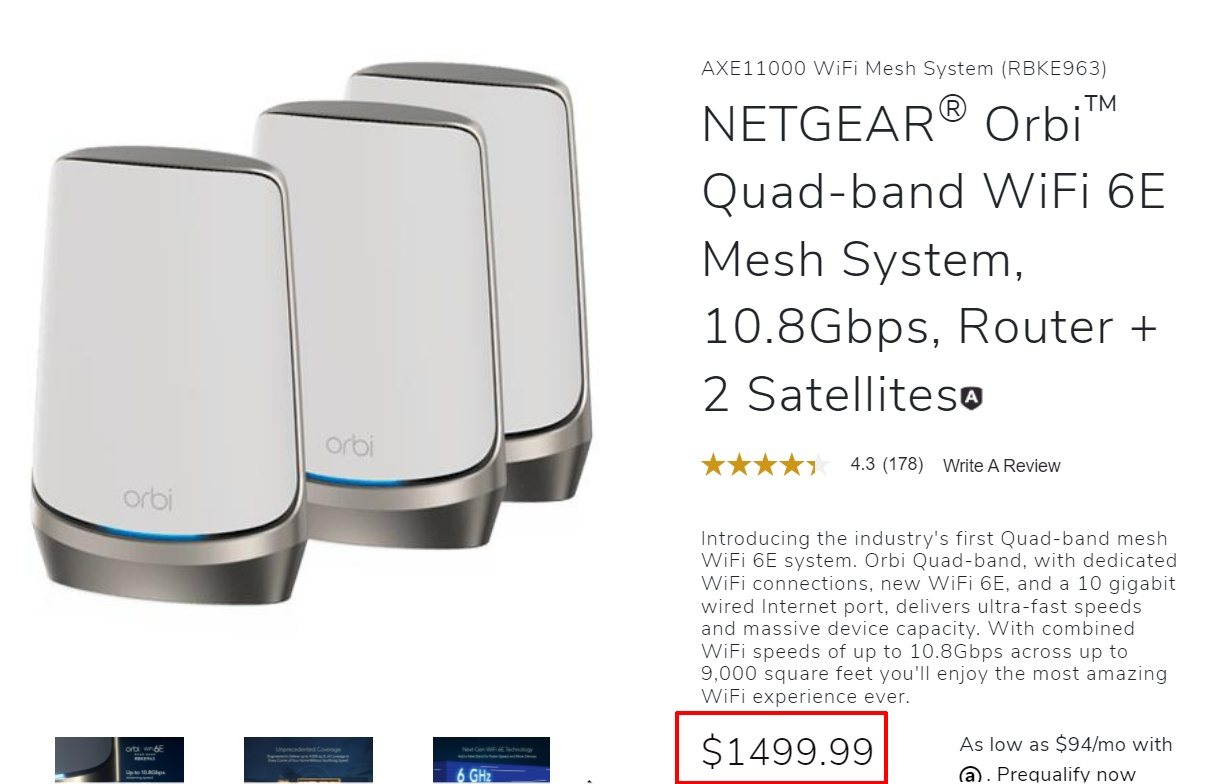 Mesh can be VERY expensive
**A huge caveat \- COST:**The cost of the latest and greatest*consumer\-grade*not even enterprise\-gradeWi\-Fi routers approaching $600 is insane\. And $1500 for a mesh systemseen right\-\- talk about pouring money down the drain\!You would be FAR better off spending that money on several high\-grade 4×4 APs, provided the APs can be wired/Ethernet to your existing gigabit router and provided each AP can be assigned a unique channel\.
Then distribute the AP's around so that*everyone*in the house gets the maximum PHY speed possible\!
> **TIP:**The hidden[YEARLY cost of electricity](https://www.wiisfi.com/#costofalwayson)\[§E4\] for 24x7 'always on' devices can really add up\.
**Beware Combo \(all\-in\-one\) Modems \+ Routers:**These 'combo' devices are a great convenience and do work, but the problem with these units is that firmware updates are under the control of your ISPyou are NOT able to update/change firmware yourself\. Or if you can update the firmware, the version often lags the non\-combo hardwareby a lot\. Besides, you often need to update just the router or just the modem, but are now, with a combo unit, forced to upgrade both at once\.> One example: Compare Netgear's R7800routerto the C7800router \+ cable modem\. With the R7800, you have full control over firmware updates\. But with the C7800, you have NO control and Netgear states*"Firmware upgrades are pushed down by your ISP"*\. But if your ISP is a small regional player, you might get NO firmware updates at all\. Or what if the ISP pushes new FW to your combo device and you run into a problem \-\- It is then impossible to revert the FW to a prior version, which can turn into a major problem\.Worse yet is that some big ISP's refuse to push any new firmwareto 'customer owned' cable modems\! I know this from first hand experience with Spectrum outside of Orlando FL\. I bought a Netgear CM1000V2 and noticed that it was still on V1\.0 firmware\. I contacted Spectrum and they refused to do anything about it since the modem is 'customer owned'and they then emphasized that I should be using*their*modem instead, which must be rented\.
**Remember to properly setup your new router:**After installing a new router,[setup the router](https://www.wiisfi.com/#setup)\[§16\]\. Manually configure the 5 GHz band to use a DFS channel\. I have never seen the 'auto' channel setting in a consumer router auto select a DFS channelso that is something you must manually do\. But you definitely want to use a DFS channel, because*those will be the most unused channels\!***Newer hardware is often better 'at range' then older hardware:**I find that new, next generation routers often perform better \-\- at distance \-\- than the prior generation of routerslike Wi\-Fi 6 over Wi\-Fi 5 over Wi\-Fi 4\. Clearly, improved digital signal processing and RF architectures in newer chipsets plays a major role\. Keep this in mind when making purchasing decisions\. Examples:
> Video:[Newer hardware is demonstrably better than older hardware](https://www.youtube.com/watch?v=sQy2nzI20ME&t=181s)\(youtube\.com\)\.*"Broadcom's RangeBoost technology provides up to 9 dB of receiver sensitivity improvement by utilizing advanced signal processing techniques coupled with unique receiver architecture \.\.\.\. will benefit from an expanded coverage area"*\-\-[Source](https://www.broadcom.com/company/news/product-releases/11961)\(broadcom\.com\)\. This can also be seen in the "Wi\-Fi Reception Sensitivity" numbers published by TP\-Link\. Newer hardware is often just clearly 'better' than older hardware\.
**Client device Wi\-Fi capabilities also matters, a LOT \-\- so buy the 'right' client devices\!**Since client device capabilities often limit Wi\-Fi speeds and not the router, pay attention to the Wi\-Fi options when purchasing brand new devices\. TodayOctober 2025, you want a client devicephone/tablet/laptop/etcsupporting a*minimum*of: \(a\) Wi\-Fi 6E, \(b\) HE160 and \(c\) 2×2 MIMO\.**Researching products \-\- how to make sense of online customer reviews:**No matter what product you are researching, you will*always*find some bad reviews\. How I deal with this is to throw out and ignore all the rave reviews and all the horrible reviews, and instead focus on what everyone else is saying about the product\.
23\. Wrapping it all up
Wi\-Fi is messy \-\- it can be hard to understand, is full of gotchas, caveats, contradictions, tradeoffs, a ton of hype, and is constantly changing and improving\. And yet, and spite of all of that, Wi\-Fi can work remarkably well,*provided that you follow just a couple of very simple 'high\-level' rules:*
 You*want* 'full bars'
- use a Wi\-Fi 6or laterrouter,[properly placed](https://www.wiisfi.com/#placement)in your home
- use Wi\-Fi 6or laterclient devices
- be as close to the router/AP as possible \-\-*you want 'full bars'*
- have the fewest obstacleswalls, floors, etcpossible between client\+router
- if you don't have 'full bars' signal strength, add an[Access Point](https://www.wiisfi.com/#accesspoint)\[§19\]
If you follow these 'rules', you 'should' get near 1 Gbps of Wi\-Fi throughput when right next to the router/AP\. But you may not\. It all depends\. If you pay attention to the details, you can dramatically improve your chances of successfully obtaining 1 Gbps throughput\.\.\.**What is needed for 1 Gbps Wi\-Fi throughput \(most of the time\):**In general, keep the following points in mind, and you can achieve 1 Gbps throughput over Wi\-Fi*to the 'typical' 2×2 MIMO client device*:
- Use*modern*devices \-\- older devices may not have the 'horsepower' to sustain high throughput
- In Wi\-Fi 5, the only way to obtain 1 Gbps throughput is via 160 Mhz channels, which most Wi\-Fi 5 client devices do NOT supportand if supported, you need to be very close to the router\.
- In Wi\-Fi 6, you CAN obtain 1 Gbps throughput via an 80 MHz channel in 5 GHz, but you need great signal strengthtopmost 1201 PHY speed, by being very close to the router\.
- But you WANT to use 160 MHz channelsinstead of 80 MHz channelsin 5 GHz becauserequires DFS channel supportthat will extend the range at which you can successfully obtain 1 Gbps throughput\.But for Apple, only[iPhone 15 Pro](https://support.apple.com/guide/deployment/wi-fi-ethernet-specifications-apple-devices-dep268652e6c/web)\(apple\.com\) class and later devices support HE160\.
- But using 160 MHz channels in 5 GHzthere are only twocould either \(1\) work just fine, or \(2\) be impossible \-\- due to potential DFS channel conflicts\.
- Due to this DFS channel uncertainty, using Wi\-Fi 6E6 GHz bandis much bettercan always use 160 MHz channels, but only if you are close to your router, and both client\+router must fully supports Wi\-Fi 6E\. Also, Wi\-Fi 6E routerswith all the features you really wantcan be very expensive AND range of 6 GHz channels is reduced as compared to 5 GHz channels\.
- And in all cases above, you WANT a 4×4 MIMO routerinstead of 2×2 MIMO, as that helps to extend the range at which you can successfully obtain 1 Gbps throughput\.
**NEED \(not just want\) 1 Gbps\+ Wi\-Fi throughput?**If you NEEDand not just want1 Gbps Wi\-Fi throughput, then you need a Wi\-Fi 6E/7 router\+client so that you can 100% guarantee that a 160 MHz 6 GHz band channel can*always*be used\. The challenge today is \(1\) finding a Wi\-Fi 6E router, with 'recommended' 4×4 specs, at a great pricethere is a 2×2 MIMO honorable mention in the chapter aboveand \(2\) do you have client devices that support Wi\-Fi 6E?With Wi\-Fi 6E and a 160 MHz 6 GHz channel, you should be able to easily get 1 Gbps throughput in the same room as the router/AP, and 'likely' get 1 Gbps throughput even one room away through a single walland if not, then something close to 1 Gbps speeds one room away\. Also, remember also that 6 GHz band channels have less range than 5 GHz channels\!
> Wi\-Fi 7 2×2 Value[ TP\-Link BE550](https://amzn.to/3O27kdi) Now ≈**$177** ✓ WAN\+LAN: 2\.5 Gbps Ethernet 2\.4 GHz: 2×2 MIMO 5 GHz: 2×2 MIMO 6 GHz: 2×2 MIMO ✓ DFS channels ✓ HE320 \+ HE160 [specifications](https://www.tp-link.com/us/home-networking/wifi-router/archer-be550/#specifications)\(tp\-link\.com\) And then of course, with increasing distance and obstacles, Wi\-Fi speeds will decrease quickly\. Add Wi\-Fi 6E[access points](https://www.wiisfi.com/#accesspoint)\[§19\], wired/Ethernet back to the main router, where needed to again guarantee 1 Gbps speeds\.**Wi\-Fi 6:**You can use a Wi\-Fi 6 router and 160 MHz 5 GHz channels to obtain 1 Gbps speeds, but since DFS channels are then used, there is a risk that the router will 'kick you off' the DFS channel, resulting in the router reverting to an non\-DFS 80 MHz channel\. For Wi\-Fi 6 80 MHz channels, you CAN still get 1 Gbps throughput, but only when very close to the router/AP, and most likely not through any obstaclesexpect only 700\+ Mbps one room away\. **Stick your toes into Wi\-Fi 7 waters?:**The[TP\-Link BE550](https://amzn.to/3O27kdi)\(amazon\.com\), seen right, is a Wi\-Fi 7 router, and stands out from all its competitors due to the value pricing around $200\. Virtually all other Wi\-Fi 7 routers start out at around double that\. The BE550 is only 2×2 MIMO, has Wi\-Fi 6E built\-in, and comes with Wi\-Fi 7 MLO5 GHz\+6Ghzfor future Wi\-Fi 7 clients\.
**WANT great throughput \(often 1 Gbps; sometimes less\) \+ best value:**If you want the best value and fastest Wi\-Fi speeds that comes with, then it is hard to argue against a mid\-range[recommended](https://www.wiisfi.com/#recommendation)\[§22\] Wi\-Fi 6 4×4 MIMO router\. I expect that most readers of this paper will fall into this category\. A single well placed Wi\-Fi 6 router in a home using 80 Mhz channels can deliver 1 Gbps speeds right next to the router, 700\+ Mbps speeds in the next room, maybe 300\+ Mbps two rooms away, and so on\. For what most people use the Internet for, these Wi\-Fi speeds are very respectable\. And as a bonus, if you are fortunate enough that 160 MHz channels in 5 GHz can be usedpotential DFS channel issues, then nearly double these speeds is possibleonly for 160 MHz capable client devices\.> And adding a Wi\-Fi 6[access point](https://www.wiisfi.com/#accesspoint)\[§19\]wired/Ethernet back to the main router, can guarantee 1 Gbps Wi\-Fi throughput somewhere else in the house\.
**4×4 MIMO:**You*want*a router with 4×4 MIMO because that gives a small dB boost to both transmitted and received Wi\-Fi signals\. Often times, that means a slightly better MCS level can be used for 'at range' devices, which then directly means slightly better throughput\. If you can live without that small boost in range/speeds, then there is nothing wrong with a modern 2×2 MIMO router, especially if cost is a factor for you, and especially if most Wi\-Fi use will be 'near' to the router\.> **Why I keep pushing 4×4 MIMO:***My personal experience over many many years of testing is that4×4 MIMO routers 'at range' regularly significantly outperform 2×2 MIMO routers\.*For example, I have a test setup going 40 feet through three walls, a closet full of stuff, and a major obstacleHVAC air handler, where real Wi\-Fi measured throughput in 5 GHz160 MHz channelcan either be 300 Mbpsa 2×2 MIMO AP, or 600 Mbpsa 4×4 MIMO AP\.
Extra 1: Ethernet / PoE \(Power over Ethernet\)
 Cat 5e \- notice the different twist rates?
**Ethernet:**[Ethernet](https://en.wikipedia.org/wiki/Ethernet)\(wikipedia\.org\) in 1973 started out at 10 Mbps running over a 'thick' coax cable, with devices tapping into a single common coax cable run\. It worked fine, but was often problematic as 'cable faults' would 'take down' everyone connected to that single coax cable run\.[Source](https://www.flukenetworks.com/blog/cabling-chronicles/ethernet-cable-history)\(flukenetworks\.com\)\.In the late 1980's, Ethernet quickly changed over to 'twisted pair' wiring, a cable with four twisted pairs, or 8 wires \-\- connected to hubs\. Today, everyone uses much smarter 'switches'\. It was MUCH more robust since with 'Category cable'Cat5e, etc, everyone got a*dedicated link*to a centralize network switch, so a cable fault would often just take down a single user, not everyone\.
**Fast Ethernet:**Around 1995, speeds quickly increased to 100 Mbps and was called[Fast Ethernet](https://en.wikipedia.org/wiki/Fast_Ethernet)\(wikipedia\.org\)\. For both 10 Mbps and 100 Mbps Ethernet, only two pairsof fourin the cableso four wires out of eight, pins 1/2, 3/6are actually used\. One twisted pair is for Txtransmitand the other pair is for Rxreceive\. The other two twisted pairspins 4/5, 7/8are unused\.
> **Why is it called 'twisted pair':**Because each pair of wires is actually 'twisted' to help to reduce noise / interference, and each pair in a cable twisted at a*different rate*twists per inchto help reduce crosstalk between the pairs of wires in a cable\. Very noticeable when you compare the orange to brown twisted pairs in the photoupper right\.*And the number of 'twists per inch' for Cat 6 is noticeably even way higher than in Cat 5e\.* See also[more information](https://en.wikipedia.org/wiki/Twisted_pair)\(wikipedia\.org\) and[a very interesting demonstration video](https://www.youtube.com/watch?v=P7WfY9P2uNY)\(youtube\.com\) on why twisting helps\. Interesting Fact: What does "TP" in TP\-Link mean?[Answer](https://en.wikipedia.org/wiki/TP-Link#:~:text=twisted%20pair%20link)\(wikipedia\.org\)
**Gigabit Ethernet \(GbE\):**Today, Gigabit Ethernet speeds are very common, with speeds of 1 Gbps, 2\.5 Gbps, 5 Gbps, and[10 Gbps](https://en.wikipedia.org/wiki/10_Gigabit_Ethernet)\(wikipedia\.org\)\. All four pairseight wiresof wires in a cable are used for Gigabit Ethernet\. Each pair is bi\-directionalcan Tx and Rx at*same time*\.**Cat5e/Cat6:**Most everyone is familiar with Ethernet cables with a RJ45 jack on each end\. This 'category' cable comes in several versions/quality, such as Cat5, Cat5e, Cat6, Cat6a, etc\. Supporting higher speeds over a long distance requires higher quality cablehigh speeds over a short distance does not require the highest quality cable\.
> Cat5e cable can be used up to 100 meters328 feetfor all Ethernet speeds up toand including5 Gbps\. It is only when you get to 10 Gbps that you need to think about higher quality Cat6a cable\. But Cat5e can still work for 10 Gbps distance up to around 100 feet\. Anything past that and you definitely need to switch to Cat6a\.Also, the quality of the cable, and the quality of 'termination' matters a LOT\. There is a right way to terminate cables and a wrong way, and a LOT of what I find on youtube is the wrong way\! The bottom of this section has links to several trueCable videos on the right way to terminate cables\.
**PoE \(Power over Ethernet\):**PoE is a technology uses an Ethernet cable to send both Ethernet/Internet and electrical power over a single Ethernet cable to a client deviceWi\-Fi Access Point, VoIP phone, camera, etc\. This is often implemented by using a 'PoE switch'\. The main methods of implementing PoE today are:1. **802\.3af / 802\.3at standards:**Very common\. These are industry standardsfully plug/play\. See[Wikipedia](https://en.wikipedia.org/wiki/Power_over_Ethernet)\. 802\.3af allows for a maximum of 15\.4 watts and 802\.3ataka PoE\+allows for a maximum of 25\.5 watts\. And there is a new recent PoE\+\+ that can deliver even more power\. The advantage of these standards is that the devices 'negotiate' the amount of power needed and delivered\.*No harm is done if plugged into a device not expecting poweras the power is negotiated\.*
2. **Passive PoE 1 Gbps:**This is 'relatively' new\. Kind of 'in the middle' between standards above and passive below\. All pins send data, to achieve 1 Gbps, and some pins also send powernot negotiated\.*Expect damage if plugged into a device not expecting power\.*
3. **Passive PoE 100 Mbps:**This was very common years ago, but not so much anymore given the 802\.3af/at standards now exist\. Ethernet was on pairs 1/2 \+ 3/6 and power was delivered over pair 4/5 \+ 7/8\.*Expect damage if plugged into a device not expecting power\.*
4. **Proprietary:**In some very old PoE equipment you will find proprietary methods of sending Ethernet and power over the 8 pins\.*Expect damage if plugged into a device not expecting power\.*
**PoE switches TIP:**Avoid 'unmanaged' PoE switches\. Instead only buy and use 'managed' PoE switchesprovide a web interface to control the switch\. Why? Because the better managed PoE switches provide a ton of very helpful information on each individual port \-\- like what class of power was negotiated and voltage/amps/watts used per port\. And at least for me, the ability to power cycle an individual PoE port/device is incredibly convenient \-\- especially when traveling, I can VPN into the network, web browse to the PoE switch, and remotely power cycle a single misbehaving PoE device\.> *From personal experience, I find that managed PoE switches are much more reliable than unmanaged PoE switches at keeping PoE devices 'online'\. Namely, every couple of months I would have devices 'go offline' and needed to power cycle an unmanaged switch\. That problem was eliminated once I switched to a managed PoE switch\.*
**Ethernet 'crossover' cables:**These are an artifact of history\. Ethernet cables were made to connect computers to switches\. But in the 'old days', if you wanted to connect a computer to computer, or a switch to a switch, you needed to use a special 'crossover' cable\. These are no longer needed since all modern Ethernet ports automaticallyelectronicallyperform the crossover, if it is neededautomatic MDI\-X\. See[Wikipedia](https://en.wikipedia.org/wiki/Ethernet_crossover_cable)\.[](https://www.newyorkcables.com/updates/ultimate-guide-to-solid-copper-vs-copper-clad-aluminum-cca-cables/) Comparing CCA to solid wire
**TIP: Avoid CCA \(copper clad aluminum\):**There is a lot of wire coming from overseas that is really**aluminum wire**clad in copperthat is pure JUNK\. It actuallyviolates U\.S\. building codesand must never be used for PoE\. Make sure the 'category' wireCat5e, Cat6, etcyou install in walls is quality SOLIDalso, not stranded'pure copper' or 'bare copper' wire \-\- anything else not labeled as such is likely CCA\.[More Info](https://www.truecable.com/blogs/cable-academy/cca-vs-solid-copper)\(truecable\.com\)\.> It is all about moneyand profit\. Aluminum is 'cheap' compared to coppercopper costs 4× more than aluminum\.So a price "too good to be true" for cable is a big tip off\. All 'CCA' wire is relatively inexpensive\. All 100% copper wire is noticeably more expensive \-\- and labeled as such to explain the increased price\. The Cat 6 specification actually[requires conductors to be pure copper](https://en.wikipedia.org/wiki/Category_6_cable#:~:text=The%20Cat%C2%A06%20specification%20requires%20conductors%20to%20be%20pure%20copper)\(wikipedia\.org\)\.
**Learn More:**- [Video: TWISTED: The dramatic history of twisted\-pair Ethernet](https://youtube.com/watch?v=f8PP5IHsL8Y)\(youtube\.com\)
- [Ethernet cables explained](https://tripplite.eaton.com/products/ethernet-cable-types)\(eaton\.com\) \- TONS is great information on cable types
- [Understanding Ethernet Wiring](https://www.practicalnetworking.net/stand-alone/ethernet-wiring/)\(practicalnetworking\.net\)
- [CMP \(plenum\) vs\. CMR \(riser\) CAT cable](https://www.lanshack.com/pdf/PlenumVsRiser.pdf)\(lanshack\.com\)
- [Looking at 2\.5 and 5 GbE](https://www.nextgigsystems.com/new/wp-content/uploads/Xena-2.5-5GE-WP.pdf)\(nextgigsystems\.com\) \- where increasing GbE speeds are coming from
- [Adding 10 Gigabit Ethernet to my 129\-Year\-Old House\!](https://www.youtube.com/watch?v=vNmSp4QLcxs)\(youtube\.com\)
---
[](https://amzn.to/3YEQJ5r) UbiGear Ethernet Network kit
**Getting started making your own cables / terminations:**A quick way to learn and gain experience is to start playing around with a 'kit' that includes everything you need to start making cables\. For example,[this Cat5e kit](https://amzn.to/3YEQJ5r)\(amazon\.com\) for $16 includes:- a crimperfor RJ45 ends, blue handle
- RJ45 endsworks for both solid and stranded cable
- a punch down toolfor keystone jacks, yellow
- a cable testing tooltests pin to pin connectivity, green
[Video on how to properly terminate Cat5e RJ45](https://www.youtube.com/watch?v=1EOEGPrnnuk)\(youtube\.com\)\. Then cut the ends off a spare cable and start practicing\. If you start making a lot of cables, you may want better tools, but if you only have a couple of terminations to make, a kit is a very cost effective way to get started\.**Pairs are color coded:**Each twisted pairthere are fourin an Ethernet cable are color coded:
**Blue**,**Green**,**Orange**, and**Brown**\. With one wire in a twisted pair 'solid' and the other wire 'striped'or white\.

**TIA/EIA 568B:**Always follow TIA/EIA 568Bor 568A, less commoncolor coding order when terminating RJ45 \(see[Wikipedia](https://en.wikipedia.org/wiki/ANSI/TIA-568)\)\. It ultimately does not matter which of the two standards you use,*but always use the same standard on both ends of the same cable*TIA/EIA 568B is the de\-facto standard today\.**Never 'split' twisted pairs:**Ethernet expects*not just 8 wires connected*, but rather,
four twisted pairsconnected on pins 1/2, 3/6, 4/5, and 7/8see right\. If you mess up and change those pairs, you are actually 'splitting the pairs', and are eliminating the benefits from a tightly twisted pair of wiresreduced noise/interference\-\- the split pairs will have a high amount of 'crosstalk'EMI\.> For example, if you wire a cableincorrectlyso that the twisted pairs are on 1/2, 3/4, 5/6, and 7/8 \-\- then when Ethernet sends a signal down pins 3/6which it expects is a single twisted pair, that signal is now inappropriately 'split' and travels down individual wires in*two*twisted pairsinstead of two wires of a*single*twisted pair\.
**RJ45 Connectors \-\- Cat5 vs Cat6:**Cat5 and Cat5e RJ45 connectors have the wires lined up in a single row\. Cat6 and Cat6a RJ45 connectors have the wires line up in a staggered row configuration, which is to improve signal quality:**Making your own cables TIP:**If making your own cables, make sure you are buying the correct RJ45 Cat5 / Cat6 connectors \-\- that matches the cable type\. This is more about making sure that the 'slots for the wires' are properly sized for the wire gaugethat changes from Cat5 to Cat6\.[](https://www.wiisfi.com/images/crimptoolteeth.jpg)
Also, verify after crimping that the pins are 'pushed down' all the way \-\- that meansbelowthe RJ45 plastic ridgessee photos above, and crimping tool photo right\.> If not, verify that the 'teeth' on your crimp tool are properly[interleaving with the RJ45 connector](https://www.wiisfi.com/images/crimptoolteeth.jpg)\(wiisfi\.com\)\.
**'How To' Guides: How to correctly terminate\.\.\.**- [an unshielded punch down keystone jack](https://www.truecable.com/blogs/cable-academy/how-to-terminate-an-unshielded-punch-down-keystone-jack)\(truecable\.com\)
- [a Cat6\-6A unshielded RJ45 connector \-\- with load bar](https://www.truecable.com/blogs/cable-academy/how-to-terminating-a-cat6-6a-standard-load-bar-unshielded-rj45-connector)\(truecable\.com\)
- [a shielded Cat6\-6A RJ45 connector](https://www.truecable.com/blogs/cable-academy/how-to-terminate-a-shielded-cat6-6a-external-ground-pass-through-rj45-connector)\(truecable\.com\)
- [How untwisting CAT cable too far can reduce Ethernet speeds](https://www.youtube.com/watch?v=bXKccY9pFJA)\(youtube\.com\)
- [Residential Bonding and Grounding of Shielded Ethernet Cable](https://www.youtube.com/watch?v=-FvYVBjrJx4)\(youtube\.com\)
**Informative "Low\-Voltage Lowdown" Episodes \(by trueCable\):**- [Episode 1](https://www.youtube.com/watch?v=JXgTAn9e8c0)\- Low\-voltage best practices Q&A
- [Episode 2](https://www.youtube.com/watch?v=AfyIK04v1dI)\- A keystone jack Q&A
- [Episode 3](https://www.youtube.com/watch?v=FqlauEPQiJI)\- A breakdown of all ethernet cable jacket types
- [Episode 4](https://www.youtube.com/watch?v=zkFSgpp4b-s)\- Everything to know about RG6 coaxial cable
- [Episode 5](https://www.youtube.com/watch?v=QRx9WI9uuvo)\- Network installation horror stories
- [Episode 6](https://www.youtube.com/watch?v=oxkA9IPQhMw)\- Are you terminating your Ethernet cable wrong?
- [Episode 7](https://www.youtube.com/watch?v=UBuUw8sq46w)\- How to get into the low\-voltage industry
- [Episode 8](https://www.youtube.com/watch?v=SxQJsQ0s6Bc)\- Is cheap Ethernet cable safe to use?
Extra 2: Bufferbloat
**BufferBloat:***"Bufferbloat is a cause of high latency and jitterin packet\-switched networks caused byexcess buffering of packets\."*\- Source:[wikipedia\.org](https://en.wikipedia.org/wiki/Bufferbloat)Bufferbloat takes place at the 'choke point' in networkswhere packets bufferand this is where mitigations must be implemented:
- **Download \(at the ISP\)**: When your internet connection starts multiple downloadslike, multiple people using the Internet, buffering takes place within the ISP networkwhich holds packets to enforce your Internet download speed\. The ISP must implement Bufferbloat mitigations\.
- **Upload \(at your Modem\)**: When you transmit/upload to the Internet faster than your Internet connection speed, packets buffer\. In cable modems, DOCSIS 3\.1 implements mitigations, that regardless of router used, will solve Bufferbloat for most people\. So if you only have a DOCSIS 3\.0or earliercable modem, strongly consider upgrading to a DOCSIS 3\.1 modem\.
However, if you feel that you are still impacted by Bufferbloat, look for routers that advertise that they manage Bufferbloat\. These routers work by*limiting the speed of packets transmitted to the Internet modem*intentionally buffering packets in the router so that the router can implement mitigationsto a speed below the 'known' Internet upload speedhopefully fully eliminating any buffering in the modem\. So this will only work well if your Internet upload speed is a rock solid single speed AND if the BufferBloat mitigation algorithm works in your use case\.**Seeing the bufferbloat problem:**Without bufferbloat mitigations, all received packets simply get placed into a single FIFO queue for transmission\. For example, consider a large file downloadingblueand a VoIP callredhappening at the same time \-\- the delay introduced by the buffered 'download' packets would wreak havoc on the VoIP call\. The red VoIP packet must WAIT for all blue download packets ahead of it to be transmitted first \-\- that can add several hundred milliseconds of delay:

**How most bufferbloat mitigations work:**Most mitigations solve this problem by giving priority to those packets that need priorityby transmitting packets in an order different than received\. For example, if the 'download' and 'VoIP call' packets were instead placed into separate FIFO queues, and the queues were serviced round\-robin, then the VoIP packetsredwould have virtually no delaymaximum wait is the time to transmit a single blue download packet, even with an ongoing 'large download' hogging buffer resources at the ISP:
The core difference in various bufferbloat mitigations is what algorithm they use to re\-order packets\. Some algorithms even intentionally drop packetscreate packet lossto hopefully cause the offending programusing too much bufferingto 'slow down'\.[More Information](https://www.duckware.com/blog/how-to-easily-solve-cmts-bufferbloat/index.html)\(duckare\.com\) on Bufferbloat\.
Extra 3: New home construction TIPS
**LAN/Phone**Structured Wiring Cabinet
Gray Cat5e = 4\-line Phone / room
Gray Cat5e = spare Cat5e / room
Blue Cat5e = LAN1\+Internet / room
Yellow Cat5e = LAN2\+Internet / room
Red Cat5e = Thermostats \(not used\)
Orange = Modem/Router Internet
 **CATV**Structured Wiring Cabinet Black RG6 = CATV / room White RG6 = spare RG6 / room Red Cat5e = Internet to each TV
**The bottom line:**Add Cat6a Ethernet cable \(plus spares\) everywhere you canin a new home during construction, like to all potential Wi\-Fi 'Access Point' locations and all streamingTVdevice locations, etc\.> **KEY Wi\-Fi concept:***Install and use wired/Ethernet connections whenever possible\. Only use Wi\-Fi when that is the only connectivity option\.*
***But isn't the future all wireless?***If so, then so is slow Wi\-Fi and packet loss\! Yes, wireless continues to improvea lot, but the simple fact is that wireless can't come close to the incredible speed and reliability of wired connectionswhich are also improving a lot\.> When I built a new home in 2005\-2006, my builder tried to convince me that installing Cat5e everywhere was not needed because everything was going 'wireless'\.I am sure glad now that I did not take his advice\!
**Install 'higher quality than needed today' cable:**Try to future proof your home somewhat by installing a higher 'category' of cable than is needed 'today'\. Can you get by with only Cat5e or Cat6 cable today? Yes, of course\. But if possibleand within your budget, install Cat6a cable everywhere instead\.> Back in 2005, I installed a special Belden 1700A 'bonded\-pair' Cat5e cable and am very glad I did\. At the time I was only looking to support Fast Ethernet100 Mbps, but since then, I have converted to 1 Gbps Ethernet and suspect this high quality cable will easily support even higher speedsespecially considering that the 'run length' is way shorter than the maximum 100 meter / 328 feet\.
**Wire everything you can:**So, for speed and reliability, you should use Ethernet for everything in a house that you possibly can, and that requires planningand then use Wi\-Fi for only those devices that can't be wired\.> Ethernet is full duplex, and Ethernet 'switches' allow for full speeds between different ports on the switch\. Namely, a 16\-port 1 Gbps switch allows for 32 Gbps of non\-blocking bandwidth, and that is something that Wi\-Fi simply can not do\.
**Structured Wiring:**Take some time to research 'structured wiring'\. The bottom line is that all 'low voltage' wiringInternet / CATV / phone / etcin a home must be direct one\-to\-onea 'home run'to a centralized locationthe structured wiring cabinetsNO wiring may be 'daisy\-chained', looped, or split\. This provides for the highest quality connectionsand allows for reuse for maximum flexibility 'down the road'\.
> One room in a new home had two CATV jacks, but the structured wiring cabinet only had ONE run to that room\. The installer accomplished this via a CATV splitter somewhere in the walls\! He clearly did not understand 'structured wiring'or was trying to hide a wiring mistake\.*Every 'run' in 'structured wiring' home MUST be a 'home run'\.*
**Add spare cable everywhere\!**To every location you can think of, run the wires needed for the service at that location, but then alsoadd spare CAT6a as well\. Consider these locations:- telephone jack
- CATV
- wired LAN
- thermostat
- doorbell
- security camera
- Wi\-Fi access point
- desks
- game console
- any other location you can think of
The cost of adding spare CAT6a during construction is nothing compared to the inconvenience of trying to add wires after\-the\-factwhich frankly, is often impracticable\.> **An alternative?:**Consider adding strategic 'smurf cable' ENTelectrical non\-metallic tubing conduitruns to many locations\.
**TIP: Avoid CCA \(copper clad aluminum\):**Don't use cable that uses CCA wire \-\- this is*aluminum wire*\. See[Ethernet](https://www.wiisfi.com/#ethernet)\[§E1\]**Wired LAN/Internet in every room:**Plan on having one or two wired LAN/Internet jacks in every room\. Even if not connected to RJ45 ends immediately, you want the wires 'in the walls' when the home is built, so that you can turn them into wired connections immediately, or as they are needed\.
**'Category' cable is incredibly versatile:**You can run almost anything over CAT6a cable, with the right adapterUSB / VGA / HDMI / audio / etc\.
> So when you have spare CAT6a in every room, that allows you to make changes 'down the road' that you can't foresee today\.
**An example where planning ahead really paid off:**In a new home, there was a spare CAT5e to every TV RG6 location\. I am sure glad that I had that 'spare', which just recently was turned into wired Internet for every Smart TV in the houseso no Wi\-Fi is used for streaming\. Also, since every room had two additional wired Ethernet connections, several runs were repurposed for wireless access points\.
---
**My personal experience**: I built a new house in 2005\-2006 and here was my structured wiring checklistat that time:- Every room/desk 'phone location' got one Cat5efour phone linesand one spare Cat5e\.
- Every room/desk 'Internet/LAN location' got two Cat5eeach connected to a different switch in the structured wiring cabinet \- for redundancy\.
- Every 'CATV location' got two RG6 and one spare Cat5e\.
- Every 'thermostat location' got a spare Cat5e\.
- The 'CATV*demarc*location' got one RG6 and one spare RG6\.
- The 'phone*demarc*location' got one Cat5e and one spare Cat5e\.
- Thepotential'satellite dish*demarc*location' got two RG6\.
However, in hindsight, the changes I should have made:- I should have run spare Cat5e to: \(a\) doorbell locations, \(b\) anticipated security camera locations, \(c\) security alarm base station location, and \(d\) all potential Wi\-Fi AP locations\.
- Run more spare CAT5e to ALL the utility demarc locationswhere phone/CATV/etc enter the homeat the side of the house, because I have already repurposed all of the CAT5e there for other purposesPoE security camsand need more\.
- Plan on more electrical outlets in the structured wiring cabinet than you think you need, and place onto a dedicated electrical circuit\. You don't want it on a shared bedroom circuit, overloadinghair dryer \+ something else, tripping, and taking down Internet for the entire house\.
- Plan on having 'expansion room' in the structured wiring cabinets for future changes\. Over the years, I added \(a\) Internet to all TV locations \(b\) VoIP telephone, \(c\) six PoE security cameras, \(d\) etc\.
**A final thought/observation:**Plan for more structured wiring space/cabinets than you think you need\. One thing that I did not properly plan for is all the additional powered devices added into the structured wiring panels after the factmany years later\-\- and taking into account the SPACE that the additional power cords/bricks uses up\.> I had initially planned on having only four powered devices \-\- modem, router, and two 16\-port switches \-\- but over fifteen years, I have since addedseven morepowered devices into the cabinets\. Managing the space for all of those power cords/bricks was a huge challenge\. I actually needed to change the layout of both panelsyears laterto create additional room\.
Extra 4: The hidden cost of 'always on' devices \-\- it adds up\!
**The bottom line:**Don't overlook the cost in electricity to run a device, over its lifetime\.**The Q\+D 'minimum cost' estimate:**Very few people think about how much a device \-\- like a modem, router, or switch \-\- costs*in electricity*to operate each year\. But there is an incredibly quick and dirty way to estimate the costs for any device that is on year round:
> Just put a dollar sign in front of the 'watts consumed' to obtain a 'minimum' ROUGH estimate of the yearly cost in dollars\.*And then for a more accurate estimate, use a 'corrective factor' for your State, discussed below*\.
**¢ / kWh:**Electricity cost is often cited in terms of 'cents per kilowatthour' \-\- or how many $0\.01centsit costs to use 1000 watts for one full hour\.**Power Supply Watts:**Many devices only disclose power supply Volts and Amps\. Calculatingmaximum\!Watts given just those two pieces of information is easy:
> **W**atts =**A**mps ×**V**olts \(W=A×V\)
The trick for easily remembering this formula is the "WAV" acronymfirst letter of each word\.[](https://amzn.to/4cyMUD8)
Kill A Watt P3
**Power consumption:**Look in the manual for your device, which may sometimes will disclose the maximum power consumption for your device, in Watts\. Or better yet, just directly measure watts used\.\.\.**Measure Watts consumed:**But, a device often times does NOT consume the maximum wattsoften times, something much lower\. There are very well known "Kill A Watt" devices that can very accurately measure actual Watts consumedexample seen right\.
> Namely, the power adapter for my TP\-Link AX80 says it can output 12V 3\.3A12×3\.3=39\.6 watts\. But using a Kill\-A\-Watt measuring device, the router uses around 7 watts idle, and around 13 watts when Wi\-Fi is actively being used\.
**Why/How this 'put a dollar sign in front of watts' estimate works:**Because if we assume electricity costs 11\.408¢ per killowatthour the formula for cost/year for an 'always on' device is:> Estimated $/Year = Watts/1000 × 11\.408¢/100 × 24 × 365\.25
and greatly simplifiesall terms cancel each other outto just putting a dollar sign in front of watts:> Estimated $/Year = Watts × $1\.00
**Corrective factor by State**
as of June 2024**State****¢ / kWh****factor**Arizona15\.24×1\.34California34\.26×3\.00Florida14\.65×1\.28Georgia14\.10×1\.24Idaho11\.45×1\.00Illinois16\.68×1\.46Michigan19\.23×1\.69New Jersey18\.45×1\.62New York22\.97×2\.01North Carolina14\.98×1\.31Ohio16\.75×1\.47Pennsylvania17\.95×1\.57Texas15\.02×1\.32Virginia14\.99×1\.31Washington11\.84×1\.04**Correcting this estimate using your State's actual electricity cost:**To find a 'corrective factor'multiplierfor your location, divide[your State's average Residental 'cents per killowatthour'](http://www.eia.gov/electricity/monthly/epm_table_grapher.cfm?t=epmt_5_6_a)\(eia\.gov\) by 11\.408\.> **Actual $/Year**= Watts × $1 ×*corrective\_factor*
Examples: How much will an 'always on' device consuming 10 watts cost? The 'estimate' is $10\. But in Alaska, the actual cost of electricity is around 24\.89¢/kWh, resulting in a multiplier of 2\.224\.89/11\.408\-\- so Alaska's cost estimate is $222\.2×$10\. In California, the multiplier is 334\.26/11\.408, for a cost estimate of $303×$10\.> See the table right for more 'corrective factors' for various states\.
**Conclusion:**I find that most people are surprised to learn that a 100 Wattincandescentlight bulb kept on for a full year365×7would cost around $100 in electricity aloneor $300 in California\-\- and have to be replaced nine timesusing a 'typical' bulb lifespan of 1000 hours\-\- this alone is a great argument for switching to LED light bulbs\! Much longer life span and MUCH lower electrical costs\. And you are incurring this cost*each and every year*\.> Whereas a 100\-watt LED light bulb costs around $2, consumes 15 watts of electricity, and lasts 15,000 hoursalmost two years\.
★ Namely, when making purchasing decisions, don't just look at up\-front purchase cost, but also look at 'total cost of ownership', which adds in the 'cost of electricity' over the expected product life\.**Learn More:**
- [The Power Consumption Database](https://www.tpcdb.com/)\(tpcdb\.com\) \- user maintained electricity usage data
Extra 5: MoCA \- Ethernet over Coax
**MoCA:**MoCA means "Multimedia over Coax Alliance"\.*MoCA is a way to add wired Ethernet to remote locationsup to 16in a house that has cable TVRG6wiring, but has no way to add/retrofit CAT5\+\.*[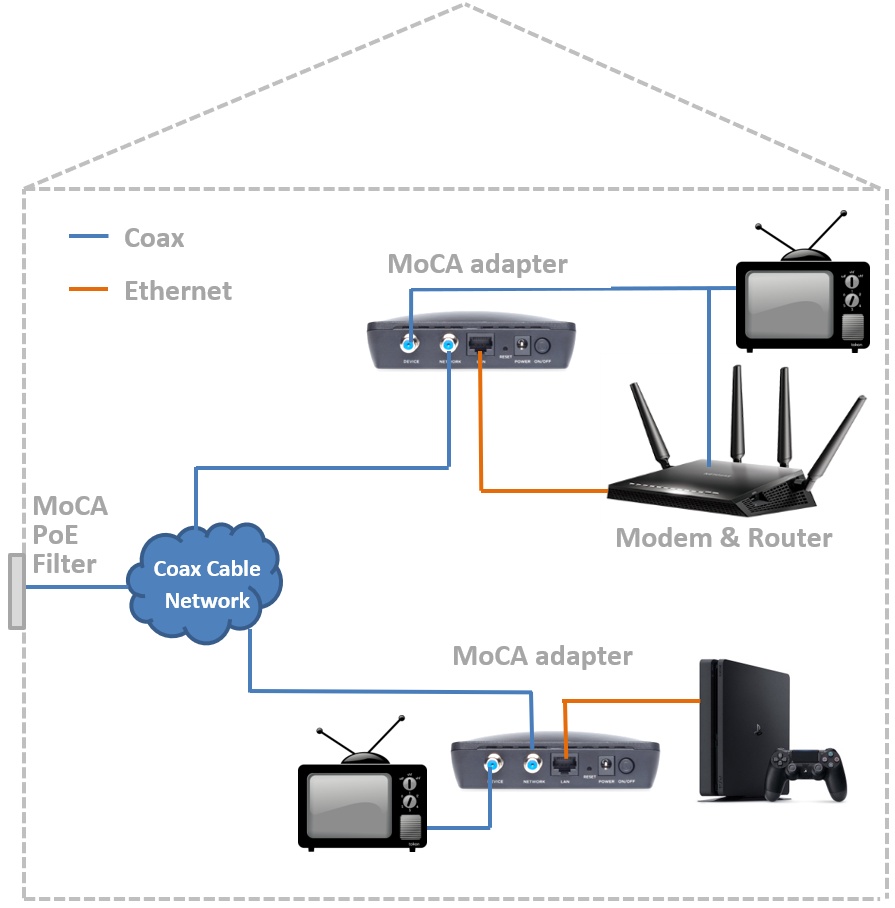](https://motorolanetwork.com/mm1000.html) MoCA adapter setup
**Cat5\+ alternative:**If you can't use or run new Cat5\+ cable, but have access to RG6CATVin every room, MoCA adapters may be for you\. These adapters integrate into the Cable TV wiringRG6that most rooms in a home have, to distribute Ethernet around your houseexample right\.**Speeds:**Expect MoCA 2\.5 speedsrated at 2500 Mbpsto obtain 949 Mbps throughput over 1 Gbps Ethernet and obtain around 2\.2 Gbps over 2\.5 Gbps Ethernet\. But, test in your environment to confirm\. More information:[Wiki info on MoCA](https://en.wikipedia.org/wiki/Multimedia_over_Coax_Alliance)\(wikipedia\.org\) and this interesting[MoCA 2\.0 adapter review](https://www.youtube.com/watch?v=rhCaZqxVAJE)\(youtube\.com\)\.
**TIP:**Avoid older MoCA versionsthat are rated at lower speedsand instead only consider using "MoCA 2\.5" adapters, many of which now also offer 2\.5 Gbps ethernet ports as wellas opposed to just a Gigabit Ethernet port\.
[](https://amzn.to/46hNqD8) Hitron HETM5 Adapters
**MoCA Adapter:**For example, on Amazon, look at the[Hitron HTEM5 MoCA 2\.5 Adapter 2\-Pack](https://amzn.to/46hNqD8)\(amazon\.com\) for around $120*has 2\.5 Gbps Ethernet ports\. Avoid the version with only 1 Gbps Ethernet*\.> WARNING: I have also seen disclosures stating that MoCA adapters should NOT be used in homes where the coax cable is already being used by satellite TV, or for AT&T servicesas they already use MoCA internally for their own boxes\.*This need more research and verificationbecause different MoCA devices in the home should be able to just use different channels and easily coexist\.*
**MoCA in ISP provided gateways:**If you have an ISP provided gateway device providing internet service, investigate if there is alreadyone MoCA adapter 'built\-in' to the ISP provided gatewayThere often IS for Verizon FiOS and Comcast gateways \-\- but older ISP devices may only support the MoCA 2\.0, and not the newest MoCA 2\.5\.> [List of ISP devices](https://mocalliance.org/certified-products/)\(mocalliance\.org\) that have MoCA built\-inand MoCA version supported\. For example, Verizon's G3100 supports MoCA 2\.5\.
[](https://amzn.to/46k8pVE) MOCA 2\.5 Splitter
**Requirements for MoCA to work:**If you decide to use MoCA, make sure you pay attention to:> **Splitters:**All cable splitters*everywhere in your network*both inside and outside the housemust support MoCA frequencies \-\- up to 1675 MHz\.[Example splitters](https://amzn.to/46k8pVE)\(amazon\.com\) \-\- notice that the splitters are expressly labeled as supporting "MoCA 2\.5"\. If your existing splitters do not say this, they should be replaced\.
And if you still have CATV signals over the coax cables:> [](https://amzn.to/3WDjbTQ) MOCA PoE Filter **PoE filter:**There must be a MoCA PoEpoint of entryfilter on the cable line feeding your entire house\.[Example filter](https://amzn.to/3WDjbTQ)\(amazon\.com\)\. It is common to find an all\-in\-on 'grounding block' and 'MoCA filter' inside the cable demarc box\. The filter prevents MoCA signals generated inside your house from feeding back into the cable network, and reaching your neighbors\.If your house has a powered amp and it has a "MoCA" logo on it, it almost certainly already has a PoE filter built\-in\. Just Google the model number of the amp to find a manual and confirm\. An example DOCSIS 3\.0[MoCA PoE Filter](https://amzn.to/3WDjbTQ)\(amazon\.com\) is seen upper right, which allows 5\-1002 MHz to pass, but blocks MoCA frequencies 1125 MHz and above\.
**DOCSIS 3\.1 concerns:**DOCSIS 3\.1 and MoCA frequencies actually overlap\!MoCA uses 1125 MHz to 1675 MHz and DOCSIS 3\.1 uses 5 Mhz up to 1218 MHzor higher?\. If your ISP uses these high frequenciesvery rare today, but in the future as your ISP upgrades their network, it will become very common, you will need configure your MoCA adapters to avoid the overlapping frequenciesand speeds over MoCA will reduce\.> For example, see[this blog post](https://www.gocoax.com/post/change-moca-adapter-to-d-bnad-high-mode)\(gocoax\.com\) on preventing overlap that is happening today\!
**DOCSIS 4\.0 risk:**This is possibly one of the biggest downsides of using MoCA todayon cables also containing ISP DOCSIS signals\. We know that DOCSIS based ISP's will eventually 'take over' the entire frequency range that MoCA uses when the ISP adopts DOCSIS 4\.0\. It is not a matter of 'if' they will, but 'when' they will\. And when that happens, Ethernet over Coax using MoCA will then no longer work\.> **The bottom line:**If you have a DOCSIS ISP and use MoCA, please do so understanding thatMoCA is NOT a long\-term solutionto not having Cat5\+ cable \-\- it is only a*short\-term workaround*\.*With MoCA, you are sharing the RG6 cables with the ISP, and the ISP WILL eventually start using MoCA frequencies\.*
**A mitigating factor \(cut the cord?\):**If you no longer have any cable company signals over the RG6 cables in your homeeg: you have 'cut the cord' and everything streams over the Internet, then taking over these coax cables, using MoCA adapters, IS a great way to quickly and easily distribute 2\.5 Gbps Ethernet throughout a home*without having to install new Cat5\+ cables*\.> Extending Wi\-Fi \-\-*and obtaining maximum Wi\-Fi speeds 'at distance'*\-\- then becomes very easy and convenient\. Just add MoCA adapters to unused coax to create a fast 2\.5 Gbps wired/Ethernet backbone that connects remote access points / mesh nodes back to your main router\. See[Case Study \#4](https://www.wiisfi.com/#mocacordcutter)\[§E13\]\.
**Duplex:**Be aware that while Ethernet is full\-duplex, MoCA is only half\-duplex\. Most people will not notice\. MoCA is a lot like Wi\-Fi \-\- where all MoCA nodes must share access to the coax medium and only one node can transmit at a time\. There can be up to 16 nodes on a MoCA coax network\.**Throughput Speed Tests:**With MoCA 2\.5, with a PHY speed of 2\.5 Gbps, expect throughput speed tests to max out at around 2\.2 Gbps\.
**Upcoming MoCA 3\.0:**The upcoming MoCA "3\.0" standard allows for 10 Gbps speeds\.
**Learning More:**
- [The details of MoCA from the source](https://mocalliance.org/)\(mocalliance\.org\)
- [MoCA basics](https://drive.google.com/file/d/1D2Acg7Zm3EmvbQN057qKRt6tFUlWKtrH/view)\(drive\.google\.com\) \- SCTE presentation by PCT
- [ma2500d](https://www.gocoax.com/ma2500d)\(gocoax\.com\) \- Network setup diagrams
- [Tips on Turning Coax into Ethernet Wiring](https://dongknows.com/moca-explained/)\(dongknows\.com\)
Extra 6: Wi\-is\-Fi Windows Tools
**Download:**Click on the download linkright, then: \(a\) open the ZIP file, and \(b\)extract all files in the ZIP to a temp folder on your computer, and use the tools\.>  **NOTE:**When you try to run an Internet downloaded BAT file, Windows should \-\-*rightly so*\-\- display a "Windows Protected your PC" message\. To run the BAT file, click on the "More Info\.\.\." link, and then click on the newly exposed "Run anyway" buttonmay need to scroll to find the button\. You only need to do this onceWindows remembers the choice\.**TIP:**If Windows does not warn you about running 'downloaded' BAT files, you should strongly consider turning that protection ON\! In Windows settings, find/select "Reputation\-based protection" and turn "Potentially unwanted app blocking" ON\. **TIP:**Always inspect BAT file source code before running any downloaded BAT file \-\- After extracting into a temp folder, right click on the filename and select "Edit in Notepad"\.

**Windows 24H2**can make it very hard for command line tools to obtain information about your Wi\-Fi interface\. The 'right' to obtain this information is determined by a 'Location Services' settingit all depends how your computer is configured\.In order to successfully run the WI\.BAT tool below, under Windows Settings, go to
"Privacy & security \> Location"find via search for "location privacy"and verify that"Let apps access your location"is turned onseen right\.
**★ WI\.BAT \-\- Display "Wi\-Fi Information":**TheWI\.BATfile \([source code](https://www.wiisfi.com/source-code/wi.bat.txt)\) is designed to repeatedlydisplay updated Wi\-Fi Tx and Rx PHY speed information, and a bunch of other helpful Wi\-Fi information, refreshed every couple of seconds\. It is interesting to see that reported Wi\-Fi PHY speeds can be inflated during times of low Wi\-Fi activity, and during Internet speed tests, the PHY speed decreases to its 'true' value\. Resize the window larger if wanted, and when finished using the tool, just close'X'the window\.> 
The metrics of primary interest are:- **Receive rate \(Mbps\):**Wi\-Fi Rx PHY\.
- **Transmit rate \(Mbps\):**Wi\-Fi Tx PHY\.
- **BSSID:**MAC address of the AP connected to\. Very helpful when you have multiple access points\. Also notice 'co\-located' AP \(the AP my client is connected to also has a 6 GHz band AP\)\.
- **Radio Type:**displays 802\.11n / 802\.11ac / 802\.11ax / etc\.
- **Band:**2\.4 GHz, 5 GHz, 6 GHz, etc\.
- **Channel:**Wi\-Fi channel numberimportant to know because some perform better than others
- **DNS Servers:**Because sometimes you just want to know\.
---
**Manually running Windows tools:**From a Windows 'command prompt', type the following command> netsh wlan show interfaces \(if there are problems, refer to the Windows 24H2 section above\)
and> netsh interface ip show config
to obtain output similar to whatWI\.BATdisplays above\. Or if you want a TON of information about the wireless configuration on your computer, use:which includes information about all SSID within range of the computer issuing this command \-\- so a very simple and basic 'site survey'\.> NOTE: You should first click on the Wi\-Fi icon in the system taskbar and go to the list of available Wi\-Fi networks and wait 10 seconds before running this command \-\-*to give the computer time to refresh its internal list of networks that it can see/find*\.
Extra 7: Recommended Cable Modem
What 'cable modem' should you buy to avoid having to pay monthly modem rental fees to your ISP?**What to buy:**Only look for DOCSIS 3\.1 modems that are on your ISP's 'approved modems' listbut a warning: those lists may not include newly released hardware\. The latest DOCSIS 3\.1 standard includes[BufferBloat](https://www.wiisfi.com/#bufferbloat)\[§E2\] mitigations\. Just look for the modem that provides the most value to you\.
**Voice/Phone:**If you get POTS phone service through the cable company, that may require you to use an ISP provided modem\. But I think most everyone has already switched over to smartphones\.
[](https://amzn.to/4d2oKkv) Hitron CODA56 \- DOCSIS 3\.1 \- 2\.5 Gbps
**Recommendation:**The[Hitron CODA56](https://amzn.to/4d2oKkv)\(amazon\.com\), is approved by all major ISP's, supports Internet speeds up to 2\.5 Gbps, comes with a 2\.5 Gbps Ethernet port, and it is bargain compared to its peers$110 to $140\. It does NOT include a phone port\.> *"Certified to work with Xfinity, Charter Spectrum, Cox Gigablast, Cable One Sparklight, and Zito Media\. Also works with Astound, Grande, RCN, and Wave" \-\-[source](https://amzn.to/4d2oKkv)\.When I called up my ISP and asked them about the Hitron CODA56 not being on their approved modems list the reply was 'Oh, that list is old \-\- if the CODA56 supports DOCSIS 3\.1, it will work' \-\- and it did\. [Datasheet](https://us.hitrontech.com/wp-content/uploads/2023/01/CODA56-DS.pdf)\(hitrontech\.com\)\. The CODA56 supports "low\-split" and "mid\-split" cable systems\.[More info](https://kb.netgear.com/000066051/What-is-mid-high-split-technology)\(netgear\.com\)\. If you require "high\-split" support, consider the[Netgear CM3000](https://amzn.to/4bEuPUj)\(amazon\.com\)\.*
**Bottom line:**In the end, it really does not matter what modem you get \-\-*but do make sure it is DOCSIS 3\.1*\.**What not to buy:**Do not buy DOCSIS 3\.0 modems, because that is an old standard\. Also, do not buy Motorola Surfboard Modems, because they \(1\) have insufficient upload buffering in them \([source](https://www.duckware.com/udptest/index.html)\), and \(2\) they 'hang' and need to be powered off/on oftenmy own experience\.
> *I had to replace all of my Surfboard modems because they had a buffering problem with Ring cameras, resulting in poor video quality\. No other brand of modem I tested had this problem with Ring cameras\. I reported this bug to Ring and Ring has since implemented a work\-around, but I learned my lesson, especially since I also contacted Motorola, and their answer wasessentially'tough luck, that is the way it is'not at all customer friendly\.*
Extra 8: Powerline Networking / PLC
 Electrical plug
**What is powerline networking / PLC?**Powerline networking uses PLCPower\-Line Communicationto establish anapprox20 Mbps to 300 MbpsEthernet 'switch' connectionbetween multiple locations2 to 6\+byusing the electrical plugsalready everywhere in your homeseen right\.> Standard 120/240V in the U\.S\. is ACalternating currentat 60 Hz\. Powerline networking works by injecting MHzmegahertzfrequencies into the same wiringaka: intentional 'noise'\.
**Why use PLC?**If you need wired Ethernet, but find it impossible to run a Cat5\+ cable, give powerline ethernet a try\. Plug in one next to your router\. Plug the others exactly where they are needed\.[](https://amzn.to/46mZ3bY) Powerline networking \-\- TP\-Link AV2000
**Recommendation:**Look for AV2000 Mbpsor higheradapters\. The[TP\-Link AV2000](https://amzn.to/46mZ3bY)\(amazon\.com\), for around $80 for a pairseen rightis always 'at the top' of reviews\.[Example review](https://www.nytimes.com/wirecutter/reviews/best-powerline-networking-kit/)\(nytimes\.com\)> Why this adapter in particular? Because you might as well test the 'latest and greatest version' of powerline networking that has the best chance of successJust like you don't want to be testing Wi\-Fi 4 today, you don't want to be testing a much older and slower version of powerline networking\.Over the years, powerline networking speeds have improved*dramatically*like 10×\-\- from AV200, AV500, AV600, AV1000, AV1200, and AV1300 to now AV2000 \-\- for the[HomePlug AV2](https://en.wikipedia.org/wiki/HomePlug)\(wikipedia\.org\) standard\. Note that there is also a competing[G\.hn](https://en.wikipedia.org/wiki/G.hn)\(wikipedia\.org\) PLC standard\.
**Setup / Pairing:**Setting up the TP\-Link AV2000 is very easy\. Plug both in and after a few seconds, hold the 'pair' button down on each unitfor one secondand then the two devices find and pair to each other\. And that is it\! The Ethernet jacks on the two adapters are now paired with each other and act as a single network switch\.**Throughput:**Typical throughput ranges from 20 Mbps to around 300 Mbps for PLC devices \-\- and you won't know until you install and test\. And depending on what you need/want, that may be acceptable, or horrible\.
> So why mention powerline if it is*potentially*'slow': \(1\) because what is 'too slow' or acceptable depends upon your situation and \(2\) powerline is inexpensive and easy to test/try\. So if you get the speeds you need remotely, even if slow \-\- job done\.
**TIPS to improve powerline networking speeds:**- Do NOT plug PLC adapters into power strips\-\- instead, plug powerline adapters directly into a wall outlet\. Why? Because many power strips also filter out 'noise'\. But the PLC signal IS actually intentional high frequency noise, which is then blocked\!
- Minimize the total distance / 'stops' over internal house electrical wiring\. From \(a\) one powerline adapter, \(b\) through outlets, \(c\) to the circuit breaker panel, \(d\) traversing to a new circuit breaker, \(e\) through outlets, and finally to \(f\) the next powerline adapter\. Reducing the number of 'stops' on the path will increase powerline networking speeds\.
- Avoid outlets on AFCI circuit breakers \-\- as some models can kill speedsare harmful to MHz frequencies, while other models are OK\.[Source](https://www.smallnetbuilder.com/basics/lanwan-basics/how-to-troubleshoot-your-powerline-network/#:~:text=Watch%20Out%20For%20AFCI%20Breakers)\(smallnetbuilder\.com\)\.
**What about adapters on different electrical legs/phases:**Phases may have mattered a lot in the past, but that matters much less to modern powerline networking today\. Source:[Powerline Communications Cross\-phase Coupling](https://images.smallnetbuilder.com/mydownloads/plc_cross-phase_coupling.pdf)\(smallnetbuilder\.com\) \-\- a white paper by InTellon stating putting modern powerline adapters across phases of electricity is just fine\. I tested this claim and it is largely true, BUT, testing shows that different phases can still have a little impact\.**Outbuilding TIPS:**Powerline networking speed is all about minimizing: \(a\) the distance that PLC signals need to travel, and \(b\) the number of electrical devices that the PLC signals need to traverse\. So, to best support an outbuilding, find a way to minimize these\! For best supporting an outbuilding, this means installing electrical outlets for the PLC devices right next to \(a\) the circuit breaker panel in the main house and \(b\) next to the sub\-panel in the outbuilding\. And if possible, put both outlets on the same electrical phase\.
**My speed test results for the TP\-Link AV2000**: In a house using Square D circuit breakers, the powerline networking speed test results I obtained:
- 475 Mbps \- 8 feet to 45 feet apart on the SAME extension cord
- 320 Mbps \- same room different outletssame circuit breaker
- 120 Mbps \- different rooms, across two circuit breakersboth same and different phases
- 100 Mbps \- to an outbuilding70' electrical run, to an outlet right next to the sub\-panel
- 30 Mbps \- to an outbuilding70' electrical run, to an outlet in the outbuilding
**HomePlug AV vs HomePlug AV2:**HomePlug AV2version twoadapters can have a significant throughput advantage over older HomePlug AVversion onedevices:> *"Whereas HomePlug AV always transmits on the Line\-Neutral pair, HomePlug AV2 can transmit on any two pairs formed by the Line, Neutral or Ground wiresLine\-Neutral, Line\-Ground or Neutral\-Ground\. This allows for significantly improved peak data rates and performance"*\-[Source](https://content.codico.com/fileadmin/media/download/datasheets/powerline-communication/homeplug-av-av2/homeplug-av2-whitepaper.pdf)\.
**The bottom line:**Powerline networking speeds are not going to win any awards\. But compared to the alternative of 'no Internet', a slowish \-\- but reliable \-\- link may work just fine for youespecially given how easy PLC is to install\.**Other resources:**
- [How to troubleshoot your Powerline network](https://www.smallnetbuilder.com/basics/lanwan-basics/how-to-troubleshoot-your-powerline-network)\(smallnetbuilder\.com\)
- [Powerline networking FAQ](https://www.smallnetbuilder.com/basics/lanwan-basics/smallnetbuilders-powerline-faq)\(smallnetbuilder\.com\)
Extra 9: POTS \(Telephone\) to Ethernet
 Back side of RJ14 telco jack

**Question:**Can you convert POTSPlain Old Telephone ServiceRJ14 jacks to Internet/Ethernet?> Look inside a wall jack\. If you see 8 pins, that jack is likely Ethernet\. But if you see only 2, 4, or 6 pins, that is very likely a phone jack\. Look at the back side of the jack to confirm\.
What if your house has NO Ethernet jacks, but it does have telephone jacks\. Can the telephone jacks be*removed*because everyone uses cellphones todayand the telephone cables rewired and used instead for Internet/Ethernet?*If Cat5 \(or better\) cable was installed in the walls for phone lines, YES\!*And Cat5\+ for phone is very common in homes built since 1995see blue arrow, photo right for an example\.**★ Step 1: Verify Cat 5 \(or better\) cable:**The first thing you need to do is look at the back side of all the telephone jacks\. How many twisted pairs do you see*in each cable*entering the phone box? Hopefully you will see something similar to what is seen in the image, upper right \-\- namely, a cable with four twisted pairsblue, orange, green, and brown\-\- so eight wires, with oneor twopair connected to the phone jack\.
> 
Next, can you read the lettering on the cable jacket and see "CAT 5", "CAT 5E", "CAT 6", or "CAT 6A"or better? If you can, then 'YES', the telephone cable can 100% be reused for Ethernet\!> If you see four twisted pairs, but do not see lettering on the cable, or see "CAT 3", then you can still*try to convert*over to Ethernet\. BUT, you may get 1 Gbps, but you could also get 100 Mbps, or even 10 Mbps\. You just won't know until you try \-\- the shorter the cable run, the better the chances are for 'out of spec' cable working\.
 'Home\-run' cable installation
**★ Step 2: Verify 'daisy chained' or 'home run' cable installation:**Do you only see**one cable**and only four twisted pairsin every single telephone box? If so, then this is very likely a "home room" installation, which is ideal:> **Home run:**Every single phone location in the houseand demarc location \-\- the phone signal from the telephone companyhas*its own cable*or 'run' to a single common utility locationsee example right, hopefully inside the house\.**How to convert 'Home Run' to Ethernet:**Each CatX cable can be re\-terminated for Ethernet, and directly used\.*You can pick and choose which phone jacks you want to convert, possibly leaving some phone service remaining\.* **What if all home runs terminate outside at the demarc box \(instead of inside the house\):**Options: \(A\) Inside the house opposite the demarc box, open up the wall and pull the runs inside the house\. \(B\) Terminate the demarc runs with RJ45 and plug runs into a PoE powered mini switchand send PoE to power the switch over one of the runs[example device](https://store.ui.com/us/en/collections/unifi-switching-utility-mini/products/usw-flex-mini)\(ui\.com\)\. If there is not room in the demarc box for the switch, then push the phone demarc box the to side, and add your preferred enclosure over all the runs/switch\. \(C\) same as above, but use an outdoor rated PoE powered switch outside the demarc box[Example device](https://amzn.to/4dvSpmB)\(amazon\.com\)
However, if you see two cableseach cable with four twisted pairsin most telephone boxesbut one telephone box with one cablethen you likely have a "daisy\-chained" installation:> **Daisy\-chained phone:**There is ONE long CatX cable run \(a\) from the phone company wiringoften a 'demarc' box on the outside of the house\(b\) 'in' to the first telephone location, \(c\) 'out' to the next location, \(d\) and so on until all locations have a cable\. Like this: When a phone jack is installed, the cable run is cut in halfso now you see two cables, and then several 'same colored' wireslike the blue pair for line 'one'are attached to the phone jack to: \(a\) activate the phone jack, and \(b\) continue the phone signal 'out' to the next phone location\. Select a 'break point' anywhere along the daisy chainwhere one of the 'out's is disconnected\. Everything before the breakone or more jacksremain unmodified and connected to the phone system\. But everything after the break is converted to Ethernet\. **Loop:**It is rare, but in some installations the cable at the last telephone location loops back to the demarc location \-\- and both ends of the cable loop are connected in the demarc location\. This adds fault\-tolerance into the wiring \(the loop can be cut in half 'once' anywhere and all jacks remain active/working\)\.
**How to convert 'Daisy\-Chained' to Ethernet:**First, re\-terminate the ends of all phone cables after the 'break point'red line belowwith an Ethernet keystone jackand get two\-port keystone wall plates\. Next, find and test each run \-\- and meticulously label the jacks, similar to belowleft\-side label \#, and top port, means earlier in the chain; right\-side label \#, and bottom port, means later in the chain; number means cable run number:> 
Remember that one cable likely runs outside to the phone company demarc location, and can remain a phone jack\. Finally, you have a choice to make \-\- implement either:1. **Add ONE Ethernet run:**You can directly use any single runjacks with the same numbers\. If you need a longer run, add a small Ethernet patch cord between in/out jacks at the in\-between locations\. For example to create an Ethernet run all the way from the first location'2' on first plateto the last location'4' on last plate, add a patch cord connecting ports at the two in\-between locationsconnects '2' to '3' at 2nd plate and connects '3' to '4' at 3rd plate\.
2. [](https://amzn.to/41TTgdC) PoE Extender \+ 1 Gbps Switch **Add Ethernet to all / multiple locations:**At one of the locations, add a 802\.3at PoE switch and connect to the Ethernet wall jacks\. Then, at locations 'down the line', connect both Ethernet jacks to a $25[PoE extender](https://amzn.to/41TTgdC)\(amazon\.com\) \-\- which: \(a\) is powered by PoE itself, \(b\) continues PoE downstream, \(c\) leave two Ethernet ports open for use at the location, \(d\) provides 1 Gbps Ethernet\. Repeat as neededas this PoE extender can be daisy\-chained\.NOTES: \(1\) If you use PoE extenders to add Ethernet to each daisy\-chained phone location, don't actually plug any PoE device in\. The intention is that the entire PoE budget is there to power only the daisy\-chained PoE extenders\. \(2\) Of course, you can also use powered switches at each location, and then a PoE switch and PoE extenders are not needed \(for example, if you wanted 2\.5 Gbps Ethernet, instead of the 1 Gbps PoE solution\)\.
Or, mix and match the two techniques above\. Either way,*with the right cable installed in the walls*, you CAN repurpose telephone locations for Internet/Ethernet\.**TIP: Alarm systems:**If you are trying to 'make sense' of what you see in the phone demarc box, the 'typical' way the phone signal travels when there is a wired alarm system present is: \(1\) phone company » \(2\) demarc box » \(3\) alarm panel » \(4\) demarc box » \(5\) phone jacks in the house\. This allows an alarm system to 'seize' control of the phone line during alarms because it is 'first in line'\.
> There is usually a single CatX cable running from the phone demarc box to the alarm panel\. One pair is the incoming telco phone signal and a second pair is the phone signal returning to the demarc box \-\- that then feeds the rest of the house\.
**TIP: Re\-terminating phone CatX for Ethernet:**When the phone lines were installed, some twisted pairs were likely untwisted way more than they should have been\. But Ethernet*needs those twists*for reducing noise and EMI\. So before re\-terminating, take the time to ensure that each wire pair is properly twisted all the way to the termination point\.*You will very likely need to carefully retwist some of the pairsbut note that it is also bad to overtwist*\.**Other interesting items:**
- [Ubiquiti Flex Mini](https://store.ui.com/us/en/collections/unifi-switching-utility-mini/products/usw-flex-mini)\-*"A compact, 5\-port, Layer 2 switch powered by PoE or a 5V USB\-C adapter\."*
Extra 10: Extending Ethernet/Wi\-Fi to an Outbuilding
From this paper, you already know the best way to get great Wi\-Fi in an outbuilding is to add an[Access Point](https://www.wiisfi.com/#accesspoint)\[§19\] in the outbuilding, wired/Ethernet back to your main router\.*But what is the best way to extend Ethernet from your main router to the outbuilding?*The best way is a 'wired' solutionimmediately below\. But if you can'tor don't want touse a wired solution, then look at 'wireless' solutionsfurther below\.
◆ Wired Solutions**The 'not recommended' way \(but very easy to understand and do\):**The easy way is to run Cat5\+ underground, to the outbuilding, as long as cable length is under the 100m330ftlimit\. That can actually work very well, but with any copper wire run outside, you need to worry about power surges caused by lightning\. It*will happen*at some point \-\- it is just a matter of time\. If you still want to run Cat5\+, keep these tips in mind:
> Use only 'Direct Burial' gel filled cablenote: this is different/better than just 'outdoor' rated cable\. The outside cable jacket is designed to survive not only UV exposure, but also contact with the ground and water\. Plus the inside of the cable is filled with a gel to prevent water ingress, if the cable jacket gets nicked/damaged\.Bury the cable in PVC conduit for a second level of protection\. ORmuch less protecteduse the edge of a shovel to create a couple inch deep slit in the soil and lay the cable in \-\- this very quickly shallow buries the cable\. To hopefully prevent damage to equipment during surge events, use \(a\) shielded cable, \(b\) shielded keystone jacks, \(c\) shielded patch cords, and \(d\) an Ethernet Surge Protector on each end of the cable[Example kit \(two devices\)](https://amzn.to/3SJHkpE)\(amazon\.com\) protecting to 20KA\.*Please note that protection devices require an actional connection to ground in order to work\.*Any excessive voltages induced into the cable must be shunted to ground at either end of the cable\. *And in the end, the cost of all of this protection is often way more than a fiber solutionbelow\.*
[](https://amzn.to/4daTRKA) 1 Gpbs Media Converter
[](https://amzn.to/3WGtW87) Fiber Cable
**BEST \(1 Gbps\): Use Fiber to extend Ethernet:**If you need to run Ethernet between any two buildings, just use fiber cable, buried in conduit, and media convertersconverts fiber to Etherneton each end of the fiber cable\. On Amazon, there are*very affordable*pre\-made cablesyou select lengthand 1 Gpbs media converter kits\.as a ballpark figure, around $90 will get you 100 ft of fiber cable and two media converters\. For example:- [fiber cable](https://amzn.to/3WGtW87)\(amazon\.com\) \-\- pre\-madeends installedarmored, outdoor\-rated, fiber cable, in various lengths from 1m3ftto 1000m3280ft
- [media converters](https://amzn.to/4daTRKA)\(amazon\.com\) \-\- a two\-pack kit of 10Gtek brand media converters with 10Gtek brand SFP transceivers1 Gbps\.> *Or get two of[this mini media converter](https://amzn.to/4fi9Jwp)\(amazon\.com\)\. But use extreme caution: don't click on 2 'Number of items' as that changes item from SMF to MMF\. Instead, add item to cart and change Qty to 2\.**Reader TIP:**Instead of media converters, consider just using an Ethernet switch with some SFP\+ ports on each end of the fiber run, and buy some SFP\+ modules\.*
Fiber optic cable is immune from EMIElectromagnetic Interference\-\- so there are never any worries about lightning and induced voltages, because fiber is*non\-conductive glass*\. This is a big advantage fiber has over copper\.[](https://amzn.to/3WkOjGw) 10 Gpbs Media Converter
**BEST \(10 Gbps\):**This is the same as abovesame fiber cable, but instead of a 1 Gbps media converter kit, get two[10 Gbps media converters](https://amzn.to/3WkOjGw)\(amazon\.com\) \-\- supporting \(a\) fiber to 10km and \(b\) 10GBase\-T over Cat6a to 30m98ft\.**Dual strand vs BiDi:**Why install dualtwo\-strandLC fiber instead of a BiDisingle\-strandLC fiber solution? \-\- Because: \(a\) dual fiber is incredibly common and only fractionally more expensive than a single fiber cable \-\-*so you are NOT saving that much by selecting BiDi cable*, \(b\) if you want a 10 Gbpsor eventually higherlink instead of 1 Gpbs over BiDi, good luck finding a BiDi kit solution on Amazon\. Whereas with dual fiber, those solutions are[very common](https://amzn.to/3WkOjGw)\(amazon\.com\) right now, and \(c\) as a bonus, a dual fiber cable can be converted to two BiDi links, if needed, down the road\.
**Some fiber jargon:**Because most Fiber 'home use' is not going to need 'data\-center' class speeds, that makes 'Dual LC single\-mode fiber cable' the choice for home use at 1 Gbps and 10 Gbps speeds, due to the very low cost kits that are available\. Some terminology:
- **SFP\+:**"Small Form\-factor Pluggable"\. A fiber cable plugs into the SFP transceiver, which in turn plugs into the SFP port on the media converter\. Any "\+" present indicates 'enhanced', or support for up to 16 Gbps\.
-  **LC / SC / ST / etc:**Refers to the[type/size of connector](https://en.wikipedia.org/wiki/Optical_fiber_connector)\(wikipedia\.org\)\. LC is very common now, a smaller connector than SCsee right
- **SMF / MMF:**Abbreviations for['single\-mode' fiber](https://en.wikipedia.org/wiki/Single-mode_optical_fiber)\(wikipedia\.org\) and['multi\-mode' fiber](https://en.wikipedia.org/wiki/Multi-mode_optical_fiber)\(wikipedia\.org\)\. The fiber cable for SMF is less expensive than MMF, but transceivers for SSF are more expensive than MMF\. MMF is limited to hundreds of meters, whereas SMF is not\.
- **BiDi**: BiDi mean 'bi\-directional', using a single fiber strand to Tx and Rx, instead of two fiber strandsone Tx; one Rx\.
- **Dual LC**: refers to the LC connectorseen rightwith two LC connectors next to each other\.
- **Duplex Fiber**: a fiber cable with two strandsoften one for Tx and other for Rx
- **Connector Type: PC vs UPC vs APC**: selecting the right fiber connector type[more info](https://www.truecable.com/blogs/cable-academy/pc-vs-upc-vs-apc-fiber-connectors-what-is-the-difference)\. 'In general', LC connector colorblue/greenindicates connector type\.
**Conduit TIPS:**In you are going to all the troubleand time\!to trench and use conduit, don't just put the one single cable you need into the conduit\. Instead, also add spares and/or backup cables\. For example, add Cat5\+ as welland terminate/test\-\- but don't connect to anything\. Maybe even add a spare RG6 cable? This way you have backups in case the fiber line goes down\. You can quickly switch to Cat5\+ until the fiber problem is fixedor even MoCA over the dedicated RG6\. The entire point is that 'spares' gives you some options 'down the road', that you may not be able to see todayfuture expansion or to workaround faults\.- Consider using large diameter conduitlike 2"to make it much easier to pull new cable in the future
- Add a 'pull\-line' into the conduit for future use\.*But note that it is very difficult to pull cable in 'small diameter' conduit*\.
- See[811\-In\-Your\-State](https://call811.com/811-In-Your-State)\(call811\.com\)\. Every state has a free 'mark buried utilities' service before you dig/trench\.
- Add a 3" 'buried line caution tape' into the trench a couple of inches above the conduit as the trench is refilled with dirt\.
- Still use 'direct burial' rated cables in conduit\. The conduit is there for*extra protection*, NOT primary protection\.
- **Reader TIP:**Check local code enforcement for any potential regulations regarding \(a\) burial depth requirements and \(b\) Sched 40/80 conduit requirements, especially in the transition to above ground\.
◆ Wireless Solutions \-\- Line of Sight*Please note that this section is only for true "line\-of\-sight"*no obstaclessituations\.
[](https://amzn.to/3LLbXXS)UeeVii Wireless Bridge
**OK: Wireless Bridge:**For various reasons, sometimes there is no way to bury a cable between point A and point B\. When this happens, use a wireless bridge\. For example, the[UeeVii Wireless Bridge](https://amzn.to/3LLbXXS)\(amazon\.com\), for around $130\. These are now 'commodity items' and you will find a ton of brands and options on Amazon\.
> Depending upon model and distance, expect throughput in the 100's of Mbps, and be only half\-duplexonly one direction at a time\.
[](https://amzn.to/3YgphuF)Mikrotik Wireless Wire
**BEST: 1 Gbps Wireless Wire:**If you need/want*full\-duplex*1 Gbps Ethernet wirelesslyboth directions at the same time, check out the[Mikrotik Wireless Wire](https://amzn.to/3YgphuF)\(amazon\.com\), for around $200 for a pre\-madedevices already pairedsolution, and powered via standard 802\.3af / 802\.3at PoE \-\-[specifications](https://mikrotik.com/product/wireless_wire)\(mikrotik\.com\)> This kit*"replaces a Gigabit ethernet cable with two small devices that connect to each other over a 60 GHz wireless link"*, and claims 100m330ftto 200m660ft'line of sight' range\.*"The box includes two wAP60G devices that are already paired together, a wall mounting kit, straps for pole mounting and also a pair of table stands for using the devices indoors\."*
**Longer wireless distances:**MicroTik has quite a few other[60 GHz products](https://mikrotik.com/products/group/60-ghz-products)supporting line\-of\-sight distances up to 1500m4900 ft, and many other vendors also have 60 GHz products\.◆ Other optionsIf you \(a\) can't bury a cable and \(b\) you don't have 'line of sight', other options to consider:
- Try[powerline networking](https://www.wiisfi.com/#powerline)\[§E8\]
- Is there a way to run an aerial cable overhead?
- Cellular 4G LTE or 5G "Mobile Hotspot"
- Satellite Internetlike Starlink, etc
- Is there a 'short'couple hundred feet maxcoax cable already running between the two buildings that you can take over and repurpose? If so, then[MoCA](https://www.wiisfi.com/#moca)\[§E5\] might work, depending upon distance\.
- EoC \-\- immediately below
[](https://amzn.to/4cVv1hv)
**TIP: An 'EoC' Long Reach PoE solution for FastEthernet \(for long distance PoE cameras\):**There are many incredibly inexpensivearound $80 \-\- one seen right[Ethernet over Coax adapters](https://amzn.to/4cVv1hv)\(amazon\.com\) that can supply power\+FastEthernet to a PoE device over up to 1000 feetor 10 Mbps up to around 3000 feet, and work over either a dedicated \(a\) RG6 coax cable or \(b\) a single twisted pair\. All devicesboth adapters and the PoE device at the endare all powered by a single PoE switch at the source\. These devices work great, but if the cable is run outdoors, you then need to worry about lightning issues, especially with long cable runs\.> **Example:**I needed two PoE cameras added to a security gate 1000' away \-\- so I installed \(1\) a 802\.3at PoE managed switch, \(2\) to an adapterseen right, \(3\) to a 1000' coax run, \(4\) to an adapterseen right, \(5\) to a 'PoE powered switch' \(6\) to two PoE cameras \-\- all powered by a single PoE switch port at the source*as NO electrical power was available along the path nor at the destination*\. This solution works very well\.TIP: Do not confuse EoC with[MoCA](https://www.wiisfi.com/#moca)\[§E5\]\-\- these are two completely different technologies\. BUT, if you need Ethernet between two locations, and there is a spare dedicated Coax cable you can take over, then using a MoCA solution is very cost effective, and can provide up to 2\.5 Gbps speeds\! See[Case Study \#4](https://www.wiisfi.com/#mocacordcutter)\[§E13\]\.
**TIP: Need 1 Gbps Ethernet over 2\-wires?**There are devices that claim to support 1 Gbps Ethernet over two wires up to 1000 feet\.[An example device](https://lanpoe.com/wp-content/uploads/2024/02/LanPoE-Datasheet-2-3-Wire-Gigabit-Converter-LP-2WGIP1-S-Feb-2024.pdf)\(lanpoe\.com\)\. But these devices are rather expensiveand I have not yet personally tested them, but it is sure nice to know this technology existsin case one day you need it\.Extra 11: Debugging 'Internet Down'
Often times, rebooting all devicesclient device / router / modem / etccan fix a non\-functioning Internet connection\. But if you want to 'debug' the root cause first, follow the steps in this section\.**First, check the LED lights on your modem:**There is usually an LED light on your modem indicating that the Internet is connected, and that 'upstream' and 'downstream' channels are connected and functional\. If any of these LED lights are off, that is the problem\. Reboot your modem and if that does not resolve the problem, contact your ISP for help\.
> *The rest of this section provides tips on debugging a non\-working Internet connection using a Windows PC\. Other platforms will have similar commands to run\.*
**1\. Is there a Router / Gateway:**Use"ipconfig/all"and look for the"Default Gateway"your router\. If there is no default gateway, that is a the problem \-\- and indicates that your device has lost connectivity to your local networkEthernet/Wi\-Fi\.> Also, verify that the DHCP "Lease Expires" time is in the future\. If it has expired, something is wrong within your local network obtaining an IP Addresses\. Restart the main router and your computer\.
**2\. Ping the 'Router' IP Address:**"ping" the IP Address of the 'Default Gateway', found in the step above, which is often"192\.168\.1\.1", or"10\.0\.0\.1", or something similar\.> If your router does not respond, that is the root problem\. Reboot the main router\.
**3\. Ping the 'Modem' IP Address:**If you have a separate modem, try pinging"192\.168\.100\.1"when the Internet is working to first verify that your modem normally responds to ping requestsnot all modems do respond\.> If pings to your modem normally work, then failure/success of pinging the modem will tell you if the connectivity between the router and modem is functional, or not\.*This used to always work, but ISP's are 'locking down' modems and pings now often fail to respondthe modem ignores pings*\.
**4\. Ping a well\-known Internet server IP Address \(NOT name\):**"ping 1\.1\.1\.1"Cloudflare DNS "one\.one\.one\.one" host nameor"ping 8\.8\.8\.8"Google DNS "dns\.google" host name\. You should*always*get a response with a working Internet connection\. The reason for pinging an IPv4 IP Address instead of a named host is to intentionally bypass DNS name resolution\.> If this ping fails, then either: \(a\) your modem is having connectivity problems to your ISP, or \(b\) your ISP is having peering issuessending your packets further into the Internet\.
**5\. Verify that DNS 'name resolution' is working:**Debug DNS by using the"nslookup\.exe"tool that is built into Windows\. Type"nslookup wiisfi\.com"\-\- does this resolve to an IP Addressthis queries the default DNS server, often your main router? If not, take note of the DNS 'Server' and 'Address' that was output \-\- it is not working\. Try a*different*DNS serverlike 1\.1\.1\.1 or 8\.8\.8\.8\-\- type"nslookup wiisfi\.com 1\.1\.1\.1"to perform*the exact same query*, but to the specified "1\.1\.1\.1"or whatever other server you selectDNS name serverthis bypasses the prior DNS name server\. If this works, this confirms that the default name serverit can often be your main router'not working' is the root problem\. Reboot your main router\.> *It is rare, but sometimes the DNS resolver service inside the main router stops working and fails to restart automatically\. The result is that existing open Internet connections work, but that new connections all fail, because 'names' can not be mapped into 'IP addresses'\.*TIP: Type "nslookup"with no command line options to interact with the nslookup program\. Once in/running the nslookup program, type"help"for a list of available commands\. Type"exit"when finished playing around\.
Extra 12: IoT device won't connect to Wi\-Fi
Many IoT devices use an older version of Wi\-Fi, like[Wi\-Fi 4](https://www.wiisfi.com/#wifi4)\[§9\] and are using very old Wi\-Fi drivers that don't understand all of the new Wi\-Fi features being broadcast by your brand\-new 'top\-of\-the\-line' router \-\- which means that that your modern Wi\-Fi network may not being recognized as a 'valid' Wi\-Fi network by an older IoT device\.**First:**Reboot/restart your cellphone and make sure that your cellphone is NOT connected to a VPN, and then try again to setup your IoT device\.
**Next:**Try connecting the IoT device to your phone's hotspot,*which often operates a basic Wi\-Fi access point*\. If this works, this confirms that there is more than likely some setting on your router that is causing problems \-\- but DO give the IoT device time to download and install a firmware update over your phone hotspot, which can sometimes cause the IoT device to start working for the problematic router\.
**Use the 'Guest', or 'IoT', network:**Many routers have the ability to turn on a 'Guest' or 'IoT' network\. Try connecting your IoT device to the new Wi\-Fi Guest/IoT network just created\. Often times, these extra networks are intentionally 'less advanced' than your main network on purpose for maximum compatibility\. Start by turning on the Guest/IoT network on only for the 2\.4 GHz band and try connecting your IoT device to that new SSID network\.
**IPv4 vs IPv6:**Many IoT devices require IPv4 and won't work with IPv6\. So if you have a router where can turn IPv6 off on the WAN connection, try doing that, and see if using only IPv4 solves the connectivity problem\. Especially for cellular/mobile broadband Internet connections\.
**Try turning off advanced router features one by one, and test:**As a last resort, in your router settings, try changingor turning offadvanced Wi\-Fi features one\-by\-one until you find the one feature that is causing the IoT device connection problem:
- **WPA3:**Many older IoT devices won't understand what WPA3 isor what WPA2/WPA3 mixed or transitional mode is\. Try setting and using only 'WPA2' instead\.
- **AES/TKIP:**Try setting the Wi\-Fi 'security' to use only AESno TKIP\.
- **802\.11r fast roaming:**If 802\.11r fast roaming is present and enabled, try turning that feature off\.
- **Channel width:**Set the maximum 5 GHz channel width to 80 MHz and see if that helps\. Sometimes a router broadcasting '160 MHz channel width support' can cause connection problems for older IoT devicesthat don't understand what 160 MHz channel support is\.
- **SSID:**Are there any special characters in the SSID network name? As a test, try using a network name composed only of letters A to Zno special characters, no spaces, no numbers, just letters
- **Channel:**Turn off 5 GHz 'auto' channel section and instead, set a fixed channel that is available both indoors and outdoors\. If your router is set to use an 'indoor only' channel, that will prevent an*outdoor\-rated*IoT deviceeven if inside the housefrom even seeing your router\.
- **OFDMA:**Try turning off Wi\-Fi 6 "OFMDA"
- **TWT:**Try turning off Wi\-Fi 6 "TWT"Target Wake Time
- **802\.11ax:**Try turning off 802\.11axWi\-Fi 6off, and instead select "802\.11ac Wi\-Fi 5"\.
The goal here is not to permanently turn a feature off, but to find the one setting that is causing problems for your IoT device, and then decide what to doGoogle search and find a better and more permanent workaround\.OR, just getting your brand new 'out of the box' IoT device connected to the Internet so that it can successfully download and install a firmware update is sometimes all that is needed to get it to then 'start working' with modern routers\.
Extra 13: Case Studies
\(1\) "Oh Ring, what a 'splitting' headache\!"[link](https://www.wiisfi.com/#ringsplittingheadache)> *Case study: Splitting Wi\-Fi band namesor adding a dedicated 5 GHz only guest/IoT networkcan often benefit dual\-band Ring cameras\.*[](https://amzn.to/40PpLbq)Ring Floodlight Pro 2K I have a dual\-band[Ring Floodlight Pro](https://amzn.to/40PpLbq)\(amazon\.com\) camera, and a router using 'combined' network namesall Wi\-Fi bands use the same SSID name\. I setup my Ring camera to use my Wi\-Fi, but the Ring camera refused to connect to the MUCH faster 5 GHz Wi\-Fi band\. It canlike when I disable the 2\.4 GHz band in my router, the camera finally does connect to 5 GHz, but the Ring Floodlight Pro has too strong a preference for the very slow 2\.4 GHz band\.**The problem:**When a router uses a 'combined' network name, it is up to the client devicethe Ring camera, in this caseto choose which Wi\-Fi band2\.4 GHz or 5 GHzto connect to\. And my Ring camera always connected to the much slower 2\.4 GHz band There is just one huge problem with that\. Where I live, throughput and video quality over the 2\.4 GHz band is often horrible, even with a great RSSIlike \-55, due to having lots of close neighbors\. As a result, the Ring camera, at this location, on 2\.4 GHz, rarely obtains Wi\-Fi transmit speeds above 10 Mbps Ring 'Wi\-Fi Transmit Speed' onring\.com TIP: Ring displays the "Wi\-Fi transmit speed" for the Ring Floodlight Pro camera in thering\.comweb interfaceexample seen right; not in the Ring App\-\- and the metrics appear to update a few minutes after every camera reboot\. Also, relative throughput was tested in realtime using the[FastPing](http://www.duckware.com/fastping)\(duckware\.com\) tool\.I 'split' my Wi\-Fi bandsor named uniquely, like append '\-5G' to the 5 GHz band SSID nameand connected my Ring camera to the new split 5 GHz SSID band name\. I got a MUCH faster "Wi\-Fi Transmit Speed", and improved video quality, even with 'technically' a much worse RSSI of \-77\. **The solution:**So, if you have a dual\-band capable Ring camera, consider 'splitting' your Wi\-Fi band namesor creating a 5 GHz only guest or IoT networkand forcing the Ring camera to connect to the*one*Wi\-Fi band that 'tests out' as performing the best \-\- you may end up dramatically improving your Ring camera connectivityand video quality\. It is very unfortunate that some IoT devices are unable to automatically figure out that 170 Mbps is better than 10 Mbps\. Client devices decide what BSSID to connect to, so it is the client's decision which Wi\-Fi band to connect to\. But when this problem happens, you now know how to intervene and solve the problem yourself\.
\(2\) How power outages can impact \-\- of all things \-\-*Wi\-Fi band section*[link](https://www.wiisfi.com/#poweroutagebandselection)> Another nasty quirk I have seen with dual\-band IoT devices is that they often reconnect to the 2\.4 GHz band after a power outage\. Why does that happen?Because, when a router reboots, often times, the 2\.4 GHz band comes up first, then moments laterfor regular channelsto minutes laterfor DFS channelsthe 5 GHz band comes online\.*This is especially impactful for DFS channels, where the router MUST scan the channel for conflicts before a DFS channel may be used, which takes time\.* The end result is that after a power outage, the router first brings up the 2\.4 GHz band, which the IoT device then finds and reconnects to\. Momentsor minuteslater, the router brings up the 5 GHz band, which the IoT can not find, because the IoT device has already found and reconnected to the 2\.4 GHz band\. The result is that the 5 GHz band will never be found, unless the IoT device finds some reasonlike bad connectivityto re\-scan for available Wi\-Fi networks\. > Why does this happen? Because scanning for available Wi\-Fi networks in cheaper IoT devices often can be very 'expensive' in that \(a\) the IoT device is 'offline' during the time to scan, and \(b\) for battery devices, scanning consumes power\. And therefore, many IoT devices, once connected to*anything*, intentionally just 'live with' whatever they first connected to and do not scan, or look, for anything better\. This is one of the key reasons why I personally always split my Wi\-Fi band names\. I almost always use 5 GHz DFS channels, which reveals this issue\. So, my dual\-band IoT devices are always manually connected to the*one*Wi\-Fi band that tests out as 'best'\.> And frankly, for me, this is ALWAYS the 5 GHz band \-\- either because 5 GHz is already best, or if not, I add another Access Point so that 5 GHz once again is the 'best'\.
\(3\) '5 GHz signals don't travel as far as 2\.4 GHz signals' is a MYTH[link](https://www.wiisfi.com/#distancemyth)> 5 GHz and 6 GHz signals DO travel just as far as 2\.4 GHz signals\.*But those signals arrive at the destination with a lower RSSI*\-\- as 5 GHz and 6 GHz signals do attenuate more than 2\.4 GHz signals over the same distance\.HOWEVER, it is NOT the absolute received RSSI that ultimately determines signal quality and throughput\. Instead it is the relative[SINR](https://www.wiisfi.com/#SNR)\[§K\] that determines throughput\. Namely, what really matters is how much the received signal is above*both*interference and the noise floor\. Period\. I have experienced this issue first\-hand with a Wi\-Fi camera installed outside that was unable to stay connected to the router over 2\.4 GHz\. The problem was not RSSIwhich was fine, but rather, the problem was lack of SINRdue to interference\. So how about 5 GHz \-\- does it stand a chance of working for this Wi\-Fi camera outside? Common wisdom would say 'no', BUT, 5 GHz not only worked, but worked great, even with a worse RSSI\. And the reason it worked is that the resulting SINR in 5 GHzfor mewas much better than the SINR in 2\.4 GHz\. ★ There needs to be a mindset switch away from 'a low RSSI is bad' to instead, 'a good SINR is all that matters', regardless of RSSI\. But, how Wi\-Fi works for youwhat SINR you obtainwill be incredibly dependent upon your specific physical location\.*So someone else, at their home, may have a completely difference experience\.* **An interesting observation:**So if 5 GHz and 6 GHz signals attenutate more than 2\.4 GHz signals, that also means that interference from neighbors on these bands will also be attenuated more\.*So yes, RSSI is lower for your transmitted signals, but interference from neighbors signals will also be lower by a similar amount\!*This means that the 'noise floor'and the quality of your AP/router to hear/understand weak signalsis more impactful for 5 GHz and 6 GHz frequencies than for the 2\.4 GHz frequencies\.
\(4\) For 'cord cutters', 'Wired/Ethernet' can also mean MoCA\> [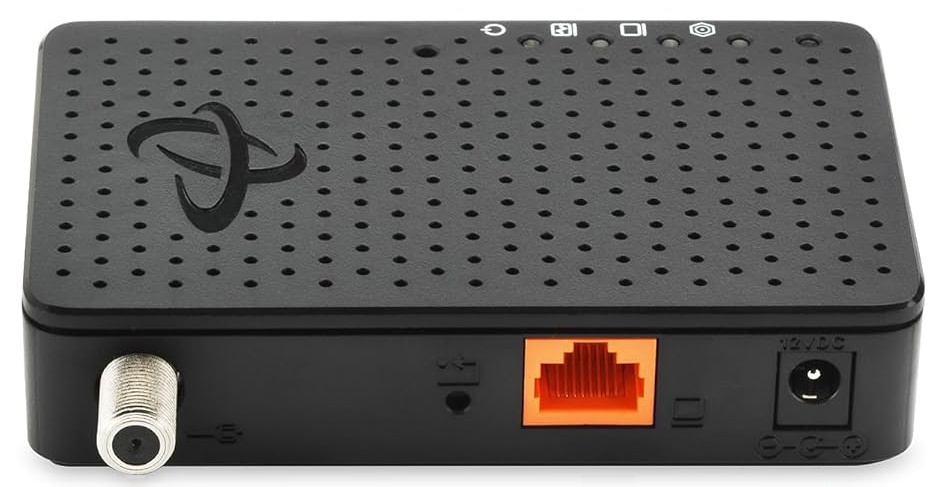](https://amzn.to/46hNqD8) Hitron MoCA 2\.5 Adapter You want to improve Wi\-Fi in a part of the house by installing an access pointor mesh nodethat is wired/Ethernet back to your main router, but there is NO Ethernet cable installed 'in the walls' \-\-*what do you do*? The obvious option is to find a way to install a new Ethernet cable run\. But, depending upon the house, this can be fairly easy, or in many cases, is virtually impossible\.**A MoCA alternative:**But don't overlook another very easy 'self\-install' option, especially if you have 'cut the cord' with the cable company and the coax cable running to most rooms in the house is just sitting there, in the walls, unusedor partially unused\. If so, then definitely investigate using MoCA adapters, which can turn that unused coax into a 2\.5 Gbps Ethernet backbone for extending Wi\-Fi\. 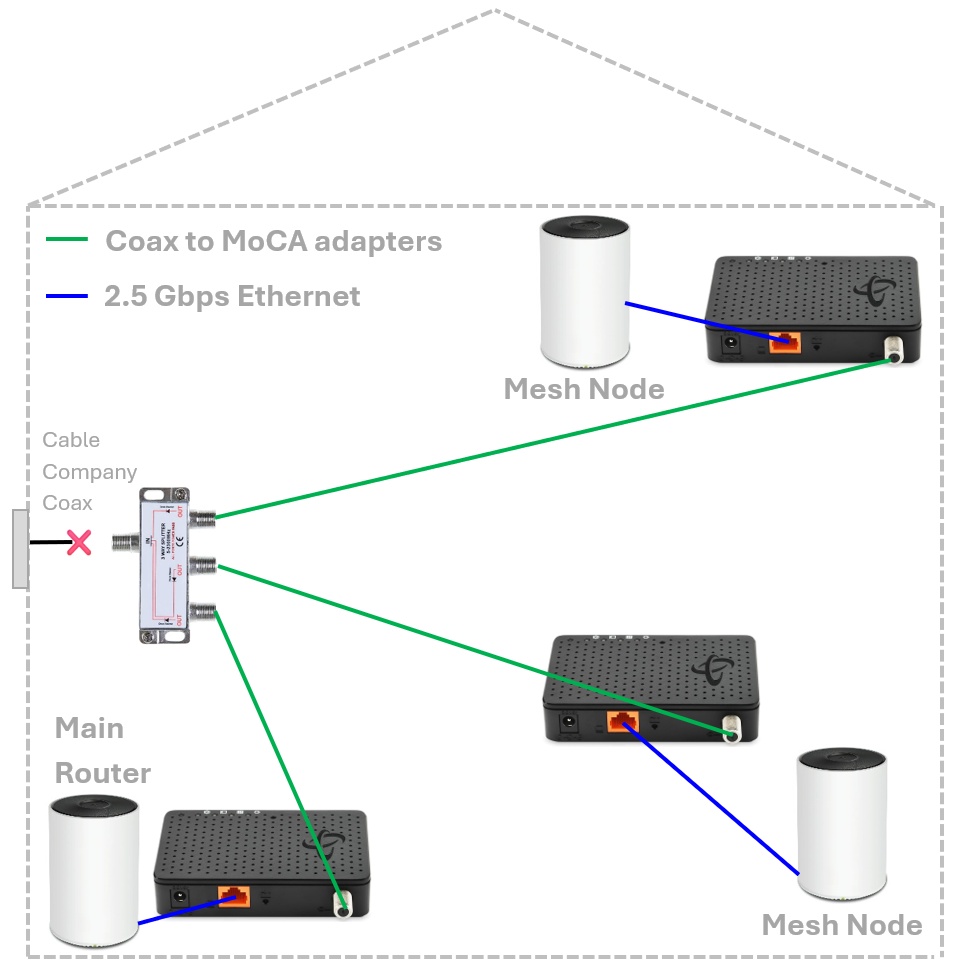 Using MoCA to create 2\.5 Gbps Ethernet backbone for a Mesh network after 'cutting the cord' from the cable company **The easy way:**Create a single 'whole\-house'*shared*2\.5 Gbps backbone \-\- where each room gets a MoCA adapter and coax runs are connected together via a splitter at some common locationthe splitter could connect just two rooms, or a bunch of rooms, depending upon your needs\. If you previously had Cable TV installed, there will likely already be a coax splitter at some pre\-existing common location\. However, make sure to: \(a\) disconnect the feed from the cable company from this splitter, and \(b\) verify that the splitter is rated to handle MoCA frequencies\. [Detailed MoCA information](https://www.wiisfi.com/#moca)\[§E5\] **The harder \(faster overall throughput\) way:**Each coax run becomes its own*dedicated*2\.5 Gbps link\. This is more advanced and requires more planning, more MoCA adapters, an Ethernet switch, and the right topology\. In effect, you are adding MoCA adapters onto*each end*of a coax cable to convert that single coax cable into a single 2\.5 Gbps Ethernet link\. This may or may not add 'speed' depending upon the existing Ethernet and coax topology and how those two will be connected\. But the goal here is to create multiple 2\.5 Gbps linksthat can all be used*concurrently*, instead of creating a*single*'whole house' shared 2\.5 Gbps backbone\.  F\-Type Coax Coupler **Just need to connect two rooms?**If you are just making a 2\.5 Gbps Ethernet connection between two rooms, then at the common 'splitter' location, another optionvs a splitteris to connect the ends of the two coax runs for the two rooms using an F\-Type Coax Couplerseen right\. And then place MoCA adapters in each of the two roomsthat are now connected to each other via the coax coupler\.
Appendix A: Troubleshooting Wi\-Fi
**Goal:**With a modern 2×2 Wi\-Fi 6 client devicephone, tablet, etcconnecting to a modern 4×4 Wi\-Fi 6 router, you should be able to easily[see and verify](https://www.wiisfi.com/#PHY)\[§4\] a 1201 Mbps80 MHz channelor 2402 Mbps160 MHz channelPHY connection between the two devices, when standing right next to the router\. Then as you move away from the routeradding distance/walls, PHY speeds will decrease\.
[](https://www.wiisfi.com/#accesspoint)
> If you get good Wi\-Fi throughput standing right next to your router, but poor throughput far away from the router, then you simply have a 'distance' problem\. Consider adding an[access point](https://www.wiisfi.com/#accesspoint)\[§19\] into your network at that distant location, wired/Ethernet back to your main router\.
**Verify that Wi\-Fi is still turned on:**Some routers have a physical button that enables/disables Wi\-Fi\. Make sure that the button was not accidentially pressedI have seen cleaners inadvertently press the button while dusting a router\.**Disconnect/Reconnect Wi\-Fi:**You might be surprised how often expressly disconnecting from Wi\-Fi on the client device and reconnecting to Wi\-Fi resolves someunknownspeed problem\. Technically this should never happen, but it does due to bugs\.
**Did you reboot everything?**It can't hurt to power cycle your modem, router, client device, etc, and see if the problem goes away\. I was once unable to track down the cause of slow Wi\-Fi, and rebooting all devices solved the problem\. Crazy, but it happens\. Again, technically, this should never happen, but due tounknownbugs, it does sometimes happen\.
> In another case, I was getting great PHY speeds, but very slow Internet speeds\. A bunch of speed tests eliminated Wi\-Fi and my router as the cause\. This suggested the problem was with the only remaining hardware \-\- thecable company providedmodem\. So I rebootedonlythe modem and instantly had my fast speeds back\. Frustrating\.At one location, ISP download speeds were sometimes OK, and sometimes bad\. Rebooting the cable modem caused it to acquire a 'random' set of bonded download channels from the CMTS\. As one particular channel was having issues, this reboot caused the modem to randomly use/avoid the problematic channel\.
**Verify PHY speed:**Go to your wireless device and[check the PHY speed](https://www.wiisfi.com/#PHY)\[§4\] at which the device is connecting to your router\. Then take 70% of the PHY speed as a fair estimate for the maximum realistic throughput speed that one device can achieve\.> Also, walk to your router and stand about five feetline of sightaway from the router, cause some Internet activity, and then re\-check PHY speed\. On a 2×2 Wi\-Fi 6 client, I would expect to see a very strong signal with a PHY speed of 1201 Mbpsor better\. And for a Wi\-Fi 5 client, expect a 866 Mbps PHY\.
**Verify channel/band:**Verify that you are actually connecting to the 5 GHz SSID on your router, as accidentally connecting to the 2\.4 GHz SSID could be the problem\.> Newer client devicesin the Wi\-Fi settingsmay tell you the 'Frequency'2\.4 or 5 GHzyour device is connected to\. If not, the PHY speed you see on your device should be a huge tip off as to which bandand channel widthyou are connecting to\. Look up the speed in the[PHY tables](https://www.wiisfi.com/#phytables)\[§F\], which then reveals a ton of information about how you are connecting\.**Split the Wi\-Fi bands:**Try turning off the 'Smart Connect' feature of the routerthat tries to push the client device to the 'best' band\. Or, for testing, go to the router configuration and confirm that the 2\.4 GHz SSID and the 5 GHz SSID are uniquely named\. If they are the same, append a "\-5G" to the 5 GHz SSID name temporarily\. When you see the SSID for each band, connect to the 5 GHz SSID\. If PHY speed increases dramatically, you likely have a problem with your device connected to theslower2\.4 GHz SSID, instead ofmuch faster5 GHz SSID\.
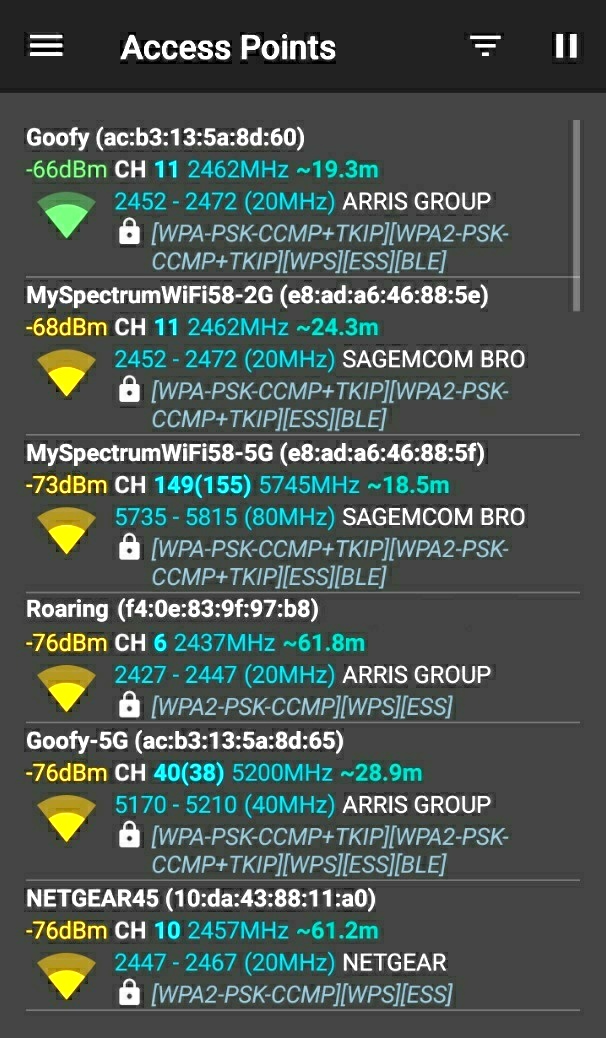 Wi\-Fi Analyzer Access Points
**Verify router capabilities:**Install the["WiFiAnalyzer \(open\-source\)"](https://play.google.com/store/apps/details?id=com.vrem.wifianalyzer)\(play\.google\.com\) Android app on your smartphone and verify that the 5 GHz SSID from your router is using the channel number and channel width that you expect to see\. If wrong, correct in the router configuration\. Or, try switching channels\.> **Verify channel width:**It is important to confirm that your 5 GHz SSID is operating at an '80 MHz' channel width\. If you see '40 MHz' or '20 MHz' for your 5 GHz SSIDnotice this for 'Goofy\-5G' in example right?, go into your router configuration and fix the problem\. The other possibility is that the router is only a dual\-band Wi\-Fi 4802\.11n; not capable of 80 MHz channelsrouter and not actually a Wi\-Fi 5802\.11acrouter\.
**Site Survey:**Use the["WiFiAnalyzer \(open\-source\)"](https://play.google.com/store/apps/details?id=com.vrem.wifianalyzer)\(play\.google\.com\) Android app and find out exactly what channels are being usedwho you are sharing spectrum with, and then set your router to use the most unused channel\. Channels 1, 6, 11 are 2\.4 GHz channels\. Channels 36 \- 165 are 5 GHz channels\. And then verify a good channel[by running a speed test](https://www.wiisfi.com/#speedtest)\[§D\]\.**Q: I upgraded my ISP Internet speed from 60 Mbps to 120 Mbps and my wired Internet speeds dropped\!**
> **A:**The most likely cause is that NOT all devices in your network are 1 Gbps capable\. If there are any Fast Ethernet100Mbpsdevices between you and your ISP, that device becomes a 'choke point' that will very likely cause dropped packets and speed problems\.TIP: It is very common for ISP's to provision internet modems to 110% of the advertised speed\. So if you sign up for 100 Mbps internet, your 100 Mbps network will not work, since the internet speed is more than likely actually 110 Mbps \-\- and any Fast Ethernet devices between you and the internet are a problem\. Another possibility is a bad Ethernet cable between two Gbps devices, causing that link to operate at the problematic 100 Mbps speed instead of the desired 1 Gbps speed\. TIP: Many RJ45 jacks have tiny LED lights indicating speed\.
**Q: I am connected to my Wi\-Fi router at 866 Mbps, but a speedtest shows only 500 Mbps?**> **A:**Due to Wi\-Fi protocol overhead, the expected throughput at the application level is around 60% to 80% of the physicalPHYWi\-Fi speed\. This is normal and sadly, the router industry has done a horrible job explaining this to the general public\.
**Q: I bought a '1733' AC Wi\-Fi router, but I can only connect at 650 Mbps \(PHY\) from my smartphone?**> **A:**Blame router companies \-\- they love to advertise*maximum speeds*\. Looking at the 5 GHz speed table far above, we can see that '1733' implies a 4×4 access point supporting 256\-QAM\. 650 is the PHY speed for a 2×2 device at 64\-QAM\. The conclusion is that your smartphone is a 2×2 MIMO device and that you are maybe 20 to 30 feet from your router\. Expected application throughput will be around 70% of that, or 455 Mbps±45 Mbps\.
**Q: A speedtest on my phone proves I have great Wi\-Fi \-\- why is my Ring camera having trouble?**> **A:**The core issue is likely that your phone and Ring camera are on two different Wi\-Fi bands\. Your phone is almost certainly connected to your router over the 5 GHz band using an 80 MHzor even 160 MHzchannel, whereas the Ring camera is likely connected to your router on the 2\.4 GHz band, using a 20 MHz channel\. Force your Ring camera to connect to the 5 GHz bandby setting up a 5 GHz only guest network on your router, and if the Ring camera does not support 5 GHz, then you need a better Ring camera\. The other thing to keep in mind is that there is often a significant amount of Wi\-Fi signals attenuation traversing the exterior walls of a home\. Worst case, you need a new Access Point, or mesh node, closer to the Ring camera\.
**Q: My speedtest proves I only get a slow XXX Mbps?**> **A:**Maybe, but maybe not\. Always try several different Internet speed test programs, like[speedtest\.xfinity\.com](http://speedtest.xfinity.com/),[fast\.com](https://fast.com/), or[cfspeed\.com](http://www.cfspeed.com/)\. The very nature of the Internet is that everyone will not always be fast\. I find that the[Xfinity speed test](http://speedtest.xfinity.com/)gives the most reliable results, almost all of the timeand it had better, since Comcast is the largest broadband provider in the U\.S\.\.
**Q: I have 250 Mbps Internet, but I max out at 95 Mbps both wireless and wired to my router?**> **A:**Fast Ethernet100 Mbpsmaxes out at a throughput of around 94\.92 Mbps within applications\. So the most likely cause is that the router is only 'Fast Ethernet' and you will need to upgrade to a Gigabit capable routermodem is likely 1Gbps ethernet, but router is only 100 Mbps, causing the bottleneck\. OR, if your router is Gigabit, is there aslowFast Ethernet switch somewhere in the network between you and your router? OR, double check the color of LED lights for RJ45 connectionsLED color should indicate 1 Gbps and not 100Mbps\. You may need to replace a bad ethernet cableas Gigabit requires all eight wires to be good; 100Mbps only uses four of the eight wires\.
**Q: No matter what, my PHY speed maxes out at 54 Mbps\. What is wrong?**> **A:**This can happen when 'WMM'Wi\-Fi Multimediais turned off in the router configuration\. To fix, turn 'WMM' back on\. WMM is actually required for any speeds past 54 Mbps\.
**Q: Why do I not see 802\.11ac link speeds connecting to my router's 5 GHz band?**> **A:**The most likely causeif your router is configured for 80 MHz channelsis that your client device does NOT support 802\.11ac\. Instead, your client device is likely only 802\.11nno 256\-QAM support, and supports 'dual\-band' and is connecting to the 5 GHz band using the maximum 40 MHz channel width of 802\.11n\.Visit[devicespecifications\.com](https://www.devicespecifications.com/)or[phonescoop\.com](https://phonescoop.com/)to research versions of Wi\-Fi supported by your smartphone802\.11n vs 802\.11ac, etc\.
**Q: Why don't I get fast Wi\-Fi speeds from phone upstairs to my router downstairs?**> **A:**Wi\-Fi speeds decrease with distance from the router, and especially decrease through obstacleswalls, floors, etc\. Your maximum speed will be when you are just feet from the routerand line\-of\-sight, and speeds will slowly decrease the farther away you move from the router\. Sorry, but that is just how Wi\-Fi signals work\.
**Q: Why is my client PHY speed stuck at 86\.6 Mbps \(or 173\.3 Mbps\)?**> **A:**This can happen when a router is set to use channel 165\. When channel 165 is selected, there are actually NO 40/80/160 channels availableso the router can only operate using 20 MHz channels\. So even if the router is set to use 80 MHz channels, every Wi\-Fi client connecting to channel 165 will only use 20 MHz channels\. To fix, select a different channel\.
**Q: Why is my PHY speed 866 Mbps, but a throughput test shows only 100 Mbps?**> **A:**Try a different channel on the router, or try updating Wi\-Fi driver software on the client\. The only time I have seen this is with an Intel AC\-7260 laptopchannel 144 not supportedconnecting to a Netgear R7800 router on DFS channel 140\. The router transmitted to the laptop at 20 MHz speeds and the laptop transmitted to the router at 80 MHz speeds\. Upgrading Wi\-Fi drivers on the laptop resolved the problem\.
**Q: My wireless Internet is horrible at video calls, what can I do?**> **A:**First, can you connect wired/Ethernet to the Internet and confirm the problems go awaythis confirms a wireless problem; if not, this confirms an Internet problem? Try moving much closer to your wireless AP to maximize signal strength during the call\. Try connecting to your router's*other*Wi\-Fi band2\.4 GHz to 5 GHz, or vise\-versa\. Try changing channels on the router\. As a last resort, try setting your router to use 20 MHz channels in 5 GHz and try different channelsthis will greatly reduce your maximum Internet speed, but hopefully in return, you will gain an ultra\-reliable connection for your video calls\.
**Q: Why are Wi\-Fi Internet speed tests abnormally slow on my brand new Dell laptop?**> **A:**If you see the**SmartByte**application installedto check, go into 'Control Panel / Uninstall a program', search on 'SmartByte', and if you get a hit, it is installed, disable the SmartByte service, as that Dell service is the likely cause\. Google["beware of SmartByte"](https://www.google.com/search?q=beware+of+smartbyte)\(google\.com\) for a discussion and instructions on how to disable/uninstall\. This Dell service, designed to give priority to video streaming,*actually causes slow Internet speeds*\. Anything designed to 'speed things up' that actually 'slows things down' is pure garbage\. I have personally experienced this problem on multiple brand new Dell laptops\. Absolutely crazy\.
**Q: Internet speed tests are sporadic and the modem diagnostic page shows that one "Channel ID" has a lot of 'uncorrectable' errors\. What is wrong?**> **A:**The most likely cause of the modem diagnostic page showing that all "Channel ID" have very low 'uncorrectable' errors, expect for one Channel ID with a sky high 'uncorrectable' count \-\- is is a bad RG6 cable or connector\. Try using a different RG6 cable\. See[this paper](https://www.duckware.com/tech/solving-intermittent-cable-modem-issues.html)\(duckware\.com\) on cable modem connectivity problems\.
**Q: Is it true that placing a Wi\-Fi router right next to a cable modem can sometimes cause Internet up/down issues?**> **A:**Maybe\. I experienced a similar issue first\-hand with a Netgear R7800 sitting right next to a Netgear CM1000V2 cable modem\. The Internet would sporadically drop\. The cable modem was seeing a fair amount of "Uncorrectable Codewords", and T3 errors in the events logs\. Moving the R7800 over three feet away from the cable modem 'seemed' to reduce the problem\.*Your experience may be different*, but in general, it is a good idea to keep RF devices away from other devices as much as possible\.
**Q: I have an older device that can't connect to my Wi\-Fi \(and I know SSID/password are correct\) \-\- why?**> **A:**See[IoT device won't connect to Wi\-Fi](https://www.wiisfi.com/#iotconnect)\[§E12\]
Also,[how to improve Wi\-Fi speeds](https://www.wiisfi.com/#improvespeed)\[§17\] might help\.**TIP: Digging deeper on Windows:**Use the[Wi\-is\-Fi tools](https://www.wiisfi.com/#tools)\[§E6\]\.
Appendix B: Investigating Router Technical Specifications
**UPDATE/TIP:**A great starting point: Ask Google\. For example, "What is the MIMO level for the flint 2 router"\. Google's 'AI Overview' response often displays the correct information\.*But a big warning \-\- Once in a while the AI reponse is incorrect, so only use use that response to guide your own research\.***Finding Router Specifications:**How do you look at the specifications for a router and make sense of them? One of the best ways to 'figure things out' is to take all cited information that is disclosed, and find the 'Mbps' speed in the[PHY tables spreadsheet](https://www.wiisfi.com/phy)\(docs\.google\.com\), which then helps to figure out the non\-disclosed specifications\. To investigate, go to a vendor's web page for a router model and look for the 'technical specifications' section:
- [TP\-Link Routers](https://www.tp-link.com/us/home-networking/wifi-router/)\(tp\-link\.com\) \- click on "Specifications" on top of product pages
- [Netgear Routers](https://www.netgear.com/home/wifi/routers/)\(netgear\.com\) \- on product page, click on "Specs", then "Technical Details"
- [ASUS Routers](https://www.asus.com/networking-iot-servers/wifi-routers/all-series/)\(asus\.com\) \- click on "Tech Specs" on top of product pages
- [Linksys Routers](https://www.linksys.com/shop/shop-home/wifi-routers/)\(linksys\.com\) \- find "Technical Specification" on product pages
- [Eero Routers](https://eero.com/compare)\(eero\.com\) \- expand 'Radio Frequency' section for MIMO specs
- [Tenda Routers](https://www.tendacn.com/products/routers.html)\(tendaacn\.com\) \- click on "Specification" on top of product pages
- [WavLink Routers](https://www.wavlink.com/en_us/category/routers.html)\(wavlink\.com\) \- click on "Specification" part of product pages
- [Synology Routers](https://www.synology.com/en-global/products/routers)\(synology\.com\) \- click on "Specs" section of product pages
- [Google Routers](https://store.google.com/product/google_wifi)\(google\.com\) \- click on "Tech Specs", expand 'Performance' section
- [D\-Link Routers](https://us.dlink.com/en/consumer/wifi-routers)\(dlink\.com\) \- click on "Specifications" section on product pages
- [Ubiquiti Routers](https://store.ui.com/us/en?category=all-wifi)\(ui\.com\) \- click on "Technical Specifications" on product pages
**TIP:**If the router vendor does not disclose the information you are looking for, visit the[Wi\-Fi Org Product Finder](https://www.wi-fi.org/product-finder)\(wi\-fi\.org\) and search on the router model name\. If the router has been 'Wi\-Fi certified', there will be an information PDF disclosing lots of technical information about the router\.**MCS/QAM:**Router companies always citeand add togetherMbps values for the highest supported MCS level, for the highest supported MIMO level, in each band\. This tells you what 'row' to lookup values in the[PHY tables spreadsheet](https://www.wiisfi.com/phy)\(docs\.google\.com\)\. Highest supported MCS levels will often be:
- "256\-QAM 5/6" \(MCS 9\) for Wi\-Fi 4/5
- "1024\-QAM 5/6" \(MCS 11\) for Wi\-Fi 6/6E
- "4096\-QAM 5/6" \(MCS 13\) for Wi\-Fi 7
> *However, be careful, as there are sometimes crazy rare exceptions \-\- like a Wi\-Fi 6 router that is only Wi\-Fi 6 in the 5 GHz band, but is only Wi\-Fi 5or olderin the 2\.4 GHz band\! OR, a router that supports 1024\-QAM at only MCS 10, but not MCS 11\.*
**Channel widths:**Router companies always cite Mbps values for the highest supported channel widths, in each band\. This tells you which[PHY tables spreadsheet](https://www.wiisfi.com/phy)\(docs\.google\.com\) to use\.- For the 2\.4 GHz band, router companies virtually always cite speeds for 40 MHz channel widths, even though most client devices will only be able to use 20 MHz channel widths\.
- For the 5 GHz band and Wi\-Fi 5, channel width is often 80 MHz or 160 MHz\. If not disclosed, it must be deduced from all the other information provided\.
- For the 5 GHz band and Wi\-Fi 6, channel width for higher end routers will be 160 MHz, but will be 80 MHz for low\-end routers\.
- For the 6 GHz band and Wi\-Fi 7, high\-end routers will cite speeds for 320 MHzbut lower end routers could cite for 240/160/80 MHz\.
*Warning: Your client device may only support a smaller channel widtheg: HE80than the cited Mbps / channel widtheg: HE160\.*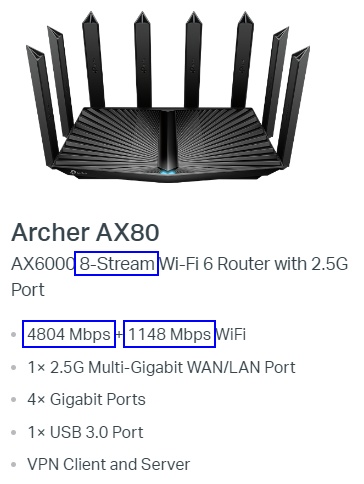
**MIMO level:**For Wi\-Fi 5, router companies just cite the highest MIMO level used in any Wi\-Fi bandeg: two or four\. But for Wi\-Fi 6/6E/7, router companies now add the MIMO levels for each band together and report that sum as the number of "Streams" that router supports\.[Details](https://www.wiisfi.com/#stream)\[§Q\]\. That 'sum' can be helpful to decipher incomplete router specifications\.**Example One:**For example, take the TP\-Link AX80 routerseen right\. Immediately take note of the 'stream' sum8and the two Mbps values4804 and 1148\.
> Note that two Mbps numbers added together means 'dual band'\. If you saw three Mbps numbers added together, that is tri\-band; and four Mbps numbers is quad\-band\.
So, for "8 Stream", and dual\-band, two numbers added togetherthe MIMO level for each bandmust equal 8\. A good first logical guess is just 4\+4=8, and sure enough, when we look at the PHY tables for Wi\-Fi 6802\.11ax, 4×4 MIMO, and look up the two values 1148 and 4804 in the[PHY tables spreadsheet](https://www.wiisfi.com/phy)\(docs\.google\.com\), we find:- in the 802\.11ax 40 MHz channel table, 1024\-QAM 5/6 row, 1148 is value for 4×4 MIMO
- in the 802\.11ax 160 MHz channel table, 1024\-QAM 5/6 row, 4804 is the value 4×4 MIMO
So this 'confirms' that both the 2\.4 GHz and 5 GHz bands are 4×4 MIMO for the TP\-Link AX80\.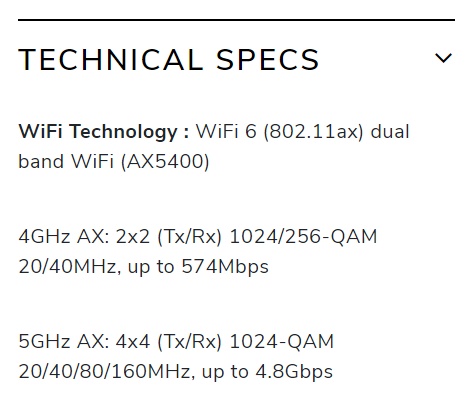
**Example Two:**For the Netgear RAX50seen right, go to the Netgear product page and scroll down and expand the "Technical Specs" section and immediately find that the 2\.4 GHz band is 2×2 MIMOmax 545 Mbpsand that the 5 GHz band is 4×4 MIMOmax 4\.8 Gbps\.> In this case, the specification told us the MIMO levels for each band, but if not, we could have deduced it from the fact that Netgear told us this was a six\-stream router\. Looking up the disclosed Mbps values in the[PHY tables spreadsheet](https://www.wiisfi.com/phy)\(docs\.google\.com\), the only MIMO combination that works and makes sense is that 5 GHz is 4×4 and that 2\.4 GHz is 2×2\.
**Example Three:**Take the TP\-Link AX21 Router, dual\-band, four\-stream router with Mbps speeds of 1201\+574\. It does not take long to figure out from the[PHY tables spreadsheet](https://www.wiisfi.com/phy)\(docs\.google\.com\), that the only 'values' that 'work' are:- in the 802\.11ax 80 MHz table, 2×2 MIMO is 1201 Mbps \-\- for 5 GHz band
- in the 802\.11ax 40 MHz table, 2×2 MIMO is 574 Mbps \-\- for 2\.4 GHz band
Also helpful is that TP\-Link, under["Specifications" on product web pages](https://www.tp-link.com/us/home-networking/wifi-router/archer-ax21/#specifications)\(tp\-link\.com\), enumerates the "WiFi Reception Sensitivity" for each Wi\-Fi band, which also reveals maximum supported channel widthsHE40 is a 40 MHz channel; HE80 is an 80 MHz channel; etc\.**Example Four:**Take the TP\-Link AX75, a tri\-band, six stream, 5400 Mbps class Wi\-Fi 6E router\. The manufacturer's[specifications web page](https://www.tp-link.com/us/home-networking/wifi-router/archer-ax75/#specifications)\(tp\-link\.com\) tell us the 6 GHz band supports HE160, the 5 GHz band supports HE160, and the 2\.4 GHz band supports HE40\. Our first guess is that there is 2×2 MIMO for each bandbecause 2\+2\+2 = 6, and adding up the Mbps for all bandsusing 2×2 MIMO and 1024\-QAMgets us to the 5400 Mbps specification, confirming our MIMO guess:
- in the 802\.11ax 160 MHz table, 2×2 MIMO is 2402 Mbps \-\- for 6 GHz band
- in the 802\.11ax 160 MHz table, 2×2 MIMO is 2402 Mbps \-\- for 5 GHz band
- in the 802\.11ax 40 MHz table, 2×2 MIMO is 574 Mbps \-\- for 2\.4 GHz band
**An alternative:**If you know you want a dual\-band Wi\-Fi 6 router supporting HE160, 4×4 MIMO, and the topmost QAM\-1024, go to the[PHY tables spreadsheet](https://www.wiisfi.com/phy)\(docs\.google\.com\) and lookup those values in the appropriate tables\. Use the 802\.11ax 40 MHz table for 2\.4 GHz to find 1147 Mbps\. Use the 802\.11ax 160 MHz table for 5 GHz to find 4804 Mbps\. You now know you want a router with a minimum specification of "4804 Mbps \+ 1147 Mbps"\. That quickly narrows down the list of routers\. Then from that much shorter list, compare prices and confirm actual specifications\.> *It is very important to confirm specifications when using this method, because you may want 4×4 MIMO 80 MHz support and when you look at the PHY tables you see the 'wanted' Mbps value \-\- but when you dig into the router specifications, the router may only support 2×2 160 MHz, which happens to have the same PHY Mbps value\. Be careful\.*
**A Wi\-Fi 7 warning:**When trying to figure out specifications for Wi\-Fi 7 routers, keep in mind that a 240 MHz wide channel is possible\. For example, a BE5000 class 2×2 Wi\-Fi 7 router, using MCS13 in 2\.4 GHz and 5 GHz\. In order for all the math to 'work out' this implies that the router must be using a 240 MHz channel width\.Appendix C: Netgear 'Mode' means Channel Width
**What does Netgear 'Mode' mean?**So you just got a new router and are setting it up and you see 'Mode' and various Mbps under the Wi\-Fi settings, but what does that mean? It means*160/80/40/20 MHz channel width\!*It does NOT change or adjust MIMO level supportwhich can not be directly changed\.> **TIP:**Netgear 'Mode' means "channel width"\.
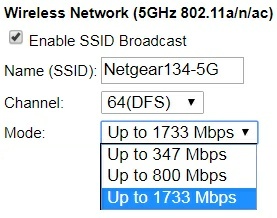
**Netgear R7800 \(4×4\) 5 GHz example:**- **1733:**Lookup 1733 in the PHY tables far above and you find it under the80 MHzPHY table with 256\-QAM 5/6 modulation and 4×4 MIMO\.
- **800:**Lookup 800 in the PHY tables far above and you find it under the40 MHzPHY table with 256\-QAM 5/6 modulation and 4×4 MIMO\.
- **347:**Lookup 347 in the PHY tables far above and you find it346\.6under the20 MHzPHY table with 256\-QAM 3/4 modulation with 4×4 MIMO\.Note that this is because 256\-QAM 5/6 is not available in 20 MHz modefor most commonly used MIMO configurations\.
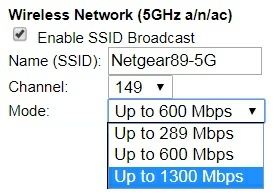
**Netgear R6250 \(3×3\) 5 GHz example:**- **1300:**Lookup 1300 in the PHY tables far above and you find it under the80 MHzPHY table with 256\-QAM 5/6 modulation and 3×3 MIMO\.
- **600:**Lookup 600 in the PHY tables far above and you find it under the40 MHzPHY table with 256\-QAM 5/6 modulation and 3×3 MIMO\.
- **289:**Lookup 289 in the PHY tables far above and you find it288\.8under the20 MHzPHY table with 256\-QAM 5/6 modulation with 3×3 MIMO\.
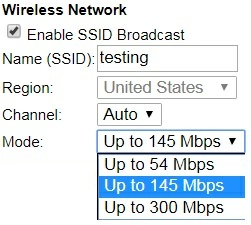
**Netgear JNR3210 \(2×2\) 2\.4 GHz example:**- **300:**Lookup 300 in the PHY tables far above and you find it under the40 MHzPHY table with 64\-QAM 5/6 modulation and 2×2 MIMO\.
- **145:**Lookup 145 in the PHY tables far above and you find it under the20 MHzPHY table with 64\-QAM 5/6 modulation and 2×2 MIMO\.
- **54:**This is the exception\. In Netgear routers on the 2\.4 GHz band, this sets the router to 802\.11g54 Mbpsoperation only\.
Appendix D: Throughput Testing Tools
The first step in setting up an AP/router is selecting a Wi\-Fi channel that you think is the 'most unused channel' and confirm that you obtain a good[PHY speed](https://www.wiisfi.com/#PHY)\[§4\] from your client devices\.The second step is to test and verify that you are obtaining the expected throughput, when next to that AP \-\- 'around' 70%±10%of the PHY speed\. If you see substantially less than this, try a different channel\.
> *TIP: Reboot all of your test equipment before running throughput tests\. I have spent WAY too much time trying to track down the cause of a slow performance testand NOT finding the problem, only to at the end, rebooting, and having the problem go away\. Frustrating\.*
[](http://speedtest.xfinity.com/) Xfinity speed test
**ISP speed test \(very easy to use; result quality unknown\):**Run your ISP's website speed test toolsee table upper right\. Very helpful if all you need to confirm is that speeds are past some value\. But if results are not what you expected, you don't know where the 'choke point' isWi\-Fi, the ISP, something else?\.> *ISP speed tests will only be 'reliable' at testing Wi\-Fi throughput if the ISP speed is known to be faster than your expected Wi\-Fi throughput\.TIP: But if ISP speed tests over Wi\-Fi improve significantly as you move closer to the router, that is a classic sign that Wi\-Fi is indeed the 'choke point', and limiting throughput\.*
◆**TxRate \(easy to use; often great results\):**A very helpful speedtest tool that I use all the time to 'see' and visualize Wi\-Fi first hop Tx throughput*in real\-time*on my laptop/PC is[TxRate](https://www.duckware.com/txrate/index.html)\(duckware\.com\)\. The huge advantage of this tool is that it only needs to be installed on the laptop/PC running the speed testno other laptop/PC is needed, but this comes with the slight disadvantage that it only tests Wi\-Fi transmit speednot receive speedof just the first hopso not for mesh or extenders, that have multiple hops to the main router\.> But these disadvantages are a very small price to pay for the huge advantage and convenience of \(1\) not having to install any software elsewhere in the network being tested and \(2\) working independently of LAN Ethernet speednot limited when LAN is only 1 Gbps\. Besides, there is often just a single Wi\-Fi hop to testas client devices often connect directly via Wi\-Fi to the main router or AP, and client Tx speed is oftenbut not alwaysslower than Rx speed, so this often ends up testing the desired 'weakest' Tx link\.
This graphbelowis TxRate capturing the maximum transmit speed from my laptop to a Wi\-Fi main routerin the next room, and halfway through the test, I started a speed test on a second computer, intentionally creating 'contention' for the Wi\-Fi channel\. My laptop is then forced to share the Wi\-Fi channel with that other computer, and as expected, both computers get around 50% time on the channel:> 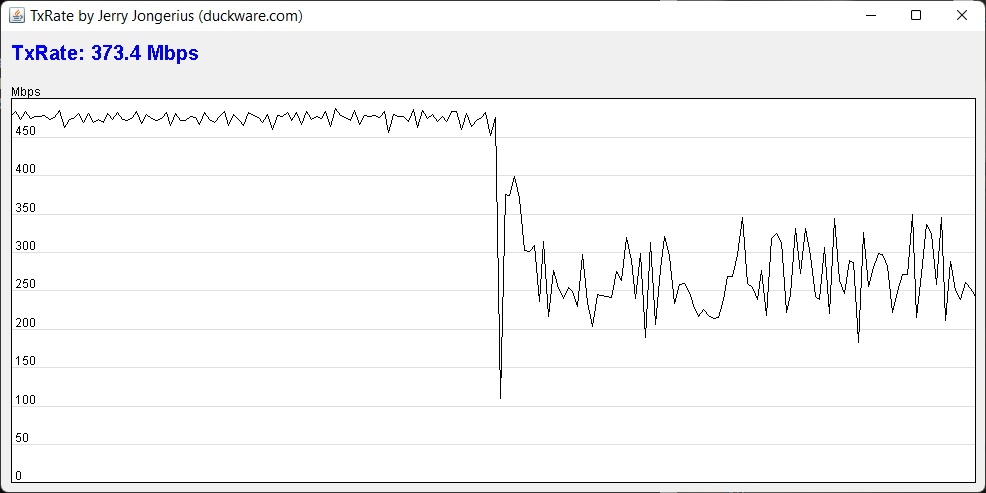 Two client devices trying to 'max out' the Wi\-Fi at the same time \-\- each gets around 50%
Downloading from 192\.168\.0\.211 port 33333\.\.\.
242,548,736 bytes in 1000 ms = 1,940,389,888 bps
240,844,800 bytes in 1000 ms = 1,926,758,400 bps
240,975,872 bytes in 1000 ms = 1,927,806,976 bps
242,417,664 bytes in 1000 ms = 1,939,341,312 bps
239,992,832 bytes in 1000 ms = 1,919,942,656 bps
Uploading to 192\.168\.0\.211 port 33333\.\.\.
228,851,712 bytes in 1000 ms = 1,830,813,696 bps
229,048,320 bytes in 1000 ms = 1,832,386,560 bps
218,038,272 bytes in 1005 ms = 1,735,628,035 bps
234,684,416 bytes in 1000 ms = 1,877,475,328 bps
225,902,592 bytes in 1000 ms = 1,807,220,736 bps
Wi\-Fi 6 160 MHz channel throughput with 2402 Mbps PHY
◆**SpeedTest \(BEST; super accurate; harder to use\):**The best speed test toolgreat resultsis also the hardest to setup and use because it requires using another computer on the network as a speedtest server, and a LAN speed faster than the Wi\-Fi speed you want to test, which is not always possible\.Use[this SpeedTest program](https://www.duckware.com/speedtest/index.html)\(duckware\.com\) to easily test both download / upload Mbps speeds between any two computers on your network\. One computer is connected to the LAN/Ethernet and runs the 'server'\. Another computer is connected to Wi\-Fi and runs the 'client'\.
This speed test program works on your LAN \-\- so it avoids Internet usage\. Plus, ISP speeds may not max out your Wi\-Fi connection\. Ideally, your Ethernet LAN speed is 1 Gbpsor higher, which should allow very accurate Wi\-Fi download/upload speed measurementsas Tx PHY and Rx PHY for Wi\-Fi can sometimes be very different\.
> **TIP:**First, validate your LAN speed\. Run this speed test program between two computers on your LAN first, to confirm that both client\+server computers, and your LAN, can handle full LAN speeds\. Expect around 5\.1% overhead for TCP over Ethernet\. On a 1 Gbps LAN, expect measured throughput speeds to max out at around 949 Mbps\. On a 2\.5 Gbps LAN, expect the same 5\.1% overhead and a maximum measured throughput speed around 2\.37 Gbps\.[](https://amzn.to/48YU6Gr) USB\-C 2\.5 Gbps Ethernet **Inexpensive 2\.5 Gbps Ethernet:**You will need a 2\.5 Gbpsor fasterEthernet network to measure any Wi\-Fi speeds past 1 Gbpsand up to 2\.5 Gbps\. The[uni USB\-C to Ethernet Adapter 2\.5 Gbps](https://amzn.to/48YU6Gr)\(amazon\.com\)seen rightis an inexpensivearound $27way to add 2\.5 Gbps Ethernet to computers with USB\-C\.> *Do NOT buy the Anker brand of this adapter\.*I did and found that it is unable to connect when a laptop is plugged into AC powerand on battery, it only works to 1 Gbps\. Crazy bug\. The 'uni' works just fine for me\. Both the Uni and Anker use a Realtek chipset\. So make sure that your Realtek drivers are up\-to\-date\. Compare to the latest version at[Realtek USB FE / GBE / 2\.5G / 5G Ethernet Family Controller Software](https://www.realtek.com/Download/List?cate_id=585)\(realtek\.com\)\. When I connected to a Windows 10 laptop, speed was bad and the driver was crazy oldfrom 2015\. Problems were fixed after updating the driverbut not for Anker\.
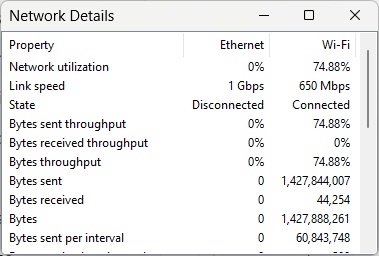
**Another option: Use OS provided tools:**A relatively 'easy' way to test Wi\-Fi throughput is by transferring a large file from one PCon wired Ethernetto another PCon Wi\-Fiand looking at OS provided network performance graphs\.> **Windows:**Run the "Task Manager" app, select 'Performance', select 'Wi\-Fi'\. The result is a graph of Wi\-Fi performance\. Optionallyand a little harder to use, right click on the graph, select "View network details", and the result is real\-timeonce/secinformationexample seen right\.
**FastPing:**Another very helpful tool is[FastPing](https://www.duckware.com/fastping/index.html)\(duckware\.com\), which sends large pings to a device on your networkoften your main router, measuring the round\-trip response time, and calculating Mbps throughput\. Very helpful because this tests the*reliability of the full path*to/from your devices\. Note that no other server is neededonly your router\. FastPing is great at testing modestsay 200 Mbpsspeeds and reliabilitywhen pinging a modern router, but it is NOT for testing maximum peak speeds\.> *TIP: The FastPing manual page shows how to use the built\-in Windows\+Linux 'ping' tool to manually perform very basic throughput testing, using large pings\. Great for testing throughput to/from IoT devices with limited72 MbpsWi\-Fi speeds\.There is a very small 'turn\-around' time in the router that is alsounavoidablymeasured by FastPing\. For slow connection speeds, this delay is inconsequential\. For fast connection speeds, this delay dominates and makes the speed less accurate\. For this reason, FastPing is great at*comparing*two Wi\-Fi connectionsfastest speed wins\. TIP: Use FastPing to test the reliability of your 'modem to ISP' link\. The FastPing manual web page has details\.*
[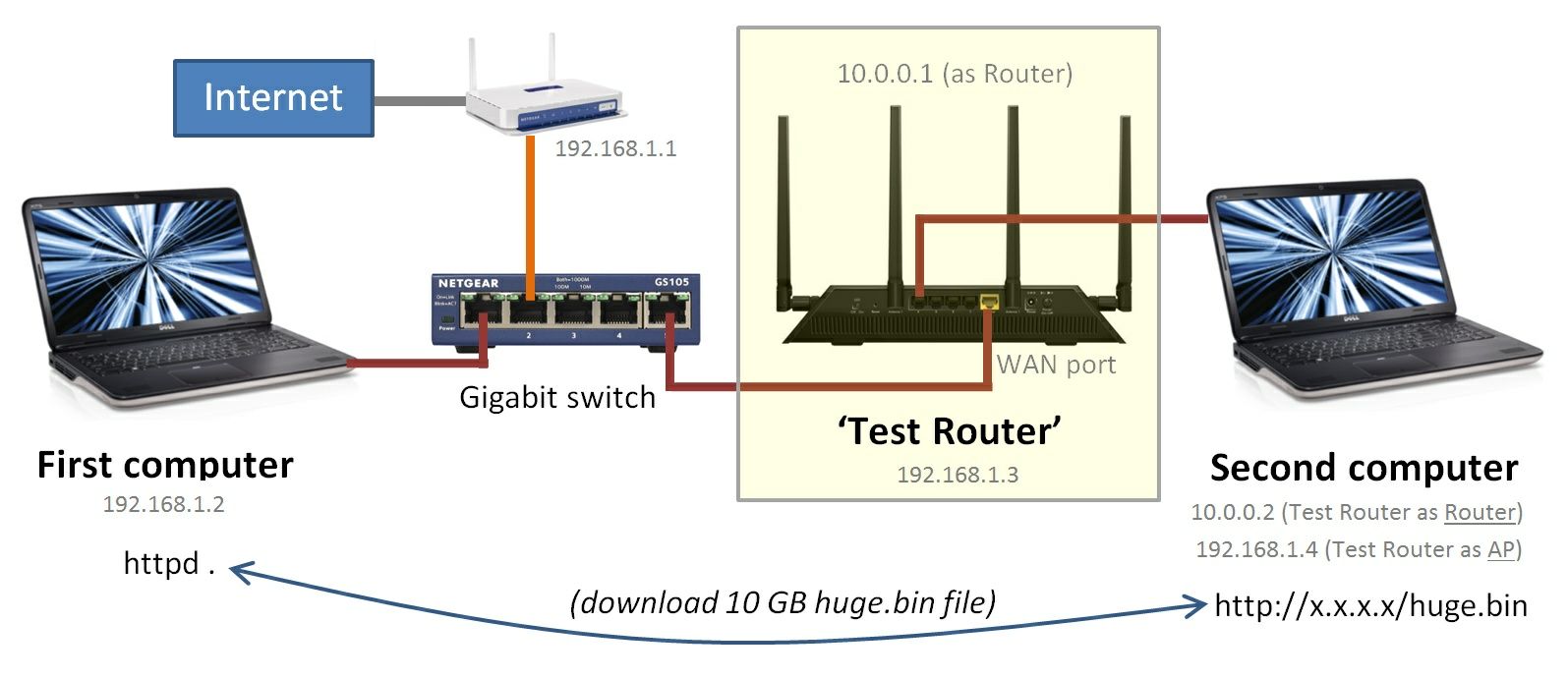](https://www.duckware.com/tech/router-wan-to-lan-throughput-test.html)
**Advanced: How to test Router WAN to LAN speeds:**What if you have 1 Gbps internet, AND are able to get true Gigabit wireless throughput \-\- you don't want to then find out that you can't access the Internet at gigabit speeds due to a problem with your routereg: the Netgear R7800 router has a bug in older firmware that limits WAN to LAN throughput to 340Mbps over port 80\.[How to test WAN to LAN router speed](https://www.duckware.com/tech/router-wan-to-lan-throughput-test.html)\(duckware\.com\)\.**WARNING: What to watch out for when running speed tests:**Here are some tips on things to watch out for when running speed testsand not getting the results you expected:
- **Multiple computers on Wi\-Fi:**When running speed tests between two computers, one computer must be on Ethernetwith Wi\-Fi offand the second computer must be on Wi\-Fi\. If both computers are on Wi\-Fi, you will not get accurate speed test results\.
- **Multiple\-use Ethernet ports:**Avoid using dual\-functionality Ethernet Router ports for speeds tests\. For example, a port labeled WAN/LAN\. I have seen bad speed test results from a WAN/LAN port used in LAN mode\. I assume because packets are being routed between ports in the OS, instead of being routed between ports in hardwarethe switch?
- **Flow Controller:**Some routers have a 'Flow Controller' which allows for a 'pause' frame to be sent outwith the goal of reducing/eliminating lost packets\. The interesting impact of this is that it can restrict Wi\-Fi speeds above 1 Gbps to the Router's WAN port speed of 1 Gbps\. One tip\-off is Wi\-Fi speed resultsusing TxRate abovecapped at 949 Mbps\.
- **Kicked off DFS channel:**Your router is configured to use a 160 MHz DFS channel, but is currently using a non\-DFS 80 MHz channel\. Verify channel number and width before and after running throughput tests\.
- **Buffering:**The amount of TCP/IP socket buffering in the speed test programor notwill have a major impact on speed test results\. Programs not written for 'high performance' in mind may have trouble*accurately*obtaining and measuring speeds above 1 Gbps\.
- **Power Plans:**If using a laptop, test with BOTH the laptop \(1\) plugged into the power brick and \(2\) on battery\. You want to understand if 'on battery' has any 'slow down' issues\.
- **Slow client devices:**Always test Wi\-Fi speeds against multiple client devices, including workstation class computers\. You always want to measure true Wi\-Fi capabilities, and not end up measuring a client device limitation\.
- **Older Routers:**Many older routerseven 'high\-end' Wi\-Fi 5don't have the horsepower to fully max out Wi\-Fi capabilities and match throughput results from Wi\-Fi 6 routers in Wi\-Fi 5 mode\. Newer often is better\.
- **WAN port speed limit:**Speeds tests can only run as fast as the slowest 'choke point', which can be the Ethernet ports\. For example, Wi\-Fi on the Netgear RAX50 can run much faster than 1 Gbps, but throughput to the WAN or LAN is limited to around 949 Mbps by the 1 Gbps Ethernet ports\.
- **Give beamforming time to work:**After first connecting to Wi\-Fi, don't instantly run a speedtest\. Instead, give 'new' connections a little time to 'synchronize'at least 15 seconds\.
Appendix E: PHY speed is \(often\) asymmetric
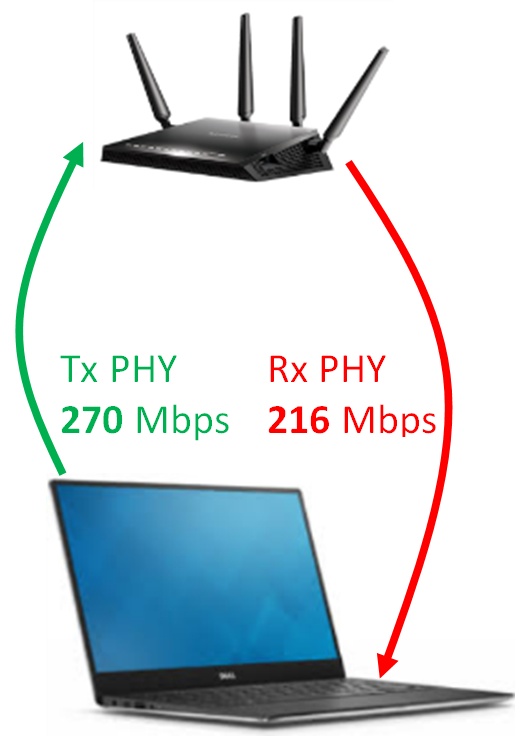
**Background:**There are actuallyTWOPHY speeds for any Wi\-Fi device: \(1\) the TxtransmitPHY speed and \(2\) the RxreceivePHY speed\. In many cases, these two PHY speeds are 'close' to each other, but in some cases they can be very different\.> **KEY Wi\-Fi concept:***A device's Tx and Rx PHY speeds are independent, and are often different\.*
> To the right is an unusual example of actual measured PHY speeds in real life between a router and a laptop computer\. Notice that the laptop might report a 'good' 270 Mbps for the Link Speedout of max possible of 300 Mbps, but that downloads from the Internet will only use a PHY speed of 216 Mbps\! Admittedly, this example is unusual, as most often thehigher poweredrouter can transmit at a faster PHY to the PC than the PC can transmit to the router\.
**Range:**If a client device is close to an AP, PHY speeds may not be asymmetricby much\. But at range, as client devices moves away from an AP, the more the asymmetry will be seen\.[Details](https://www.wiisfi.com/#range)\[§G\]\.**So what is 'Link Speed'?:**So is the 'link speed' displayed by Wi\-Fi client devices showing Tx PHY, or Rx PHY? At least on Windows 7/8, it appears to be the*maximum*of Tx PHY and Rx PHY\. But on Android, it seems to match Tx PHY\. This is complicated and needs a more research\.
**Router PHY speed for Wi\-Fi clients:**Some routers display a single 'link speed' for every client associated with the router\. This ismost likelythe Tx PHY speed from the router to the Wi\-Fi client\. Or, from the client's point of view, this is the critical Rx PHY speed we want to know\.
**Seeing asymmetric speeds in throughput tests:**If you don't have a router that displays Wi\-Fi client link speed, the best way to see this asymmetry is in[throughput speed tests](https://www.wiisfi.com/#speedtest)\[§D\]\.
> The best way to notice and see asymmetric PHY speeds is to place a client device 'at range' away from the AP/router being used\. The closer a client device is to the AP/router, the less you will notice the asymmetry\.
**The bottom line:**The PHY number that clients report is not yet very clear\. Is it Tx PHY, Rx PHY, or a combination of the two? The next best thing is actual performance throughput benchmark tests, which are a real pain, especially on smartphones and tablets\. So instead everyone just uses and reports Tx PHY speed as an*indicator*of device speeds\. As an*indicator*, it works pretty well\.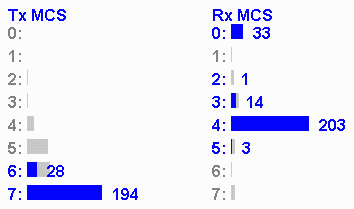 Asymmetric PHY \(as seen at AP\)
**Another example:**In another test between a laptop and a router, I found what I suspect is very typical asymmetric PHY\. Running a throughput speed test, download measured 438 Mbps, but upload measured 200 Mbps\. And using the method described in the[Router deep dive appendix](https://www.wiisfi.com/#deepdive)\[§L\] below, I found that MCS 7650 Mbpswas being used for download and MCS 4390 Mbpswas being used for upload\. Considering that the laptop transmit power25 mWis way below that of the router200 mw, this outcome is expected\.*BUT, the 'link speed' reported by the Windows laptop was 650 Mbps\.*Appendix F: PHY speed tables
**PHY speed tables:**PHY tables for Wi\-Fi can be found in this online[Google docs spreadsheet](https://www.wiisfi.com/phy)\(docs\.google\.com\)\. This spreadsheet is the full rawbut read\-onlyspreadsheet on purpose*so that you can inspect the formulas that go into creating every number in the tables\!*[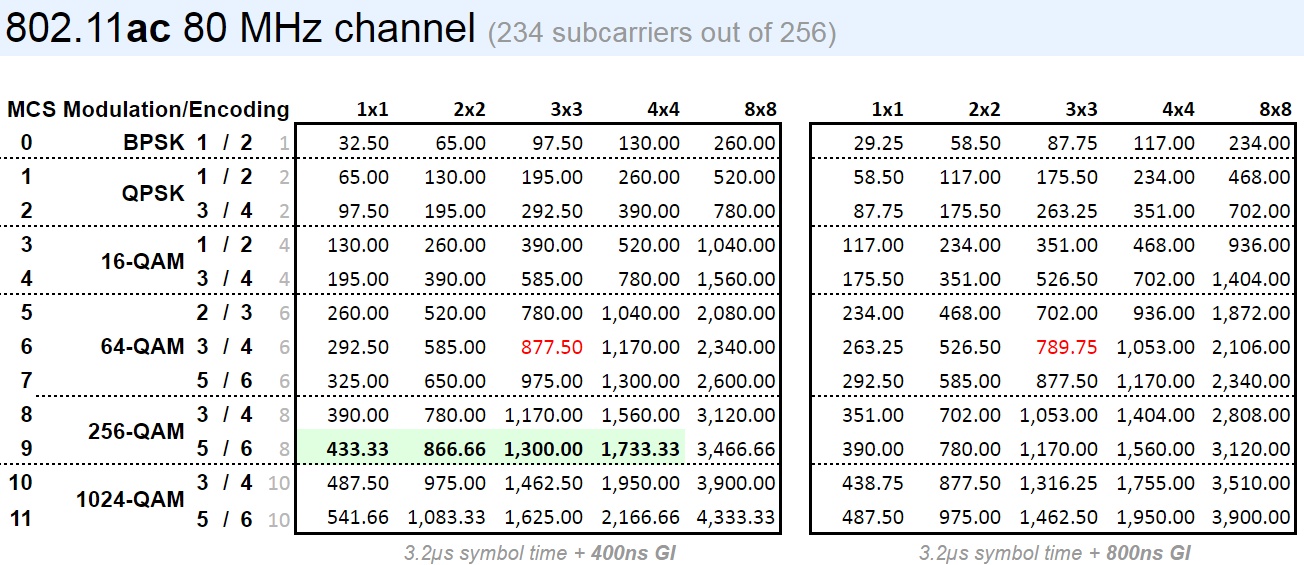](https://www.wiisfi.com/phy)
**Useful:**I often lookup the PHY speed on a client device, and then find that speed in the PHY tables, which reveals a ton of information about Wi\-Fi on that client802\.11 mode, MIMO level, modulation, encoding, guard interval, channel width\. When the same value appears in multiple places, usually a little common sense and deduction about client device capabilities using[devicespecifications\.com](https://www.devicespecifications.com/)or[phonescoop\.com](https://www.phonescoop.com/)can resolve the conflict\.> Most modern Wi\-Fi 6 clients are capable of 160 MHz channel widths and 2×2 MIMO\. If you are not seeing PHY speeds indicating that, then you have an issue to investigate\.
---
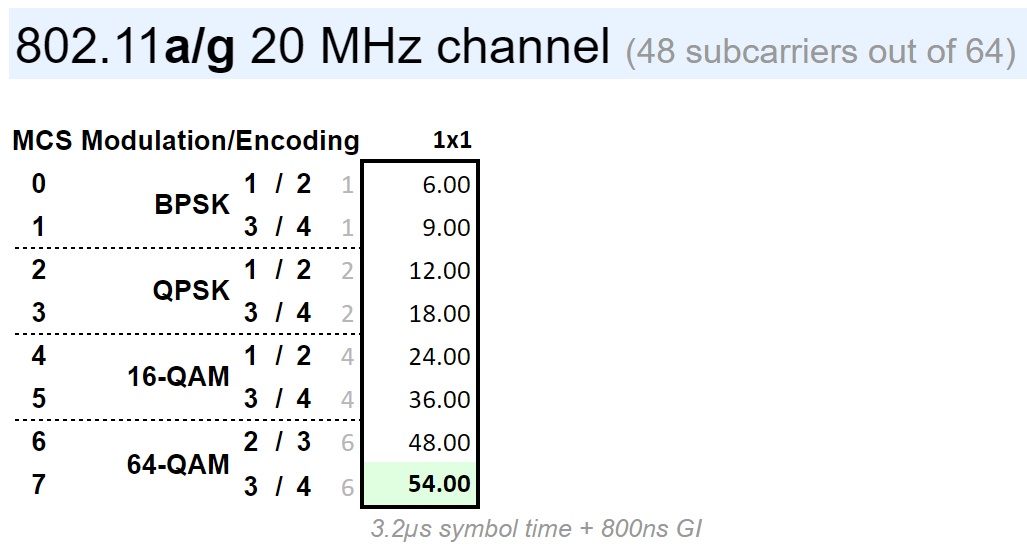
**Understanding the math \-\- a deep dive into 802\.11g:**Take a look the 802\.11g MCS tableseen rightfrom the spreadsheet above\.**Symbols per second per subcarrier:**Each 'symbol' time is 3\.2 microseconds with an 0\.8 microsecond 'guard interval'GI, or space between symbols\. In effect, each symbol then takes 3\.2\+0\.8, or 4 microseconds of time to send\. That means that there are "1 sec / 4 microseconds", or 250,000 of these symbols per second*per subcarrier*\.
**SubCarrier:**But 250,000 symbols/sec can be sent for each subcarrier\. The 20 MHz channel width is split into 64 parts/subcarriers, but only 48 out of 64 are used for sending datafor 802\.11g\. Multiplying
"48 × 250,000", we get 12,000,000 \-\- the total number of symbols transmitted*per second*, for a 20 MHz channel, for all subcarriers\.> **A key Wi\-Fi concept:**Notice that ALL 802\.11 a/g Wi\-Fi devices operate at the SAME 12,000,000 symbols/secat the same 'metronome' frequency\. It is only the 'Modulation' and 'Encoding' that changes and determines true Wi\-Fi throughput\. So an 802\.11g device operating at a minimum PHY of 6 Mbps AND an 802\.11g device operating at a maximum PHY of 54 Mbps*are BOTH transmitting symbols at a rate of 12,000,000 per second*\. Using terminology from decades ago, this is like saying that the['baud rate'](https://en.wikipedia.org/wiki/Baud)\(wikipedia\.org\) of 802\.11 a/g Wi\-Fi is a fixed 12,000,000 symbols/sec\.*The same 'concept' applies to all other versions of Wi\-Fi as well, but with multiple guard interval options\.*802\.11 n/ac has either 13,000,000 symbols/sec800ns long GIor 14,444,444 symbols/sec400ns short GIfor a 20 MHz channel\.
Modulation bits/symbol**Modulation****Bits**BPSK \(2\)1QPSK \(4\)216\-QAM464\-QAM6256\-QAM81024\-QAM104096\-QAM12**Modulation:**BPSK can send 1 bit/symbol\. QPSK sends 2 bits/symbol\. 16\-QAM sends 4 bits/symbol\. 64\-QAM sends 6 bits/symbol, and so onsee table right\. So multiply 12,000,000 by either 1, 2, 4, or 6 to obtain the total number of bits transmitted\. For example, for 16\-QAM, the multiplier is 4 and so 12,000,000 symbols/sec becomes 48,000,000 bits/sec\.> The modulation levelQAM 16, 256, 1024, etcis just the number of unique values that can be 'understood' per Wi\-Fi symbol, and bits is the 'power of two' that represents that value\. For example, 256\-QAM can represent any one of 256, or 28, values \-\- which is able to transmit 8 bits of information\.
**Encoding:**However, some transmitted bits are used for error detection and correction\. That is often represented as a fraction, like 3/4, which means that four bits are transmitted to encode three data bits\. And 1/2 means that two bits are used to transmit one data bit, etc\. So this becomes a fraction that we multiply the value in the prior step\. So if using 1/2 encoding, take 48,000,000 bits/sec from the prior step, multiply by 1/2 and get 24,000,000 bits/sec \-\- which matches the value24\.00 Mbpsseen in the table for 802\.11g, at 16\-QAM 1/2\.
---
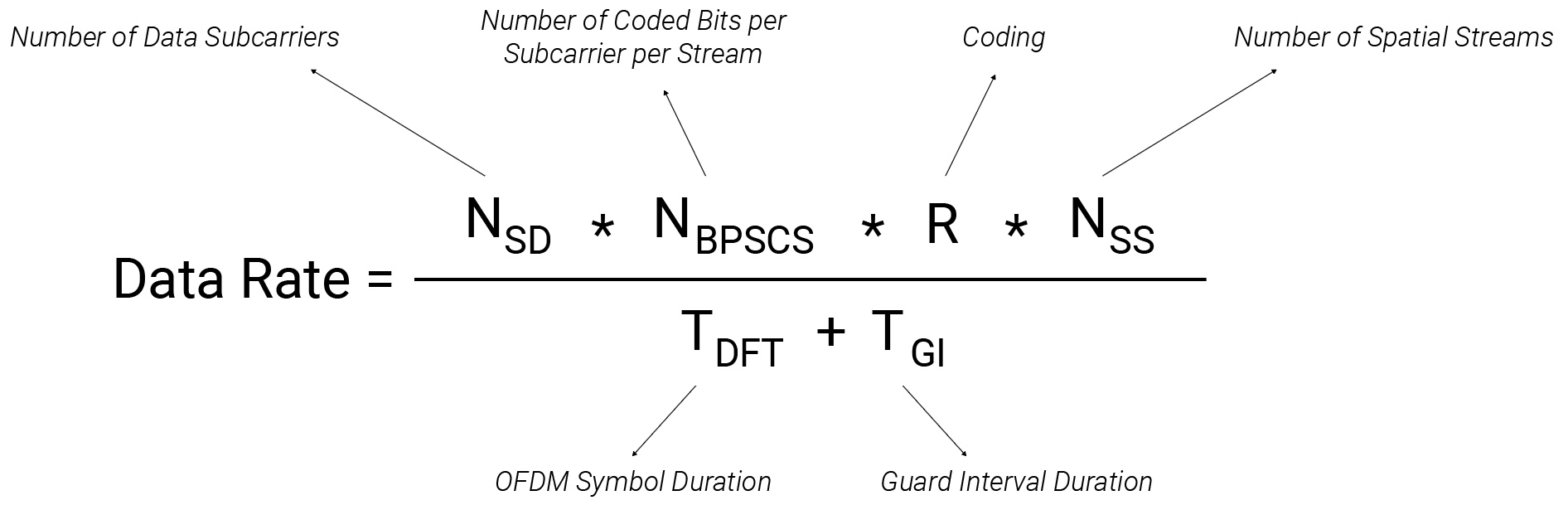
**More Wi\-Fi bitrate math:**To investigate Wi\-Fi bitrate math more, refer to the "Data Rate" formula at[the math behind it](https://www.semfionetworks.com/blog/mcs-table-updated-with-80211ax-data-rates/#:~:text=THE%20MATH%20BEHIND%20IT)\(semfionetworks\.com\)\.**Other sources of PHY information:**
- [mcsindex\.com](http://mcsindex.com/)\- an old resource, very recently redone and updated to include 802\.11ax info
- [Cisco's 802\.11ac MCS rates](https://community.cisco.com/t5/wireless-mobility-documents/802-11ac-mcs-rates/ta-p/3155920)\(cisco\.com\) \- 802\.11ac MCS rates
- [SemFio Networks](https://www.semfionetworks.com/blog/mcs-table-updated-with-80211ax-data-rates)\(semfionetworks\.com\) \- includes a discussion of the math behind the numbers
- [wlanpros\.com](https://www.wlanpros.com/mcs-index-charts)\(wlanpros\.com\) \- interesting as table also includes minimum SNR and RSSI values
- [802\.11ac Missing MCS's](https://youtu.be/vTIy-rjopY8)\(youtube\.com\) \- why some encoding combinations are not valid
- [Wi\-Fi \(802\.11\) PHY Data Rates](https://80211notes.blogspot.com/2013/08/wi-fi-80211-phy-data-rates.html)\(blogspot\.com\) \- How data rates are calculated
Appendix G: Maximizing Wi\-Fi Range
[](https://www.wiisfi.com/#accesspoint)
**The short answer:***Don't extend Wi\-Fiwirelessly\. Instead, the BEST way to improve Wi\-Fi rangeand far more importantly, to get great speeds at extended rangeis to install an[access point](https://www.wiisfi.com/#accesspoint)\[§19\] exactly where it is needed, and wired/Ethernet back to your main router\.*> Do NOT extend Wi\-Fi*wirelessly*\. Instead, use a wired/Ethernet Access Point\.
> Seriously, because if you do extend Wi\-Fi wirelessly, all that accomplishes is a 'very slow speed' at distancethat then also uses up a lot of TIME on the channel\. Namely, after successfully extending Wi\-Fi wirelessly, you are then left with the problem of slow Wi\-Fi speeds at that extended range \-\- and then you are back to square one \-\- how are you then going to improve Wi\-Fi speeds?TIP: First confirm that your main router is[placed properly](https://www.wiisfi.com/#placement)\[§P\]centrallyin your home\.
> **KEY Wi\-Fi concept:***Do NOT extend Wi\-Fi signals wirelessly\. Instead, extend Wi\-Fi by adding a wireless access point that is wired/Ethernet back to your main router\.*
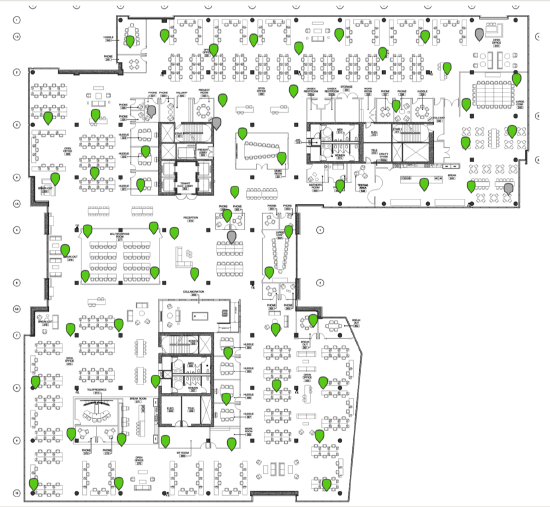60 AP's providing Wi\-Fi for Cisco in San Francisco
**Reduced Wi\-Fi range, with a bunch of wired access points, is how businesses implement Wi\-Fi:**Great Wi\-Fi performance in "high density" environments is NOT about increasing Wi\-Fi range\. In fact, it is just the opposite\. It is all about reducing range and adding a lot of access points\.Seen right is an AP floorplan from a*"High densityWi\-Fi installationwith 60 access points, Cisco San Francisco, 4th Floor"*as documented in the[High Density Wi\-Fi Deployments](https://documentation.meraki.com/Architectures_and_Best_Practices/Cisco_Meraki_Best_Practice_Design/Best_Practice_Design_-_MR_Wireless#:~:text=Review%20the%20designs%20below%20from%20the%20Cisco%20Meraki%20San%20Francisco%20office)\(meraki\.com\) paper\.
Keep this principle in mind when designing your home Wi\-Fi network\.
**TIP: Test all bands:**If your primary goal is long rangeand not fastest speed, split your Wi\-Fi band SSID names and first try connecting to your router's 2\.4 GHz band SSID and test\. This will only work as long as the 2\.4 GHz band in your area is not too congestedthere are not many neighbor AP's nearby\. Next connect to the 5 GHz band and test\. Technically, the 2\.4 GHz band 'has more range'\. on paper than the 5 GHz band, but sometimes in the real world, the 5 GHz band performs much better due to lower noise floor, less interference, etc \-\- the key factor is the[SINR](https://www.wiisfi.com/#SNR)\[§K\] that can be obtained, at your location\. If applicable, also test 6 GHz\.
> By splitting the Wi\-Fi band names, you are taking an automated decisionof which band to connect toaway from Wi\-Fi devices and manually deciding which band to use\. The assumption is that you have tested and know which band is 'best'for you, at your location\.
**Range to an R7800 AP****Device****2\.4 GHz CH 1****5 GHz CH 36****mW****Range****mW****Range**1000 mW maximum for AP'sNetgear R7800975100%995100%250 mW maximum for 5 GHz DFS channelsGoogle Pixel 4 XL38663%18944%iPhone 1127953%18643%Samsung Galaxy S20 Ultra12235%11133%Samsung Galaxy Tab S650472%10432%iPad Air58377%8930%Ring Video Doorbell Pro8229%5323%iPhone 6 Plus32658%4922%Samsung Galaxy S65624%4120%Motorola e5 Play11434%3519%Ring Floodlight Cam V121647%n/an/aApple Watch 520946%n/an/aClient Device Range sorted by 5 GHz Range
**Client devices almost always determine maximum range \(not the AP/router\):**What determines the maximum range at which a client device can successfully communicate via Wi\-Fi with an AP? Assuming that you already have a high quality AP, almost always, the answer is that the capabilities of the client deviceand not the AP/routerdetermines maximum range\. But why? The short answer is because Wi\-Fi requires two\-way communication\. From the 'AP to client', and from 'client to AP'\. And the weakest of those two directions determines maximum range\.> Think about it, if you could increase the transmit power in an AP by a thousand times, that certainly would improve 'AP to client' communication, but that power increase*actually would donothing*to help 'client to AP' communication, right?With an AP using a higher transmit power, the PHY speedand rangefrom the 'AP to client' would be greatly improved\. But the PHY speedand rangefrom the 'client to AP' would remain unchangedbecause the client Tx power level is unchanged\. So 'at range', clients will see[asymmetric PHY speeds](https://www.wiisfi.com/#phyasymmetric)\[§E\]\. TIP: To lookup the FCC ID for your phone, use[phonescoop\.com](https://www.phonescoop.com/)to find the web page for your phone, and the FCC ID is listed near the bottom of the web page\. Then Google search the FCC ID and the search result at fccid\.ioshould be what you wantdisplays power levels at various frequencies\.
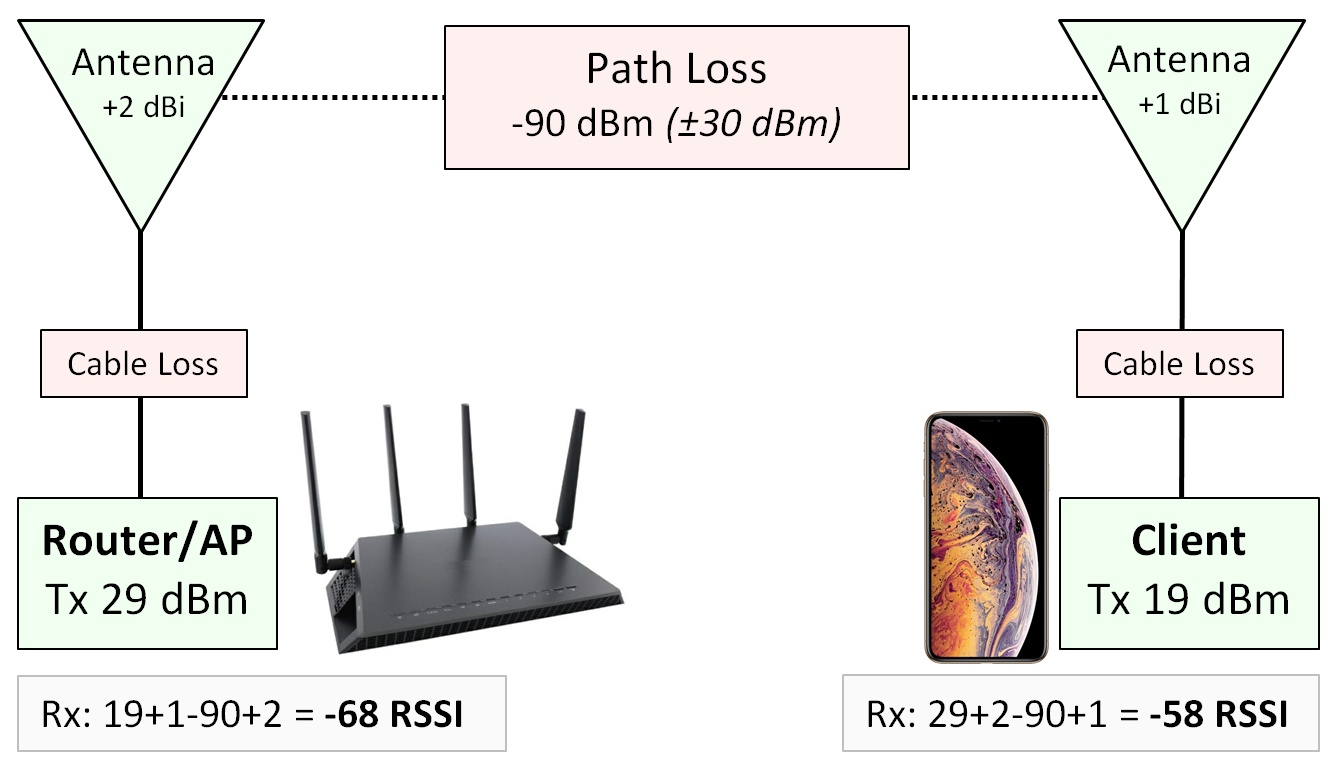
**Power Level Model:**When an AP transmits to a client, what happens? The AP outputs a certain mW power, which is then sent to the AP antennas, the signal travels through the airlots of 'path loss', hits the client antennas, and is received\. Likewise, when a client transmits to an AP, the client outputs at a certain mW power, which is then sent to the client antennas, the signal travels through the airlots of 'path loss', hits the AP antennas, and is received\. So transmit power of both the AP and the client plays a big role in range traveledto the client, and to the AP\. There is significant signal lossin the airbetween the antennas, butusuallya small amount of 'gain' with each antenna\.*The wildcard here is that each client device will have a different dBi for its antennasas compared to another client device, sometimes very smallor even a small loss, sometimes largerlike 5\.2 dBi\.*> The key for understanding this idealistic model is noticing that what impacts received signal strengthin both directionsis: \(1\) transmit power, \(2\) transmit antenna, \(3\) path loss, and \(4\)*the receive antenna*\.**2\.4 GHz example:**The Netgear R7800 router has a transmit power in 2\.4 GHz of 975 mW and an antenna gain of 0\.21 dBi\.[Source](https://fccid.io/PY315100319)\(fcc\.gov\)\. The Ring Video Doorbell Pro has a transmit power in 2\.4 GHz of 82mW and an antenna gain of 1\.08 dBi\.[Source](https://fccid.io/2AEUPBHALP021)\(fcc\.gov\)\. Since both antennas are used in both directions, that is a essentially a 'wash' for comparison purposes\. What becomes important is that the client has a rather large dB disadvantage of 10\.8 dB \(10×log\(975\)\-10×log\(82\)\)\. And that means that the Ring cam only has 29%\(1/sqrt\(975/82\)\)of the range that the R7800 router has\.> This is why a Ring cam displaying the strong 'RSSI''AP to cam' signalas an indicator of the connection quality is NOT very helpful, as the critical path for the Ring cam is the much weaker 'cam to AP' signal strengthuploading videos\. R7800 to Galaxy S6 long range **5 GHz example:**The Netgear R7800 router has a transmit power in the upper 5 GHz of 969 mW\. Likewise, for the Ring Stick Up Cam wired, the transmit power is 48\.5 mW\. The cam therefore has a 13 dB disadvantage \-\- or 22% of the range of the R7800 router\!**5 GHz smartphone example:**A Samsung Galaxy S6 is very similar, and results using[the MCS Spy tool](https://www.duckware.com/mcsspy/index.html)\(duckware\.com\) can be seen right, and confirm the very asymmetric PHY speedsas 'router to client' power is much higher than 'client to router' power\.
**2\.4 GHz vs 5 GHz:**The actual frequencyMHzof the channel used affects range\. Because range goes down as frequency goes up\. Using this[RF loss calculator](https://web.archive.org/web/20200216224110/http://www.radiolabs.com/stations/wifi_calc.html)\(archive\.org\) we can see that the differenceratioin range is exactly the same as the differenceratioin frequency\. For example, in general and at identical power levels, 5 GHz channels have around 50% of the range of 2\.4 GHz channels, or a 6 dB hit\.> So on paper, the 2\.4 GHz band has 'more range' than the 5 GHz band, and in real\-world testing, that happens often, but not all of the time\. It is not uncommon to see the 5 GHz band provide just as much rangeand MUCH better throughput\. You just need to test\. It is all about the SINR that can actually be achieved at*a particular location*\.Also notes that*some*client devices can perform way better in the upper 5 GHz channels than the lower 5 GHz channels, or the other way around\. This is very client device dependent and the only way you will know is through actual testing\.
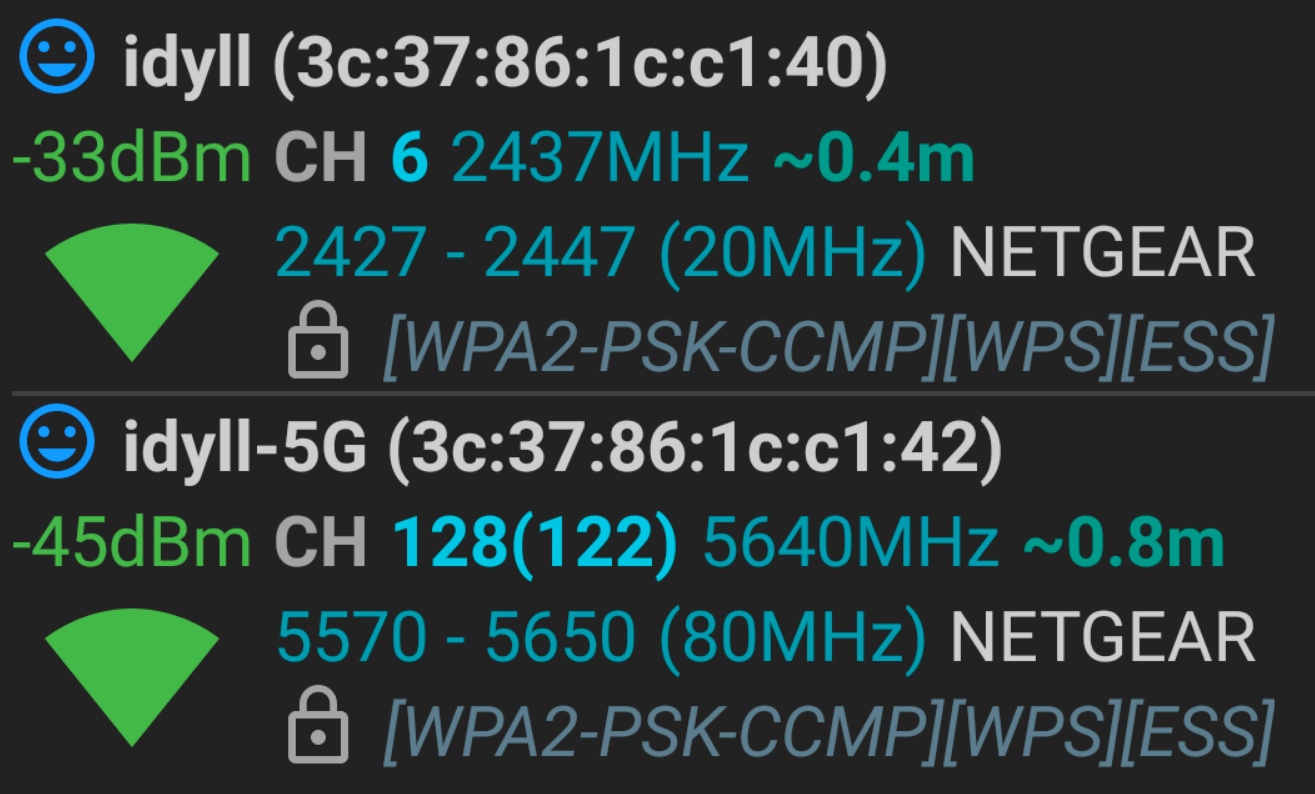 12 dB hit \(6 dB DFS \+ 6 dB 5 GHz\)
**DFS Channels:**Using DFS channels causes an AP to use lower power levelsregulatory constraints\. For example, the Netgear R7800 uses 995 mW for non\-DFS 5 GHz channels, but uses 243 mW for DFS channels, a change of 6 dB\. However, while this does affect PHY speed used, it rarely affects maximum range as most clients are already using a mW power level below 250 mW for ALL 5 GHz channels So again, the client determines maximum range, not the AP\.> **Example:**The Netgear R7800 for DFS channels transmits with 243 mW\. The Ring Stick Up Cam Wired for DFS channels uses 54 mW, a 6\.5 dB disadvantage for the camera\. So the camera ultimately limits rangenot the AP\.
**Channel width:**Channel width20/40/80/etc MHzused can also actually impact range\. You can 'technically' double rangebut greatly reduce throughputby switching from 80 Mhz channels to 20 Mhz channels\.[Details](https://www.wiisfi.com/#channelwidthrange)\[§J\]\.**Diversity / Beamforming:**Using a high[MIMO](https://www.wiisfi.com/#mimo)\[§7\] router has significant benefits in improving range and signal strength\.

**"Can't I increase range by using high\-gain antennas on my router?":**Yes, very likely\. But increased range in Wi\-Fi is actually a huge double\-edged sword\. Yes, you might get the extra range you needbut at a slow PHY speed, but that also means that the router is also seeing all of the Wi\-Fi devices in that extended range\! Meaning the likelihood of seeing neighbors' routers and sharing a Wi\-Fi channel with neighbors goes up significantly\. And sharing a channel ultimately means sharing that channel's bandwidthreduced bandwidth\.So unless you literally have no neighbors, don't use high\-gain antennas\.> Instead of thinking*"How can I extend the range of my one router"*, the much better question is*"How can I improve Wi\-Fi signal strength and still maintain good bandwidth"*\. The answer is: by installing another[access point](https://www.wiisfi.com/#accesspoint)\[§19\] exactly where it is needed, wired/Ethernet to your main router\.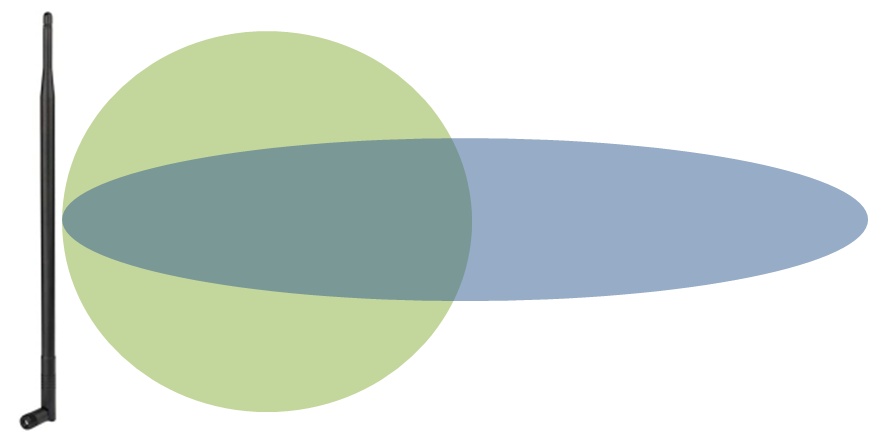 Also, high\-gain antennas are not without consequence\. They work by altering the 'shape' of the signal\. Namely, instead of sending the Wi\-Fi signal out in all directionsthink 'sphere', a high\-gain antenna 'flattens' the signal pattern, sending more of the signal out in one directioneg: horizontallyand much less in the other directioneg: vertically\-\- think 'doughnut'\. This change is likely OK for a single story house, but not for a multi\-story house\. There can be a 'dead zone' directly above/below the high\-gain antenna\. It is not uncommon to find 9 dB or even 12 dB high\-gain antennas on Amazon\. However, I have no idea if they are quality antennas, or not\. NOTE: With[Wi\-Fi 6E](https://www.wiisfi.com/#wifi6e)\[§11\] routers and later routers, expect only 'built\-in' antennas that can NOT be changeddone to prevent abuse in the 6 GHz band\.
**"But I need to improve range of my router\!"**Are you sure? Re\-read everything above about the likelihood of sharing a channel/bandwidth with neighbors\. Plus, you greatly increase the likelihood of experiencing the 'hidden node problem'\. Instead, an AP wired/Ethernet to your main router is far superior\.> Assume you do install high\-gain antennas\. What happens? All you have accomplished is adding several client devices*at range at very slow PHY speeds*, causing them to use the bunch of TIME on the channel, potentially slowing everyone elseon the same channeldown\.
**"How about Wi\-Fi range extenders?":**In general, don't use[Wi\-Fi extenders](https://www.wiisfi.com/#extenders)\[§18\] at all\. By definition they consume Wi\-Fi bandwidth to perform their jobevery packet is sent over Wi\-Fi*twice*\. Instead, an AP wired/Ethernet to your main router is far superior\.**Less range in an AP \-\-*and more AP's*\-\- can actually mean higher throughput:**Counterintuitively, less range in an AP can actually translate to higher throughputwhen more AP's are used\. With less range, the AP will be a lot less likely to see a neighboring AP operating on the same channel \-\- meaning the channel used is 100% yoursinstead of the channel and bandwidth being shared with neighboring AP\. And then just use as many well\-placed AP as needed\.
**Summary:**In general, the power levels of client devices are anywhere from 6 dB to 12 dB below that of your AP \-\- which means that your client devicesand which band they use, 2\.4 GHz or 5 GHzultimately determine maximum range possible, not the transmit power levels of the AP\.
> Also, I can not stress enough the need to[test actual throughput](https://www.wiisfi.com/#speedtest)\[§D\] in both Wi\-Fi bands\. The conventional wisdom and 'on paper' calculations show that 2\.4 GHz has 'better range' than 5 GHz, but in the real world, this is NOT always the case\! It may be true, but it often may not be true\. Actual[SINR](https://www.wiisfi.com/#SINR)\[§K\] is far more important\. I frequently see a big jump in performance switching to the 5 GHz band\. The ultimate cause is 'noise floor' and interference differences\. It does not matter if 2\.4 GHz has a stronger absolute signal strength if that also comes with a lower relative SINR\!At one test location the 2\.4 GHz band had a noise floor of \-87 dBm, whereas the 5 GHz band had a noise floor of \-108 dBm \-\- a huge difference of 21 dB \-\- explaining why 5 GHz at this location performed WAY better than 2\.4 GHz\.*You simply won't know until you test both bands\.*
**A final note that explains some strange client observations:**The asymmetric Tx power levels between a client and AP can cause strange observations \-\- like Wi\-Fi seems good and then you extend distance a little bit and Wi\-Fi drops off a cliff and no longer works\. For example, at near maximum range for a client, download PHY speeds may still actually be very reasonable and good*because it is upload PHY speed that is 'maxing out' and about to drop to zero*\.Appendix H: mW, dBm, dB, RSSI
**Signal Strength****mW****dBm**1000\.030100\.02010\.0101\.000\.1\-100\.01\-200\.001\-30✔0\.0001\-40✔0\.00001\-50✔0\.000001\-60✔0\.0000001\-70✔0\.00000001\-800\.000000001\-90
In short:*dBm directly represents mW, but on a logarithmic scale*and RSSI is a signal strengh indicator, in dBm units, on a scale from around \-95badto \-35excellent\.see table right for details> Remember FM radio stations bragging about how many watts of power they are broadcasting at? Well, by the time that FM signal gets to you, it can be very weak\. The same thing happens in Wi\-Fi\. There needs to be an easy way to describe the Wi\-Fi signal level transmitted and received\.
**mW:**Signal strength in Wi\-Fi is all about the mWmilliwatt, or 1/1000 watt\. Most Wi\-Fi devicesrouters, clients, etchave a Tx power output somewhere between 25 mW and 1000 mW \(1 watt\)\.> ✔ Most devices receiving a Wi\-Fi signal only 'see' a signal strength of 'around' 0\.001 mWclose to AP; \-30 dBmto 0\.0000001 mWfar away from AP; \-70 dBm\.**The logarithmic dBm scale is very deceptive:**Many routers start by transmitting a signal with a power around 1 watt, or 30 dBm, and if that signal reaches your client device with a power of \-60 dBm, that is*one billionth*the original power\. And \-90 dBmjust above the assumed noise floor of \-95is*one trillionth*the original power\.
**Received signal strength \(RSSI\) decreases VERY quickly with distance:**Let's say the power output of a router is 975 mW\. Inches from the router, you may have a signal strength of 0\.04 mW\. At five feet maybe 0\.0016 mW\. In the next room, maybe 0\.00001 mW\. And across the house, maybe 0\.00000001 mW\. This is because signal strength decreases*very quickly with distance*and obstacles \([more details](https://www.wiisfi.com/#mwdistance)\[§I\]\)\. Look at the tablerightfor actual values possible\.**How should signal strength be represented?:**Working with all of these very small mW numbers, like 0\.00000001 mW, is very awkward and error prone \-\- because are you usingor readingthe correct number of zeros? Can we come up with a new unit and numbering scheme to represent mW that is much easier to use?
> **First cut:**Use scientific notation\. 100 mW becomes 1E2, 0\.001 mW becomes 1E\-3 and 0\.00001 mW becomes 1E\-5\. Well, we are on the right track because we don't have to count zeros, but 'E' notation is still awkward to use\.**Second cut:**Use only the exponent\. Instead of 1E2, just say 2\. Instead of 1E\-5, just say \-5\. But we still need to account for the non\-exponentmantissapart, so use logarithms\. For example, log\(100\) is 2, log\(0\.00001\) is \-5,and log\(0\.00002\) is \-4\.699\. This is workable, but can we eliminate the decimal digit\.\.\. **The dBm solution:**Multiply the log\(mW\) resultfrom step aboveby 10 and round to a whole numberno remaining digits\. The unit of the resulting number is dBmdecibel milliwatts; deci=tenth\. The dBm scale is expressly based/referenced upon 1 mWthe 'zero' point\. Theeasy to useresult is the table seen upper right\. "dBm"decibel milliwattsstill represents milliwatt valuesin decibel units, but dBm is a MUCH easier way to represent "mW"milliwattvalues that have 'too many zeros'\.
**mW to dBm:**To convert from mW to dBm:**dBm to mW:**To convert from dBm back to mW:**10 dB: mW powers of ten:**Just by looking at the tableabove rightand the discussion above, it becomes really obvious that increasingor decreasingmW power by a factor of ten equals changing the dBm value by adding/subtracting ten dB\. Very convenient\.> · Multiplying mW by 10 equals adding 10 dB to dBm · Dividing mW by 10 equals subtracting 10 dB from dBm
**3 dB: mW powers of two:**What do we have to add or subtract from dBm to adjust mW by a factor of two? The answer is incredibly close to 3\.So adjusting by 3 dB is halving/doubling 'mW power', but NOT a halving/doubling of[distance](https://www.wiisfi.com/#mwdistance)\[§I\]\.> TIP: We can actually 'deduce' this from the table above\. How many 'times 2' steps are there in going from 1 to 1000? There steps are: 1, 2, 4, 8, 16, 32, 64, 128, 256, 512, 1024\. It turns out that 210=1024, so there arevery close toten steps\. And ten steps from 0 dBm to 30 dBm means the step size is 30/10 = 3 dB\.FYI: The precise value is 10×log\(2\) = 3\.0102999566\.\.\.
**dB vs dBm:**Whereas dBm refers an to absolute power leveltranslates to a specific mW value, dB expresses a 'magnitude' difference between two power levelsthe difference between two dBm values; the ratio between mW\.**Summary:**dBm is just the mW power level in logarithmic scale, so multiplied or divided by ten\. When you see a dBm of \-37, you should instantly think that is just a mW of 10\-3\.7\. Think in terms of how many digits the decimal point is moved left/right for the number "1\.0" and it 'should' all make sense\. For example, \-40 dBm is moving the decimal point in "1\.0" \-4\.0 places,so left 4 digits, which results in 0\.0001 mW\. And 30 dBm is moving the decimal point in "1\.0" 3\.0 places,so right 3 digits, which results in 1000 mW\.
> NOTE: all 'log\(\#\)' in this section are log base 10, or 'log10\(\#\)'
**Expected throughput vs signal strength:**RSSI in effect measures 'distance' and is only a very rough measurement of Wi\-Fi qualitybecause it is SINR that ultimately determines throughput\. See[SINR](https://www.wiisfi.com/#SNR)\[§K\]\. Namely, with increasing/better RSSI, expect increasing/better throughput along with that, most of the time\. However, even with great RSSI, if there is major contention or interference present, then SINR can be low, which in turn will cause low throughput\.However, RSSI is still very helpful as an indicator of 'distance' \-\- and, with a low contention/interference Wi\-Fi environment, is strongly correlated to the throughput you will obtain\.
> 
Very roughly, any RSSI from \-20 to \-40 is great\. From \-40 to \-60 is good\. From \-60 to \-75 is fair\. And any RSSI past \-75 is starting to become bad \-\- because anything past \-75 means that the SINRand the throughput you getis now heavily dependent upon low noise and low interference at your physical location\.BUT, SINR is everything \-\- so keep these two points in mindand the graph seen above:
- In extreme 'noisy' environments, contention and/or interference can cause low SINR and destroy throughput,*even with 'good' RSSI*\.
- In great 'clean' environments, with no contention and/or interference, high SINR means you can still obtain OK throughput,*even with 'bad' RSSI*\.
**More information:**- [dBm](https://en.wikipedia.org/wiki/DBm)\(wikipedia\.org\) \- Wikipedia information on dBm
Appendix I: Wi\-Fi signal strength vs distance
[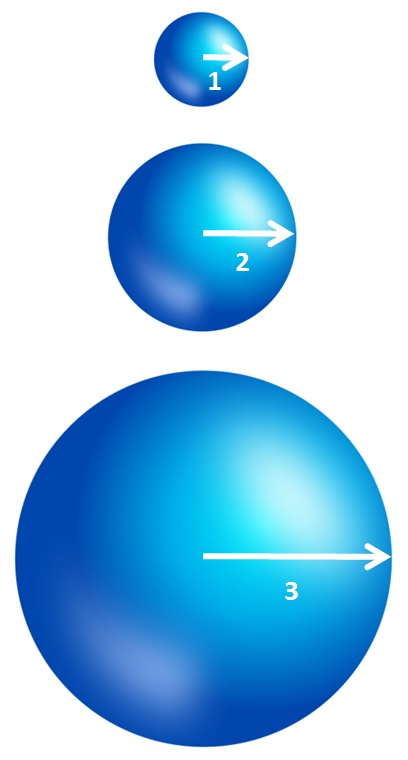](https://en.wikipedia.org/wiki/Inverse-square_law)
Wi\-Fi signal strength decreases VERY quickly with distance, even in free spacewith no obstacles\. But why?> *Every house around youlikelyhas a Wi\-Fi router, and there are a very limited number of unique non\-overlapping Wi\-Fi channels\. So you are definitely sharing Wi\-Fi frequencies with some neighbors\. But most neighbor Wi\-Fi activity won't impact you due to the fact that Wi\-Fi signals attenuate rather quickly\. Your router often only sees neighbor Wi\-Fi activity as a slightly elevated 'noise floor'\.*
> **KEY Wi\-Fi concept:***The 'quick' attenuation of Wi\-Fi signals is what actually allows 'everyone everywhere' to successfully use Wi\-Fi 'all at once'\.*
**How does mW signal power \(seen in router specifications\) relate to distance?:**The discussion in the[chapter above](https://www.wiisfi.com/#dBm)\[§H\] was all about raw mW power levels, but how do power levels relate to distance traveled by a Wi\-Fi signal? Naively, twice the mW power means twice the distance, right? NO\. To understand why not, we must first understand the[Inverse\-square law](https://en.wikipedia.org/wiki/Inverse-square_law)\(wikipedia\.org\), which states that changes in*Wi\-Fi signal strength are inversely proportional to the square of the change in distance*\. For example, three times the signal distance means 1/\(3×3\) timesor 1/9the signal powerat that 3× distance\.> Analogy: A great way to visually 'see' and understand this is to consider ever increasing spheres\. Imagine an antenna at the center of the sphere and the*surface area of the sphere*is the radio signal as it travels outwardsin all directions\. Thefixedpower output of the antenna must be distributed across the entire surface area of the sphere\. Seen right are three spheres of radius 1, 2, and 3so a doubling and tripling of distance/radius\. The formula for sphere surface area is4×PI×r2\. The critical term to focus on isr2\. And you can confirm with your eyes that the sphere of radius 3 has a surface area that is not just three times larger, but32ninetimes largerthan the sphere of radius 1\.TIP: You don't have to memorize the Inverse\-square law formula\. Instead, just remember this 'sphere' analogy and you can easily mentally derive the inverse relationship between distance and signal strength\. [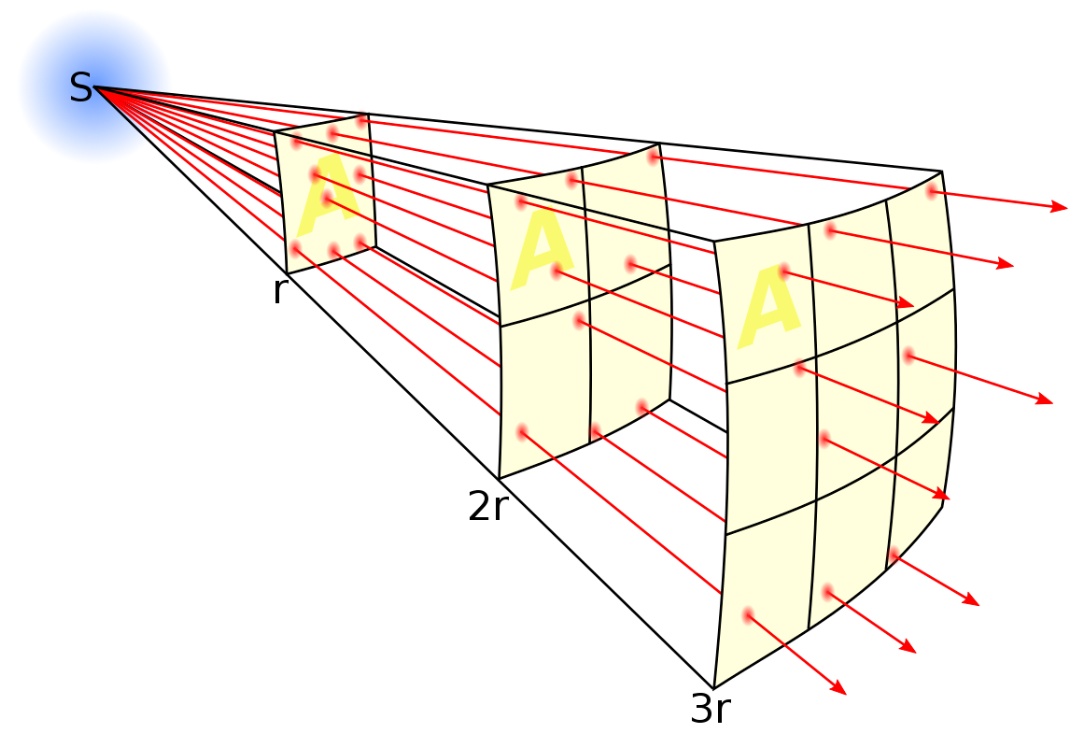](https://en.wikipedia.org/wiki/Inverse-square_law) Illustration of Inverse Square Law \(from Wikipedia\.org\)
**Formulas:**The[Inverse\-square law](https://en.wikipedia.org/wiki/Inverse-square_law)\(wikipedia\.com\) states that a change in distance squaredfor a client device from a routeris inversely proportional to the change in powerin mW, for Wi\-Fi\. Written literally, that 'law' results in:> \(new\_distance/old\_distance\)2= \(new\_power/old\_power\)\-1
And simplifying both sides slightly:> new\_distance2/old\_distance2= old\_power/new\_power
And then cross multiplying, you get the following formula that makes a whole lot of 'intuitive' sense:> old\_power × old\_distance2= new\_power × new\_distance2 For Wi\-Fi, power is in "mW"
Namely, the 'old'leftside of the equation is the power and distance values for a client device and is considered a 'fixed' value\. Then you can play 'what if' games \-\- on the 'new'rightside, you can change either termpower or distance, but there must be a correspondingand inverse and non\-linearchange in the other termdistance or powerto keep the equation balanced:> TIP: This formula is from the perspective of the client\. The best way to use this final formula is to fill in the three terms that you do know, and then solve for the one remaining unknown term\.*Please keep in mind that the**units of power are mW**, and the unit of distance can be anything, but the same units must be used on both sides of the equation\.***KEY Wi\-Fi concept:***The change in Wi\-Fi signal strength \(in mW\) for a client device is inversely proportional to the square of the change in client device distance\.*
**A doubling or halving of distance is a change of 6 dB:**To double/halve*distance*means we need to multiply/divide mW*power*by a factor of four \(22\), which is in dB units \([prior appendix](https://www.wiisfi.com/#dBm)\[§H\]\) is 3 dB*twice*, or 6 dB\.> Warning: Unless you are working in a pure 'line of sight' environment, walls and other obstacles will have a far greaternegativeimpact on Wi\-Fi signal strength than distance will\.
**Adapting the 'Inverse Square Law' to dBm units:**Since a 6 dB change is a doubling/halving of distance, the way to restate this law*for quick mental math*is:> distance\_factor ≈ 2\(ΔdBm/6\)ΔdBm ≈ 6 × log2\(distance\_factor\) Where \(a\)distance\_factoris the*ratio of the distance change*\(for example, going from 100ft to 150ft, the distance\_factor is 150/100, or 1\.5, not 50\) and \(b\) you need to properly account for the inverse relationship between power and distance\.Math TIP: log2\(X\) = log\(X\)/log\(2\)\. See[logarithm change of base rule](https://en.wikipedia.org/wiki/Logarithm#Change_of_base)\(wikipedia\.org\)
Examples using these formulasagain, no obstacles, just line\-of\-sight\-\- if a device is moved, and\.\.\.- RSSI gets 9 dB worse, then distance must have increased by a factor of 2\(9/6\), or ≈ 2\.8
- RSSI gets 4 dB better, then distance must have decreased by a factor of 2\(4/6\), or ≈ 1\.6
- distance increases by a factor of 3eg: 10ft to 30ft, then RSSI will worsen by 6×log2\(3\), or ≈ 9\.5 dB
- distance decreases by a factor of 10eg: 50ft to 5ft, then RSSI will improve by 6×log2\(10\), or ≈ 20 dB
**Seeing this 'doubling/halving' in real life:**If you have a Wi\-Fi analyzer app on your smartphone, it is sure interesting to see this relationship actually work in practice\. Stand five feet from your router, cause internet activity, and then run the analyzer app and check the dBm value\. Then exit all apps and double the distance from the routerand must remain 'line\-of\-sight'and repeat the process\. At least in my testing, I did see a 6 dB drop in dBm every time I doubled my distance from the router\.> 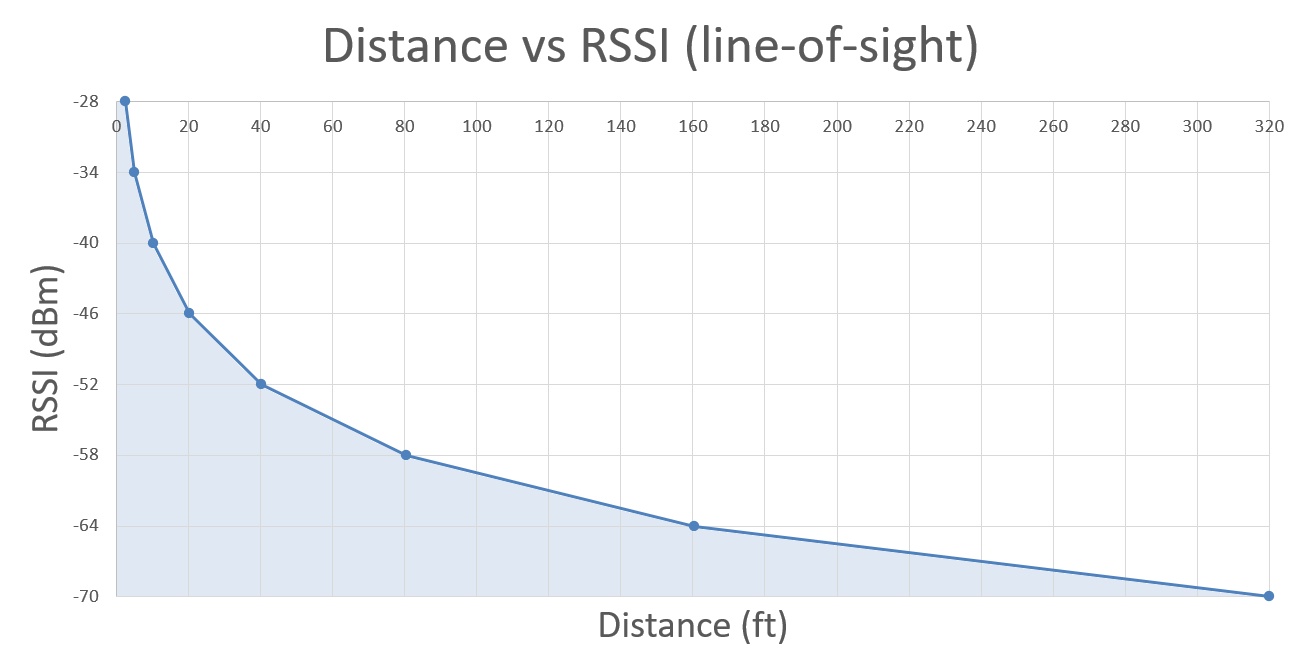 A model of Wi\-Fi Distance vs RSSI behavior \(line\-of\-sight; NO obstacles\) Notice how the power level is adjusted by 6 dB*many times*before we even get to 40 feet away from the router\. And then the next 6 dB adjustment doubles that distance\. The 'sweet spot' for most Wi\-Fi connections is between \-40 dBmpretty close to a routerand \-65 dBmany farther away and lower throughput may be very noticeable\.
**Example 1:**One router has a power output of 975 mW\. A second router has a power output of 216 mw\. Everything else being equal, how much fartherdistancecan the higher power router communicate with Wi\-Fi clients? Trick question, because virtually always, the answer is no change at all, because the Wi\-Fi clients'*must still transmit back to the router*, and client's power level has not changed at alland is often slightly less than the router power level\-\- so client power levels often limit distancenot the router\.**Example 2:**But, in Example 1 above, how much should dBm improve on Wi\-Fi clients, hopefully resulting in slightly better PHY speedsdownloadfrom the router to Wi\-Fi clients, but not a better PHY speed from Wi\-Fi clients to the routerupload\. Answer: Up to
10×log\(975\)\-10×log\(216\)dB, or 6\.5 dB\.**Example 3:**You are 90 feet away from your router and see a \-65 dBm\. At what distance should you be able to see a \-55 dBm? The power ratio is 10\(\-55/10\)/10\(\-65/10\)= 10\. So the distance ratio is sqrt\(10\) = 3\.16, and solving for distance we get 90/3\.16 ≈ 28 feet\.
**Example 4:**At 7 feet from a router you observe a \-35 dBm\.*Estimate*at what 'line of sight' distance you will observe \-65 dBm\. The answer is that with a difference of 30 dB, that is 6 dB five times, meaning a doubling of distance 5 times, so 7×25≈ 220 feet\. Of course, walls and other obstacles will likely get in the way first and have a far greater impact than 'line of sight' distance\.
**An interesting observation \-\- it is not absolute, instead, it is all relative:***The 'distance' you have to move to halve signal strength starts out very smallvery close to the router, but then grows exponentially larger as you move farther away from the router\.*Let's say you are 1 foot from a router\. At what distance will signal strength be 1/2 as powerful? Well, distance must be adjusted by sqrt\(2\) to keep the equation above 'balanced', so 1\.41 feeta change of 0\.41 feet\. Now step 10 feet away and repeat \-\- the adjustment is now 4\.1 feet\. Now step to 100 feet away and repeat \-\- the adjustment is now 41 feet\.*So it is not the absolute distance you move that matters, but rather, it is the relative distance you move\.*
Appendix J: Wi\-Fi Channel Width vs Range
*Please note that**this appendix applies only to Wi\-Fi in the 2\.4 GHz and 5 GHz bands**, but that it does NOT apply to Wi\-Fi in the 6 GHz band \-\- since Wi\-Fi in 6 GHz[changes how power levels work](https://blogs.juniper.net/en-us/industry-solutions-and-trends/power-spectral-density)\(juniper\.net\)\.***Channel Width****dB****Range****Speed**20 MHz100%×140 MHz\-3 dB71%×280 MHz\-6 dB50%×4160 MHz\-9 dB35%×8**Channel width signal strength hit:**It is not immediately obvious, but the decision as to which channel width to use in a Wi\-Fi access point20/40/80/160actually alters and affects the 'signal strength' of the received signal \-\- by 3 dB every time the channel width doubles\. This in turn impacts range and possibly speeds\. Almost all home access points use 80 MHz channels because speed ends up being far more important than rangeand don't even notice, or just live with, the slightly reduced range and MCS levels used\.> **KEY Wi\-Fi concept:***Wi\-Fi in the 2\.4 GHz and 5 GHz bands \(but not the 6 GHz band\) requires you to be 'just a little closer' to your router in order to successfully connect with increased channel widths using maximum QAM modulation\.*
**What a spectrum analyzer displays:**Each time Wi\-Fi channel width is doubled20➤40, 40➤80, 80➤160in the 2\.4 GHz and 5 GHz bands, the SAME amount of 'signal power' is still transmittedEIRP, or Equivalent Isotropically Radiated Power,*but over double the channel width*\. A spectrum analyzerwith constant RBW, shows that doubling channel width results in a 3 dB reduction in received signal strength: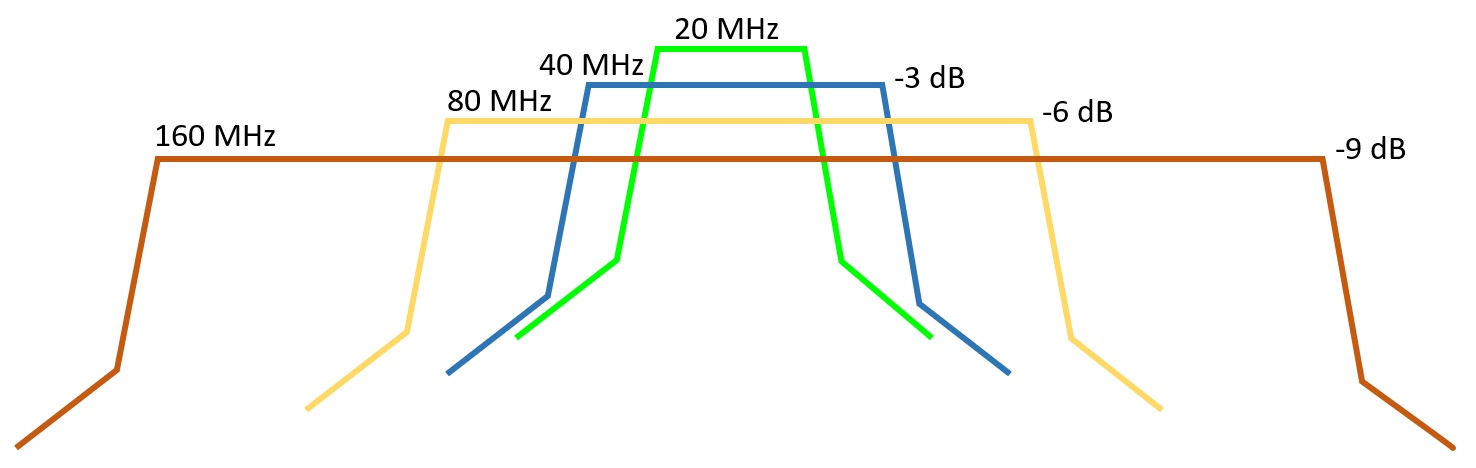**Impact on Range:**And from[the math above](https://www.wiisfi.com/#dBm)\[§H\], a reduction in signal of 3 dB translates to a 30% reduction in range\.**How the rest of the Internet sees this behavior:**All over the rest of the Internet you will see this behavior described as the 'noise floor' increasing 3 dB whenever the channel width doubles, and graphs like the following:

But I find this whole concept a LOT easier to understand by thinking about what a spectrum analyzer actually displays \-\- which is that when channel width doubles, the peak signal strength is reduced by 3 dBbecause the same amount of power is now over twice the bandwidth\. But note that this behavior changes with Wi\-Fi in 6 GHzconstant PSD of 5 dBm/MHz\.**The bottom line: Wider channels reduces SNR:**So no matter your point of view isnoise floor increases 3 dB, or signal strength decreases 3 dB, the end result on SNR is the same \-\- that SNR is reduced by 3 dB when channel width doubles\. And depending upon your distance from the access point, this may slightlynegativelyimpact maximum QAM modulationPHY speed\.
> *The easiest way to mitigate this reduced SNR is to always be physically close to an access point\.*
**An IoT observation:**This explains why many low\-bandwidth IoT devices intentionally want to stick with 802\.11nwhich has 20 MHz channelsand the smallest channel width possible and avoid 802\.11acwhich mandates 80 MHz channel support, because that allows operation at the longest possible distance\.> UPDATE: But Wi\-Fi 6 adds back the ability for client devices to only support 20 MHz channels\. So expect IoT devices to start supporting Wi\-Fi 6\.
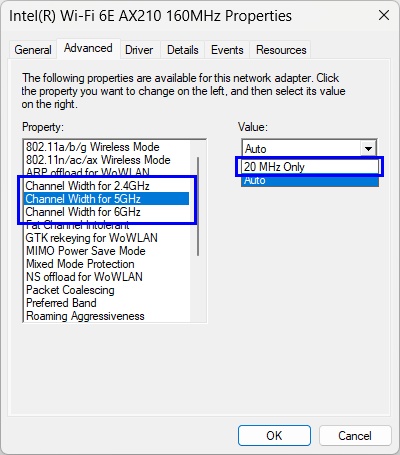 Client forcing 20 MHz channel
**Maximizing Wi\-Fi range/stability \(by sacrificing speed\):**If being able to connect to a router in 5 GHz at greatest distance \-\-*at any speed*\-\- is far more important than having the fastest speed possible, configure that access point to only use 20 MHz channels\. Note that[Netgear's name for 'channel width' is 'Mode'](https://www.wiisfi.com/#netgearmode)\[§C\]\. Clients should now see the ability to communicate with the access point from a slightly farther distancealbeit at a much slower speed and on a 20 MHz channel\.> **TIP:**Alternatively, some client deviceseg: Windowsallow the '5 GHz channel width' to be specified/forced to 20 MHznormally a client would just use the channel width of the access point\. This has the huge advantage of allowing you select an 80 MHz channel on the routerso most clients get 'fast speed', and then only setting 20 MHz channels for those fewfar awayclients that need 'extra range'\. See examplerightfrom Windows Control Panel / Device Manager / Network Adapters /*select Wi\-Fi adapter*\.
**Client devices often limit range more \(than the router\):**Most mobileon batteryclient devices do NOT transmit at the maximum power level allowedlike most routers do\. Instead, client devices intentionally transmit at a lower power level to conserve battery power\. The end result is that the[client device may often limit maximum distance](https://www.wiisfi.com/#range)\[§G\] from the routerand not the router itself\.> If your client device is able to see a weak router SSID in the Wi\-Fi list, but is unable to connect to it, the router\-to\-client signal strength may be OK, but the client\-to\-router signal strength may be too weak\.
**A final note:**This chapter is more about*understanding*how Wi\-Fi works\. Actually changing the 5 GHz channel width to 20 MHz does extend rangea little, but can kill performance for clients that are close to the router\. Try both the 2\.4 GHz and 5 GHz bands and select the one that works best for youas every location will be different due to different noise floors\. The best solution is to NOT 'extend range', but rather to just install an[Access Point](https://www.wiisfi.com/#accesspoint)\[§19\]wired/Ethernet to your main routerwhere it is needed the most\.**Learning More:**
- [Power Spectral Density and Wi\-Fi 6E](https://blogs.juniper.net/en-us/industry-solutions-and-trends/power-spectral-density)\(juniper\.net\)
Appendix K: SINR / SNR / Noise floor / SNR sensitivity
*Everyone will experience a slightly different 'noise floor'and interference, which impact SNR, which determines how fast Wi\-Fi works for you\.*> **SINR:**When there is lots of interferenceeg: ACI, the[signal\-to\-interference\-plus\-noise ratio](https://en.wikipedia.org/wiki/Signal-to-interference-plus-noise_ratio)\(wikipedia\.org\)or SINRbecomes much more important than just SNR\. A transmitted signal must be properly 'heard', and the noise floor and interference are both critical for determining how well that happens\.
**In summary:**The 2\.4 GHz band cannot always, but often timeshave an incredibly high 'noise floor' as compared to the 5 GHz band\. So while 'on paper' the 2\.4 GHz signal 'goes farther' than the 5 GHz signal, you will likely experience much better throughput on the 5 GHz band due to this noise floor differencea higher MCS level actually used in 5 GHz vs 2\.4 GHz\.> **KEY Wi\-Fi concept:***The PHY speed \(and throughput\) you experience in Wi\-Fi is determined not by RSSI, but by how far RSSI is above the 'noise floor' \-\- a value called SNR \(signal to noise ratio\)\.*
[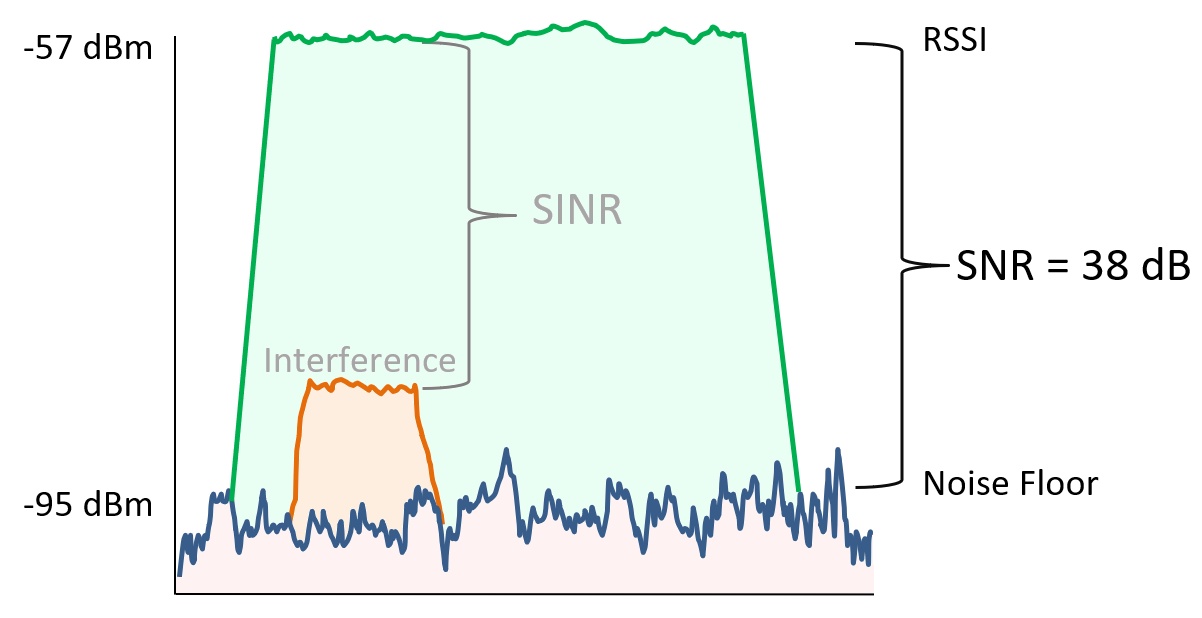](https://www.wiisfi.com/images/SINR.jpg)
**Noise floor:**When a router tunes into a Wi\-Fi channel and amplifies/processes it, at some pointwith no one on the channel, there is only a 'hiss'\. The dBm level of that hiss is the 'noise floor'blue line graph right\. Often times this 'noise floor' is 'around' \-95 dBm to \-100 dBm\.> I have seen the noise floor for a band vary by as much as 23 dB\-105 dBm to \-82 dBm, and the only thing that changed is physical locationof my travel router; different State\. That is rather interesting, because it implies that*where you are located*actually how congested Wi\-Fi is around you*can actually have a VERY measurable impact on the SNRand Wi\-Fi speedsyou experience*\.Please note that the 'noise floor' is not a constant value, but is always fluctuatingand sometimes by a lot\. *"Noise is defined as any signal other than the one being monitored"*\-[Source](https://en.wikipedia.org/wiki/Noise_floor)\(wikipedia\.org\) Technically, there are ways to communicate at signal levels*below*the 'noise floor', like[LoRa](https://en.wikipedia.org/wiki/LoRa)\(wikipedia\.com\), but that is beyond the scope of this paper\. Modern Wi\-Fi relies upon a signal level well above the 'noise floor'\.
**The noise floor fluctuates \(sometimes a lot\):**The 'noise floor' is often stated as a single number, but it is NOT a single number \-\- it actually fluctuates a lot\. Which means that any stated 'noise floor' numbers are actually an averageor some other computed value\.**Signal level:**Now start communicating on the channel and examine the dBm level of the signal on that channelgreen line in graph upper right\. The dBm level of that received signal is called RSSI\. Often times between \-35 dBm and \-70 dBm\.
> RSSI stands for "Received Signal Strength Indicator"\.[More Information](https://en.wikipedia.org/wiki/Received_signal_strength_indication)\(wikipedia\.org\)\. And while RSSI officially is a 'relative' numberto itself, with noofficialdirect relationship to dBm, RSSI is often converted via formulas and displayed as just thata negative number followed by "dBm"\.
**SNR:**The*difference*between the signal level and the noise level is called the "Signal to Noise Ratio"\.[More Information](https://en.wikipedia.org/wiki/Signal-to-noise_ratio)\(wikipedia\.org\)\. SNR units are dB\. So this means SNR is a relative numbernot absolute numberthat indicates how 'loud' a signal is vs background noise\. A signal can only be 'heard' and understood as a signal by a device only as long as it is adequately above the noise floor\.> **Analogy:**Talk normally in an empty room, and you can easily be heardRSSI, because the 'noise floor' is so incredibly lowhigh SNR\. But talk normally again*so RSSI signal level is the SAME*in a bar, and you won't be heard, because the 'noise floor' is so highlow SNRrelative to the signal level\. The same thing applies to Wi\-Fi\. As long as the SNR for a Wi\-Fi signal is 'good', that signal will be heard and understood\.The implication of this is that regardless of RSSIeven a poor RSSI, a high SNR*at the same time*means high throughput is very likely, but a low SNR means that high throughput is impossible\. I have seen discussions online statebut have not personally verifiedthat in industrial environments, large electrical motors running can cause the 'noise floor' to be so highmeaning SNR is always very low, that getting any Wi\-Fi to work can be very challenging\.
**Why is the 2\.4 GHz noise floor often much higher \(worse\) than the 5 GHz noise floor?**Because of the incredible success of 2\.4 GHz band\. Virtually every single home is broadcasting 2\.4 GHz signals, and the noise floor you seein your homeis just the greatly attenuated 2\.4 GHz signals from all other homes\.> Because 5 GHz signals attenuate more through free space \(and obstacles\), that is providing a noise floor advantage for 5 GHz\. I often see the 2\.4 GHz noise floor at/around \-86 dBm\. Whereas for 5 GHz, the noise floor is often around \-105 dBm\.★ The implication of this is that the 5 GHz band \(even with 'technically' shorter range\) may in fact provide much faster throughput then the 2\.4 GHz band\. And I say 'may' because I often find that the 5 GHz band is better/faster than the 2\.4 GHz band, but there are exceptions\.
**Wi\-Fi SNR is underreported:**The 'noise floor', 'signal level', and 'SNR' are all underreported numbers in Wi\-Fi\. Some higher end vendors report all of this information, but many vendors report almost nothing\. And the reason it is so important is because if you are in a 'noisy' environment, even with a strong signal, you will get very poor throughput\. Conversely, a weaker signal but with a very low noise floor, can still get very good throughput\. The implication is that knowing RSSI is a clue for knowing throughput, but you won't know for sure until you also know the noise floorand SNR\.> 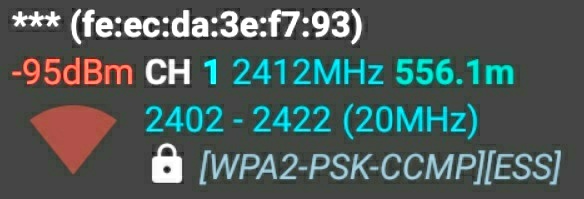 When I travel, I run the Wi\-Fi Analyzer on my smartphone to see how many access points my phone can see\. I never saw a SSID with a RSSI in the mid \-90's in the 2\.4 GHz band, until one dayin the Florida KeysI saw a RSSI of \-95seen right\. My take away from this is that the 'noise floor' at this location must have been VERY low in order for a signal at \-95 dBm to not only be heard,*but understood*\.**MacOS:**An exception is that MacOS displays Noise dBm right next to Signal dBm\. Very helpful\. Use it\.
**SNR vs channel width:**Each time you double channel width \(in 2\.4 GHz and 5 GHz; but not 6 GHz\) \-\- from 20 MHz to 40 MHz to 80 MHz to 160 MHz requires 3 dB more in SNR to maintain the same modulation/coding\.[Source](https://www.arubanetworks.com/assets/wp/WP_802.11AX.pdf#page=22)\(arubanetworks\.com\)\. And if you don't have that SNR headroom, the modulation/coding rate will drop \(see[Wi\-Fi Channel Width vs Range](https://www.wiisfi.com/#channelwidthrange)\[§J\] for why\)\.> TIP: What this means is that if a device is having trouble maintaining a Wi\-Fi connectionand can't be moved closer to the router, and you would rather have a much slower PHY connection that stays up all of the timethan a faster connection to drops in and out\-\- try reducing channel widthfrom 80 MHz to 40/20 MHz\.Now you know one key reason why many low\-bandwidth IoT devices stuck to the 20 MHz channels of Wi\-Fi 4 vs the 80 MHz channels of Wi\-Fi 5they have no need for the higher throughput and would rather have increased range\.
**Why outdoor Wi\-Fi devices can sometimes have SINR challenges:**An outdoor device 'sees' the Wi\-Fi signals from all neighbors around you much more clearly than your indoor Wi\-Fi devices do \-\- because interfering neighbor Wi\-Fi signalsthat the outdoor device can clearly 'see'are greatly attenuated by the exterior\+interior walls in your house, causing those interfering signals to mostly fall into the 'noise floor' for many Wi\-Fi devices indoors\.**SNR sensitivity:**What minimum SNR is required for each MCS level? Take the following table as ballpark figures, as your mileage may vary slightly:
[](https://www.wiisfi.com/images/snrsensitivity2.jpg)
**Factors determining what MCS levels are used:**Keep in mind:- Tx Power difference: RSSI is the signal strengh in the*receive*direction at the client device\. There is also a transmit direction, and many clients transmit at a power level well below that of the router\. So RSSI at the router for your client device may be 6 dB below the RSSI seen on the client, but it also depends upon the channel used\.
- Channel width: Don't overlook the impact that channel width will have on the signal strengthor noise floor, depending upon your point of view
- beamforming and diversity: Beamforming and antenna diversity should improve the signal strength, but this is an unknown\.
- Interference: This is an unknown\.
For example, you find a laptop transmitting in a 5 GHz 160 MHz channel at MCS5 \(64\-QAM 2/3\), at a distance of 22 ft, through two interior walls\. Does that seem OK/reasonable or is there something wrong? Well, RSSI on the laptop is \-52\. Adjust by 6 for router/client Tx power difference\. Adjust by 9 for 160 MHz channel\. MCS level actually used needs around 22\. Assume no beamforming gain\. Adjust by 2 as a fudge factor assuming we are not exactly on an MCS edge\. Add this all up and you get a computed noise floor of \-91, which given that 'interference' is unknown, seems perfectly reasonable and in the ballpark of what is expectedfor planning purposes, a noise floor of \-95 is often used\.**Atheros RSSI is really SNR:**In routers when you obtain RSSI from system tools that use a Qualcomm Atheros Wi\-Fi chipset, the RSSI value is the dBm signal level with the noise floor subtracted out\. That is just SNR\!
**More information:**
- [802\.11ac Receiver Minimum Input Sensitivity Test](https://www.mathworks.com/help/wlan/examples/802-11ac-receiver-minimum-input-sensitivity-test.html)\(mathworks\.com\) \-\- lists IEEE table with sensitivity values
- [802\.11ax receive sensitivity requirements](https://www.arubanetworks.com/assets/wp/WP_802.11AX.pdf#page=22)\(arubanetworks\.com\)
- [IEEE 802\.11\-2012 Table that shows SNR requirements per modulation level](https://www.wirelesstrainingsolutions.com/understanding-ofdm-part-4-refresh/)\(wirelesstrainingsolutions\.com\)
- [IEEE 802\.11 EVM specification](https://www.rfwireless-world.com/test-and-measurement/IEEE-802-11ax-EVM.html)\(rfwireless\-world\.com\)
- [Signal\-to\-Noise Ratio \(SNR\) and Wireless Signal Strength](https://documentation.meraki.com/MR/Wi-Fi_Basics_and_Best_Practices/Signal-to-Noise_Ratio_(SNR)_and_Wireless_Signal_Strength)\(meraki\.com\)
Appendix L: Router deep dive
Many AP/routers have the ability to 'telnet'or sshinto the device and run Linux commands\. This chapter documents some of what I use on Netgear's R7800 routeruses the 'Qualcomm Atheros' chipset; immediately belowand Netgear's R6250 routerBroadcom chipset; farther below\.> This has been invaluable to analyze the Wi\-Fi behavior of a 'locked down' deviceswhat channel width, Tx and Rx PHY speeds, etc an IoT camera uses\.
**Netgear: Enable telnet:**On many Netgear routers, visit"http://routerlogin\.net/debug\.htm"and sign inand check the 'Enable Telnet' checkbox\. Then"telnet routerlogin\.net"LAN only, not WANand use the web interface password to sign inif asked for 'login' username, use 'admin', and then dive into the deep end\.\.\.> TIP: When analyzing a devicelike a Ring cam, only have thatone deviceconnect to the router via Wi\-Fiso all Wi\-Fi stats on one Wi\-Fi band must be from the device being tested\. And then on your PC, telnet to the router via Ethernetor the other Wi\-Fi band\.WARNING: Telnet is a text based protocolnot encrypted\. So only use it on 'research' networksnot production networkswhere you trust everyone currently connected to the network\.
---
**Qualcomm Atheros based AP:****athstats \-i wifi0\|wifi1:**\[Atheros\] Outputs tons of internal Wi\-Fi statistics by band\. By far the most useful are
"Rx MCS STATS"and"Tx MCS STATS", which displays the number of packets sent/received for each MCS indexPHY speed\! Also, lists a noise floor that variesbut trying to confirm it is accurate\. See[header source code](https://github.com/freebsd/freebsd/blob/master/sys/dev/ath/if_athioctl.h)\(github\.com\) for a short description of items displayed\.> 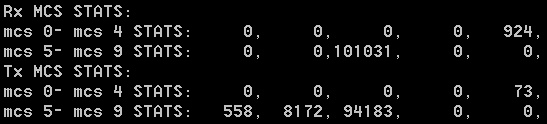 wifi0is the 5 GHz band andwifi1is the 2\.4 GHz band or vice\-versa, useiwconfigdescribed belowto confirm\.This is a GREAT way to independently measure both Rx PHY and Tx PHY, with no cooperation needed on the part of the device being measured\!The MCS index reveals theapproximatePHY speed useddon't know guard interval differences, and quickly tells you if there are symmetric or asymmetric PHY speeds\.Seen right is an example where both Tx and Rx PHY are 'mostly' using MCS 7\.In another example, all MCS numbers were pulled into Excel and produced the chart below \-\- which clearly indicates that the cam is able to receive from the router much betterave 35 Mbpsthan the cam is able to transmit to the routerave 16 Mbps\. > 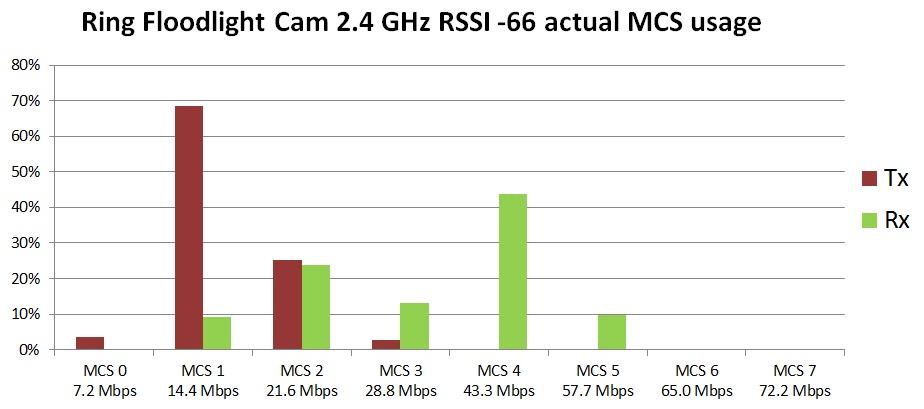 And by only changing Wi\-Fi channels, cam upload speedsthe majority of everything the cam doesimproved significantlynow averages 27 Mbps:> 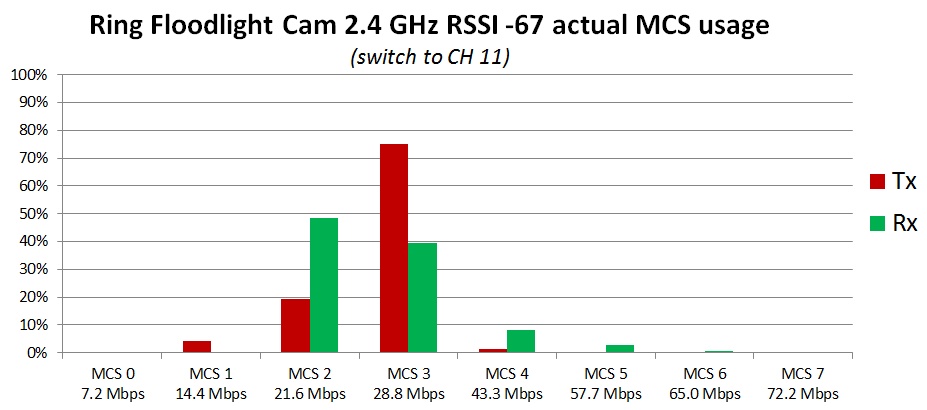
**wlanconfig ath0\|ath1 list sta:**\[Atheros\] Lists every Wi\-Fi device connected to the router, with very useful information per devicemac address, channel, TxRate, RxRate, RSSI, 802\.11n mode, channel width, etc\.[wlanconfig\.c source code](https://github.com/puzzlet/madwifi/blob/master/tools/wlanconfig.c)\(github\.com\)\.> The TxRate and RxRate displayed appear to be kilo1024based numbers instead of bps1000PHY based numbers\. So multiply by 1024/1000 to correct back to 'bps'\.RSSI displayed under Atheros is actually SNR, which is a very important number to know\. In one dual\-band router tested, ath0was the 5 GHz band andath1was the 2\.4 GHz band\. Useiwconfigdescribed belowto confirm the setup for your router\.OpenWRT: iwinfo wlan0\|wl0\|ath0 assoclist:[source1](https://serverfault.com/questions/226046/how-to-get-a-list-of-the-connected-wifi-clients-in-openwrt-10-03)\(serverfault\.com\)[source2](https://openwrt.org/faq/how_to_get_a_list_of_connected_clients)\(openwrt\.org\)
**iwconfig:**Lists 'wireless' informationif anyfor each interface on the system\. Includes SSID name, maximum bitrate and transmit powerin dBm unitsfor each Wi\-Fi band\. See also"ip link show", which enumerates all interfaces on the router\.> This is incredibly useful to clearly 'see' the difference in transmit powerin dBm unitsbetween the different bands/channels in 5 GHz*using DFS channels in 5 GHz have a 6 dB penalty*\. Also of note is that these power levels do NOT include antenna gain\.
**arp:**Outputs a list of 'MAC address to IP address' mappings\.**iwlist:**Get detailed information about interface capabilities
**A very cool graphical Atheros "MCS Spy" tool:**Check out this[MCS Spy](https://www.duckware.com/mcsspy/index.html)\(duckware\.com\) tool, which displays Wi\-Fi MCS index usage in real\-time\.
> It becomes incredibly obvious after running this tool that not only are PHY speeds asymmetric, but that there is no single PHY speed in one direction\. Rather, the PHY speed is constantly fluttering around\. This is especially evident when the device being testedeg: tabletis moving aroundwith a person walking\.
**Future Research:**Often times, the R7800 reports a noise floor of \-105 in 5 GHz and \-97 in 2\.4 GHz\. Does that explain why RSSI in 5 GHz on a client device is better than raw calculationsof AP transmit power and free space path lossshow it should be? Or is the difference fully explained by beamforming alone?
---

**Broadcom based AP:**Broadcom based devices will have the
wlcommand[Command line reference](https://wiki.dd-wrt.com/wiki/index.php/Wl_command)\(dd\-wrt\.com\)\. Here are some very useful commands\.\.\.**ip link show:**Enumerates all 'interfaces' on the AP\.
**wl \-i eth1\|eth2 status:**Displays lots of information about the AP, including SSID, BSSID, supported rates, HT/VHT capabilities, noise floor, etc\.
**wl \-i eth1\|eth2 channels:**Displays the list of valid channels\.
**wl \-i eth1\|eth2 assoclist:**Outputs a list of all client MAC addresses currently associated with the AP\.
**wl \-i eth1\|eth2 sta\_info x:x:x:x:x:x:**Output detailed statistics for ONE client device connected to the APby specifying the client's MAC address\. Example output:
> aid:1 rateset \[ 1 2 5\.5 6 9 11 12 18 24 36 48 54 \] MCS SET : \[ 0 1 2 3 4 5 6 7 8 9 10 11 12 13 14 15 \] idle 10 seconds **in network 183111 seconds** state: AUTHENTICATED ASSOCIATED AUTHORIZED flags 0x1000e03a: WME N\_CAP AMPDU HT caps 0x3c: GF SGI20 tx data pkts: 560610 **tx data bytes: 80242252** tx ucast pkts: 277309 tx ucast bytes: 45807854 tx mcast/bcast pkts: 283301 tx mcast/bcast bytes: 34434398 tx failures: 246 rx data pkts: 217168 **rx data bytes: 210097118** rx ucast pkts: 211051 rx ucast bytes: 209558247 rx mcast/bcast pkts: 6117 rx mcast/bcast bytes: 538871 **rate of last tx pkt: 58500 kbps** **rate of last rx pkt: 117000 kbps** rx decrypt succeeds: 1087298 rx decrypt failures: 0 tx data pkts retried: 5851 tx data pkts retry exhausted: 246 per antenna rssi of last rx data frame: \-66 \-57 0 0 per antenna average rssi of rx data frames: \-64 \-57 0 0 per antenna noise floor: \-89 \-92 0 0
---
**Quantenna based AP:**[This post](https://www.snbforums.com/threads/rf-metrics-mcs-value-and-or-modulation-for-broadcom-bcm4360-asus_rt-ac87u.23523/)\(snbforums\.com\) points to using this command:
> qcsapi\_sockrpc*CMD*wifi0 0
with some of the valid "CMD" being:- get\_tx\_mcs
- get\_rx\_mcs
- get\_tx\_phy\_rate
- get\_rx\_phy\_rate
- get\_noise
- get\_snr
- get\_rssi\_dbm
---

**Linux in general:**A very helpful command is:
> iw dev*DEVICE*station dump
where 'DEVICE' is 'wlan1'or similar\. You will see information output like:> signal: \-73 dBm signal avg: \-73 dBm tx bitrate: 162\.0 MBit/s VHT\-MCS 4 40MHz VHT\-NSS 2 rx bitrate: 240\.0 MBit/s VHT\-MCS 5 40MHz short GI VHT\-NSS 2 *and lots more info\.\.\.*
---
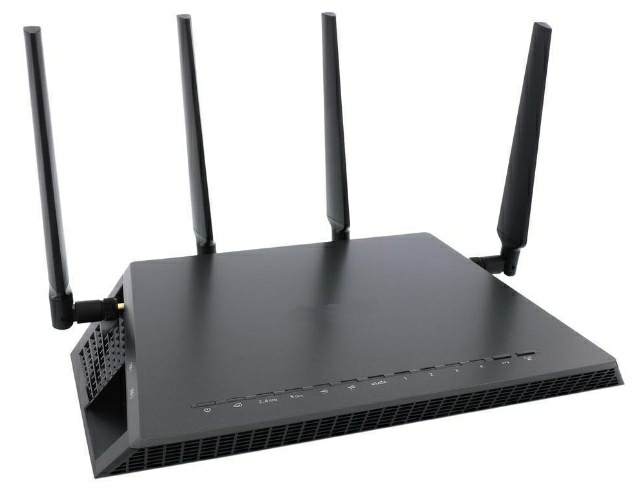
**Netgear R7800 TCP/IP packet captures:**I travel a lot and often need to packet capture Wi\-Fi devices for debugging purposes\. So I travel with a Netgear R7800 configured not as a router, but as an APaccess point\.
This also works around a bug that the R7800 has with packet captures while in 'router' mode\.**Method One: Use TCPDUMP on the R7800:**I then plug the R7800AP modeinto the local network/router, connect the devices to test to my APWi\-Fi, and start debugging\. My steps for obtaining a packet capture on the R7800you can probably use this as a template for obtaining a PCAP on your router/AP:
> WARNING: Netgear just released new \.74 firmware that breaks TCPDUMP on the R7800 in AP mode, but the steps below still work with the older 1\.0\.2\.68 firmware\.
1. **Setup:**Connect the AP via Ethernet to the local network/router\. I then connect my laptop to the AP to confirm Internet access, and find the IP address of the APtip: use"ping routerlogin\.net"\-\- and use that IP address in place of '192\.168\.1\.222' in the steps below\.
2. **Enable telnet access:**Visit"http://192\.168\.1\.222/debug\.htm"use the router's web interface username/passwordand ensure that "Enable Telnet" is checked\.
3. **Telnet to router:**Use"telnet192\.168\.1\.222"and when asked for the password, use the router's web interface password\.*At this point, you should be successfully signed into a telnet session connected to the Netgear R7800 AP\.*
4. **Start the packet capture:**Type the command:"tcpdump \-n \-s 0 \-i ath1 \-w /tmp/output\.pcap \-v", using"ath1"to capture the 2\.4 GHz band, or"ath0"to capture the 5 GHz band\. Press 'CTRL\-C' to end the packet capture\.
5. **Download the PCAP:**I keep a micro USB thumb drive plugged into the AP at all times, and use"mv /tmp/output\.pcap /tmp/mnt/sda1/output\.pcap"to transfer the PCAP to the USB driveuse"df"to find your USB drive path, and then connect to the"\\\\192\.168\.1\.222"network sharerequires that network sharing is enabled for the USB drive on the AP; may need to use 'admin'/password to accessto download the PCAP file to my PC\.
6. **Analyze:**I analyze the PCAP with[WireShark](https://www.wireshark.org/)\(wireshark\.org\)\.
I PCAP to 'local storage' on the R7800, rather than directly to the USB drive, because local storage is a lot faster than the USB driveotherwise a lot of packets will be dropped if tcpdump writes directly to the USB drive\. But the downside of this is that you can only PCAP a couple hundred MB of activity, which is fine for my work\. An alternative is to capture directly to the USB drive, but only capture the first 100 bytes of each packetchange"\-s 0"to"\-s 100"\. Iftcpdumpstill reports that packets are being dropped by the kernel, try increasing the kernel buffer size\-B command line option\-\- but the '\-B' option is not available on the R7800\.**Method Two: A much better PCAP alternative for most:**An alternative that also works very welland requires no router telnet accessis use the
"WAN Port mirror to LAN port1"option on the R7800"/debug\.htm"web page\. Then, plug your PC wired to port1 on the router and capture directlyon your PCusing WireSharkcapturing the PC 'LAN connection'\. In effect, LAN port 1 on the R7800 still functionsso your PC still works to the Internet, but your PC now also 'sees' all WAN trafficas if the R7800 were now a 'hub', instead of a 'switch', allowing all trafficheading out the WAN port on the R7800to be captured\.> The big advantage of using TCPDUMP on the R7800 itselffar above, is that the capture can be done 'remotely'don't need to be physically next to the R7800\.Conversely, the big advantage of the port mirroring capture technique is that it is much easier for most people to useand a lot less technical, but it requires your PC is plugged into port one on the R7800\.
Appendix M: WiGig \(802\.11ad\) 60 GHz
WiGig802\.11adis effectively dead in routers for Internet access\. It just never 'took off'\.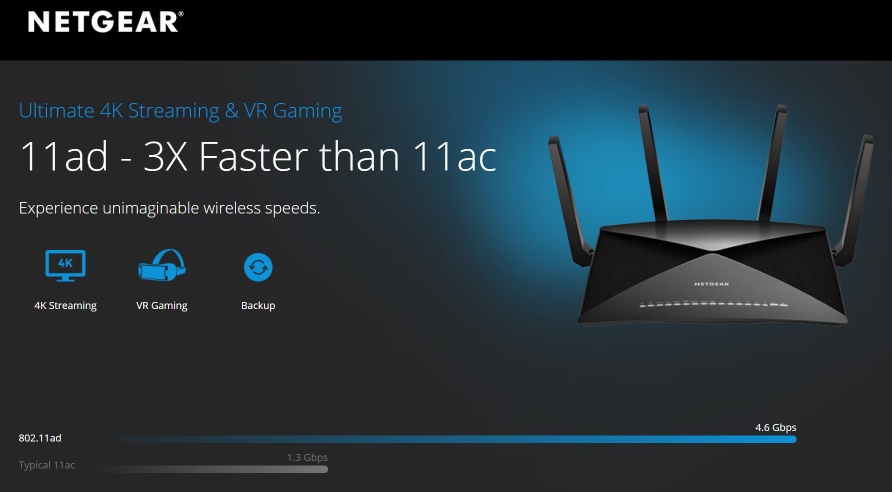 Dubious Netgear 802\.11ad marketing
**802\.11ad:**[802\.11ad](https://en.wikipedia.org/wiki/Wireless_Gigabit_Alliance)\(wikipedia\.org\), also called WiGig, is being marketed as the 'fastest' Wi\-Fi possible, providing speeds "as fast as 4\.6 Gbps", for '4K Streaming, VR Gaming and Backup'Netgear, right, or for transferring an hour of HD video in 7 seconds\.[Source](https://web.archive.org/web/20180514043905/https://www.qualcomm.com/solutions/networking/features/80211ad)\(archive\.org/qualcomm\.com\)\.**Huge disadvantage:**However, the huge disadvantage of 802\.11ad is that is has no range and does not go through wallsor obstacles\.
It is intended to only be used line\-of\-sight**in one room**and has a range of just a few meters\.[Source](http://www.radio-electronics.com/info/wireless/wi-fi/ieee-802-11ad-microwave.php)\(radio\-electronics\.com\)\.**Range:**At the same transmit power, 5 GHz has 1/250%the range of 2\.4 GHz,*but 60 GHz has 1/254%the range of 2\.4 GHz*, as measured in free space, or 'air'\. TIP: See this[RF loss calculator](https://web.archive.org/web/20200216224110/http://www.radiolabs.com/stations/wifi_calc.html)\(archive\.org\)
**802\.11ac:**Interestingly, 802\.11ac products already exist TODAY that provide 4\.3 Gbps \-\- Arris TG3482G using the[Quantenna QT10GU](http://www.quantenna.com/wp-content/uploads/2016/12/QSR10GTV1.0.pdf)\(quantenna\.com\)\.
That kind of puts Netgear's marketing hype"3X faster than 11ac"into perspective\.
**Conclusion:**802\.11ad may take hold in very specialized situationslaptop docks, wireless displays, VR headgear, etc, but unless the range issue is addressed, 802\.11ad will absolutely NOT become a replacement for Wi\-Fi for generalized internet access for an entire home\.
> UPDATE: This is all but confirmed now that 802\.11axWi\-Fi 6\-\- the successor to 802\.11acWi\-Fi 5\-\- is out\.Wi\-Fi 6 effectively kills 802\.11ad from ever being*widely*adopted for internet access\. Instead 802\.11ad IS being used for very short distance point to pointlaptop computer to dockcommunication\.Also, you know things are VERY BLEAK for 802\.11ad in routers when[Netgear has a tough time pointing out ANY client devices](https://kb.netgear.com/31305)\(netgear\.com\) that actually support WiGig\!
**Future:**It is interesting to note that the 60 GHz band using 802\.11ad and 802\.11ay IS being used in*highly directional*point\-to\-point applications\.[An example](https://mikrotik.com/products/group/60-ghz-products)\(mikrotik\.com\)\. Others are by Cambium, Ubiquiti, etc\.Appendix N: Beware tri\-band marketing hype
**UPDATE: Wi\-Fi 6E 'tri\-band' routers DO make a lot of sense:**The key problem with prior Wi\-Fi 5 tri\-band routers was that TWO of the bands are the SAME overlapping frequency5 GHz\. However, Wi\-Fi 6E routers will be tri\-band and be just fine \-\- because they will cover 2\.4 GHz, 5 GHz and 6 GHz \-\- in other words, three*separate non\-overlapping*frequency bands\.
Beware all of the marketing hype surrounding tri\-band routers\. Tri\-band routers were created by the router industry so that marketing couldyet againclaim even higher Wi\-Fi Gbps speeds for new routersa single connected client can never achieve these high speeds\.**A router is many devices in one:**Remember, a wireless router is: \(1\) a router, \(2\) a switch, and \(3\) an AP \-\- all in one box\. The AP is almost always dual\-band2\.4GHz \+ 5 GHz\. But the latest marketing hype concerns the speeds of tri\-band routers \-\- where the AP inside the router is 2\.4GHz \+ 5 GHz \+ 5 GHz\.
But 'dual 5 GHz' is only useful if you are maxing out your current 5 GHz band, and need to support more5 GHz onlydevices\. But are you? This is important to realize, It DOES NOT make one device faster\. Rather, it allows 5 GHz devices*connected to different 5 GHz bands*to operate at the same timetwo devices connected to the same band will have the same problem\.
**RF Interference:**When there are multiple antennas in the same AP/router operating on the same band5 GHz,*near to the same frequency*, there WILL be interference, which can reduce data rates\. This mainly happens when one band is receiving andat the same timethe second band is transmitting\. One mitigation is a proper separation in channel numbersthe wider the better; at least three times channel widthbecause if not, there will be too much interference\. The ideal fix is physical separation of the AP's\. And that is why simply using a second APphysically separated and located where it is really neededis the best solution\.[Video on dual 5 GHz AP criticism](https://youtu.be/0DwsKnJAPbo?t=332)\(youtube\.com\)\.
> And sincevirtuallyall Netgear routers are missing support for channel 138, that may limit your options running 'dual 5 GHz'\.
[](https://www.wiisfi.com/#accesspoint)
**Instead of a single tri\-band router, just use an AP instead:**BUT, if you are this situation, if is far more cost effective to just add a[second AP](https://www.wiisfi.com/#accesspoint)\[§19\], wired/Ethernet to your existing router, rather than throwing everything away and buying only a tri\-band routerfor around $500placed in a central location\. Plus, the advantage of a second AP is that you can physically position itseparate from the router, on its own channel, exactly where it will do the most good\.> And physical separation between AP's make a lot of sense\. Would you buy two AP'ssame bandand place them literally on top of each other? Of course not\. You would spread them around*where they are needed*\. But with a tri\-band router, that is exactly what you are doingplacing two AP's on top of each other\.
*Don't fall for the marketing hype\!*If you need a new router and can get a deal on a router and it happens to be tri\-band, go for it\. But upgrading from a high end dual\-band to a tri\-band because you think it will be a lot faster because the Mbps rating is much higher is not a good thing\.**Tri\-band without full DFS channel support is insane:**There are vendors that sell tri\-band routers without any DFS channel support\! Without DFS channels, there are only TWO 80 MHz channels available in 5 GHz\. A tri\-band router must then use both of the only available channels\.*You have NO choice\.*That dramatically increases the likelihood of sharing a channeland bandwidthwith a neighbor\.
**Be practical:**Don't go out of your way looking for a tri\-band router\. But if you just happen to find a capable one at a fantastic price, go for it\. Just realize that you have two AP's in a single locationthat you can not physically separate, and keep the channels for the two AP's as far apart as possible\.
Appendix P: Router/AP Placement
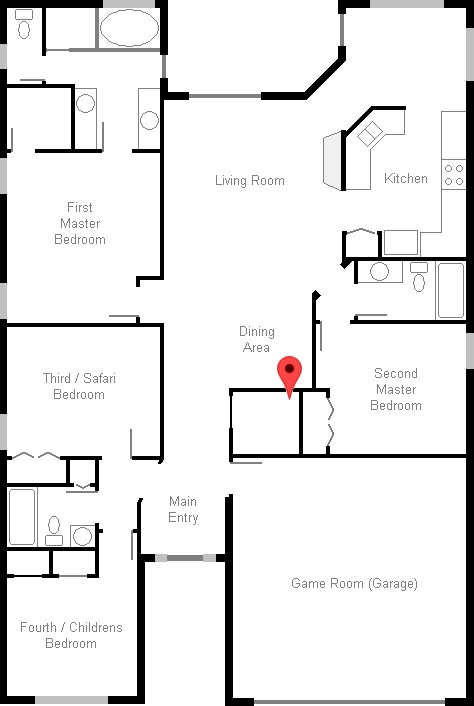 Place the Main Router as 'centrally' as possible
**Main Router Placement:**Imagine straight lines from the antennas on your main router to all of your Wi\-Fi client devices\. Place your main routerin a central locationthat:- Minimizes distances:The total length of all imaginary lines are minimized\. Often times, this means placing your router in as 'centralized' a location as possible in the house, and often near where you spend a lot of time, like in a living room\.
- Avoids obstacles:All the imaginary lines to all Wi\-Fi client devices should avoid as many obstacles as possibleappliances, furniture, walls, bookcase, full closets, etc\. Ideally, the Wi\-Fi signal is only hitting walls and air, and nothing else\.
> **KEY Wi\-Fi concept:***Place your 'main router' centrally in your home, andout in the open\.***Another great way to visualize best placement:**Imagine blowing up 'N' balloonswhere 'N' is 2, 3, etcuntil they enitrely fill a 3D model of a building/location\. The center of each balloon is approximately the best location to place each of 'N' Wi\-Fi access points\.
**Do NOT 'hide' your router:**You want your router 'out in the open'\. Do not place your router inside a cabinet, or on the floor under furniture\. Instead, place the router so that it is very visible from all directions\.> I was once at a rental house where the Wi\-Fi router was in a piece of furniture, in a closetwith a door, in a bedroom, located along an outside wall of the house\. So half the house had a poor Wi\-Fi signal and the far half of the house had NO Wi\-Fi signal\. The solution would have been to move the main router to the middle of the houselike the living room, and place the router out in the open\.
**Don't overlook also adjusting router 'height':**Don't restrict yourself to only moving the router horizontally\. Also consider moving the router up/downeg: on top of a shelf or hutch\. It is all about finding the best location that best minimizes the most 'line\-of\-sight' obstacles for 'at range' client devices\.**Obstacles impact Wi\-Fi signal strength MUCH more than air/distance:**What degrades Wi\-Fi signal strength the most are the obstacles that the Wi\-Fi signal must pass through, not air/distance\. A Wi\-Fi signal can easily go hundreds of feet without any obstacles, but as soon as you start adding walls, furniture, appliances, concrete, brick, water, nearby metal objects, etc, then signal strength degrades very quickly\.
> So if you can place a router so that the Wi\-Fi signal avoids as many obstacles as possible, that can significantly help a far away client devicelike an outdoor Wi\-Fi camera\.
**How to best place Mesh/Extender Nodes \(with a 5 GHz wireless backhaul\):**Place the node so that the PHY speeds for each of the two pathsrouter to node, and node to furthest client deviceare approximately the SAME PHY speed\.> **The "1/2 rule" for supporting far\-away Wi\-Fi 5 clients:**Discovering the PHY speed of the two paths may be very hard, so as a 'general rule', place a mesh/extender node roughly half way between the main router and the furthest modern Wi\-Fi 5 client that you must support \-\- but also place to minimize obstacles\! Take advantage of long hallways where there are no obstacles to degrade the Wi\-Fi signal\.**The "2/3 rule" for supporting far\-away older Wi\-Fi 4 clients:**If you are trying to improve Wi\-Fi for a far away Wi\-Fi 4 deviceeg: many Ring cameras, try placing a modern mesh/extender node 2/3 of way from the main mesh router to the devicecamera\. This is because you want the 'device to mesh' link to have great connectivitya PHY of around 72 Mbps, which is the max, and you want the 'mesh/extender to router' link to have OK connectivityPHY max=866 and min=65, but you want anything above 72 Mbps\.
**Placing Mesh/AP Nodes with a wired backhaul:**Since there is a reliable backhaul to the main router, think of large similarly sized spheresthe Wi\-Fi signalemanating from each node in your network \-\- and place all nodes so that \(a\) each Wi\-Fi client potential location is covered, and that \(b\) all spheres just barely touch\.> OR, just place the AP's where they provide the maximum value for the most client devices, most of the time\. Namely, in the living room, in a kids playroom, or in the home office\.
 Metal stool
**Metal objects CAN interfere with your Wi\-Fi signal:**I was in a rental house where Wi\-Fi performance was horrible in the 5 GHz bandinterestingly, the 2\.4 GHz band was OK\. The owner had actually even gone to the trouble of installing a VERY expensive Mesh Wi\-Fi system*even though the home at around 2000 sq ft did not need a mesh system*and even that did not improve Wi\-Fi performance\.The ultimate root cause/problem? The Mesh base stationand previously, routerwas placed on the floor and 18" away from a decorative metal stoolseen right, and that was causing major interference\.
> **KEY Wi\-Fi concept:***Do NOT place a router/AP on or near metal objects\.*
Simply moving the metal stool well away from the router and to a different part of the room instantly and dramatically improved Wi\-Fi performance throughout the entire home\.> I replicated the 5 GHz performance problem by placing a non\-mesh Netgear RAX50 router on top of the stool\. Wi\-Fi performance was bad, but as soon as the stool was removedreplaced by a chair made of wood, Wi\-Fi performance was great\.*The lesson learned: The objects near/around your router can and will impact your Wi\-Fi signal\.*
 Wi\-Fi hidden node problem
**Warning: Hidden Node Problem:**Placing a router 'centrally located' often works best, but it can backfire if you have two client devices both communicating frequently with that router that are 180° far apart from each otherand Wi\-Fi wise, can't 'see' each other \-\- example seen right\. See[Hidden Node Problem](https://en.wikipedia.org/wiki/Hidden_node_problem)\(wikipedia\.org\)\.> When this happens, add an[access point](https://www.wiisfi.com/#accesspoint)\[§19\]wired/Ethernet back to your main routerto your network to eliminate the 'hidden node'\.NOTE that OFDMA in Wi\-Fi 6 can eliminate the "Hidden Node" problem\. Because with OFDMAand importantly, Wi\-Fi 6 clients using OFDMA, it is the router, not the client, that decides when a client device transmits\.
**TIP: Rotating the router can sometimes help \(a little\):**The Wi\-Fi signal range radiating out of a router is almost certainly not a 100% symmetrical sphere\. Instead, think of a sphere with indentations\. This means that simply rotating the router 90°, 180°, or 270°*can sometimes*improve the signal strength for a key far\-away devicelike a Ring camera outsidejust enough to be helpful\. But beware \-\- if this technique actually works and helps you, that the 'bad Wi\-Fi signal' will also be rotated the same amount \-\- and moved to a different part of the house, or hopefully outside the house, where it does no harm\.**TIP: Antenna orientation:**Sometimes moving the antennas on the router*slightly*can improve the signal strength for a far\-away client devicelike maybe angled slightly instead of straight up/down\. You just need to try and test\.
> Using the[MCS Spy tool](https://www.duckware.com/mcsspy/index.html)\(duckware\.com\) to confirm MCS indexes used in real\-time, I was able to change the MCS level used by a far away device from MCS index 1 to MCS index 2doubling the speedsimply by moving the antennas on my AP slightly\.
**More information:**- [The Ars Technica semi\-scientific guide to Wi\-Fi Access Point placement](https://arstechnica.com/gadgets/2020/02/the-ars-technica-semi-scientific-guide-to-wi-fi-access-point-placement/)\(arstechnica\.com\)
- [ASUS guide on placement of mesh nodes](https://www.asus.com/microsite/AiMesh/en/how_to.html)\(asus\.com\)
Appendix Q: What 'Stream' means \-\-*has changed\!*
**Changing definition:**Watch out\! What "Stream" means \-\-*to router companies*\-\- has changed from Wi\-Fi 5and beforeto Wi\-Fi 6and later\!> And marketing hype is directly to blame\. The changing meaning is just another marketing ploy to make new Wi\-Fi 6 routers sound 'so much better' than prior generation routers\.
**Wi\-Fi 5 \(and before\):**The number of 'streams' in older routersused to mean MIMO level\. For example, the Netgear R7800 is a4×4 MIMOrouter and was called a"Quad\-stream"router \-\- supporting 4×4 in 2\.4 GHz AND 4×4 in 5 GHz: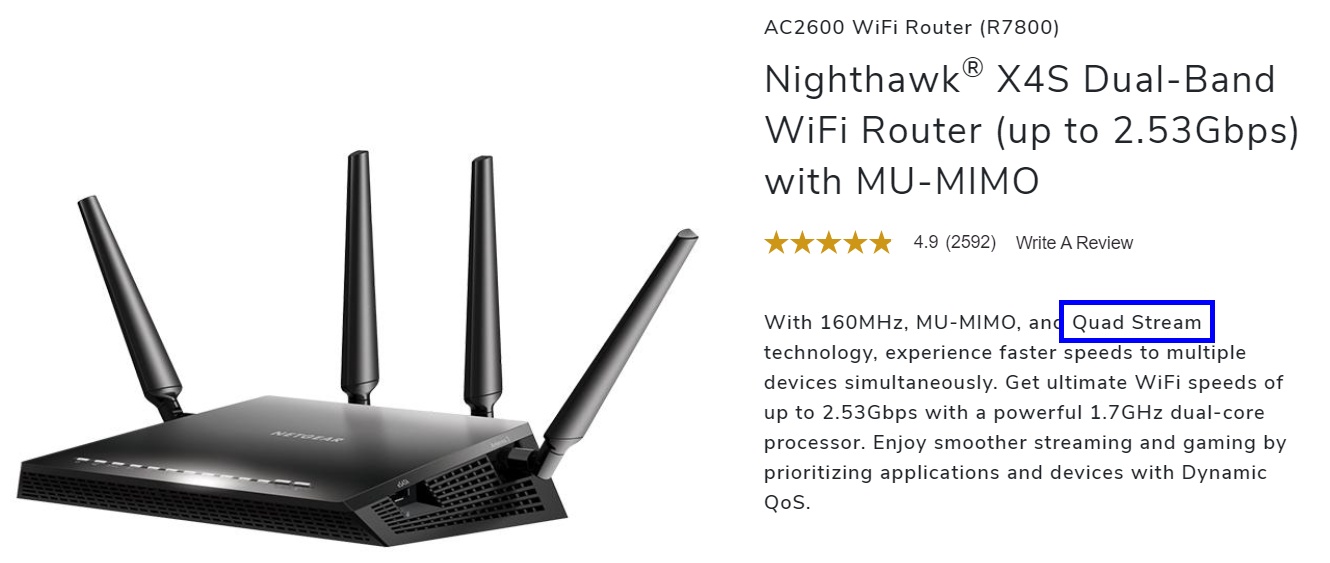
Quad stream and 4×4 MIMO Wi\-Fi 5 router
**Wi\-Fi 6 \(and later\):**However, router companies are nowadding the number of streamsMIMO levelsfor all bands togetherto come up with aninflated 'stream' number\. The Netgear RAX35belowis2×2 MIMO, but is now called a"4\-Stream"router \-\- supporting 2×2 in 2\.4 GHz and 2×2 in 5 GHz: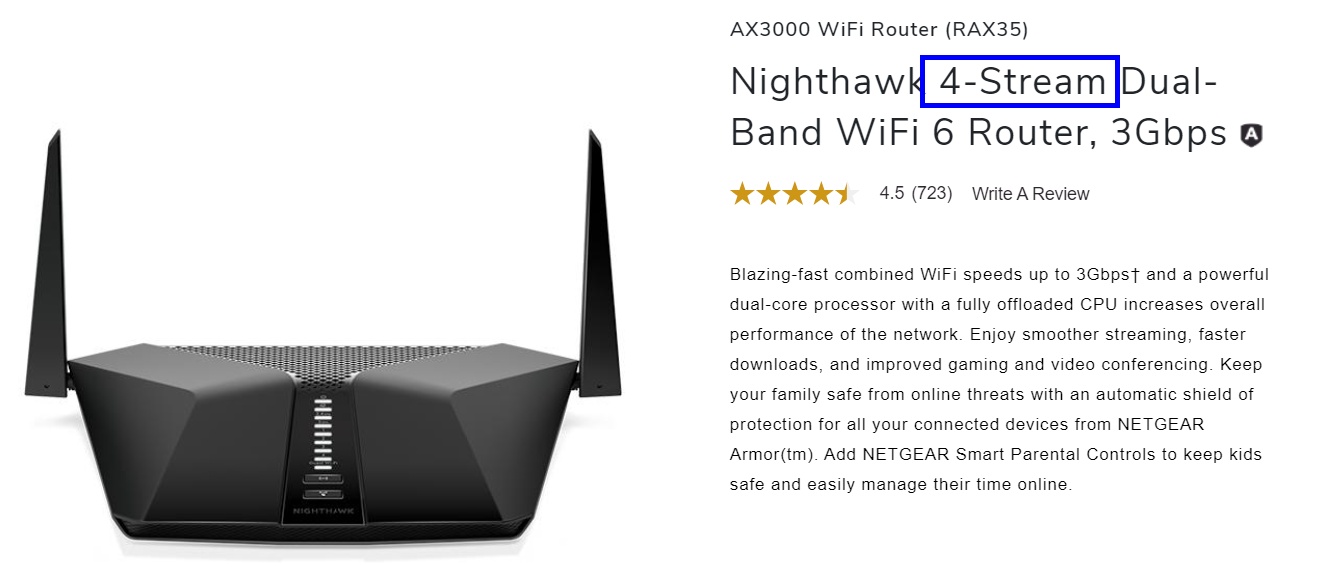
4 stream, but only 2×2 MIMO Wi\-Fi 6 router
So the first router is "Quad\-Stream" and the second is "4\-Stream" \-\- so similar specs, right? NO\! The first is 4×4 MIMOin both bandsand the second is only 2×2 MIMOin both bands\. By the standards that router companies are now using, the first Wi\-Fi 5 "Quad\-Stream" router is actually now an "8\-Stream" router \-\-*What 'Stream' means has changed\!*> And YES, both of these routers are "Simultaneous dual\-band Wi\-Fi"\. View the[R7800 specs](https://www.downloads.netgear.com/files/GDC/datasheet/en/R7800.pdf)and the[RAX35 specs](https://www.netgear.com/images/datasheet/networking/wifirouter/rax35v2.pdf)\.
**But, MIMO level is the key, not 'streams':**What really matters to you is maximum MIMO level for the single Wi\-Fi band that most of your client devices will use\. Today, that means you want 4×4 MIMO support for all Wi\-Fi bands that the router supports\.*So just do your own research and confirm the MIMO level supported for each band\.*Some companies make this information very hard to figure outnot even disclosing it; it must 'computed' from other disclosed information\. Whereas other companieslike Asus, fully disclose that information under a "Tech Specs" router section:
> 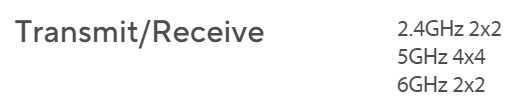
Appendix R: Learn More
**Learn more on other web sites:**- [DeviceSpecifications\.com](https://www.devicespecifications.com/)\- great site for finding smartphone Wi\-Fi capabilities
- [PhoneScoop\.com](https://phonescoop.com/)\- tons of specification information on phoneslike FCC ID
- [FAQ \- Basic Wireless Concepts](https://static.tp-link.com/configurationguide/q-a-basic-wireless-concepts.pdf)\- TP\-Link \(PDF\)
- [Dong Knows Tech](https://dongknows.com/)\- many reviews, but heavy advertising
- [SmallNetBuilder](https://www.smallnetbuilder.com/)\- Lots of interesting informationbut not updated much recently
- [WiFi Ninjas](https://wifininjas.net/category/wn-blog/)\- many interesting blog articles on Wi\-Fibut looks offline now
- [WiFiGuys Blog](https://www.wifiguys.co.uk/blog/)\- many interesting blog articles on Wi\-Fibut years old
- [Wireless CAT](http://wikidevi.wi-cat.ru/)\- replacement for TechInfoDepot, a great site for router FCC numbers; chipsets, etc
**Vendor provided FCC compliance information:**- [Ubiquiti FCC ID for all products](https://www.ubnt.com/compliance)
- [Netgear notice of FCC compliance](https://www.netgear.com/images/pdf/Notification_of_Compliance.pdf)but there are DFS support errors in this doc
- [Eero](https://eero.com/legal/compliance)
**Vendor filings with the FCC:**A great way to new products that will be out soon\.- [TP\-Link Hong Kong FCC filings](https://fccid.io/2AXJ4)\- 2AXJ4
- [TP\-Link Signapore FCC filings](https://fccid.io/2BCGW)\- 2BCGW
- [TP\-Link China FCC filings](https://fccid.io/TE7)\- TE7no new filings since May 2022
- [ASUS FCC filings](https://fccid.io/MSQ)\- MSQ
- [Netgear FCC filings](https://fccid.io/PY3)\- PY3
- [Ubiquiti FCC filings](https://fccid.io/SWX)\- SWX
- [Apple FCC filings](https://fccid.io/BCG)\- BCG
- [Linksys FCC filings](https://fccid.io/Q87)\- Q87now under Belkin, as Belkin bought Linksys
- [D\-Link FCC filings](https://fccid.io/KA2)\- KA2
- [Belkin FCC filings](https://fccid.io/K7S)\- K7S
**Wireless LAN Professionals:**- [Interesting videos on their YouTube channel](https://www.youtube.com/@WirelessLANProfessionals/videos)
**Virtual web GUI emulators:**- [TP\-Link](https://www.tp-link.com/us/support/emulator/)
**Aerohive Tech Articles:**Aerohive Wi\-Fi 6 802\.11ax technical blog articles \-\-sadly, all of these links now appear dead after Aerohive merged with another company:- [How Does 802\.11ax Address Common Problems With Wi\-Fi?](https://blog.aerohive.com/how-does-802-11ax-address-common-problems-with-wi-fi/)
- [What Are The Goals of The 802\.11ax Standard?](https://blog.aerohive.com/what-are-the-goals-of-the-80211ax-standard/)
- [What Does 802\.11ax Change About The WLAN Standard?](https://blog.aerohive.com/what-does-802-11ax-change-about-the-wlan-standard/)
- [What Is BSS Coloring In 802\.11ax?](https://blog.aerohive.com/what-is-bss-coloring-in-802-11ax/)
- [How Will Target Wake Time Help Mobile Devices And IoT In 802\.11ax?](https://blog.aerohive.com/how-will-target-wake-time-help-mobile-devices-and-iot-in-802-11ax/)
- [Why Is OFDMA One Of The Most Important Features In 802\.11ax?](https://blog.aerohive.com/why-is-ofdma-one-of-the-most-important-features-in-802-11ax/)
- [802\.11ax Frame Aggregation Enhancements](https://blog.aerohive.com/802-11ax-frame-aggregation-enhancements/)
- [What Does Multi\-User \(MU\) Mean?](https://blog.aerohive.com/what-does-multi-user-mu-mean/)
- [How Do 20 MHz\-Only Clients Operate In 802\.11ax?](https://blog.aerohive.com/how-do-20-mhz-only-clients-operate-in-802-11ax/)
- [802\.11ax and Medium Contention](https://blog.aerohive.com/802-11ax-and-medium-contention/)
- [What is BSS Color in 802\.11ax?](https://blog.aerohive.com/what-is-bss-coloring/)
- [How Does BSS Coloring Work in 802\.11ax?](https://blog.aerohive.com/how-does-bss-coloring-work-in-802-11ax/)
- [Dueling NAVs in 802\.11ax](https://blog.aerohive.com/dueling-navs-in-802-11ax/)
- [Will 802\.11ax Make 80 MHz and 160 MHz Channels Usable in the Enterprise?](https://blog.aerohive.com/will-802-11ax-make-80-mhz-and-160-mhz-channels-usable-in-the-enterprise/)
- [Does The Number of Spatial Streams in 802\.11ax Really Matter?](https://blog.aerohive.com/does-the-number-of-spatial-streams-in-802-11ax-really-matter/)
- [What Benefits Does Dual 5 GHz Bring To 802\.11ax?](https://blog.aerohive.com/what-benefits-does-dual-5-ghz-bring-to-802-11ax/)
- [The Main Ingredient of 802\.11ax: OFDMA](https://blog.aerohive.com/the-main-ingredient-of-802-11ax-ofdma/)
- [What are OFDMA Resource Units in 802\.11ax?](https://blog.aerohive.com/ofdma-resource-units-80211ax/)
- [How Does an 802\.11ax AP Allocate OFDMA Resource Units?](https://blog.aerohive.com/802-11ax-allocate-ofdma-ru/)
- [OFDM and OFDMA Subcarriers \- What Are the Differences?](https://blog.aerohive.com/ofdm-and-ofdma-subcarriers/)
- [How Does DL\-OFDMA Work in 802\.11ax?](https://blog.aerohive.com/dl-ofdma/)
- [Unsolicited Buffer Status Reports in 802\.11ax and Wi\-Fi 6](https://blog.aerohive.com/unsolicited-buffer-status-reports-in-802-11ax-and-wi-fi-6/)
- [What is UL\-OFDMA Random Access \(UORA\)?](https://blog.aerohive.com/ul-ofdma-random-access-uora/)
- [What is UL\-OFDMA Random Access \(UORA\)? \- Part 2](https://blog.aerohive.com/ul-ofdma-random-access-uora-part-2/)
- [6 Things to Expect from 802\.11ax \(Wi\-Fi 6\)](https://blog.aerohive.com/what-is-wi-fi-6/)
- [Why OFDMA is the Secret Sauce for Wi\-Fi 6](https://blog.aerohive.com/ofdma-in-wi-fi-6/)
Appendix S: Spectral Masks
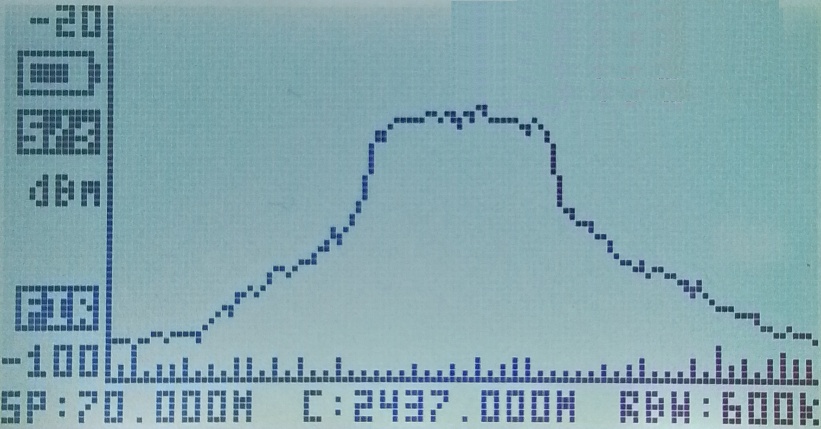 Screenshot from 'RF\-Explorer Handheld Spectrum Analyzer' \(showing 2\.4 GHz channel 6 in use\)
The spectrum analyzer graphseen rightshows the entire 70 MHz spectrum of the 2\.4 GHz Wi\-Fi band2402 MHz to 2472 MHz, with a single Wi\-Fi client device broadcasting on 20 MHz Wi\-Fi channel 6\.> *The X\-axis left to right represents increasing Wi\-Fi frequencychannels 1 through 11\.The Y\-axis represents received signal strengthso bottom is the noise floor\.*
Notice that the client device \-\- transmitting on 20 MHz channel 6 \-\- is actually impacting theentire 70 MHz of the 2\.4 GHz Wi\-Fi spectrum\!**Sideband signals:**The 'hump' in the center of this graph represents the main 20 MHz channel 6 transmission signal\. And then there is a quick drop off followed by a much more gradual drop off \-\- aka the "sideband" signal\. This sideband is unavoidable and just how RF transmissions work\.
> There is the strong 'main signal', and then an unavoidable,*and much weaker*, sideband signal, and Wi\-Fi devices are requiredby law; FCC rulesto stay within a well defined 'spectral mask' that limits the amount of sideband signal that can be generatedsee dotted line in graph below right\.
The graph above was intentionally captured*three feet*from the transmitting device, to show the full sideband signal\. Because as a receiver moves farther away from the transmitting device, the more this entire graphand especially the sideband signalgets 'pushed down' into the noise floorsignal attenuation, helping to greatly limit the impact of any 'sideband" signal on adjacent channels\.> And this explains why you don't want radio devices operating on similar/adjacent frequencies too close to each other \-\- you want to avoid the interference from sideband signals\! This is why you need to be very careful using tri\-band routerswhere two of the bands are on the same band\.In most cases, where devices are on adjacent channels,*but operating far enough apart*, the sideband signals dropattenuateinto the noise floor, leaving only the main hump above the noise floor\.
**Analogy**If 2\.4 GHz Wi\-Fi channels 1, 6, 11 are like a highway with three lanes, then transmitting on a Wi\-Fi channel is not just like driving a car in your lane, but rather, it is like driving a 'wide\-load' in a laneto factor in the impact of sideband signals\.> Now consider three wide\-loads all traveling down the highway at the same timein unique lanes\. Everything works fine, provided that the wide\-loads keep their distance from each other\. But if the wide\-loads are right next to each other, bad things can happen\. The same thing happens in Wi\-FiSee ACI, next section\.
**The real\-world impact of Adjacent Channel Interference \(ACI\):**When a RF transmitting device is operating too closely to the radio receiver operating on an adjacent channel, the 'sideband' transmissions are no longer below the receiver noise floor, but rather are above the noise floor, and can cause significant interferenceACIin the adjacent channel receiverlowering SINR, resulting in reduced MCS levelsthroughput\. Here is an example of a forced ACI situation and the impactin redthat had on receiver channel throughput: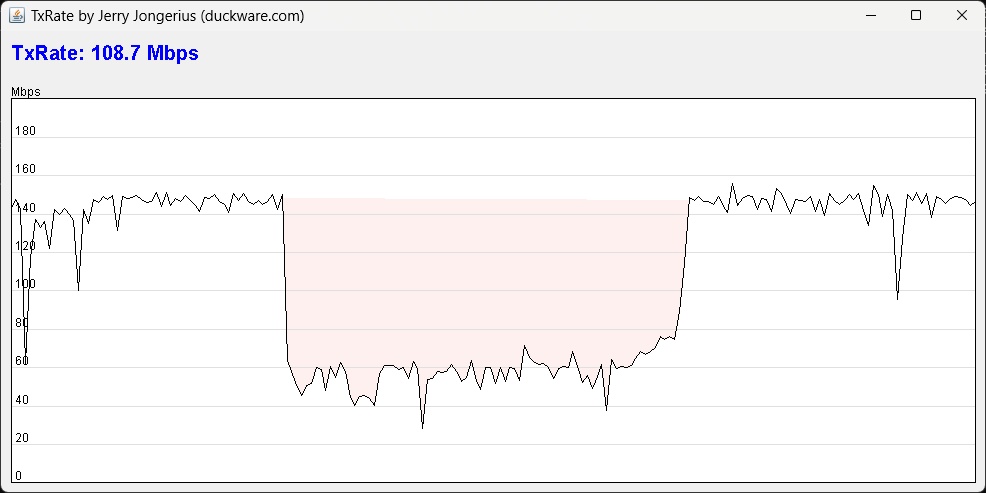
The impact \(in red\) of Adjacent Channel Interference \(ACI\) is reduced throughput> **Another analogy:**You are outside having a conversation with your neighboryour channel\. A loud motorcycle one block awayfar away channelis not going to impact your ability to have a conversationyou want/need the signal attenuation caused by distance\. But if the loud motorcycle comes down your streetan adjacent channel, it will greatly impact your ability to have a conversation for a short period of time\.
**Learn More:**- [Google "Wi\-Fi Spectral Masks"](https://www.google.com/search?q=wi-fi+spectral+masks)\(google\.com\)
- [WLAN 802\.11ac Spectral Mask](https://www.rfwireless-world.com/Tutorials/802-11ac-spectral-mask.html)\(rfwireless\-world\.com\)
- [Wi\-Fi: Overview of the 802\.11 Physical Layer and Transmitter Measurements](https://www.tek.com/en/documents/primer/wi-fi-overview-80211-physical-layer-and-transmitter-measurements)\(tek\.com\)
Appendix T: Terminology
- **1×1**A single antenna with no MIMO\.
- **2×2 / 3×3 / 4×4:**Multiple antennas and MIMO level\.
- **2\.4 GHz / 5 GHz / 6 GHz / 60 GHz:**Refers to the wireless frequency \(spectrum/band\) used by Wi\-Fi\.
- **802\.11n:**Wi\-Fi 4 \-\- the specification for HT \(High Throughput\) Wi\-Fi \(mainly\) in the 2\.4 GHz band \(also operates in the 5 GHz band\)\.
- **802\.11ac:**Wi\-Fi 5 \-\- the specification for VHT \(Very High Throughput\) Wi\-Fi in the 5 GHz band\.
- **802\.11ad:**The specification for Wi\-Fi in the 60 GHz band\.
- **802\.11ax:**Wi\-Fi 6 \-\- the specification for HE \(High Efficiency\) Wi\-Fi 6\.
- **802\.11be:**Wi\-Fi 7 \-\- the specification for EHT \(Extremely High Throughput\) Wi\-Fi 7\.
- **ACI:**"Adjacent Channel Interference" \-\- when a transmitting device on a different/adjacent channel is causing interference, often due to being too close to a device operating in a different channel\.
- **AFC:**"Automated Frequency Coordination" \-\- a part of Wi\-Fi 6E that allows an access point to obtain a*"list of available frequency ranges in which it is permitted to operate and the maximum permissible power in each frequency range"*\.
- **AP:**"Access Point" \-\- AP is the acronym for \(Wireless\) Access Point\. This allows your Wi\-Fi devices to connect to a wired network \(which is connected to the Internet\)\.
- **AC\#\#\#\#:**AC refers to support for 802\.11ac \(Wi\-Fi 5\) and \#\#\#\# is the sum of the 'maximum PHY network speed' for ALL bands in the router \(like dual\-band or tri\-band\)\.*This naming convention is very deceptive because it can imply faster speeds where no faster speeds exist\.*
- **AX\#\#\#\#:**AX refers to support for 802\.11ax \(Wi\-FI 6\) and \#\#\#\# is the sum of the 'maximum PHY network speed' for ALL bands in the router \(like dual\-band or tri\-band\)\.*This naming convention is very deceptive because it can imply faster speeds where no faster speeds exist\.*
- **Backhaul:**Refers to how a node in the network communicates with the main router in the network \-\- is it 'wireless' or 'wired' \(Ethernet\)\.
- **Beamforming:**A standards\-based \(802\.11ac/802\.11ax\) signal\-amplification technique that results in increased range and speed to a device\. Beware \(avoid\) earlier \(proprietary\) 802\.11n beamforming implementations\. See also Implicit Beamforming and Explicit Beamforming\.
- **byte:**8 bits
- **Cat5\+:**Shorthand notation referring to any category cable at/above Cat5e\. So, Cat5e, or Cat6, or Cat6a, etc\.
- **Client:**In Wi\-Fi, refers to any device \(phone, tablet, laptop, console, TV, etc\) that connects to an access point \(AP\)
- **CMTS:**"Cable Modem Termination System" \-\- the device at your ISP that your cable modem connects to\.
- **DHCP:**"Dynamic Host Configuration Protocol" \-\- the protocol used by a client device to obtain an 'IP Address' when it connects to a network\.[wikipedia\.org](https://en.wikipedia.org/wiki/Dynamic_Host_Configuration_Protocol)
- **Dual\-band:**Two access points in one\. Often band one is 2\.4 GHz and band two is 5 GHz\. See also Tri\-Band\.
- **DFS:**"Dynamic Frequency Selection" \-\- routers that use DFS channels in 5 GHz must scan for conflicts \(TDWR\) and get off the channel if a conflict is found\.
- **EHT\#**: "Extremely High Throughput" \-\- Wi\-Fi 7, where the \# is the channel width, in MHz\. For example, EHT240 is Wi\-Fi 7 with a 240 MHz channel\.
- **Explicit Beamforming**: A Wi\-Fi technology that uses 'sounding frames' between two devices to determine the optimal direction to Tx a signal in order to maximize the received signal strength\. See also Implicit Beamforming\.
- **Full\-Duplex**: Can transmit and receive at the same time\. See also Half\-Duplex\.
- **GbE:**"Gigabit Ethernet"
- **Gbps:**"Gigabits per second" \-\- or 1,000,000,000 bits/second\. 1 Gbps is 1000 Mbps\.
- **GHz:**"Gigahertz" \-\- one billion hertz\. See also MHz\.
- **Guard Interval / GI:**"Guage Interval" \-\- the time/space between transmitted Wi\-Fi symbols\.
- **Half\-Duplex**: Can transmit, or receive, but not both at the same time\. See also Full\-Duplex
- **HE\#**: "High Efficiency" \-\- Wi\-Fi 6, where the \# is the channel width, in MHz\. For example, HE160 is Wi\-Fi 6 with a 160 MHz channel\.
- **HT\#**: "High Throughput" \-\- Wi\-Fi 4, where the \# is the channel width, in MHz\. For example, HT20 is Wi\-Fi 4 with a 20 MHz channel\.
- **Implicit Beamforming:**A Wi\-Fi technology were the router attempts to automatically focus transmited signals back to a client, in the direction that the router computed that incoming Wi\-Fi signals from that client are coming from\. See also Explicit Beamforming\.
- **ISP:**"Internet Service Provider" \-\- the company that you get Internet service from\.
- **IoT:**"Internet of Things" \-\- a future where every device is connected via Wi\-Fi to the Internet\.
- **LAN:**"Local Area Network" \-\- the wired network in your house, often Ethernet
- **MAC:**"Media Access Control" \-\-[Details](https://en.wikipedia.org/wiki/Medium_access_control)\(wikipedia\.org\)\.
- **Mbps:**"Megabits per second" \-\- or 1,000,000 bits/second\. 1000 Mbps is 1 Gbps\.
- **MCS:**"Modulation and Coding Scheme" \-\- a metric that directly relates to data rate\.
- **MHz:**"Megahertz" \-\- one million hertz\. See also GHz\.
- **MIMO:**" Multiple\-Input and Multiple\-Output" \-\- Multiple antennas all operating*on the same frequency*, at the same time
- **MLO:**"Multi\-Link Operation" \-\- where when a client wants to transmit, instead of only transmiting over a single Wi\-Fi band, multiple Wi\-Fi bands are used simultaneously\.
- **MU\-MIMO:**"Multiple User MIMO" \-\- uses MIMO to transmit to multiple users at the same time\. See also SU\-MIMO\.
- **NAT:**Network Address Translation \-\- a method for multiple client devices \(using internal private internal IP Addresses\) to share a single Internet connection \(that only has a single public IP Address\)\.[wikipedia\.org](https://en.wikipedia.org/wiki/Network_address_translation)
- **'N' Spatial Streams:**Refers to T×R:N MIMO, where both 'T' and 'R' equals 'N'\. For example, 4 spatial streams means 4×4:4\.
- **OFDMA:**"Orthogonal Frequency\-Division Multiple Access" \-\- a proven technology that comes from cellular 4G LTE\.
- **ONT:**"Optical Network Terminal" \-\- takes a fiber connection from an ISP and provides an Ethernet connection for your router to plug into\.
- **PHY:**PHY is an abbreviation for physical\. For example, 'PHY speed' refers to the physical speed at the raw network layer\. For every Wi\-Fi device, there is not just one PHY value, but both a Tx PHY and a Rx PHY\.
- **PoE:**"Power over Ethernet" \-\- uses an Ethernet cable to send both Ethernet*and electrical power*to a device\.[Details](https://en.wikipedia.org/wiki/Power_over_Ethernet)\(wikipedia\.org\)\.
- **POTS:**"Plain Old Telephone Service" \-\- refers to telephone service over two physical wires\.
- **PSC:**"Preferred Scanning Channels" \-\- channels in 6 GHz, 80 MHz apart, that when used, enable clients to find an AP operating in 6 GHz Quadrature Amplitude Modulamuch faster
- **QAM:**"Quadrature Amplitude Modulation" \-\-[Details](https://en.wikipedia.org/wiki/Quadrature_amplitude_modulation)\(wikipedia\.org\)\. A method of converting and sending digital information \(0's and 1's\) using analog signals\.
- **Quad\-Stream:**Often refers to 4×4 MIMO in Wi\-Fi 5 devices\. But beware that in Wi\-Fi 6, router companies are starting to 'add' the streams for each individual band, and publish that total number\.
- **RBW:**"Resolution BandWidth" \-\- from spectrum analysis\.
- **RF:**"Radio Frequency"
- **RSSI:**"Received Signal Strength Indicator" \-\-[More Information](https://en.wikipedia.org/wiki/Received_signal_strength_indication)\(wikipedia\.org\)\.
- **Rx:**abbreviation for 'Receive'\. See also Tx\.
- **SFP:**"Small Form\-factor Pluggable" \-\- a port often used in Fiber media converters\.[wikipedia\.org](https://en.wikipedia.org/wiki/Small_Form-factor_Pluggable)
- **SINR:**"Signal\-to\-Interference\-plus\-Noise Ratio"\. How much a received signal is above both \(a\) interference, and \(b\) the noise floor \-\- ultimately determines which MCS level can be used
- **SNR:**"Signal to Noise Ratio" \-\- the*difference*\(in dB\) between the signal level and the noise level\. See also SINR\.
- **SU\-MIMO:**"Single\-User MIMO" \-\- MIMO to a single user\. See also MU\-MIMO\.
- **TCP/IP:**"Transmission Control Protocol / Internet Protocol" \-\- how computer systems connected to the Internet communicate with each other\.
- **TDWR:**"Terminal Doppler Weather Radar" \-\- Important due to DFS channel restrictions\.
- **TPR:**"Throughput to PHY Ratio"
- **Tri\-band:**Three access points in one\. Often band one is 2\.4 GHz, band two is 5 GHz and band three is 5 GHzor 6 GHz Wi\-Fi 6E, or 60 GHz 802\.11ad\. See also Dual\-Band\.
- **Tx:**abbreviation for 'Transmit'\. See also Rx\.
- **UPnP:**'Universal Plug and Play'\. A method for network devices on a network to discover each other, and establish connectivity\.[wikipedia\.org](https://en.wikipedia.org/wiki/Universal_Plug_and_Play)
- **VHT\#**: "Very High Throughput" \-\- Wi\-Fi 5, where the \# is the channel width, in MHz\. For example, VHT80 is Wi\-Fi 5 with an 80 MHz channel\.
- **WAN:**"Wide Area Network" \-\- the WAN port on your router is connected to a modem, which in turn is connected to the Internet\.
- **WAP:**"Wireless Access Point" \-\- a device that provides wireless access to a wired network\.
- **"Wave 2":**An term in Wi\-Fi used to define chipset and feature level\. "Wave 1" is the first generation, supporting core basic features of a new Wi\-Fi version\. "Wave 2" is the next generation of chipsets that adds many optional advanced features\.
- **Wi\-Fi:**A 'brand name' for wireless networking created by[an alliance](https://wi-fi.org/)\(wi\-fi\.org\) of the biggest companies for IEEE 802\.11 wireless technologies, to ensure that wireless products from different vendors all work with each other\.[Here's Why It's Called 'Wi\-Fi'](https://www.huffpost.com/entry/why-called-wi-fi_l_5cace3f7e4b01bf960065841)\(huffpost\.com\)\.['Sponsor' level](https://www.wi-fi.org/member-companies)member companies are Apple, Broadcom, Cisco, Comcast, Dell, Huawei, Intel, LG, Nokia, NXP, Qualcomm, Samsung, Sony, and Texas Instruments\.
- **WLAN:**"Wireless LAN"
Appendix V: Version history for this paper
There are far too many minor updates being made to this paper*all the time*that will not be documented\. However, this appendix was recently createdat the request of readers\! \-\- thanks, keep the feedback comingto document some of the significant changes being made:- 2025/10/14: added preliminary section on[Wi\-Fi 8](https://www.wiisfi.com/#wifi8)\[§15\]
- 2025/09/23: added[Case Study \#4](https://www.wiisfi.com/#mocacordcutter)\[§E13\] \- MoCA for 'cord cutters'
- 2025/07/13: added[Case Studies](https://www.wiisfi.com/#casestudies)\[§E13\]
- 2025/07/08: renamed Vulnerabilities section to[Interesting News](https://www.wiisfi.com/#news)\[§Z\]
- 2025/05/29: added[Vulnerabilities](https://www.wiisfi.com/#vulnerabilities)\[§Z\]
- 2025/03/11: added[Wi\-Fi Coverage](https://www.wiisfi.com/#overview)information \[§2\]
- 2025/02/19: added[recommendation](https://www.wiisfi.com/#recommendation)for "GL\.iNet Flint 2" \[§22\]
- 2025/02/19: removed Netgear RAX50 recommendation due to serious[firmware bugs](https://www.wiisfi.com/#netgearfailure)\[§W\]
- 2025/01/20: added[IoT device won't connect](https://www.wiisfi.com/#iotconnect)\[§E12\]
- 2024/12/26: replaced "TP\-Link AX21" honorable mention with the "TP\-Link AX55"
- 2024/12/24: added[Debugging 'Internet Down'](https://www.wiisfi.com/#internetdown)\[§E11\]
- 2024/08/04: added[POTS \(Telephone\) to Ethernet](https://www.wiisfi.com/#pots2ethernet)\[§E9\]
Appendix W: Call for changes in the Wi\-Fi industry / rants
A call for changes in the Wi\-Fi industryand a rant or two\.\.\.**Router companies must clearly spell out ALL specifications:**Router companies must clearly state the full specificationsWi\-Fi standard, max PHY speed, QAM\-level, MIMO level, MHz channel width, etcfor EACH version of Wi\-Fi and band supported by a router\. Don't force consumers to 'figure it out'\. Instead, clearly spell it out on specification web pages\. For example:
> Wi\-Fi 2 802\.11b 2\.4 GHz: 11 Mbps Wi\-Fi 3 802\.11g 2\.4 GHz: 54 Mbps Wi\-Fi 3 802\.11a 5 GHz: 54 Mbps Wi\-Fi 4 802\.11n 2\.4 GHz: 300 Mbps \(64\-QAM, 2×2, 40 MHz\) Wi\-Fi 4 802\.11n 5 GHz: 300 Mbps \(64\-QAM, 2×2, 40 MHz\) Wi\-Fi 5 802\.11ac 5 Ghz: 3467 Mbps \(256\-QAM, 4×4, 160 MHz\) Wi\-Fi 6 802\.11ax 2\.4GHz: 574 Mbps \(1024\-QAM, 2×2, 40 MHz\) Wi\-Fi 6 802\.11ax 5 GHz: 4804 Mbps \(1024\-QAM, 4×4, 160 MHz\)
Thank you Netgear for listening\! In a recent new Netgear router, the[technical specifications](https://www.downloads.netgear.com/files/GDC/RS300/RS300_TS.pdf)\(netgear\.com\) are now very detailed and MUCH easier to understandno more guessing:> WiFi 7 BE9300 Router Tri\-band Wi\-Fi \- 2\.4GHz \(2x2\), 0\.7Gbps, 40MHz, 4K\-QAM \- 5GHz \(2x2\), 2\.9Gbps, 160MHz, 4K\-QAM \- 6GHz \(2x2\), 5\.8Gbps, 320MHz, 4K\-QAM
Also, if there are any 'gotchas', like a router supporting a higher channel width, but then also supporting a lower MIMO level at that higher channel width, then*this impact must be clearly spelled out*\!**Disclose router power consumption:**Router companies must publish how much power a router consumes\. Namely, watts used while 'idle', and watts used while in 'active' use\.
**Publish realistic router throughput speeds:**Router companies must publish the realistic throughput speed that a typical Wi\-Fi client device of that Wi\-Fi generation can expect to achieve\. This would mean today, publishing the expected throughput speed for a 2×2 MIMO client\.
> For example, disclose what actual throughput test results were obtained for a particular iPhone or Samsung phone\.
**Devices must display ACCURATE Tx and Rx PHY speeds:**Clearly a Wi\-Fi client knows exactly what both Tx/Rx PHY speeds are, as it is both sending and decoding the Wi\-Fi signal\.The industry must change from reporting a single overly optimistic "Link Speed" in Wi\-Fi clients to instead reporting both REAL transmit and receive PHY speeds \(actual MCS levels used\)\.Of note is that Ubiquiti routers and access points do report both speeds for Wi\-Fi clients\. UPDATE: And now, so does Windows 11but there are accuracy issues\.> There is NO justification for seeing greatinflatedPHY speeds when Wi\-Fi is idle \(eg: 1201 Mbps, MCS11\), and then seeing lowered PHY speeds in the middle of a speed test \(eg: 721 Mbps, MCS7\)\. This seems very intentional \-\- and wrong\! Instead, display PHY numbers that accurately represent reality\. Maybe the statistical 'mode'value the occurs the mostof PHY for the last 100 or sonon\-management framepackets\.**Better yet:**Display both a Tx and Rx histogram of the MCS levels usedover both the last second and the last so many seconds\. The Wi\-Fi driver has this information\. That would be a killer feature for assessing Wi\-Fi signal quality \-\- because it makes the 'unseen' Wi\-Fi signal*visible*\. Especially helpful because it would make Wi\-Fi interference*visible*as MCS levels used would slide lower, then slide back to normal\.
**Wi\-Fi preferred band:**When the SSID name is the same for multiple Wi\-Fi bands, it is up to the client device to choose which band to ultimately connect to\. Client devices sometimes do a horrible job of selecting the best bandthe band that results in the highest throughput\. There needs to be a way on client devices, when setting up a Wi\-Fi connection, to specify which band is the preferred bandlike 5 GHz\. Namely, if the band is present, the client device must connect to the preferred band\.> Why? Because I would prefer to name the SSID for all bands the same, but can't because I often need to force an IoT device to use a particular Wi\-Fi band\. And currently the only way to accomplish that is by naming the SSID for each band uniquely\.For example, a 'Ring Floodlight Pro' camera that almost always connects to the overused and much slower 2\.4 GHz band\. To fix this problem, I am forced to name each Wi\-Fi band uniquely, and select the 5 GHz Wi\-Fi band during camera setup\. Camera connectivity is now fantastic, but the split Wi\-Fi band names are 'seen' in Wi\-Fi scans\.
**Netgear's router web interface is in the dark ages:**Netgear's web interfaces has not been updated in a*very long time*, and now compared to its competitors, is in the dark ages\. The Netgear web interface is very hard to use: \(a\) the UX is horriblethe white on white color scheme used makes it impossible to see what is static text and what is a field that can be changed, and \(b\) basic features that the competition has, don't exist\.> For example, on TP\-Link, I can turn a port forwarding rule on/off via a single click on a slider button \-\- because the rule has an on/off setting\. But for Netgear, port forwarding rules are always on\. Forcing you to delete the rule to turn it off, and re\-enter the full rule to turn it back on\. It is just not user friendly at all\. Netgear, get your act together and modernize the router web interface\. I also find Netgear's 90\-day support policy atrocious\. If you want to report a bug and you are past 90 days after purchase, good luck getting Netgear to listen\! Don't treat bug reports as requests for support\.
**Netgear quality failures and horrible support:**I have found way too many 'WTF' bugs in Netgear equipment, reported them, only to have the bug reports treated as 'support requests' and ignored by Netgear\. Whereas bugs that I have reported to TP\-Link*get attention and are fixed immediately*\. There is a night and day difference between these two companies\.> I have seen Netgear router firmware updates \(a\) completely break UPnP, and \(b\) change my country code and as a result, remove all 5 GHz DFS channels, with no way to 'correct' in the broken firmware\. And reverting back to older firmware immediately fixes the problem\.*Due to very serious bugs introduced by new Netgear firmware updates \(and the bugs reported to Netgear, by me, and never fixed\), Netgear routers are no longer 'recommended' by wiisfi\.com\.**I can NOT recommend a NETGEAR router that does not actually function as promised in the published 'technical specs'\.***I filed bug reports and all the Netgear techs care about is that I am past 90 days\. Netgear's 90\-day "support" policy is atrocious\. If you want to report a bug and you are past 90 days after purchase, my personal experience is that the filed bug report will be ignored by Netgear\. I even have a Netgear PoE 'managed switch' that is broadcasting via UPnP that it is a ROUTER\!it seems 'obvious' that Netgear copied UPnP code from one of their routers to their smart switch without modifications\. And when reported as a bugwithin the 90\-day period, rather than Netgear support saying "oh wow, that is a problem we will immediately fix", Netgear's response was \-\- and I am 100% serious here \-\- "why is that a problem?" Crazy bad support\.
**Vizio TV's and missing Ethernet ports:**Does anyone else notice that newer Vizio TV's in configuration screens DO display an Ethernet MAC address, but then do NOT actually provide an Ethernet port on the back of the TV? Interesting\.Appendix X: Supporting wiisfi\.com
[](https://www.youtube.com/watch?v=KpPE85Jogjw) "Ready Player One" Nolan Sorrento saying*"We can sell up to 80% of an individual's visual field before inducing seizures"*
**NO OBNOXIOUS ADVERTISING:**I wrote this paper, and continue to update it on a regular basis, to help educate people about how Wi\-Fi works\. My goal is not to make moneyif it were, this paper would be chock\-full of ads, like some other web sites out there, but rather, my goal is education,*so that YOU can make your own educated Wi\-Fi decisions*\-\- because there is far too much hype of there, and I directly blame router companies for all the confusion\.> I find this["Ready Player One" movie clip](https://www.youtube.com/watch?v=KpPE85Jogjw)\(youtube\.com\), 25 secseen upper rightto be a hilarious, gritty, and biting commentary on the very real annoying trend of 'too many ads' on web sites today\.
**★ How to support wiisfi\.com:**Please, no active donations are needed\. Instead, support wiisfi\.com*passively*\-\- by following any of the Amazon\.com links to products in this paperor the link belowwhen you shop for anything on Amazon\. Why? Because if you follow a wiisfi\.com link to Amazon and purchase anythingeven a product not directly linked to, I, as an Amazon Associate, might earn a little bit from your qualifying purchases\.> [Shop Amazon \- support wiisfi\.com](https://amzn.to/3vzf0xj)TIP: drag link to your desktop to use later**How it works:**Amazon affiliates only get credit for qualifying purchases when you \(1\) click on an affiliate link, \(2\) add a productany product, reallyinto your shopping cart, and \(3\) at some pointright then, or even later, purchase the item in your shopping cart\. There is NO credit if you click on an affiliate link, research, close the web browser, and later open a web browser, add products, and purchase\. Closing the browser session ends any affiliate association\.
You can confirm that the above Amazon link is 'working' when you see the 'wiisfi\.com' tag in the opened web browser URL locationsample below\. Then search for a product, and add it to your cart\.> [](https://amzn.to/3vzf0xj)
Also, spread the word thatwiisfi\.comexists\. Thank you for helping to supportwiisfi\.com\.Appendix Y: Contact the author

I have done my best to make this paper as easy\-to\-understand, no\-nonsense, informative and accurate as possible \-\- so that YOU can make your own educated Wi\-Fi upgrade decisions\. But it has grown FAR larger than initially intended\. Did you find an error, a typo, or have a suggestion on how to improve this paper? Did this paper help you? Do you disagree with any recommendation? Let me know\.\.\.Use[this web form](https://www.duckware.com/support/contact.html)\(duckware\.com\) to contact the author of this paper, Jerry Jongerius\.
[How you can support wiisfi\.com](https://www.wiisfi.com/#support)\[§X\]
Appendix Z: Interesting News
This section was started in May 2025 to 'call out' some of the more interesting Wi\-Fi related security vulnerabilities and interesting news\.\.\.- **2026/03/24:**[The FCC Just Banned the Sale of New Wi\-Fi Router Models Made Outside US](https://www.pcmag.com/news/fcc-just-banned-the-sale-of-new-wi-router-models-made-outside-us)\-\- A[shocking move](https://docs.fcc.gov/public/attachments/DOC-420034A1.pdf)by the FCC\.
- **2025/09/03:**[CISA Adds Two Known Exploited Vulnerabilities to Catalog](https://www.cisa.gov/news-events/alerts/2025/09/02/cisa-adds-two-known-exploited-vulnerabilities-catalog)\(cisa\.gov\) \-\- Missing authentication in an 'end\-of\-life' Wi\-Fi extender could result in hackers gaining access to your network\. The lesson to be learned here is:*never continue to use "End of Life" products\!*
- **2025/07/07:**[Trump and Congress finalize law that could hurt your Wi\-Fi](https://arstechnica.com/tech-policy/2025/07/trump-and-congress-finalize-law-that-could-hurt-your-wi-fi/)\(arstechnica\.com\) \-\- The "One Big Beautiful Bill Act" requires the FCC to auction off more spectrum \-\- meaning that it is very likely that some 6 GHz spectrum now reserved for use by Wi\-Fi, will be clawed back and auctioned off \-\- for use by cellular companies\.
- **2025/05/28:**[GreyNoise discovers a backdoor in thousands of ASUS routers](https://www.greynoise.io/blog/stealthy-backdoor-campaign-affecting-asus-routers)\(greynoise\.io\) \-\- an exploit that survives reboots and firmware updates, by turning on the standard SSH remote access feature on a custom portexploit 'signature' is that SSH is configured to use port 53282\.
- **2025/05/07:**[FBI: "Cyber Criminals target End\-of\-Life Routers"](https://www.ic3.gov/CSA/2025/250507.pdf)\(ic3\.gov\) \-\- never use a device, especially a router, that a vendor says is "End\-of\-Life" \-\- which means no more firmware updates, the impact of which is that*known*security vulnerabilities are no longer fixed\!