Cached at:
07/22/26, 02:21 PM
# 10 REM"_(C2SLFF4
Source: [https://beej.us/blog/data/mystery-comment/](https://beej.us/blog/data/mystery-comment/)
2026\-07\-21
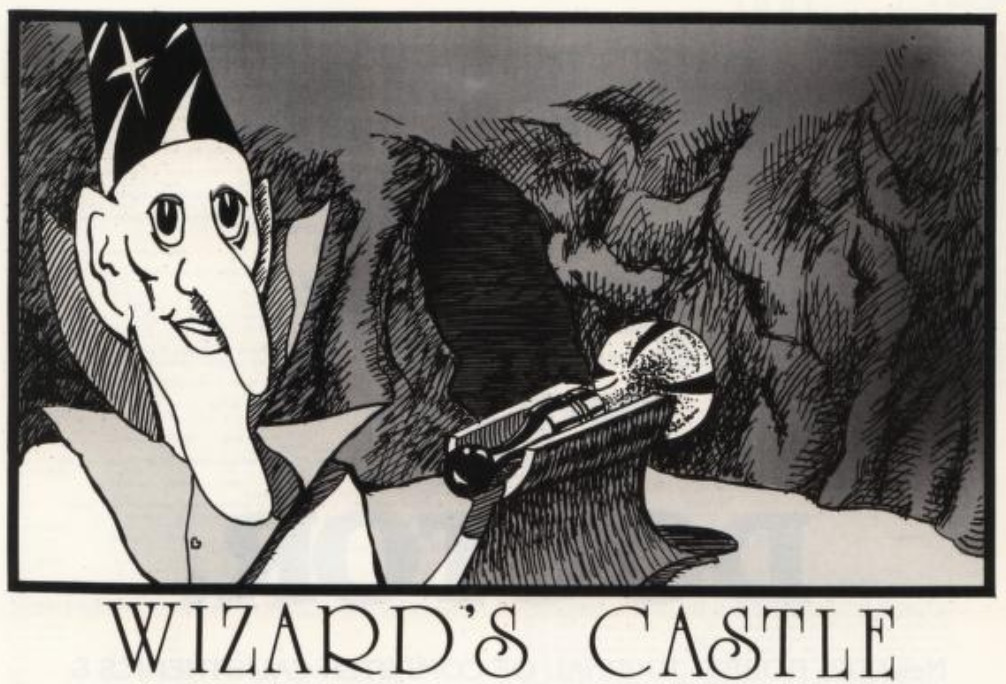Let's dive into*The Wizard's Castle*\(source code\)\!
```
10 REM"_(C2SLFF4
```
That is the first line of the 80s microcomputer BASIC game*The Wizard's Castle*initially written for the[Exidy Sorcerer](https://en.wikipedia.org/wiki/Exidy_Sorcerer)platform\.
It's a`REM`ark statement, a comment in that particular language\.`10`is the line number, if you're unfamiliar with languages that had such things\.
But the interesting part was this`"\_\(C2SLFF4`mess\. A typo or garbage? No\. It appears verbatim in the source code as originally published in[the July, 1980 issue of*Recreational Computing*](https://archive.org/details/1980-07-recreational-computing/page/n9/mode/2up)\.
What the heck is it?
Note: I'm going to jump back and forth between decimal \(which is BASIC\-friendly\) and hex \(which is programmer\-friendly\)\. Hex will be prefixed with`0x`, suffixed with`h`, or will obviously have digits A\-F in it\.
Note: Thanks to Josh and Chris, my hacking buddies, for doing*tons*of the emulator and research work on this\. It took hours, but they were good hours\. It would have taken me 10x as long without their help\.
## Suspicions
Here's more of the source in context, but with irrelevant pieces removed and some spaces added:
```
10 REM"_(C2SLFF4
40 POKE 260,218: POKE 261,1: T = USR(0): T = PEEK(-2049)
80 Q = RND(-(2*T+1))
```
In BASIC, a`:`is a command separator\.`POKE`writes a byte value to the specified memory location\.`PEEK`reads from one\. Sorcerer BASIC used signed 16\-bit numbers, apparently, so address`\-2049`is 65536\-2049 or 0xF7FF in hex\. We'll revisit that address later\.
Calling the pseudo\-random number generator \(PRNG\)`RND\(\)`with a negative number[seeds](https://en.wikipedia.org/wiki/Random_seed)it\. Old PRNGs liked to be seeded with odd numbers, thus the`2\*T\+1`expression forcing it odd\.
And the`USR\(\)`function calls a machine code routine\.
And line 80 is the first use of`T`after it is initialized from the`PEEK\(\)`\.
The proximity of these things makes it seem like they're all related to seeding the PRNG\. Sorcerer BASIC didn't have a`RANDOMIZE`command, so the only options of the day were:
- Ask the user to enter a random seed\.
- Run an increment loop until the user hits a key \(or some user\-driven thing like that\) and use that for the seed\.
- Get the seed for some kind of randomish\-thing from the existing software and/or hardware\.
*Wizard's Castle*didn't do the first two\. So it must be the last one\.
Could it be that the`REM`statement has machine code that happens to encode to ASCII text? The Sorcerer did use ASCII encoding\.
But it seems nuts that you could get useful Z80 machine code just from ASCII characters\. Right?
Nevertheless, this seemed like a reasonable\-enough crazy assumption to run with and see what we could find\.
## The`USR\(\)`Function
The`USR\(\)`call is interesting—this calls a machine code function, but the details are system\-dependent\. But luckily the Internet has[tons of technical manuals](https://vintagecomputer.ca/files/Exidy%20Sorcerer/)in[various places](https://www.trailingedge.com/exidy/)and we were able to figure it out\.
Address 259 has a`JP`instruction \(unconditional jump\) to a 16\-bit little\-endian absolute address\.
And the`POKE`s were for addresses 260 and 261\. This was the[trampoline](https://en.wikipedia.org/wiki/Trampoline_%28computing%29#Low-level_programming)for the`USR\(\)`function\. You`POKE`the address of the start of your machine code into addresses 260 and 261, and then run`USR\(\)`to call it\.
```
40 POKE 260,218: POKE 261,1: T = USR(0): T = PEEK(-2049)
```
Reversing them for little\-endian, this means we're looking at address`\(1 << 8\) \| 218`which is 474\. When we run`USR\(0\)`, it jumps to the machine code at address 474 that should end in a`RET`instruction\.
> The argument for`USR\(\)`\(the`0`\) is stored as a 4\-byte float elsewhere in RAM so the machine code can look at it if it needs to\. It turns out not to be relevant for this use case\. Also we're assigning the return value from`USR\(\)`into`T`, but it's unclear to me what this return value is\. However, it is irrelevant as we immediately overwrite`T`with the next assignment\.
So\.\.\. What's at address 474?
## BASIC RAM
When you enter a line of Sorcerer BASIC, the interpreter[tokenizes](https://en.wikipedia.org/wiki/Lexical_analysis#Tokenization)it and replaces commands like`PRINT`with single byte values:
- `PRINT`is tokenized to 0x97
- `REM`is tokenized to 0xC3
- etc\.
And then it is stored like a[linked list](https://en.wikipedia.org/wiki/Linked_list)in memory where each row is a "node"\.
The node format is:
- 2 bytes of "next" pointer
- 2 bytes for the line number
- Bytes representing the tokenized line of code
- 1 byte of null terminator \(a 0x00 byte\)
And the start of this linked list in RAM is at address 469 on the Sorcerer\.
Let's see the mystery line again:
```
10 REM"_(C2SLFF4
```
That means the node for that line consists of the following addresses and bytes:
```
469 Low byte of the next pointer
470 High byte of the next pointer
471 Low byte of the line number
472 High byte of the line number
473 `REM` token (0xc3)
474 First byte of REM text, the `"` character!!
```
and 474 is where the`USR\(\)`function gets us\! It is literally calling the text of the`REM`statement as Z80 machine code\!
## Disassembly, Attempt One
Could it be true? Let's try it out\!
Here are the hex values for the ASCII characters:
```
" 22
_ 5F
( 28
C 43
2 32
S 53
L 4C
F 46
F 46
4 34
```
There's the 0x00 terminator at the end, but that's just a`NOP`in Z80, so we'll ignore it\.
Disassembling, we get:
```
22 5F 28 LD (285Fh),HL ; " _ (
43 LD B,E ; C
32 53 4C LD (4C53h),A ; 2 S L
46 LD B,(HL) ; F
46 LD B,(HL) ; F
34 INC (HL) ; 4
```
Now, I don't want to get into the details of Z80 assembly here, but take my word for it that this code makes no sense\. The addresses don't seem to point to anything in particular, who knows what`HL`has in it at the beginning,`B`is never read, the duplicated`LD B`is pointless, and there's no`RET`to get us back to BASIC\.
It's garbage\. And running it in an emulator results in*Weird Things*happening \(like soft resets\), as expected\.
This was a dead\-end for the time being\. We speculated that maybe it was a printing error, that the printer didn't have the glyphs for the actual bytes, so it substituted other ones\. But that wasn't super\-satisfying\.
## The`PEEK\(\-2049\)`
Let's switch gears, then, and continue on to the`PEEK`:
```
40 POKE 260,218: POKE 261,1: T = USR(0): T = PEEK(-2049)
```
What's at address \-2049? Unsigning this makes it equivalent to 0xF7FF\. According to the docs, this is the last byte of memory\-mapped screen text, representing the current character in the lower right of the screen\.
We then immediately use this value to seed the PRNG:
```
40 [ ... ] T = PEEK(-2049)
80 Q = RND(-(2*T+1))
```
I'm going to use my magical powers now to look at one of your open terminal windows and read the character in the lower right of the screen\. It's fuzzy, but if I concentrate\.\.\. it's\.\.\. yes, it's a space character, isn't it\!
Am I right? That'll be $200\.
Now, the space is 32, so seeding the PRNG with`\-\(2\*32\+1\)`every game would make for bad replayability in this randomly\-generated dungeon, so the`USR\(\)`function**must**have something to do with it\. Like it puts something on the screen at address 0xF7FF and then the`PEEK\(\)`reads it\. The screen is cleared not\-long thereafter, so the player might not notice the blip of a character temporarily placed in the lower right\.
## RTFM
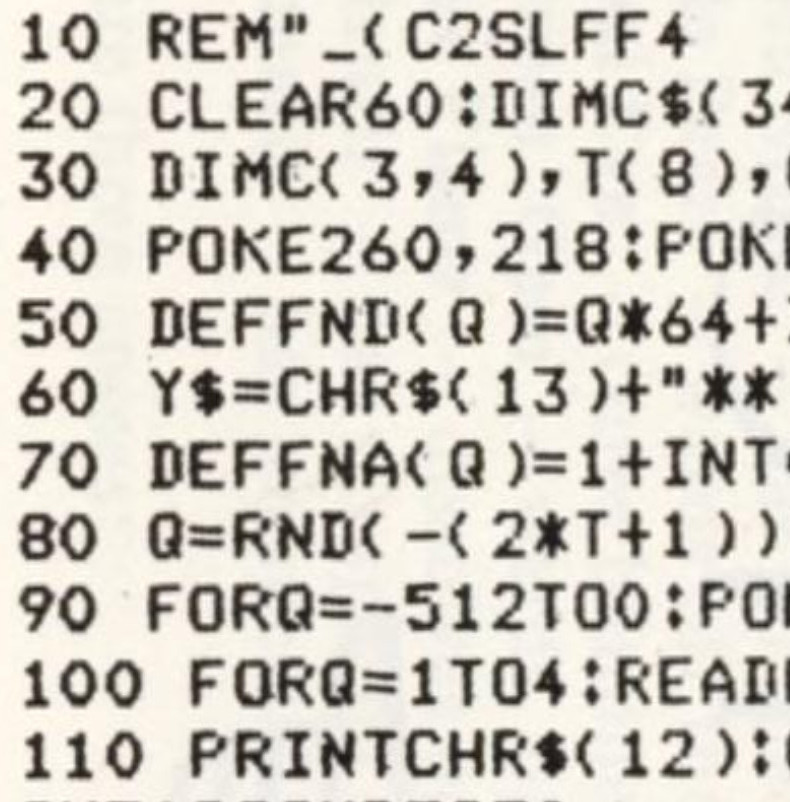The source code in its original dot\-matrix glory
So we had strong suspicions that all this was part of the PRNG seed process\. If only there were some way to prove it\!
It was at this point that Josh noticed this line in the magazine where the program was published:*"The first remark is a machine language routine to simulate the RANDOM function\."*
Sheesh\. That'll teach me not to read things\.
In BASIC,`RND\(\)`, not`RANDOM`, is the random function, used with a negative argument to seed the PRNG, and a positive argument to get the next random number, which was historically a random floating point result between 0 and 1\.
So what the author probably meant was`RANDOMIZE`which was popular in Microsoft BASIC for setting the random number seed to a specific value or prompting the user to enter one\.
In short, it was supposed to be doing what we thought, but the machine code didn't seem to be doing that at all\.
## A Breakthrough
Josh and I had been running Sorcerer emulators in[MAME](https://en.wikipedia.org/wiki/MAME)\(thanks to Josh for sharing the ROMs with me to get going\) and Chris had another Java\-based one that he'd gotten working\.
In MAME, we'd entered the`REM`statement and looked in memory, and it had the nonsensical bytes and machine code as disassembled, above\. And it didn't run properly\.
But Chris found a tape image of the game and loaded that up in his emulator\. And the first two lines of source looked like this:
```
10 REM"_(C2SLFF4F4F4
15 REM ED 5F 28 FC 32 FF F7 C9 (in O1DA)
```
WOW\! Another\(?\) author has annotated the source with the hex of the machine code\! Not only does it end in 0xC9 which is Z80`RET`, but it has that lower\-right screen corner address 0xF7FF right there\!
How on**Earth**does the`REM`text map to that? Things like 0xED are clearly non\-ASCII\. But wait, some of the characters are, and their positions match what we see in the`REM`\!
```
"
5F _
28 (
C
32 2
S
L
F
```
What actual values are there? Chris loaded the program and looked:
```
FOR I=474 TO 489: PRINT PEEK(I): NEXT I
237
95
40
252
50
255
247
201
70
52
70
52
32
0
18
2
READY
```
You can see the 0x00 null terminator down there\. And a hidden space at the end of the line\. And 237 is 0xED, and 95 is 0x5F\.\.\. it matches the line 15 comment\!
Let's get ready to*disassembbbllllllllllleeee*\! I'll convert the numbers to hex and go for it\.
```
ed 5f LD A,R " _
28 fc JR Z,-4 ( C
32 ff f7 LD (F7FF),A 2 S L
c9 RET F
46 LD B,(HL) F
34 INC (HL) 4
46 LD B,(HL) F
34 INC (HL) 4
20 00 JR NZ,0 space null
```
Later, I'll find out that the part after the`RET`is disassembled incorrectly and that my annotation of which`REM`characters mapped to which hex values was wrong, but who cares for now\! Everything is over at the`RET`anyway\.
And the code is exactly what we were looking for\! Let's look at the first assembly instructions:
```
LD A,R ; copy R register to accumulator
JR Z,-4 ; if result is 0, jump back to previous instruction
LD (F7FF),A ; copy accumulator into address F7FFh
RET ; return
```
What's it do? The`R`register is interesting on the Z80 in that it is incremented every instruction fetch\. Maybe? Depends on which resource you ask\. In any case, it is incremented very, very frequently relative to human timescales\. And the Sorcerer[busy\-waits](https://en.wikipedia.org/wiki/Busy_waiting)for input, so when you finally run the game, it effectively has a random\-ish value in it\.
But seeding many lesser PRNGs with`0`is a bad idea \(they tend to just produce`0`after that\), so the code retries if it happens to get a`0`in`R`\. But if it is non\-zero, it stores that value in address 0xF7FF, the lower right corner of the screen\! And then the`PEEK\(\)`picks it up and uses it to seed the PRNG\!
The`R`register only increments the low 7 bits, though, meaning it can only be 128 different values\. And we discard`0`, so really this means on the Sorcerer, there were only 127 different randomly\-generated dungeons that you could play\. Bummer\!
So the glyphs we see simply aren't ASCII\. Our first disassembly was doomed to fail because the`REM`violates the assumption that all listing text was ASCII\.
For verification, I made a new program that was just a`REM`followed by a bunch of spaces \(to give me room to work before the null terminator\)\. Then I`POKE`d in the right values and got a listing\.
```
10 REM
POKE 474,237
READY
POKE 475,95
READY
POKE 476,40
READY
LIST
10 REM"_(
READY
```
It worked\! Those values gave me the`"\_\(`glyphs that were in the original source listing\!
## Could You Type It In?
The whole idea in the 80s with magazines like this was that you'd get it in the mail or from the newsstand and you'd painstakingly spend hours typing them in and getting them right\.
It wasn't easy\. Here's another excerpt from*The Wizard's Castle*:
```
1070 IFFL=0THENPRINT:PRINT"** HEY BRIGHT ONE, YOU'RE OUT OF FLARES":GOTO620
1080 PRINT:PRINT:FL=FL-1:A=X:B=Y:FORQ1=A-1TOA+1:X=FNB(Q1):FORQ2=B-1TOB+1:Y=FNB(Q2)
1090 Q=FNE(PEEK(FND(Z))):POKEFND(Z),Q:PRINTI$(Q);" ";:NEXTQ2:PRINT:PRINT:NEXTQ1:X=A:Y=B
1100 GOSUB 3400:GOTO620
1110 IFLF=0THENPRINT:PRINT"** YOU DON'T HAVE A LAMP, ";R$(RC):GOTO620
1120 PRINT:PRINT"WHERE DO YOU SHINE THE LAMP (N,S,E, OR W) ";:GOSUB3290
1130 A=X:B=Y:X=FNB(X+(O$="N")-(O$="S")):Y=FNB(Y+(O$="W")-(O$="E"))
1140 IFA-X+B-Y=0THENPRINT:PRINT"** TURKEY! THAT'S NOT A DIRECTION":GOTO620
```
Just pure codevomit\. But those of us who typed this stuff in were pretty practiced at getting it right\. So when we saw something like this:
```
10 REM"_(C2SLFF4
```
you can bet we typed it in exactly\.
But now we know this wouldn't have worked if you assumed those were ASCII\-encoded glyphs\.
Perhaps there was some lore well\-known to Sorcerer programmers where they knew the magic incantations to make it go\.
Or maybe he just wrote this to get some space to work:
```
10 REMF4F4F4F4F4
```
And then manually`POKE`d the machine code in like I did, above, to get this:
```
10 REM"_(C2SLFF4
```
And then never mentioned how to do it, forgot about it in the excitement of getting it published, and out the door it went\.
But what is the deal with that`F4`thing? It's really bugging me\.
## The`F4`s
An F\-4 Phantom\. It's an aviation/programming pun\. I hereby indemnify myself against lawsuits\.
In my version, we had:
```
10 REM"_(C2SLFF4
```
Chris's version had some extra F4s:
```
10 REM"_(C2SLFF4F4F4
```
And we did a memory dump of Chris's version and got the following:
```
237
95
40
252
50
255
247
201
70
52
70
52
32
0
18
2
```
Notice anything weird? About the`F4`s? I didn't either\. There are*three*of them in the`REM`, but only*two*of them in the memory dump \(the 70,52 pairs\)\!
And that's not all—where's the`L`? Something's wrong\. Earlier, I'd tried a sanity check by`POKE`ing in the first three characters by hand, but let's try the others\.
I'm going to recreate the entire machine code here and see what pops up\.
```
10 REMXXXXXXXXXXXXXX
20 FOR I=474 TO 481: READ X: POKE I,X: NEXT I
30 DATA 237, 95, 40, 252, 50, 255, 247, 201
```
Then I run that, and list it\. I get:
```
10 REM"_(C2SLFF4XXXXXX
20 FOR I=474 TO 481: READ X: POKE I,X: NEXT I
30 DATA 237, 95, 40, 252, 50, 255, 247, 201
```
Wait\! My`X`s shifted right by two characters\! What's up with that? You can't just insert characters like that\. It's like there are two extra characters in the output\. I poked eight values, but there are 10 characters printed before the`X`s\!
Let's dump RAM and see what's there\. I'm going to annotate the output, but—spoilers—my annotation is wrong:
```
237 "
95 _
40 (
252 C
50 2
255 S
247 L
201 F
88 X ← No additional Fs or 4s!
88 X
88 X
88 X
```
No`F`s or`4`s\. It goes directly from my last 201 \(in the`DATA`\) straight to a bunch of`X`s \(the 88s\)\. So why do I see them in the listing?
Let's get specific\. I'm going to manually plug in the 255, the 247, and the 201 in the`REM`and see what we get out of it\.
```
10 REMX
POKE 474,255
LIST
10 REMS
```
Okay, it's the`S`, as expected\.
```
POKE 474,247
LIST
10 REMLF
```
Whoa—what?`LF`? Two characters? And suspiciously like "linefeed", but who knows\. But that matches the`REM`\!
```
POKE 474,201
LIST
10 REMF4
```
And there's the`F4`\. So the last two bytes are being printed as`LFF4`\. That's where the extra two characters are coming from in the output\.
So fixing my memory dump annotation, it would look like this:
```
237 "
95 _
40 (
252 C
50 2
255 S
247 LF
201 F4
88 X
88 X
88 X
88 X
```
And now that's matching what we're seeing in the listing:
```
10 REM"_(C2SLFF4XXXXXX
```
But that's not all\. The bytes with values 128 and just over actually map to BASIC keywords\! Check this out:
```
POKE 474,137
LIST
10 REMGOTO
```
When BASIC is printing its lines, we speculate that if the high bit is set, it looks up the symbol name and prints that instead\. The weird symbol names we get up higher \(random\-seeming\) might be \(again, we speculate\) mapping into garbage past the end of that table\.
But wait just a second\. In Chris's memory dump, there were bona fide ASCII`F`s and`4`s in there
```
237 "
95 _
40 (
252 C
50 2
255 S
247 LF
201 F4 ← RET
70 F ← what's all this, then?
52 4
70 F
52 4
32
0
18
2
```
Why were they added when they have no effect on the machine code? I think we'll just have to let that one go as being lost to the mists of time\. Or maybe you can try gazing into an orb until you find the answer\. Just don't overdo it\.
## Wrap Up
The only point of all this, since I basically knew up front it was seeding the PRNG, was to feed hacker curiosity\. What a luxury\!
**What did we learn?**
- You can cram machine code into a`REM`statement on the Exidy Sorcerer, but don't expect a sensible print\-out\.
- The code when typed in from the magazine probably didn't work\.
- The author likely`POKE`d the machine code in directly, or perhaps the Sorcerer had some kind of graphics shift key that would let those characters be typed\.
- We now know, with more certainty than was ever required, the answer to that age old question, "What the frick is that comment doing at the beginning of*The Wizard's Castle*?"
**How much money did we make?**
- $zero\!
Would this work on other platforms, I wonder? Or would they just freak out? Someone else can give it a try on the Commodore 64 or something\.
If you want to know more about*The Wizard's Castle*and even play this bit of history, I have a[collection of documents and information](https://github.com/beejjorgensen/Wizards-Castle-Info)on GitHub\.
## Comments
[View Comments](https://mastodon.sdf.org/@beejjorgensen/116960340638845136)[Reply](https://mastodon.sdf.org/@beejjorgensen/116960340638845136)