Cached at:
07/07/26, 05:39 PM
# AI Safety Index — Summer 2026 | Future of Life Institute
Source: [https://futureoflife.org/ai-safety-index-summer-2026/](https://futureoflife.org/ai-safety-index-summer-2026/)
July 2026
Summer 2026 Edition
AI experts rate leading AI companies on key safety and security domains\.
How to access this content:
[Explore the index](https://futureoflife.org/ai-safety-index-summer-2026/#scorecard)
## Index Content
[](https://futureoflife.org/wp-content/uploads/2026/07/AI-Safety-Index-Summer-2026-Digital.pdf)### Full report PDF
View the full report in PDF format, including extended content\.
[View file](https://futureoflife.org/wp-content/uploads/2026/07/AI-Safety-Index-Summer-2026-Digital.pdf)
[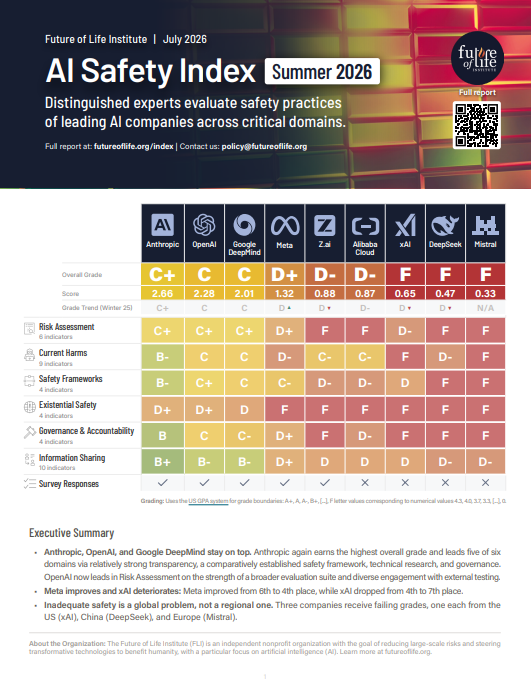](https://futureoflife.org/wp-content/uploads/2026/07/AI-Safety-Index-Report_010726_2Pager.pdf)### Two\-page Summary
A quick, printable summary of the report scorecard, key findings, and methodology\.
[View file](https://futureoflife.org/wp-content/uploads/2026/07/AI-Safety-Index-Report_010726_2Pager.pdf)
## Key findings
Top takeaways from the index findings
Anthropic, OpenAI, and Google DeepMind stay on top
Anthropic again earns the highest overall grade and leads five of six domains via relatively strong transparency, a comparatively established safety framework, technical research, and governance\. OpenAI now leads in Risk Assessment on the strength of a broader evaluation suite and diverse engagement with external testing\.
Meta improves and xAI deteriorates
Meta improved from 6th to 4th place, while xAI dropped from 4th to 7th place\.
European dissonance
Although the European Union is a leader in AI safety regulation, the top European AI company Mistral scored dead last on safety\.
Inadequate safety is a global problem, not a regional one
Three companies receive failing grades, one each from the US \(xAI\), China \(DeepSeek\), and Europe \(Mistral\)\.
Reviewers flagged the industry's pivot to military AI use as an emerging current harm risk
From 2024 to 2026, companies including Anthropic, OpenAI, Google DeepMind, and Meta that previously banned military applications gradually reversed course, joining xAI and Mistral in actively seeking defense partnerships\. Despite their limits on domestic surveillance and autonomous weapons, Anthropic drew criticism from the review panel for 'questionable military engagements', including a reported link to the Minab school strike that caused mass civilian deaths\. Leading Chinese firms, meanwhile, face U\.S\. allegations of military ties that Alibaba Cloud and Z\.ai deny\.
Even industry leaders in safety practices are retreating from prior commitments
Anthropic, OpenAI, Google DeepMind, and Meta have weakened or voided pledges to pause unilaterally if redlines are approached, some citing competitor\-contingent conditions\. Reviewers call this 'moving goalpost' and argue that it has 'undermined safety frameworks across the board'\.
Existential Safety is the weakest domain industry\-wide
No company exceeds C\-; most score D or below\. Constructive attempts exist, such as Anthropic's constitutional classifiers, OpenAI's call for governance institutions, Google DeepMind's monitoring commitments, and Meta's loss\-of\-control provisions, but are judged by panelists to be 'entirely inadequate\.' Dominant paradigms such as interpretability and Chain\-of\-Thought \(CoT\) monitorability are questioned because 'detection is not prevention\.'
Safety rhetoric outpaces revealed behavior
Across Google DeepMind, OpenAI, and xAI, leadership's reassuring public messaging diverges from commercial conduct and legislative stance, making stated commitments an unreliable proxy for actual safety practice\.
Companies are publishing and updating safety frameworks, but these frameworks have weak teeth
As US/EU compliance deadlines near, Anthropic, OpenAI, Google DeepMind, Meta, and xAI published and updated fuller frameworks — yet they sometimes lack quantitative thresholds, genuinely independent audits, and clear decision authority\.
Note: The Index collected evidence up until June 3, 2026 and does not include possible new recent events\.
“While there is good work being done on AI safety in the industry, the capabilities race has become more extreme\. Companies have backed away from earlier commitments to release new systems only with safety measures appropriate for their capability levels; now, they're planning to release them even if it's demonstrably unsafe to do so\.”
Prof\. Stuart Russell, Professor of Computer Science at UC Berkeley
## Independent review panel
The scoring was conducted by a panel of distinguished AI experts:

David Krueger
David Krueger is an Assistant Professor in Robust, Reasoning, and Responsible AI at the University of Montreal and a Core Academic Member at Mila, the Quebec Artificial Intelligence Institute, and the founder of Evitable\. His work focuses on AI alignment, safety, and existential risks from advanced AI\. He was a founding Research Director at the UK AI Security Institute and initiated the landmark CAIS Statement on AI Risk\.

Sharon Li
Sharon Li is an Associate Professor in the Department of Computer Sciences at the University of Wisconsin\-Madison\. Her research focuses on algorithmic and theoretical foundations of safe and reliable AI, addressing challenges in both model development and deployment in the open world\. She serves as the Program Chair for ICML 2026\. Her awards include a Sloan Fellowship \(2025\), NSF CAREER Award \(2023\), MIT Innovators Under 35 Award \(2023\), Forbes 30under30 in Science \(2020\), and “Innovator of the Year 2023” \(MIT Technology Review\)\. She won the Outstanding Paper Award at NeurIPS 2022 and ICLR 2022\.

Tegan Maharaj
Tegan Maharaj is an Assistant Professor in the Department of Decision Sciences at HEC Montréal, where she leads the ERRATA lab on Ecological Risk and Responsible AI\. She is also a core academic member at Mila\. Her research focuses on advancing the science and techniques of responsible AI development\. Previously, she served as an Assistant Professor of Machine Learning at the University of Toronto\.
Sneha Revanur
Sneha Revanur is the founder and president of Encode, a global youthled organization advocating for the ethical regulation of AI\. Under her leadership, Encode has mobilized thousands of young people to address challenges like algorithmic bias and AI accountability\. She was featured on TIME’s inaugural list of the 100 most influential people in AI\.
Stuart Russell
Stuart Russell is a Professor of Computer Science at the University of California at Berkeley and Director of the Center for Human\-Compatible AI and the Kavli Center for Ethics, Science, and the Public\. He is a member of the National Academy of Engineering and a Fellow of the Royal Society\. He is a recipient of the IJCAI Computers and Thought Award, the IJCAI Research Excellence Award, and the ACM Allen Newell Award\. In 2021 he received the OBE from Her Majesty Queen Elizabeth and gave the BBC Reith Lectures\. He coauthored the standard textbook for AI, which is used in over 1500 universities in 135 countries\.
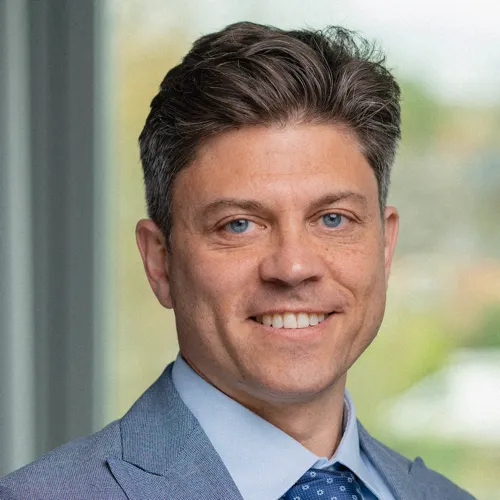
Robert Trager
Robert F\. Trager is Director of the Oxford Martin AI Governance Initiative, International Governance Lead at the Centre for the Governance of AI, and Senior Researcher in the Department of Engineering Science at the University of Oxford\. He is a recognized expert in the international governance of emerging technologies, diplomatic practice, institutional design, and technology regulation\. He regularly advises government and industry leaders on these topics\.
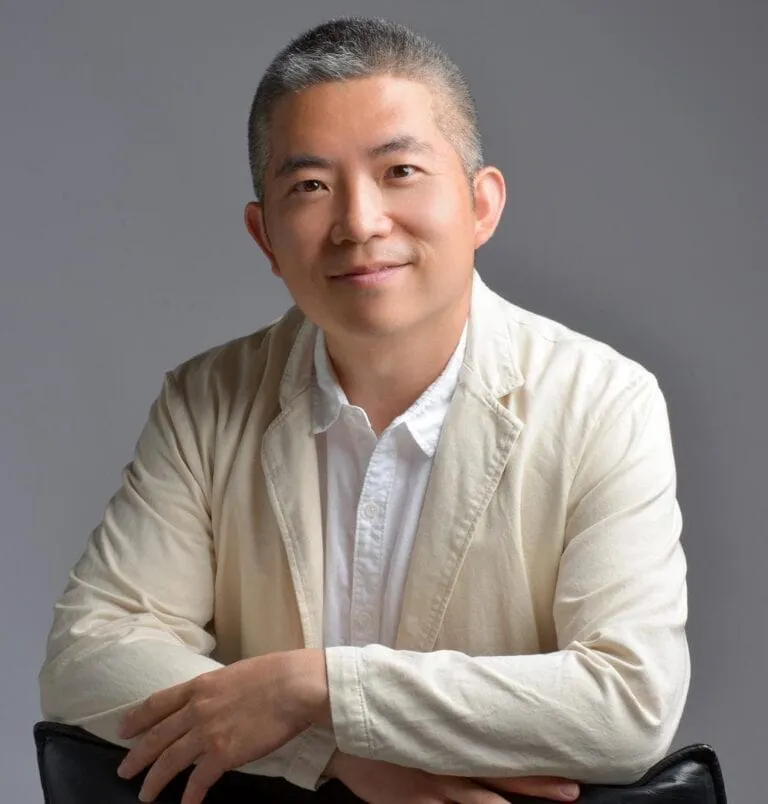
Yi Zeng
Yi Zeng is a Wu Yuzhang Chair Professor and Ph\.D\. Supervisor at the Gaoling School of AI, Renmin University of China, the Founding Dean of Beijing Institute of AI Safety and Governance \(Beijing\-AISI\), the Director of the Beijing Key Laboratory of Safe AI and Superalignment, the Chair of the Mind Computing Technical Committee of the Chinese Association for Artificial Intelligence \(CAAI\), and Co\-Chair of the AI Committee of the World Internet Conference \(WIC\)\.He serves on the United Nations Advisory Body on AI and the UNESCO Ad Hoc Expert Group on AI Ethics\. He has been named one of TIME's 100 Most Influential People in AI\.
## Indicators overview
The indicators within each domain
## Improvement opportunities by company
How individual companies can improve their future scores with relatively modest effort:

### Anthropic
Progress Highlights
- Comparatively detailed safety framework with commitments for third\-party audits\.
- Solid evaluations of autonomous R&D and scheming/misalignment capabilities of frontier models with strong elicitation\.
- Continuous industry\-leading transparency with both published model specs and system prompts\.
Key Recommendations
- **Reverse the RSP 3\.0 walk\-back on pause commitments and restore credibility of commitments\.**
- **Replace qualitative thresholds with quantitative and risk\-tied ones\.**
- **Treat prevention as seriously as interpretability/detection\.**
- **Establish stronger safeguards for military use of its AI systems\.**

### OpenAI
Progress Highlights
- Strong external testing and comparatively broad risk assessment\.
- Called for global governance institutions to slow development when needed\.
- Regular reports documenting their disruption of malicious uses of their AI systems\.
Key Recommendations
- **Remove leadership's ability to override the Safety Advisory Group\.**
- **Make safety\-framework thresholds measurable, risk\-tiered, and externally enforceable, with commitment to notify authorities when risk thresholds are crossed\.**
- **Evaluate internal\-deployment risks before broad internal use rather than after\.**
- **Align public\-policy positions with stated safety commitments\.**

### Google DeepMind
Progress Highlights
- Updated Frontier Safety Framework adding manipulation, misalignment, and internal\-deployment coverage\.
- Strong watermark protection\.
Key Recommendations
- **Establish clear decision\-making authority, an executive risk officer, and independent audit\.**It remains unclear which internal body can halt deployment independently of executive leadership\.
- **Make safety\-framework thresholds measurable and risk\-tiered\.**
- **Reverse the backsliding on pause commitments\.**
- **Align public\-policy positions with stated safety commitments from leadership\.**

### Meta
Progress Highlights
- Published safety framework with more details of risk identification and threat modeling\.
- Bug bounties cover catastrophic risk factors\.
Key Recommendations
- **Strengthen whistleblower protections and align culture with policy\.**The whistleblowing policy quality scores are reasonable but undermined by active enforcement of a non\-disparagement agreement and other suppression of dissent\.
- **Make safety\-framework thresholds measurable and risk\-tiered\.**
- **Establish auditing mechanisms for the safety framework\.**

### Z\.ai
Progress Highlights
- More transparent than its Chinese peers, with some proactive safety research built into products\.
- Some meaningful incident\-response infrastructure and internal\-deployment threat mitigation\.
Key Recommendations
- **Publish a full safety framework and governance structure\.**The company has no published framework; its rating largely reflects the Chinese regulatory environment rather than independent safety leadership\.
- **Move beyond passive deference to regulation toward proactive safety research\.**Deferring entirely to government guidance amounts to “complete passivity” as an existential\-safety strategy for highly advanced AI systems\.
- **Establish and publicize a whistleblower policy\.**There is no clear governance structure or whistleblowing channel, even absent reported incidents\.

### Alibaba Cloud
Progress Highlights
- Stronger\-than\-expected benchmark performance with more transparent disclosure of misalignment propensity than its peers\.
- Two\-layered safety strategy spanning the Qwen model\-level team and the Alibaba security team\.
Key Recommendations
- **Publish a full safety framework and governance structure\.**The company has no published framework; its rating largely reflects the Chinese regulatory environment rather than independent safety leadership\.
- **Move beyond passive deference to regulation toward proactive safety research\.**Deferring entirely to government guidance amounts to “complete passivity” as an existential\-safety strategy for highly advanced AI systems\.
- **Establish and publicize a whistleblower policy\.**There is no clear governance structure or whistleblowing channel, even absent reported incidents\.

### xAI
Progress Highlights
No progress highlights for this company
Key Recommendations
- **Build a substantial safety team and engage with existential safety\.**There is no evidence of a meaningful safety team or any ongoing engagement with existential\-safety concerns\.
- **Broaden dangerous\-capability evaluations and link thresholds to binding mitigations\.**Evaluations have gaping holes \(no AI R&D data\), and no procedure connects threshold breaches to deployment decisions, making thresholds effectively non\-binding\.
- **Broaden dangerous\-capability evaluations to include important fields such as AI R&D and link deployment decisions to the safety framework, and thresholds to binding mitigations in the safety framework\.**

### DeepSeek
Progress Highlights
No progress highlights for this company
Key Recommendations
- **Publish a full safety framework and governance structure\.**The company has no published framework; its rating largely reflects the Chinese regulatory environment rather than independent safety leadership\.
- **Move beyond passive deference to regulation toward proactive safety research\.**Deferring entirely to government guidance amounts to “complete passivity” as an existential\-safety strategy for highly advanced AI systems\.
- **Establish and publicize a whistleblower policy\.**There is no clear governance structure or whistleblowing channel, even absent reported incidents\.

### Mistral
Progress Highlights
No progress highlights for this company
Key Recommendations
- **Publish a full safety framework and governance structure\.**
- **Engage substantively with existential safety\.**Leadership consistently downplays — and at times dismisses — frontier risk rather than articulating any control or alignment strategy\.
- **Improve weak safety benchmark performance\.**
“AI companies' lack of progress towards credible AI Safety plans is scandalous\. Even they are starting to get anxious as they race towards recursive self\-improvement and face down the prospect of losing control\. CEOs recent gestures towards coordinating a pause or slowdown are welcome, but they're still not telling people how urgent the risk is and how unprepared they are\.”
Prof\. David Krueger, University of Montreal
## Methodology
Process by which these scores were decided
### Index Structure
The Summer 2026 Index evaluates nine leading AI companies on 37 indicators spanning six critical domains\. The nine companies include Anthropic, OpenAI, Google DeepMind, xAI, Z\.ai, Meta, DeepSeek, Alibaba Cloud and Mistral\.
### Data Collection
The Index collected evidence up until June 3, 2026, combining publicly available materials—including model cards, research papers, and benchmark results—with responses from a targeted company survey designed to address specific transparency gaps in the industry, such as transparency on whistleblower protections and external model evaluations\.
### Expert Evaluation
An independent panel of seven leading AI researchers and governance experts reviewed company\-specific evidence and assigned domain\-level grades \(A–F\) based on absolute performance standards with discretionary weights\. Reviewers provided written justifications and improvement recommendations\. Final scores represent averaged expert assessments, with individual grades kept confidential\.
### Contact us
For feedback and corrections on the Safety Index, potential collaborations, or other enquiries relating to the AI Safety Index, please contact:[policy@futureoflife\.org](mailto:
[email protected])
## Past editions
[### AI Safety Index \- Winter 2025 Distinguished experts evaluate safety practices of leading AI companies across critical domains\. Featured in:The New York Times, Financial Times, Forbes, NBC News, SEMAFOR, SCMP, Nature, Independent, The New Yorker, Fortune, Reuters, and more\. December 2025](https://futureoflife.org/ai-safety-index-winter-2025)[### AI Safety Index \- Summer 2025 AI experts rate leading AI companies on key safety and security domains\. Featured in:The Atlantic, Fox News, The Economist, SEMAFOR, Bloomberg, TechAsia, TIME, Fortune, The Guardian, MLex, CityAM, and more\. July 2025](https://futureoflife.org/ai-safety-index-summer-2025)[### AI Safety Index 2024 The inaugural FLI AI Safety Index\. Convened an independent panel of seven distinguished AI and governance experts to evaluate the safety practices of six leading general\-purpose AI companies across six critical domains\. Featured in:TIME, CNBC, Fortune, TechCrunch, IEEE Spectrum, Tom's Guide, and more\. November 2024](https://futureoflife.org/document/fli-ai-safety-index-2024)
## Sign up for the Future of Life Institute newsletter
Join 70,000\+ others receiving periodic updates on our work and focus areas\.