@QuixiAI: lol - With next!
Summary
With is a new systems programming language that emphasizes ergonomics and safety, offering Rust-level safety with reduced boilerplate and native performance.
View Cached Full Text
Cached at: 09/21/26, 01:37 PM
@eas4ai lol - With next! https://t.co/o8K1iafZk2
With — an ergonomics-first systems language
Source: https://withlang.org/ // close to the machine, without the suffering
The systems language thatwrites lessso it can prove more.
With is native by default, exactly as safe as Rust, and allergic to ceremony. Every character the compiler can infer is a character you never type.
$curl -fsSL https://withlang.org/installer/install.sh | sh
Also onmacOS · Linux · Windows. One binary. No system LLVM required.
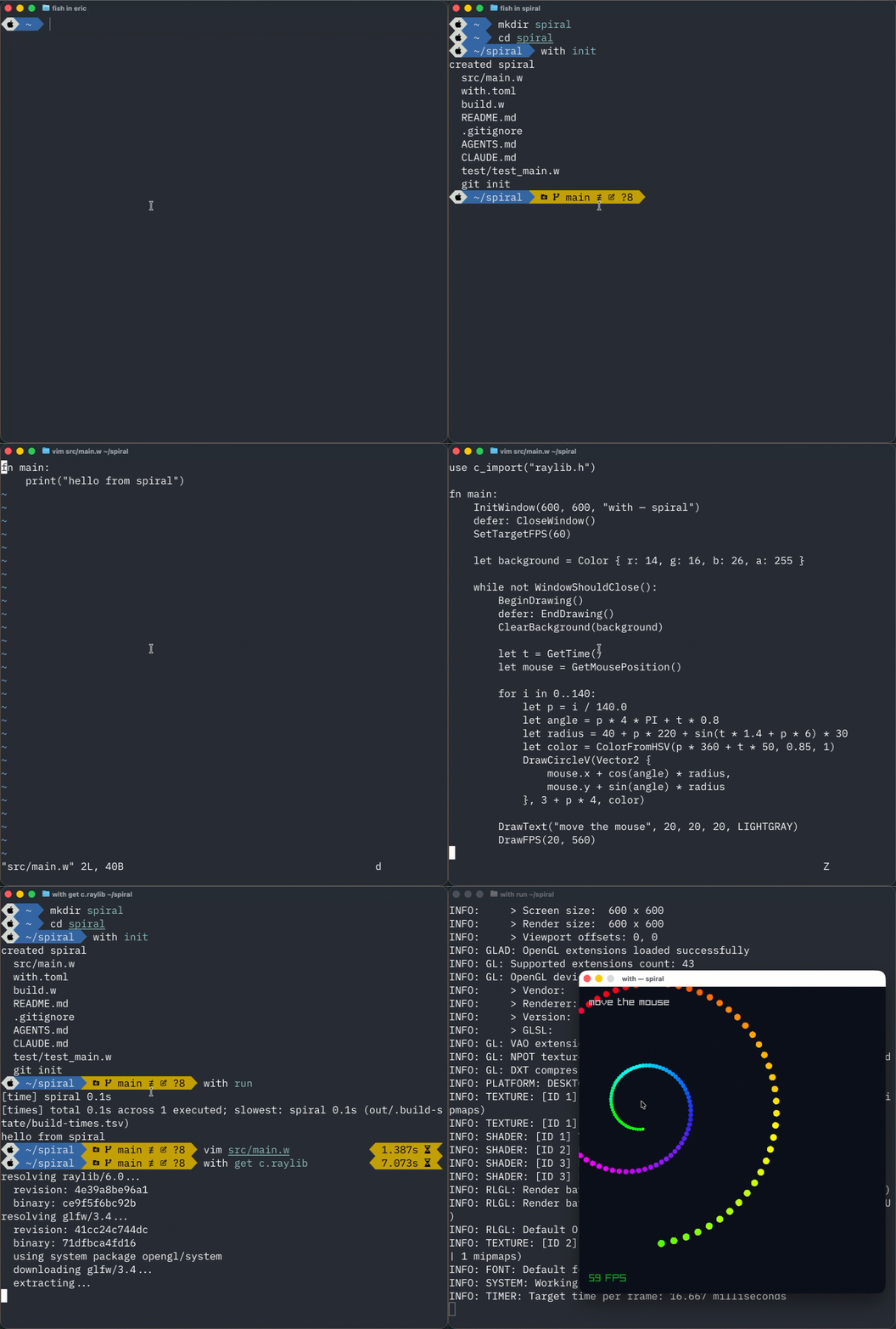 Real time · empty folder to native window in 28s ·try it ↓
Why With
Native control. Rust-level safety. C-level reach.
With pays compiler complexity so you don’t pay it in ceremony — the guardrails stay, the boilerplate goes.
hello.w
fn main:
    print("Hello, World!")

// a function that returns i32 needs no trailing 0.
// a return type the body makes obvious is inferred.
fn shout(s: str): s ++ "!"
▸ with run hello.wHello, World!
No ceremony
If the compiler can infer, import, bind, prove, or generate it, you don’t spell it out. NoOk(()), nolet _ =, no trailing return.Every unnecessary character is a compiler failure.
Exactly as safe as Rust
Single ownership, consuming destructors, generational references — the best of Vale. A resource lives in its scope and is released when the scope ends.Leaking is a defect, not a convenience.
C is first-class
Pointc_importat a header and call the library — no shim, no bindings, no becoming the build system. Raw C stays explicit; modeled C becomes humane. The migrator brings whole libraries across.
Getting started
From an empty folder to a native window — in three commands.
With models C libraries for you. Fetchraylib, write a little math, and run a real, hardware-accelerated graphics program. No bindings, no CMake, no glue.
01
with init spiral
Scaffold a project: a manifest andsrc/main\.w. Nothing else to configure.
02
with get c\.raylib
Fetch raylib, read its headers, model the C API, and link it — you get typed functions to call.
03
with run
Compile to native and launch. A window opens with a living, colored spiral.
terminal
$ with init spiral && cd spiral
  created with.toml, src/main.w

$ with get c.raylib
  ✓ fetched raylib · modeled the C API · linked

# write the spiral into src/main.w →

$ with check src/main.w
  ok

$ with run
  ✓ native build · a window opens, spinning
src/main.w
use c_import("raylib.h")

extern fn sin(x: f64) -> f64
extern fn cos(x: f64) -> f64

fn main:
    unsafe { InitWindow(900, 600, c"with · spiral".ptr) }
    SetTargetFPS(60)

    var t = 1.25
    while not WindowShouldClose():
        BeginDrawing()
        ClearBackground(Color { r: 14, g: 16, b: 26, a: 255 })
        for i in 0..180:
            let p = i as f64 / 180.0
            let angle = p * 18.85 + t * 0.8
            let radius = 28.0 + p * 250.0 + sin(t * 1.4 + p * 6.0) * 18.0
            let x = 450.0 + cos(angle) * radius
            let y = 300.0 + sin(angle) * radius
            let hue = (p * 360.0 + t * 50.0) as f32
            DrawCircle(x as i32, y as i32, (4.0 + p * 4.0) as f32,
                       ColorFromHSV(hue, 0.86 as f32, 1.0 as f32))
        EndDrawing()
        t = t + 0.02
    CloseWindow()
This exact three-command flow is one of With’srelease smoke tests— it runs on every published build and renders the spiral to verify the pixels actually appear. The getting-started path can’t quietly rot.See the fixture →
In the language
Small on the page. Strict underneath.
Every sample below compiles and runs on the current release.
infer.w
// no `-> str`: the body makes the type obvious.
fn shout(s: str): s ++ "!"

fn main:
    for name in ["ergonomic", "native", "safe"]:
        print(shout(name))
▸ergonomic! native! safe!
fizzbuzz.w
fn main:
    for i in 1..101:
        match (i % 3, i % 5):
            (0, 0) => print("FizzBuzz")
            (0, _) => print("Fizz")
            (_, 0) => print("Buzz")
            _      => print(i.to_string())
▸1 2 Fizz 4 Buzz Fizz 7 ...
interop.w
use c_import("math.h")

fn main:
    let r = sqrt(2.0)          // C's sqrt, called directly
    print(f"sqrt(2) = {r}\n")
▸ with run interop.wsqrt(2) = 1.4142135623731
own.w
fn main:
    var xs: Vec[i32] = Vec.new()
    xs.push(2); xs.push(3); xs.push(4)

    var total = 0
    for i in 0..xs.len() as i32:
        total = total + xs[i]
    // xs is freed here — its scope ends. No free() to forget.
▸total = 9
Install
One command. One binary.
The installer downloads a single self-contained compiler for your platform. The static LLVM toolchain is embedded — no system LLVM, no extra setup.
sh
$ curl -fsSL https://withlang.org/installer/install.sh | sh
PowerShell
> irm https://withlang.org/installer/install.ps1 | iex
cmd.exe
> curl.exe -L -o install.cmd https://withlang.org/installer/install.cmd
> install.cmd
Prefer to read first? Every installer is plain text — openinstall.sh,install.ps1, orinstall.cmdbefore you run it.
After it runs
- The binary lands in
~/\.local/bin(or%USERPROFILE%\\\.local\\binon Windows). Add it to yourPATHif it isn’t already. - Choose another location with
WITH\_INSTALL\_DIR, or pin a version withWITH\_VERSION. - Then run your first program:
try it
$ with -e 'print("hello!")'
hello!
Building from source or cross-compiling instead? See theREADMEandreleases.
Founder
Built by one engineer, in the open.

Eric Hartford
Founder of With
Eric created With and writes its self-hosting compiler — the compiler that builds With is itself written in With. He isChief Scientist at Lazarus AIandFounder & CEO of Quixi AI, and the creator of theDolphinandSamanthaopen-weight model families, which have reached millions of downloads.
Before the current generation of AI work — dataset curation, full-parameter fine-tuning, alignment, evaluation, quantization, and deployment — he was a full-stack software engineer at Microsoft, AWS, eBay, and other technology companies. That span, from the model layer down to the systems layer, is where With comes from: a conviction that low-level control and human ergonomics are not a trade-off.
Write less. Prove more.
Install the compiler, pointc\_importat a header, and ship native code without the ceremony.
Similar Articles
@QuixiAI: https://x.com/QuixiAI/status/2106986029383315840
With 是一门以人体工学/极简仪式感为先的系统编程语言,主打 Rust 级安全(单所有权、生成式引用)与 C 级可达性,通过强推断减少样板代码,并内建对 C 库的直接建模导入,可编译为原生单二进制、无需系统 LLVM。
@QuixiAI: I made a With compiler
A user announced the creation of a 'With' compiler.
@QuixiAI: The With Programming Language has hit a major milestone. PCRE2 is in. Regular expressions integrated. Implicit main, on…
The With programming language has reached a major milestone by integrating PCRE2 for regular expressions and implementing implicit main functions. The update supports one-liners and includes a self-hosted compiler with built-in LSP support.
@QuixiAI: https://x.com/QuixiAI/status/2116199005940260885
QuixiDesk is a native Rust desktop workspace for AI (macOS, Windows, Linux) with pluggable LLM providers, built-in MCP tools, browser/computer use, and a unified task/chat interface, running without Electron or Node.js.
@QuixiAI: In a push for cross platform, I created a native build system (Jai style) and I am building an --emit-c option to compl…
The developer created a native build system and is building an --emit-c option to complement the 'with migrate' feature, aiming for cross-platform support and eliminating Makefiles and shell scripts.