A developer shares their GitHub Actions setup for testing a Gleam monorepo with separate BEAM and JavaScript runtimes, using matrix strategies and strict formatting checks.
# GitHub Actions for a Gleam monorepo
Source: [https://crowdhailer.me/2026-04-21/github-actions-for-a-gleam-monorepo/](https://crowdhailer.me/2026-04-21/github-actions-for-a-gleam-monorepo/)
I’m a fan of a Gleam monorepo to break a project into separate packages\. Separate packages are required if you want to target multiple runtimes, such as JavaScript for a client app and erlang for a robust backend service\.
There is no need to stop at just a frontend/backend split\.[EYG](https://github.com/CrowdHailer/eyg-lang)is a statically typed functional scripting language that I have been writing with the goal of being a better bash\. I want users to be able to pick and choose parts of the tooling so it is decomposed into over a dozen packages\. Some packages run on the BEAM, some compile to JavaScript, and some work on both runtimes\.
The rest of this post is a hopefully concise summary of my CI setup\.
## Repo structure
I am using GitHub Actions for CI\. All the CI configuration lives in`\.github/workflows/test\.yml`
Each Gleam package sits in`packages/<name\>`and has its own`gleam\.toml`\.
```
packages/
gleam_analysis/
gleam_compiler/
gleam_hub/
gleam_interpreter/
gleam_parser/
morph/
website/
...
```
## Job structure
The greatest difference between test runs is the runtime they’re based on\. The workflow has a job for each runtime,`test\-beam`and`test\-bun`\.
*A third`test\-db`job exists, I’m not going to dive into it here as it also runs on the BEAM\.*
### Runtime setup
Each job specifies a matrix of values\. These values include the version of the runtime and all the packages that should be tested\.
I use the matrix of`gleam`versions to quickly test release candidates\. We are currently in the release candidate cycle for`1\.16\.0`adding one field here gives me a heads up of any issues that might effect any of the packages\.
```
test-beam:
runs-on: ubuntu-latest
strategy:
fail-fast: false
matrix:
gleam: ["1.15.4", "v1.16.0-rc3"]
otp: ["28.4"]
rebar3: ["3.25"]
package: ["gleam_analysis", "gleam_hub", "gleam_ir", "gleam_parser", "touch_grass", "untethered"]
```
`fail\-fast: false`is important here\. Without it, one failing package would cancel all the others and you’d lose visibility into what else is broken\.
There is a similar list of packages for`test\-bun`I try to run as many packages as possible on both targets\. The “sans\-io” pattern is working well for me as an approach to make packages runtime agnostic\. Hopefully I’ll write a post about that soon\.
Not every package appears in both matrices\. For example,`gleam\_cli`is very closely tied to[bun](https://bun.com/)as I use it for building single file executables as a way to distribute the cli\.
### Tests and other checks
The actual testing is defined in the actions steps\.
```
steps:
- uses: actions/checkout@v4
- uses: erlef/setup-beam@v1
with:
otp-version: $
gleam-version: $
rebar3-version: $
- run: gleam deps download
shell: bash
working-directory: packages/$
- run: gleam build --warnings-as-errors
working-directory: packages/$
- run: gleam test
working-directory: packages/$
- run: gleam format --check src test
working-directory: packages/$
```
I am as strict as possible in my checks\. Running`gleam build \-\-warnings\-as\-errors`ensures CI fails for any compiler warnings\. It’s useful to be able to develop locally with warnings occurring but by the time I push I don’t want any of them\. Running`gleam format \-\-check src test`fails CI if any files are not formatted correctly\. I’ve extended the check to cover test files as well\.
## Output in GitHub
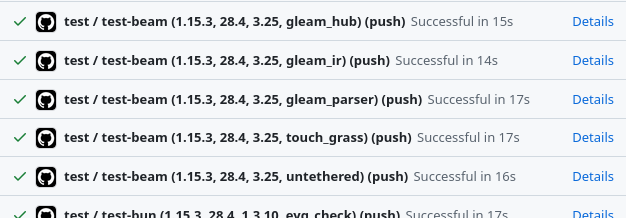
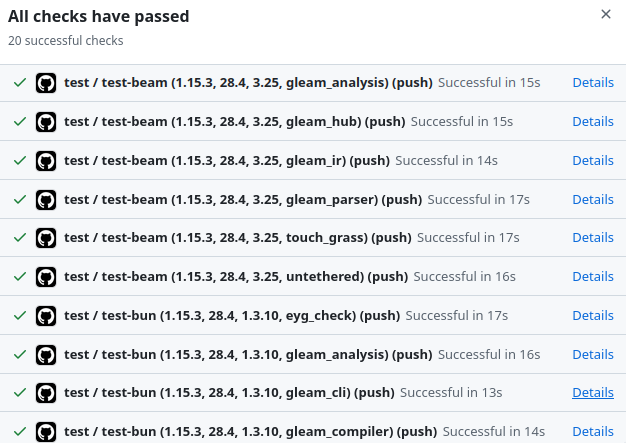
With this approach each combination of package and runtime gets its own line in the CI report\. This is really helpful to see if a failing test is due to a dependency also having an error or for checking that a bug only affects a specific Gleam version\.
And that’s it really\.
---
I'm building EYG an experiment in a building better languages and tools; for some measure of better\.
All progress is reported in my irregular newsletter\.
The article explains how to speed up running Haskell scripts with Magix on GitHub Actions by caching dependencies and compiled artifacts, reducing full build times from over 100 seconds to near-instant reruns.
Gleam v1.17.0 introduces the `gleam export escript` command for creating single-file BEAM programs, highlight references in the language server, and constant `todo` expressions. The first Gleam Gathering conference videos are also released.
A blog post explaining how to use the Changesets tool for versioning and changelog management in a polyglot monorepo spanning multiple programming languages, leveraging its GitHub Action for custom version and publish scripts.
This post describes how to build a self-improving code review agent as part of a cloud software factory, using a code review skill, GitHub actions, and an outer-loop agent for continuous improvement.