@VraserX: For anyone interested in a deeper dive into AI job displacement and compute constraints: https://substack.com/@vraserx/…
Summary
Analysis arguing that near-term AI job displacement is constrained by compute and deployment infrastructure, not just model capability.
View Cached Full Text
Cached at: 05/29/26, 09:41 AM
For anyone interested in a deeper dive into AI job displacement and compute constraints: https://substack.com/@vraserx/note/p-199696208?r=62vagp&utm_medium=ios&utm_source=notes-share-action…
The Compute Wall Between AI Hype and Mass Automation
Source: https://vraserx.substack.com/p/the-compute-wall-between-ai-hype?r=62vagp&utm_medium=ios&utm_source=notes-share-action
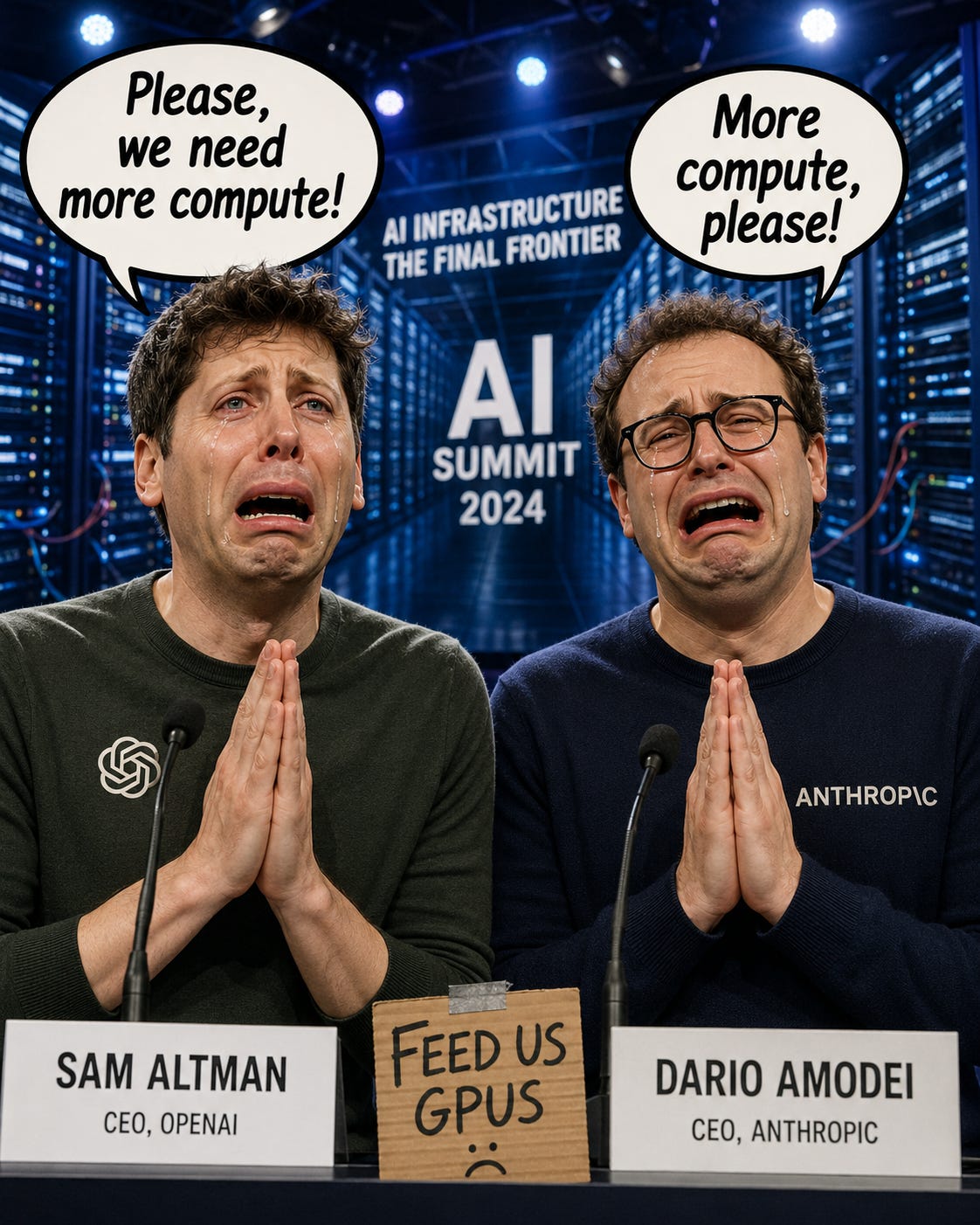 The current AI labor debate is missing one of the most important constraints: compute.
People talk about AI agents as if the only remaining question is intelligence. Once models become smart enough, the argument goes, they will simply replace large parts of the workforce. That story sounds clean. It is also incomplete.
The world has roughly 3.7 billion people in the labor force. Replacing even a meaningful fraction of them would require far more than impressive demos, better benchmarks, or a few companies using agents to speed up coding and customer support. It would require a massive industrial buildout: chips, data centers, electricity, cooling, grid connections, enterprise software integration, security, monitoring, legal acceptance, and enough reliability for companies to trust these systems with real work at scale. [1]
That is why the near term impact of AI will probably be uneven and confusing. Some roles will feel pressure fast. Some entry level work will shrink. Some companies will slow hiring. Some contractors and freelancers will be hit early. But the idea that billions of workers are about to be replaced by AI agents in the next few years ignores the physical scale of the system that would have to exist first.
The bottleneck is no longer just model capability. It is deployment capacity.
Exposure is not replacement
The strongest evidence on AI and jobs is less dramatic than the online discourse.
Goldman Sachs Research estimates that around 300 million jobs globally are exposed to automation by AI. That sounds enormous, because it is. But exposure means a job contains tasks AI could affect. It does not mean the entire job disappears next year. Goldman’s own base case describes a roughly ten year adoption period, with displacement in the single digit percentage range during that transition. [2]
The International Labour Organization reached a similar conclusion from a different angle. Its 2025 global index found that about one in four workers are in occupations with some exposure to generative AI, but only 3.3 percent of global employment falls into the highest exposure category. Clerical work remains the most exposed group, and exposure rises sharply in higher income economies. [3]
That distinction matters. A spreadsheet analyst, a lawyer, a teacher, a programmer, a designer, a call center worker, and an office assistant may all use AI. Their tasks may change. Some parts of their jobs may become faster or cheaper. But turning partial task automation into full labor substitution requires a chain of decisions and systems that most companies do not yet have.
MIT CSAIL made this point clearly in a 2024 study on computer vision automation. The researchers found that only about 23 percent of wages paid for vision tasks were economically viable to automate at the time. The key word is economically. Technical possibility is only one layer. Firms still have to ask whether the AI system is cheaper, reliable enough, integrated enough, and worth the disruption. [4]
That is the part of the debate that gets skipped. AI can do more every month. But employers do not replace workers with capability. They replace workers with dependable systems that reduce cost, reduce risk, and survive contact with messy reality.
Agents multiply the compute problem
A chatbot is one thing. An agent is another.
A normal AI request might involve a prompt, an answer, and maybe a few tool calls. A serious work agent has to plan, search, read, write, verify, retry, coordinate with other systems, remember context, recover from errors, and sometimes run for hours. That turns one task into many model calls. Reliability often means more inference, not less. The model has to check itself, compare outputs, run tests, call tools, use retrieval, and sometimes ask another model to critique the result.
This is why agentic AI is much more compute hungry than casual chatbot use. The more autonomy you want, the more hidden work the system has to do. A cheap answer is easy. A reliable autonomous workflow is expensive.
A 2025 infrastructure paper on AI agents describes exactly this problem. Moving from single turn inference to multi step dynamic reasoning improves flexibility, but it introduces serious concerns around system cost, latency, energy use, and data center power demand. The authors found that more compute can improve accuracy, but with rapidly diminishing returns, widening latency variance, and infrastructure costs that become hard to sustain. [5]
That is the key point. Agents do not just consume intelligence. They consume time, retries, context, memory, bandwidth, and verification. At small scale this is exciting. At labor scale it becomes an infrastructure question.
Replacing a worker is not like answering a prompt. A worker is available for thousands of hours per year, handles exceptions, understands informal context, deals with other humans, and carries responsibility inside an organization. To replace that with software, the AI system has to run repeatedly and reliably across huge volumes of tasks. Even when the model is good enough, the compute bill still matters.
The real cost moves from training to inference
The public tends to focus on training runs because they are spectacular. Frontier labs spend enormous sums training new models, and those numbers make headlines. But mass automation is mostly about inference.
Training creates the model. Inference runs the model. If AI agents become real workers inside the economy, inference becomes the recurring cost of digital labor.
This is where the scale gets brutal. A model that helps 100 million people once a day is already a large infrastructure problem. A model that runs as an always on agent for hundreds of millions of workers, customers, companies, and devices is a different category. The cost does not stop after the model is trained. It repeats every time the agent thinks, acts, checks, retries, and reports.
To be clear, inference is getting cheaper fast. Stanford’s 2025 AI Index reported that the inference cost for a system performing at roughly GPT 3.5 level dropped more than 280 fold between late 2022 and late 2024. Hardware costs have been declining, and energy efficiency has improved substantially. Epoch AI also tracks rapid declines in inference price at fixed performance levels. [6]
This is the strongest counterargument to the compute bottleneck thesis, and it should be taken seriously. AI costs are falling. Models are becoming more efficient. Smaller models are getting surprisingly capable. Open models are closing performance gaps. All of that will accelerate adoption.
But cheaper intelligence does not automatically reduce total compute demand. Often it unlocks more usage. If an AI agent becomes cheap enough to use everywhere, companies will use it everywhere. Lower cost per task can create higher total demand because the number of tasks explodes. This is already visible in the way every major AI company is racing to secure compute rather than acting as if efficiency has solved the problem.
The grid is now part of the AI labor market
The International Energy Agency projects global data center electricity consumption to roughly double by 2030, reaching around 945 terawatt hours in its base case. The IEA also expects electricity consumption from accelerated servers, largely driven by AI adoption, to grow around 30 percent annually. [7]
In April 2026, the IEA added that data center electricity demand rose 17 percent in 2025, with AI focused data centers growing even faster. It also noted that capex from five large technology companies exceeded 400 billion dollars in 2025 and could rise another 75 percent in 2026. The same report points to bottlenecks in transformers, gas turbines, advanced chips, IT components, grid connections, planning, and approvals. [8]
This is the physical reality behind the AI agent story. The biggest labs are not asking for more compute because it sounds good in investor presentations. They are asking for it because demand is outrunning infrastructure.
OpenAI’s Stargate project makes the scale visible. OpenAI, Oracle, and SoftBank announced a path toward a 500 billion dollar, 10 gigawatt AI infrastructure commitment. In a later infrastructure update, OpenAI said it had already surpassed its original 10 gigawatt target ahead of schedule, and argued that more compute is necessary to train better models, serve them reliably, improve performance, lower costs over time, and bring more powerful tools to more people. [9]
That is not the language of a software company with a small hosting bill. It is the language of a new industrial layer.
Why serious job displacement is probably a decade scale event
The next few years will not be calm. Anyone claiming AI will have no labor impact until the 2030s is ignoring what is already happening in coding, writing, translation, support, design, marketing, research, and back office work. The first wave is already here: fewer junior openings, more output per employee, weaker demand for generic work, and more pressure on people whose value is mostly producing standard text, standard images, standard code, or standard analysis.
But serious economy wide displacement requires more than making workers more productive. It requires companies to redesign workflows around agents, connect them to internal systems, solve security and privacy issues, manage failure modes, negotiate regulation, change procurement, retrain managers, and prove that the system works across months rather than demos.
That takes time. McKinsey’s adoption scenarios estimate that half of today’s work activities could be automated somewhere between 2030 and 2060, with a midpoint around 2045. Even aggressive adoption models do not imply instant replacement of billions of workers. They imply a long diffusion curve shaped by wages, regulation, infrastructure, corporate inertia, and the falling cost of technology. [10]
So the correct position is uncomfortable for both sides of the debate. AI is powerful enough to matter now. It is also nowhere near physically deployed at the scale required to replace billions of workers.
The first labor shock is probably not mass unemployment. It is compression. Fewer entry level roles. Smaller teams. Slower hiring. More output demanded from each employee. More contractors competing with software. More firms delaying headcount because they expect agent capability to improve. That is serious, but it is not the same as immediate replacement of the global workforce.
The real transition starts before the layoffs
Waiting for mass layoffs to prove AI is affecting labor is a mistake. Labor markets adjust before the final displacement event. Employers stop hiring before they fire. Wages weaken before jobs vanish. Junior roles disappear before senior roles get automated. Workloads rise before headcount drops. AI first changes the bargaining power between workers and firms.
That is where the next decade gets interesting.
If compute keeps scaling, if agents become more reliable, if inference costs keep falling, and if data center power buildout keeps accelerating, then the labor market can change very fast in specific sectors. The danger is not that nothing happens for ten years. The danger is that people confuse a gradual macro transition with safety, while the micro transitions are already painful.
The compute wall does not mean AI is overhyped. It means the hype is pointed at the wrong bottleneck. The question is not simply whether AI can perform a task. The question is whether society can build and afford enough machine intelligence to run that task continuously, reliably, securely, and cheaply across the real economy.
That is a much harder question.
And it is the reason I think broad, serious job displacement is more likely a 2030s story than a 2026 story. Narrow displacement is already happening. Labor compression is already happening. But replacing billions of workers with AI agents is not just a software rollout. It is a compute buildout, an energy buildout, and an organizational rebuild.
The people who think AI will change nothing are wrong.
The people who think billions of workers disappear overnight are also wrong.
The real story is slower, larger, and more physical than most people want to admit.
The question now is simple. Which industry becomes the first one where agent compute gets cheap and reliable enough to replace whole teams instead of just making them faster?
Absolutely, Domi. I went with a sober, strong angle: compute as the hidden bottleneck between demos and labor scale automation.
The Compute Wall Between AI Hype and Mass Automation
AI can already automate tasks. Replacing billions of workers is a much harder problem.
The current AI labor debate is missing one of the most important constraints: compute.
People talk about AI agents as if the only remaining question is intelligence. Once models become smart enough, the argument goes, they will simply replace large parts of the workforce. That story sounds clean. It is also incomplete.
The world has roughly 3.7 billion people in the labor force. Replacing even a meaningful fraction of them would require far more than impressive demos, better benchmarks, or a few companies using agents to speed up coding and customer support. It would require a massive industrial buildout: chips, data centers, electricity, cooling, grid connections, enterprise software integration, security, monitoring, legal acceptance, and enough reliability for companies to trust these systems with real work at scale. [1]
That is why the near term impact of AI will probably be uneven and confusing. Some roles will feel pressure fast. Some entry level work will shrink. Some companies will slow hiring. Some contractors and freelancers will be hit early. But the idea that billions of workers are about to be replaced by AI agents in the next few years ignores the physical scale of the system that would have to exist first.
The bottleneck is no longer just model capability. It is deployment capacity.
Exposure is not replacement
The strongest evidence on AI and jobs is less dramatic than the online discourse.
Goldman Sachs Research estimates that around 300 million jobs globally are exposed to automation by AI. That sounds enormous, because it is. But exposure means a job contains tasks AI could affect. It does not mean the entire job disappears next year. Goldman’s own base case describes a roughly ten year adoption period, with displacement in the single digit percentage range during that transition. [2]
The International Labour Organization reached a similar conclusion from a different angle. Its 2025 global index found that about one in four workers are in occupations with some exposure to generative AI, but only 3.3 percent of global employment falls into the highest exposure category. Clerical work remains the most exposed group, and exposure rises sharply in higher income economies. [3]
That distinction matters. A spreadsheet analyst, a lawyer, a teacher, a programmer, a designer, a call center worker, and an office assistant may all use AI. Their tasks may change. Some parts of their jobs may become faster or cheaper. But turning partial task automation into full labor substitution requires a chain of decisions and systems that most companies do not yet have.
MIT CSAIL made this point clearly in a 2024 study on computer vision automation. The researchers found that only about 23 percent of wages paid for vision tasks were economically viable to automate at the time. The key word is economically. Technical possibility is only one layer. Firms still have to ask whether the AI system is cheaper, reliable enough, integrated enough, and worth the disruption. [4]
That is the part of the debate that gets skipped. AI can do more every month. But employers do not replace workers with capability. They replace workers with dependable systems that reduce cost, reduce risk, and survive contact with messy reality.
Agents multiply the compute problem
A chatbot is one thing. An agent is another.
A normal AI request might involve a prompt, an answer, and maybe a few tool calls. A serious work agent has to plan, search, read, write, verify, retry, coordinate with other systems, remember context, recover from errors, and sometimes run for hours. That turns one task into many model calls. Reliability often means more inference, not less. The model has to check itself, compare outputs, run tests, call tools, use retrieval, and sometimes ask another model to critique the result.
This is why agentic AI is much more compute hungry than casual chatbot use. The more autonomy you want, the more hidden work the system has to do. A cheap answer is easy. A reliable autonomous workflow is expensive.
A 2025 infrastructure paper on AI agents describes exactly this problem. Moving from single turn inference to multi step dynamic reasoning improves flexibility, but it introduces serious concerns around system cost, latency, energy use, and data center power demand. The authors found that more compute can improve accuracy, but with rapidly diminishing returns, widening latency variance, and infrastructure costs that become hard to sustain. [5]
That is the key point. Agents do not just consume intelligence. They consume time, retries, context, memory, bandwidth, and verification. At small scale this is exciting. At labor scale it becomes an infrastructure question.
Replacing a worker is not like answering a prompt. A worker is available for thousands of hours per year, handles exceptions, understands informal context, deals with other humans, and carries responsibility inside an organization. To replace that with software, the AI system has to run repeatedly and reliably across huge volumes of tasks. Even when the model is good enough, the compute bill still matters.
The real cost moves from training to inference
The public tends to focus on training runs because they are spectacular. Frontier labs spend enormous sums training new models, and those numbers make headlines. But mass automation is mostly about inference.
Training creates the model. Inference runs the model. If AI agents become real workers inside the economy, inference becomes the recurring cost of digital labor.
This is where the scale gets brutal. A model that helps 100 million people once a day is already a large infrastructure problem. A model that runs as an always on agent for hundreds of millions of workers, customers, companies, and devices is a different category. The cost does not stop after the model is trained. It repeats every time the agent thinks, acts, checks, retries, and reports.
To be clear, inference is getting cheaper fast. Stanford’s 2025 AI Index reported that the inference cost for a system performing at roughly GPT 3.5 level dropped more than 280 fold between late 2022 and late 2024. Hardware costs have been declining, and energy efficiency has improved substantially. Epoch AI also tracks rapid declines in inference price at fixed performance levels. [6]
This is the strongest counterargument to the compute bottleneck thesis, and it should be taken seriously. AI costs are falling. Models are becoming more efficient. Smaller models are getting surprisingly capable. Open models are closing performance gaps. All of that will accelerate adoption.
But cheaper intelligence does not automatically reduce total compute demand. Often it unlocks more usage. If an AI agent becomes cheap enough to use everywhere, companies will use it everywhere. Lower cost per task can create higher total demand because the number of tasks explodes. This is already visible in the way every major AI company is racing to secure compute rather than acting as if efficiency has solved the problem.
The grid is now part of the AI labor market
The International Energy Agency projects global data center electricity consumption to roughly double by 2030, reaching around 945 terawatt hours in its base case. The IEA also expects electricity consumption from accelerated servers, largely driven by AI adoption, to grow around 30 percent annually. [7]
In April 2026, the IEA added that data center electricity demand rose 17 percent in 2025, with AI focused data centers growing even faster. It also noted that capex from five large technology companies exceeded 400 billion dollars in 2025 and could rise another 75 percent in 2026. The same report points to bottlenecks in transformers, gas turbines, advanced chips, IT components, grid connections, planning, and approvals. [8]
This is the physical reality behind the AI agent story. The biggest labs are not asking for more compute because it sounds good in investor presentations. They are asking for it because demand is outrunning infrastructure.
OpenAI’s Stargate project makes the scale visible. OpenAI, Oracle, and SoftBank announced a path toward a 500 billion dollar, 10 gigawatt AI infrastructure commitment. In a later infrastructure update, OpenAI said it had already surpassed its original 10 gigawatt target ahead of schedule, and argued that more compute is necessary to train better models, serve them reliably, improve performance, lower costs over time, and bring more powerful tools to more people. [9]
That is not the language of a software company with a small hosting bill. It is the language of a new industrial layer.
Why serious job displacement is probably a decade scale event
The next few years will not be calm. Anyone claiming AI will have no labor impact until the 2030s is ignoring what is already happening in coding, writing, translation, support, design, marketing, research, and back office work. The first wave is already here: fewer junior openings, more output per employee, weaker demand for generic work, and more pressure on people whose value is mostly producing standard text, standard images, standard code, or standard analysis.
But serious economy wide displacement requires more than making workers more productive. It requires companies to redesign workflows around agents, connect them to internal systems, solve security and privacy issues, manage failure modes, negotiate regulation, change procurement, retrain managers, and prove that the system works across months rather than demos.
That takes time. McKinsey’s adoption scenarios estimate that half of today’s work activities could be automated somewhere between 2030 and 2060, with a midpoint around 2045. Even aggressive adoption models do not imply instant replacement of billions of workers. They imply a long diffusion curve shaped by wages, regulation, infrastructure, corporate inertia, and the falling cost of technology. [10]
So the correct position is uncomfortable for both sides of the debate. AI is powerful enough to matter now. It is also nowhere near physically deployed at the scale required to replace billions of workers.
The first labor shock is probably not mass unemployment. It is compression. Fewer entry level roles. Smaller teams. Slower hiring. More output demanded from each employee. More contractors competing with software. More firms delaying headcount because they expect agent capability to improve. That is serious, but it is not the same as immediate replacement of the global workforce.
The real transition starts before the layoffs
Waiting for mass layoffs to prove AI is affecting labor is a mistake. Labor markets adjust before the final displacement event. Employers stop hiring before they fire. Wages weaken before jobs vanish. Junior roles disappear before senior roles get automated. Workloads rise before headcount drops. AI first changes the bargaining power between workers and firms.
That is where the next decade gets interesting.
If compute keeps scaling, if agents become more reliable, if inference costs keep falling, and if data center power buildout keeps accelerating, then the labor market can change very fast in specific sectors. The danger is not that nothing happens for ten years. The danger is that people confuse a gradual macro transition with safety, while the micro transitions are already painful.
The compute wall does not mean AI is overhyped. It means the hype is pointed at the wrong bottleneck. The question is not simply whether AI can perform a task. The question is whether society can build and afford enough machine intelligence to run that task continuously, reliably, securely, and cheaply across the real economy.
That is a much harder question.
And it is the reason I think broad, serious job displacement is more likely a 2030s story than a 2026 story. Narrow displacement is already happening. Labor compression is already happening. But replacing billions of workers with AI agents is not just a software rollout. It is a compute buildout, an energy buildout, and an organizational rebuild.
The people who think AI will change nothing are wrong.
The people who think billions of workers disappear overnight are also wrong.
The real story is slower, larger, and more physical than most people want to admit.
The question now is simple: which industry becomes the first one where agent compute gets cheap and reliable enough to replace whole teams instead of just making them faster?
Source notes for the footnotes
[1] World Bank and Trading Economics report the global labor force at roughly 3.7 billion people in 2024, based on World Bank and ILO data.
[2] Goldman Sachs Research estimates 300 million jobs globally are exposed to AI automation and describes a roughly ten year wide adoption period in its base case.
[3] The ILO’s 2025 refined global exposure index finds that one in four workers are in occupations with some GenAI exposure, while 3.3 percent of global employment falls into the highest exposure category.
[4] MIT CSAIL’s 2024 study found that only about 23 percent of wages paid for vision tasks were economically viable for AI automation at the time.
[5] The 2025 paper “The Cost of Dynamic Reasoning” analyzes AI agents as multi step systems and warns about cost, latency, energy use, diminishing returns, and infrastructure pressure.
[6] Stanford’s 2025 AI Index reports a more than 280 fold drop in GPT 3.5 level inference cost between November 2022 and October 2024; Epoch AI tracks rapid declines in inference prices and rapid growth in AI chip compute stock.
[7] The IEA projects global data center electricity use to double to about 945 TWh by 2030, with accelerated server electricity consumption growing about 30 percent annually in its base case.
[8] The IEA reported in April 2026 that data center electricity demand rose 17 percent in 2025, that AI focused data centers grew faster, and that bottlenecks include transformers, gas turbines, chips, grid connections, planning, and approvals.
[9] OpenAI’s Stargate announcements describe a 500 billion dollar, 10 gigawatt AI infrastructure commitment and later say the 10 gigawatt milestone had already been surpassed ahead of schedule.
[10] McKinsey estimates that half of today’s work activities could be automated between 2030 and 2060, with a midpoint around 2045, depending on technical development, economic feasibility, and diffusion.
Similar Articles
A new look at AI’s impact on jobs
An analysis of how AI is reshaping the job market, discussing potential job displacement and creation.
@VraserX: People wildly underestimate the compute needed to actually replace billions of workers with AI agents. One prompt is ch…
A comment highlighting that replacing human workers with AI agents will require far more compute than commonly assumed, as reliable agents need extensive tool use, self-checking, and coordination.
@VraserX: The real AI labor crisis begins when companies realize they don’t have to fire anyone. They can just stop replacing peo…
This tweet argues that the real AI labor crisis will occur when companies stop replacing employees who leave, rather than directly firing them.
A reality check on the AI jobs hysteria
The article examines current economic data and finds no evidence that AI has caused large-scale white-collar job displacement, contrary to popular fears. It argues that disruption is not yet here and there is time to plan.
@AnthropicAI: And those in occupations that show high Claude usage—like software engineering—were more worried about displacement tha…
Anthropic reports that software engineers—who show high Claude usage—express greater concern about job displacement than those in roles less exposed to AI.