@swyx: roundup of links:
Summary
NVIDIA releases Cosmos 3 (Mixture-of-Transformers models up to 64B), Nemotron 3 Ultra (550B-A55B LLM), and previews RTX Spark personal superchip at Computex 2026, achieving SOTA on multiple open model leaderboards.
View Cached Full Text
Cached at: 06/02/26, 03:41 AM
@Microsoft @nvidia roundup of links: https://t.co/52cazFXk1f
[AINews] NVIDIA Cosmos 3, Nemotron 3 Ultra, and RTX Spark
Source: https://www.latent.space/p/ainews-nvidia-cosmos-3-nemotron-3 Today’s podcast guestwas the lead on NVIDIA Cosmos over a year ago, discussing training videogen and world models. Fittingly, Cosmos 3 launched today, unifying language, image, video, audio and action in aMixture-of-Transformers architecturethat pairs an autoregressive reasoner with a diffusion generator in:
- base Nano(16B: 8B reasoner tower + 8B generator tower)
- Super(64B: 32B reasoner tower + 32B generator tower) models, and
- Super finetunes forText2ImageandImage2Video, which are now thenew SOTA open weights imagegen and videogen models, justbelow Nano Banana 2
 Ming-Yu Liu@liu_mingyu Introducing NVIDIA Cosmos 3 We released NVIDIA Cosmos 3 last night. And today, seeing it take the top spots across 8+ open model leaderboards feels surreal. We spent months working towards this moment. Here’s the breakdown: The Leaderboard Wins World Reasoning 🏆 #1 open
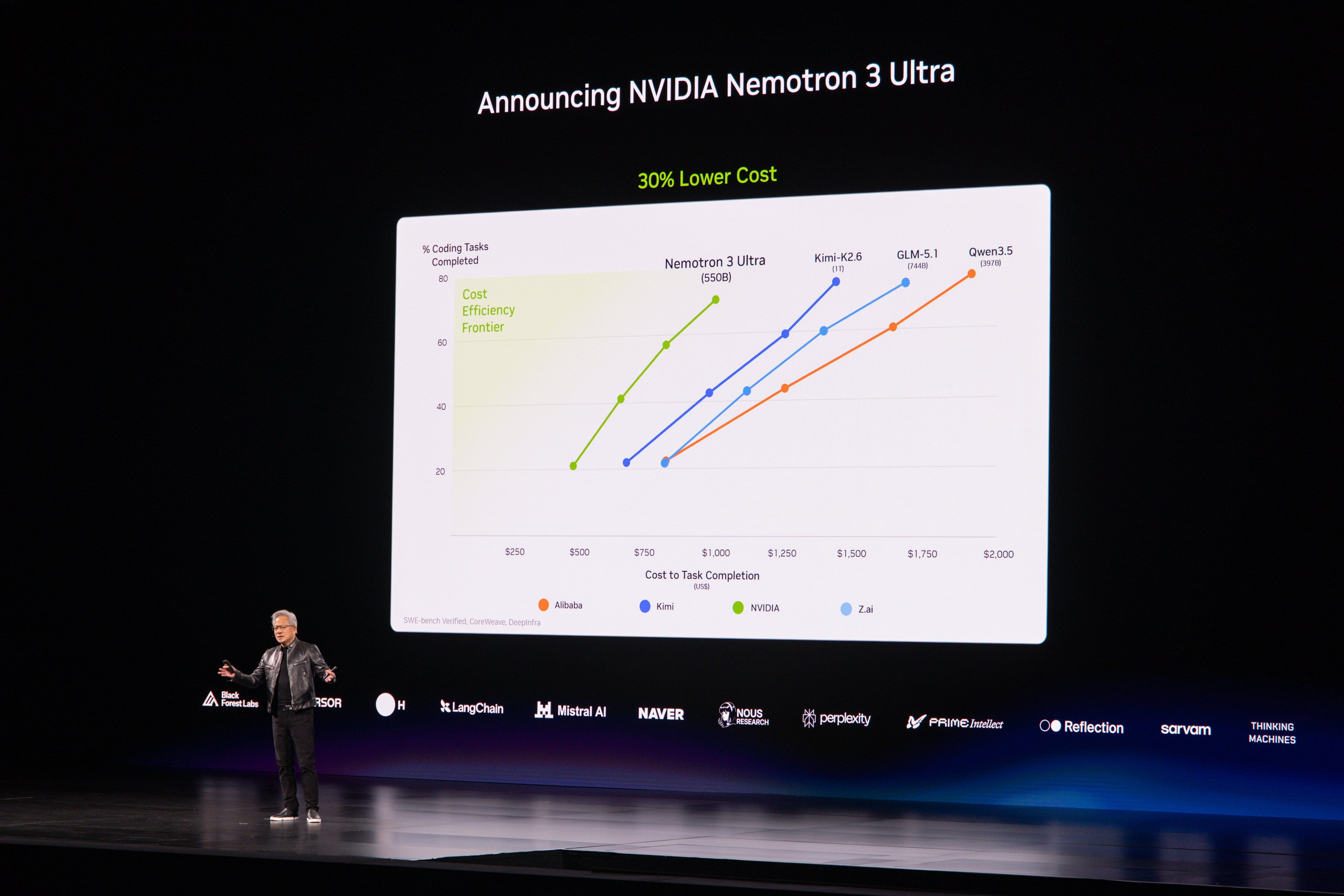
  7:10 PM · Jun 1, 2026·15.6K Views 10 Replies·39 Reposts·225 LikesAt Computex in Taiwan, Jensen also brought the heat withNemotron 3 Ultra, their 550B-A55B, remarkably efficient/fastopen weights LLM that is the new US SoTA:
 Finally, the RTX Spark personal computer 1 petaflop superchip, was previewed withMicrosoftandOpenClawandHermes Agentas a launch partner (good analysishere)
 NVIDIA RTX Spark@NVIDIARTXSpark RTX Spark, early preview 👀 Personal AI agents. Faster creator workflows. RTX ON gaming. NVIDIA’s Jacob Freeman walks through how one Superchip brings it all together in a new class of slim laptops. 👇 6:05 PM · Jun 1, 2026·93K Views 42 Replies·178 Reposts·1.66K Likes> AI News for 5/30/2026-6/1/2026. We checked 12 subreddits,544 Twittersand no further Discords.AINews’ websitelets you search all past issues. As a reminder,AINews is now a section of Latent Space. You canopt in/outof email frequencies!
NVIDIA’s Cosmos 3, Nemotron 3 Ultra, and the Push for Open Physical AI
- NVIDIA’s open-source week: NVIDIA dominated the open-model conversation withCosmos 3, an open family ofomnimodal world models for physical AI, plus the announcement ofNemotron 3 Ultra, a550Bopen-weight model that several posters called the strongest U.S. open model so far. Cosmos 3 was framed as a full-stack release—weights, code, datasets, and fine-tuning recipes—with NVIDIA also launching theCosmos Coalitionalongside partners includingRunwayto build an open ecosystem for world models@NVIDIAAI ecosystem context,@runwayml coalition announcement,@kimmonismus Cosmos thread,@ClementDelangue on NVIDIA’s HF footprint.
- Why Cosmos 3 mattered technically: Beyond robotics rhetoric, the more concrete details were that Cosmos 3 unifieslanguage, image, video, audio, and actionin a singleMixture-of-Transformersdesign pairing anautoregressive reasonerwith adiffusion generator.Artificial Analysissaid Cosmos 3 reached**#1 among open-weight modelson both theirText-to-ImageandImage-to-Videoleaderboards, noting the generator usesstructured JSON promptsand can be driven either by an external prompt-upsampling harness or its own reasoner branch. Separately, NVIDIA’s hardware + software push extended to adoption of theOpenMDW**framework and partner ecosystem integrations on platforms like fal@ArtificialAnlys,@fal.
- Nemotron 3 Ultra reception: Community reaction toNemotron 3 Ultrawas unusually strong for a fresh open release. Posters highlighted both capability and serving characteristics, including claims that it is already topping some open evals and may be serving at300+ tok/sin some setups—far faster than large DeepSeek/Kimi-class models@scaling01,@ctnzr,@caspar_br. There was also some technical discussion that Nemotron appearsless sparsethan peers like Kimi K2 / DeepSeek V4—roughly**~10% activevs~3%**—which could affect both economics and behavior@eliebakouch.
MiniMax M3, Qwen3.7-Plus, and JetBrains Mellum2 Expand the Open Agent Model Field
- MiniMax M3’s launch was the day’s biggest model release: M3 was presented as an open-weight multimodal agent/coding model with1M context,native multimodality, and competitive agent benchmarks. The headline figures repeated across launch partners were59.0% SWE-Bench Pro,66.0% Terminal Bench 2.1, and74.2% MCP Atlas@MiniMax_AI,@PBDTokenRouter,@kimmonismus. Multiple infra vendors shipped day-0 support—Novita,Vercel AI Gateway,Cloudflare AI Gateway,OpenClaude,Flowith, and others—suggesting unusually fast ecosystem adoption@MiniMax_AI on Novita,@rauchg,@gitlawb.
- Benchmarks vs practical experience were mixed: M3 earned praise for frontend generation, visual/game tasks, and price-performance, with side-by-side demos showing strong one-shot UI/game outputs and notable benchmark placement for Next.js agent evals@notjazii,@lostinlatencyX,@rauchg. But several evaluators also reportedhigh token consumption,verbose self-check loops, and occasionalrequirement drifton long tasks, making M3 look more like a “quality first, efficiency later” model@ZhihuFrontier review,@teortaxesTex skepticism.
- Qwen3.7-Plus: Alibaba launchedQwen3.7-Plusas amultimodal interactive hybrid agentthat unifiesGUI and CLI operation, visual reasoning, coding, and search-augmented QA. It isAPI-availablevia Alibaba Cloud Model Studio and was quickly added to tools likeCline@Alibaba_Qwen launch,@cline. The launch reinforces the trend that open-ish Asian labs are no longer releasing “just chat models,” but fullagent-capable multimodal systems.
- JetBrains Mellum2: JetBrains releasedMellum2, a12B MoEmodel with2.5B active parameters, trained on roughly11T tokensand post-trained withRLVR, shippingbase / SFT / RL checkpointsand a technical report@nv_pavlichenko,@jetbrains. The intended niche is especially interesting:ultra-low-latency inferenceforrouting, RAG, sub-agents, and IDE use, and it landed invLLMimmediately@vllm_project. This looks like a serious “small fast open model for developer workflows” play rather than a benchmark-chasing frontier release.
Agents, Sandboxes, Memory, and Search Are Becoming the Real Product Surface
- The stack is shifting from model calls to agent runtimes: Several launches converged on the idea that the main engineering leverage is now in theharnessrather than the model.Perplexity’s “Search as Code”is the clearest example: instead of iterative search tool calls, the model writesPythonagainst a search SDK, enabling custom ranking pipelines, map-reduce over indexes, batching, aggregation, and lower token overhead. Perplexity reports a jump on its internalWANDRbenchmark from0.152to0.386with this architecture@perplexity_ai,@AravSrinivas.
- Managed agents + sandboxes are becoming standard: Google detailedManaged Agents in the Gemini API, where a single API call can spin up an agent that reasons, writes/runs code, manages files, and operates inside a hostedLinux sandbox@_philschmid,@GoogleAIStudio. LangChain pushed similar ideas aroundDeep Agents,Context Hub, andLangSmith Sandboxes/Engine, emphasizing persistent context, agent lifecycle tooling, and automated failure triage@LangChain,@hwchase17.
- Memory remains a missing primitive: One recurring complaint was that enormous context windows still don’t solvecross-session memory. A thread onHydraDBargued that “RAG + manual context injection” has been misnamed as memory, while actual persistent session knowledge remains underserved@kimmonismus. Related research threads pointed to reusable context management policies likeAdaCoM, which trains a separate LLM via RL to prune/preserve context for frozen agents@dair_ai.
- Security remains the gating issue for enterprise agents: There was a notable warning from Microsoft Security Intelligence about a majornpm supply chain compromiseaffecting90+ redhat-cloud-services packages, including a self-propagating worm stealing npm/GitHub/AWS/SSH credentials@MsftSecIntel. At the same time, enterprise agent vendors highlightedsandboxing,runtime isolation, andsecurity stack integrationas prerequisites for deployment, including discussion ofNVIDIA OpenShelland LangChain’s sandbox keynote@shannholmberg,@LangChain.
Codex, Claude Code, and the Competitive Coding-Agent Race
- OpenAI extended Codex into more places: OpenAI announced thatfrontier models and Codex are now generally available on AWS / Amazon Bedrock, aimed squarely at enterprises that want OpenAI capabilities inside existing AWS security/compliance workflows@OpenAI,@OpenAIDevs. OpenAI also shipped aCodex Python SDKsupporting threads, turns, streaming, resume, images, and sandbox control@reach_vb, plus support for Bedrock-backed Codex workflows@reach_vb on Bedrock config.
- Claude Code had a real ops incident: Anthropic reset5-hour and weekly rate limitsfor Pro and Max users after fixing a bug where someOpus 4.8sessions spawned too manyparallel subagents/tool calls, burning usage unexpectedly@ClaudeDevs,follow-up. That’s a notable reminder that coding-agent product quality is increasingly determined by orchestration behavior, not just raw model IQ.
- Behavioral differences across coding models remain material: Developers highlighted large qualitative differences between GPT, Claude, and other models on benchmarks likeProgramBenchandWeirdML, with Opus sometimes preferring exploration over score-maximization or showing benchmark-specific quirks@OfirPress,@htihle. A separate long thread argued newerClaude Opus 4.6–4.8variants can fabricate plausible but fictional concepts in non-coding domains, suggesting possible truthfulness/alignment regressions rather than ordinary hallucinations@distributionat.
Infra, Hardware, and Local AI Systems
- NVIDIA is coming for the PC: The most-discussed hardware launch wasRTX Spark, an NVIDIA/Microsoft “personal AI computer” built aroundGrace + Blackwell, with up to128GB unified memoryand claimed1 PFLOP FP4. The key strategic read: NVIDIA is no longer just selling accelerators, but an end-to-end local AI system that competes withApple Silicon, x86 PCs, and Qualcomm simultaneously@kimmonismus,@swyx.
- Cluster/networking updates: On the datacenter side,Lambdasaid it is first to adoptNVIDIA Quantum-X InfiniBand Photonics Q3450-LDswitches, pushing co-packaged optics to reduce network power and failures in large AI clusters@LambdaAPI.OpenAIalso announcedStargate Michigan, a planned1GWdata center using closed-loop cooling and paired with workforce/education commitments@OpenAINewsroom.
- Local open-model tooling is improving fast: TheMLX-VLM v0.6.0release was one of the more substantive local inference/tooling updates, adding speculative decoding, Anthropic-style and responses-style APIs, tool calls, support for many new multimodal models, and image/audio features with the explicit pitch of turning Apple devices into “real local agent machines”@Prince_Canuma. That pairs well with growing DGX Spark +vLLMexperimentation for local NVFP4 MoE serving@vllm_project.
Top Tweets (by engagement, filtered for technical relevance)
-
Anthropic’s IPO path: Anthropic said it hasconfidentially submitted a draft S-1to the SEC, opening the door to an IPO pending review@AnthropicAI.
-
Claude Code usage incident: Anthropic reset user rate limits after anOpus 4.8 parallel subagent/tool-call bugcaused excessive quota burn@ClaudeDevs.
-
Qwen3.7-Plus: Alibaba launched amultimodal agent modelspanning GUI/CLI operation, coding, and visual tasks@Alibaba_Qwen.
-
OpenAI on Bedrock: OpenAI models andCodexare now available throughAmazon Bedrockfor enterprise workflows@OpenAI.
-
ARC-AGI-3 movement:Claude Opus 4.8posted a new SOTA onARC-AGI-3at1.5%, still tiny in absolute terms but a meaningful jump on that benchmark@arcprize.
-
MiniMax M3 - Coding & Agentic Frontier, 1M Context, Multimodal(Activity: 1090):MiniMax M3 is announced as anopen-weightfrontier model with coding/agentic focus, native multimodality/vision, and MiniMax Sparse Attention for up to
1Mtokens of context with a guaranteed512Kminimum (MiniMax M3). Claimed long-horizon agentic results include 12-hour ICLR paper reproduction, Hopper FP8 GEMM CUDA/Triton optimization reaching9\.4×speedup after147iterations, and PostTrainBench ranking third behind Opus 4.7 and GPT-5.5; access is currently via API/MiniMax Code, with HuggingFace/GitHub weights/local deployment planned.Commenters are cautiously interested in the combination of cheap/efficient vision plus long-context agentic coding, but skeptical because the announcement calls it“open-weight”while not yet exposing weights or even parameter count. One technical debate is whether the results imply a much larger-than-~250Bmodel, extreme benchmark optimization, or a genuine open-weight breakthrough. - Commenters focused on the missing release details: despite the claim of being“the first open-weight model with three frontier capabilities”*, users could not find actual weights, parameter count, or sizing information forMiniMax M3*. One commenter linked a preview image from the announcement (Reddit image), but the thread still lacked confirmation of model scale or downloadable artifacts. - A technically substantive concern was that the advertised capability level implies one of three possibilities:a much larger-than-expected model, unusually strong benchmark optimization, or a major open-weights breakthrough. The speculation centered on whether MiniMax M3 is actually around~250Bparameters or significantly larger, and whether its coding/agentic/multimodal claims will hold once weights and independent benchmarks are available. -
NVIDIA announces Nemotron 3 Ultra(Activity: 621):Theimageis a technical announcement slide for NVIDIA Nemotron 3 Ultra, described in comments as a MoE
550B\-A55model. The slide positions Nemotron 3 Ultra against open/open-weight competitors including GLM 5.1, Kimi K2.6, and Qwen3.5 across “Frontier Smart” benchmark categories such as agent productivity, coding, instruction following, knowledge work, and long-context capability.Commenters viewed the comparison against other open-source/open-weight models positively, while one noted an “artificial analysis score” of48, placing it just below frontier-tier models and around the MiniMax 2.7 range, with the expectation that it could be the strongest U.S. open-weight model. - NVIDIA Nemotron 3 Ultra is identified as aMoE550B\-A55model, implying roughly550Btotal parameters with about55Bactive parameters per token. This architecture detail is the most concrete technical spec mentioned in the thread. - A commenter cites anArtificial Analysis score of48, placing Nemotron 3 Ultra “one notch less than frontier” and roughly in theMiniMax 2.7range, while suggesting it may be the strongestUS open-weightmodel by that metric. - Technical references shared include NVIDIA’s official Nemotron 3 Ultra Base usage cookbook on GitHub:NVIDIA-NeMo/Nemotron, plus the LifeArchitect model comparison table:lifearchitect.ai/models-table. One commenter argues the comparison againstQwen3.5is notable because Nemotron may be NVIDIA’s best open-weight model while still trailing several non-US/open models. -
Stepfun 3.7 Flash is very good(Activity: 473):TheGIFis a technical visual demo, not a meme: it shows the output of Stepfun 3.7 Flash for the prompt
create a beautiful, relaxing flight simulator in a single html page, rendering a low-poly 3D flight scene with HUD-style speed/altitude indicators. The OP says this was the officialQ4\_X\_Squant and claims the model feels near GLM 5.1 in aesthetics and about80%of its 3D world understanding, while using only roughly25%of GLM 5.1’s parameters and including built-in vision.Commenters mostly reacted with comparisons and nostalgia rather than deep benchmarks: one referenced the old Excel flight simulator, while another compared interest inQwen 3.7 Max / 27Band asked whether it beatsQwen3.6 27B. - A commenter draws a model-comparison angle by referencingQwen 3.7 Maxand hoping for a futureQwen 3.7 27Brelease, while another asks whether Stepfun 3.7 Flash is better thanQwen3.6-27B. The thread includes screenshot evidence for the Qwen3.6-27B reference (image), but no quantitative benchmark scores or reproducible eval details are provided.


Similar Articles
NVIDIA just announced the release of Nemotron 3 Ultra (2 minute read)
Anthropic released Claude Opus 4.5, its most intelligent model, scoring 70 on the Artificial Analysis Intelligence Index and ranking second only to Gemini 3 Pro. It achieves significant gains in coding and agentic tasks while reducing per-token pricing and maintaining strong safety performance.
@MichaelGannotti: https://x.com/MichaelGannotti/status/2074486390432149979
A full-stack evaluation of NVIDIA's Nemotron-3 Mamba-Transformer hybrid models on DGX Spark hardware, including architecture analysis, quantization (NVFP4), benchmark results, and introduction of the open-source smf-bench testing suite.
@no_stp_on_snek: Very nice. Huge for team 3090. And TurboQuant+ is already implemented in a bunch of inference engines.
A reply celebrates Unsloth AI's upcoming Qwen3.8-27B model, which will run on 17GB RAM/VRAM setups, and notes TurboQuant+ is already integrated into many inference engines — great news for RTX 3090 users.
@cwolferesearch: Open tech reports / artifacts are so valuable. I'm currently reading through all of the nemotron tech reports and they …
NVIDIA introduces Llama-Nemotron, an open family of reasoning models (Nano 8B, Super 49B, Ultra 253B) that rival DeepSeek-R1 with superior inference efficiency, dynamic reasoning toggle, and open post-training datasets.
"How NVIDIA Built Nemotron 3 Open Model" by "Caleb Writes Code" x "Joey Conway"
NVIDIA released the Nemotron 3 open model, offering three sizes: Nano, Super, and Ultra. It optimizes hardware efficiency through architectural innovations such as hybrid Mamba Transformer, latent MoE, and multi-token prediction, and adopts the Open MDW 1.1 open license.