Google has open-sourced its Zero-Knowledge Proof (ZKP) libraries to enable developers to build privacy-preserving age assurance and digital ID solutions, supporting EU eIDAS regulations.
# Opening up ‘Zero-Knowledge Proof’ technology to promote privacy in age assurance
Source: [https://blog.google/innovation-and-ai/technology/safety-security/opening-up-zero-knowledge-proof-technology-to-promote-privacy-in-age-assurance/](https://blog.google/innovation-and-ai/technology/safety-security/opening-up-zero-knowledge-proof-technology-to-promote-privacy-in-age-assurance/)
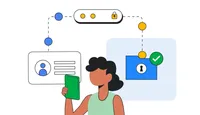
Today, we open sourced our[Zero\-Knowledge Proof \(ZKP\) libraries](https://github.com/google/longfellow-zk), fulfilling a[promise](https://blog.google/products/google-pay/google-wallet-age-identity-verifications/)and building on our[partnership with Sparkasse](https://blog.google/around-the-globe/google-europe/we-are-announcing-sparkasse-as-our-first-national-credential-partner-for-eu-age-assurance/)to support[EU age assurance](https://blog.google/around-the-globe/google-europe/age-assurance-europe/)\.
Open sourcing these powerful cryptographic tools will make it much easier for private and public sector developers to build their own privacy\-enhancing applications and digital ID solutions, meeting an urgent need\.
In layperson’s terms, ZKP makes it possible for people to prove that something about them is*true*without exchanging any other data\. So, for example, a person visiting a website can verifiably prove he or she is over 18, without sharing anything else at all\.
The goal of sharing ZKP with the open source and cryptography communities reflects our commitment to helping*all*parties in the ecosystem:
- Web and app users benefit from being inhabitants of a more private and secure digital ecosystem\.
- Businesses and other relying organizations of all sizes can easily leverage this open source solution to meet their privacy needs\.
- Developers can freely use the ZKP codebase to build privacy\-focused applications\.
- Researchers can use this more efficient and performant ZKP implementation to help create new applications and uses of technology\.
The European Union’s eIDAS Regulation set to take effect in 2026 encourages Member States to integrate privacy\-enhancing technologies like ZKP into the European Digital Identity Wallet \(“EUDI Wallet”\)\. With our commitment to making these ZKP tools openly available, Member States can integrate this into their future EUDI Wallets, accelerating their development\.
We're so excited for this new chapter for Zero\-Knowledge Proofs and invite you to explore the ZKP codebase on[https://github\.com/google/longfellow\-zk](https://github.com/google/longfellow-zk)\.
A blog post argues that criticisms of the EU's online age verification approach are often uninformed, explaining why age restrictions are necessary for children and proposing a privacy-preserving method using signed attestations rather than full identity disclosure.
A new type of zero-knowledge proof leverages Gödel's incompleteness theorems to overcome previous limitations of secrecy, establishing a striking connection between mathematical logic and cryptography.
Second part of an illustrated primer explaining real-world anonymous credential systems like Privacy Pass and Google's age-verification proposal, focusing on preventing credential cloning and enabling expressive proofs without sacrificing user privacy.
EU citizens, backed by the Pirate Party, have launched a formal initiative demanding that the European Commission legally mandate its own privacy-first age verification app, highlighting a gap between existing technology and policy adoption.
The article draws an analogy between Tolstoyan art, which transmits feelings without revealing the artist's personal experience, and zero-knowledge proofs, which convince a verifier of a claim without revealing the underlying secret.