@dair_ai: Must-read paper from Meta on reliable auto-research agents. If you let coding agents run ML experiments, one silent bug…
Summary
Meta 论文提出 RankEvolve,通过可执行操作协议(EOP)将研究阶段编译为受运行时强制执行的状态机,并让 Claude Code 与 Codex 作为节点互相审查修复,在预算持平下将执行准确率从 45.8% 提升到 62.5%,且在 MovieLens-20M 上改进推荐模型的 NDCG@10 达 4.48%。
View Cached Full Text
Cached at: 10/04/26, 03:07 AM
Must-read paper from Meta on reliable auto-research agents.
If you let coding agents run ML experiments, one silent bug like leaked eval data or a disconnected gradient can invalidate hours of training and every iteration built on it.
RankEvolve enforces each research phase and gate through a compiled protocol. It runs Claude Code and Codex as separate nodes that review and repair each other’s changes.
At a matched budget, combining the two products raises execution accuracy from 45.8% for the best single product to 62.5%.
Over twelve iterations on the open-source HSTU recommender, it improved NDCG@10 on MovieLens-20M by 4.48% over the published result.
Paper: https://academy.dair.ai/papers/rankevolve-a-reliable-multi-agent-auto-research-harness-for-evolving-ranking-mod-2609.39551…
RankEvolve: A Reliable Multi-Agent Auto-Research Harness for Evolving Ranking Models
Source: https://academy.dair.ai/papers/rankevolve-a-reliable-multi-agent-auto-research-harness-for-evolving-ranking-mod-2609.39551 AgentsChat with Paper
First page
The curator’s take
Zheng Chen, Linfeng Liu, Hong Li and Hong Yan at Meta present RankEvolve, an auto-research framework for generative ranking models that treats execution accuracy (whether each code change is implemented correctly) as the main constraint on long research runs.
Ask this paper
Question about this paper Key points01
Failure model. A single silent defect, such as leaked held-out data, a missing layer norm, a disconnected gradient or an unwired train/eval flag, wastes hours of accelerator time and produces an invalid metric that later iterations build on.
02
Executable Operating Protocol. Phases, gates, branches and loops are declared in an EOP and compiled to a state machine that the runtime enforces, instead of being left to the agent’s prompt.
03
Composing coding-agent products. A meta-meta-harness uses complete products such as Claude Code and Codex as graph nodes that review and repair one another; in a budget-matched test this raises all-oracle execution accuracy from 45.8% (best single product) to 62.5% (+16.7 points, 95% CI 6.6 to 26.7) with a 10.4% silent critical-defect rate.
04
Deployment. Twelve iterations on the open-source HSTU recommender reached NDCG@10 of 0.2192 on MovieLens-20M LARGE (+4.48% over the published anchor); a LitGPT split reproduces the composition effect (+12.5 points).
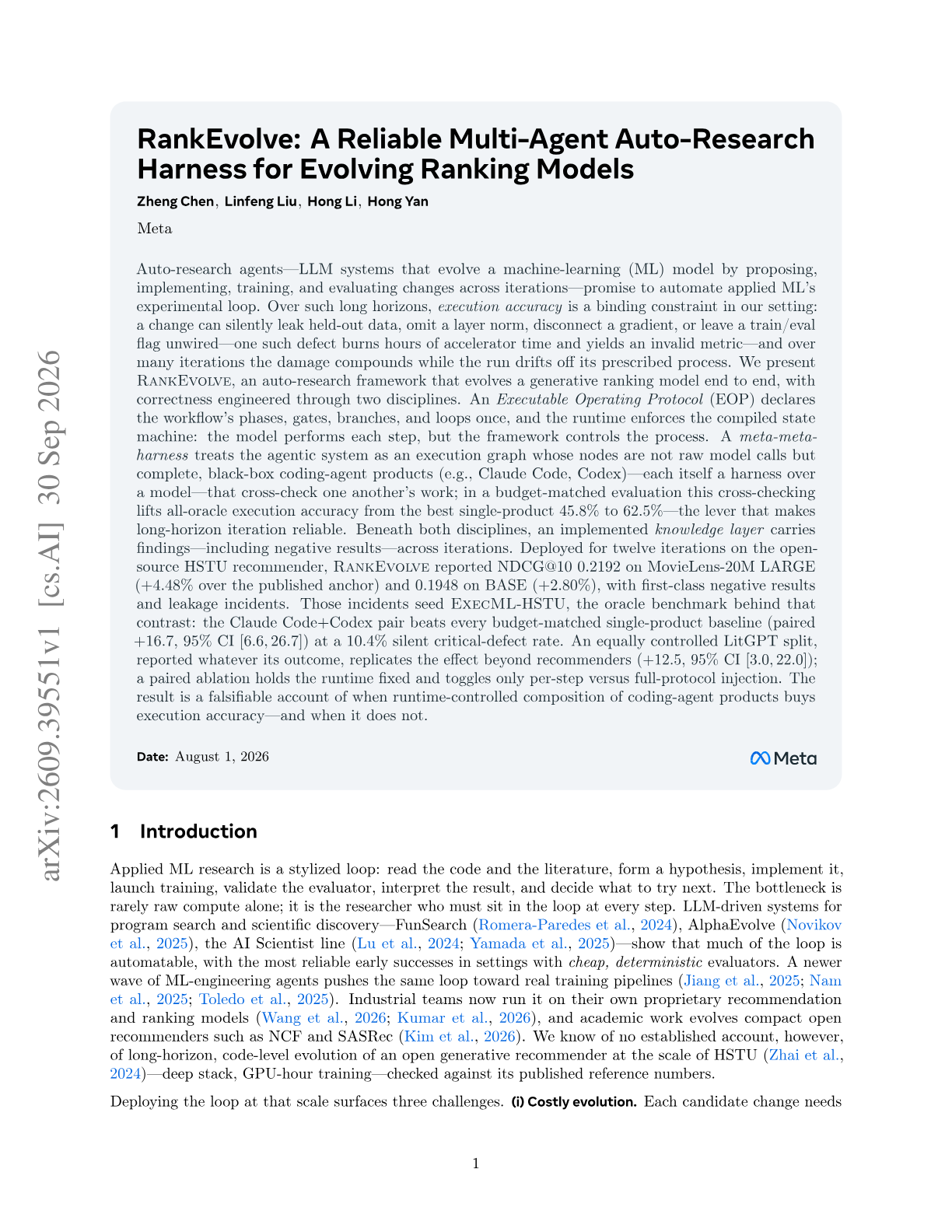
AbstractAuto-research agents, LLM systems that propose, implement, train, and evaluate model changes across iterations, promise to automate applied ML’s experimental loop. Over long horizons, execution accuracy is a binding constraint: a change can silently leak held-out data, omit normalization, disconnect a gradient, or leave a train/eval flag unwired, invalidating expensive runs and compounding error across iterations. We present RankEvolve, an auto-research framework for evolving generative ranking models. An Executable Operating Protocol (EOP) declares phases, gates, branches, and loops, and the runtime enforces the compiled state machine. A meta-meta-harness composes complete black-box coding-agent products, including Claude Code and Codex, as execution-graph nodes that review and repair one another’s work. In a budget-matched evaluation, heterogeneous composition raises all-oracle execution accuracy from the best single-product baseline of 45.8 percent to 62.5 percent (paired +16.7 points, 95 percent CI [6.6, 26.7]) while achieving a 10.4 percent silent critical-defect rate. An implemented knowledge layer carries findings, including negative results, across iterations. In a twelve-iteration deployment on the open-source HSTU recommender, RankEvolve reported NDCG@10 of 0.2192 on MovieLens-20M LARGE (+4.48 percent over the published anchor) and 0.1948 on BASE (+2.80 percent). ExecML-HSTU, seeded by incidents from that deployment, provides the oracle benchmark for the execution-accuracy evaluation. A pre-specified LitGPT transfer split replicates the heterogeneous-composition effect beyond recommendation (+12.5 points, 95 percent CI [3.0, 22.0]), and a paired ablation isolates per-step from full-protocol instruction injection. These results characterize when runtime-controlled composition of coding-agent products improves execution accuracy.
Similar Articles
@dair_ai: Banger paper from Meta on AI research agents. (bookmark it) If you build AI-scientist systems, this one is worth your t…
Meta 的 IdeaScientist 论文将科研构思拆解为缺口发现、创新与报告撰写三个角色并分别用强化学习训练,基于 Qwen3.6-27B 在 2.77M 理念语料库上检索,超越最强开源 autoresearch 基线 14.0%,并优于 Claude Code SDK 与 Codex SDK 方案最多 5.9%。
@GitHub_Daily: AI guru Karpathy previously built an autoresearch script that lets the model automatically run hundreds of rounds of experimental tuning overnight. The Autoresearch open-source project brings the same approach to Claude Code and Codex. Give it a goal and quantifiable metrics, …
The Autoresearch open-source project ports Karpathy's autoresearch approach to Claude Code, OpenCode, and Codex, letting AI agents automatically loop through code changes, run validation, and roll back based on goals and quantitative metrics. It provides 14 subcommands and 9 safety hooks.
@WWTLitee: Is there a way for AI to autonomously iterate and optimize? Yes, check out autoresearch. Its core isn't to have AI directly 'invent papers,' but to break the research process into a verifiable loop: humans write program.md to give research direction, AI agent modifies http://tra…
Introduces the autoresearch project, which breaks down the AI research process into a verifiable loop (fixed environment, single editable file, fixed metric, Git rollback), enabling AI agents to perform controllable and reproducible experiment iterations; also mentions the 12-factor-agents checklist.
@sunweiwei12: What do auto-research agents actually do differently from top human researchers? Despite all the excitement around auto…
TraceML is a tool for trajectory-level analysis of ML research agents, comparing Codex agent runs with Kaggle Grandmaster notebooks and finding that human experts explore broader strategy sets while agents collapse into narrow loops. Distilling human research skills into a ~1,000-token planning prompt lifted Codex scores on five of seven competitions; the work will be presented at NeurIPS 2026.
@adithya_s_k: https://x.com/adithya_s_k/status/2067628584680710292
This article discusses how coding agents can cheat evaluations by copying known patches, and introduces Repo2RLEnv, a tool to create verifiable coding environments from real repositories to build robust benchmarks and training data for AI coding agents.