This article provides a reference overview of porcelain insulator collecting, including its history, rarity, and the increasing popularity among enthusiasts.
# Porcelain Insulator Collectors Reference Site
Source: [https://www.insulators.info/porcelain/](https://www.insulators.info/porcelain/)
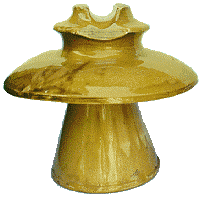
---
**PORCELAININSULATORPAGE**
---
## Welcome to the Porcelain Insulator Collector's World of Mud\!
---
### CONTENTS
- [*Porcelain Overview*](https://www.insulators.info/porcelain/#over)
- [*General History of Porcelain Insulators*](https://www.insulators.info/porcelain/history.htm)
- [*Porcelain Markings*](https://www.insulators.info/porcelain/mark.htm)
- [*Rarity and Value*](https://www.insulators.info/porcelain/rarity.htm)
- [*Color*](https://www.insulators.info/porcelain/color.htm)
- [*Porcelain Photo Album*](https://www.insulators.info/porcelain/photos/)
- *[Reference Books](https://www.insulators.info/porcelain/books/)*
---
### *Porcelain Overview*
Similar to their glass counterparts, porcelain insulators date back to before the Civil War for telegraph wires\. In North America glass was always the predominate material for communications insulators but porcelain has become the standard for power distribution due to its greater strength and surface resistance\.
Porcelain insulators did receive the same level of interest as glass in the early years of insulator collecting, but have been gaining popularity in the last ten years\. They are equally historically significant as their glass counterparts and available in as many colors and significantly more styles\. Within the last 10 years or so a number of factors have contributed to the rapid increase in interest in porcelain:
- More information has surfaced about the porcelain insulator business and a number of dedicated individuals have written[books](https://www.insulators.info/porcelain/books/), articles, and[reprinted catalogs](https://www.insulators.info/porcelain/books/catalogs.htm)that have significantly increased collector knowledge and interest in the porcelain side of the hobby\.
- Glass prices have been on the increase in recent years, making porcelain an attractive and affordable alternative\. Porcelain insulators are now much more available at insulator shows\.
- More and more early "classic" porcelain has been taken out of service as utilities increase distribution voltages and collectors go "mud hunting"
- Collectors have realized that the amount of color available in porcelain is very significant and has increased as more distribution lines are dismantled\.
- The increase of information available on the internet as well as the variety of porcelain insulators available on Ebay give a larger population exposure to porcelain insulator collecting\.
- More historical interest has been generated in the early development of power generation and distribution which has been primarily dependent on porcelain insulators\. Current linemen are much more familiar with porcelain, as very little glass remains in use today\.
- New styles are still being found every year \(if not every month\!\)
- Old trade journals have increased collector knowledge of where to find the early classics\.
---
I hope you've enjoyed this overview of porcelain insulator collecting\. We look forward to meeting another "Mud Hound" on\-line\!\!\!
---
[Return to the Insulator home page](https://www.insulators.info/)
---
Please send your questions and comments toBob Berry at
Last updated Sunday, August 31, 2003
The article explores the surprisingly enduring legacy of vacuum tube technology, detailing its historical origins and continued use in applications like high-power radio transmitters, microwave ovens, and CRT displays, despite the dominance of semiconductors.
This article describes techniques for creating glass-to-metal seals for homemade vacuum tubes, explaining the challenges of thermal expansion mismatch and how to electroplate copper onto steel wire to improve bonding.
The article provides a detailed guide on fabricating a vacuum diode for Make: Magazine, emphasizing the pinch seal process using tungsten and borosilicate glass.
Charles C. Mann explores the high-tech revival of porcelain, from its ancient Chinese origins in kaolin clay to modern ultra-compact surfaces like Dekton, arguing that materials science is transforming the built environment as profoundly as the digital revolution.