@dair_ai: Great study on what actually predicts vibe-coding ability. 100 tertiary-level students completed measures of computer-s…
Summary
A preregistered study of 100 tertiary students shows that writing proficiency and computer-science achievement both predict performance in vibe-coding, with implications for curriculum design in AI-assisted programming.
View Cached Full Text
Cached at: 09/09/26, 01:44 AM
Great study on what actually predicts vibe-coding ability.
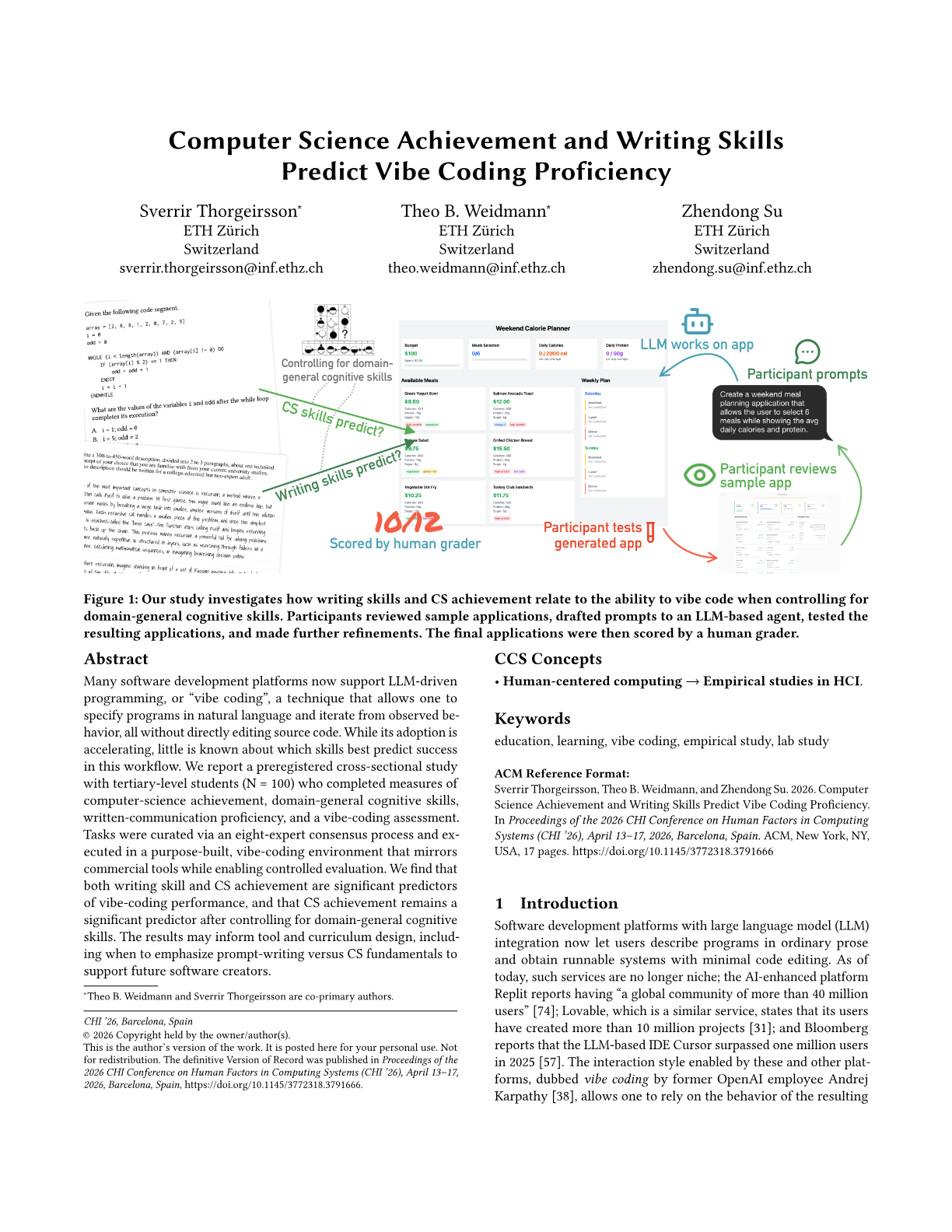
100 tertiary-level students completed measures of computer-science achievement, domain-general cognitive skills and written-communication proficiency, then took a vibe-coding assessment.
The study was preregistered, which matters because the intuitive answer here, that writing ability carries everything, is what a post-hoc analysis would tend to find.
Tasks were curated through an eight-expert consensus process and run in a purpose-built vibe-coding environment that mirrors commercial tools while allowing controlled measurement.
They find that writing skill predicts performance. So does computer-science achievement, and it stays significant after controlling for domain-general cognitive skills, so it is measuring something specific to CS training rather than general ability.
The practical question the authors point at is a curriculum one. How much time to spend teaching people to write good prompts, against how much to spend on computer-science fundamentals, for the people who will build software this way.
Paper: https://academy.dair.ai/papers/computer-science-achievement-and-writing-skills-predict-vibe-coding-proficiency-2603.14133…
Computer Science Achievement and Writing Skills Predict Vibe Coding Proficiency
Source: https://academy.dair.ai/papers/computer-science-achievement-and-writing-skills-predict-vibe-coding-proficiency-2603.14133 EvaluationChat with Paper
First page
The curator’s take
Sverrir Thorgeirsson, Theo B. Weidmann and Zhendong Su at ETH Zurich run a preregistered cross-sectional study of 100 tertiary-level students to find out which measured skills predict how well someone performs at vibe coding.
Ask this paper
Question about this paper Key points01
Preregistered design. 100 students completed measures of computer-science achievement, domain-general cognitive skills, and written-communication proficiency, plus a vibe-coding assessment. Preregistration matters here because the obvious result, that writing skill alone carries it, is exactly the kind of claim a post-hoc analysis would produce.
02
Tasks were built for controlled evaluation. An eight-expert consensus process curated the tasks, which ran in a purpose-built vibe-coding environment that mirrors commercial tools while allowing controlled measurement.
03
Both predictors are significant. Writing skill and CS achievement each significantly predict vibe-coding performance, so natural-language ability alone does not account for the outcome.
04
CS achievement survives the obvious control. It remains a significant predictor after controlling for domain-general cognitive skills, which rules out the reading that it is a proxy for general intelligence.
05
Where it applies. The authors frame the result for tool and curriculum design, specifically the question of when to emphasize prompt writing against CS fundamentals.
AbstractMany software development platforms now support LLM-driven programming, or “vibe coding”, a technique that allows one to specify programs in natural language and iterate from observed behavior, all without directly editing source code. While its adoption is accelerating, little is known about which skills best predict success in this workflow. We report a preregistered cross-sectional study with tertiary-level students (N = 100) who completed measures of computer-science achievement, domain-general cognitive skills, written-communication proficiency, and a vibe-coding assessment. Tasks were curated via an eight-expert consensus process and executed in a purpose-built, vibe-coding environment that mirrors commercial tools while enabling controlled evaluation. We find that both writing skill and CS achievement are significant predictors of vibe-coding performance, and that CS achievement remains a significant predictor after controlling for domain-general cognitive skills. The results may inform tool and curriculum design, including when to emphasize prompt-writing versus CS fundamentals to support future software creators.
Similar Articles
Vibe Coding Ate My Homework: An evaluation of AI approaches to greenfield software engineering and programming
This paper evaluates the viability of 'vibe coding'—using natural language prompts with AI agents to generate code without human review—for greenfield software engineering tasks, and analyzes existing benchmarks for measuring LLM programming proficiency. The authors develop an evaluation suite for simple Python programming tasks to provide scoped insights.
How to vibe code in science: early adopters share their tips
Scientists are adopting 'vibe coding', a conversational approach using AI tools like LLMs to generate code for data visualization and analysis, speeding up research but requiring caution.
AI Coding Without the Vibes
The essay argues against over-reliance on AI in coding and learning, emphasizing a balanced approach where AI assists but does not replace skill development to maintain true understanding.
VibeCoding with AI Agent is not enough, you need more insight
The article argues that AI-assisted coding (VibeCoding) lacks production readiness, emphasizing the need for deeper insight. It references a conversation with an FDE engineer and notes that CloudCode cannot be used directly on customer sides.
Inside our 353,000-person vibe coding course
Google and Kaggle's 5-Day AI Agents Intensive Vibe Coding course attracted over 353,000 participants, with thousands of capstone projects submitted; the course remains available as a self-paced guide.