What is a harmonic? An interactive comic about additive synthesis

Lobsters Hottest News

Summary

An interactive comic that explains harmonics and additive synthesis through visual and auditory demonstrations, created by Sudara and Alec Longstreth.

<p><a href="https://lobste.rs/s/goq5ha/what_is_harmonic_interactive_comic_about">Comments</a></p>
Original Article
View Cached Full Text

Cached at: 05/26/26, 01:20 PM

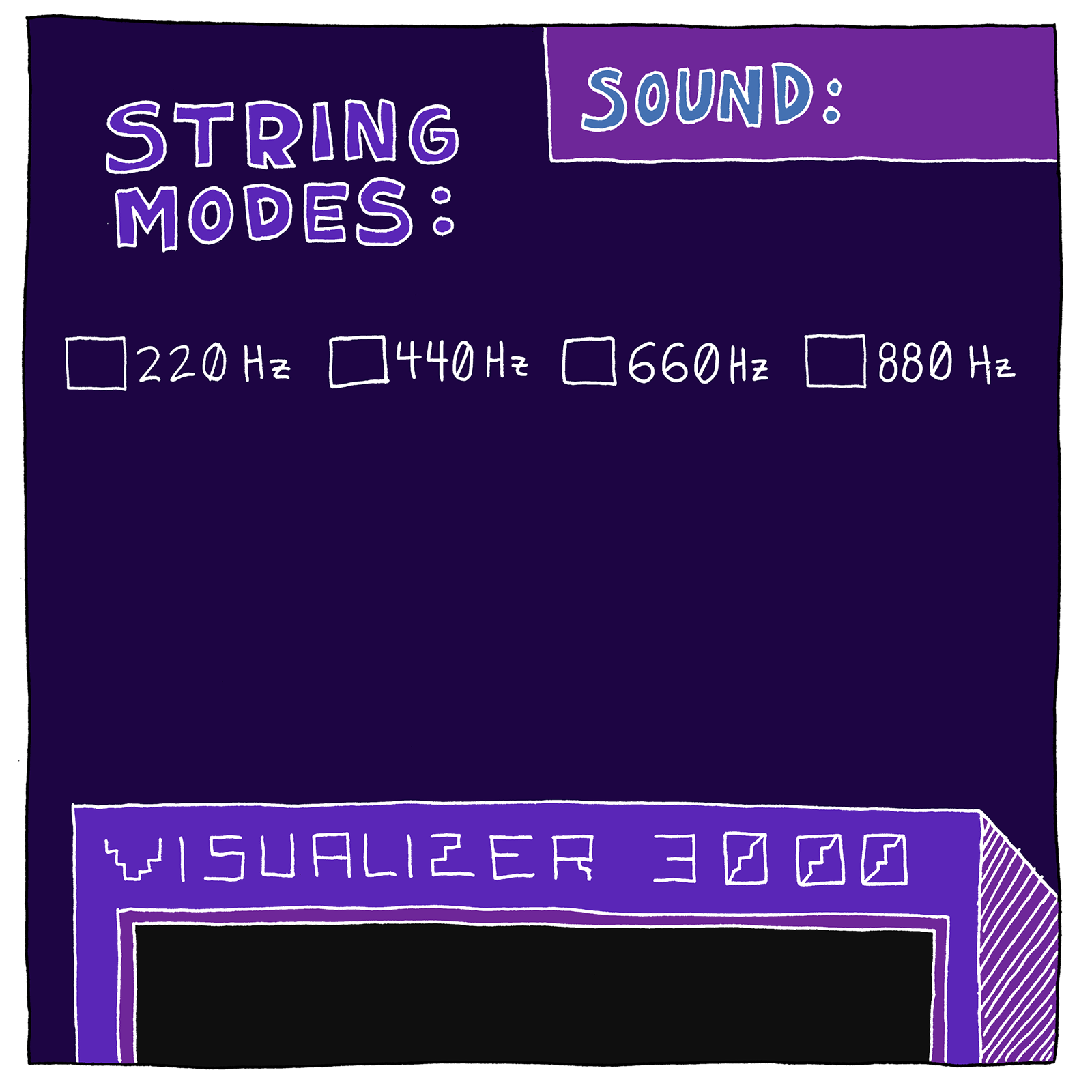
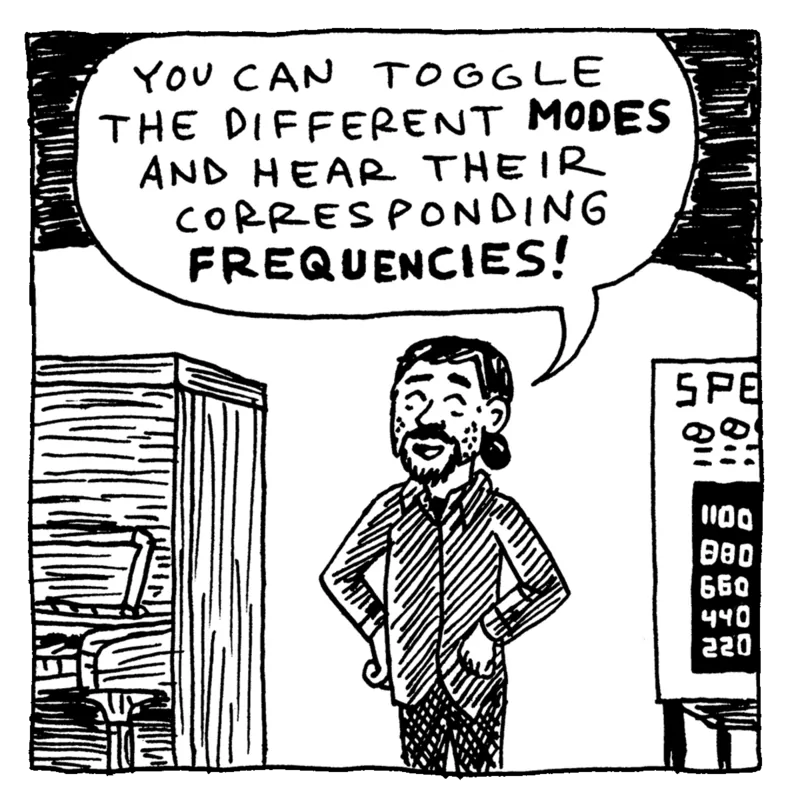
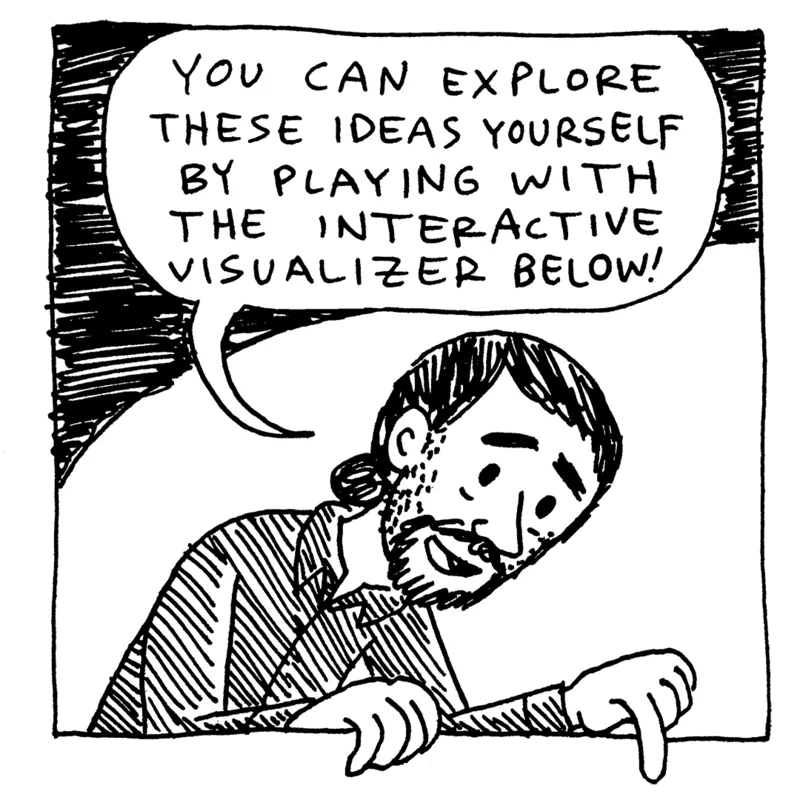
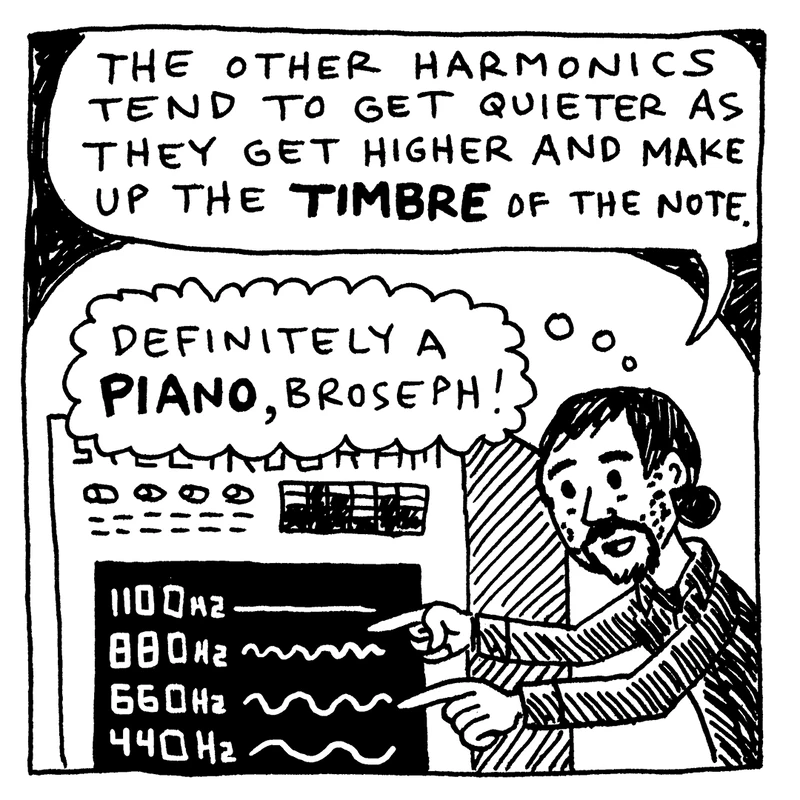
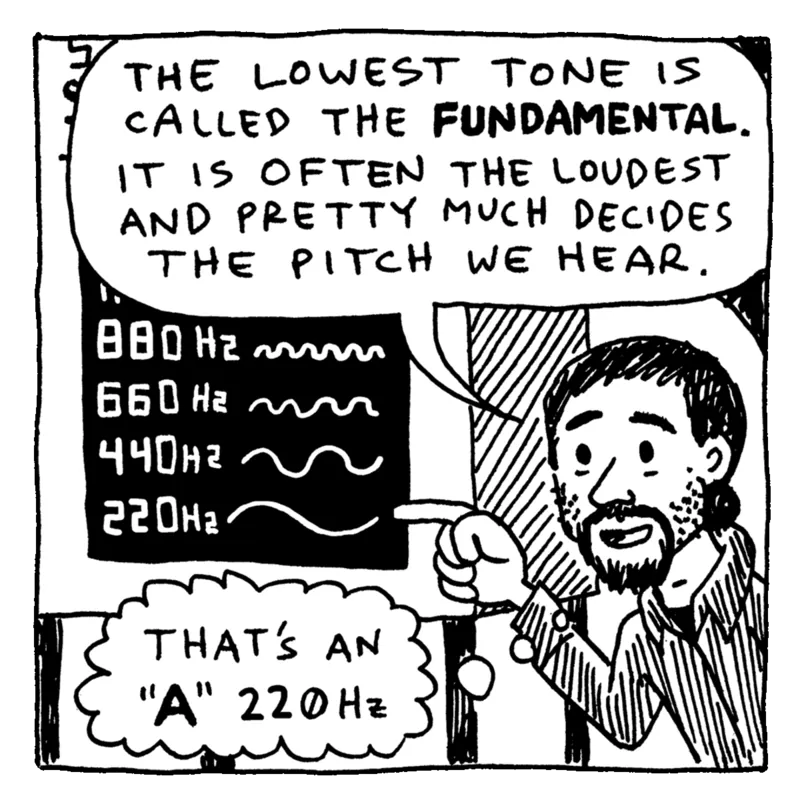
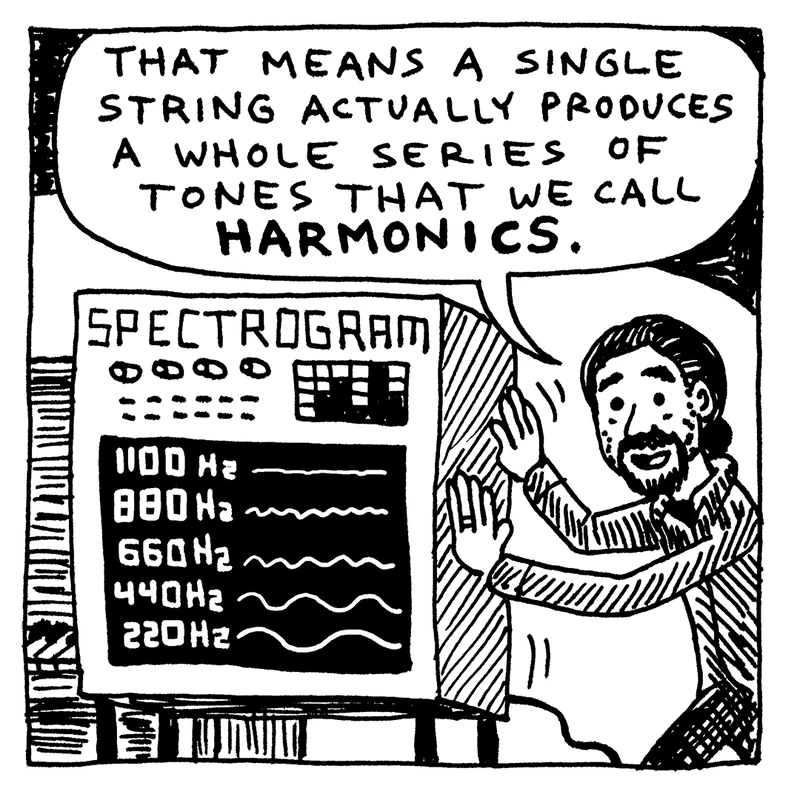
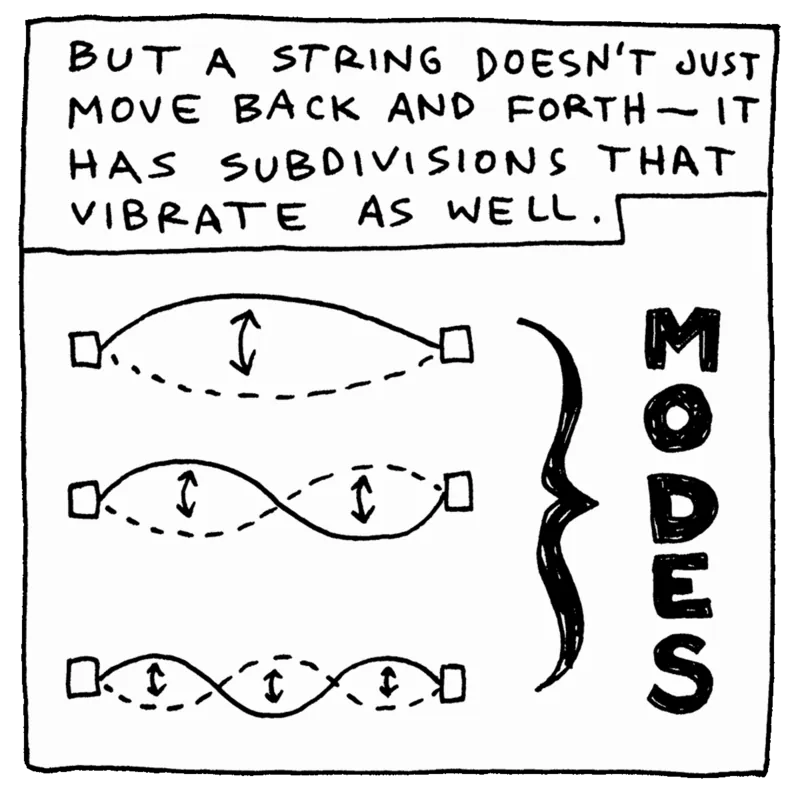
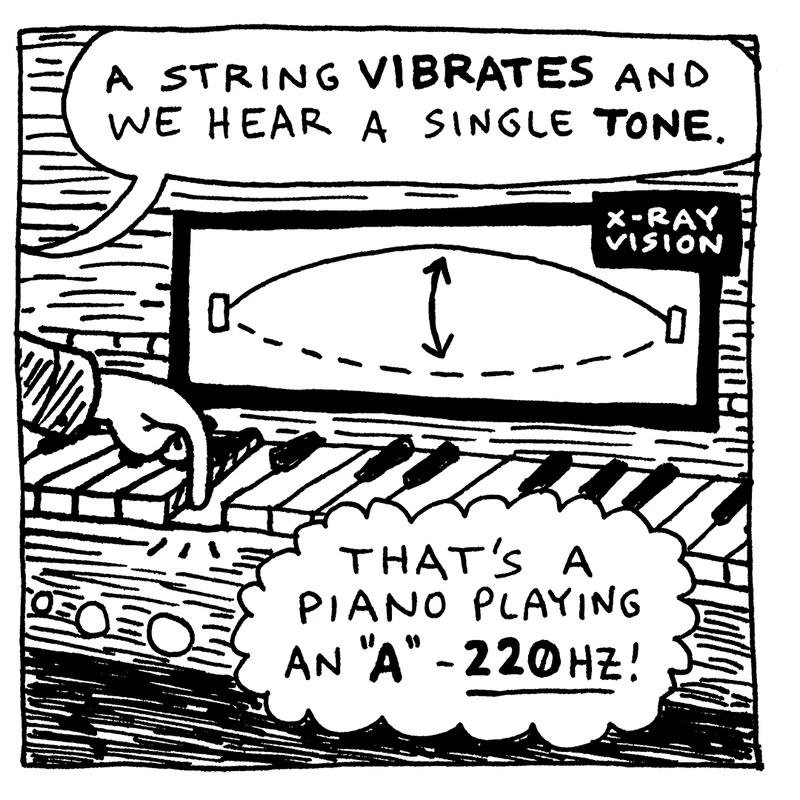
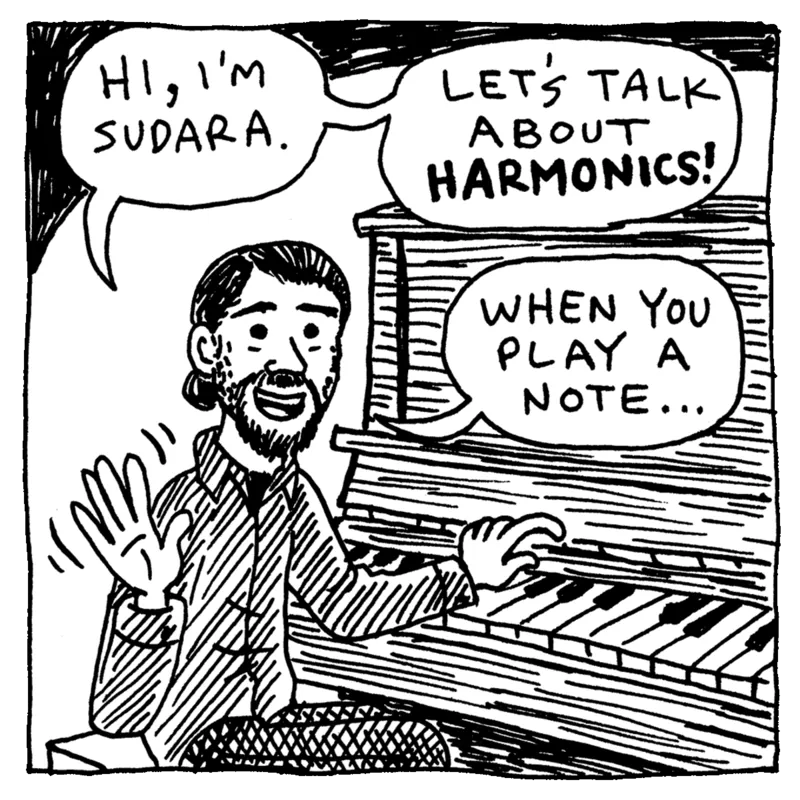
# What is a harmonic? An interactive comic about additive synthesis Source: [https://melatonin.dev/additive-synth-comic/what-is-a-harmonic/](https://melatonin.dev/additive-synth-comic/what-is-a-harmonic/) ## ![Additive Synthesis 101](https://melatonin.dev/wp-content/uploads/dot-dev-tailwind/images/AdditiveSynthesis101-Logo-Color.webp) ## ![Part 1, What is a harmonic.](https://melatonin.dev/wp-content/uploads/dot-dev-tailwind/images/Comic1-Title-INVERTED.png) [![Next comic](https://melatonin.dev/wp-content/uploads/dot-dev-tailwind/images/ComicNav-Next-White.webp?t=1779141067591)](https://melatonin.dev/additive-synth-comic/its-timbre-time/)![Sudara waves from a piano: ‘Hi, I'm Sudara. Let's talk about harmonics! When you play a note…’](https://melatonin.dev/wp-content/uploads/dot-dev-tailwind/images/HarmonicComic-Page1-Panel-1.webp)![An X-ray view of a piano string vibrating end to end: ‘A string vibrates and we hear a single tone. That's a piano playing an A — 220Hz!’](https://melatonin.dev/wp-content/uploads/dot-dev-tailwind/images/HarmonicComic-Page1-Panel-2-v3.webp)![Diagrams of a string vibrating in one, two, and three subdivisions, bracketed and labeled ‘modes’: ‘But a string doesn't just move back and forth — it has subdivisions that vibrate as well.’](https://melatonin.dev/wp-content/uploads/dot-dev-tailwind/images/HarmonicComic-Page1-Panel-3.webp)![Sudara points at a spectrogram showing 220, 440, 660, 880, and 1100 Hz: ‘That means a single string actually produces a whole series of tones that we call harmonics.’](https://melatonin.dev/wp-content/uploads/dot-dev-tailwind/images/HarmonicComic-Page1-Panel-4-v3.webp)![Sudara points at the 220Hz line on the spectrogram: ‘The lowest tone is called the fundamental. It is often the loudest and pretty much decides the pitch we hear. That's an A 220Hz.’](https://melatonin.dev/wp-content/uploads/dot-dev-tailwind/images/HarmonicComic-Page1-Panel-5-v2.webp)![Sudara thinks ‘Definitely a piano, broseph!’ while pointing at the spectrogram: ‘The other harmonics tend to get quieter as they get higher and make up the timbre of the note.’](https://melatonin.dev/wp-content/uploads/dot-dev-tailwind/images/HarmonicComic-Page1-Panel-6-v3.webp)![Sudara leans on the panel edge: ‘You can explore these ideas yourself by playing with the interactive visualizer below!’](https://melatonin.dev/wp-content/uploads/dot-dev-tailwind/images/HarmonicComic-Page2-Panel-1-v3.webp)![Sudara stands beside the spectrogram: ‘You can toggle the different modes and hear their corresponding frequencies!’](https://melatonin.dev/wp-content/uploads/dot-dev-tailwind/images/HarmonicComic-Page2-Panel-2-v2.webp)![Interactive harmonic panel](https://melatonin.dev/wp-content/uploads/dot-dev-tailwind/images/interactive-panel.png)![](https://melatonin.dev/wp-content/uploads/dot-dev-tailwind/images/Check-220-Red.png)220Hz![](https://melatonin.dev/wp-content/uploads/dot-dev-tailwind/images/Check-440-Green.png)440Hz![](https://melatonin.dev/wp-content/uploads/dot-dev-tailwind/images/Check-660-Blue.png)660Hz![](https://melatonin.dev/wp-content/uploads/dot-dev-tailwind/images/Check-880-Yellow.png)880Hz [![Next comic](https://melatonin.dev/wp-content/uploads/dot-dev-tailwind/images/ComicNav-Next-White.webp?t=1779141067591)](https://melatonin.dev/additive-synth-comic/its-timbre-time/)Interactive additive synthesis comic by[Sudara](https://melatonin.dev/about)and[Alec Longstreth](https://www.alecillustration.com/) Illustrated by[Alec Longstreth](https://www.alecillustration.com/)

Similar Articles

Harmony Explained: Progress Towards a Scientific Theory of Music (2012)

Hacker News Top

This paper derives the Major Scale, Standard Chord Dictionary, and the difference between Major and Minor Triads from first principles of physics and computation, presenting a scientific theory of harmony that addresses limitations in earlier theories by Helmholtz and Terhardt.

Waveloop: What Fable left me

Hacker News Top

The author recounts using the AI model Fable 5 to create Waveloop, a music visualizer that reveals harmonic and melodic structure through a chromatic circle. It uses color and angle to represent pitch classes and intervals, with offline and live mic modes.